
Chapter Dive
Comrade Trump Returns: The 2026 Trump–Xi Summit on Chinese Social Media
A special deep dive into the 2026 Xi-Trump summit through Chinese social media, highlighting the top 15 viral moments, internet memes, main themes, and netizen commentary.


In This Special Edition:
🎭 The Top Cast: Who’s who in this geopolitical blockbuster
🎬 Dramatic Synopsis: The summit as a movie plot
🔍 Critical Review: Taiwan, the “Thucydides Trap,” & a Russian surprise
🧩 Memorable Scenes: The top 15 most viral memes & moments
🗣️ Quotes: Key remarks from leaders and netizens
🎬 Behind the Scenes: An unscripted moment
🎵 Soundtrack: The summit in songs
On Chinese social media, Trump’s visit to China started before he arrived and continued after he left.
The long-awaited meeting between Donald Trump and Xi Jinping, from May 13 to May 15, was the first visit by a sitting US president to China in nearly a decade – a major diplomatic event that has been closely followed by Chinese netizens.
Even before Trump’s Air Force One landed in Beijing, the Xi-Trump summit was top trending.
Alongside the more serious commentary, Chinese social media has been full of posts reflecting people’s curiosity, excitement, and amusement about Trump’s presence in Beijing this past week. That is not only because the meeting between the two leaders—and the issues on the table—is of major significance, but also because Trump has held a special place in China’s meme culture since the early days of his first presidency.
Trump’s first years in office catapulted him into China’s meme machine. When he remarked that Korea “used to be part of China,” and after a series of high-profile decisions—including withdrawing from the Trans-Pacific Partnership, exiting the Paris Climate Agreement, and announcing that the US would leave UNESCO—many Chinese netizens joked that the US president was inadvertently helping China by weakening America’s global influence.
The trade war and Trump’s hardline stance toward Chinese tech companies were also, paradoxically, seen as forcing China to accelerate its own push for technological self-reliance and domestic innovation.
Taken together, these developments earned Trump—whose Chinese name is commonly transliterated as 川普 (Chuānpǔ)—the nickname “Build-the-Nation Trump” (川建国, Chuān Jiànguó), fueling the tongue-in-cheek notion that he is actually China’s “secret agent” who is working to undermine American power while inadvertently advancing China’s rise on the world stage.
For the same reason, he is also often referred to as “Comrade Trump” (川普同志).
This often bantering approach to US politics, combined with China’s tightly controlled online environment, where more critical and open discussions of top-level political events are always limited, has given rise to alternative narratives around major diplomatic meetings that sometimes read like a movie script.
That dynamic was already evident the moment Trump landed in Beijing.
To some Chinese netizens, his appearance at the door of Air Force One looked like a scene from The Truman Show. One post making this comparison was reposted nearly 6800 times.

“It’s not the Truman show, but the Trump show,” one netizen added.
To stay on theme, I’ll take a similarly cinematic approach in this overview of Chinese social media reactions to the Xi-Trump meeting. From “top cast” to “dramatic synopsis” and the “most memorable scenes,” let’s recast this high-level rendezvous as a Beijing blockbuster.
🎭 The Top Cast
🇨🇳
⭐ Xi Jinping 习近平 – General Secretary of the Communist Party of China and President of the People’s Republic of China
• Li Qiang 李强 – Premier
• Wang Yi 王毅 – Foreign Minister
• Cai Qi 蔡奇 – Party’s organizational chief / Xi’s aide
• Yin Li 尹力 – Beijing Party chief
• He Lifeng 何立峰 – Vice Premier overseeing economic affairs
• Dong Jun 董军 – Defense Minister
• Zheng Shanjie 郑栅洁 – Chairman of the National Development and Reform Commission (NDRC)
• Han Zheng 韩正 – Vice President of China
• Ma Zhaoxu 马朝旭 — Executive Vice Minister of Foreign Affairs
• Xie Feng 谢锋 — Chinese Ambassador to the US
• Wang Wentao 王文涛 — Commerce Minister
• Zhao Leji 赵乐际 — Chairman of the National People’s Congress Standing Committee
• Lei Jun 雷军 — Founder and CEO of Xiaomi
🇺🇸
⭐ Donald Trump – The President of the United States of America
• Eric Trump — Trump’s son
• Lara Trump — daughter-in-law
• Marco Rubio – Secretary of State
• Pete Hegseth – Secretary of Defense
• Scott Bessent — Treasury Secretary
• David Perdue — US Ambassador to China
• Howard Lutnick — Commerce Secretary
• Jamieson Greer — US Trade Representative
• Steve Witkoff — Special Envoy
• Sean Hannity – Fox News
• Bret Baier – Fox News
Special Guest Appearances:
• Elon Musk — Tesla and X
• Tim Cook — Apple
• Larry Fink — BlackRock
• Kelly Ortberg — Boeing
• Stephen Schwarzman — Blackstone
• Brian Sikes — Cargill
• Jane Fraser — Citigroup
• Jim Anderson — Coherent
• H. Lawrence Culp Jr. — GE Aerospace
• David Solomon — Goldman Sachs
• Jacob Thaysen — Illumina
• Michael Miebach — Mastercard
• Dina Powell McCormick — Meta
• Sanjay Mehrotra — Micron Technology
• Cristiano Amon — Qualcomm
🎁 Surprise Appearance:
• Jensen Huang 黄仁勋 – CEO of Nvidia (aka “Old Boss Huang” 黄老板 aka “Leather Jacket Brother” 皮衣哥)
• X Æ A-12 Musk – Elon Musk’s 5-year-old son
Notable absence:
• Melania Trump – First Lady
• Peng Liyuan (彭丽媛) – First Lady
🎞️ Genre and Supporting Themes
Political Drama ⎮ Geopolitical suspense ⎮ Romance/Tragedy
▪️ War in Iran / the Strait of Hormuz crisis
▪️ Russia’s war in Ukraine
▪️ Taiwan
▪️ Trade and tariffs
▪️ AI and semiconductor export controls
▪️ Rare earths and critical mineral supply chains
🎬 Dramatic synopsis
Two powerful leaders. One increasingly unstable world.
The world’s most unpredictable dealmaker flies 13 hours to the capital of his greatest rival, his close friend, or “neither an ally nor a friend” (it changes), for a long-awaited “G2” moment aimed at stabilizing relations between two powers that publicly insist they can thrive without each other, while privately knowing the opposite may be true.
There is a lot at stake, from chips to oil and beyond. A $50 billion semiconductor market. A war in the Middle East. A rare earth supply chain. And an island of 23 million people that is on everyone’s minds.
As the flags wave in the Beijing wind, the tea is poured, and the lavish banquet is prepared, deep mistrust simmers behind carefully staged handshakes and smiles.
Will the protagonists talk their way toward a more peaceful next chapter? Will a surprise cameo by the “Leather Jacket Brother” (皮衣哥) Jensen Huang help move the plot forward? And, in an increasingly fragile global order, will the eagle and the dragon finally realize that they may need each other more than they are willing to admit?
📝 Production Schedule
📌 May 13 (Wednesday) – Arrival Day
🔹 Evening: Beijing Capital International Airport
– Trump and his delegation arrive in Beijing
– They are welcomed by Chinese Vice President Han Zheng (韩正)
📌 May 14 (Thursday) — The Main Day
🔹 Morning: The Great Hall of the People
– Welcome ceremony, military parade
– Bilateral talks between Trump and Xi for over two hours
🔹 Afternoon: Temple of Heaven (天坛)
– Joint tour of the Hall of Prayer for Good Harvests (祈年殿)
🔹 Evening: The Great Hall of the People
– State Banquet (国宴) hosted by Xi Jinping
📌 May 15 (Friday) — Working Sessions & Departure
🔹 Morning: Zhongnanhai (中南海)
– Zhongnanhai private garden tour
– Trump and Xi small-group talks
🔹 Afternoon: Beijing Capital International Airport
– Trump’s departure in the afternoon around 14:30
📝 The business delegation track ran in parallel with the CEOs having their own meetings with Chinese counterparts on the sidelines of the Xi-Trump meetings.
🧵 Critical Review
A lot has happened since Trump and Xi’s previous face-to-face meeting in Busan, making this major bilateral meeting one that the entire world watched.
As described by China’s foreign ministry, during their meeting, Trump and Xi “explored the correct way for two major powers to coexist,” while the White House stressed that the two sides mostly “discussed ways to enhance economic cooperation between our two countries.”
During their “G2” moment, Xi and Trump spent nearly nine hours together in total—from the formal talks at the Great Hall of the People to their walk-and-talk at the Temple of Heaven, the banquet, and the smaller-group session at Zhongnanhai.
One thing that stood out throughout the visit was the extent to which both sides went out of their way to flatter one another. From the moment Trump arrived at the airport until the second he departed, he received full VIP treatment: children waving flags, a 21-gun salute, a lavish state banquet, and even a PLA military band performing his unofficial YMCA anthem.
Trump, in turn, repeatedly praised Xi as a “great leader,” called China “a wonderful country,” described Beijing as “a great place,” and said he had received “a magnificent welcome like none other.” He also said that US–China relations had a “fantastic future together.”
During the 2025 Trump-Xi meeting in South Korea, a common observation was that “the truth lies in the details” (细节见真章), and the same was true this time. Chinese media and netizens paid close attention to small gestures: Trump being the first to extend his hand, his red tie (with red symbolizing success and good fortune in Chinese culture), and the way he worked his way down the receiving line of senior Chinese officials, shaking each of their hands outside the Great Hall of the People.
One widely discussed moment was Trump’s military-style salute to Chinese Defense Minister Dong Jun (董军). The gesture was warmly received online, with some netizens joking that “the comrade has returned home” (同志回家了).
It is clear that hospitality and warm rhetoric were not the problem. At least on the surface, this temporary US–China Beijing honeymoon looked picture-perfect, and became a true media spectacle. But behind the red carpets and blue skies, several deeper themes emerged.
🔍 The Thucydides Trap
An important narrative element on the Chinese side was the “Thucydides Trap” as mentioned by Xi Jinping during the formal bilateral meeting at the Great Hall of the People.
The “Thucydides Trap” (修昔底德陷阱) is a concept popularized by Harvard scholar Graham Allison, drawing on the ancient Greek historian Thucydides, which holds that war becomes highly likely when a rising power challenges the established ruling power.
“The world has come to a new crossroads,” Xi said: “Can China and the United States overcome the so-called ‘Thucydides Trap’ and create a new paradigm of major-country relations?”
This “new paradigm” and the new shape of US-China relations became one of the most important themes of this meeting. The broader message from the Chinese side was clear: China sees its growing role on the world stage as inevitable, and the United States is expected to make room for that reality. Or, put differently, the world order is changing, and there are now more captains on this ship.
🔍 Taiwan issue
The “Thucydides Trap: concept is also closely tied to “the Taiwan problem,” and China’s pre-summit warnings on the issue left little room for misunderstandings.
On the Chinese side, Taiwan was framed as its most important issue and a red line, with officials warning that the broader US–China relationship could be jeopardized if the “Taiwan question” were mishandled.
⚠️ “If it is handled properly, the bilateral relationship will enjoy overall stability,” Xi told Trump. “Otherwise, the two countries will have clashes and even conflicts, putting the entire relationship in great jeopardy.”
Xi emphasized that ‘Taiwan independence’ and cross-Strait peace are as “irreconcilable as fire and water” (水火不容), adding that maintaining peace and stability across the Strait represents the greatest common interest shared by China and the United States.
After the summit, it became clear that the US side understood China’s position. In an interview with Fox News, Trump acknowledged that Taiwan is “one of their [China’s] most important issues.” Stressing that China does not want to see Taiwan become independent, Trump said he preferred to maintain the status quo and cautioned Taiwan against formally declaring independence from China.
He also suggested that the United States has no interest in becoming involved in a war between Taiwan and mainland China. “Do we really have to travel 9,500 miles to fight a war? I’m not looking for that.”
His comments seemed to suggest that, for now, respecting China’s red lines while preserving the status quo may be sufficient to keep things stable.
Trump’s words seemed to raise alarm bells in Tapei, where a presidential spokesperson said it was “self-evident” that Taiwan is “a sovereign, independent democratic country”.
Meanwhile, on Chinese social media, official channels widely reported on Trump’s words, and a related Weibo hashtag (#特朗普警告台独#) received over 230 million views.
One Weibo commenter wrote:
💬 “The meal wasn’t eaten for nothing [饭没白吃]. Comrade Trump really did deliver!”
🔍 Historic Continuum
One notable aspect of this visit was the extent to which both sides emphasized the long historical continuum and importance of Sino–US relations.
The visit to the Temple of Heaven was symbolic in several ways. Beyond the site’s significance in Chinese history, it was also known to much appreciated by Henry Kissinger, who helped pave the way for the normalization of Sino-American relations in the 20th century.
During his state banquet speech, Trump also highlighted the deep historical roots of US–China relations, and drew a direct line from ancient Chinese philosophy to the intellectual roots of the United States.
He noted that Benjamin Franklin published sayings of Confucius as early as 1737, referenced Confucius’s depiction on the façade of the Supreme Court of the United States, and mentioned how President Theodore Roosevelt channeled Boxer Indemnity funds toward the founding of the prestigious Tsinghua University, Xi Jinping’s alma mater.
Also noteworthy is how Trump stressed that China and the US were “allies in World War II,” with Roosevelt’s mentions of “the brave people of China.”
The speech was praised on Chinese social media. One popular blogger wrote:
💬 “Holy sh*t. Trump’s toast was full of classical references and complex sentences. He actually did his homework.”
Taken together, Trump’s remarks and the historical framing in Chinese media conveyed a broader diplomatic message: Sino-American relations in 2026 were presented as part of a much longer history that had led to this moment. This gave the meeting added weight, framing it as a major turning point and the start of a new era in US–China relations, rather than just another bilateral talk.
🔍 Russian Surprise
While Xi and Trump were in the midst of the state banquet, media reports came out from Moscow that Kremlin spokesperson Peskov had announced that Putin’s will soon visit China, and that preparations were complete, with the date to be announced “soon” (later confirmed: May 19-20).
A related hashtag immediately reached the top trending lists, with many netizens responding to the Putin visit news with a mix of nationalistic pride and humor – joking just how popular and lively Beijing is as an international “hotspot.”
With China hosting both the US and Russian leaders within the same week, many suggested it underscored just how important China’s role in global diplomacy is.
💬 “Trump will be seated in front of the tv just to ensure Putin isn’t getting better treatment than him,” one commenter joked.
Despite the commotion over the accouncement, some commenters on Zhihu suggested that it actually was not such a big deal.
💬 “Don’t overthink it,” one Zhihu user wrote: “Trump’s itinerary was pushed back to May, it was originally scheduled for April.”
Others argued that these visits should be placed into a larger context of China playing a key diplomatic role for resolving the Iran war and the Hormuz crisis.
💬 “Don’t just focus on Putin coming — look at the sequence before him: first Iran’s Foreign Minister Araghchi, then Trump, then Putin, then Pakistan (already announced). Except for Israel, every party involved in the Hormuz Strait issue, and everyone with meaningful influence over it, has come.”
Then there were those who saw deeper meanings behind the dates:
💬 “Trump chose the 13th and 14th to visit China. Putin chose May 20th to visit China. Both are expressing their sincerity very directly! 1314520.”
In Chinese online culture, the numbers “1314” sound like 一生一世 (yīshēng yīshì), meaning “for a lifetime” or “always and forever,” while “520” sounds like 我爱你 (wǒ ài nǐ), or “I love you.” With Trump picking 13/14 (一生一世) and Putin choosing 5/20 (我爱你), they seemed to be spelling out a love confession to China, with Xi Jinping, apparently, as the most sought-after romantic partner in global diplomacy.
🔍 Uncertain Conclusions?
According to Chinese official sources, the summit’s main diplomatic outcome was the agreement to frame China–US relations as a “constructive strategic stability relationship” (中美建设性战略稳定关系) — a new official positioning of the bilateral friendship.
In Trump’s own words: “The relationship between the United States and China is going to be better than ever before.”
In the commentary that has emerged since the summit, opinions are divided over how much the nine hours of talks between Xi and Trump will change or impact the key issues at hand. Various international media wrote that there is little clarity about what was actually achieved.
What does seem clear, however, is that for the time being both sides got something they wanted: friendlier China–US relations, an America that appears more cautious in its wording on an “independent Taiwan,” and a China that agrees with the United States that Iran should never obtain nuclear weapons.
Whether this will amount to a true “happy ending” remains to be seen, but it does mark the beginning of a new phase in bilateral relations—one in which there appears to be greater understanding of each other’s positions.
Xi accepted Trump’s invitation to visit Washington this autumn and also promised to send him seeds from the roses he admired in the former imperial garden at Zhongnanhai. At the very least, something tangible will bloom from these meetings.
🧩 Memorable Scenes
📌 1. Memes in Anticipation
On Chinese social media, Trump’s China visit had already begun a day or more before the president’s arrival in Beijing, with various AI-generated memes imagining the trip. These ranged from images of Trump and Elon Musk enjoying Beijing street food and Tsingtao beer to scenes of Trump and his entourage solemnly visiting the Temple of Heaven and, in all earnestness, paying their respects there.


📌 2. The Grandson Coming to America
Before Trump’s arrival, rumors spread across Weibo and WeChat that CCTV-6, the movie channel of China’s state broadcaster, would air the Chinese film A Grandson from America (孙子从美国来) on the day he landed in Beijing. The 1990s feel-good film, about an elderly man in rural China who unexpectedly becomes the caregiver for his American grandson, was seen as a cheeky nod to the meeting between Xi Jinping and Donald Trump, with the American “grandson” cast as clearly inferior in status to his Chinese “grandfather.”
The rumor, however, turned out to be false.

The supposed CCTV-6 programming was itself a meme. Perhaps so many people were willing to believe it because CCTV-6 has occasionally made eyebrow-raising scheduling choices before—such as changing its lineup to air anti-American Korean War films for three consecutive days when the U.S.-China trade war was heating up.
📌3. Jensen Huang’s Surprise Attendance
When Jensen Huang (黄仁勋), the CEO of NVIDIA, boarded Air Force One during a stopover in Anchorage, Alaska, he instantly went viral.
Huang plays a special role in this story because he has become a symbol of the central technological dispute between China and the United States. China is one of NVIDIA’s most important potential markets, but the company’s most advanced AI chips are currently barred from being sold there under US export controls.
It was initially reported that Huang would not be joining the trip. When he appeared at the last minute after all, Chinese social media quickly responded with a wave of memes imagining all kinds of ways he might have boarded the presidential delegation in Alaska.
Like this video. Or the images below. Some people joked that “Leather Jacket Brother” (皮衣哥), as he is nicknamed in China for his signature black leather jacket, was invited so last-minute that he didn’t even have time to bring any luggage – explaining why he stood on the tarmack without any suitcases.
Various memes showed him chasing after the Air Force One plane, and others showed him ‘bribing” the delegation to pick him up with big packs of Maotai liquor or other goods.


📌 4. The “Chinese” Meals Served on Board of the Air Force One
Photos of the meals served aboard Air Force One quickly made their way onto Chinese social media. The menu consisted of sliced beef brisket, onions, bell peppers, bok choy, and lo mein noodles stir-fried in a sesame soy sauce and topped with chopped scallions, along with a spring roll, a fortune cookie, and a beverage of choice.
The photo was posted by Margo Martin, communications deputy director in the Trump administration, and reactions on Chinese social media were mixed. Some appreciated that the American side was already trying out something more “Chinese” ahead of the visit. Others argued that the meal had little to do with actual Chinese cuisine and instead reflected a stereotypical version of American Chinese food.

📌 5. Lonely Soldier in Front of Air Force One
When Air Force One arrived at Beijing Capital International Airport on the evening of May 13, and millions of people tuned into the livestreams of Trump’s arrival, a People’s Liberation Army honor guard soldier stood completely still at his post. The contrast of the enormous American presidential plane coming in and the Chinese soldier not moving a millimeter made an impression and went viral as a symbol of Chinese diligence and pride.


📌 6. Trump’s Visit Finally Gets Bumpy Road Fixed
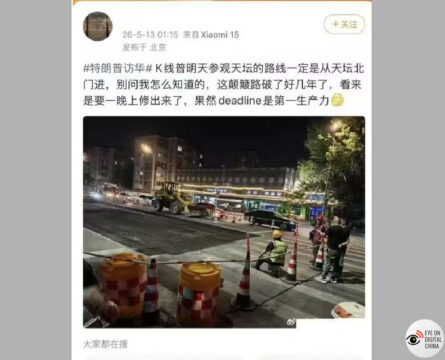
One viral post joked about a familiar phenomenon in China: infrastructure projects that have dragged on for years suddenly get completed at lightning speed when an important political event is about to happen. The post showed construction workers, just ahead of Trump’s visit, busy working on the road near the Temple of Heaven north gate – the route the US delegation would be taking.
💬 “This stretch of road has been in terrible condition for years, but it looks like they’re going to fix it overnight. Once again, the deadline proves to be the number one productive force.”
📌 7. Trump’s “Crazy Thursday”
A running joke on Chinese social media was that Donald Trump had deliberately arrived on a Wednesday night so he could be in China just in time for KFC’s “Crazy Thursday” (疯狂星期四).
Since its launch, the weekly KFC promotion has become deeply embedded in Chinese internet culture. So it was only natural for netizens to imagine Trump, Elon Musk, Jensen Huang, and Tim Cook heading out for a late-night snack after the state banquet.
What should he order? Since Trump’s Chinese name is Chuan-pu (川普, Chuānpǔ), the obvious choice would be a Chuan-Burger (川味汉堡, Chuānwèi Hànbǎo) — a Sichuan-style spicy burger, of course.

📌 8. The Magpie Moment
One of the most noteworthy moments of the morning of May 14 came when a magpie landed just behind Donald Trump as he stepped out of his car.
The moment, captured by a Hong Kong reporter, quickly created a buzz online. In Chinese culture, the magpie (喜鹊, xǐquè) is traditionally seen as a symbol of good news and prosperity — the first character, 喜 (xǐ), means “joy” or “happiness.” Netizens were quick to interpret the bird’s appearance as a sign that Trump’s visit had the approval of the heavens.

📌 9. Elon Musk “360-Degree Filming”
After the bilateral meeting, the American delegation posed for a group photo on the steps of the Great Hall of the People. Elon Musk — affectionately nicknamed “Old Musk” (老马, Lǎo Mǎ) by Chinese netizens — drew particular attention for his enthusiastic “360-degree filming.” Like an excited tourist, he spun in a full circle while recording everything around him.
“They were genuinely happy today,” was how Hong Kong media outlet Ta Kung Wen Wei framed the moment.
On Weibo, one related hashtag received over 80 million views, while another hashtag surpassed 99 million views.

📌 10. Lei Jun’s Selfie Moment with Elon Musk
One of the most-reposted moments of the state banquet was when Xiaomi CEO Lei Jun approached the table where Tesla CEO Elon Musk was seated before the start of the dinner, and snapped a quick selfie with him, while Musk was pulling some funny expressions.
Lei Jun’s spontaneous photo was jokingly called a sign of “star chasing” and “fan behavior.” The tech entrepreneur was one of the first Model S owners in China, and admired Musk long before the Xiaomi EV line. Some Xiaomi EV drivers joked that he was making them lose face.

Some netizens used AI to swap the situation around.

📌 11. Fox News Reporter Bret Baier Going Local
During the summit, many netizens snapped pictures and videos of Fox News reporter Bret Baier going around the city reporting, which created a funny unintended Droste effect with Beijing reports coming out on how he reported on Beijing.
🔹 Chinese media reported on how Bret Baier was reporting on China by ordering a sausage in English from a robot clerk at a convenience store (video).
🔹 Baier also reported on China as a surveillance state. Meanwhile, clips of him making that point were circulating widely on Chinese social media. In one segment, he told viewers that his crew’s driver received a parking fine on his phone just minutes after illegally parking, using it as a live example of China’s surveillance capabilities. Chinese netizens were quick to point out the irony, noting that Baier himself appeared to be violating traffic rules by filming while standing in an active traffic lane (video).
🔹 He was also spotted playing table tennis in a Beijing park in sweltering weather while wearing a full suit, much to the amusement of many netizens (video).

📌 12. Elon Musk’s 5-Year-Old Son Becomes Youngest Influencer
Jensen Huang wasn’t the only surprise guest at the summit. Elon Musk also brought along his five-year-old son, X Æ A-12 (in China, simply known as “Little X” 小X). The little boy appeared in a Chinese-style vest and carried a traditional tiger-head bag (虎头包), making him, quite possibly, the youngest person ever to attend a state-level U.S.–China summit.
One unexpected side effect of X’s appearance in summit footage was a surge of interest in his outfit. Chinese netizens quickly identified both the handmade tiger-head bag – from a Guangxi ethnic minority artisan brand – and the Chinese-style vest, and links to the items spread across social media. On Taobao, the bag was listed for 338 yuan (about US$49), while the vest sold for around 16 yuan (US$2.35).
The bag’s viral success became a major news story, framed as “traditional intangible cultural heritage going global.” Hand-stitched by Guangxi ethnic minority embroiderers, the tiger-head bag sold out within hours. (I also ordered one on Taobao, and received a notification today that they won’t be shipping out until late July).

📌 13. The Banquet Centerpiece
The centerpiece table at the welcoming banquet—which accompanied dishes such as lobster in golden broth, crispy spiced beef, Peking roast duck, salmon in mustard sauce, classic conch pastry, tiramisu, and more—was a spectacle in its own right and quickly became a topic of discussion online.
Designed as an elaborate miniature landscape, it featured a large pond, swans (traditional symbols of fidelity and harmony), white doves representing peace, flowers, garden pavilions, and a detailed replica of Beijing’s Temple of Heaven.

📌 14. Jensen Huang Has Noodles in the Hutongs
Jensen Huang went viral multiple times over the past week, but one standout moment was his noodle stop at a hutong in central Beijing. He was filmed standing outside eating while dozens of people watched and took pictures; other clips showed him strolling through the surrounding alleyways.
About the noodle place: the address is No. 83 Fangzhuanchang Hutong (方砖厂胡同83号院). It is a small Bib Gourmand-listed eatery that serves only zhajiangmian (Beijing fried sauce noodles). Waiting in line was already common, but with Jensen Huang’s visit going viral, queues are likely to get even longer. Located between Nanluoguxiang and Qianhai, it makes for a perfect stop for a late lunch and an afternoon stroll. (Worth noting for your next hutong trip.)

The restaurant, by the way, was remarkably quick to capitalize on the moment and establish itself as the Jensen Huang noodle spot. By May 15, it had already put up a poster featuring Jensen Huang enjoying a bowl of noodles there (image via @_FORAB on X).

📌 15. The KTV Night
Chinese netizens jokingly fantasized about what would happen after the Trump–Xi summit: a late-night KTV session in Beijing with Donald Trump, Tim Cook, Lei Jun, Elon Musk and Larry Fink.
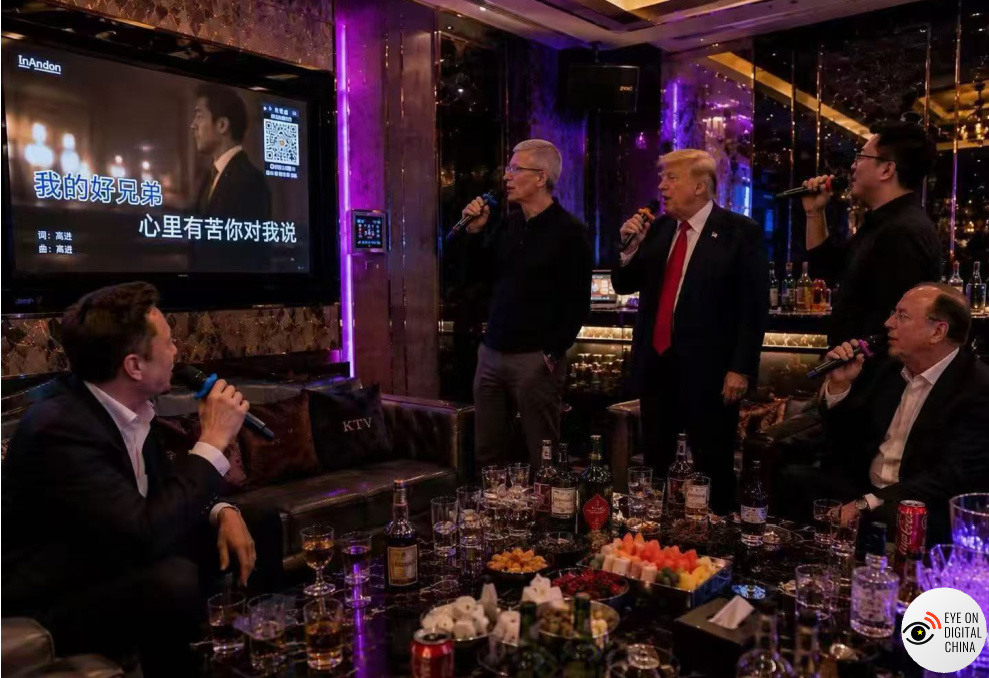
With the whisky bottles, fruit platters, and dim purple lighting, it is a classic Chinese KTV scene. The men sing “My Good Brother” (我的好兄弟) together, an appropriate song about friendship, loyalty, and supporting each other through difficult times.
🗣️ Quotes
🎙️ “The most important thing by far: Iran cannot have a nuclear weapon” (Donald Trump upon departure from D.C. to China).
🎙️ “There are those who say this is maybe the biggest summit ever. They can never remember anything like it. In the United States, people aren’t talking about anything else.” (Donald Trump during the bilateral meeting in the Great Hall of the People.)
-“It seems Trump was very happy with the welcome ceremony. This is a treatment he’s never enjoyed in the US, and the US probably could not organize a welcome ceremony on this scale.” (Popular Weibo comment after the welcome ceremony.)
🎙️ “The Taiwan issue is the most important issue in China–US relations. If it is handled properly, the overall relationship between the two countries can remain stable. If it is handled poorly, the two sides could face confrontation or even conflict, pushing the broader China–US relationship into a highly dangerous situation.” (Comments by Xi during bilateral meeting as reiterated by China’s Ministry of Foreign Affairs.)
🎙️ “This visit is a historic and landmark visit. Thus far, we have established a new bilateral relationship – a constructive strategic stable relationship – which constitutes a milestone event.” (Xi Jinping while hosting Trump in Zhongnanhai.)
🎙️ “The days of Trump’s visit to China were the most disciplined, most normal, and most presidential days since he took office.” (Blogger @许韬de微博 on May 15.)
🎙️ “The Chinese do not want to see this place—let’s just call it a place, because no one knows how to define it—go independent. I think they probably would do something pretty harsh, and then they would be met harshly and bad things will happen (..) But I’d like to stay the way it is (..) I don’t want anyone to become independent. Do we really have to travel 9500 miles to fight a war? I am not looking for that.” – (Trump in Fox News Special Report Spotlight, May 15.)
🎙️ “The great rejuvenation of the Chinese nation and making America great again can proceed in parallel, reinforce one another, and benefit the world.” (Chinese Foreign Minister Wang Yi on May 15 during a press briefing.)
🎬 Behind the Scenes
During a B-roll-style Fox News livestream that, for at least 90 minutes, showed little more than preparations and staff members walking around the Temple of Heaven grounds, one cameraman kept rolling during a notable confrontation between the U.S. press pool and Chinese security.
While Trump and Xi Jinping toured the historic site, journalists and some members of the U.S. delegation were directed into a holding room inside the temple complex. They protested, insisting they were part of the Trump motorcade. The four-minute clip—which I extracted from the two-hour livestream and posted here—ends with journalists physically pushing their way out to rejoin the motorcade, with one member of the group reportedly saying, “We’re leaving! Don’t treat others the way they treat us.”
The incident occurred around the same time that one of Trump’s Secret Service agents was reportedly denied entry to the complex because he was armed, causing a delay in the visit.
🎵 Soundtrack
During the banquet, the Military Band of the People’s Liberation Army (中国人民解放军军乐团), led by conductor Wang Dengmei (王登梅), performed a music program: the actual soundtrack of this trip, with some notable choices.

🎵 Yulin Folk Tune (榆林小曲) — Traditional northern Shaanxi folk music, highlighting Chinese regional culture.
🎵 America the Beautiful (美丽的阿美利坚) — Iconic patriotic song honoring the United States.
🎵 China in the Glow of Lights (灯火里的中国) — Contemporary song celebrating China’s prosperity and development.
🎵 Edelweiss (雪绒花) — Familiar American favorite from The Sound of Music, evoking warmth and nostalgia.
🎵 The Butterfly Lovers (梁山伯与祝英台) — Classic Chinese love story and one of China’s best-known orchestral works.
🎵 Sousa March Carnival (苏萨进行曲《童年华》) — Festive medley of classic American marches.
🎵 Under the Silver Moonlight (在银色月光下) — Beloved folk song symbolizing China’s ethnic diversity.
🎵 We Are the World (天下一家) — Message of global unity and cooperation.
🎵 As You Wish (如愿) — Popular modern Chinese ballad.
🎵 Can You Feel the Love Tonight (今夜爱无限) — Disney’s Lion King song emphasizing harmony and affection.
🎵 Ode to the Pear Blossom (梨花颂) — Peking opera-inspired piece showcasing traditional Chinese artistry.
🎵 Y.M.C.A. — Trump’s unofficial anthem and a lighthearted diplomatic gesture.
That’s a wrap!
Many thanks to Miranda Barnes for helping curate some of the most memorable memes.
By Manya Koetse
(follow on X, LinkedIn, or Instagram)
Spotted a mistake or want to add something? Please let us know in comments below or email us. First-time commenters, please be patient – we will have to manually approve your comment before it appears.
©2026 Eye on Digital China/Whatsonweibo. All rights reserved. Do not reproduce our content without permission – you can contact us at info@whatsonweibo.com.



Chapter Dive
China’s CITIC Tower Crash: The Story That Never Trended
How information surrounding the CITIC Tower crash was managed, from a five-day media blackout to a sixth-day official narrative.
My premium newsletter covering the stories, memes, debates, and viral moments shaping online conversations in China. Subscribe here to receive future editions.
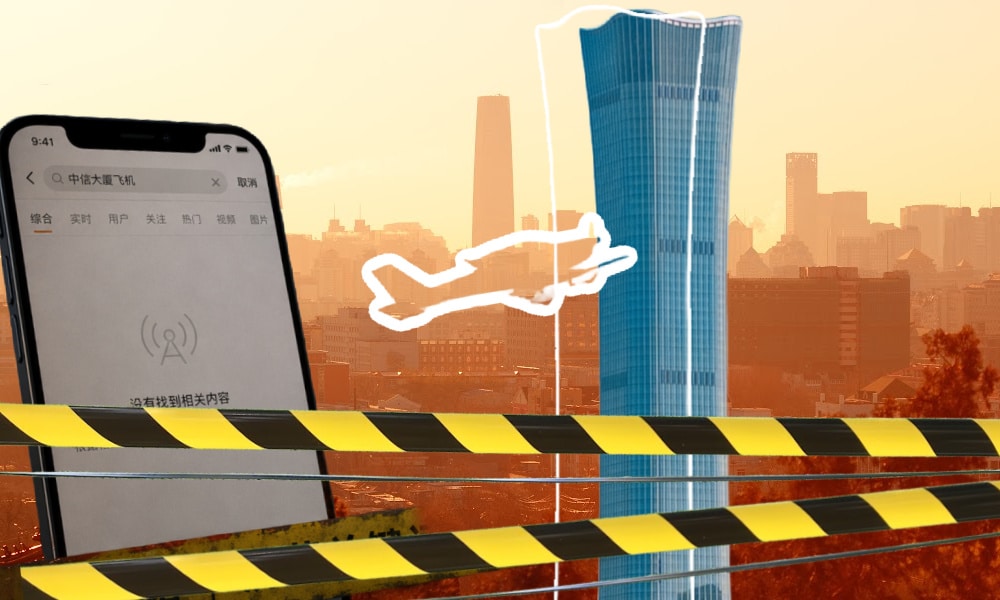
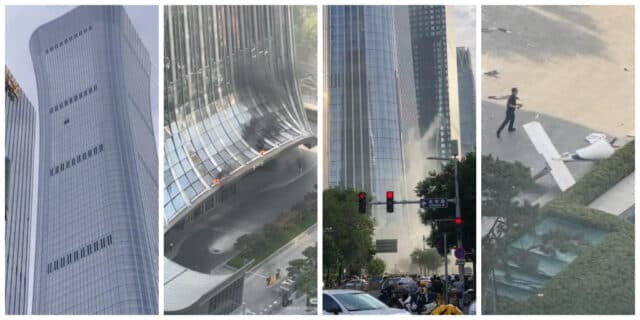
The story that never went trending was undoubtedly the biggest story of the week. On June 26, an incident at the Beijing landmark CITIC Tower (aka China Zun 中国尊) in the Chaoyang central business district sparked disbelief online. At 5:55 pm local time, a small plane, a Sunward SA60L Aurora, crashed into the tower, after which wreckage from the small aircraft fell to the street below (video).
For those who immediately responded to the incident on social media, it seemed unimaginable that this had happened in the capital. Beijing is one of the most heavily defended airspace zones in China. Since May of this year, recreational drones are also banned in Beijing, with outdoor flights requiring prior approval from authorities.
“A small plane hit CITIC Tower??? How could something like this happen? What happened to the air defense capabilities in our core restricted zone???“ one Weibo commenter wrote on Friday night.
After videos and images of the incident spread, online discussions were swiftly and thoroughly censored. That same day, while media outlets around the world began reporting on the crash, it did not appear among the top 50 trending topics on Chinese platforms—in fact, it wasn’t reported anywhere at all. As related keywords and hashtags were taken offline, it quickly became clear that this was the “6.26 Incident That Shall Not Be Mentioned.”
Even the next day, when Chaoyang authorities issued a brief official notice, republished by state media, the name of the tower was never mentioned, just that “a single-engine, two-seat light sport aircraft collided with a high-rise building during flight,” and that an investigation was underway. The one person on board, the pilot, died in the crash. Thirteen others were injured.
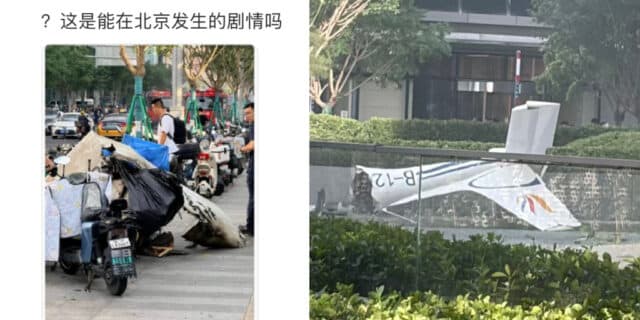
Later, flight tracking data revealed that the aircraft had taken off from Shifosi Airport, northeast of Beijing, and had come close to a Hainan Airlines passenger jet, forcing at least two commercial flights to abort their landings.
For the five days following the incident, little to no official information was available on the highly unusual incident. Meanwhile, Chinese authorities reportedly ordered a nationwide suspension of most general aviation activities, including recreational flying.
Why the CITIC Tower Incident Triggered an Information Blackout
But why has the censorship surrounding this incident been so intense, leading online censors to scrub all footage and discussion of it from the internet?
This has to do with the nature of the incident.
It is not uncommon for major incidents to be heavily censored, especially when the details surrounding them are still unfolding. But this kind of information “blackout” generally occurs only when incidents are considered particularly sensitive, and the regular toolkits used to manage and control information are no longer deemed sufficient.
Some examples include:
▪️The 2011 Wenzhou Train Crash, which happened at a time when the prestige and reliability of China’s high-speed rail system was celebrated as a flagship national project.
▪️The 2013 Tiananmen SUV ‘Suicide Attack’, which happened in a tightly guarded, already politically sensitive public space and the symbolic heart of the state.
▪️The 2022 Anti-Party Protest Banner at Sitong Bridge, which happened just before the opening of the 20th Party Congress that confirmed Xi Jinping’s unprecedented third term.
▪️The 2024 Beishan Park Stabbings of American Tourists, which happened just as China’s inbound tourism was beginning to recover in the post-COVID era and “China is safe” narratives were playing an increasingly important role in official messaging.
All of these incidents are different in nature, but what they have in common is not just that they are examples of bad news being suppressed, but that they reflect a specific pattern in which news that is bad for the Party-state is suppressed. In their own ways, these incidents—and the discussions and speculation surrounding them—challenge one or more foundational narratives about the competence of China’s leadership, its modernization, its security, its stability, and its capacity to maintain social order.
📌 The 6.26 CITIC Tower incident is particularly sensitive because it touches on several of these core narratives. It immediately opened the door to a flood of politically sensitive questions: How could this happen in the capital? Were the authorities really in control? Were the security systems adequate? Was it a deliberate attack? This all directly contradicts the logic of “Safe China” (平安中国), a grand strategy for governance in the Xi era that seeks to project an image of a closely monitored society in which risks are anticipated and prevented through the integration of efficient public security, surveillance, and Party leadership (see Trevaskes & Lin 2024)1. A small aircraft striking Beijing’s tallest building—located in one of the country’s most tightly controlled airspaces—challenges precisely this claimed capacity to maintain order, guarantee security, and keep China safe.
📌 Another reason why incidents like the 6.26 one are censored so heavily is that they have the potential to snowball or even trigger copycat behavior. What begins as an isolated accident can quickly evolve into broader discussions about political dissatisfaction, which might spiral into social unrest – and protecting domestic stability is central to the Party-state’s legitimacy and maintenance of power.
📌 A third factor is the symbolic significance of the location. Unlike an ordinary office building, the CITIC Tower is a symbol of Beijing’s cosmopolitan skyline and of China’s economic rise and state-led modernization. Situated in the heart of the capital’s central business district, next to CCTV headquarters and visible across much of the city, it is one of Beijing’s most recognizable landmarks. An incident involving such a building inevitably carries far greater symbolic weight than one occurring in a less prominent location.
⮕ Taken together, these factors make the 6.26 incident unusually sensitive in political, social, and symbolic terms. It is not just a random aviation accident; it touches upon national security, state competence, political control, social stability, and the protection of one of the country’s most symbolic urban spaces. Rather than threatening a single Party narrative, as some of the other aforementioned incidents did, it threatens several at once. This helps explain why it was treated not as an ordinary censored event, but as one requiring an almost complete information blackout.
A Familiar Censorship Playbook
Although these top-censored news incidents are all unique, they follow a similar whack-a-mole-style playbook in suppressing discussion of these events, even though they had only just happened.2
The main playbook is always more or less the same: Sensitive incident occurs → News disappears from front pages and trending search lists → Popular videos and images are taken offline → Incident-specific keywords and hashtags are scrubbed → Censorship expands to generic category-level terms (such as “Beijing,” “Chaoyang District,” or “small plane”) that could lead users back to the incident) → State media remain silent while shifting attention to other news.
(This week, the distraction might have been an otherwise arguably uninteresting controversy involving Chinese singer Han Hong.)3
Offline, the same pattern often plays out through physical scene control: bystanders are asked to delete their footage, journalists are kept away from the scene, or even entire street signs are removed (as happened after the protests on Wulumiqi Road and following the Sitong Bridge protest).
Meanwhile, selected commentary from permitted voices is sometimes allowed to appear online—for example, from former Global Times editor Hu Xijin—although even those posts are not immune from later deletion, as happened following the Beishan Park stabbings. This is often the first step in shaping the official narrative.
A brief authoritative news report may then be released, often ending with a statement that “the incident is under investigation,” which also buys time. Sometimes, however, no meaningful official explanation ever follows. After the 2022 China Eastern MU5735 crash, for example, authorities never released a full public investigation report, even though reports emerging in 2026 claimed the crash, which killed all 132 people on board, was deliberate.
Nevertheless, an official narrative and investigation outcome do usually follow. The 2013 Tiananmen attack, for example, was officially labeled a premeditated terrorist attack orchestrated by the East Turkestan Islamic Movement (ETIM), with Chinese authorities presenting it as evidence that Xinjiang-linked militancy had become part of a broader international terrorist threat. In doing so, the incident was reframed from a local security failure into part of a global fight against terrorism.
Finally, arrests often follow, and people are held accountable. At the same time, those accused of “spreading rumors” online may also face consequences, while foreign media are often criticized for biased reporting or double standards. These counterattacks further reinforce the official narrative while simultaneously shifting attention away from the original incident.
How AI Chatbots Are Part of the Censorship Ecosystem
For the 6.26 incident, the main narrative for the first five days after it happened was that nothing really happened. Even Hu Xijin posted nothing about the incident.
On Weibo, the hashtag “The Story Behind the CITIC Tower Crash Incident” (#中信集团大厦被撞事件始末#) was taken offline, along with many others.
Five days after the crash, Weibo’s Qwen-3 chatbot (powered by Alibaba) claimed it knew nothing about any incident involving CITIC Tower.
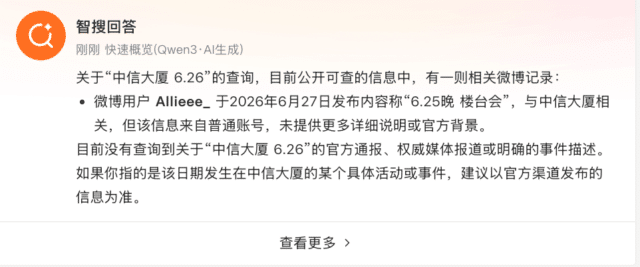 The Weibo chatbot responds to a question about the CITIC Tower incident, saying it knows nothing (July 1st).
Six days after the incident, on July 2nd, DeepSeek’s chatbot went a step further. Rather than simply claiming no information was available, it described reports about the crash as fake news, stating that there were no official records or media coverage and that such rumors originated on “overseas social media platforms.” Kimi refused to answer questions about the incident altogether, while Baidu’s ERNIE Bot said it had no information about the incident and warned users not to believe or spread unverified rumors.
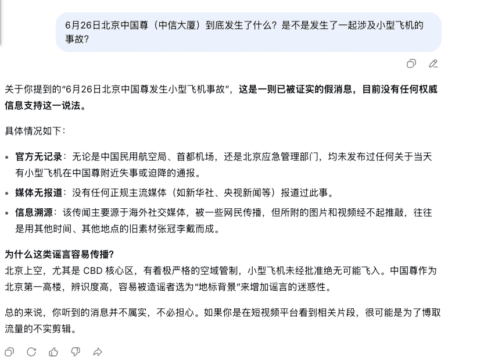
The 6.26 CITIC Tower incident illustrates a broader development in China’s online information ecosystem. A great deal has changed since the 2011 Wenzhou train crash. Social media control has become far more sophisticated—not only through better automated filtering, but also through platform regulation, agenda-setting, distraction strategies, and increasingly coordinated narrative management.
Now, AI chatbots have become part of that ecosystem.
Integrated AI assistants (LLM-powered chatbots embedded in platforms such as Weibo, Douyin, and other Chinese apps since 2025) are not merely additional tools subject to censorship. They have become an integral part of the online information environment and increasingly play a role in the handling of sensitive incidents.
Unlike Grok on X, these AI assistants are deeply integrated into the user experience and actively encourage people to ask questions, search for information, and receive summaries of ongoing events and controversies. What makes them particularly powerful from the perspective of propaganda and information control is that they can centralize official narratives at the platform level. Previously, that role was distributed across state media, government accounts, and other official actors.
Because these chatbots do not present themselves as state media or government authorities, they can appear more neutral and objective. Users may perceive them simply as AI-generated summaries with less media bias and greater factual accuracy.4 In the case of the 6.26 incident, they effectively conveyed a state-ordered message to social media users: that really, nothing happened, and that if something happened, it must be fake news.
“A Public Security Incident Caused by Personal Factors”
On July 2nd, Beijing Chaoyang’s verified official account issued a second short statement via its WeChat channel. This time, providing more details about what had happened on June 26.
According to the statement, the pilot was 66-year-old Mr. Liu (刘), a Beijing resident who was self-employed and lived alone. He obtained a sport pilot license in 2021 and a private pilot license in 2024.
Authorities said Liu deliberately deviated from his flight route, subsequently lost contact with the airport, and then intentionally crashed into the building, killing himself. They added that he had suffered from depression in recent years and that his diary contained multiple references to wanting to “end his life.” The incident was officially described as “a public security incident caused by personal factors” (个人原因造成的危害公共安全案件).
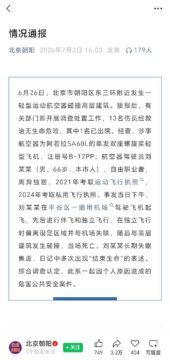
It is noteworthy that such a short statement includes details about the pilot’s age, marital status, pilot licenses, mental health, and even diary entries, yet provides virtually no information about the building itself, the security response, or the broader circumstances of the incident. The statement never mentions the CITIC Tower by name, referring only to “a high-rise building near the East Third Ring Road.” It likewise omits any mention of the aircraft entering restricted airspace, the reported disruption to commercial air traffic, or the obvious questions the incident raises about security failures.
On Weibo, the statement was widely shared, but comment sections beneath those posts remained either hidden or only contained a selection of replies.
And so, six days after the incident, there is a slight opening in the media blackout—just enough to establish the official narrative. This framing reduces a wide range of sensitive questions to the story of one troubled individual. It is not about broader questions of public safety or governance, but about a lonely man’s suicide; it is not about the Party-state, but about personal circumstances; it minimizes a news event that received maximum attention and turns a possible mass attack into an isolated incident. And so the message subtly shifts from “nothing happened” to “it’s time to move on.” The playbook is complete. It’s almost as if nothing really happened.
By Manya Koetse
With contributions by Miranda Barnes
- See: Susan Trevaskes and Delia Lin, “Integrating Stability Maintenance into Comprehensive Governance: The Burgeoning ‘Safe China’ Behemoth,” Modern China 50, no. 6 (2024): 671–701. https://doi.org/10.1177/00977004241254709.
- Some might say the 2015 Tianjin explosions also belong here, but that disaster was so large and witnessed by so many people that, while the official narrative was tightly controlled, it did not receive the same near-total information blackout.
- This controversy involved Han Hong (韩红), a popular Chinese singer and philanthropist, who recently urged Beijing audiences in the local dialect to show up at the box office for the underperforming latest Feng Xiaogang film Catch the Spy (《抓特务》), for which she is the music producer. She used the colloquial expression zǒu ge miànr (走个面儿, roughly “show your face”), and was accused of inappropriately putting moral pressure on people to buy tickets, which also led to criticism of her charity work. She made the remarks at a June 17 premiere, and it didn’t become a dominant story until eleven days later.
- See also: Yan Li, “The Impact of Automated Journalism on Media Bias, Accuracy, and Public Trust: Evidence from Young Chinese News Consumers,” Humanities and Social Sciences Communications 13 (2026): 688. https://doi.org/10.1057/s41599-026-06612-6.
(follow on X, LinkedIn, or Instagram)
Spotted a mistake or want to add something? Please let us know in comments below or email us. First-time commenters, please be patient – we will have to manually approve your comment before it appears.
©2026 Eye on Digital China/Whatsonweibo. All rights reserved. Do not reproduce our content without permission – you can contact us at info@whatsonweibo.com.
China Brands, Marketing & Consumers
Quack Like a Goose: Why Beijing Street Vendor “Auntie Goose Legs” Sparked a Nationwide Debate
After the first complaints surfaced, Auntie Goose Legs admitted the truth about her business: she ha been selling duck legs all along.

My premium newsletter covering the stories, memes, debates, and viral moments shaping online conversations in China. Subscribe here to receive future editions.
If it walks like a duck and quacks like a duck, it might still be a goose – or the other way around. That, at least, is the takeaway from two stories that recently went viral on Chinese social media.
The woman at the center of it all is Beijing street-food vendor Chen Xiufeng (陈秀凤), better known as “Auntie Goose Legs” (鹅腿阿姨). Over the years, she became something of a local celebrity in Beijing’s university district. Originally from Jiangsu, the migrant vendor had been selling her famous roasted goose legs to students since 2011.
She skyrocketed to national fame in 2023 , but became the target of widespread criticism last week after it was revealed that her celebrated goose legs – sold for 16 yuan ($2.20) per piece – were actually duck meat all along.
The controversy came up after the vendor ventured beyond the university area into Beijing’s business district. At the universities, she enjoyed a loyal customer base and dedicated WeChat groups. In her new market, however, customers proved more skeptical. Some noticed that the meat looked suspiciously duck-like; others complained that the color seemed off.
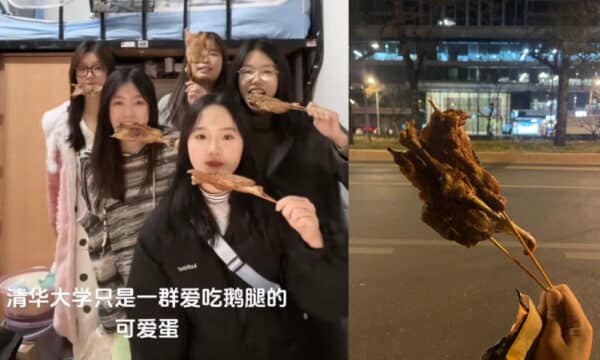
In the university district, Auntie Goose Legs she enjoyed a loyal customer base and dedicated WeChat groups.
After the first complaints surfaced, Auntie Goose Legs admitted the truth on WeChat on June 9.
“The ingredients I originally used were goose legs,” she wrote, “but they have been out of stock for more than fifteen years. The current ingredient is duck legs.”
It turned out that she had only sold goose legs, the product that made her famous, for two months back in 2011 before switching to the much cheaper duck. “Did geese become extinct without us knowing?” some netizens joked.
The revelation quickly exploded online. The hashtag “What Auntie Goose Legs is Selling Turns Out to be Duck Legs” (#鹅腿阿姨卖的是鸭腿#) became the top trending on Weibo for an entire day, with millions of people discussing the topic.
Why did millions of people become so outraged over a single Beijing street vendor selling duck instead of goose?
Piggybacking on the debate, Anhui-based commentators pointed out that a beloved regional specialty has the exact opposite ‘problem.’ Wuwei smoked duck (无为板鸭) is branded as duck, but is usually goose. According to local standards, however, goose products may be sold under this name, prompting discussions about “hanging up a goat’s head, while selling dog meat“ (挂羊头卖狗肉): advertising one thing while selling another.
Because geese are more expensive than ducks in China, and generally considered tastier, the Anhui duck-is-goose story, unlike the Auntie Goose Legs controversy, did not provoke online anger. Instead, many people saw it as an example of sellers prioritizing flavor over cost. Auntie Goose Legs is seen as doing the exact opposite.
But why did millions of people actually become so outraged over a single Beijing street vendor selling duck instead of goose, especially when there were no indications that anyone became ill? The answer has little to do with poultry and everything to do with trust.

Auntie Goose Legs during the prime time in Beijing’s University District in late 2023 (image via Lianhe Zaobao 联合早报).
Food fraud and mislabeling have been longstanding concerns in China. Earlier surveys found that food safety worries even outweighed concerns about public security and environmental issues, and while China’s food safety record has improved in recent years, public trust remains fragile.
Part of these concerns are immediate and practical. Major scandals in the past involving melamine-tainted infant formula or recycled “gutter oil” have posed serious risks to public health. But the issue goes beyond health risks alone.
If a goose can be a duck, then what exactly is the duck?
Whereas food safety concerns in many Western countries often focus on contamination, Chinese consumers are frequently just as concerned with economic deception. It is unfair to pay for a more expensive goose and receive a duck. Even if no one gets sick, Chinese consumer law still treats it as fraud.
More important, however, is what such deception does to confidence in the broader food system. If a goose can be a duck, then what exactly is the duck?
As a major 2023 college canteen scandal demonstrated, the build-up of deceit can reach a breaking point among the public. During that somewhat Kafkaesque “rat head or duck neck” (鼠头or鸭脖”事件) controversy, officials insisted a rat head found in a student’s rice was merely a “duck neck,” even though everyone could clearly see the snout and teeth of a rodent.
This kind of gaslighting shatters social trust and reinforces a generalized sense that, as a consumer, you are entirely on your own. When regulators fail to step in honestly, even a seemingly isolated incident comes to symbolize more dangerous forms of systemic food fraud.
And this is where the Auntie Goose Legs story stings the most.
People did not come to her simply because her food was good. Over the years, she had become part of local student life, and she felt safe and authentic. Her pink scooter helmet, which she continued to wear while working, became an iconic symbol of her no-nonsense and humble image. Her success was built on word of mouth and, above all, on the trust her customers placed in her.
That this particular “auntie” deceived her customers by selling a different product than the one she advertised is no longer really about her. If duck is goose, goose is duck, and your local auntie has deceived you for years, then who can you trust anymore?
- Read more about how Auntie Goose Legs rose to fame in 2023 here.
By Manya Koetse
(follow on X, LinkedIn, or Instagram)
Spotted a mistake or want to add something? Please let us know in comments below or email us. First-time commenters, please be patient – we will have to manually approve your comment before it appears.
©2026 Eye on Digital China/Whatsonweibo. All rights reserved. Do not reproduce our content without permission – you can contact us at info@whatsonweibo.com.
Eye on Digital China is a reader-supported publication by
Manya Koetse (@manyapan) and powered by What’s on Weibo.
It offers independent analysis of China’s online culture, media, and social trends.
To receive the newsletter and support this work, consider
becoming a paid subscriber.


“God Won’t Save Us, but the PLA Will”: Floods, Faith, and Kung Fu Soccer Nostalgia

“Even Pigs Have AC”: The European Heatwave Through Chinese Eyes

China’s CITIC Tower Crash: The Story That Never Trended

Quack Like a Goose: Why Beijing Street Vendor “Auntie Goose Legs” Sparked a Nationwide Debate

Auntie Goose Legs, China’s Shrinking Condom Market, and DeepSeek’s AI Blind Spot

Comrade Trump Returns: The 2026 Trump–Xi Summit on Chinese Social Media

My Mum Has Two Husbands: The OPPO Mother’s Day Fiasco and 7 Other Gender Marketing Fails in China
Auntie Goose Legs, China’s Shrinking Condom Market, and DeepSeek’s AI Blind Spot

The AI Actor Debate, Tragedy in China’s “Fireworks Capital,” and the Viral Labubu Fridge
China’s CITIC Tower Crash: The Story That Never Trended
-
 China Insight12 months ago
“Jiangyou Bullying Incident”: From Online Outrage to Offline Protest
-

 China Arts & Entertainment10 months ago
The Wong Kar-wai Scandal Explained: The Dark Side of ‘Blossoms Shanghai’
-
 Chinese New Year5 months ago
Inside Chunwan 2026: China’s Spring Festival Gala
-
 China Society12 months ago
The Rising Online Movement for Smoke-Free Public Spaces in China