
China Insight
Blame Games & Bad Signs: Nepal–Tibet Floods, Huawei’s Toilet Trouble, “Screwed” Graduates
How the Nepal–Tibet floods are being discussed on Chinese social media. From solidarity and sadness over Gyirong to censorship and anger at Taiwanese, Indian, and Western media.


In this edition:
- Teachers get shamed for their students’ bad grades
- Why the Nepal–Tibet floods sparked arguments about blame, BBC reporting, and Chinese censorship
- Huawei doesn’t appreciate viral toilet humor
- Dads are carrying mattresses into Peking University
- Chinese graduates are getting “screwed” by a million-dollar company
🗞️ QUICK SCROLLS
🧑🏫 A teacher “shame photo” taken at a local education meeting in Liangshan, Sichuan, has sparked nationwide outrage. A group of primary school teachers was forced to pose in front of a giant “SHAME” sign because their classes’ average final exam scores were below 30. “This isn’t merely ‘shame’—it’s outright public humiliation,” one commenter wrote. Liangshan’s education bureau confirmed the photo was real and said it was “puzzled” by the practice; the Leibo County government has apologized and launched an investigation.

Teachers lined up in front of a big screen that says: “Group photo of primary-school teachers whose classes averaged below 30 points in the 2025–2026 end-of-year examinations”
🥬 “Chemical cabbages” (药水白菜) or “formaldehyde cabbages” (甲醛白菜) have been a major topic on Chinese social media after a Chinese investigative vlogger captured workers in Kangbao, Hebei, dipping cabbages into formaldehyde solution before loading them onto trucks. This procedure, which allegedly adds 2–3 extra days of shelf life, is illegal: formaldehyde is a Group 1 carcinogen.
🍫 It’s been a bad week for Mars-owned chocolate brand Dove. A marketing campaign suggesting that a girl received a box of chocolates from a man she was flirting with while her boyfriend was away (“趁男友不在”) drew anger online. Then the brand’s apology also became a massive failure: when it was flagged as 100% AI-generated, Chinese netizens had little sympathy left for the brand.
💸 A “century-old” shark fin soup served by a Shanghai restaurant for no less than 4,800 yuan (US$715) per bowl (!) has gone viral for its exorbitant price and claims that it has been “simmering for more than 100 years,” since the late Qing dynasty. There was plenty of skepticism about the soup, but also disbelief that anyone would spend an ordinary person’s entire monthly living budget on a single bowl of soup.
👩💻 An eighth-grader from Shanghai earned 18,000 yuan (US$2,678) in three days using AI. Despite her limited programming experience, the 13-year-old placed third in a marketing hackathon, where teams had 48 hours to develop and market an entire AI product. She launched a study-companion app called “Being There” (在场) that 92 people bought. Although Chinese media praised her, commenters were critical, suggesting she received help from her mother, an influencer on Douyin.
💍 In an aging society where marriage rates have AGAIN dropped, more and more places are making it easier than ever to tie the knot. Registration services are popping up in…

China Insight
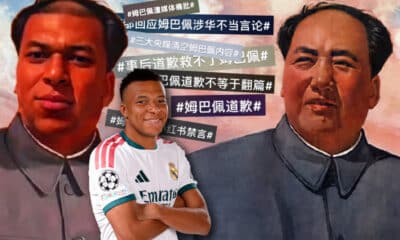
Mbappé, Mao, and the Joke That Shall Not Be Named
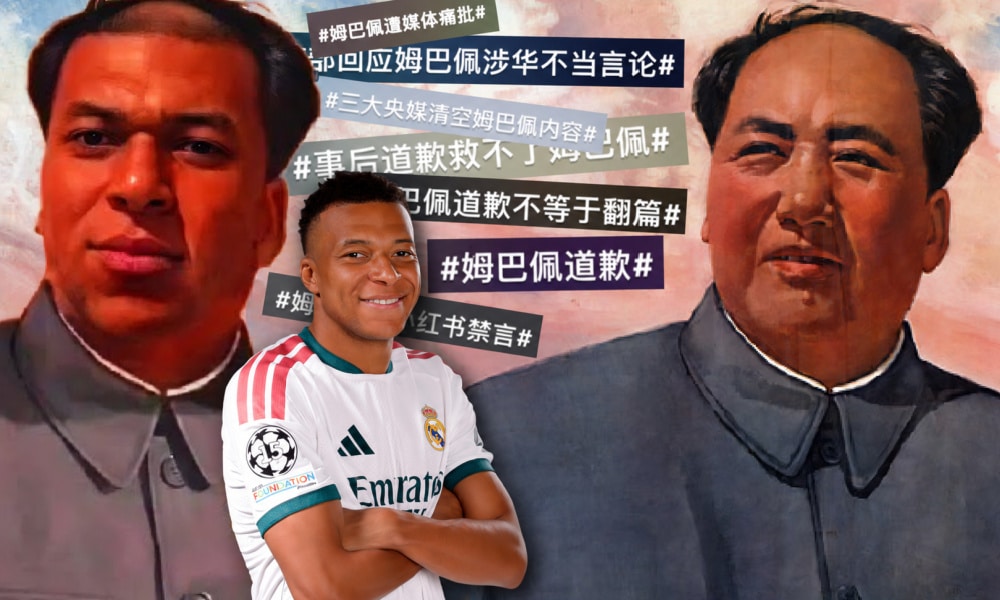
Mbappé’s favorite Mao meme sparked major backlash in China. More on what the controversy reveals about political red lines, online humor, and censorship.
RESOU 热搜 | What’s Trending in China, Explained
Here, I briefly unpack the stories making waves on Chinese social media and share what stands out to me. Don’t miss an update: become a subscriber to Eye on Digital China today.
Oh oh oh, Mbappé, all those goals, yet you lost so many points on Chinese social media over the past 48 hours.
Following his 100th goal for Real Madrid during El Clásico and finishing second on Ballon d’Or night, French football player Mbappé is all the talk on Chinese social media — not for his achievements, but for what is seen as crossing a major red line in an online interview.
On Tuesday night, a text came in from Ruixin: “I am wide awake tonight and somehow witnessed live how the footballer Kylian Mbappé was getting blocked and totally canceled on Chinese social media for his comments about Mao Zedong over the past, like, three hours 😅”
I quickly grabbed my phone and saw the flood of Mbappé posts rapidly coming in, and it was clear that people were very cross with him.
Although it was already clear that this might not blow over any time soon, by early Wednesday morning it became painfully clear how the controversy had snowballed. Dongpeng Beverage Group (东鹏), one of the many Chinese companies that signed the famous sportsman as its brand ambassador, publicly stated that it was cutting all commercial ties with Mbappé. Soon, others followed.
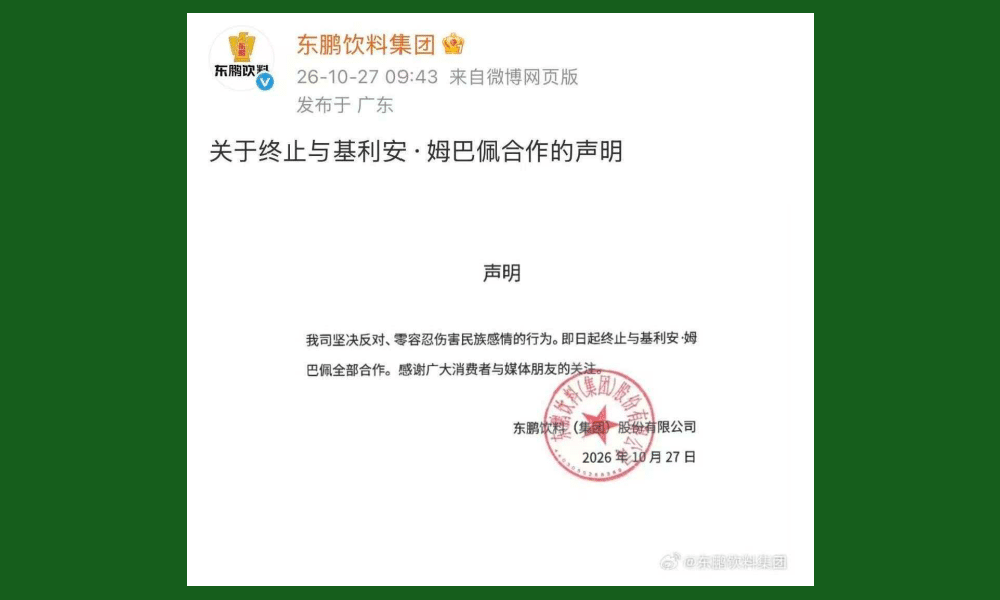
Dongpeng Beverage Group (东鹏): the first in a string of companies to cut ties with French footballer Kylian Mbappé.
Mbappé’s fall from grace in China has been sudden and spectacular, like a major avalanche of backlash that unfolded in one night, and it can all be traced back to one segment of an interview the footballer previously did on a French YouTube show (The Bridge) that resurfaced online — initially through Reddit and X, and then on Chinese social media apps, like football platform Dongqiudi (懂球帝).
In that segment, when asked about his favorite meme, Mbappé replied that one of the memes he finds funniest is:
🗣️ “the one where they put my face on some guy, a Chinese dictator. That really makes me laugh, I use it with my friends all the time.”

The interview segment where Mbappé shares his favorite meme: his face photoshopped onto the face of a “Chinese dictator.”
The show, created by Mbappé’s Real Madrid teammate Aurélien Tchouaméni, added the image Mbappé referred to: his face photoshopped on a Mao propaganda visual. It’s part of a series of memes that emerged in 2024 in which Mbappé’s face is edited onto the faces of dictators.1
Chapter Dive
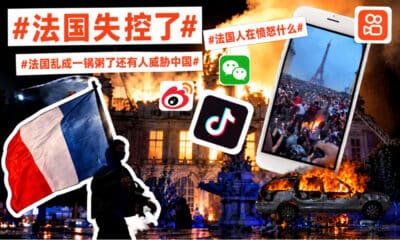
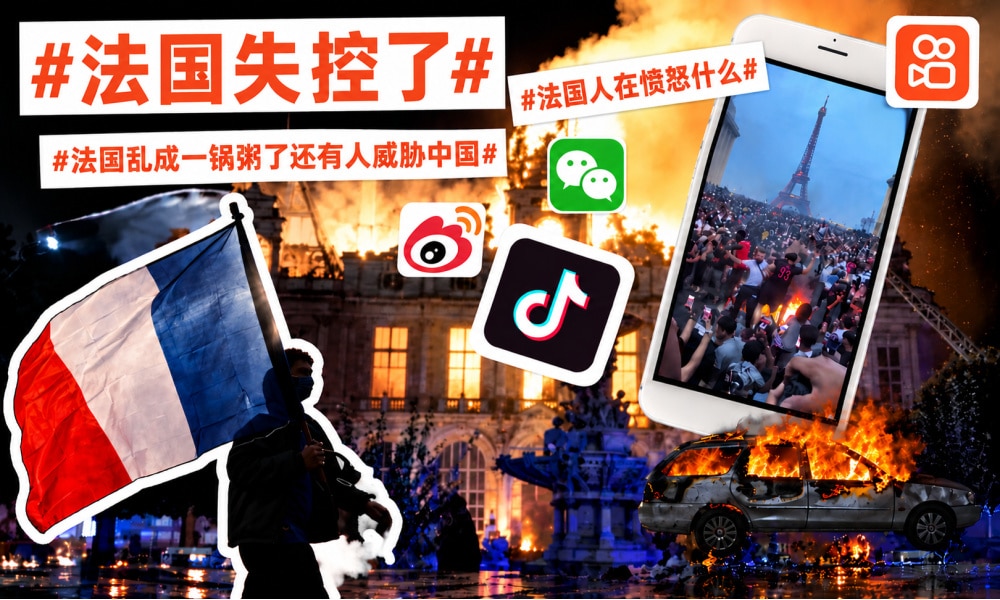
The French Protests, Viewed from China: Five Narratives on Chinese Social Media
From the decline of Europe to historical karma: these 5 narratives reveal how Chinese social media discusses the recent unrest in France.
Eye on Digital China is a reader-supported publication by
Manya Koetse (@manyapan) and powered by What’s on Weibo.
It offers independent analysis of China’s online culture, media, and social trends.
To receive the newsletter and support this work, consider
becoming a paid subscriber.


From “Pure Love Warrior” to Political Victim: Jensen Huang’s Fall on Chinese Social Media

China Trend Watch: Digital Dementia and Why Everyone Says ‘Li Na’

Mbappé, Mao & the Backlash on Chinese Social Media

Mbappé, Mao, and the Joke That Shall Not Be Named

The French Protests, Viewed from China: Five Narratives on Chinese Social Media

Why Japan Has So Many Surnames, China’s Back-to-School Shifts & Taiwan Pavilion Trouble

The Rise of “Shuaqi-ism,” Taking Starbucks to the Fields, and Pretending to Go to Work

Starbucks Goes Xinjiang & The Kardashians in China

Red Carpet, Pandas, and Power: How China Read the Trump-Xi Summit

Keeping Score of History: The Mukden Incident and China’s Basketball Defeat to Japan
-
 Chinese New Year10 months ago
Inside Chunwan 2026: China’s Spring Festival Gala
-

 Chapter Dive9 months ago
Inside the Great Chinese Debate Over the Iran War
-

 Chapter Dive10 months ago
Chinamaxxing and the “Kill Line”: Why Two Viral Trends Took Off in the US and China
-

 China Memes & Viral9 months ago
Two Sessions, a Celebrity Meltdown, and the Rise of China’s “Forget It” Mindset