SubscribeLog in
Connect with us

Free Version The French Protests, Viewed from China / Five Narratives on Chinese Social Media

Published

on


This is the free preview of this deep dive; you can read the full premium newsletter online here.

Over the past week, the widespread protests and unrest in France have been trending on Chinese social media. From October 18 to today, turmoil in Paris and other cities appeared in the top trending lists on Weibo, Kuaishou, and other apps, with Chinese netizens and commentators discussing the situation in various ways under numerous hashtags.

In this latest Eye on Digital China analysis, I explore five recurring narratives in these discussions—and what they reveal about Chinese perceptions of France and Europe.

Key takeaways:

📌 Chinese online discussions frame the French protests through 5 main narratives: a French crisis of governance & security, a broader European decline, the impact on Chinese people, Western hypocrisy, and historical retribution.

📌 These discussions are about France and Europe, but actually often turn the lens back on China – its growing strength, its standing in the world, and memories of humiliation at the hands of foreign powers.

📌 The protests are more than a French domestic story: they offer a window into changing Chinese perceptions of Europe and the Chinese and French positions on the world stage.

Below is an excerpt from the full analysis, exploring the first of these five narratives, from concerns about Europe’s decline to sarcasm about revolution, Zero Yuan Shopping, and more..👇

1. “France Has Lost Control”: A Nation in Crisis

How can a developed country like France fail to maintain basic order? One dominant framing of the recent protests on Chinese social media is that they demonstrate the French state’s inability to keep the situation under control, indicating a crisis of governance and security.

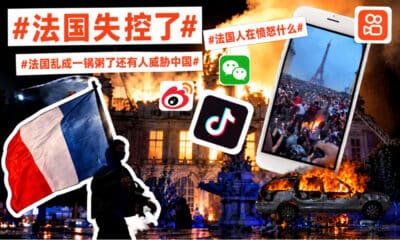
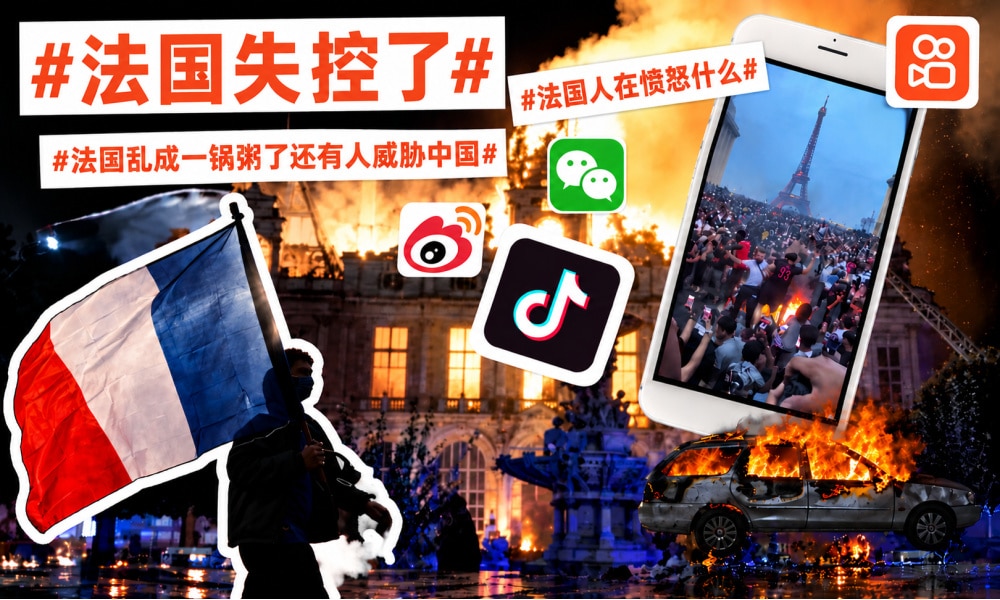
One of the highest-ranking hashtags among more than 300 trending topics on Chinese social media apps related to the unrest in France is: “France is out of control” (法国失控了). Along with hashtags like “France is in chaos again,” that hashtag first came up last Sunday on Weibo during a weekend filled with looting, arson, destruction, and violence by groups of rioters in Paris, Marseille, Lyon, Lille, and elsewhere.

The perceived weakness of President Macron’s leadership was highlighted on Chinese social media through memes and jokes mocking the leader for attending a Celine Dion concert right before the situation escalated. A commentary on Sina compared the concert to company executives holding a celebration banquet and handing out bonuses just before the firm collapses, framing the riots as a “run on trust” (信任挤兑) against the government.

Videos of the chaotic scenes on the streets spread to various platforms, where some described it as a “war zone.” Others suggested that

💬 “it looks like France is finished (..) The situation has spiraled completely out of control.”

💬 “If I didn’t see this with my own eyes, I never would’ve believed it,” one Douyin user wrote, with others stressing:

💬 “I’m so grateful to live in China.”

Many Chinese netizens wondered who would pay for the losses and who the victims of the riots could turn to. In some of these discussions, there was little understanding or sympathy for the protesters, with some Douyin users writing:

💬 “And yet there are still people trying to spin this as a revolution, as something righteous. I genuinely don’t understand. What kind of revolution involves smashing the doors of luxury stores and setting cars parked along the streets on fire? Isn’t this just outright rioting?”

But following videos showing the more peaceful protests, there are also voices that praise the French for standing up:

💬 “These are people who are expressing their demands and anger, they are far braver than the Chinese who remain silent.”

🔹 Revolutionary Spirit

At the same time, the protests also serve as an opportunity for sarcasm and jokes that echo the Chinese revolutionary spirit, writing:

💬 “The French people should sing The Internationale at the top of their lungs! Unite with the people of Germany, Italy, and Britain to fight (…) Smash the old world and create a new one! Keep going, keep going, and strive for even greater victories! Let the red flag fly across all of Europe!”

💬 “Who would’ve thought France would be the first country to enter a communist society?”

💬 “The Paris Commune is back! They’ve achieved communism ahead of schedule. Distribution according to need: whatever you want, just go and take it.”

By portraying the French protesters as though they are carrying out a glorious proletarian revolution, netizens may be mocking the protests, but are actually also implicitly poking fun at China’s own Mao-era revolutionary past.

🔹 Zero Yuan Shopping

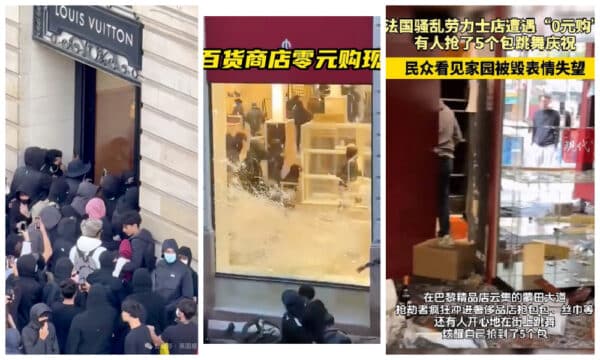
As part of this online sarcasm and humor surrounding the protests, Chinese netizens refer to the looting as “Zero-Yuan Shopping” (líng yuán gòu, 零元购 or 0元购), joking that the riots are the French version of China’s Singles’ Day Shopping Festival.

Zero Yuan Shopping on Chinese social media

“Zero-Yuan Shopping” was originally a livestream promotion term for getting a product for free, but it has become a sarcastic buzzword among netizens for flash mob-style looting in Western countries, especially since the plundering following the George Floyd protests in 2020.

Some netizens suggest that the protests are no longer about their original aims at all, but have just become a way to get free goods for masked rioters, while ordinary people and their livelihoods get hurt in the meantime.

🔹 Welcome to Paris

A globally viral AI-generated video by Dutch filmmaker Wytse Koetse, presented as an advertisement for the fictional “Paris City Tours,” also struck a humorous chord with Chinese netizens as it was shared on various platforms, including by a state media outlet on Kuaishou.

Featured image of the Paris City Tours AI video that went viral (see original).

The video shows an upbeat French tour guide taking a group of Asian tourists through the “real Paris,” seemingly unfazed by the flames, looting, and fighting unfolding around them. She cheerfully continues the tour as though everything is business as usual. “Very passionate people, the French,” she remarks, before wishing the tourists a pleasant stay in Paris as explosions erupt around them.

“She’s giving these Chinese country bumpkins a taste of the free France,” some sarcastically commented. Others replied: “A tour to witness the European revolution,” and: “Now, this is real romance!”

The video, as well as the reactions to it, plays with the contrast between the old image of Paris, associated with romance, luxury, refinement, and intellectual life, and the current-day scenes of chaos, looting, disorder, and street confrontations.

💬 “It’s like the end of a civilization,” one Weibo user wrote….

In the full analysis, I explore four additional narratives that show how discussions about France become conversations about China’s past, present, and place in the world.

Upgrade to a paid subscription to read the full piece. If you appreciate my independent reporting and analysis, your support helps make this work possible.

Thank you for reading,
Manya


Are you receiving duplicate newsletters? You may be subscribed through both What’s on Weibo and Substack. Both feature the same new content — so you can read and subscribe wherever you prefer. If so, let me know, and I’ll help sort it out (or you can unsubscribe) (If it doesn’t work just reply ‘unsubscribe’ to this email).

Chapter Dive

The French Protests, Viewed from China: Five Narratives on Chinese Social Media
From the decline of Europe to historical karma: these 5 narratives reveal how Chinese social media discusses the recent unrest in France.

Manya Koetse

Published

on

Originally published in the Eye on Digital China newsletter on Sunday, October 25, 2026.

The protests in France have been trending in China all week. The ways in which they are being discussed perhaps reveal more about Chinese views of France and Europe—and about China’s own place in the world today—than about the protests themselves. Here are five of the main narratives shaping the discussion.

Over the past week, the widespread protests and unrest in France have been trending on Chinese social media. From October 18 to today, turmoil in Paris and other cities consistently appeared in the top trending lists on Weibo, Kuaishou, and other apps, with Chinese netizens and commentators discussing the situation in various ways under numerous hashtags.

The topic remained trending all week not only because of the October 17–18 riots and their aftermath, but also because of the new round of protests on October 24, for which French authorities deployed 70,000 police officers and the Chinese embassy in France issued new warnings.

Here, we’ll take a closer look at five dominant narratives surrounding the protests in France on Chinese social media, and what this says about Chinese perceptions of France and Europe, from common ideas about the decline of Europe to the protests being a form of “historical karma.”[1]


1. “France Has Lost Control”: A Nation in Crisis


How can a developed country like France fail to maintain basic order? One dominant framing of the recent protests on Chinese social media is that they demonstrate the French state’s inability to keep the situation under control, indicating a crisis of governance and security.

One of the highest-ranking hashtags among more than 300 trending topics on Chinese social media apps related to the unrest in France is: “France is out of control” (法国失控了). Along with hashtags like “France is in chaos again,” that hashtag first came up last Sunday on Weibo during a weekend filled with looting, arson, destruction, and violence by groups of rioters in Paris, Marseille, Lyon, Lille, and elsewhere.

The perceived weakness of President Macron’s leadership was highlighted on Chinese social media through memes and jokes mocking the leader for attending a Celine Dion concert right before the situation escalated. A commentary on Sina compared the concert to company executives holding a celebration banquet and handing out bonuses just before the firm collapses, framing the riots as a “run on…

Continue Reading

China Insight

What Does 20 Yuan ($3) Mean Anymore? China’s Disappearing Living Rooms & the Great Laundry Debate

What does 20 yuan mean in China today? Why are traditional living rooms disappearing? And can underwear and socks be washed together? Plus, China’s latest travel trends.
Manya Koetse

Published

on

Welcome back to Signals, my newsletter about the slower trends, broader shifts, and cultural currents shaping Chinese society and its digital landscape. Want to receive the next edition in your inbox? Become a paid subscriber here.


It’s been some time since the last Signals newsletter, so it’s high time for a new edition. This is where I bring you the slower trends, broader shifts, and cultural currents that I’ve been keeping an eye on. Next to the more regular China Trend Watch & deeper dives, this is meant to give you a fuller picture of ongoing conversations and themes in Chinese society and the digital landscape. I hope you find it insightful!

📰 In this edition: Is Hangzhou setting an example with a ban on daytime dog-walking? China’s traditional living rooms are disappearing, what is the value of 20 yuan ($2.99) nowadays and why are people discussing it, and a resurfacing of an old debate: can socks and underwear be washed together? Also: four travel trends that stood out during this year’s National Day holiday.


📶 SHORT SIGNALS
 

🎬 This year has seen mind-blowing changes in the production and consumption of Chinese short dramas. Now, so many popular short dramas are AI-generated (19 out of 20 microdramas on a recent Hongguo hot list made by AI) that Chinese netizens are wondering if short-drama actors might be disappearing altogether.

💰 70% of households in China have less than 100,000 yuan (about US$14,900) in savings, according to Chinese media reports, which state that the median household savings stand at 87,000 yuan ($13,000). Only 6% – the “lucky few” (人上人) – have 300,000 ($44,800) yuan or more in liquid assets.

🐕 In main urban districts of Hangzhou, people aren’t allowed to walk their dogs during the day, and some netizens hope these strict dog-control rules will set an example for the rest of China. The local rule only allows owners of small dogs – larger breeds aren’t allowed – to walk their furry friends between 7 PM-7AM. The strict rule is supported by many, who hope other…

Continue Reading

Subscribe

Eye on Digital China is a reader-supported publication by
Manya Koetse (@manyapan) and powered by What’s on Weibo.
It offers independent analysis of China’s online culture, media, and social trends.

To receive the newsletter and support this work, consider
becoming a paid subscriber.

Manya Koetse's Profile Picture

Get in touch

Have a tip, story lead, or book recommendation? Interested in contributing? For ideas, suggestions, or just a quick hello, reach out here.

Popular Reads