
China Insight
Something In the Water: How Yuhang’s Smelly Water Went from Odor Incident to Trust Crisis
“Tap water safety is a barometer of a city’s level of civilization.”


On July 16, locals in Yuhang (余杭), a district of Hangzhou, noticed something fishy about their running water. It had turned brown and smelled unpleasant.
From residential compounds in Liangzhu to Renhe Street (良渚街道–仁和街道), some residents complained that their water smelled like “dead rats,” while others thought it resembled the odor of sewage, and later started smelling like disinfectant or other chemicals.
Soon, rumors began to spread that there was poop in the water, sparking panic among residents from Yuhang and beyond, especially because no official bulletin had been released explaining what was wrong with their tap water, despite its strange color and scent.
Worried about what was in the water, many people refrained from bathing, cooking, or cleaning, and rushed to supermarkets to stock up on bottled water.
The incident became known among netizens as the “Hangzhou Stinky Water Incident” (杭州臭水事件).
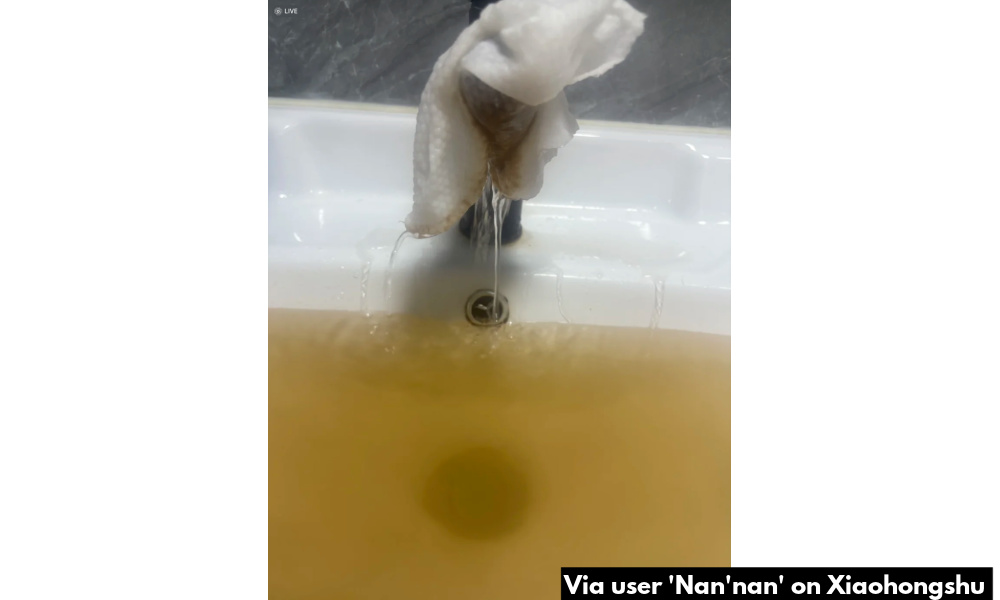
Later that same day, the water utility company stated that the quality of the main pipeline water had been restored, recommending local communities and residents to flush out the pipes and let the faucets run for up to 30 minutes to get rid of residual water.
In some neighborhoods, however, the water remained brown for some time – perhaps due to water tanks that had not been thoroughly cleaned yet.
Even days after, on July 24 and also later, locals posted on social media about the water being yellowish or leaving brownish residue on white cloths inside the sink. Videos posted online showed that the run on bottled water continued after July 16.
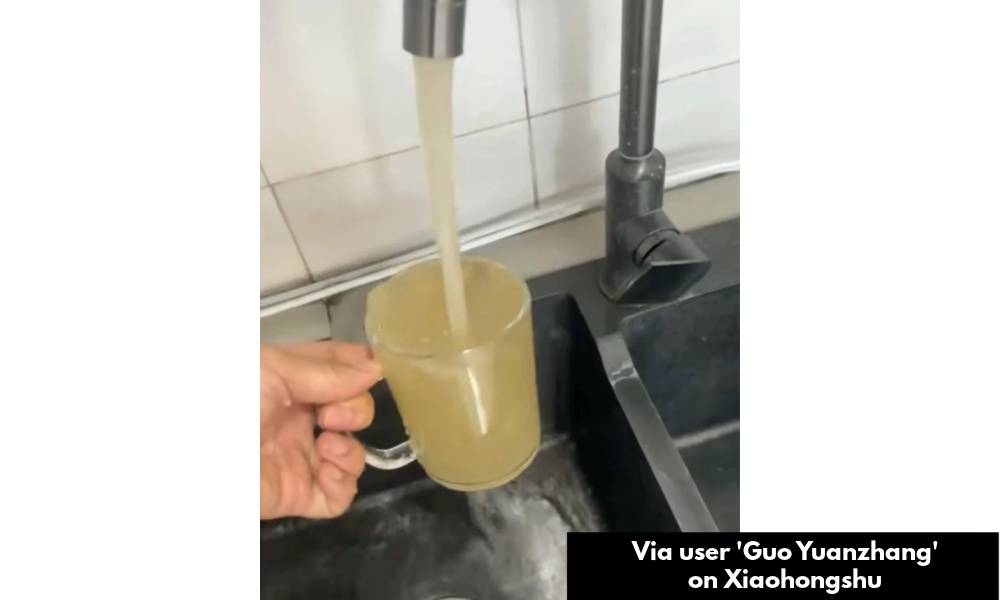
“They say it’s ok for us to use,” one commenter said: “But how can ordinary people like us actually use it?!”
Algae in the Water, Officials Punished
On July 19, official media reported that preliminary findings linked the water issues to algae contamination. Yuhang authorities issued an apology, and the water company announced it would waive 5 tons of water fees per household—roughly 20 yuan ($2.8) (or about the price of a takeaway milk tea, which many suggested) (hashtag: #余杭水务承诺为臭水用户免5吨水费#).
Nearly a week after residents first started noticing a problem with their water, an official report on the issue was finally released on July 23, following an investigation launched by Hangzhou authorities.
The report confirmed that the extremely warm weather had indeed led to rapid algae growth in the water bodies near the intake point of the Renhe Water Plant (人和水厂) on the Dongtiaoxi (东苕溪) River, which supplies treated drinking water to Hangzhou and nearby areas.
After recent rainfall and runoff, algae and their breakdown products (which include foul-smelling sulfur compounds) accumulated near the intake and entered the plant in the early hours of July 16. After discovering the issue that morning, the water company quickly switched to a new water source.
Following the incident, the relevant water authorities conducted a city-wide inspection and found that all water plants met national standards, with no harmful bacteria such as E. coli detected.
Nevertheless, the Hangzhou municipal authorities concluded that the response to the water crisis was flawed on multiple levels. The water supply company, for instance, failed to promptly notify residents, while the district government was slow in coordinating the response and reporting it to city-level authorities.
In total, seven local officials were formally held accountable for their handling of the incident. Some received official warnings, while others faced more serious consequences, including the Deputy General Manager of the Yuhang Environmental Protection Science and Tech Company (under the Yuhang Water Group), who was removed from his position and expelled from the Party.
Awakening a Trust Crisis That Already Existed
On Chinese social media, the entire “stinky water incident” has been trending for days. The anger isn’t just about the algae itself, but more about how officials handled the situation: the delay in informing residents, the late investigation, and the media machine that echoes the official line.
It’s also because this is about running water — the lifeline of any city. It’s what you bathe in, cook with, and wash your child with. It crosses the boundary between public infrastructure and private life.
One post on Xiaohongshu called tap water safety “a barometer of a city’s level of civilization” (“自来水安全是城市文明的试纸”).
Multiple people felt that they weren’t — and still aren’t — getting the right information about what is wrong with their water. One Weibo commenter wrote:
“In our country, you absolutely do not want to let your child major in journalism. Just look at news media organizations nationwide, including state-run media, which one is actually truly fulfilling their journalistic responsibilities? Every time a social incident happens, all the news outlets do is forward official notices and they’re not doing any on-site news investigation reports. Take the recent lead poisoning incident, or the Yuhang tap water case as examples. At first, all the reports were just reposts of local government notices. Later, when local officials were arrested, the updates again just came from forwarded investigation team reports.
Earlier this month, the Tianshui lead scandal also made headlines after more than 250 children in a kindergarten in Tianshui, Gansu Province, were poisoned after staff used industrial pigments to color food, some containing over 20% lead and far exceeding safety limits.
The Yuhang stinky water incident isn’t introducing new fears, but rather awakening a trust crisis that already existed. It’s sharpening public awareness around food and water safety, and fueling skepticism toward the official narratives and media reports that follow.
On July 23, residents in Rizhao’s Wulian County also reported murky tap water in their homes and posted videos about it.
According to some Chinese media reports, the problems with the muddy tap water in Rizhao – like in Hangzhou – also related to the hot weather. One spokesperson reportedly stated that water levels in the reservoirs wa dropping quickly. Combined with low water pressure, this led to water quality problems in the pipes and supply lines. Some neighborhoods reportedly have no water at all.
“How can unqualified water even enter the pipes?” some concerned netizens asked.
“Is this the beginning of a water crisis?” others wonder.
Despite the seriousness of the situation, some commenters joked: “They saw Hangzhou trending and felt competitive, and wanted to make the hot search lists too.”
By Manya Koetse
(follow on X, LinkedIn, or Instagram)
Spotted a mistake or want to add something? Please let us know in comments below or email us. First-time commenters, please be patient – we will have to manually approve your comment before it appears.
©2025 Whatsonweibo. All rights reserved. Do not reproduce our content without permission – you can contact us at info@whatsonweibo.com.
Follow What’s on Weibo on





China Insight
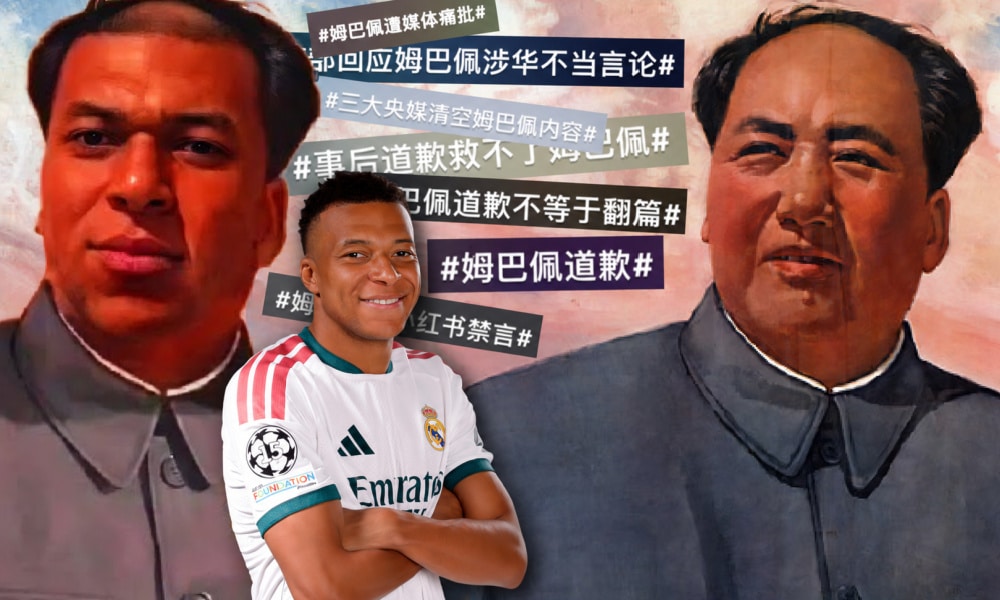
Mbappé, Mao, and the Joke That Shall Not Be Named
Mbappé’s favorite Mao meme sparked major backlash in China. More on what the controversy reveals about political red lines, online humor, and censorship.
RESOU 热搜 | What’s Trending in China, Explained
Here, I briefly unpack the stories making waves on Chinese social media and share what stands out to me. Don’t miss an update: become a subscriber to Eye on Digital China today.
Oh oh oh, Mbappé, all those goals, yet you lost so many points on Chinese social media over the past 48 hours.
Following his 100th goal for Real Madrid during El Clásico and finishing second on Ballon d’Or night, French football player Mbappé is all the talk on Chinese social media — not for his achievements, but for what is seen as crossing a major red line in an online interview.
On Tuesday night, a text came in from Ruixin: “I am wide awake tonight and somehow witnessed live how the footballer Kylian Mbappé was getting blocked and totally canceled on Chinese social media for his comments about Mao Zedong over the past, like, three hours 😅”
I quickly grabbed my phone and saw the flood of Mbappé posts rapidly coming in, and it was clear that people were very cross with him.
Although it was already clear that this might not blow over any time soon, by early Wednesday morning it became painfully clear how the controversy had snowballed. Dongpeng Beverage Group (东鹏), one of the many Chinese companies that signed the famous sportsman as its brand ambassador, publicly stated that it was cutting all commercial ties with Mbappé. Soon, others followed.
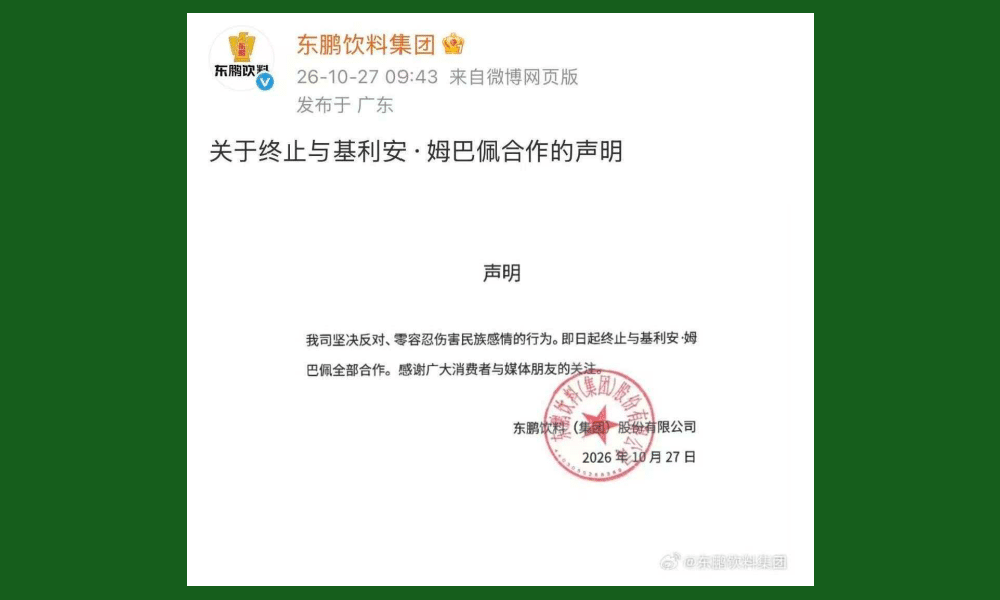
Dongpeng Beverage Group (东鹏): the first in a string of companies to cut ties with French footballer Kylian Mbappé.
Mbappé’s fall from grace in China has been sudden and spectacular, like a major avalanche of backlash that unfolded in one night, and it can all be traced back to one segment of an interview the footballer previously did on a French YouTube show (The Bridge) that resurfaced online — initially through Reddit and X, and then on Chinese social media apps, like football platform Dongqiudi (懂球帝).
In that segment, when asked about his favorite meme, Mbappé replied that one of the memes he finds funniest is:
🗣️ “the one where they put my face on some guy, a Chinese dictator. That really makes me laugh, I use it with my friends all the time.”

The interview segment where Mbappé shares his favorite meme: his face photoshopped onto the face of a “Chinese dictator.”
The show, created by Mbappé’s Real Madrid teammate Aurélien Tchouaméni, added the image Mbappé referred to: his face photoshopped on a Mao propaganda visual. It’s part of a series of memes that emerged in 2024 in which Mbappé’s face is edited onto the faces of dictators.1
Chapter Dive
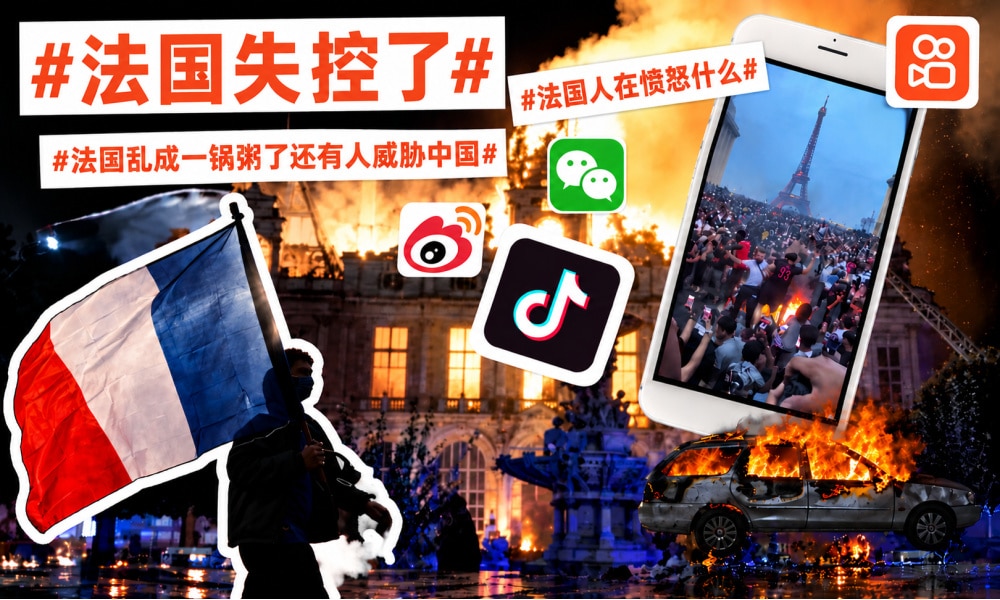
The French Protests, Viewed from China: Five Narratives on Chinese Social Media
From the decline of Europe to historical karma: these 5 narratives reveal how Chinese social media discusses the recent unrest in France.
Eye on Digital China is a reader-supported publication by
Manya Koetse (@manyapan) and powered by What’s on Weibo.
It offers independent analysis of China’s online culture, media, and social trends.
To receive the newsletter and support this work, consider
becoming a paid subscriber.

From “Pure Love Warrior” to Political Victim: Jensen Huang’s Fall on Chinese Social Media

China Trend Watch: Digital Dementia and Why Everyone Says ‘Li Na’

Mbappé, Mao & the Backlash on Chinese Social Media

Mbappé, Mao, and the Joke That Shall Not Be Named

The French Protests, Viewed from China: Five Narratives on Chinese Social Media

Why Japan Has So Many Surnames, China’s Back-to-School Shifts & Taiwan Pavilion Trouble

The Power of Ugly: Why Niu Lai Became China’s Unlikeliest Box-Office Hit

The Rise of “Shuaqi-ism,” Taking Starbucks to the Fields, and Pretending to Go to Work

Blame Games & Bad Signs: Nepal–Tibet Floods, Huawei’s Toilet Trouble, “Screwed” Graduates

Starbucks Goes Xinjiang & The Kardashians in China
-

 Chinese New Year9 months ago
Inside Chunwan 2026: China’s Spring Festival Gala
-
 China Brands, Marketing & Consumers12 months ago
Hasan Piker’s China Trip & the Unexpected Journey of a Chinese School Uniform to Angola
-

 Chapter Dive9 months ago
Inside the Great Chinese Debate Over the Iran War
-

 China Trend Watch12 months ago
Japan Tensions, Nexperia Fallout, Yunnan’s ‘Wild Child,’ & “Modern Opium”