SubscribeLog in
Connect with us

China Memes & Viral

The AI Actor Debate, Tragedy in China’s “Fireworks Capital,” and the Viral Labubu Fridge

From AI-generated film releases to popular “micro-vacations”, these are the digital & social trends shaping Chinese online conversations this May Day holiday.

Manya Koetse

Published

on

In this China Trend Watch edition:

– AI actors vs human storytelling
– China’s deadly fireworks disaster
– Chengdu car attack controversy
– A blogger tracked down over pink river water
– The $1,900 Labubu fridge
– “Micro-vacations” & more


Everything seems to be about AI these days. Especially in China, where AI has permeated so many industries that it’s simply become part of the daily conversation.

Over the “Golden Week” holiday, Hangzhou deployed its first smart-robot traffic police teams. Demand for Huawei’s Ascend 950 AI chips surged following the release of DeepSeek’s V4 model (designed to run on the Huawei hardware). Across sectors, Chinese companies are racing to integrate AI into their factories, vehicles, and everyday services.

In recent weeks, AI’s role in China’s entertainment industry has particularly sparked intense discussion.

In late April, China’s major streaming platform iQIYI unveiled its “Nadou Pro” (拿豆Pro) AI film production initiative, alongside an “AI Artist Library” featuring dozens of actors whose likenesses could be used for AI-generated content. CEO Gong Yu (龚宇) suggested this could allow some actors to “appear” in up to 14 dramas per year, rather than only four.

The announcement immediately triggered online backlash. Some actors said they had not agreed to be included, while Gong’s remarks were widely seen as tone-deaf. Beyond concerns about consent, many netizens questioned the appeal: do audiences actually want 14 AI-generated performances more than a few real ones?

Although iQIYI later clarified that actors would remain involved in decision-making and that consent would be required for any AI scenes, skepticism remains strong. Many fear AI will gradually replace human actors and make films or dramas feel increasingly artificial.

Perhaps this is also one of the reasons why the “dark horse” hit of this May Day holiday box office season was a smaller local production with little pre-release buzz: Love Letters to Grandma (给阿嬷的情书, alternative English title: Dear You). With no big stars or special effects, the film stands out for its authenticity, featuring Chaoshan actors speaking their native dialect and telling an intimate, emotional story.

Still from Love Letters to Grandma (给阿嬷的情书, alternative English title: Dear You)

Set against the historical backdrop of the mass migration of southern Chinese to Southeast Asia, the film follows a grandson searching for the truth about his long-absent, supposedly wealthy grandfather, who continued sending letters and money home despite decades of separation from his family. (This type of family correspondence is called 潮汕僑批, Teochew Letters.)

What the grandson discovers in Thailand is unexpected: the letters his grandmother relied on for years were not sent by her husband, but by a stranger who chose to continue the correspondence on his behalf.

The film – that now scores a 9 on Douban – has been widely praised for its sincerity: the little details hidden in everyday life, the genuine emotions on the actor’s faces, and the fragile image of a grandmother reading love letters in the Chaoshan dialect.

As China moves deeper into the AI era, the film’s success highlights an interesting countercurrent: while major platforms push more toward AI-generated content, audiences are increasingly embracing stories that feel more human and emotionally real. There’s nothing artificial about that.

There’s much more trending news this week, so let’s dive into the other stories.

📌 PS: Also noteworthy this week: a Hangzhou court ruled that Chinese companies cannot fire workers simply because their jobs are replaced by AI. A 35-year-old tech worker sued his employer after being told his role would be handled by AI systems. The court was clear: adopting AI to reduce costs is not a lawful reason for dismissal.


Quick Scroll

  • 🎬 China has approved the country’s first AI-generated film for theatrical release. The 90-minute sci-fi film Sanxingdui: Future Memories (三星堆:未来记忆) was made using tools from ByteDance.
  • ❗ A 16-year-old female tourist died on May 3 after falling from a swing suspended above a waterfall at a scenic park in Sichuan, prompting discussions about safety regulations in China’s fast-growing adventure and thrill tourism sector.
  • 🔬 Three Chinese female scientists simultaneously won awards at the 2026 Breakthrough Prize ceremony in Los Angeles — the ‘Oscars of science’ — for their exceptional contributions to mathematics.
  • ✈️ Jackie Chan has been appointed as the new cultural ambassador for Chinese travel platform Trip.com, which has set a target of bringing 200 million foreign tourists to China over the next five years.
  • 💬 Wechat has redesigned its app’s social “Moments” layout, with users calling it “ugly” and finding it hard to adapt.
  • ☕ The Guangzhou Coffee Festival drew 37,000 visitors in one day, signaling strong consumer enthusiasm for cafe & coffee culture over this May Day holiday.
  • 🍬 Most people are familiar with White Rabbit – that milky sticky white candy – and in China it’s a nostalgia staple. The brand has now opened a flagship store on Shanghai’s Nanjing Road, with many netizens being happy about how it brings back childhood memories.
  • 🚗 After the 2026 Beijing Auto Show, commentators & car bloggers argue that many domestic high-end EVs are all look-alikes. As competition shifts from price wars to tech differentiation, this perceived lack of originality has drawn concern about brand identity and long-term innovation.
  • 📱 American streamer IShowSpeed went viral after accidentally dropping his Huawei tri-fold phone into the ocean during a livestream. He had purchased the device last year during his famous China tour.

What Really Stood Out

Devastating Explosion in China’s “Fireworks Capital” Exposes Deep-Rooted Safety Risks

[#烟花爆炸#] [#花炮之都30万人的生计之困#]

Twenty-six people were killed and 61 injured in a major explosion at a fireworks plant in Guandu Township, Liuyang (Hunan Province). The incident exposes deeper structural safety risks in this so-called “fireworks capital of the world.”

The explosion occurred late in the afternoon of May 4 at Liuyang Huasheng Fireworks Manufacturing Company (浏阳华盛烟花制造有限公司), a mid-sized factory that had been operating for over 26 years. Shockwaves were reportedly felt up to 10 kilometers away, and windows shattered at distances of up to one kilometer from the blast site.

More than 480 emergency personnel were dispatched. A second round of searches on Tuesday raised the confirmed death toll to 26, though it remains unclear at this time how many people are still missing.

Beyond the tragic loss of life and damage, the explosion has far-reaching consequences for Liuyang, as all fireworks manufacturers have been ordered to halt production pending safety inspections and rectification.

As one of the world’s leading fireworks production hubs, the industry is the backbone of the local economy, with 431 factories directly employing around 300,000 people. A prolonged shutdown could leave thousands of workers and their families without income.

At the same time, safety issues at Liuyang factories have been a point of concern for at least two decades. The factory involved had been penalized earlier this year for storing industrial potassium perchlorate (高氯酸钾) together with phthalate compounds (苯二甲酸盐), materials that can trigger chain explosions from even minor sparks or static discharge.

While many commenters express sympathy for those affected, there is broad agreement that safety must come first. Many also note that such a major incident may have been preventable (investigations are ongoing) and should never happen again in Liuyang.


Chengdu Car Attack Sparks Anger Over “Accident” Framing

[#成都撞人#] [#成都男子驾车碰撞行人1死11伤#]

On the first day of the May Day holiday, a horrific hit-and-run incident at a busy Chengdu intersection triggered public frustration over the official framing of the incident.

At around 17:20, a 31-year-old male driver identified as Li (李某某) drove his sedan into a crosswalk full of pedestrians along Jiannan Avenue, striking multiple people. Videos from the scene showed at least five people lying motionless on the street. The driver then continued, hitting people at other locations, including a motorcycle and dragging one victim along the road.

The Li Laoshi X account reported that a bystander captured the driver exiting the vehicle while still holding a knife. According to official reports, the incident resulted in one death and 11 injuries. The driver was arrested at the scene and was reportedly not under the influence of alcohol or drugs.

In its statement, the Chengdu Public Security Bureau described the incident as a “road traffic accident” (道路交通事故), saying the driver had “collided with pedestrians” (与行人发生碰撞).

As videos were taken offline and some comment sections shut down, the wording of the official statement drew online criticism. Many argued this was not an “accident,” but a case of “intentionally endangering public safety” or “revenge against society” (bàofù shèhuì 报复社会).

Bàofù shèhuì,” or “taking revenge on society,” is often used to describe violent incidents in China in which individuals with personal grievances or mental health issues commit extreme acts.

In such cases—whether car-ramming or knife attacks—online discussions are often tightly controlled, and detailed information about the incident tends to remain limited.

Earlier this year, there were two other fatal incidents in Chengdu involving cars ramming into crowds, involving a 38-year-old and a 19-year-old driver. In March 2024, a black Maybach sedan also drove into pedestrians in Chengdu, killing two. In that case, netizens likewise claimed the incident was suppressed and that there was little follow-up information.

The latest case is currently under investigation.

This is a country where everything is always ‘under investigation,’” one Douyin commenter wrote sarcastically.


Chinese Environmental Blogger Harassed for Exposing Local Pollution

[#警方回应博主取样河水后被半夜敲门#] [#环保博主取样河水被半夜敲门#]

An environmental blogger known online as Dongbei Biaoge (东北彪哥, “Northeast Tough Guy,” 97k followers on Douyin) is at the center of a local scandal that has sparked nationwide discussion, shifting from conversations over pink water to a midnight knock on the door.

The story began with Dongbei Biaoge’s May 1 trip to Henan province after receiving tips from followers that river water in a Zhoukou waterway, next to farmland used by local residents, had turned bright pink and was covered in green algae. The blogger collected a sample of the pink water in Dancheng County, which is also home to a major industrial company.

Using a DIY rapid test kit, he recorded ammonia-nitrogen levels of approximately 5–10 mg/L, several times above national thresholds, and promised followers an update.

That next update, however, focused on something else: Dongbei Biaoge said he had been receiving nonstop harassing phone calls since posting his video. Despite using a friend’s out-of-province vehicle and not disclosing his location, unknown individuals were able to track him down. Around midnight / early morning on May 2, two men knocked on his hotel room door, asking to “have a talk” (谈一谈). He refused to open and called the police.

The following morning, local police confirmed by phone that the two men were township government officials and described the late-night visit as a “misunderstanding.”

Meanwhile, Dancheng County issued a statement saying it had launched an overnight investigation following online reports of possible pollution, claiming there was no evidence of industrial wastewater entering the water and announcing further investigation.

Online discussions have since shifted, with many focusing on how Dongbei Biaoge was tracked down, who leaked his personal details, and why his privacy was violated. Some commenters describe the situation as “terrifying,” seeing it as a worrying signal for others trying to expose local environmental issues.


On the Feed

The $1900 Labubu Mini Fridge

If you thought the Labubu hype had ended, I’m afraid to disappoint you. Labubu might start popping up in even more unexpected places now that Pop Mart, the company behind The Monsters series, has entered the world of home appliances.

First launch: the Labubu fridge, featuring original artwork by Hong Kong illustrator Kasing Lung. Two versions of the limited-edition mini fridge (just 999 units, each with a unique serial number) were officially priced at 5,999 yuan ($878). By April 29, nearly 38,000 preorders had been placed.


After selling out within seconds of the April 30 launch, the fridge quickly appeared on resale platforms for 12,999 yuan ($1,900).

Founder Wang Ning has said Pop Mart’s IP-driven small appliance line will expand to include electric kettles, coffee machines, electric toothbrushes, hair dryers, and more. Mass production is already underway, with a “China first, overseas later” rollout strategy. Are you ready for Labubu to move in with you?


Word of the Week

Go Slow, Stay Close: “Micro Vacations” (微度假 Wēi Dùjià) on the Rise in China

The word of the week is “Micro Vacation”: 微度假 Wēi Dùjià.

This year’s May Day holiday was extra long, making it the perfect time for travel. According to Chinese state media, the many trips made are proof of the country’s economic vitality.

But at the same time, economic pressures are showing in the way people are traveling: shorter distances and smaller budgets, combined with a quieter pace—very different from the busy city trips and do-and-see-as-much-as-possible travel boom following the immediate post-Covid years.

Many Chinese travelers are now gradually shifting away from traditional tourist hotspots toward more low-key, low-cost, and nearby destinations, where they spend 2–3 days to relax and slow down. These so-called “micro-vacations”—a term that has been around since about 2013—are gaining in popularity.

As part of this trend, farms and other rural destinations are seeing a sharp rise in visitors and revenue this year. People are going camping (often renting gear instead of buying it, called “travel light rentals” 轻装租用, qīngzhuāng zūyòng), enjoying outdoor cooking, fishing, and tea-picking, and bringing back fruit and vegetables in the trunk of their cars.


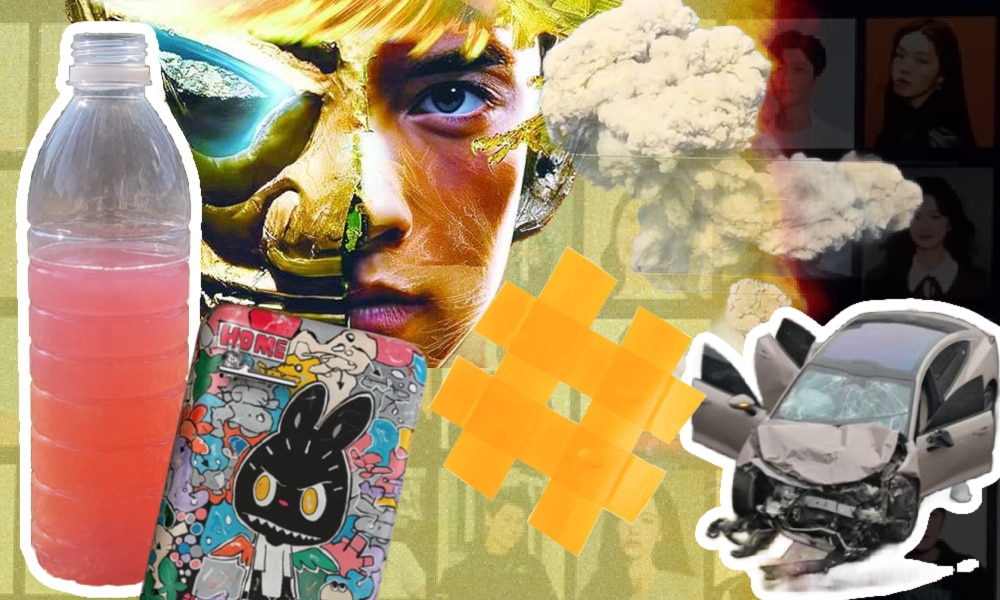
Featured image: consists of various images combined from China’s first AI film poster (三星堆:未来记忆); pink water scandal; Chengdu car attack; Liuyang explosion; and in the background, the AI artist library by IQIYI.

Eye on Digital China, by Manya Koetse, is co-published on Substack and What’s on Weibo. Both feature the same new content — so you can read and subscribe wherever you prefer. Substack offers community features, while What’s on Weibo provides full archive access. 

Manya Koetse is a sinologist, writer, and public speaker specializing in China’s social trends, digital culture, and online media ecosystems. She founded What’s on Weibo in 2013 and now runs the Eye on Digital China newsletter. Learn more at manyakoetse.com or follow her on X, Instagram, or LinkedIn.

Continue Reading
Click to comment

Leave a Reply

Your email address will not be published. Required fields are marked *

China Insight

“Even Pigs Have AC”: The European Heatwave Through Chinese Eyes

As Europe struggles through record heat, Chinese social media is turning the story into something much bigger than the weather. Plus: the graduation speech everyone is talking about & more.

Manya Koetse

Published

on

🔥 China Trend Watch (week 26/27 | 2026) Part of Eye on Digital China, this is my premium newsletter where I explain the stories, memes, debates, and viral moments shaping online conversations in China. This edition was sent to paid subscribers — subscribe to receive the next issue in your inbox.


Here’s your weekly update on what’s been trending. In case you missed it, earlier this week I published a deep dive into the CITIC Tower plane crash and how its immediate aftermath was handled online. In this newsletter: Louis Vuitton’s victory in a noteworthy trademark case against a Chinese tea brand; how and why the European heatwave has become a major topic in China; a controversial gaming character; and an inspiring must-know phrase of the week.


🗞️ QUICK SCROLLS


🍉 Don’t buy precut watermelons. During these hot days, watermelons are a popular snack, but this stern warning went viral: avoid pre-cut watermelons sold by roadside vendors, as they’re a potential health hazard due to improper refrigeration and cross-contamination from cutting surfaces and knives —you have no idea what else they’ve been used for 😬.

🇯🇵 China blames Japan for ties hitting a new low. During a July 1st press briefing, China’s Foreign Ministry said Sino-Japanese relations are facing “severe difficulties,” blaming Tokyo’s stance on Taiwan and security issues. The remarks come amid renewed tensions, including Japan’s announcement that multiple Chinese naval vessels had transited waters near the country and the reported formal arrest of a Japanese citizen detained in Dalian.

🌾 No messing around with China’s heroes. A Chinese agricultural influencer with over 2 million followers has been permanently banned from Douyin after posting negative remarks about the hybrid rice breeding technology developed by the late Yuan Longping (袁隆平), China’s national hero and “Father of Hybrid Rice,” widely praised for his role in combating poverty and hunger.

🛎️ The 24-hour checkout as a new hotel standard? Check in at 3 pm, check out at 3 pm the next day—that’s the idea behind a viral checkout policy introduced by the Chinese hotel chain Qinzhu Hotel (沁住酒店). The policy breaks with the long-standing industry practice of requiring guests to check out before noon. Instead, checkout is calculated from the guest’s actual check-in time, allowing them to stay for a full 24 hours before checking out. The policy is generating discussions, with many wondering if this could point towards changing policies in the broader industry.

🎖️ The Party turns 105. July 1 marked the 105th founding anniversary of the Communist Party, an occasion heavily promoted across Chinese social media as eight Party members received the “July 1 Medal” (七一勋章), the Party’s highest honor. Among them was Henan village Party secretary Li Liancheng (李连成), who transformed a poor village into a model of rural development. July 1 also marks 29 years since Hong Kong’s return to Chinese sovereignty in 1997.

📅 Interesting fact: July 1 is not the Communist Party’s actual founding date. The 1st National Congress opened in Shanghai on July 23, 1921. The Party settled on July 1 as its anniversary in 1938 only because the Yan’an-based delegates who had attended the congress, including Mao Zedong and Dong Biwu, could remember that it had taken place in July, but not the exact day (and wartime conditions made archival verification difficult).

🌸 Whose flower is it anyway? The French luxury house Louis Vuitton won a first-instance trademark infringement case against the new Chinese tea chain Molly Tea (茉莉奶白) this week. The Chinese brand was sued over the four-petal flower symbol in its logo, similar to LV’s core floral element. But many netizens disagree with the judge’s decision, arguing that the flower can be traced to the iconic Baoxianghua (宝相花) motif that flourished during the Tang Dynasty (618-907).


👁️ WHAT STOOD OUT


Nationalism, Soft Power, and the European Heatwave in China

AI-generated images posted on Chinese social media showing Europeans suffering in the heat while Chinese pigs are relaxing with cool units (left) and Chinese manufacturers selling out (right).

The high temperatures in Europe have become a hot topic in China, where the heatwave across France, Belgium, Germany, and other countries has been one of the biggest international stories of the past two weeks, with China cast in a particularly prominent role.

In China, the European heatwave, with temperatures reaching 40–45°C and causing deaths across several countries, is discussed from various angles and is also used to make broader geopolitical, economic, and ideological points about Europe and China-EU relations. These are the three dominant ways in which the heatwave is currently being discussed on Chinese social media:

 
🌡️ 1. “China Is Keeping Europe Cool”: European Heat Through the Lens of Chinese Soft Power and Anti-”De-Risking” Narratives

Chinese state media have framed the European heatwave by emphasizing the role of Chinese-made air conditioners. In countries such as Spain, Germany, and France, air-conditioner sales have nearly doubled compared to last year, with Chinese manufacturers such as Haier and Midea reporting sales increases of up to 70% while ramping up production to meet demand.

A main narrative is that China is helping Europe by meeting demand at a critical time. A similar narrative emerged during the 2022 energy crisis, when Chinese media emphasized how made-in-China products, from blankets to heaters, were keeping Europeans warm.

As a recent Xinhua commentary argued, the current shortage demonstrates that Chinese manufacturers are filling a gap where European companies are falling short. While Europe increasingly frames China-EU trade in terms of “de-risking,” the article argues that Chinese manufacturing actually provides resilience during times of crisis and should therefore be seen as an asset rather than a risk.

 
🌡️ 2. “Even Pigs Have Air Conditioning in China”: Schadenfreude and Nationalism

The heatwave story and the fact that most European homes do not have air conditioning have also been met with ridicule and disbelief on Chinese social media, where one recurring joke is that while Europeans are suffering through extreme heat, even pigs have air conditioning in China.

The story partly originated on Chinese social media but was also fueled by posts on X. Around June 24, one tweet showing Chinese pigsties equipped with air conditioners received thousands of likes.

Chinese netizens also had plenty of banter over other X posts in which Europeans proudly showed off their newly purchased air conditioners, as though they had just discovered a new technology. For many Chinese commenters, it is simply unimaginable that air conditioning is still considered a luxury in much of Europe.

A local Hai’er account on Xiaohongshu joked:

💬 “Europeans spend hundreds of euros on an AC and still have to check the regulations; we spend a few thousand yuan (…) and enjoy wrapping ourselves in a quilt while eating watermelon in the middle of summer.”

A recurring theme in these discussions is that China once admired Western technology and modernity, whereas today the roles seem reversed. Now, some commenters say, Europeans are marveling at Chinese-made air conditioners. As one Weibo wrote: “It’s like our ancestors when they first saw cars.”

 
🌡️ 3. Europe Is Putting Climate Policy Ahead of Ordinary People: Criticism of EU Governance

Another dominant theme is the idea that Europe has become hypocritical—or excessively “politically correct”—in its environmental policies. Many commenters argue that the low prevalence of air conditioning in European homes is partly the result of regulators’ longstanding skepticism toward air conditioning on environmental grounds.

This has fueled the narrative, amplified by Chinese media this month, that Europeans are now suffering and even dying during heatwaves because green ideology has stigmatized air conditioning.

At the same time, many users mock what they see as the EU’s willingness to criticize other countries over greenhouse gas emissions while failing to protect its own citizens from extreme heat.

One AI-generated meme showed crying polar bears, monkeys, and penguins alongside the slogan:”Save nature! Save the animals! Oppose Europe installing air conditioning—this is a betrayal of Mother Nature.” One of the meme’s posters wrote on Weibo:

💬 “Europeans have been preaching the gospel of environmentalism (环保圣经). Now, it’s finally coming back to bite them.”

Another depicted Ursula von der Leyen relaxing beneath a powerful Midea air conditioner, comfortably enjoying the very equipment that her policies supposedly discourage.

All in all, for some, the debate over air conditioning is about something much bigger. The lack of air conditioning in many European countries—along with the regulations, infrastructure constraints, and electricity costs surrounding it—has become symbolic of a broader reassessment of Europe. For some Chinese netizens, it challenges the long-held idea that life in Europe is necessarily better or more idyllic than life in China.

One netizen even advised fellow Chinese against emigrating to Europe:

💬 “Over the next five to ten years, I think people in China will become much more clear-eyed, and many existing illusions about Europe will gradually disappear.”


📱ON THE FEEDS


No More Werewolves in the Love and Deepspace House

The Chinese mobile game Love and Deepspace (恋与深空) has been all over the feeds, with some Weibo discussions garnering nearly half a billion views after the game was hit by controversy.

The game, developed by Papergames, is a so-called otome game — a story-based romance video game aimed primarily at women. Recently, a new male character lead was introduced: Ao Yin (敖尹, English name: Valk0), introduced as a werewolf, who breaks into the home of a woman living alone as part of a romantic scenario, after which he says: “What’s wrong with inviting the wolf into the house?” (引狼入室有什么不好) — a line critics say romanticizes non-consensual home intrusion.

What also sparked outrage was a reference to an “A-0731” file number tied to an in-game human drug-trial dossier. Players connected “0731” to Unit 731, the biological and chemical weapons program operated by the Japanese Army in China during the Second Sino-Japanese War/WWII.

The developers apologized, and for now, Ao Yin is canceled entirely — no more werewolves coming in the house.


🀄 ONLINE PHRASE OF THE WEEK


“Move forward firmly amid the noise”

在众声喧哗中坚定前行 (zài zhòngshēng xuānhuá zhōng jiāndìng qiánxíng)

An unusual speech by a Peking University professor made waves over the past week. Cheng Lesong (程乐松), chair of Peking University’s Department of Philosophy, delivered a graduation speech on June 26 that sparked widespread discussion for breaking away from the usual clichés and generic commencement themes.

In the speech, Cheng captured the cultural mood and social pressures facing China’s younger generations today: a society where everything—from career choices to a cup of milk tea—needs to be meaningful, yet increasingly feels meaningless; and where everyone is expected to succeed while increasingly feeling like they’re falling short.

“The anticipatory anxiety about the ruthlessness of social competition leads us to plunge into an overwhelming fear of failure,” Cheng said. “Because we expect constant affirmation, we come to interpret every ordinary day as proof that our lives have failed. We become absorbed in the hope that one day we will ‘begin our real lives,’ forgetting that we are already living them.”

Life was never meant to be meticulously ordered, Cheng argues, and needs room for a certain amount of chaos and twists and turns that no one saw coming. A completely disordered life is unimaginable, but so too is a life of perfect precision. How we go through life depends on how we deal with it, how we understand ourselves, and how we learn to allow life to unfold.

The true mission in our lives, the lifelong task that philosophy presents to us according to Cheng, is therefore to carve out a unique spiritual path for ourselves, and “to move forward steadily amid the cacophony of many voices.”

That message has struck a chord among netizens, with some saying they replayed the speech over and over again because they felt Cheng was really talking about the predicament facing young people today.


That’s a wrap. Have a good week, and keep your head cool.

If you find these newsletters useful, please be sure to like them, and share them if you want. I only started out Eye on Digital China on Substack late last year and could use some help in making sure the right audiences – like you – find my work.

Best,

Manya


Eye on Digital China, by Manya Koetse, is co-published on Substack and What’s on Weibo. Both feature the same new content — so you can read and subscribe wherever you prefer. Substack offers community features, while What’s on Weibo provides full archive access. If you’re already subscribed and want to switch platforms, just get in touch for help. If you no longer wish to receive these newsletters, or are receiving duplicate editions, you can unsubscribe at any time.

Continue Reading

China Memes & Viral

Auntie Goose Legs, China’s Shrinking Condom Market, and DeepSeek’s AI Blind Spot

If it walks like a duck, it might just be Auntie Goose Legs. A wrap-up of noteworthy trending stories in China. From the real Rolex recruiting fake crowds to diaper scares & a funny Deepseek moment.

Manya Koetse

Published

on

🔥 China Trend Watch (week 25 | 2026) Part of Eye on Digital China, this is my premium newsletter where I explain the stories, memes, debates, and viral moments shaping online conversations in China. This edition was sent to paid subscribers — subscribe to receive the next issue in your inbox.


China celebrated the more than 2,000-year-old Dragon Boat Festival (端午节) holiday this Friday, so I wish you health, good luck, and plenty of zongzi (sticky rice dumplings) and dragon boat races – they’re now held in many places around the world and are continuing into the weekend anywhere from Toronto to Dresden.

In this newsletter, you will find the trends and stories that caught my attention this week. This edition includes one longer read alongside a handful of shorter stories.

I always just start working on stories and noteworthy trends for the newsletter during the week, and often only discover an overarching theme later. This time, I realized that from the goose aunt who turned out to be suspiciously “quacky,” to Lululemon presenting Japanese drums as ‘truly Chinese,’ and trusted diaper brands being exposed for toxic chemicals, recent online discussions in China seem to revolve around similar questions: what is real, who can be trusted, and where do we find authenticity in a world where things are increasingly not what they seem? It is perhaps one of the reasons why the Chinese World Cup referee who is painfully straightforward in handing out red cards is now so beloved by the public.

With that in mind, here are the social media stories, debates, and internet moments you should know about this week 👇


🔍 EXPLAINER


Why One Beijing Street Vendor Sparked a Nationwide Debate


If it walks like a duck and quacks like a duck, it might still be a goose – or the other way around. That, at least, is the takeaway from two stories that recently went viral on Chinese social media.

The woman at the center of it all is Beijing street-food vendor Chen Xiufeng (陈秀凤), better known as “Auntie Goose Legs” (鹅腿阿姨). Over the years, she became something of a local celebrity in Beijing’s university district. Originally from Jiangsu, the migrant vendor had been selling her famous roasted goose legs to students since 2011.

She skyrocketed to national fame in 2023 , but became the target of widespread criticism last week after it was revealed that her celebrated goose legs – sold for 16 yuan ($2.20) per piece – were actually duck meat all along.

The controversy came up after the vendor ventured beyond the university area into Beijing’s business district. At the universities, she enjoyed a loyal customer base and dedicated WeChat groups. In her new market, however, customers proved more skeptical. Some noticed that the meat looked suspiciously duck-like; others complained that the color seemed off.

In the university district, Auntie Goose Legs she enjoyed a loyal customer base and dedicated WeChat groups.

After the first complaints surfaced, Auntie Goose Legs admitted the truth on WeChat on June 9.

“The ingredients I originally used were goose legs,” she wrote, “but they have been out of stock for more than fifteen years. The current ingredient is duck legs.”

It turned out that she had only sold goose legs, the product that made her famous, for two months back in 2011 before switching to the much cheaper duck. “Did geese become extinct without us knowing?” some netizens joked.

The revelation quickly exploded online. The hashtag “What Auntie Goose Legs is Selling Turns Out to be Duck Legs” (#鹅腿阿姨卖的是鸭腿#) became the top trending on Weibo for an entire day, with millions of people discussing the topic.


Why did millions of people become so outraged over a single Beijing street vendor selling duck instead of goose?


Piggybacking on the debate, Anhui-based commentators pointed out that a beloved regional specialty has the exact opposite ‘problem.’ Wuwei smoked duck (无为板鸭) is branded as duck, but is usually goose. According to local standards, however, goose products may be sold under this name, prompting discussions about “hanging up a goat’s head, while selling dog meat“ (挂羊头卖狗肉): advertising one thing while selling another.

Because geese are more expensive than ducks in China, and generally considered tastier, the Anhui duck-is-goose story, unlike the Auntie Goose Legs controversy, did not provoke online anger. Instead, many people saw it as an example of sellers prioritizing flavor over cost. Auntie Goose Legs is seen as doing the exact opposite.

But why did millions of people actually become so outraged over a single Beijing street vendor selling duck instead of goose, especially when there were no indications that anyone became ill? The answer has little to do with poultry and everything to do with trust.

Auntie Goose Legs during the prime time in Beijing’s University District in late 2023 (image via Lianhe Zaobao 联合早报).

Food fraud and mislabeling have been longstanding concerns in China. Earlier surveys found that food safety worries even outweighed concerns about public security and environmental issues, and while China’s food safety record has improved in recent years, public trust remains fragile.

Part of these concerns are immediate and practical. Major scandals in the past involving melamine-tainted infant formula or recycled “gutter oil” have posed serious risks to public health. But the issue goes beyond health risks alone.


If a goose can be a duck, then what exactly is the duck?


Whereas food safety concerns in many Western countries often focus on contamination, Chinese consumers are frequently just as concerned with economic deception. It is unfair to pay for a more expensive goose and receive a duck. Even if no one gets sick, Chinese consumer law still treats it as fraud.

More important, however, is what such deception does to confidence in the broader food system. If a goose can be a duck, then what exactly is the duck?

As a major 2023 college canteen scandal demonstrated, the build-up of deceit can reach a breaking point among the public. During that somewhat Kafkaesque “rat head or duck neck” (鼠头or鸭脖”事件) controversy, officials insisted a rat head found in a student’s rice was merely a “duck neck,” even though everyone could clearly see the snout and teeth of a rodent.

This kind of gaslighting shatters social trust and reinforces a generalized sense that, as a consumer, you are entirely on your own. When regulators fail to step in honestly, even a seemingly isolated incident comes to symbolize more dangerous forms of systemic food fraud.

And this is where the Auntie Goose Legs story stings the most.

People did not come to her simply because her food was good. Over the years, she had become part of local student life, and she felt safe and authentic. Her pink scooter helmet, which she continued to wear while working, became an iconic symbol of her no-nonsense and humble image. Her success was built on word of mouth and, above all, on the trust her customers placed in her.

That this particular “auntie” deceived her customers by selling a different product than the one she advertised is no longer really about her. If duck is goose, goose is duck, and your local auntie has deceived you for years, then who can you trust anymore?


👁️ WHAT STOOD OUT


1. China’s Condom Market Shrinks 25% in Four Years


China’s biggest condom brand is being sold off, facing a market where fewer people are buying condoms. The brand is Jissbon (杰士), and the company behind it, Renfu Medical (人福医药), recently announced it would sell its stake in the international parent company that owns Jissbon and exit the condom business entirely.

Founded in 1998, Jissbon was once considered a “profit cash cow,” but this is already the third time it has been sold. As one commenter wrote, “Now even the parent company doesn’t want it anymore.” Jissbon is not the only brand struggling in China’s condom market, which shrank by 25% between 2020 and 2025, with all leading brands seeing sales drop by 15–20% (#避孕套销售缩水25%#).

The decline is linked to multiple factors, such as the rising popularity of oral contraceptives and other birth control methods. But alongside China’s rising single market, sex toys have been booming, reflecting a shift from two-person dating life to “private solo consumption,” as Chinese media outlet Dushi Kuaibao (都市快报) put it.


2. China’s World Cup Pride: Ma Ning, the Card Master


Even though Team China is not participating in the World Cup, Chinese referee Ma Ning (马宁) is, and he has become a viral talking point and a source of national pride. Ma is only the second Chinese central referee in World Cup history, 24 years after the lauded Chinese football referee Lu Jun (陆俊).

On Chinese social media, Ma is also nicknamed the “Grandmaster of Cards” (卡牌大师 kǎpái dàshī) for his strict, no-hesitation approach to handing out cards. During one infamous Shanghai match, he issued a total of nine yellow cards and three red cards.

AI-generated image of Ma Ning on Xiaohongshu, showing him arriving at the World Cup with his suitcases filled with red and yellow cards.

Chinese social media is now full of creative images celebrating Ma Ning, often depicting him handing out cards. Although strict referees are usually not that popular among football fans, for Ma it is the opposite: he is actually praised by Chinese fans for being honest, unyielding, and having “no soft spot” (没有软肋).

Ma has been assigned to referee Ecuador vs. Curaçao, scheduled for June 20 (this Saturday). Millions of Chinese fans are definitely tuning in.


3. Rolex Accused of Hiring 3,000 Paid Attendees


Rumors that Rolex recruited around 3,000 paid crowd extras to make its 100th-anniversary “Oyster Story” temporary exhibition in Shanghai, which opened on June 10, appear more popular than it actually was have sparked discussions on the Chinese internet.

The rumors surfaced after members of the so-called “crowd-filler” (群演 qúnyǎn) groups were allegedly promised 75 yuan (US$11) to attend, only to see the fee drop to 55 yuan (US$8.15) per person. Some claim they have not been paid at all, while others say they were removed from group chats after complaining.

It is not unusual for brands and companies in China to pay people to hype up an opening or stand in line to create queues that attract actual customers. But the idea that one of the world’s most prestigious watchmakers would need fake social engagement to drive exhibition attendance is being seen as another sign that the foreign luxury-brand boom in China has cooled down significantly. (I also wrote about this last week in the context of Nike’s declining popularity.)


4. Lululemon Beating the Wrong Drum


One of the most talked-about brand-related stories this week has been how Canadian athletic apparel brand Lululemon made a culturally sensitive faux pas. The company staged a yoga-themed event at the Great Wall of China featuring Chinese actor Zhu Yilong (朱一龙) and a giant drum. It was meant to represent a “Chinese grand drum” at one of the country’s most famous cultural landmarks – but it turned out to be Japanese taiko drums (日本太鼓).

A familiar playbook unfolded: netizens were outraged, online discussions exploded, and Lululemon scrambled to apologize. In this case, the mistake was especially sensitive. The Great Wall carries immense historical significance and is seen as a symbol of Chinese national identity, and using Japanese drums there – particularly at a time when Sino-Japanese political relations are tense – is viewed not as a simple prop mistake, but as a complete and “disrespectful” failure to get cultural symbolism right. Ouch.


5. China’s Diaper Safety Scandal


After this week, most parents in China will know what formamide is: a hazardous chemical classified as a reproductive toxin in the EU. The compound started trending after Chinese state media newspaper Economic Information Daily (经济参考报) reported that three popular diaper brands — Huggies (好奇), BIBAbebe (碧芭宝贝), and Babycare — contain the substance, with blood formamide levels reportedly doubling after wearing a diaper overnight (the reporter even wore one to test). The investigation followed online complaints from parents whose infants developed redness or skin irritation after diaper use.

Formamide (甲酰胺, jiǎ’án’àn), the chemical at the center of the controversy, is explicitly banned in China’s cosmetics regulations, but is not included in China’s mandatory national testing standards for infant hygiene products. Long-term exposure may affect the reproductive system while also causing chronic liver and kidney damage.

This story is still developing at the time of writing. The brands involved have all responded that they’re complying with relevant national standards for baby diapers and/or that their in-house testing could not detect formamide. Still, many questions are left unanswered. Although this story can be placed in a broader string of controversies surrounding food & product safety, this one hits especially hard because it concerns the safety and health of China’s most vulnerable: its babies.


📱ON THE FEEDS


Award-Winning Actress Uses Teleprompter on Stage


An award-winning Chinese actress using a teleprompter in her latest stage play at the Aranya Theatre Festival is sparking debate after audience members revealed that, in addition to relying on a teleprompter, she at times allegedly even read directly from a physical script.

The actress in question is Zhou Dongyu (周冬雨), considered one of the best actresses of China’s post-90s generation. With tickets for City of Fiction (文城) — a stage adaptation of the novel by Yu Hua — costing between 480 and 880 yuan (US$70–130), viewers took to Xiaohongshu and Weibo to voice their frustration after seeing the play.

“It’s simply not worth paying so much money to basically watch a rehearsal,” one commenter wrote.

Recently, there have been many discussions within China’s arts and entertainment world on what’s real and what’s not. In an age of AI-generated dramas and actors, audiences are increasingly looking for authenticity and genuine productions. The surprising success of the underdog local-dialect film Dear You (给阿嬷的情书, Love Letters to Grandma) is perhaps the best example of this trend. As for a stage performance starring one of China’s most celebrated actresses, audiences expect a higher standard and are disappointed when it feels “fake.”


DeepSeek Can’t Recognize Its Own Founder


China’s major AI startup DeepSeek (深度求索) made headlines this week after confirming its first-ever external funding round on June 16. The company reportedly raised over 50 billion RMB (approximately US$7.4 billion), making it the largest single funding round in Chinese AI history.

Alongside this serious news, however, a much more amusing story also started trending. On June 18, DeepSeek launched an image recognition feature on its web version, only for users to discover that it could not even recognize Liang Wenfeng (梁文锋) — the company’s own founder. In some cases, DeepSeek identified Liang as Moonshot AI founder Yang Zhilin (杨植麟) or even as a younger version of Tencent CEO Pony Ma (马化腾). Liang still has some work to do 😂.


🀄 ONLINE PHRASE OF THE WEEK


‘Shenzhen Airport Says Sorry’ Returns: “sorry全场” (sorry quánchǎng):


It’s that time for “Shenzhen Airport Says Sorry” (hashtag: #深圳机场sorry#): an ongoing joke on Chinese social media about Shenzhen Bao’an International Airport and its chronic flight delays during the rainy season, when one gate announcement after another says, “Sorry to inform you…” [that your flight has been delayed], and departure boards turn orange with delays and red with cancellations.

Because of the endless announcements and the airport’s PA system repeatedly saying “sorry” to passengers during mass flight delays, netizens have jokingly started referring to these airport-wide apologies as “sorry全场” (sorry quánchǎng), “sorry, everyone” or “apologies for everyone.”

It’s partly the force majeure nature of the delays and partly Shenzhen Airport’s proactive and overly apologetic response style that people have come to view with a sense of humor.

On June 18 alone, more than 400 flights were delayed due to thunderstorms and heavy rain. On June 19, netizens once again wrote: “It’s another ‘sorry全场’ day at Shenzhen Airport.”

By now, the phrase has become a meme. When Hong Kong Airport recently did not apologize for its delays, some netizens commented that the least it could do was to issue a “sorry全场.” The expression has also started appearing in unrelated contexts: if you want to jokingly apologize to an entire room in a routine and matter-of-fact way, it’s now perfectly acceptable to say “sorry全场.”


Also, perhaps it’s interesting to note what wasn’t necessarily trending this week. I found that the G7 summit hasn’t been a particularly big topic on Chinese social media. Meanwhile, the 618 shopping festival, now in its 16th year, still matters but no longer dominates online conversations as it once did.

Hope you all enjoy this weekend’s games, if you’re watching, and the remainder of the Dragon Boat Festival.

If you enjoyed this newsletter, please share it with your colleagues and China-focused friends, and encourage them to subscribe, too. Every new subscriber helps support my work. Thanks!

Best,

Manya


Eye on Digital China, by Manya Koetse, is co-published on Substack and What’s on Weibo. Both feature the same new content — so you can read and subscribe wherever you prefer. Substack offers community features, while What’s on Weibo provides full archive access. If you’re already subscribed and want to switch platforms, just get in touch for help. If you no longer wish to receive these newsletters, or are receiving duplicate editions, you can unsubscribe at any time.

Continue Reading

Subscribe

Eye on Digital China is a reader-supported publication by
Manya Koetse (@manyapan) and powered by What’s on Weibo.
It offers independent analysis of China’s online culture, media, and social trends.

To receive the newsletter and support this work, consider
becoming a paid subscriber.

Manya Koetse's Profile Picture

Get in touch

Have a tip, story lead, or book recommendation? Interested in contributing? For ideas, suggestions, or just a quick hello, reach out here.

Popular Reads