
Chapter Dive
Chinamaxxing and the “Kill Line”: Why Two Viral Trends Took Off in the US and China
We’re at a very complicated time in our online lives. An explainer of “Chinamaxxing,” the “kill line,” and the platform politics behind them.

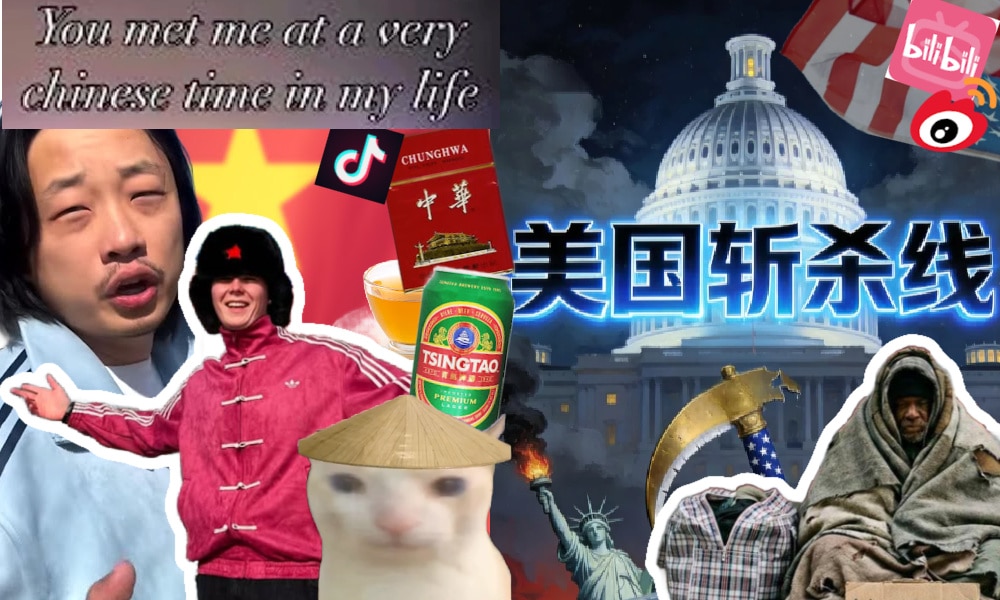
In the first month of 2026, two noteworthy social-media trends, both telling of the times we live in, went viral in the US and China: a China-focused trend in the US and an America-focused one in China.
In the US, TikTok videos and Instagram posts showing young people cheerfully portraying themselves as “Chinamaxxing,” or being “in a very Chinese time” of their lives, began popping up across social media.
Meanwhile, in China, posts about the darker side of American society and its so-called “kill line” (斩杀线) dominated trending lists.
In this week’s chapter dive, I’ll explain the stories behind both of these trends and why, despite their very different implications, the dynamics driving them are strikingly similar.
Converting to “Chinese Baddies”
Over the past week, the phrase “Becoming Chinese” (成为中国人 chéngwéi Zhōngguórén) has been gaining traction on Chinese social media. On January 30, the headline “Why ‘Becoming Chinese’ Videos Are Going Viral’ even made it to the number one most popular topic on Chinese platform Toutiao (“成为中国人视频为什么火了”).
Before reaching China’s social media, the trend had been gaining momentum on TikTok and Instagram for months, with viral videos showing foreigners humorously flaunting their supposedly deep connection to China by doing things like drinking a nice cup of hot water (the solution to everything), using traditional Chinese medicine, sitting in a squatting position while smoking Chinese cigarettes and holding Tsingtao beer, eating noodles or dim sum—all while wearing that popular Adidas “Chinese jacket.”
This is all referred to as “Chinamaxxing” or “Chinesemaxxing”: optimizing life by living in a Chinese-coded way.
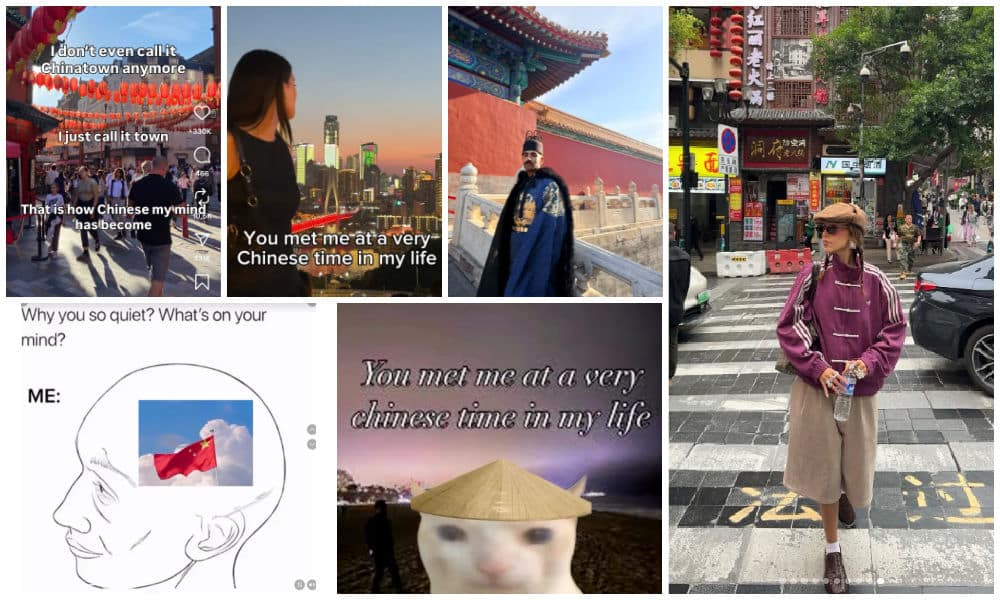
Various “very Chinese time” examples (TikTok/Instagram).
The build-up to this moment has actually been underway for several years. In the post-Covid era, China’s global pop culture influence has grown noticeably, driven both by increasingly outward-facing efforts from Chinese companies and state actors, and by a broader shift among younger audiences in the US toward Asia.
As part of this broader shift, several notable online moments have emerged over the past few years, including the viral success of a Chinese pop song in 2022; the 2024 breakout of Black Myth: Wukong; the 2025 “TikTok refugee” phenomenon; Chinese rapper SKAI ISYOURGOD becoming a staple on TikTok; and the widely watched March 2025 China tour of American YouTuber IShowSpeed, followed by a less impactful but still meaningful China visit by American influencer Hasan Piker.
The now-famous line “You met me at a very Chinese time in my life”—inspired by the quote “You met me at a very strange time in my life” from the final scene of Fight Club—first surfaced on X in April 2025. The X account “Perfect Angel” (@girl__virus) then posted the phrase in a tweet that since has gathered over 950,000 views.1
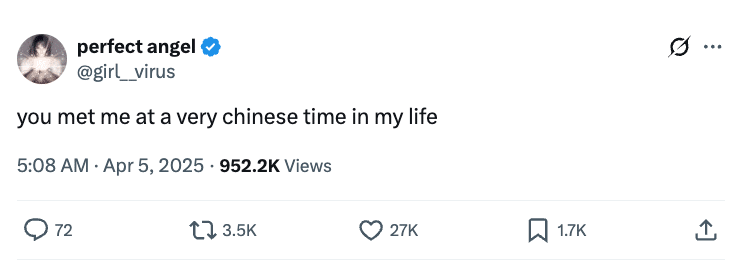
The X post of April 5, screenshotted Jan 30, 2026.
The trend snowballed from there, especially in October 2025. When creator Myles Marchant posted a video of himself eating dumplings while using the phrase, it received nearly 200k likes. Afterward, all kinds of internet users, but particularly American content creators, started using the phrase in videos to show off just how “Chinese” they were.
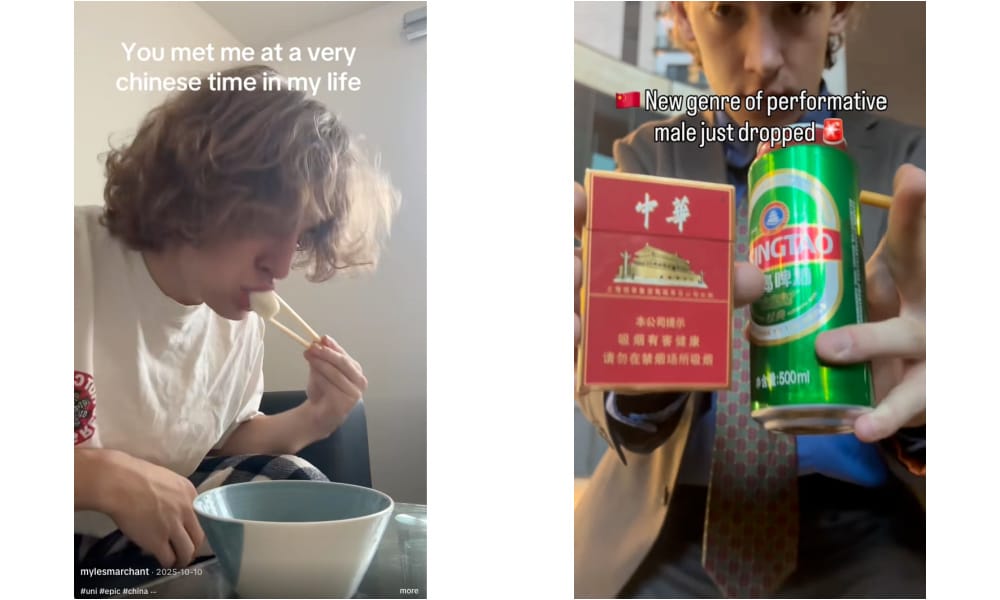
Myles Marchant and McMungo in their videos.
As the meme went viral, from October 2025 through January 2026, it continued to evolve. What began with cigarette smoking and playful performances of “Chinese” behavior has, for many TikTok users, grown into something more. Drawing on Chinese food philosophies and wellness practices, they now present “Becoming Chinese” as a lifestyle trend focused on better energy, health, and skincare.
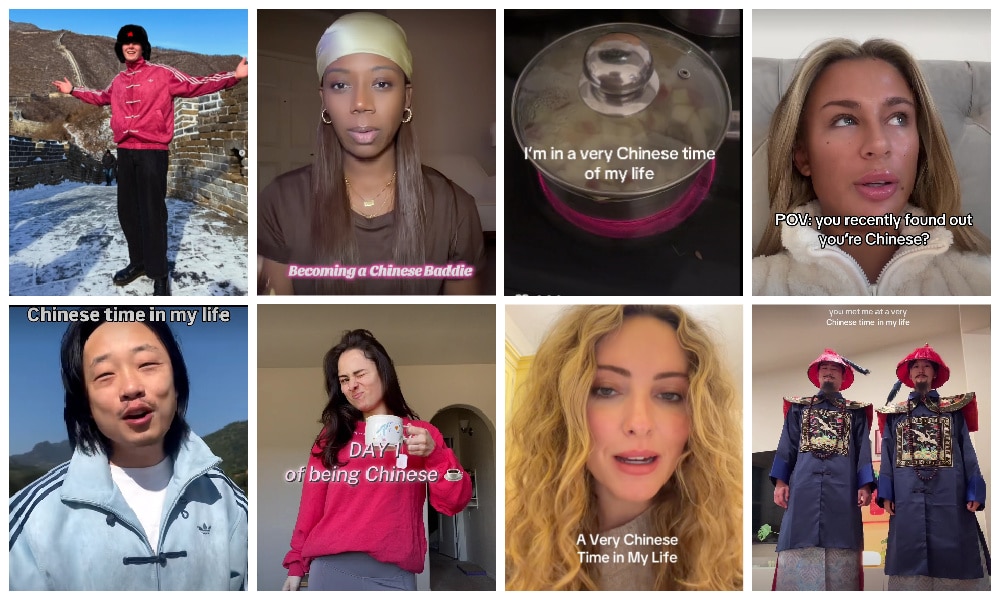
Chinamaxxing, Chinese Baddies, Becoming Chinese, A Very Chinese Time of My Life: Trends on Tiktok.
TikTok creator Missmazz, for example, introduced her morning routine “since recently converting to Chinese”: wearing slippers in the house, doing small jumps to “activate” lymph nodes, and drinking warm water and herbal tea. Creator Ohplsnatagain also shared her “first day of being Chinese,” drinking ginger tea, boiling apples, wearing red, and avoiding cold drinks.
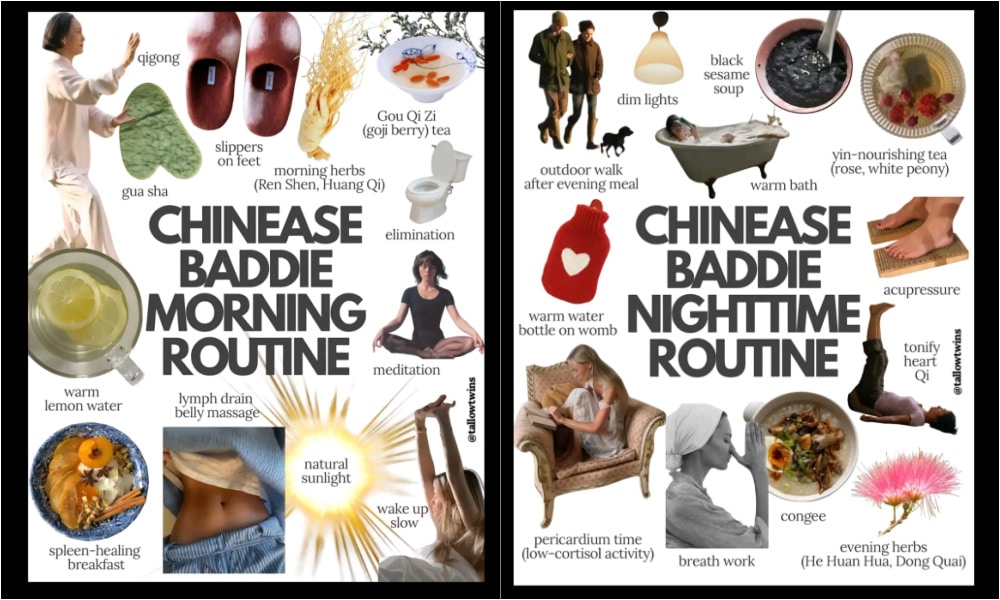
“Chinease” morning and night routines, shared on TikTok by Tallow Twins.
Besides those aspiring to become Chinese, some Chinese creators have expressed their joy about the trend others emerged as online guides to these newly adopted identities and lifestyles. Creators like Emma Peng made a video telling people, “my culture can be your culture,” while others, like Sherry, actively encourage people to become Chinese: “It’s gonna be so fun!”
They have now formed an online community of self-labeled “Chinese baddies,” sharing recipes, morning routines, and tips for being as ‘Chinese’ as possible. On Chinese social media, netizens are humored by the overseas trend, and see it as a sign of just how powerful Chinese cultural confidence has become (“藏在烟火气里的文化自信才最有感染力”).
America’s “Kill Line”
While American social media users have been busy Chinamaxxing, Chinese social media have been feverishly discussing America’s so-called “kill line” (also translated as “execution line,” 斩杀 zhǎnshāxiàn).
The term first went trending in late 2025 after it was coined by the Northern Chinese livestreamer Squishy King (斯奎奇大王), better known by his nickname “Lao-A” (牢A), who is particularly active on Bilibili, the Chinese platform known for its strong anime and gaming subculture.
Lao-A has been livestreaming since 2024 without ever showing his face on camera. Through pure voice narration over images, he became known for casually chatting in livestreams—sometimes lasting over five hours—about a wide range of topics, especially those connected to American society. Lao-A claimed he was a Chinese biomedical student in Seattle who worked part-time as a forensic assistant, handling unclaimed bodies and preparing them for medical education or research.

Profile image of “Lao A”, who never shows his face on streams.
On November 1, 2025, during a stormy Halloween Friday night, Lao-A hosted another one of his five-plus-hour live-chatting streams, in which he spoke about the bad weather and homelessness in the US.
He mentioned how people living on the streets could easily die from a cold or Covid that turns into pneumonia without proper treatment, and how dreadful he felt about the freezing conditions—knowing that on Monday he would see the bodies of people who had died on the streets that very weekend.
According to Lao-A, the unidentified bodies of homeless people would be brought by the police to his school, where they could still generate some value. Drawing comparisons to “harvesting in harsh winter,” he introduced the concept of the “kill line,” borrowing the term from multiplayer/role-playing games such as Hades or League of Legends.
In gaming, a “kill line” refers to the health-point (HP) threshold below which a character can be instantly killed, with no possibility of recovery. Lao-A suggested that the situation of marginalized and homeless people during Seattle’s winter was similarly bleak: their deaths are treated as almost inevitable, even though basic medical care—such as antibiotics—might prevent them.
The way Lao-A spoke about his work and the darker sides of American society spread rapidly through Bilibili’s comment culture and then into wider Chinese social media, especially as he expanded on the topic in other livestreams, where he further discussed poverty in America, from the healthcare system to food assistance programs.
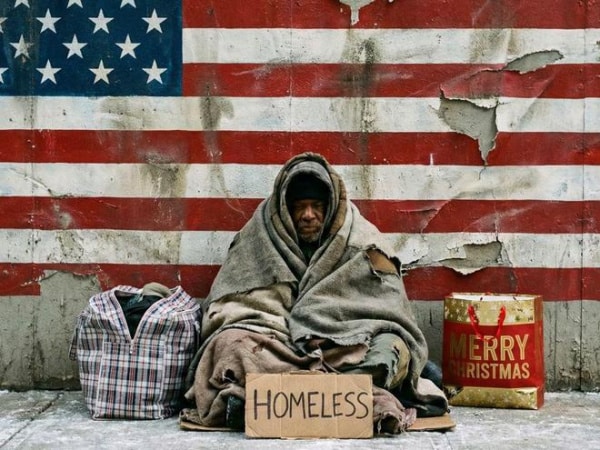
Visuals accompanying a report about Lao-A on the 163.com website.
Lao-A particularly focused on medical bills as a key component of America’s “kill line.” He described how people suffer first and then seek care, only to be further burdened by crushing costs—arguing that the American system drains people at their most vulnerable. An unexpected event such as illness, job loss, or a car breakdown can suddenly disrupt a family’s cash flow, leading to unpaid bills and a collapse in credit scores. Bad credit, in turn, makes it harder to rent housing, pass background checks, or secure affordable insurance, while debts pile up. This downward spiral, he suggested, eventually pushes people past a final execution threshold: too broke, too sick, too depressed, and too far gone to recover, ending in homelessness or addiction and shortening life spans.
Lao-A framed this as a systemic trap created by capitalism: a game mechanic in which the rules are rigged so that once someone falls below the threshold, the system itself kills them. Besides the “kill line,” he introduced other gaming-inspired terms, such as using “Gundam” (高达, after the Japanese model kits) to refer to the bodies he handled, or “slimes” (史莱姆) for decomposed bodies found in sewers.
In some ways, Lao-A’s “kill line” resembles the concept of ALICE (“Asset Limited, Income Constrained, Employed”), a demographic category created by the nonprofit United For ALICE to describe American households that earn above the federal poverty line but still cannot afford basic necessities such as housing, childcare, healthcare, or groceries.
By mid-December 2025, the term and the stories surrounding it had entered the mainstream and began hitting trending lists on Weibo, Toutiao, and Kuaishou.
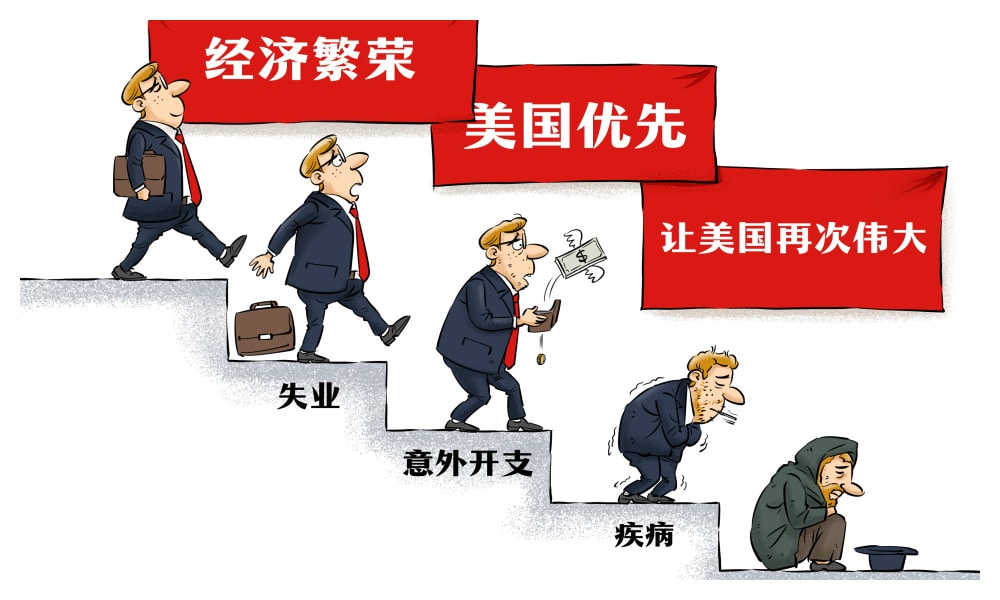
Cartoon by Chinese state media outlet CRI Online about the killing line. Top texts say: “Thriving economy, America first, America great again.” On the staircase, it says: “Unemployment, unexpected costs, illness.”
As the “kill line” quickly entered China’s online lexicon, it was also embraced and boosted by official media. After earlier coverage, Qiushi (qstheory), the Chinese Communist Party’s most authoritative theoretical journal, published a January 4 commentary arguing that the “kill line” reflects a widespread condition in which Americans’ capacity to withstand risk has been pushed to its limits, while Trump’s MAGA movement fails to work towards a solution as it focuses on cultural identity rather than addressing the economic challenges faced by millions of Americans.
Something that also caused a stir online, is how American media began reporting on the Chinese “kill line” concept. First Newsweek on December 26, followed by The Economist and later The New York Times. The phrase even surfaced at the World Economic Forum in Davos, when a Chinese state-media reporter asked US Treasury Secretary Scott Bessent about the phenomenon.
All of this placed a considerable spotlight on Lao-A himself, whose real identity and personal backstory began to be questioned by internet users. After he was identified as the possibly 30-year-old “Alex Kong 孔” from Daqing, who attended a community college in Seattle, more of his details were leaked online. Lao-A said he feared for his safety and returned to China.
This supposed “escape from America” became a major story on Chinese social media, with Lao-A repeatedly topping trending charts from January 17 onward. Attention peaked around January 22–23, after he joined Weibo and participated in joint livestreams with Chinese professor and prominent nationalist commentator Shen Yi (沈逸), and again around February 1, when he streamed with foreign-policy commentator Gao Zhikai (高志凯). During this period, Lao-A and the dystopian “kill line” narrative completely dominated Chinese online discussions.
Throughout his solo livestreams and collaborative appearances, Lao-A has continued to paint an especially dark picture of American society, describing graphic gang violence, failures in the education system, murky organ-transplant systems and black markets for organ harvesting (claiming that healthy Chinese students who have not used drugs are “very valuable”), and Chinese female students abroad as “ideal hunting targets” for white men—explicitly warning Chinese parents not to send their daughters to study overseas.
By now, “kill line” is a term that pops up all over Chinese social media and is applied to all kinds of news coming from America, from the Epstein files to the Alex Pretti shooting.
Where the “Kill Line” Meets “Chinamaxxing”
On the famous Know your Meme website, the phrase “You Met Me At A Very Chinese Time In My Life” is described as “ultimately meaningless and purposefully absurd.” But it’s actually not.
Both the “Becoming Chinese” trend and the discourse surrounding the “kill line” are shaped by our current media moment and reflect broader, shifting narratives about China, the United States, and global power.
While China’s rise has been a major media theme for years, a lot of Chinese influence had felt invisible for younger generations in the West, even if they were already living, wearing, and consuming “made in China.” More recently, however, China’s soft power narratives have become more visible, with popular culture emerging as a powerful tool.
The changing attitudes toward “made in China,” alongside a growing interest in Chinese tradition and elements of ancient culture, took shape in the late 2010s as China’s domestic cultural confidence increased. This development was partly supported by China’s flourishing livestreaming economy & homegrown e-commerce platforms, as well as more assertive official messaging around the idea of products being “proudly made in China.”

Wang Yibo poses with Anta’s “China” t-shirt in 2021, the year that “made in China” had become cool again.
Younger Chinese consumers in particular—those born after 1995 or 2000—began showing more interest in domestic brands than earlier generations. This trend reflected not just consumer preference, but a stronger identification with Chinese culture and national identity. By 2021, a Global Times survey indicated that most Chinese consumers believed Western brands could be replaced by Chinese ones (75% of respondents agreed that “national products could fully or partially replace Western products“).
By 2025, pop-culture products emerging from this renewed focus on domestically produced goods—often incorporating traditional Chinese aesthetics—began reaching audiences beyond China, finding traction in Western markets as well.
At the same time, the United States experienced significant societal divisions in the aftermath of the 2024 elections, while its global image and cultural influence were affected by the dismantling of traditional US soft power channels.
Together, these developments shaped broader changes in global public opinion, tilting toward a more favorable view of China as “the world’s leading power,” and fueling conversations about a future increasingly framed through a Chinese lens.
This wider geopolitical context forms the backdrop against which the two viral trends discussed here took shape.
–Why these trends took off
🔹 The Decay of the American Dream and Insecurities about China’s Dream
Geopolitical power shifts alone are not enough to explain the virality of both “Becoming Chinese” and the “kill line” discourse. Current socio-cultural dynamics also play a major role.
In both the US and China, people’s sense of security, future, and identity is shifting, and other countries are increasingly used as mirrors, escape routes, or coping mechanisms to process that change. Young working-class Americans under Trump and middle-class Chinese facing “involution” (nèijuǎn 内卷, a seemingly never-ending societal rat race) are questioning their systems, but arrive at opposite conclusions by using each other as contrasts.
🇺🇸 “A projection of what Americans believe their own country has lost”
In a recent article for Wired,”Why Everyone Is Suddenly in a ‘Very Chinese Time’ in Their Lives,” the authors argue that the “very Chinese time” meme is “not really about China or actual Chinese people,” but instead functions as a projection of what Americans believe their own country has lost.2
Rather than offering an accurate depiction of China, the trend relies on stereotyped markers of “Chineseness” to express frustration with US infrastructure erosion, political instability, polarization and, as PhD researcher Tianyu Fang puts it, “the decay of the American dream.”
In this context, China appears as an aspirational contrast—”less as a real place than an abstraction”—through which Americans critique their own realities.
🇨🇳 “Why China is suddenly obsessed with American poverty”
Similarly, in a The New York Times article titled “Why China Is Suddenly Obsessed With American Poverty,” author Li Yuan argues that the “kill line” narrative offers emotional relief to Chinese netizens while also helping to deflect criticism of domestic leadership. As she writes, “the worse things look across the Pacific (…), the more tolerable present struggles become.”3
A related conclusion is reached in an article by The Economist,4 which suggests that the surge in discussion about America’s failures says less about the realities of life in the US than about China’s own anxieties over slowing growth and the fragility of domestic political discourse.
While the “Chinese Dream,” which prioritizes collective effort and national strength, is promoted as part of state ideology, everyday life tells a more sobering story, in which climbing the social ladder seems increasingly out of reach for millions of Chinese facing economic slowdown, high youth unemployment, and a constrained space for criticism.5
Yet as narratives about the perceived failure of the “American Dream” flood Chinese social media, China itself begins to look like the better place—even with all of its own challenges.
Ultimately, both the “Becoming Chinese” and “kill line” phenomena are embedded in collective anxieties about vulnerability and decline, fueling a growing hunger for counter-narratives.
–The stories told
🔹Fantasizing about “the Other”
Those counter-narratives do not need to be realistic. To fulfill their role in channeling perspectives, insecurities, and even a sense of cathartic relief about the present and future, they can’t actually be nuanced. Simplification, exaggeration, and symbolic contrast are precisely what make them effective.
🇺🇸 “Chinese cultural identity as a disposable trend”
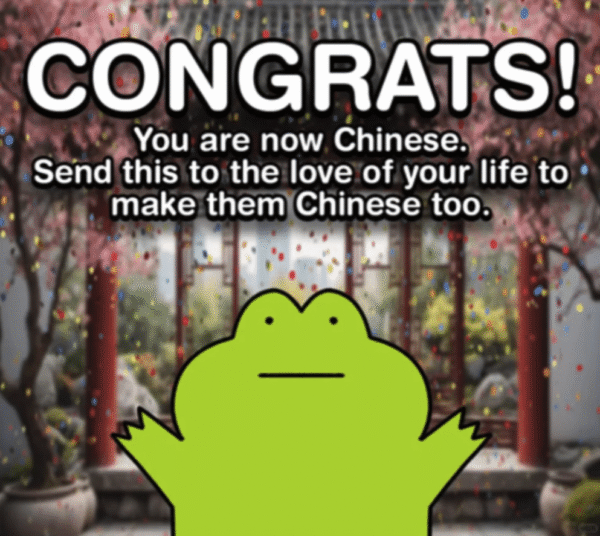
In the case of “Becoming Chinese,” the trend is comically fairy-tale–like, suggesting that people of all backgrounds can “turn Chinese” in the blink of an eye. One popular meme even implies that there is no need to “kiss the frog” to meet the prince: simply looking at the frog would already make you Chinese.
Beyond fairy tales, there is also a gaming logic at play in other “Becoming Chinese” memes, with different levels of “Chineseness” to unlock to reach that final mythical state of Being Chinese.
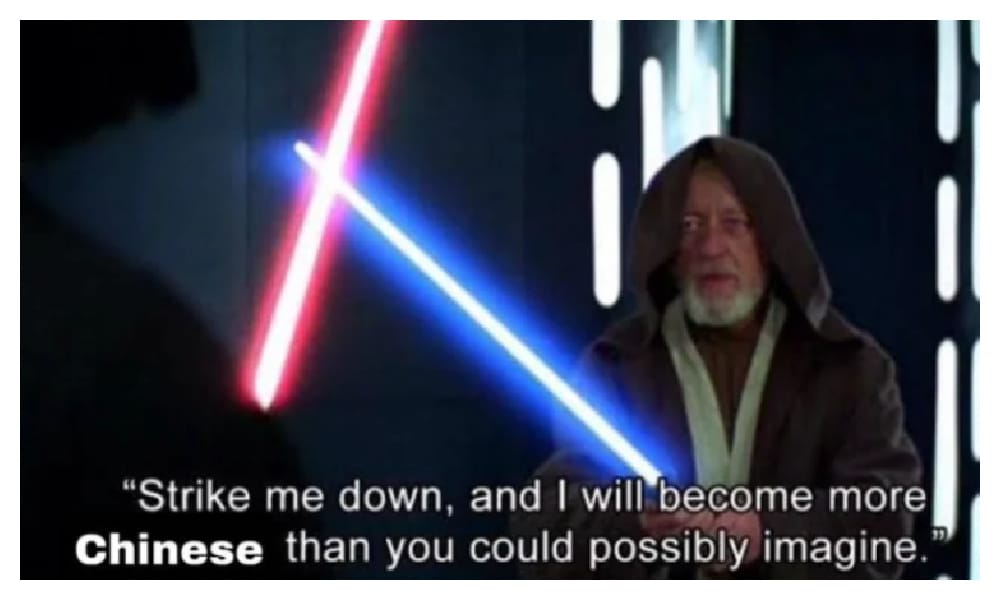
Although this is all tongue-in-cheek, it is also what has made the trend a focal point of criticism recently. Chinese cultural identity is turned into a game, a disposable trend for non-Chinese users. Some Chinese and Chinese-American creators have taken offense at how casually Chinese identity is treated—particularly after being a target of discrimination during the Covid era, only to now become a source of social-media hype.
Others argue that it feels more like appropriation than appreciation, suggesting that “Becoming Chinese” reflects a form of Orientalism: a simplified fantasy of an “exotic” China that mirrors Western desires, anxieties, and power relations rather than the lived realities of Chinese people.
Similar critiques have surfaced on Weibo, especially targeting Chinese-American social-media users. Some commenters accused them of seeking Western validation, framing their participation in the trend as an expression of unresolved insecurities about their own identity.
When confronted with such criticisms, some TikTok users respond defensively. One critical creator shot back at the “dumb comments” in his feed, saying: “Forget meeting you at a very Chinese time in your life—when am I going to meet you at a very intellectual time in your life?”
🇨🇳 “American society as a dystopian game”
The success of Lao-A’s descriptions of America’s dark sides and its “kill line” also lies in how he gamifies social stratification and marginalization. He does not just borrow terms from gaming, but frames society itself as a dystopian game, where reaching certain thresholds means it is simply game over.
While the “kill line” concept has been embraced by netizens and official media alike, the persona of Lao-A has grown increasingly controversial. As criticism mounted over inconsistencies and falsehoods in his stories about America, including his education and alleged “escape,” netizens began questioning how much was factual and how much was Hollywood-inspired: from slimy corpses in Seattle sewers to thriving black markets for organs, cannibalism or gangs beheading victims and hanging their skinned heads like “candied apples” (糖霜苹果).
In a recent livestream, Lao-A finally admitted that around “40 percent” of what he had told was not based on his own experience, with part drawn from borrowed accounts and part outright fabricated.
In a way, the popularization of Lao-A’s stories about the US resembles the wave of reporting about China’s “social credit score” in Western media between 2018 and 2020, when even reputable outlets claimed that the Chinese government was assigning all of its 1.4 billion citizens a personal score based on their behavior, linked to what they buy, watch, and say online. In many ways, those stories fed into Western fears about AI, privacy, and these developments becoming reality in Western societies themselves.
There was some truth in reports about the nascent social credit system in China, but much of the coverage was exaggerated or simply false—much like Lao-A’s stories, which mix real structural problems with a heavy dramatization and elements of fiction. In the end, that distinction matters less than you might expect. Lao-A has by now almost become a myth himself, praised by many not for the falsehoods he spread, but for consolidating a strong image of a dystopian America, one that balances the dark portrayal of China so often encountered in US media.
–Dynamics behind the trends
🔹Platform Politics
Both “Becoming Chinese” and the “kill line” are not just products of broader geopolitical shifts, US–China relations, and growing social insecurities. They are also inherently shaped by the platforms they emerged from and, in many ways, are products of those platforms themselves.
🇺🇸 “Chinese baddies building their TikTok success on Chinamaxxing”
In the West, “Becoming Chinese” trends are primarily created and shared on TikTok, an entertainment-focused platform built around endlessly scrolling short-form videos that are algorithmically recommended based on user behavior (particularly what people watch, engage with, or quickly scroll past). Although TikTok is originally Chinese—its parent company is ByteDance—it is separated from the app’s Chinese version (Douyin) and is only used outside China. TikTok has been popular in the US ever since its 2017 launch and is now used by some 200 million people there, with daily life, comedy, fashion & beauty and pop culture being among some of the popular content categories.
Since 2020, there have been repeated discussions about banning TikTok in the US over concerns about national security and the power of its algorithm due to its Chinese ownership—a prospect that proved widely unpopular among American TikTok creators. (As of this month, TikTok has finally reached a deal that allows the app to continue operating in the US, with its algorithm trained only on US data.)
As a result of this resistance against a potential ban, and against any policies changing the app’s dynamics, large numbers of users previously “fled” to the Chinese social media app Xiaohongshu, and began expressing overtly pro-China sentiments as a playful form of protest against what they saw as the anti-Chinese undertones of the proposed ban.
This background, along with the fact that TikTok is a platform generally focused on humor and relatability, has made it a place that is rather positive when it comes to China-related content. Earlier research confirms that, in sharp contrast to traditional US media, popular content on the app tends to frame China in a largely non-political and positive way.6
This has led to the current dynamics of the “Becoming Chinese” trend as a way for creators to profit. By creating these positive, entertaining, and short videos, they can aim for likes, build community, and grow their accounts. For a few “Chinese baddies,” their entire success was built on “Chinamaxxing.”
🇨🇳 “How to score on Bilibili”
In China’s social media environment, stories about the darker side of American society have always been a consistent part of online circles discussing US–China relations, and this holds especially true for Bilibili.
Although Bilibili originally started as a platform focused on ACG (anime, cartoons, games), it has evolved over the years along with its user base, which consists largely of college students and young professionals. It is now home to many creators producing political and geopolitical analytical content in a way that encourages interaction and aligns with Bilibili’s rather unpolished, humorous style.
Different from TikTok in America, popular Western-related content on China’s Bilibili platform is often framed through a strongly pro-Chinese lens and frequently carries anti-Western narratives. There are also foreign creators on the platform whose credibility is boosted when they produce what is considered pro-China or party-conforming content.7
Lao-A succeeded on Bilibili precisely because he tapped into what its users are most drawn to: using gaming slang and imagery to cast a dark light on American society on a platform whose users are increasingly politically engaged. At the same time, he claimed to be located in America itself, deep within the grim reality he described—further boosting his credibility.
In doing so, Lao-A showed that he understands how to “score” on Bilibili and has ultimately made an irreversible impact. The fact that he fabricated some of his stories does not seem to bother many people, who claim that being more nuanced would have simply led viewers to swipe away. These tactics have helped make him one of the most prominent “America watchers” on China’s social media in 2026.
🌀 Utopian Borrowing and Dystopian Pointing
Put side by side, “Becoming Chinese” and the “kill line” appear to be opposites: one romanticizes China, the other condemns America; one is playful and humorous, the other dark and serious; one thrives on Western social media, the other emerged from Chinese platforms; one is entertainment-driven, the other overtly political.
Yet both are built on similar foundations. Each taps into underlying anxieties and frustrations about the present, responds to broader global shifts, and relies on gamified language, stereotypes, or selective details that easily resonate with online audiences and encourage them to engage. In doing so, both trends are perfectly adapted to the platform dynamics and social media environments in which they flourish, and from which they benefit.
What these trends ultimately reveal is not a definitive truth about either country, but the power of digital discourse to seize on existing discontent to shape or influence perceptions of the United States and China. One becomes a utopia to borrow from, the other a dystopia to point at. Perhaps the most important takeaway is not how different these trends are, but how similar the underlying impulses behind these narratives actually are, revealing deeper ideas about American and Chinese internet users having so much more in common than meets the eye.
Meanwhile, Lao-A has already begun to move on a bit. His focus for now has shifted, at least partly, from America’s “kill line” to Japanese society. On TikTok, many of the creators who “discovered” they were “Chinese” in early January have also pivoted and are now posting about Pilates, reviewing Thai food, or booking holidays to Spain. Even “Perfect Angel,” who was the first to tweet that “Very Chinese time” phrase in 2025, just tweeted that “being Canadian is in this year.”
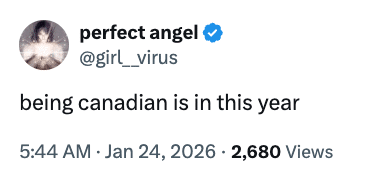
Who knows what we’ll become tomorrow? Maybe it really is time for that cup of hot water now.
By Manya Koetse
(follow on X, LinkedIn, or Instagram)
1 See: Elle Jones. 2026. “Why Everyone Is Now Chinese.” Substack, January 11. https://substack.com/home/post/p-184141480 [January 30, 2026].
2 See: Zeyi Yang and Louise Matsakis. 2026. “Why Everyone Is Suddenly in a ‘Very Chinese Time’ in Their Lives.” WIRED, January 16 https://www.wired.com/story/made-in-china-chinese-time-of-my-life/ [January 30, 2026].
3 See: Li Yuan. 2026. “Why China Is Suddenly Obsessed With American Poverty.” The New York Times, January 13 https://www.nytimes.com/2026/01/13/business/china-american-poverty.html [February 1, 2026].
4 See: The Economist. 2026. “China Obsesses over America’s “Kill Line.”” The Economist, January 12 https://www.economist.com/china/2026/01/12/china-obsesses-over-americas-kill-line [February 1, 2026].
5 See: Ma Junjie. 2025. “A ‘Loser’s Nation’ and the Abandoned Chinese Dream.” The Diplomat, September 4. https://thediplomat.com/2025/09/a-losers-nation-and-the-abandoned-chinese-dream/ [February 3, 2026].
6 See: Cole Henry Highhouse. 2022. “China Content on TikTok: The Influence of Social Media Videos on National Image.” Online Media and Global Communication 1 (4): 697–722.
6 See: Florian Schneider. 2021. “China’s Viral Villages: Digital Nationalism and the COVID-19 Crisis on Online Video-Sharing Platform Bilibili.” Communication And The Public 6 (1-4): 48-66.
Spotted a mistake or want to add something? Please let us know in comments below or email us. First-time commenters, please be patient – we will have to manually approve your comment before it appears.
©2026 Eye on Digital China/Whatsonweibo. All rights reserved. Do not reproduce our content without permission – you can contact us at info@whatsonweibo.com.

Chapter Dive
“Going to Town to Handle Business”: How Adidas Went from Hated in China to a Chinamaxxing Brand
Why has Adidas regained cultural relevance in China while Nike is struggling despite its global strength?

My premium newsletter covering the stories, memes, debates, and viral moments shaping online conversations in China. Subscribe here to receive future editions.
Just five years ago, Adidas was one of the most criticized foreign brands in China. Now, it seems to have become one of the most celebrated. Ironically, the brand’s biggest success in China yet started with a mistake it made last month.
In 2021, Adidas – along with Nike and other foreign brands – faced severe backlash and boycotts in China for participating in the Better Cotton Initiative (BCI) move to stop sourcing cotton from the Xinjiang region, which Chinese consumers viewed as a hostile anti-Chinese political stance (and was framed that way by state media and official channels).
Chinese livestreamers for the brands were scolded online, Adidas employees were brought to tears, and stores across the country saw their sales drop. People began posting videos of themselves burning their Nike Air Jordans on Weibo. For the brands involved, it became a marketing nightmare.
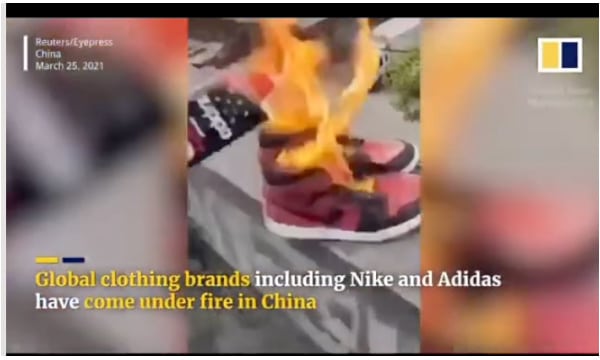
Screenshot of SCMP report about the Nike sneakers being burnt, Adidas employees facing backlash back in 2021.
But now, Adidas has managed to completely turn its image around in mainland China, where it is being praised for its top-of-game PR skills.
Adidas: Heading to Town to Take Care of Business
Over the past few years, Adidas has increasingly embraced “New Chinese Style” (新中式), a design direction that blends Chinese aesthetics with contemporary fashion. The October 2025 launch of its “Chinese New Year Jacket”—combining tang suit-inspired elements with classic Adidas sportswear—became a huge hit, not just in China but globally.

The Adidas Chinese New Year collection became a huge hit in 2025. On the left: American influencer Hasan Piker wearing the jacket while visiting Tiananmen Square in Beijing.
But that was only the beginning of Adidas’s social media success in China.
In late May, some netizens spotted a machine-translated text on the Adidas website that immediately went viral for its unintentional humor.
A jacket promoted in English with the unremarkable phrase “pair it with jeans for errands around town“ appeared on the Chinese website as the clunky “pair it with jeans to handle business in the city“ (搭配牛仔裤,在城里办事 zài chénglǐ bàn shì).
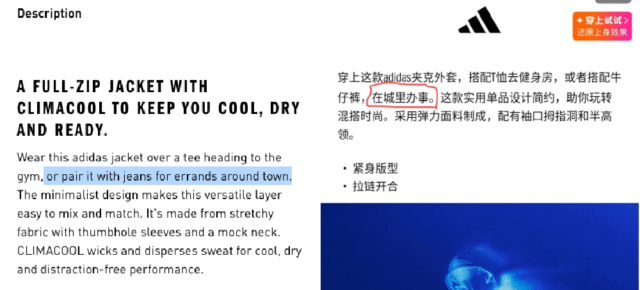
The original English text and the clunky machine translation on the right.
More than a simple mistake, it was a cultural mistranslation. Running some errands is not the same as 办事 bàn shì in Chinese, which is more formal, bureaucratic language for handling affairs, such as going to the bank, notary, or police station—not a quick run to buy some eggs and milk.
For many Chinese netizens, the phrase evoked an image of an old villager cycling into the county town for official business, all while wearing an Adidas jacket.
Although the website was quickly adjusted, the meme was already snowballing and evolved into the more playful “off to town to take care of business” (进城办事 jìn chéng bàn shì).
One popular comment played on the rural-to-city associations of the phrase:
💬 “While you’re back in the village talking trash about me, I’m already wearing Adidas and heading into town to take care of business.”
Adidas responded with surprising speed and wit.
Instead of apologizing for the mistake, they posted a video showing their own “off to town to do business” T-shirt, which quickly became available for sale online and at flagship stores in Beijing, Shanghai, and Chengdu.
Chinese actor and Adidas ambassador Li Xian (李现) was later spotted wearing a “handling business” T-shirt, and the comment sections exploded.
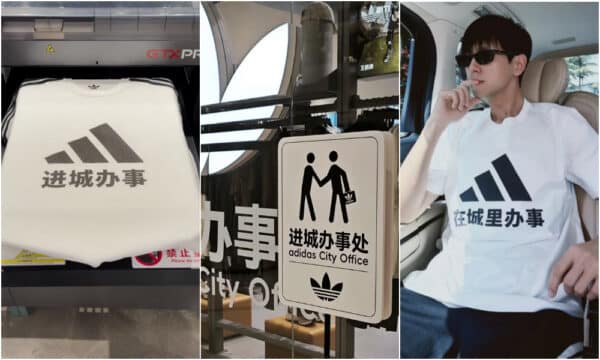
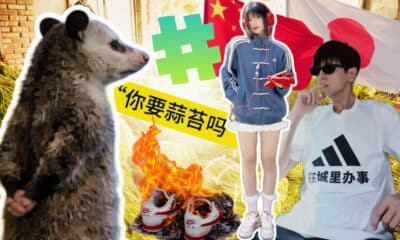
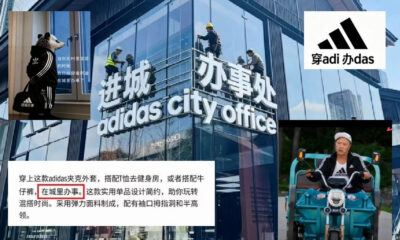
Adidas read the room and went on to launch a marketing campaign featuring China’s popular possum meme wearing one of its jackets alongside slogans such as “Wear Adidas, Handle Serious Affairs” and “Wear Adi, Handle Big Things“—a nod to the original mistranslation and a series of viral wordplays built around the brand’s Chinese name (including “穿Adi办大事” and “穿Adi, 办das”, with das meaning dàshì 大事, “important business” here).
They also put up signs labeling some of their stores as “Adidas Errands Office” (阿迪办事处).
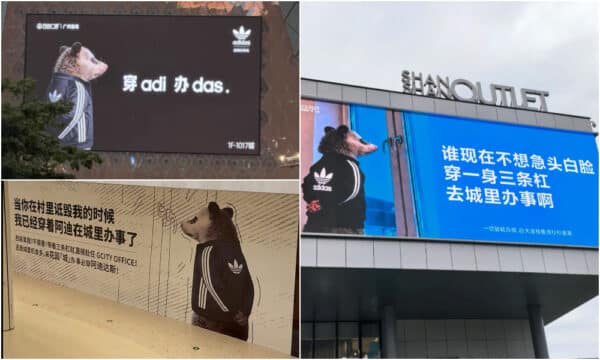
Rather than distancing itself from the joke, Adidas amplified it, becoming even funnier than the netizens themselves.
Other brands in China, from Lays to Alipay, saw the hype surrounding the meme and also started incorporating the “handle business” phrase into their online campaigns, referencing Adidas.
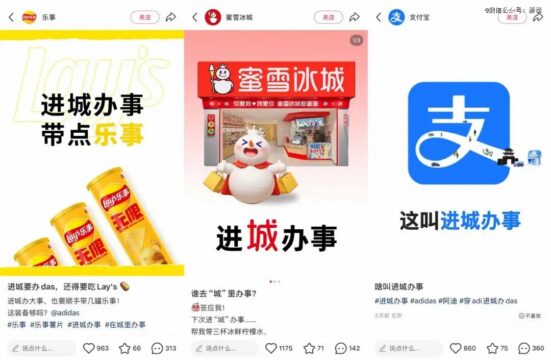
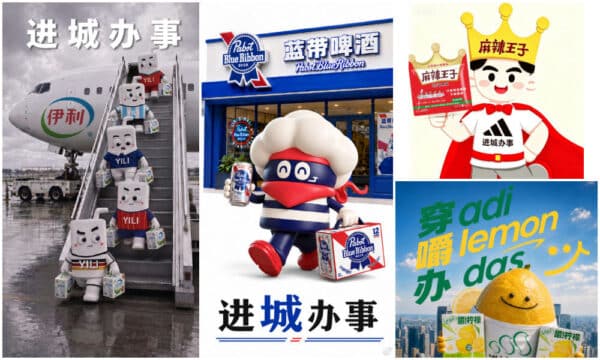
Various Chinese brands incorporated the Adidas meme into their own campaigns.
Because Adidas’s response felt effortless, authentic, and on-brand, it greatly boosted the brand’s popularity and appeal among young Chinese consumers.
Nike’s Grass is No Longer Greener
Sportswear giant Nike also became a major trending topic in China over the past week, but for entirely different reasons. Nike hasn’t been doing all that well recently, and the brand’s decline went viral in the same week that Adidas’s success was evident.
Nike became a top trending topic under the hashtag “Chinese consumers are abandoning Nike faster than anyone expected” (中国消费者抛弃耐克比想象中更快) after reports that a pair of sneakers originally sold for 899 yuan (US$132) are now selling for 429 yuan ($63) and still failing to attract buyers.
Nike’s decline is noteworthy because the brand was once booming in China. As with many other Western brands, it symbolized quality, prestige, and a cosmopolitan future for much of the 1990s and 2000s.
In a 2011 study of Chinese consumer aspirations, one respondent imagined a future in which she would drive a Mercedes-Benz, wear Nike, and eat KFC—a vision of modernity built around foreign brands. Another person dreamt of wearing “Nike clothes and Nike shoes (…) on the green grass, swinging golf clubs under the golden sunshine.”[1]
But Nike’s grass is no longer greener. Chinese commenters largely agree that much of the trust and desire surrounding the brand has eroded.
Many former Nike consumers now prefer Chinese brands such as Anta, Li-Ning or ERKE. Multiple posts on Chinese social media cite the Xinjiang cotton controversy as a turning point from which Nike never fully recovered.
The Localization Dilemma: A Strategic Catch-22?
The contrasting fortunes of Nike and Adidas reveal something important about the position of foreign brands in China today.
As domestic brands improved and narratives of national rejuvenation and the “Chinese Dream” gained prominence under Xi Jinping, consumer sentiment toward Western brands shifted dramatically, especially amid a growing number of controversies involving them.
From a Dolce & Gabbana campaign deemed racist to a witch hunt for Western brands listing Hong Kong and Taiwan as separate countries, international brands increasingly started struggling to find their place between politics, patriotism, and consumers who are choosing “Made in China” over global consumer culture.
As Zhihong Gao[2] observed as early as 2012, the rise of cultural confidence and renewed appreciation for Chinese traditions created a dilemma for foreign brands.
They find themselves caught in a strategic catch-22: if they localize too much, they risk losing the distinctiveness that made their brands attractive in the first place, while also reinforcing consumer preference for local cultural elements; yet if they remain too foreign, they risk appearing culturally tone-deaf and disconnected from Chinese consumers.
This is where Adidas appears to have found a sweet spot.
Unlike Nike, which seems to be living off its past success while showing little urgency in adapting to the Chinese market, Adidas has fully embraced Chinese digital culture, local humor, wordplay, and youth trends without abandoning its own identity.
Rather than pretending to be Chinese, Adidas is participating in Chinese culture as a distinctly foreign brand. By celebrating the unique elements of Chinese culture, both in tradition and modernity, it is boosting both its own image and the cultural pride it is tapping into. That is Chinamaxxing in a nutshell.
- Read more about Chinamaxxing here.
- Read more about the rise of ‘proudly made in China’ here.
- Read more about Nike vs ERKE here.
[1] Kelly Tian and Lily Dong, Consumer-Citizens of China: The Role of Foreign Brands in the Imagined Future China (London: Routledge, 2011), 70–71.
[2] Zhihong Gao, “Chinese Grassroots Nationalism and Its Impact on Foreign Brands,” Journal of Macromarketing 32, no. 2 (2012): 184–185.
By Manya Koetse
(follow on X, LinkedIn, or Instagram)
Spotted a mistake or want to add something? Please let us know in comments below or email us. First-time commenters, please be patient – we will have to manually approve your comment before it appears.
©2026 Eye on Digital China/Whatsonweibo. All rights reserved. Do not reproduce our content without permission – you can contact us at info@whatsonweibo.com.
Chapter Dive
Comrade Trump Returns: The 2026 Trump–Xi Summit on Chinese Social Media
A special deep dive into the 2026 Xi-Trump summit through Chinese social media, highlighting the top 15 viral moments, internet memes, main themes, and netizen commentary.

In This Special Edition:
🎭 The Top Cast: Who’s who in this geopolitical blockbuster
🎬 Dramatic Synopsis: The summit as a movie plot
🔍 Critical Review: Taiwan, the “Thucydides Trap,” & a Russian surprise
🧩 Memorable Scenes: The top 15 most viral memes & moments
🗣️ Quotes: Key remarks from leaders and netizens
🎬 Behind the Scenes: An unscripted moment
🎵 Soundtrack: The summit in songs
On Chinese social media, Trump’s visit to China started before he arrived and continued after he left.
The long-awaited meeting between Donald Trump and Xi Jinping, from May 13 to May 15, was the first visit by a sitting US president to China in nearly a decade – a major diplomatic event that has been closely followed by Chinese netizens.
Even before Trump’s Air Force One landed in Beijing, the Xi-Trump summit was top trending.
Alongside the more serious commentary, Chinese social media has been full of posts reflecting people’s curiosity, excitement, and amusement about Trump’s presence in Beijing this past week. That is not only because the meeting between the two leaders—and the issues on the table—is of major significance, but also because Trump has held a special place in China’s meme culture since the early days of his first presidency.
Trump’s first years in office catapulted him into China’s meme machine. When he remarked that Korea “used to be part of China,” and after a series of high-profile decisions—including withdrawing from the Trans-Pacific Partnership, exiting the Paris Climate Agreement, and announcing that the US would leave UNESCO—many Chinese netizens joked that the US president was inadvertently helping China by weakening America’s global influence.
The trade war and Trump’s hardline stance toward Chinese tech companies were also, paradoxically, seen as forcing China to accelerate its own push for technological self-reliance and domestic innovation.
Taken together, these developments earned Trump—whose Chinese name is commonly transliterated as 川普 (Chuānpǔ)—the nickname “Build-the-Nation Trump” (川建国, Chuān Jiànguó), fueling the tongue-in-cheek notion that he is actually China’s “secret agent” who is working to undermine American power while inadvertently advancing China’s rise on the world stage.
For the same reason, he is also often referred to as “Comrade Trump” (川普同志).
This often bantering approach to US politics, combined with China’s tightly controlled online environment, where more critical and open discussions of top-level political events are always limited, has given rise to alternative narratives around major diplomatic meetings that sometimes read like a movie script.
That dynamic was already evident the moment Trump landed in Beijing.
To some Chinese netizens, his appearance at the door of Air Force One looked like a scene from The Truman Show. One post making this comparison was reposted nearly 6800 times.

“It’s not the Truman show, but the Trump show,” one netizen added.
To stay on theme, I’ll take a similarly cinematic approach in this overview of Chinese social media reactions to the Xi-Trump meeting. From “top cast” to “dramatic synopsis” and the “most memorable scenes,” let’s recast this high-level rendezvous as a Beijing blockbuster.
🎭 The Top Cast
🇨🇳
⭐ Xi Jinping 习近平 – General Secretary of the Communist Party of China and President of the People’s Republic of China
• Li Qiang 李强 – Premier
• Wang Yi 王毅 – Foreign Minister
• Cai Qi 蔡奇 – Party’s organizational chief / Xi’s aide
• Yin Li 尹力 – Beijing Party chief
• He Lifeng 何立峰 – Vice Premier overseeing economic affairs
• Dong Jun 董军 – Defense Minister
• Zheng Shanjie 郑栅洁 – Chairman of the National Development and Reform Commission (NDRC)
• Han Zheng 韩正 – Vice President of China
• Ma Zhaoxu 马朝旭 — Executive Vice Minister of Foreign Affairs
• Xie Feng 谢锋 — Chinese Ambassador to the US
• Wang Wentao 王文涛 — Commerce Minister
• Zhao Leji 赵乐际 — Chairman of the National People’s Congress Standing Committee
• Lei Jun 雷军 — Founder and CEO of Xiaomi
🇺🇸
⭐ Donald Trump – The President of the United States of America
• Eric Trump — Trump’s son
• Lara Trump — daughter-in-law
• Marco Rubio – Secretary of State
• Pete Hegseth – Secretary of Defense
• Scott Bessent — Treasury Secretary
• David Perdue — US Ambassador to China
• Howard Lutnick — Commerce Secretary
• Jamieson Greer — US Trade Representative
• Steve Witkoff — Special Envoy
• Sean Hannity – Fox News
• Bret Baier – Fox News
Special Guest Appearances:
• Elon Musk — Tesla and X
• Tim Cook — Apple
• Larry Fink — BlackRock
• Kelly Ortberg — Boeing
• Stephen Schwarzman — Blackstone
• Brian Sikes — Cargill
• Jane Fraser — Citigroup
• Jim Anderson — Coherent
• H. Lawrence Culp Jr. — GE Aerospace
• David Solomon — Goldman Sachs
• Jacob Thaysen — Illumina
• Michael Miebach — Mastercard
• Dina Powell McCormick — Meta
• Sanjay Mehrotra — Micron Technology
• Cristiano Amon — Qualcomm
🎁 Surprise Appearance:
• Jensen Huang 黄仁勋 – CEO of Nvidia (aka “Old Boss Huang” 黄老板 aka “Leather Jacket Brother” 皮衣哥)
• X Æ A-12 Musk – Elon Musk’s 5-year-old son
Notable absence:
• Melania Trump – First Lady
• Peng Liyuan (彭丽媛) – First Lady
🎞️ Genre and Supporting Themes
Political Drama ⎮ Geopolitical suspense ⎮ Romance/Tragedy
▪️ War in Iran / the Strait of Hormuz crisis
▪️ Russia’s war in Ukraine
▪️ Taiwan
▪️ Trade and tariffs
▪️ AI and semiconductor export controls
▪️ Rare earths and critical mineral supply chains
🎬 Dramatic synopsis
Two powerful leaders. One increasingly unstable world.
The world’s most unpredictable dealmaker flies 13 hours to the capital of his greatest rival, his close friend, or “neither an ally nor a friend” (it changes), for a long-awaited “G2” moment aimed at stabilizing relations between two powers that publicly insist they can thrive without each other, while privately knowing the opposite may be true.
There is a lot at stake, from chips to oil and beyond. A $50 billion semiconductor market. A war in the Middle East. A rare earth supply chain. And an island of 23 million people that is on everyone’s minds.
As the flags wave in the Beijing wind, the tea is poured, and the lavish banquet is prepared, deep mistrust simmers behind carefully staged handshakes and smiles.
Will the protagonists talk their way toward a more peaceful next chapter? Will a surprise cameo by the “Leather Jacket Brother” (皮衣哥) Jensen Huang help move the plot forward? And, in an increasingly fragile global order, will the eagle and the dragon finally realize that they may need each other more than they are willing to admit?
📝 Production Schedule
📌 May 13 (Wednesday) – Arrival Day
🔹 Evening: Beijing Capital International Airport
– Trump and his delegation arrive in Beijing
– They are welcomed by Chinese Vice President Han Zheng (韩正)
📌 May 14 (Thursday) — The Main Day
🔹 Morning: The Great Hall of the People
– Welcome ceremony, military parade
– Bilateral talks between Trump and Xi for over two hours
🔹 Afternoon: Temple of Heaven (天坛)
– Joint tour of the Hall of Prayer for Good Harvests (祈年殿)
🔹 Evening: The Great Hall of the People
– State Banquet (国宴) hosted by Xi Jinping
📌 May 15 (Friday) — Working Sessions & Departure
🔹 Morning: Zhongnanhai (中南海)
– Zhongnanhai private garden tour
– Trump and Xi small-group talks
🔹 Afternoon: Beijing Capital International Airport
– Trump’s departure in the afternoon around 14:30
📝 The business delegation track ran in parallel with the CEOs having their own meetings with Chinese counterparts on the sidelines of the Xi-Trump meetings.
🧵 Critical Review
A lot has happened since Trump and Xi’s previous face-to-face meeting in Busan, making this major bilateral meeting one that the entire world watched.
As described by China’s foreign ministry, during their meeting, Trump and Xi “explored the correct way for two major powers to coexist,” while the White House stressed that the two sides mostly “discussed ways to enhance economic cooperation between our two countries.”
During their “G2” moment, Xi and Trump spent nearly nine hours together in total—from the formal talks at the Great Hall of the People to their walk-and-talk at the Temple of Heaven, the banquet, and the smaller-group session at Zhongnanhai.
One thing that stood out throughout the visit was the extent to which both sides went out of their way to flatter one another. From the moment Trump arrived at the airport until the second he departed, he received full VIP treatment: children waving flags, a 21-gun salute, a lavish state banquet, and even a PLA military band performing his unofficial YMCA anthem.
Trump, in turn, repeatedly praised Xi as a “great leader,” called China “a wonderful country,” described Beijing as “a great place,” and said he had received “a magnificent welcome like none other.” He also said that US–China relations had a “fantastic future together.”
During the 2025 Trump-Xi meeting in South Korea, a common observation was that “the truth lies in the details” (细节见真章), and the same was true this time. Chinese media and netizens paid close attention to small gestures: Trump being the first to extend his hand, his red tie (with red symbolizing success and good fortune in Chinese culture), and the way he worked his way down the receiving line of senior Chinese officials, shaking each of their hands outside the Great Hall of the People.
One widely discussed moment was Trump’s military-style salute to Chinese Defense Minister Dong Jun (董军). The gesture was warmly received online, with some netizens joking that “the comrade has returned home” (同志回家了).
It is clear that hospitality and warm rhetoric were not the problem. At least on the surface, this temporary US–China Beijing honeymoon looked picture-perfect, and became a true media spectacle. But behind the red carpets and blue skies, several deeper themes emerged.
🔍 The Thucydides Trap
An important narrative element on the Chinese side was the “Thucydides Trap” as mentioned by Xi Jinping during the formal bilateral meeting at the Great Hall of the People.
The “Thucydides Trap” (修昔底德陷阱) is a concept popularized by Harvard scholar Graham Allison, drawing on the ancient Greek historian Thucydides, which holds that war becomes highly likely when a rising power challenges the established ruling power.
“The world has come to a new crossroads,” Xi said: “Can China and the United States overcome the so-called ‘Thucydides Trap’ and create a new paradigm of major-country relations?”
This “new paradigm” and the new shape of US-China relations became one of the most important themes of this meeting. The broader message from the Chinese side was clear: China sees its growing role on the world stage as inevitable, and the United States is expected to make room for that reality. Or, put differently, the world order is changing, and there are now more captains on this ship.
🔍 Taiwan issue
The “Thucydides Trap: concept is also closely tied to “the Taiwan problem,” and China’s pre-summit warnings on the issue left little room for misunderstandings.
On the Chinese side, Taiwan was framed as its most important issue and a red line, with officials warning that the broader US–China relationship could be jeopardized if the “Taiwan question” were mishandled.
⚠️ “If it is handled properly, the bilateral relationship will enjoy overall stability,” Xi told Trump. “Otherwise, the two countries will have clashes and even conflicts, putting the entire relationship in great jeopardy.”
Xi emphasized that ‘Taiwan independence’ and cross-Strait peace are as “irreconcilable as fire and water” (水火不容), adding that maintaining peace and stability across the Strait represents the greatest common interest shared by China and the United States.
After the summit, it became clear that the US side understood China’s position. In an interview with Fox News, Trump acknowledged that Taiwan is “one of their [China’s] most important issues.” Stressing that China does not want to see Taiwan become independent, Trump said he preferred to maintain the status quo and cautioned Taiwan against formally declaring independence from China.
He also suggested that the United States has no interest in becoming involved in a war between Taiwan and mainland China. “Do we really have to travel 9,500 miles to fight a war? I’m not looking for that.”
His comments seemed to suggest that, for now, respecting China’s red lines while preserving the status quo may be sufficient to keep things stable.
Trump’s words seemed to raise alarm bells in Tapei, where a presidential spokesperson said it was “self-evident” that Taiwan is “a sovereign, independent democratic country”.
Meanwhile, on Chinese social media, official channels widely reported on Trump’s words, and a related Weibo hashtag (#特朗普警告台独#) received over 230 million views.
One Weibo commenter wrote:
💬 “The meal wasn’t eaten for nothing [饭没白吃]. Comrade Trump really did deliver!”
🔍 Historic Continuum
One notable aspect of this visit was the extent to which both sides emphasized the long historical continuum and importance of Sino–US relations.
The visit to the Temple of Heaven was symbolic in several ways. Beyond the site’s significance in Chinese history, it was also known to much appreciated by Henry Kissinger, who helped pave the way for the normalization of Sino-American relations in the 20th century.
During his state banquet speech, Trump also highlighted the deep historical roots of US–China relations, and drew a direct line from ancient Chinese philosophy to the intellectual roots of the United States.
He noted that Benjamin Franklin published sayings of Confucius as early as 1737, referenced Confucius’s depiction on the façade of the Supreme Court of the United States, and mentioned how President Theodore Roosevelt channeled Boxer Indemnity funds toward the founding of the prestigious Tsinghua University, Xi Jinping’s alma mater.
Also noteworthy is how Trump stressed that China and the US were “allies in World War II,” with Roosevelt’s mentions of “the brave people of China.”
The speech was praised on Chinese social media. One popular blogger wrote:
💬 “Holy sh*t. Trump’s toast was full of classical references and complex sentences. He actually did his homework.”
Taken together, Trump’s remarks and the historical framing in Chinese media conveyed a broader diplomatic message: Sino-American relations in 2026 were presented as part of a much longer history that had led to this moment. This gave the meeting added weight, framing it as a major turning point and the start of a new era in US–China relations, rather than just another bilateral talk.
🔍 Russian Surprise
While Xi and Trump were in the midst of the state banquet, media reports came out from Moscow that Kremlin spokesperson Peskov had announced that Putin’s will soon visit China, and that preparations were complete, with the date to be announced “soon” (later confirmed: May 19-20).
A related hashtag immediately reached the top trending lists, with many netizens responding to the Putin visit news with a mix of nationalistic pride and humor – joking just how popular and lively Beijing is as an international “hotspot.”
With China hosting both the US and Russian leaders within the same week, many suggested it underscored just how important China’s role in global diplomacy is.
💬 “Trump will be seated in front of the tv just to ensure Putin isn’t getting better treatment than him,” one commenter joked.
Despite the commotion over the accouncement, some commenters on Zhihu suggested that it actually was not such a big deal.
💬 “Don’t overthink it,” one Zhihu user wrote: “Trump’s itinerary was pushed back to May, it was originally scheduled for April.”
Others argued that these visits should be placed into a larger context of China playing a key diplomatic role for resolving the Iran war and the Hormuz crisis.
💬 “Don’t just focus on Putin coming — look at the sequence before him: first Iran’s Foreign Minister Araghchi, then Trump, then Putin, then Pakistan (already announced). Except for Israel, every party involved in the Hormuz Strait issue, and everyone with meaningful influence over it, has come.”
Then there were those who saw deeper meanings behind the dates:
💬 “Trump chose the 13th and 14th to visit China. Putin chose May 20th to visit China. Both are expressing their sincerity very directly! 1314520.”
In Chinese online culture, the numbers “1314” sound like 一生一世 (yīshēng yīshì), meaning “for a lifetime” or “always and forever,” while “520” sounds like 我爱你 (wǒ ài nǐ), or “I love you.” With Trump picking 13/14 (一生一世) and Putin choosing 5/20 (我爱你), they seemed to be spelling out a love confession to China, with Xi Jinping, apparently, as the most sought-after romantic partner in global diplomacy.
🔍 Uncertain Conclusions?
According to Chinese official sources, the summit’s main diplomatic outcome was the agreement to frame China–US relations as a “constructive strategic stability relationship” (中美建设性战略稳定关系) — a new official positioning of the bilateral friendship.
In Trump’s own words: “The relationship between the United States and China is going to be better than ever before.”
In the commentary that has emerged since the summit, opinions are divided over how much the nine hours of talks between Xi and Trump will change or impact the key issues at hand. Various international media wrote that there is little clarity about what was actually achieved.
What does seem clear, however, is that for the time being both sides got something they wanted: friendlier China–US relations, an America that appears more cautious in its wording on an “independent Taiwan,” and a China that agrees with the United States that Iran should never obtain nuclear weapons.
Whether this will amount to a true “happy ending” remains to be seen, but it does mark the beginning of a new phase in bilateral relations—one in which there appears to be greater understanding of each other’s positions.
Xi accepted Trump’s invitation to visit Washington this autumn and also promised to send him seeds from the roses he admired in the former imperial garden at Zhongnanhai. At the very least, something tangible will bloom from these meetings.
🧩 Memorable Scenes
📌 1. Memes in Anticipation
On Chinese social media, Trump’s China visit had already begun a day or more before the president’s arrival in Beijing, with various AI-generated memes imagining the trip. These ranged from images of Trump and Elon Musk enjoying Beijing street food and Tsingtao beer to scenes of Trump and his entourage solemnly visiting the Temple of Heaven and, in all earnestness, paying their respects there.


📌 2. The Grandson Coming to America
Before Trump’s arrival, rumors spread across Weibo and WeChat that CCTV-6, the movie channel of China’s state broadcaster, would air the Chinese film A Grandson from America (孙子从美国来) on the day he landed in Beijing. The 1990s feel-good film, about an elderly man in rural China who unexpectedly becomes the caregiver for his American grandson, was seen as a cheeky nod to the meeting between Xi Jinping and Donald Trump, with the American “grandson” cast as clearly inferior in status to his Chinese “grandfather.”
The rumor, however, turned out to be false.

The supposed CCTV-6 programming was itself a meme. Perhaps so many people were willing to believe it because CCTV-6 has occasionally made eyebrow-raising scheduling choices before—such as changing its lineup to air anti-American Korean War films for three consecutive days when the U.S.-China trade war was heating up.
📌3. Jensen Huang’s Surprise Attendance
When Jensen Huang (黄仁勋), the CEO of NVIDIA, boarded Air Force One during a stopover in Anchorage, Alaska, he instantly went viral.
Huang plays a special role in this story because he has become a symbol of the central technological dispute between China and the United States. China is one of NVIDIA’s most important potential markets, but the company’s most advanced AI chips are currently barred from being sold there under US export controls.
It was initially reported that Huang would not be joining the trip. When he appeared at the last minute after all, Chinese social media quickly responded with a wave of memes imagining all kinds of ways he might have boarded the presidential delegation in Alaska.
Like this video. Or the images below. Some people joked that “Leather Jacket Brother” (皮衣哥), as he is nicknamed in China for his signature black leather jacket, was invited so last-minute that he didn’t even have time to bring any luggage – explaining why he stood on the tarmack without any suitcases.
Various memes showed him chasing after the Air Force One plane, and others showed him ‘bribing” the delegation to pick him up with big packs of Maotai liquor or other goods.


📌 4. The “Chinese” Meals Served on Board of the Air Force One
Photos of the meals served aboard Air Force One quickly made their way onto Chinese social media. The menu consisted of sliced beef brisket, onions, bell peppers, bok choy, and lo mein noodles stir-fried in a sesame soy sauce and topped with chopped scallions, along with a spring roll, a fortune cookie, and a beverage of choice.
The photo was posted by Margo Martin, communications deputy director in the Trump administration, and reactions on Chinese social media were mixed. Some appreciated that the American side was already trying out something more “Chinese” ahead of the visit. Others argued that the meal had little to do with actual Chinese cuisine and instead reflected a stereotypical version of American Chinese food.

📌 5. Lonely Soldier in Front of Air Force One
When Air Force One arrived at Beijing Capital International Airport on the evening of May 13, and millions of people tuned into the livestreams of Trump’s arrival, a People’s Liberation Army honor guard soldier stood completely still at his post. The contrast of the enormous American presidential plane coming in and the Chinese soldier not moving a millimeter made an impression and went viral as a symbol of Chinese diligence and pride.


📌 6. Trump’s Visit Finally Gets Bumpy Road Fixed
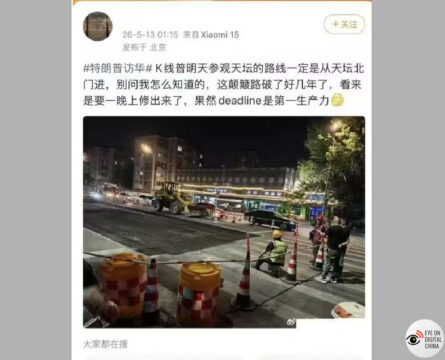
One viral post joked about a familiar phenomenon in China: infrastructure projects that have dragged on for years suddenly get completed at lightning speed when an important political event is about to happen. The post showed construction workers, just ahead of Trump’s visit, busy working on the road near the Temple of Heaven north gate – the route the US delegation would be taking.
💬 “This stretch of road has been in terrible condition for years, but it looks like they’re going to fix it overnight. Once again, the deadline proves to be the number one productive force.”
📌 7. Trump’s “Crazy Thursday”
A running joke on Chinese social media was that Donald Trump had deliberately arrived on a Wednesday night so he could be in China just in time for KFC’s “Crazy Thursday” (疯狂星期四).
Since its launch, the weekly KFC promotion has become deeply embedded in Chinese internet culture. So it was only natural for netizens to imagine Trump, Elon Musk, Jensen Huang, and Tim Cook heading out for a late-night snack after the state banquet.
What should he order? Since Trump’s Chinese name is Chuan-pu (川普, Chuānpǔ), the obvious choice would be a Chuan-Burger (川味汉堡, Chuānwèi Hànbǎo) — a Sichuan-style spicy burger, of course.

📌 8. The Magpie Moment
One of the most noteworthy moments of the morning of May 14 came when a magpie landed just behind Donald Trump as he stepped out of his car.
The moment, captured by a Hong Kong reporter, quickly created a buzz online. In Chinese culture, the magpie (喜鹊, xǐquè) is traditionally seen as a symbol of good news and prosperity — the first character, 喜 (xǐ), means “joy” or “happiness.” Netizens were quick to interpret the bird’s appearance as a sign that Trump’s visit had the approval of the heavens.

📌 9. Elon Musk “360-Degree Filming”
After the bilateral meeting, the American delegation posed for a group photo on the steps of the Great Hall of the People. Elon Musk — affectionately nicknamed “Old Musk” (老马, Lǎo Mǎ) by Chinese netizens — drew particular attention for his enthusiastic “360-degree filming.” Like an excited tourist, he spun in a full circle while recording everything around him.
“They were genuinely happy today,” was how Hong Kong media outlet Ta Kung Wen Wei framed the moment.
On Weibo, one related hashtag received over 80 million views, while another hashtag surpassed 99 million views.

📌 10. Lei Jun’s Selfie Moment with Elon Musk
One of the most-reposted moments of the state banquet was when Xiaomi CEO Lei Jun approached the table where Tesla CEO Elon Musk was seated before the start of the dinner, and snapped a quick selfie with him, while Musk was pulling some funny expressions.
Lei Jun’s spontaneous photo was jokingly called a sign of “star chasing” and “fan behavior.” The tech entrepreneur was one of the first Model S owners in China, and admired Musk long before the Xiaomi EV line. Some Xiaomi EV drivers joked that he was making them lose face.

Some netizens used AI to swap the situation around.

📌 11. Fox News Reporter Bret Baier Going Local
During the summit, many netizens snapped pictures and videos of Fox News reporter Bret Baier going around the city reporting, which created a funny unintended Droste effect with Beijing reports coming out on how he reported on Beijing.
🔹 Chinese media reported on how Bret Baier was reporting on China by ordering a sausage in English from a robot clerk at a convenience store (video).
🔹 Baier also reported on China as a surveillance state. Meanwhile, clips of him making that point were circulating widely on Chinese social media. In one segment, he told viewers that his crew’s driver received a parking fine on his phone just minutes after illegally parking, using it as a live example of China’s surveillance capabilities. Chinese netizens were quick to point out the irony, noting that Baier himself appeared to be violating traffic rules by filming while standing in an active traffic lane (video).
🔹 He was also spotted playing table tennis in a Beijing park in sweltering weather while wearing a full suit, much to the amusement of many netizens (video).

📌 12. Elon Musk’s 5-Year-Old Son Becomes Youngest Influencer
Jensen Huang wasn’t the only surprise guest at the summit. Elon Musk also brought along his five-year-old son, X Æ A-12 (in China, simply known as “Little X” 小X). The little boy appeared in a Chinese-style vest and carried a traditional tiger-head bag (虎头包), making him, quite possibly, the youngest person ever to attend a state-level U.S.–China summit.
One unexpected side effect of X’s appearance in summit footage was a surge of interest in his outfit. Chinese netizens quickly identified both the handmade tiger-head bag – from a Guangxi ethnic minority artisan brand – and the Chinese-style vest, and links to the items spread across social media. On Taobao, the bag was listed for 338 yuan (about US$49), while the vest sold for around 16 yuan (US$2.35).
The bag’s viral success became a major news story, framed as “traditional intangible cultural heritage going global.” Hand-stitched by Guangxi ethnic minority embroiderers, the tiger-head bag sold out within hours. (I also ordered one on Taobao, and received a notification today that they won’t be shipping out until late July).

📌 13. The Banquet Centerpiece
The centerpiece table at the welcoming banquet—which accompanied dishes such as lobster in golden broth, crispy spiced beef, Peking roast duck, salmon in mustard sauce, classic conch pastry, tiramisu, and more—was a spectacle in its own right and quickly became a topic of discussion online.
Designed as an elaborate miniature landscape, it featured a large pond, swans (traditional symbols of fidelity and harmony), white doves representing peace, flowers, garden pavilions, and a detailed replica of Beijing’s Temple of Heaven.

📌 14. Jensen Huang Has Noodles in the Hutongs
Jensen Huang went viral multiple times over the past week, but one standout moment was his noodle stop at a hutong in central Beijing. He was filmed standing outside eating while dozens of people watched and took pictures; other clips showed him strolling through the surrounding alleyways.
About the noodle place: the address is No. 83 Fangzhuanchang Hutong (方砖厂胡同83号院). It is a small Bib Gourmand-listed eatery that serves only zhajiangmian (Beijing fried sauce noodles). Waiting in line was already common, but with Jensen Huang’s visit going viral, queues are likely to get even longer. Located between Nanluoguxiang and Qianhai, it makes for a perfect stop for a late lunch and an afternoon stroll. (Worth noting for your next hutong trip.)

The restaurant, by the way, was remarkably quick to capitalize on the moment and establish itself as the Jensen Huang noodle spot. By May 15, it had already put up a poster featuring Jensen Huang enjoying a bowl of noodles there (image via @_FORAB on X).

📌 15. The KTV Night
Chinese netizens jokingly fantasized about what would happen after the Trump–Xi summit: a late-night KTV session in Beijing with Donald Trump, Tim Cook, Lei Jun, Elon Musk and Larry Fink.
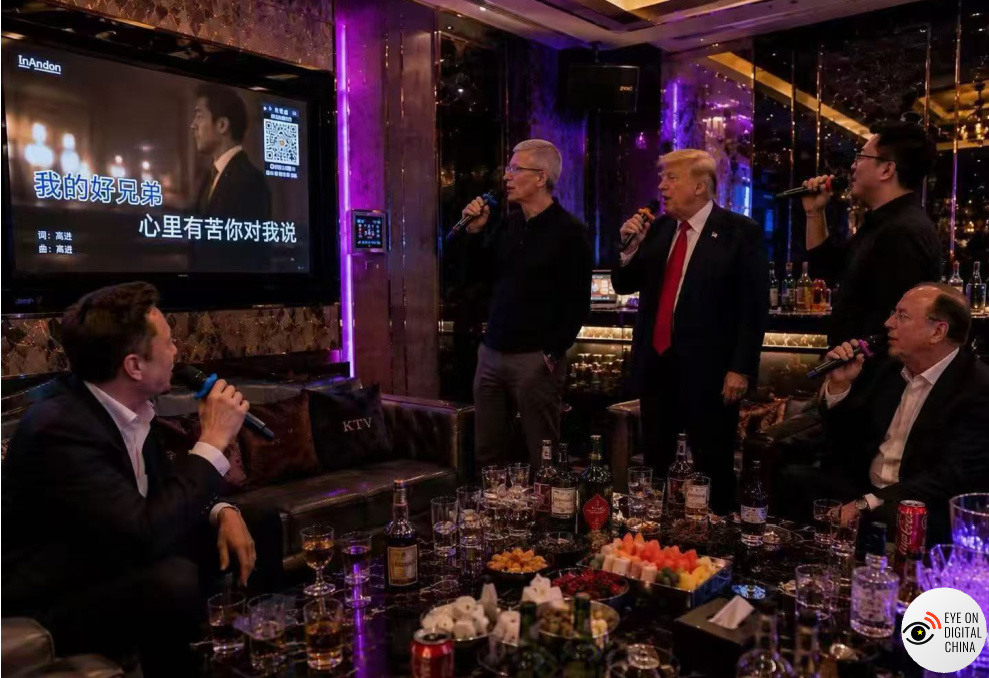
With the whisky bottles, fruit platters, and dim purple lighting, it is a classic Chinese KTV scene. The men sing “My Good Brother” (我的好兄弟) together, an appropriate song about friendship, loyalty, and supporting each other through difficult times.
🗣️ Quotes
🎙️ “The most important thing by far: Iran cannot have a nuclear weapon” (Donald Trump upon departure from D.C. to China).
🎙️ “There are those who say this is maybe the biggest summit ever. They can never remember anything like it. In the United States, people aren’t talking about anything else.” (Donald Trump during the bilateral meeting in the Great Hall of the People.)
-“It seems Trump was very happy with the welcome ceremony. This is a treatment he’s never enjoyed in the US, and the US probably could not organize a welcome ceremony on this scale.” (Popular Weibo comment after the welcome ceremony.)
🎙️ “The Taiwan issue is the most important issue in China–US relations. If it is handled properly, the overall relationship between the two countries can remain stable. If it is handled poorly, the two sides could face confrontation or even conflict, pushing the broader China–US relationship into a highly dangerous situation.” (Comments by Xi during bilateral meeting as reiterated by China’s Ministry of Foreign Affairs.)
🎙️ “This visit is a historic and landmark visit. Thus far, we have established a new bilateral relationship – a constructive strategic stable relationship – which constitutes a milestone event.” (Xi Jinping while hosting Trump in Zhongnanhai.)
🎙️ “The days of Trump’s visit to China were the most disciplined, most normal, and most presidential days since he took office.” (Blogger @许韬de微博 on May 15.)
🎙️ “The Chinese do not want to see this place—let’s just call it a place, because no one knows how to define it—go independent. I think they probably would do something pretty harsh, and then they would be met harshly and bad things will happen (..) But I’d like to stay the way it is (..) I don’t want anyone to become independent. Do we really have to travel 9500 miles to fight a war? I am not looking for that.” – (Trump in Fox News Special Report Spotlight, May 15.)
🎙️ “The great rejuvenation of the Chinese nation and making America great again can proceed in parallel, reinforce one another, and benefit the world.” (Chinese Foreign Minister Wang Yi on May 15 during a press briefing.)
🎬 Behind the Scenes
During a B-roll-style Fox News livestream that, for at least 90 minutes, showed little more than preparations and staff members walking around the Temple of Heaven grounds, one cameraman kept rolling during a notable confrontation between the U.S. press pool and Chinese security.
While Trump and Xi Jinping toured the historic site, journalists and some members of the U.S. delegation were directed into a holding room inside the temple complex. They protested, insisting they were part of the Trump motorcade. The four-minute clip—which I extracted from the two-hour livestream and posted here—ends with journalists physically pushing their way out to rejoin the motorcade, with one member of the group reportedly saying, “We’re leaving! Don’t treat others the way they treat us.”
The incident occurred around the same time that one of Trump’s Secret Service agents was reportedly denied entry to the complex because he was armed, causing a delay in the visit.
🎵 Soundtrack
During the banquet, the Military Band of the People’s Liberation Army (中国人民解放军军乐团), led by conductor Wang Dengmei (王登梅), performed a music program: the actual soundtrack of this trip, with some notable choices.

🎵 Yulin Folk Tune (榆林小曲) — Traditional northern Shaanxi folk music, highlighting Chinese regional culture.
🎵 America the Beautiful (美丽的阿美利坚) — Iconic patriotic song honoring the United States.
🎵 China in the Glow of Lights (灯火里的中国) — Contemporary song celebrating China’s prosperity and development.
🎵 Edelweiss (雪绒花) — Familiar American favorite from The Sound of Music, evoking warmth and nostalgia.
🎵 The Butterfly Lovers (梁山伯与祝英台) — Classic Chinese love story and one of China’s best-known orchestral works.
🎵 Sousa March Carnival (苏萨进行曲《童年华》) — Festive medley of classic American marches.
🎵 Under the Silver Moonlight (在银色月光下) — Beloved folk song symbolizing China’s ethnic diversity.
🎵 We Are the World (天下一家) — Message of global unity and cooperation.
🎵 As You Wish (如愿) — Popular modern Chinese ballad.
🎵 Can You Feel the Love Tonight (今夜爱无限) — Disney’s Lion King song emphasizing harmony and affection.
🎵 Ode to the Pear Blossom (梨花颂) — Peking opera-inspired piece showcasing traditional Chinese artistry.
🎵 Y.M.C.A. — Trump’s unofficial anthem and a lighthearted diplomatic gesture.
That’s a wrap!
Many thanks to Miranda Barnes for helping curate some of the most memorable memes.
By Manya Koetse
(follow on X, LinkedIn, or Instagram)
Spotted a mistake or want to add something? Please let us know in comments below or email us. First-time commenters, please be patient – we will have to manually approve your comment before it appears.
©2026 Eye on Digital China/Whatsonweibo. All rights reserved. Do not reproduce our content without permission – you can contact us at info@whatsonweibo.com.
Eye on Digital China is a reader-supported publication by
Manya Koetse (@manyapan) and powered by What’s on Weibo.
It offers independent analysis of China’s online culture, media, and social trends.
To receive the newsletter and support this work, consider
becoming a paid subscriber.


A Chinamaxxing Brand, a Stressed-Out Possum, and Japan’s Lost Decades

“Going to Town to Handle Business”: How Adidas Went from Hated in China to a Chinamaxxing Brand

Look Only at the Ugly Sides, and You Won’t See China

The Reunification with Taiwan is Hitting Chinese Cinemas This Summer

Comrade Trump Returns: The 2026 Trump–Xi Summit on Chinese Social Media

“Auntie Mei” Captured After 20 Years, China’s Train-Stain Scandal, and Zhang Xuefeng’s Final Lesson
Comrade Trump Returns: The 2026 Trump–Xi Summit on Chinese Social Media

Chinese Postdoc Death Raises Questions as Key Details Remain Missing

My Mum Has Two Husbands: The OPPO Mother’s Day Fiasco and 7 Other Gender Marketing Fails in China

The AI Actor Debate, Tragedy in China’s “Fireworks Capital,” and the Viral Labubu Fridge
-

 Chapter Dive11 months ago
Hidden Cameras and Taboo Topics: The Many Layers of the “Nanjing Sister Hong” Scandal
-
 China Insight11 months ago
“Jiangyou Bullying Incident”: From Online Outrage to Offline Protest
-

 China Arts & Entertainment9 months ago
The Wong Kar-wai Scandal Explained: The Dark Side of ‘Blossoms Shanghai’
-

 Chapter Dive12 months ago
The Next Labubu: What the Rise of Wakuku Tells Us About China’s Collectible Toy Wave