
China Trend Watch
China Trend Watch: Deadly Nanchang Stabbing, Animation Hit ‘Nobody’ & Diplomatic Rift over Dalai Lama
This is What’s on Weibo’s top 3 of what’s trending (Aug 12–13): public outrage over a fatal stabbing in Nanchang, the record-breaking Chinese animation hit Nobody, and China’s diplomatic freeze with the Czech president over a Dalai Lama meeting.


🔥What’s on Weibo’s Top 3: What’s Trending in China Today Stay updated with China Trend Watch by What’s on Weibo — your quick overview of what’s trending on Weibo and across other Chinese social media today. Trending topics all curated by me, with a little help from my AI sidekick.
1. Fatal Stabbing of 19-Year-Old Student at Popular Chinese Tourist Spot Sparks Public Outrage [#19岁女大学生景区内遭捅多刀身亡#, #19岁女生遭杀害男子有精神疾病史#]
A tragic fatal stabbing of a 19-year-old Chinese female at a popular scenic spot in Nanchang, Jiangxi Province, has shocked Chinese social media, with one related hashtag garnering over 620 million views in a single day (#19岁女大学生景区内遭捅多刀身亡#). The victim was attacked and stabbed over ten times by a 23-year-old man from Gao’an with a reported history of mental illness. The case has ignited heated debate over security measures at China’s scenic sites, gender-based violence, and the misuse of “mental illness” as a legal defense. “Again it’s a ‘mental illness’ case, again and again,” one Weibo user (@甜热热的小兔子) wrote: “In recent years, how many perpetrators in serious violent incidents have not been labeled as mentally ill? So having mental illness means you’re above the law, is that it?”
Manya’s Take:
In recent years, China has seemingly seen an increase in deadly incidents by “lone wolves” who are later said to be suffering from mental illness. The widespread frustration over this phenomenon on Chinese social media is, on the one hand, directed at Chinese state media and local public security authorities—although usually leaving out many details involving suspects and incidents, they do mention the mental illness background of the suspect. This is then seen as providing an “excuse” for unforgivable acts. On the other hand, it is also about a feeling of public unsafety—if people with supposed serious mental illness can just walk around freely everywhere, who is safe? Or, as one commenter in a popular thread put it: “Who takes responsibility?”

2. Chinese Animation ‘Nobody’ Becomes Top Domestic 2D Animation [#浪浪山小妖怪#]
It’s being called the “dark horse of China’s summer box office.” The latest Chinese animation hit Nobody (浪浪山小妖怪) has surpassed 615 million yuan ($85.6 million USD) as of Monday, overtaking China’s previous 2D animation record-holder Big Fish & Begonia (大鱼海棠) to top the domestic 2D animation box office chart. High ratings on Chinese review platform Douban (8.6) and strong merchandise sales have fueled the film’s momentum, sending multiple related hashtags to the top of Weibo’s Hot Search list these days.
Manya’s Take:
It’s a peak time for Chinese ACG (Anime, Comics, Games), from the global success of Ne Zha 2 (link) to the worldwide buzz around the game Black Myth: Wukong. While many styles and techniques in China’s ACG culture have traditionally drawn from Western pop culture or Japanese anime, the country is now producing strong homegrown works rooted in Chinese mythology. Like Ne Zha and Black Myth, Nobody is also inspired by the classic Journey to the West. The film incorporates traditional Chinese ink-wash and brushwork techniques, marking another step toward realizing China’s “animation dream” (link).
3. China Ceases All Contact with Czech President Over Dalai Lama Meeting [#中方决定不同捷克总统进行任何交往#]
China’s Ministry of Foreign Affairs announced on August 12 that it will cease all contact with Czech President Petr Pavel after he met with the 14th Dalai Lama during a visit to India, following his trip to Japan. Foreign Ministry spokesperson Lin Jian (林剑) said the meeting “seriously violated” political commitments made by the Czech government to China and harmed China’s sovereignty and territorial integrity. Lin stressed that China had repeatedly warned against the meeting and has lodged a formal protest with Prague, condemning Pavel’s actions as a “gross provocation.”
Manya’s Take:
These kinds of trending topics (geopolitical affairs + sensitive issues) are often hard to track — they can hit the top of the trending lists, yet are also highly controlled. Most comments on this topic support China’s decision and criticize the short-sightedness of European leaders in their dealings with China, suggesting that if they don’t take China seriously, they will face the repercussions.



China Trend Watch
“God Won’t Save Us, but the PLA Will”: Floods, Faith, and Kung Fu Soccer Nostalgia
Also: the Hong Kong bookstore arrests that did not go trending, AI bank cards, Haaland becoming China’s summer meme king, and a delivery rider winning the Lu Xun Literature Prize.

In this issue, I’m catching you up on the stories you need to know about, including the extreme weather and the noteworthy narratives surrounding it, China’s second “DeepSeek moment,” the nostalgic summer hit at the cinemas, how the Hong Kong bookshop raids did not go trending, and why “grassroots plagiarism-detection” is the word of the week.
🗞️ QUICK SCROLLS
😷 COVID-19 returned to the top of Weibo’s hot lists. Mainland China recorded 79,000 newly confirmed COVID-19 cases between June 1-30, including 130 severe cases and 1 death. In July, COVID numbers have continued to climb. This summer surge reignited discussions about wearing face masks and other precautions to avoid contracting COVID (again). One commenter wrote: “What do you mean, “COVID is back? It never completely went away!”
💳 Chinese banks are giving away AI tokens as loyalty rewards. Six of China’s major banks are launching “AI bank cards” – debit and credit cards – that come with token allowances and AI memberships from companies such as Kimi, MiniMax, Alibaba Cloud, and Tencent instead of traditional perks like coffee coupons or travel benefits. The moves show new ways for traditional banks to embrace the AI boom.
👑 Erling Haaland has become China’s meme king for summer 2026. The Norwegian striker became the biggest viral sensation of the 2026 World Cup on Chinese social media, where his combination of monstrous goal-scoring, Viking-like appearance, and cheeky behavior (such as drinking his opponent’s water during matches) made him irresistible and highly ‘memeable’ to netizens. Haaland also joined the fun on Douyin, where he soon had over 7.3 million followers (& counting).
📚 China’s best-known “delivery poet” has won one of the country’s highest literary awards. Former delivery rider Wang Jibing (王计兵), known as China’s “delivery rider poet” (外卖诗人), is receiving renewed attention after his poetry collection Flying Low (低处飞行) was first shortlisted and then won the prestigious Lu Xun Literature Prize. The 56-year-old first rose to fame in 2022 for writing relatable poems on scraps of paper between food deliveries, and he is the first delivery rider to ever win the award.
🚗 A parking dispute between an ordinary citizen and a local official turned into one of China’s biggest online discussions recently. What started with a Changsha resident finding his privately owned parking space occupied by the car of a government official spiraled into a days-long standoff involving police, mediation, and a social media circus. For netizens watching the story unfold, it wasn’t about parking space but about abuse of power and privilege.
📸 An AI-generated “photo” won first prize in a much-discussed photography contest. The contest was organized by the Federation of Literary & Art Circles in Hohhot, the capital of Inner Mongolia. It was only after it became the winning entry that the picture, showing sanitation workers laughing in the sun, was discovered to be AI-generated. For now, the federation has not only revoked the award but also canceled the entire competition to reflect and do some soul-searching (officially: “carrying out a comprehensive review and rectification process”) in these confusing AI times.

The “photo” that originally won the contest in Hohhot before the organizers discovered it was AI-generated.
🚖 Baidu is doing the Belt and Road by robotaxi. On the sidelines of the World Artificial Intelligence Conference (=WAIC, where Xi Jinping personally delivered the opening keynote), Baidu signed a partnership deal to bring its robotaxi service, Apollo Go (萝卜快跑), to Kazakhstan, marking its first major expansion into Central Asia. Apollo Go, with a strong focus on international expansion from Germany to Dubai, has already facilitated 22 million rides worldwide.
🌙 Overnight, everybody is talking about K3, the latest model by the Beijing-based Moonshot AI (月之暗面). Released just before the WAIC, Kimi K3 is now the world’s largest open-source model with 2.8 trillion parameters. Compared to Western counterparts, it stands out for its affordability and coding capabilities. Kimi K3 is available through Moonshot’s own website and API, but they promised to release the full downloadable version around July 27. That would make it the largest, most powerful AI model ever made freely available for download. Some are already calling this a second “DeepSeek moment.”
👁️ EXPLAINER
“God Will Not Save Us, the PLA Will”: Extreme Weather Highlights Divisions, but Official Narratives Stress Unity

“Dear, you Chinese are very strange,” says a Western woman at the start of a video recently posted on social media, questioning why Chinese people don’t share a collective belief in God.
The video appeared after the floods in Guangxi earlier this month—marking the beginning of an extreme summer weather period that disrupted daily life, flooded villages, and caused buildings to collapse.
Starting on July 4, Typhoon Maysak wreaked havoc in Guangxi, where the breach of the Liulan Reservoir led to massive floods (see videos). Farms became completely submerged, while snakes escaped from breeding facilities into nearby villages (one woman in Hengzhou died after getting bitten). At least 39 people were killed in the floods.
Severe storms also killed eleven people in Hubei, while a rain-triggered landslide left 21 dead in Gansu. In Liaoning, more than 260,000 people had to evacuate their homes as Typhoon Bavi brought intense flooding. On July 17, a massive hillside collapse in Pengshui County, Chongqing, left at least eight people dead and 34 missing.
Despite the devastation, there were also more lighthearted moments surrounding the extreme weather. Residents in Shanghai, Jiangsu, and Zhejiang prepared for Bavi with the so-called “Bavi Shopping Festival” (巴威购物节), using the weather as an excuse to stock up on food and snacks and treat themselves while staying indoors.
Although many joined in on the fun, the trend also triggered criticism. Some argued that turning a natural disaster into a “festival” trivialized the suffering of those affected. It also highlighted a rural-urban and labor divide. While some residents in Shanghai’s high-rise buildings could turn the weather into a moment of comfort, delivery riders and public cleaners had to continue working. Meanwhile, farmers in Guangxi (affected by Maysak) saw their livestock drown.
There was also criticism that celebrity gossip climbed higher on the trending charts than the deadly Guangxi floods. Questions arose about why the Liulan Reservoir, a major water infrastructure project, had suffered a breach and why residents of local villages allegedly weren’t told to evacuate.
But the main message from Chinese officials was one of unity, strength, and collective faith in times of crisis.
One particularly noteworthy 3.5-minute AI-made video contrasted Western spiritual beliefs with Chinese trust in the authorities. Posted on X by the Chinese Consul in Osaka and also shared across Douyin, Bilibili, Facebook, and Instagram, it was titled: “Your God May Not Save You, but the People’s Liberation Army Will” (你的神或许不会救你!但是人民子弟兵会!).

The video shows a Western woman and Chinese man having a romantic dinner after which the sky darkens and a dam breaks. Calling the flood “Satan’s tears,” she insists that God will save them.
“God won’t save us,” he says. “But…”

The video then shows the PLA coming to the aid of people in need. As the Chinese man carries a little girl out of a flooded school, she asks: “Will we die, uncle?”
“No,” he says. “The PLA has already come.”

After being rescued, the woman observes the soldiers working in the rain and sacrificing their own needs to serve the people. She says:
“That day, I saw a miracle. They didn’t come down from the sky, and there was no parting of the Red Sea. But whenever they heard someone crying out, they rushed over. When they saw danger, they stepped up. They don’t believe in God, but they believe in the people.”
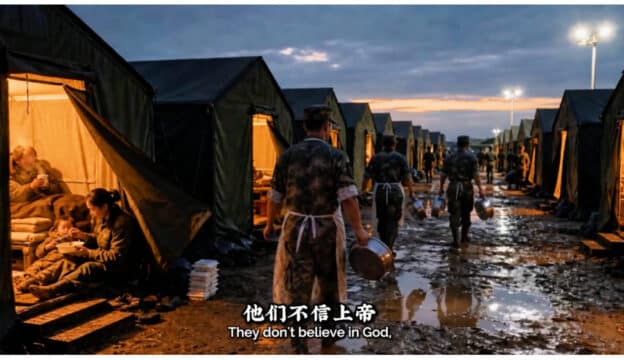
Mixing actual footage of PLA rescue operations with AI-generated scenes, the video portrays the PLA as a “miracle” of modern-day China. In doing so, it creates a dichotomy between passive, hopeless Western belief in divine intervention and proactive, optimistic Chinese trust in the power of the Party and the PLA.
Similar narratives are widespread on Chinese social media, where hashtags such as “The Chinese-style unity foreigners will never understand” (#外国人永远无法理解的中国式团结#) are used to share images of rescue workers helping people.

Although narratives of unity are part of the propaganda playbook in times of crisis, these state-centered stories of national resilience and strength truly resonate, especially among netizens whose brothers, fathers, cousins, or friends are serving in the military or involved in rescue efforts.
These messages draw on public solidarity and boost collective belief that China is strong because the people, the Party, and the PLA stand together in times of disaster. In doing so, they also redirect attention away from more uncomfortable questions of responsibility and the divisions exposed during times of crisis.
One Douyin commenter replied:
“Please remember that the People’s Army we cherish and support is led by the Communist Party of China. So don’t let the trivial frustrations of everyday life, personal disappointments, or attempts by internet trolls, agenda-pushers, and ‘[foreign] colonizer dogs’ to sow division and make you abandon our true faith.”
Another person wrote:
“The gods will not save the people, but the people will save the people.”
📱ON THE FEEDS
“Kung Fu Soccer” Scores for Cartoonish Moves and a Sense of Nostalgia

The latest movie by Hong Kong comedy legend Stephen Chow (周星驰), Kung Fu Soccer (功夫女足), has become a social media breakout hit this summer.
The film is a spiritual successor to Chow’s 2001 classic Shaolin Soccer (少林足球), this time swapping genders and focusing on a Chinese women’s team that combines kung fu with football and competes in the AFC Women’s Champions League.
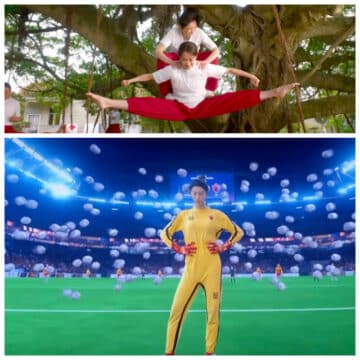
Scenes from “Kung Fu Soccer”
Although opinions on the comedy are polarized (it has only received a 6.5 rating on Douban), the film, featuring stars such as Zhang Xiaofei (张小斐), Dilraba Dilmurat (迪丽热巴), and Lay Zhang (张艺兴), passed 1.2 billion yuan (US$177.1 million) at the box office within a single week. It is also all over Chinese social media feeds thanks to its anime-like moves, comic dialogue, and numerous Easter eggs.
For many viewers, the film evokes a sense of nostalgia, bringing back memories of Shaolin Soccer and how it made them feel at the time.
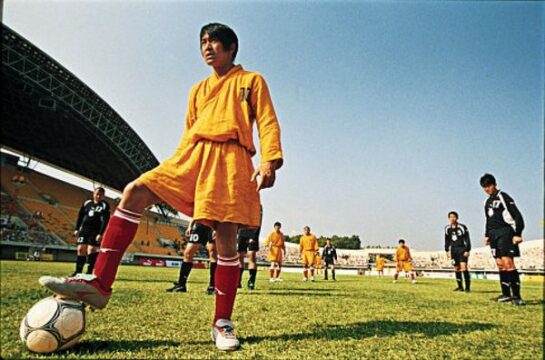
From 2001 Shaolin Soccer
One Xiaohongshu user wrote after seeing the film:
“The fire inside me is still there. As a kid, I watched Shaolin Soccer and remembered the line: ‘If a person has no dreams, what’s the difference between them and a salted fish?’ (做人如果没有梦想,跟咸鱼有什么分别) […] Maybe the fire doesn’t burn as fiercely as it did when I was younger. But it hasn’t gone out.”
WHAT’S NOT TRENDING
Hong Kong’s Bookstore Arrests and the Silence on China’s Social Media
One story of great significance this week, despite not trending at all, is the recent round of bookstore arrests in Hong Kong. Following similar operations in March and June this year, authorities targeted the “Have a Nice Stay” (留下书舍) and “Greenfield Bookstore” (田园书屋) shops in the Mong Kok area this time. Both are being investigated for selling “seditious” publications, and five people were arrested.
One much-shared clip showed a female bookstore employee being taken away wearing a simple black T-shirt with the words “I am bookstore staff”, almost turning the phrase into a defiant slogan.
It’s noteworthy that although news of the raids has been widely discussed on X and covered by international media, it has barely circulated on mainland Chinese social media. At the time of writing, I could find just two Weibo posts about the arrests. One was published by a nationalist blogger who wrote: “Good work! Crack down as soon as they rear their heads! ✊”
Another commentary by pro-Beijing Hong Kong commentator “Ko Sir” (@香港高Sir高松杰) described the bookstore employee’s T-shirt as a deliberate attempt to “win sympathy” and “conceal a crime.” Ironically, Ko Sir also saw his own post censored, as two of the four images he posted were taken offline.
🀄 ONLINE PHRASE OF THE WEEK
“Grassroots plagiarism-detection”
民间鉴抄 (mínjiān jiànchāo)

Recently, the phenomenon of “grassroots plagiarism-detection” 民间鉴抄 (mínjiān jiànchāo) and “plagiarism-checking bloggers” 鉴抄博主 (jiànchāo bózhǔ) have received spotlight attention in China.
民间鉴抄 (mínjiān jiànchāo) is a word to describe how ordinary internet users independently scrutinize books, theses, and other publications for signs of plagiarism.
The phenomenon first gained attention in 2024 and reached a climax this week, when two well-known writers were exposed for plagiarism and had their academic degrees revoked. The cases concern Jia Qianqian (贾浅浅), a poet and the daughter of the famous Chinese author Jia Pingwa (贾平凹), and Jiang Fangzhou (蒋方舟), a former child prodigy-turned-writer.
The reason both writers lost their credentials within just a few days of each other is that their theses were flagged for plagiarism by the enthusiastic book blogger Wang Hao (王浩). Writing under the alias “Lyrical Forest” (抒情的森林), he began checking well-known literary authors for academic plagiarism in 2024 after discovering a plagiarized passage in a book by coincidence. He has since uncovered suspected plagiarism involving nearly forty well-known authors, including Jia Qianqian and Jiang Fangzhou.
In this case, both Renmin University, where Jiang earned her master’s degree, and Shaanxi Normal University and Northwest University, where Jia earned her degree and obtained her teaching qualifications, took action following the allegations.
Many netizens applaud this kind of plagiarism detection: if the authorities do not check, it is up to the people. In their eyes, this is not just about individual cases of plagiarism, but about a deep-rooted problem of academic misconduct in China and the power dynamics that perpetuate it. For now, it looks like “grassroots plagiarism detection” is here to stay, especially as long as formal institutions fail to address these problems.
That’s a wrap! Thanks to Miranda Barnes, who contributed to multiple topics discussed in this edition.
Eye on Digital China, by Manya Koetse, is co-published on Substack and What’s on Weibo. Both feature the same new content — so you can read and subscribe wherever you prefer. Substack offers community features, while What’s on Weibo provides full archive access.
Spotted a mistake or want to add something? Please let us know in comments below or email us. First-time commenters, please be patient – we will have to manually approve your comment before it appears.
©2026 Eye on Digital China/Whatsonweibo. All rights reserved. Do not reproduce our content without permission – you can contact us at info@whatsonweibo.com.
China Memes & Viral
Auntie Goose Legs, China’s Shrinking Condom Market, and DeepSeek’s AI Blind Spot
If it walks like a duck, it might just be Auntie Goose Legs. A wrap-up of noteworthy trending stories in China. From the real Rolex recruiting fake crowds to diaper scares & a funny Deepseek moment.
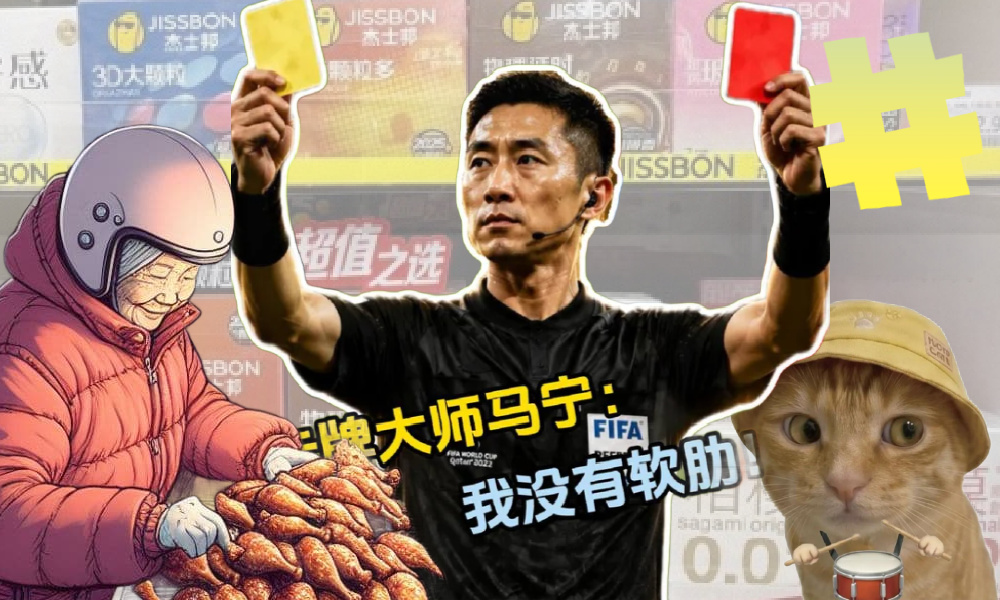
🔥 China Trend Watch (week 25 | 2026) Part of Eye on Digital China, this is my premium newsletter where I explain the stories, memes, debates, and viral moments shaping online conversations in China. This edition was sent to paid subscribers — subscribe to receive the next issue in your inbox.
China celebrated the more than 2,000-year-old Dragon Boat Festival (端午节) holiday this Friday, so I wish you health, good luck, and plenty of zongzi (sticky rice dumplings) and dragon boat races – they’re now held in many places around the world and are continuing into the weekend anywhere from Toronto to Dresden.
In this newsletter, you will find the trends and stories that caught my attention this week. This edition includes one longer read alongside a handful of shorter stories.
I always just start working on stories and noteworthy trends for the newsletter during the week, and often only discover an overarching theme later. This time, I realized that from the goose aunt who turned out to be suspiciously “quacky,” to Lululemon presenting Japanese drums as ‘truly Chinese,’ and trusted diaper brands being exposed for toxic chemicals, recent online discussions in China seem to revolve around similar questions: what is real, who can be trusted, and where do we find authenticity in a world where things are increasingly not what they seem? It is perhaps one of the reasons why the Chinese World Cup referee who is painfully straightforward in handing out red cards is now so beloved by the public.
With that in mind, here are the social media stories, debates, and internet moments you should know about this week 👇
🔍 EXPLAINER
Why One Beijing Street Vendor Sparked a Nationwide Debate

If it walks like a duck and quacks like a duck, it might still be a goose – or the other way around. That, at least, is the takeaway from two stories that recently went viral on Chinese social media.
The woman at the center of it all is Beijing street-food vendor Chen Xiufeng (陈秀凤), better known as “Auntie Goose Legs” (鹅腿阿姨). Over the years, she became something of a local celebrity in Beijing’s university district. Originally from Jiangsu, the migrant vendor had been selling her famous roasted goose legs to students since 2011.
She skyrocketed to national fame in 2023 , but became the target of widespread criticism last week after it was revealed that her celebrated goose legs – sold for 16 yuan ($2.20) per piece – were actually duck meat all along.
The controversy came up after the vendor ventured beyond the university area into Beijing’s business district. At the universities, she enjoyed a loyal customer base and dedicated WeChat groups. In her new market, however, customers proved more skeptical. Some noticed that the meat looked suspiciously duck-like; others complained that the color seemed off.
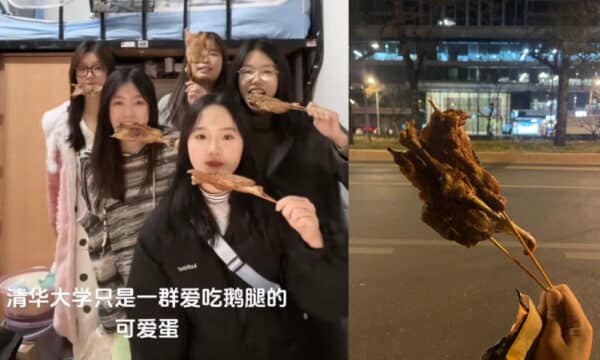
In the university district, Auntie Goose Legs she enjoyed a loyal customer base and dedicated WeChat groups.
After the first complaints surfaced, Auntie Goose Legs admitted the truth on WeChat on June 9.
“The ingredients I originally used were goose legs,” she wrote, “but they have been out of stock for more than fifteen years. The current ingredient is duck legs.”
It turned out that she had only sold goose legs, the product that made her famous, for two months back in 2011 before switching to the much cheaper duck. “Did geese become extinct without us knowing?” some netizens joked.
The revelation quickly exploded online. The hashtag “What Auntie Goose Legs is Selling Turns Out to be Duck Legs” (#鹅腿阿姨卖的是鸭腿#) became the top trending on Weibo for an entire day, with millions of people discussing the topic.
Why did millions of people become so outraged over a single Beijing street vendor selling duck instead of goose?
Piggybacking on the debate, Anhui-based commentators pointed out that a beloved regional specialty has the exact opposite ‘problem.’ Wuwei smoked duck (无为板鸭) is branded as duck, but is usually goose. According to local standards, however, goose products may be sold under this name, prompting discussions about “hanging up a goat’s head, while selling dog meat“ (挂羊头卖狗肉): advertising one thing while selling another.
Because geese are more expensive than ducks in China, and generally considered tastier, the Anhui duck-is-goose story, unlike the Auntie Goose Legs controversy, did not provoke online anger. Instead, many people saw it as an example of sellers prioritizing flavor over cost. Auntie Goose Legs is seen as doing the exact opposite.
But why did millions of people actually become so outraged over a single Beijing street vendor selling duck instead of goose, especially when there were no indications that anyone became ill? The answer has little to do with poultry and everything to do with trust.

Auntie Goose Legs during the prime time in Beijing’s University District in late 2023 (image via Lianhe Zaobao 联合早报).
Food fraud and mislabeling have been longstanding concerns in China. Earlier surveys found that food safety worries even outweighed concerns about public security and environmental issues, and while China’s food safety record has improved in recent years, public trust remains fragile.
Part of these concerns are immediate and practical. Major scandals in the past involving melamine-tainted infant formula or recycled “gutter oil” have posed serious risks to public health. But the issue goes beyond health risks alone.
If a goose can be a duck, then what exactly is the duck?
Whereas food safety concerns in many Western countries often focus on contamination, Chinese consumers are frequently just as concerned with economic deception. It is unfair to pay for a more expensive goose and receive a duck. Even if no one gets sick, Chinese consumer law still treats it as fraud.
More important, however, is what such deception does to confidence in the broader food system. If a goose can be a duck, then what exactly is the duck?
As a major 2023 college canteen scandal demonstrated, the build-up of deceit can reach a breaking point among the public. During that somewhat Kafkaesque “rat head or duck neck” (鼠头or鸭脖”事件) controversy, officials insisted a rat head found in a student’s rice was merely a “duck neck,” even though everyone could clearly see the snout and teeth of a rodent.
This kind of gaslighting shatters social trust and reinforces a generalized sense that, as a consumer, you are entirely on your own. When regulators fail to step in honestly, even a seemingly isolated incident comes to symbolize more dangerous forms of systemic food fraud.
And this is where the Auntie Goose Legs story stings the most.
People did not come to her simply because her food was good. Over the years, she had become part of local student life, and she felt safe and authentic. Her pink scooter helmet, which she continued to wear while working, became an iconic symbol of her no-nonsense and humble image. Her success was built on word of mouth and, above all, on the trust her customers placed in her.
That this particular “auntie” deceived her customers by selling a different product than the one she advertised is no longer really about her. If duck is goose, goose is duck, and your local auntie has deceived you for years, then who can you trust anymore?
👁️ WHAT STOOD OUT
1. China’s Condom Market Shrinks 25% in Four Years

China’s biggest condom brand is being sold off, facing a market where fewer people are buying condoms. The brand is Jissbon (杰士), and the company behind it, Renfu Medical (人福医药), recently announced it would sell its stake in the international parent company that owns Jissbon and exit the condom business entirely.
Founded in 1998, Jissbon was once considered a “profit cash cow,” but this is already the third time it has been sold. As one commenter wrote, “Now even the parent company doesn’t want it anymore.” Jissbon is not the only brand struggling in China’s condom market, which shrank by 25% between 2020 and 2025, with all leading brands seeing sales drop by 15–20% (#避孕套销售缩水25%#).
The decline is linked to multiple factors, such as the rising popularity of oral contraceptives and other birth control methods. But alongside China’s rising single market, sex toys have been booming, reflecting a shift from two-person dating life to “private solo consumption,” as Chinese media outlet Dushi Kuaibao (都市快报) put it.
2. China’s World Cup Pride: Ma Ning, the Card Master
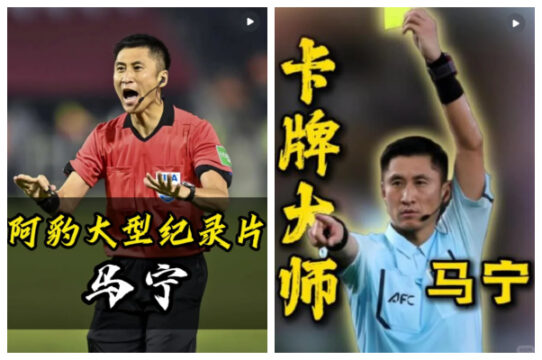
Even though Team China is not participating in the World Cup, Chinese referee Ma Ning (马宁) is, and he has become a viral talking point and a source of national pride. Ma is only the second Chinese central referee in World Cup history, 24 years after the lauded Chinese football referee Lu Jun (陆俊).
On Chinese social media, Ma is also nicknamed the “Grandmaster of Cards” (卡牌大师 kǎpái dàshī) for his strict, no-hesitation approach to handing out cards. During one infamous Shanghai match, he issued a total of nine yellow cards and three red cards.

AI-generated image of Ma Ning on Xiaohongshu, showing him arriving at the World Cup with his suitcases filled with red and yellow cards.
Chinese social media is now full of creative images celebrating Ma Ning, often depicting him handing out cards. Although strict referees are usually not that popular among football fans, for Ma it is the opposite: he is actually praised by Chinese fans for being honest, unyielding, and having “no soft spot” (没有软肋).
Ma has been assigned to referee Ecuador vs. Curaçao, scheduled for June 20 (this Saturday). Millions of Chinese fans are definitely tuning in.
3. Rolex Accused of Hiring 3,000 Paid Attendees
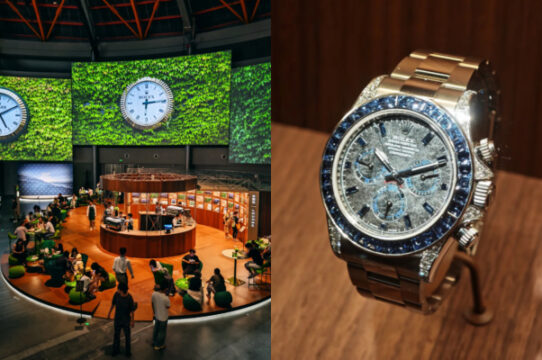
Rumors that Rolex recruited around 3,000 paid crowd extras to make its 100th-anniversary “Oyster Story” temporary exhibition in Shanghai, which opened on June 10, appear more popular than it actually was have sparked discussions on the Chinese internet.
The rumors surfaced after members of the so-called “crowd-filler” (群演 qúnyǎn) groups were allegedly promised 75 yuan (US$11) to attend, only to see the fee drop to 55 yuan (US$8.15) per person. Some claim they have not been paid at all, while others say they were removed from group chats after complaining.
It is not unusual for brands and companies in China to pay people to hype up an opening or stand in line to create queues that attract actual customers. But the idea that one of the world’s most prestigious watchmakers would need fake social engagement to drive exhibition attendance is being seen as another sign that the foreign luxury-brand boom in China has cooled down significantly. (I also wrote about this last week in the context of Nike’s declining popularity.)
4. Lululemon Beating the Wrong Drum
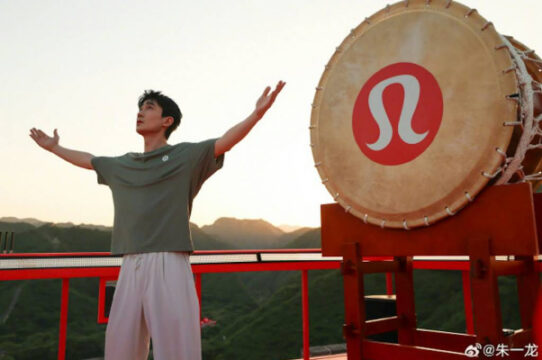
One of the most talked-about brand-related stories this week has been how Canadian athletic apparel brand Lululemon made a culturally sensitive faux pas. The company staged a yoga-themed event at the Great Wall of China featuring Chinese actor Zhu Yilong (朱一龙) and a giant drum. It was meant to represent a “Chinese grand drum” at one of the country’s most famous cultural landmarks – but it turned out to be Japanese taiko drums (日本太鼓).
A familiar playbook unfolded: netizens were outraged, online discussions exploded, and Lululemon scrambled to apologize. In this case, the mistake was especially sensitive. The Great Wall carries immense historical significance and is seen as a symbol of Chinese national identity, and using Japanese drums there – particularly at a time when Sino-Japanese political relations are tense – is viewed not as a simple prop mistake, but as a complete and “disrespectful” failure to get cultural symbolism right. Ouch.
5. China’s Diaper Safety Scandal
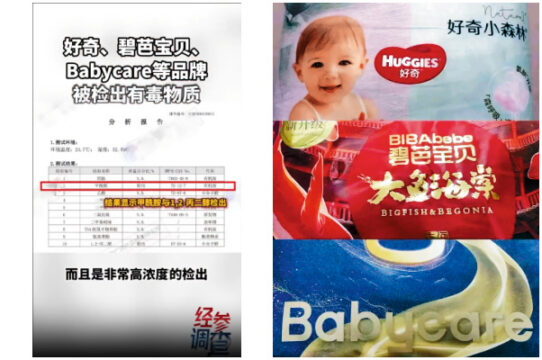
After this week, most parents in China will know what formamide is: a hazardous chemical classified as a reproductive toxin in the EU. The compound started trending after Chinese state media newspaper Economic Information Daily (经济参考报) reported that three popular diaper brands — Huggies (好奇), BIBAbebe (碧芭宝贝), and Babycare — contain the substance, with blood formamide levels reportedly doubling after wearing a diaper overnight (the reporter even wore one to test). The investigation followed online complaints from parents whose infants developed redness or skin irritation after diaper use.
Formamide (甲酰胺, jiǎ’án’àn), the chemical at the center of the controversy, is explicitly banned in China’s cosmetics regulations, but is not included in China’s mandatory national testing standards for infant hygiene products. Long-term exposure may affect the reproductive system while also causing chronic liver and kidney damage.
This story is still developing at the time of writing. The brands involved have all responded that they’re complying with relevant national standards for baby diapers and/or that their in-house testing could not detect formamide. Still, many questions are left unanswered. Although this story can be placed in a broader string of controversies surrounding food & product safety, this one hits especially hard because it concerns the safety and health of China’s most vulnerable: its babies.
📱ON THE FEEDS
Award-Winning Actress Uses Teleprompter on Stage
An award-winning Chinese actress using a teleprompter in her latest stage play at the Aranya Theatre Festival is sparking debate after audience members revealed that, in addition to relying on a teleprompter, she at times allegedly even read directly from a physical script.
The actress in question is Zhou Dongyu (周冬雨), considered one of the best actresses of China’s post-90s generation. With tickets for City of Fiction (文城) — a stage adaptation of the novel by Yu Hua — costing between 480 and 880 yuan (US$70–130), viewers took to Xiaohongshu and Weibo to voice their frustration after seeing the play.
“It’s simply not worth paying so much money to basically watch a rehearsal,” one commenter wrote.
Recently, there have been many discussions within China’s arts and entertainment world on what’s real and what’s not. In an age of AI-generated dramas and actors, audiences are increasingly looking for authenticity and genuine productions. The surprising success of the underdog local-dialect film Dear You (给阿嬷的情书, Love Letters to Grandma) is perhaps the best example of this trend. As for a stage performance starring one of China’s most celebrated actresses, audiences expect a higher standard and are disappointed when it feels “fake.”
DeepSeek Can’t Recognize Its Own Founder

China’s major AI startup DeepSeek (深度求索) made headlines this week after confirming its first-ever external funding round on June 16. The company reportedly raised over 50 billion RMB (approximately US$7.4 billion), making it the largest single funding round in Chinese AI history.
Alongside this serious news, however, a much more amusing story also started trending. On June 18, DeepSeek launched an image recognition feature on its web version, only for users to discover that it could not even recognize Liang Wenfeng (梁文锋) — the company’s own founder. In some cases, DeepSeek identified Liang as Moonshot AI founder Yang Zhilin (杨植麟) or even as a younger version of Tencent CEO Pony Ma (马化腾). Liang still has some work to do 😂.
🀄 ONLINE PHRASE OF THE WEEK
‘Shenzhen Airport Says Sorry’ Returns: “sorry全场” (sorry quánchǎng):
It’s that time for “Shenzhen Airport Says Sorry” (hashtag: #深圳机场sorry#): an ongoing joke on Chinese social media about Shenzhen Bao’an International Airport and its chronic flight delays during the rainy season, when one gate announcement after another says, “Sorry to inform you…” [that your flight has been delayed], and departure boards turn orange with delays and red with cancellations.
Because of the endless announcements and the airport’s PA system repeatedly saying “sorry” to passengers during mass flight delays, netizens have jokingly started referring to these airport-wide apologies as “sorry全场” (sorry quánchǎng), “sorry, everyone” or “apologies for everyone.”
It’s partly the force majeure nature of the delays and partly Shenzhen Airport’s proactive and overly apologetic response style that people have come to view with a sense of humor.
On June 18 alone, more than 400 flights were delayed due to thunderstorms and heavy rain. On June 19, netizens once again wrote: “It’s another ‘sorry全场’ day at Shenzhen Airport.”
By now, the phrase has become a meme. When Hong Kong Airport recently did not apologize for its delays, some netizens commented that the least it could do was to issue a “sorry全场.” The expression has also started appearing in unrelated contexts: if you want to jokingly apologize to an entire room in a routine and matter-of-fact way, it’s now perfectly acceptable to say “sorry全场.”
Also, perhaps it’s interesting to note what wasn’t necessarily trending this week. I found that the G7 summit hasn’t been a particularly big topic on Chinese social media. Meanwhile, the 618 shopping festival, now in its 16th year, still matters but no longer dominates online conversations as it once did.
Hope you all enjoy this weekend’s games, if you’re watching, and the remainder of the Dragon Boat Festival.
If you enjoyed this newsletter, please share it with your colleagues and China-focused friends, and encourage them to subscribe, too. Every new subscriber helps support my work. Thanks!
Best,
Manya
Eye on Digital China, by Manya Koetse, is co-published on Substack and What’s on Weibo. Both feature the same new content — so you can read and subscribe wherever you prefer. Substack offers community features, while What’s on Weibo provides full archive access. If you’re already subscribed and want to switch platforms, just get in touch for help. If you no longer wish to receive these newsletters, or are receiving duplicate editions, you can unsubscribe at any time.
Eye on Digital China is a reader-supported publication by
Manya Koetse (@manyapan) and powered by What’s on Weibo.
It offers independent analysis of China’s online culture, media, and social trends.
To receive the newsletter and support this work, consider
becoming a paid subscriber.


“God Won’t Save Us, but the PLA Will”: Floods, Faith, and Kung Fu Soccer Nostalgia

“Even Pigs Have AC”: The European Heatwave Through Chinese Eyes

China’s CITIC Tower Crash: The Story That Never Trended

Quack Like a Goose: Why Beijing Street Vendor “Auntie Goose Legs” Sparked a Nationwide Debate

Auntie Goose Legs, China’s Shrinking Condom Market, and DeepSeek’s AI Blind Spot

Comrade Trump Returns: The 2026 Trump–Xi Summit on Chinese Social Media

My Mum Has Two Husbands: The OPPO Mother’s Day Fiasco and 7 Other Gender Marketing Fails in China

The AI Actor Debate, Tragedy in China’s “Fireworks Capital,” and the Viral Labubu Fridge
Auntie Goose Legs, China’s Shrinking Condom Market, and DeepSeek’s AI Blind Spot

The Reunification with Taiwan is Hitting Chinese Cinemas This Summer
-

 China Insight12 months ago
“Jiangyou Bullying Incident”: From Online Outrage to Offline Protest
-

 China Arts & Entertainment10 months ago
The Wong Kar-wai Scandal Explained: The Dark Side of ‘Blossoms Shanghai’
-

 Chinese New Year5 months ago
Inside Chunwan 2026: China’s Spring Festival Gala
-
 China Society11 months ago
The Rising Online Movement for Smoke-Free Public Spaces in China