SubscribeLog in
Connect with us

China World

From Schadenfreude to Sympathy: Chinese Online Reactions to Charlie Kirk Shooting

From mockery of his pro-gun stance to posts over America’s deepening divisions, Chinese social media responds to the Charlie Kirk shooting.

Manya Koetse

Published

on

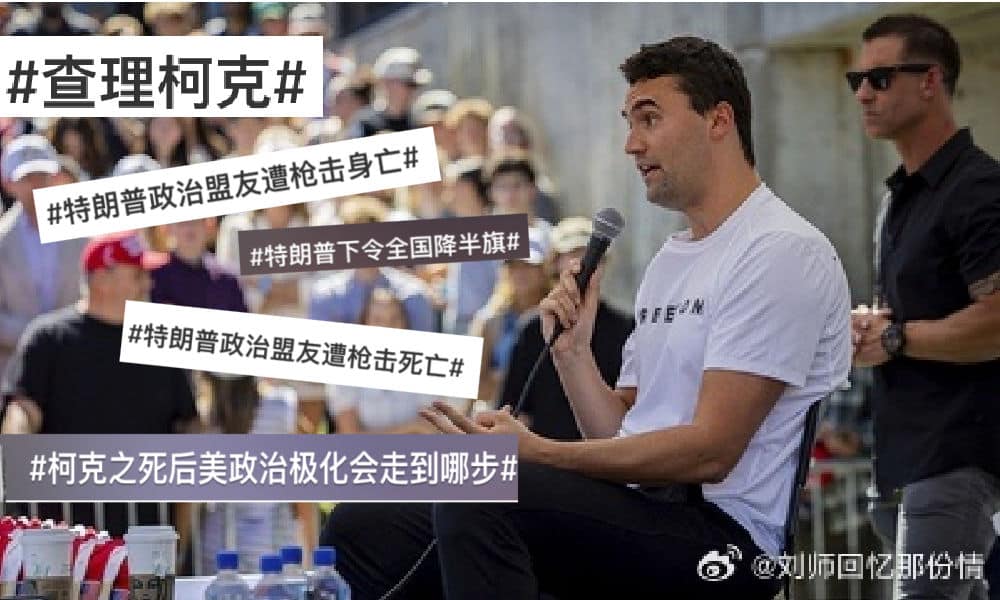
The assassination of prominent American activist and Trump ally Charlie Kirk, 31, became a trending topic on social media all over the world, including on Chinese social media platforms Weibo, Douyin, Toutiao, and Zhihu.

Kirk was shot on September 10 while speaking at an event at Utah Valley University in Orem, Utah. At the time of writing, a suspect was apprehended after a manhunt of two days (#特朗普称柯克枪击嫌疑人已被拘留#).

Using hashtags such as “Trump’s Political Ally Shot While Speaking” (#特朗普政治盟友演讲时遭枪击#), Chinese media outlets, online commentators, and regular netizens have been discussing Kirk’s death, with a focus on Kirk’s ideologies and the deeper issues in the United States that may have contributed to him being shot.

Although Charlie Kirk (查理·柯克) is not widely known among the mainstream Chinese audience, avid social media users are familiar with him. His past videos, with added Chinese subtitles, are popular on platforms like Bilibili, and his persona and viewpoints have sparked debate on sites like Zhihu.

Charlie Kirk is a highly visible figure on global social media for engaging in face-to-face debates with left-leaning students (or anyone who disagrees with him) on university campuses in the United States and even in the United Kingdom. These debates often became heated, as they touched on some of the most polarizing political issues.

Kirk defended his anti-abortion, pro-gun, pro-Trump, and anti-immigration stances and criticized transgender identities and same-sex marriage.

There are various discussions on Chinese social media related to his death.


1. No Sympathy: Linking Kirk’s Death to His Pro-Gun Advocacy


A central part of the discussions surrounding Kirk’s death on Chinese social media focuses on American gun laws and Kirk’s own views on gun control.

On Zhihu and Weibo, many commenters echoed a sentiment also seen on Western social media, noting the irony of Kirk being killed while advocating for gun rights. In 2018, Kirk tweeted about a mass shooter being shot, writing: “guns save lives” (#查理柯克宣扬枪支拯救生命#).

Kirk was discussing and defending his pro-gun stance in Utah at the moment he was shot.

With this in mind, as well as taking Kirk’s other conservative viewpoints into account, many Chinese netizens do not necessarily empathize, with some even creating light banter around his death.

One popular comment on Weibo said:

“This person once publicly stated that in order to uphold the Second Amendment, having some shootings occur each year is a price worth paying.”

Others claimed that Kirk “got what he wanted”:

“This guy really achieved the gun freedom he always talked about; this is what he supported, and he got what he wanted, serving as an example.”

This sentiment was quite prevalent on Chinese social media, where others also stressed that the very gun freedoms Kirk advocated for ultimately killed him, calling it the “gunshot of freedom” (“自由的枪声”).

Another commenter (元锡损) on Zhihu even described the killing of Kirk as a form of “art,” presuming that he was shot by someone who opposed gun ownership:

“Kirk was just a sophist. The person who hit him with a bullet in the throat was an artist. What makes this art is how the actions of both sides were the exact opposite of the ideas they each claimed to support, yet this very contradiction ironically proved each side’s point. Charlie claimed guns save lives, but he died. The other side believed guns should be banned, yet they shot and killed someone. Charlie’s death shows that having guns really can be used to fight for your interests. The killer’s act shows that only banning guns can actually protect people’s lives. And the fact that the shot hit his neck — whether or not it was by chance — is deeply symbolic: guns mute people.”

But some argue it all goes beyond a pro-gun stance, like the international news commentator Zhu Xi Er Ming (@逐汐而鸣), who also showed little empathy for Kirk:

“Many people in China keep saying Kirk was “pro-gun” and that’s why he got killed, which just shows how ignorant they are about America. In my view, Charlie Kirk’s greatest offense was that for over a decade he relentlessly pushed far-right MAGA extremism and conspiracy theories to American youth, deepening social division. Let me repeat: I don’t feel even a bit of sympathy over his death. There’s no need to fake sympathy just to perform cheap correctness.”

These kinds of reactions often appear on Chinese social media whenever political unrest or major incidents occur in the United States, with netizens expressing anti-American sentiments and criticizing America’s “so-called freedom” — especially since human rights are a sensitive topic in China–US relations.

Criticism of America’s gun laws is often part of such criticism, such as after the Orlando shooting or other major shootings. This, in part, has to do with how US and China are practically polar opposites on the issue of gun control and what it means for ‘freedom.’

As one Xiaohongshu blogger (@民间观察员张向强) wrote, before news of the suspect’s apprehension came out:

“It’s 2025, and a quarter of the 21st century has passed, and yet physically eliminating a person is still somehow an option in America. And because of privacy protections and no cameras, no security checks, the shooter hasn’t even been caught yet. If this were here, first of all, it likely wouldn’t have happened at all; and even if it did, the perpetrator would have been executed and cremated within a month.”

China has some of the world’s strictest gun control laws and the ban on civilian gun ownership – as well as extensive surveillance systems for public safety – is generally supported by the public.


2. Calls for Compassion and Condemnation of Violence


But reactions are mixed; not everyone is unsympathetic toward Kirk, nor do all commenters link his pro-gun stance to his death. Many voices also pushed back against claims that Kirk “got what he deserved.”

Yan Feng (严锋), a prominent commentator and Professor of Chinese Literature at Fudan University, called for a more compassionate response. He wrote:

“American right-wing influencer Charlie Kirk has been shot dead. Regardless of one’s viewpoint or what they have said, it is never a reason to kill someone while they are giving a speech, nor to rejoice in their death. This is the bottom line of human civilization.”

In other comments, he said he opposed private gun ownership, but also suggested he did not believe Kirk was shot due to his pro-gun stance, while also stressing that Kirk never supported the use of guns to kill people with opposing views.

Luo Yiming (@罗祎明医生), a medical doctor at Mount Sinai St. Luke’s, wrote:

“So what if he supported gun rights? That may seem unthinkable to many Chinese people, but in America, guns carry deep historical roots and symbolic meaning. I support banning high-powered semi-automatic rifles, but harboring such hatred for a conservative who supports gun rights is no different from the hatred spread by far-right extremists. On most issues, I support moderate Democrats and progressives, and that means there shouldn’t be double standards when it comes to opposing hate.”

There were also posts highlighting how Dean Withers, a left-wing influencer and long-time opponent of Charlie Kirk, reacted to the news of his death during a livestream — with shock and tears. That reaction also sparked discussions about how, even if you hold opposing views, you can still feel sorrow over someone being killed.


3. “More Charlies Will Stand Up”: American Dysfunction ad Division


Although the initial discussions over Kirk’s death on Chinese social media seem to remain a bit on the surface, focusing on gun control and going from questions of karma to compassion, there are also other discussions placing his assassination more into a context of American social and political polarization.

One of China’s most famous online political commentators, Hu Xijin (@胡锡进), argued that political assassination is an inherent, dark part of American modern history. He wrote a lengthy column on Kirk’s death, calling it “a crash of the software of American democracy” (“这是美国民主软件的一次死机”) and also saying:

“Political assassination has always been a shady side path in American politics: if you can’t win, can’t out-argue, and can’t beat your opponent, you just eliminate their physical existence. From Lincoln to McKinley, from the Kennedy brothers to Martin Luther King, and later Reagan and now Trump, they have all constantly faced the threat of a bullet.”

Well-known Chinese internet commentator Wanghu de Jianqiao (@王虎的舰桥) blamed American social governance for Kirk’s killing. He wrote:

“Although it is said that this young man, being part of the hard-core pro-gun clique, got ‘what he asked for’ by being killed by a gun, I’d like to repeat my stance, which I’ve said before: America’s problem never really was about guns. Even if you exclude shooting cases, the incidence of murders and other serious violent crimes in the US is still far ahead of the rest of the world, especially among industrialized nations. The number of people killed by other means than guns is ten, even nearly nine times more. What’s more, given the population distribution and natural environment of the United States, the problems and losses caused by a strict gun ban could actually be much greater. America’s real problem is actually about social governance. It’s a problem of how basic-level communities are organized, how the police is organized, how education is organized, how Wall Street is… But these real problems are all taboo topics; it is the invisible elephant in the room. So no matter how fiercely politicians and voters from both parties argue and fight, the focus of controversy can only fall back on this issue of ‘gun control.'”

Others agree with the notion that something is inherently amiss in American society, with some suggesting that the shooting shows the “unusually intense class struggle in the United States” (“凸显了美国阶级斗争的异常尖锐”).

Zhihu user Wenhou (文猴), who also runs a WeChat account focused on men’s self-improvement, blamed Kirk’s death on leftist policies and suggested that American feminism was complicit in the country’s “social decay.”

Hu Xijin, as well as other commenters, think that the Charlie Kirk shooting might be a turning point for what is yet to come. On Zhihu, some predict an ideological hardening that could push America closer to more political violence and societal fragmentation. Others think that it will weaken the radical left and unite the modern right-wing factions.

Some commentators are especially pessimistic about America’s future. One example is the active Weibo commentator, entrepreneur and public persona Xiang Ligang (@飞象网项立刚), who tied Kirk’s assassination to the recent shocking murder of Ukrainian refugee Iryna Zarutska while driving a train home in Charlotte, North Carolina.

Xiang wrote:

“I believe that one day the US will face major problems, and in the end this country will head toward division. A huge country like this — without a dominant ethnic group, without shared values, only believing in fists and force — when it can no longer project power outward and begins to shrink inward, they will surely start slaughtering each other within America. In fact, this has already started.”

Zhihu blogger ‘Patrick’ wrote:

“In recent years, the ideological conflict between left and right in Western societies has reached a boiling point (..) This ‘terrorist-style assassination’ allegedly led by far-left forces has placed Kirk on a pedestal, making him the first ‘saint’ of the modern right wing, on equal footing with Martin Luther King Jr. This not only strengthened the unity of the right but also exposed the weakness of the left: from verbal protests to acts of violence, the increasingly radical left is losing the support of the political center. Kirk’s death has once again widened the rift between the American left and right. (..) The right and conservatives will see a resurgence. Historically, the death of a figure has often accelerated political movements (..), and Kirk’s sacrifice will drive a revival of conservatism.”

One anonymous Weibo commenter wrote:

“Because of this one shot, more Charlies will stand up, more young people will wake up, regardless of what color.”

By Manya Koetse

(follow on X, LinkedIn, or Instagram)

Spotted a mistake or want to add something? Please let us know in comments below or email us. First-time commenters, please be patient – we will have to manually approve your comment before it appears.

©2025 Whatsonweibo. All rights reserved. Do not reproduce our content without permission – you can contact us at info@whatsonweibo.com.

Manya is the founder and editor-in-chief of What's on Weibo, offering independent analysis of social trends, online media, and digital culture in China for over a decade. Subscribe to gain access to content, including the Weibo Watch newsletter, which provides deeper insights into the China trends that matter. More about Manya at manyakoetse.com or follow on X.

Continue Reading
1 Comment

1 Comment

  1. Pingback: The Barrel of a Gun | China - in His image ministry

Leave a Reply

Your email address will not be published. Required fields are marked *

Chapter Dive

Inside the Great Chinese Debate Over the Iran War

From official reactions and armchair generals to women’s rights defenders: China’s online discourse surrounding the war in Iran.

Manya Koetse

Published

on

This is a deep dive into how the latest developments in Iran are being discussed and reflected on in China, focusing on four aspects: (1) China’s official response, (2) key dynamics within the online discourse, (3) clashing views among key opinion leaders, and (4) polarized reactions within grassroots online communities.


“We’re witnessing history.” That was one sentiment seemingly shared by almost everyone across Chinese social media as news broke of a joint US-Israeli strike on Iran on February 28. Over the past few days, military operations in Iran, Iran’s retaliatory strikes against US military bases across the Middle East, and the death of Supreme Leader Khamenei (哈梅内伊) have been top trending topics across virtually all Chinese social media platforms, from Kuaishou to Douyin and beyond.

Even with the Two Sessions about to start, roughly one in every five posts on Weibo’s main feed have been about Iran in the four days since the attack. Some hashtags there, such as “Khamanei Killed” (#哈梅内伊遇害#), have accumulated over a billion views in less than three days. News of a Chinese civilian killed in the attack reached over 250 million views in a day (#伊朗一名中国公民遇难#).

China’s online responses to the developments in Iran cannot be captured in a few sentences. Interpretations vary among netizens, online commentators, and official actors.

At the same time, sentiments have shifted in response to ongoing strikes and emerging reports, ranging from geopolitical and economic concerns to questions about what this war means for ordinary Chinese citizens.


● China’s Official Response and State Media Coverage


One element that has not changed over the past few days—and was to be expected—is China’s official disapproval of the US-Israeli strikes on Iran.

China-Iran relations have deepened since 1979, and the two countries have been economic and military allies for decades. China is Iran’s largest trading partner, and the Sino-Iranian partnership is strategically important to China, especially in light of the Belt and Road Initiative.

On Saturday, China’s Ministry of Foreign Affairs responded, stating that China was “highly concerned” about the military operations, calling for an immediate halt to attacks, urging against further escalation, and advocating a return to diplomatic negotiations. A day later, Beijing described the killing of Iran’s highest leader as a “severe violation of Iran’s sovereignty and security” and a trampling of the principles of the UN Charter.

In a phone conversation with Russian Foreign Minister Sergey Lavrov, Chinese Foreign Minister Wang Yi (王毅) called the attack “unacceptable” (‘不可接受”) and outlined China’s three-point position:

– Immediately cease military operations.

– Return to dialogue and negotiations as soon as possible.

– Jointly oppose these actions that ignore the rules-based order.

What’s particularly noticeable in the official Chinese hashtags surrounding developments in Iran is that they closely align with the perspective of Iranian media reports rather than Western coverage.

Beyond voicing China’s official expression of concern about the war and highlighting the safety and evacuation of Chinese citizens abroad, the majority of official media hashtags fall into four main categories. Although the reporting tone is relatively neutral, the selection of hashtags—and, because this is social media, the discussions they generate—reveals a clear editorial direction in how the US-Israel war on Iran is framed.


📢 1. Iranian Regime Shock: Continuity Over Collapse


State-media-backed narratives on Chinese social media frame the military attack on Iran as a systemic shock to the regime. While focusing on the leadership crisis, presented as directly caused by the US and indirectly fueled by “internal betrayal,” these stories ultimately prioritize themes of Iranian institutional continuity and the preservation of order, with no attention to popular resistance or potential grassroots power shifts.

Hashtag Examples:

  • CCTV: “How Will Iran’s New Supreme Leader Arise?” #伊朗新的最高领袖如何产生#
  • China News Service: “Iran Interim Leadership Committee Begins Work” #伊朗临时领导委员会开始工作#
  • Global Times: “Internal Traitors Are Iran’s Deadly Danger” #伊朗的致命隐患是内奸#
  • China News Service: “Iran’s Foreign Minister Says the US and Israel Cannot Overthrow the Iranian Regime” #伊外长称美以不可能推翻伊朗政权#


📢 2. Iran Fights Back: Agency & Retaliation

There is another set of hashtags that mainly focus on Tehran’s retaliation, military actions, and refusal to negotiate with the United States. These hashtags promote narratives about the agency and strength of Iran’s leadership, and its successful resistance to US-Israeli attacks.

Hashtag Examples:

  • Global Times: “Advisor to Iran’s Supreme Leader Promises Further Retaliation Against US and Israel” #伊朗最高领袖顾问承诺进一步报复美以#
  • CCTV: “Iranian President Says Enemies Will Be Driven to Despair” #伊朗总统称将让敌人绝望#
  • CCTV: “Iranian Missiles Break Through Israel’s Defense System” #伊朗导弹突破以色列防御系统#
  • Global Times: “Iran Says It Won’t Talk to US” #伊朗称不会与美国进行谈判#
  • CCTV: “Iran Says It’s Preparing for a Long-Term War” #伊朗称已准备好长期战争#
  • China Blue News: “Iranian Foreign Minister Says: Though the Leader Was Killed, Iran Will Not Fall” #伊朗外长称领袖虽遇难但伊朗不会倒下#


📢 3. Focus on Iranian Suffering and Human Impact

A third overarching narrative seen in the hashtags is a moral one that highlights death & destruction brought by US–Israeli strikes in Iran and beyond, and their impact on civilians. Especially on Saturday, this perspective became prominent through many hashtags emphasizing how a girls’ elementary school in Minab, southern Iran, was reportedly hit by missiles during the military operation, resulting in around 150 deaths, according to Iranian media.

Hashtag examples:

  • CCTV: “US–Israeli Attack Kills 555 People” #美以袭击致伊朗555人死亡#
  • China Blue News: “Hospital Bombed: Iranian Medics Rescue Baby from Incubator” #医院被炸伊朗医护抢出保温箱内婴儿#
  • Dazhong News: “Iranian People Do Their Best to Escort Chinese to Safety” #伊朗人民拼全力护送中国人安全离开#


📢 4. US–Israeli Actions as Global Destabilization

Another trend in Chinese media headlines over the past few days portrays US and Israeli actions as not only illegitimate and irresponsible but also as the trigger for wider global ripple effects. One post by People’s Daily claimed that the US and Israel are “undermining the foundations of peace established after World War II,” and a provocative AI video posted by China Daily, titled “The Bloody Arsenal,” suggested that the US only engages in bloody warfare for profit and power.

Hashtag examples:

  • China News Service: “US-Israel Strike May Lead to a Global Food Crisis” #美以袭击伊朗或引发全球粮食危机#
  • CCTV International: “America and Israel Can’t Attack Iran and then Walk Away” #美以不可能打了伊朗就一走了之#
  • The Paper: “U.S. Strikes Iran Without Congressional Authorization” #美国未经国会授权空袭伊朗#
  • Xinhua: “Iran Will Not Allow a Single Drop of Oil to Flow Out” #伊朗不允许一滴石油流出#
  • CCTV: “Protests in US Capital Against US–Israel Strikes on Iran” #美首都集会抗议美以对伊朗动武#

“The Bloody Arsenal” AI video cover, by China Daily. Editor-in-charge, He Si (何思)

Notably, none of the approximately 450 Chinese media hashtags I have gathered and analyzed from Feb 28-March 4 portray Iranians as welcoming American intervention or celebrating Khamenei’s death. Nor do they express any pro-US or pro-Israeli sentiment, directly or indirectly.

Besides Iranian women appearing as victims of strikes, there are also no trending headlines highlighting Iranian women’s voices or women’s rights in this context.

Another viewpoint missing from these official media talking points is how the conflict is directly affecting China, diplomatically or economically, and how China’s own interests are being harmed in this war.


● Beyond the Headlines: Debate, Skepticism, and China-Focused Concerns


Although the main online narratives surrounding the war in Iran are led by Chinese media outlets (mainly CCTV, Xinhua, and China News Service), a lot is happening in the comment sections of state media social posts.

I find three things particularly noteworthy about these comment sections in general:


📌 There is room for relatively open discussion, but within a geopolitical frame


There is room for discussion. For many major international events, especially when China itself is involved, comment sections are often limited or completely closed. Content surrounding the Iranian conflict, however, has become one of the biggest drivers of engagement on Chinese social media in recent days.

In the past, some Iran-related news was heavily censored in China. For example, in 2022, the death of Mahsa Amini—the young woman who died after being detained and beaten by Tehran police for not properly wearing a hijab—made international headlines. The incident sparked outrage and protests worldwide. In China, however, coverage was limited, and there were no hashtags about Mahsa Amini on Chinese social media.

This time, reporting on developments in Iran focuses mainly on geopolitical aspects. By omitting certain grassroots elements (anti-regime demonstrations, pro-American sentiments), the Iranian war becomes less sensitive for China.

At the same time, the story is shaped and amplified in ways that reinforce Chinese narratives portraying the United States and Israel as irresponsible, unreliable aggressors driven by hegemony, while positioning China as a stable and trustworthy great power calling for peace in a multipolar world order.


📌 Netizens push back against state media narratives and are critical of Iran’s regime


Another noteworthy aspect is the overall tone of the comments. Especially in the first two days after the attacks began, I’ve seen far less overwhelming anti-Americanism than one might expect. Compared to other major international news moments, such as the US military operation in Venezuela, there appears to be not only less overt anti-American sentiment but also more skepticism toward Chinese state media reporting on the war, with many comments going against state media narratives.

When initial reports confirmed Khamanei’s death and the Israeli military claimed it had also killed other top Iranian regime officials, state media emphasized official condemnation and mourning, yet waves of Douyin users responded with thumbs-up and applause emojis.

On Kuaishou, some highly upvoted comments under videos of missile attacks, such as the Minab schoolgirl airstrike, questioned the authenticity of the reported facts. Others simply concluded that “war is always cruel.”

Some social media users also called out the algorithms of these short video platforms (Douyin & Kuaishou) for excessively pushing and amplifying Iranian military claims. Some joked that if they believed what their feeds were showing them, not only had the USS Abraham Lincoln already been sunk by Iran, but the United States itself had already been destroyed.

Sarcastic Weibo post: “On Douyin, the USS Lincoln aircraft carrier is about to be sunk by Iran,” responding to fake viral war footage circulating on the platform..

Other videos posted by state media outlets, such as Beijing Times, showing Iranian state media footage of people mourning the death of Khamenei, received top comments such as: “Why cry? Stand up and revolt,” or “They must have hired these people to cry, right?”

Following reports on the death of former Iranian President Mahmoud Ahmadinejad, popular comments praised the US-Israeli intelligence system for its strength and efficiency, while also expressing surprise at the perceived fragility of Iran’s regime following the decapitation of its senior leadership.

The fact that public sentiment is not uniformly condemning the US—and that many comments openly push back against official narratives—does not necessarily indicate a decline in anti-American sentiment on Chinese social media. Rather, it reflects clear negative sentiment toward the Iranian regime, making public responses to recent developments more complex and less monolithic than in previous international crises.


📌 Chinese netizens want to know what the Iran war means for China


Although official media reports and hashtags avoid focusing on how the Iranian conflict directly affects China, the war’s direct consequences are top of mind for netizens – not only do they want to know what it means for China, but also how it could affect them personally.

Perhaps as part of a broader simmering economic anxiety, people immediately began discussing commodity prices and personal financial planning after the attacks were reported.

Besides oil prices and crypto crashes, there’s been a special focus on gold buying. China is seeing a “gold rush” among Chinese consumers. Gold jewelry prices (金饰克价) have soared to 1,600 yuan (US$232) per gram, a historic milestone widely discussed on Chinese social media. Silver and crude oil prices have also risen sharply, while the cryptocurrency market has suffered a major decline, much to the dismay of those who admitted they had just invested.

In response to a video posted on Douyin by Chinese journalist Li Rui (李睿) showing Iranians weeping over Khamenei’s death, people in the comment sections joked:

💬 “I’m also weeping. My gold investment hadn’t recovered yet, and now I’ve lost money on it all over again 😭😭😭” (9300+likes)

💬 “I’m crying more. I just bought oil😭”

💬 “I also wanna cry. I just went all in on tech stocks on Friday.”

Footage shared by journalist Li Rui on Douyin showing Iranians mourning the loss of their Supreme Leader, while many reactions joked that they were also weeping due to rising prices and dropping stocks. Some even joked they found the carpet pretty, and where to get it.

Another popular talking point in this context is energy vulnerability and how the Iranian military locked down the Strait of Hormuz, a critical chokepoint for global energy.

The Strait of Hormuz is important to China because of its reliance on energy imports. In 2025, over 80% of Iran’s shipped oil went to China. Although this represents only about 13.4% of China’s total oil imports, China’s dependence on imported crude oil exceeds 70%, and roughly 40% of its total oil imports pass through Hormuz.

One widely shared Sina Finance article by “Wangye Talks Finance” (王爷说财经讯) predicted “severe turbulence” for the global energy market, leading to dramatic price jumps, not just in China’s domestic fuel windows, but also in driving costs and logistics, adding that “even courier fees and vegetable prices may climb.”

Other sources (Phoenix News, now offline) also covered other risks of supply disruptions, including how the war affects China’s chemical industry. (Iran is the world’s second-largest methanol producer, and over 60% of China’s methanol imports reportedly come from Iran.)

At the same time, there are also voices (such as blogger 枫冷慕诗, with 640k+ followers) who argue that Iran is not nearly as important to China as many believe, and that its role is often overestimated while its relationship with China is misunderstood.

Pointing to Iran’s inconsistent foreign policy, its relative weakness, and China’s limited economic ties with Iran (as well as its diversified energy imports), they argue that China likely anticipated the conflict and would not suffer catastrophic damage, even under the most extreme circumstances.


● Competing Narratives Among China’s Online Commentators


The complexity of US–Israeli military operations in Iran—and what they could mean for China and the rest of the world—is also reflected in the responses of China’s online key opinion leaders (KOLs). Rather than presenting a single narrative, many prominent commentators have offered sharply differing interpretations of the conflict, at times sparking heated debates among their followers.


🗣️ “The only one who can beat Hu Xijin is the Hu Xijin of the next day”


▪️Hu Xijin (胡锡进, former Global Times editor-in-chief, 24.9 million followers) immediately took to Weibo after the first reports came out about strikes on Iran. In one post, he called it “Iran’s tragedy” (“伊朗的悲剧”) that its people have to pay a heavy price for ambitions that exceed its actual strength and for confronting powers much greater than itself. He also proposed that it would be better for Israel to “move to Mars to find a place of peace there,” as the nation is “bound to fight one party after the other in the Middle East.”

But his focus shifted with the news of Khamenei’s death, moving from military escalation to the possible political outcomes in Iran. He described it as a historic turning point and leadership transition that could push the country either toward a harder anti-US/anti-Israel stance to preserve regime unity and deter domestic revolt, or toward a more conciliatory, American-friendly approach.

At the same time, Hu became a target of online jokes. When the first rumors of Khamenei’s death surfaced, he suggested the Iranian leader was probably keeping a low profile and preparing a public address that would be a major blow to the US and Israel, only to acknowledge the next day that Khamenei had indeed died. Later, Hu predicted that Iran’s new leader would be swiftly elected. As none of his predictions seem to be aging well, some netizens joked: “The only one who can beat Hu Xijin is the Hu Xijin of the next day” (“能打败胡锡进的是第二天的胡锡进”).


🗣️ “This is warfare with warmth and humanity, a new realm of the art of war”


▪️Zhu Zhiyong (朱智勇, blogger / formerly an author at the now-defunct China Elections and Governance academic website, 中国选举与治理, 210k followers) also shared a controversial opinion on March 1. He initially suggested that “Iran has taken the wrong path and made the wrong choices, it’s time to correct course,” and then praised the US-Israeli strategy.

💬 “Khamenei was precisely targeted and killed. Israel and the United States are writing a new era in the history of warfare: targeted elimination with minimal civilian and military casualties – this is warfare with warmth and humanity, a new realm of the art of war.”

The framing drew sharp pushback in comments from users who pointed to the bombing of the elementary school and called Zhu’s comments a rationalization of political assassination under international law.

His comments seem to have been deleted at the time of writing.


🗣️ “Iran should concentrate more missiles on striking Israel”


Other key opinion leaders and influencers took a completely different stance. Instead of praising the US and Israel, they praised Iranian counterattacks and promoted anti-American and anti-Israeli aggression.

▪️Sima Pinbang (司马平邦, military blogger, 7 million followers) suggested that Iran should focus more on missiles aimed specifically at Israel, and speculated that confiscated Starlink (星链) devices could give Iran a more useful targeting capability.

▪️Korolev (科罗廖夫, military affairs blogger, 6 million followers) made a bold post suggesting that Iran had only “one single move” left to counter both America and Israel, which would be a full-blown attack on Israel’s city centers, writing:

💬 “Iran should (..) exhaust all means to strike Israel’s population centers and civilian infrastructure. It should strike airports, fuel depots, electric power plants, transportation hubs, and communications centers..”


🗣️ “Iran’s counterattack against the US and Israel is something that will rewrite global military history”


▪️Luosifen Ge (螺蛳粉哥, a commentary account with 330k followers) shared another popular thread, where he suggested that Iran’s ability to bypass Israeli missile defenses reveals their weakness and serves as a lesson for China on the shortcomings of US/Israel military power.

💬 “The harder Iran’s missiles strike, the more the United States fears the nation-destroying capabilities of China and Russia. Many people have not realized that Iran’s counterattack against the US and Israel is an event that will rewrite global military history. (..) The reason is that Iran’s strikes represent the largest-scale missile war in human history, and also the first comprehensive real-combat stress test of modern strategic and tactical air-defense systems. (..)  Iran used more than one hundred missiles to give the world a very real lesson. After this lesson, one conclusion is clear: the US homeland is no longer truly secure in the face of China and Russia.


● The Armchair Generals and Women’s Rights Defenders on Chinese Social Media


While official media outlets are shaping China’s online discourse in response to developments in Iran, and key opinion leaders are sharing their views on the future of the conflict, there are also large numbers of commentators who focus on specific and often polarized views of the war in Iran.


⚔️ China’s online army of military strategists

Chinese social media users like the aforementioned “Luosifen Ge” are part of a large group of nationalist commentators with a specific interest in military affairs, who believe they know the best strategies for handling the war. We’ve seen them in action before, such as during the outbreak of the Russia-Ukraine war and in the years afterward.

Now, these supposed “military strategists” (军师们) have appeared in various online discussions, such as in the comment section under the Douyin account of the Iranian Embassy in China, sharing detailed plans and strategic outlines for how Iran should build defense lines, strike civilian infrastructure, and eliminate its enemies.

Some commenters even went so far as to list the names and exact coordinates of major Israeli desalination plants, concluding: “Don’t stop, attack until the coast.” Others listed multiple US bases in Qatar, Bahrain, Kuwait, the UAE, Iraq, and Syria, including geolocations and troop numbers, and described their strategic functions.

These “armchair generals” seem to use the conflict as a way to fulfill militaristic fantasies while also showing Chinese nationalist feelings.

They are the ones who want Iran to retaliate against America for Chinese gains. Maybe because they believe that if Iran collapses, China loses a key strategic buffer in the broader Middle East, or because they see Iran as a counterweight to challenge US dominance. Or perhaps because they view Iran as a prime military learning example for China, especially given that its main vulnerability is said to be not just military capacity but also counterintelligence failures.

“The weak get beaten. I suggest we significantly increase military spending this year,” some wrote. Such messaging is also in part boosted by Chinese official military accounts, writing things like: “The law of the jungle still prevails across human history. The moment vigilance slackens, it may bring irreversible disaster upon the nation and the people.”

On Kuaishou, one of China’s official military accounts posted a video featuring Chinese armed forces, with the text reading, “Only by being able to fight can you stop war.” The video clearly conveyed that “if war breaks out today,” China is prepared for it.

Screenshots from the video posted by China’s military account on Kuaishou: “If war breaks out today, only those who are able to fight can stop it.”

China’s “armchair generals,” who are mostly found on Bilibili besides Douyin, show little empathy for ordinary Iranians. Instead, their discussions focus on military analysis, market watching, and a general sympathy for Iran as the party being attacked by the US and Israel — not for its people as potential beneficiaries of regime change.


⚔️ “A new era has begun”: Iran through a women’s rights lens

On the other end of the online spectrum, there’s a group of social media users whose voices have also become prominent over the past few days. They focus not on the military aspect but on women’s freedom, and are generally positive about the US-Israeli strikes as a possible liberation for Iranian women.

These days, one of the most-liked non-state-media posts on Weibo about Iran was a video shared by one Weibo user (光影总管) showing an Iranian woman crying tears of joy after hearing about the death of Khamenei, shouting: “Khamenei is dead! Finally! We are free! I can’t believe it!” It received at least 81,000 likes before being taken offline.

Many commenters expressed empathy for ordinary Iranians like her who lived under Khamenei’s theocratic rule, writing things like “Iranian women and children are [finally] seeing some light” (“伊朗女人,儿童看到光明了”) and: “In a country where women get killed for wearing the wrong headscarf, how could she not be glad?”

Examples of images shared by netizens: Iranian women in the 1970s, a meme about women in Islam being covered up, and a post with an AI image suggesting women in Iran lived under a regime that’s like a prison.

One Douyin user posted a photo showing women drinking beer and seemingly celebrating the death of the Iranian supreme leader, writing “Iranian girls tear off their face coverings and reveal their true faces, how beautiful.”

“A new era has begun,” others wrote, and some even called Khamenei’s death, which coincided with the end of the Spring Festival, the “first joy of the year” (“开年第一喜”).

Image posted on Douyin discussing Iranian women removing their headscarves and celebrating: ““Iranian girls tear off their face coverings and reveal their real faces.” (Original photo source unverified).

Others who expressed delight over the death of Khamenei called him “an enemy of civilization, the rule of law, openness, and progress,” and took this as an opportunity to remember Mahsa Amini.

Netease creator “Legal Classroom” (@法律学堂) expressed his hope that the death of the supreme leader represents a form of historical justice: “Today, the Iranian girl Mahsa Amini may finally be able to rest in peace.”

In comment sections, people cheer on women who celebrate a new beginning: “Iran, stand strong!”

One social media user (狮子头萌萌) wrote:

💬 “Iranian women are different, okay? They have always stood at the very front of resistance, whether during the struggle against the imperial monarchy back then, or later in opposition to the religious regime. The mistake they made was believing that religion and modern democracy could coexist.”

Meanwhile, there are also voices condemning these sentiments. One well-known nationalist account (@子午侠士) criticized a Chinese-speaking woman in Tehran who livestreamed, rejoicing during her broadcast. She said that because the United States and Israel launched a war against Iran, the political climate inside the country has changed. On the streets of Iran, fewer women are wearing headscarves, and Iranian women are moving toward greater freedom.

The Chinese blogger argued: “A headscarf does not represent everything, and the happiness of a people cannot be measured solely by whether they wear one,” and suggested the woman was an “anti-regime traitor.”

Those who disagree responded: “Did you go to Iran? Did you live there? Did you ask them? Do you know what they want?” Others echo this sentiment: “Go and ask Iranian women.”

Another commenter added: “There is nothing wrong with wanting to fight for freedom.”

Aside from detailed discussions regarding Iran, “armchair generals,” and women’s rights advocates, celebrity news continues as usual. Although the conflict in Iran remains a major topic, a juicy new scandal involving a popular Chinese singer has begun dominating headlines.

As the initial shock over the war in Iran subsides, it is becoming just another part of the daily news cycle. It now competes with Chinese celebrity gossip and is being shaped, reshaped, and contested in ways that, perhaps, reveal more about China’s online discourse than about the events in Iran themselves.

Many thanks to Miranda Barnes for her research contributions to this newsletter. Stay tuned for an overview of other trending news (including that juicy celebrity story) in our next edition.

Best,

Manya

Continue Reading

Chapter Dive

Trump, Taiwan & The Three-Body Problem: How Chinese Social Media Frames the US Strike on Venezuela

How Chinese social media is making sense of the first geopolitical shockwaves of 2026.

Manya Koetse

Published

on

2026 hasn’t exactly seen a peaceful start. In a shocking turn of geopolitical events, Venezuelan leader Nicolás Maduro was captured by the US on Saturday. Facing narco-terrorism charges, he was flown to New York, where he is still being held in custody alongside his wife, Cilia Flores. President Trump announced that the United States would be taking control in Venezuela, stating they are going to “get the oil flowing.”

Maduro has pleaded not guilty to the charges during an initial hearing in federal court. Meanwhile, Maduro ally Delcy Rodríguez was formally sworn in as Venezuela’s interim president, while up to 50 million barrels of oil resources are set to go to the US.

Further shaking up geopolitical tensions were Donald Trump’s comments suggesting an American takeover of Greenland, arguing that the US needs to control Greenland to ensure the security of the NATO territory in the face of rising threats from China and Russia in the Arctic.

On Chinese social media, these developments have been dominating trending lists, with “Greenland” (格陵兰岛), “military force” (武力), “Trump” (特朗普), “Venezuela” (委内瑞拉), and “Maduro” (马杜罗) among the hottest keywords across various platforms from January 6 to today.

So what is the main gist of these discussions? From official reactions to dominant interpretive frames used by Chinese commentators and bloggers, there are various angles that are highlighted the most. I’ll explore them here.


🔴 China’s Official Response: Stressing Sovereignty & Strategic Ties


Chinese officials strongly condemned the capture of the Venezuelan president. Foreign Minister Wang Yi (王毅) stated in Beijing on Sunday that China has never accepted the idea that any country has the right to act as an “international police” or an “international judge.” The Ministry of Foreign Affairs called for Maduro’s immediate release.

Spokesperson Lin Jian (林剑) described the strikes on Venezuela as “a grave violation of international law and the basic norms governing international relations,” while spokesperson Mao Ning (毛宁) condemned what she called the United States’ “long-standing and illegal sanctions” on Venezuela’s oil sector.

These statements match the broader trajectory of China–Venezuela relations.

Over the past decades, particularly since Xi Jinping’s leadership began, the relationship between the two countries has evolved from a basic economic partnership into a more strategically significant one.

During Maduro’s 2023 visit to Beijing, the two sides elevated China–Venezuela ties to a so-called “all-weather strategic partnership” (全天候战略伙伴关系), signaling close, deep, and broad bilateral relations that go beyond a general partnership, with oil cooperation as a central pillar. (In 2025 alone, Venezuela exported around 470,000 barrels per day of crude oil to China.)

Following China’s condemnation of the US actions, Venezuelan Foreign Minister Gil expressed gratitude for China’s support, underscoring their bilateral friendship.

Beyond the official response to the recent developments, there are three main frameworks within which the ‘Trump turmoil’ is discussed on Chinese social media.


🔴 Three Main Angles in China’s Online Debate


🔷 1. Major Power Politics & US Aggression


Chinese media commentators are calling Trump’s capture of Maduro a potential “major turning point” for the world. While many described the developments as a sign that “the world has gone crazy” (这个世界太疯狂了), those trying to make sense of what happened see the US move as a warning: that relatively weak countries may increasingly become playgrounds for major powers & potential targets of US aggression.

Within this reading, China is portrayed as the most stable and peaceful superpower, increasingly important in a future multipolar world order.

On the popular podcast Qiánliáng Hútòng FM (钱粮胡同), recent developments were discussed as part of America’s dominant behavior on the world stage over decades. The hosts argued that, unlike previous US leaders, Trump is far less secretive about his goals and, in this case, no longer even follows the process of seeking UN authorization or congressional approval.

Similar views appeared elsewhere, including in a trending Bilibili video by the political commentary channel Looking at America from the Inside (内部看美国), which described the Venezuela raid not as an endpoint, but as a “signal” of what is yet to come, as the US, sensing structural decline, increasingly acts reactively rather than strategically.

Zhihu author Fēng Lěng Mù Shī (枫冷慕诗), whose post rose in the platform’s popularity charts on Wednesday, also framed the moment as pivotal. While the US may once have held the upper hand, they argue, other countries now have an actual choice in which side to take in a world ruled by superpowers. They write:

💬 “If the US truly had the strength to crush everyone and dominate everything completely, it might still be able to control global affairs. But now, with the rise of China, countries bullied by the US have new choices. If you were one of them, what would you choose? To cooperate with a bandit who might kill you with an axe at any moment? Or to cooperate with a reasonable businessman who follows the rules? I believe any rational person would make the obvious choice.“1

Social media posts made with AI featuring “Know-It-All Trump” or “The King of Understanding.”

At the same time, US behavior also became a source of banter. Some netizens, from Bilibili to Xiaohongshu, posted about “The Know-It-All King” (懂王 Dǒng Wáng—a Chinese nickname for Trump reflecting his often-quoted claims to understand complex issues better than anyone) as a comical villain on a shopping spree for new territories to conquer.

Weibo post: a creative solution to the Greenland issue?

One poster offered a creative solution to the Greenland issue:

💬 “Regarding Greenland, a simple diplomatic solution would be for Barron Trump [Trump’s son, b. 2006] to marry Princess Isabella [of Denmark, b. 2007], with Greenland given to the United States as the dowry. 😁”


🔷 2. The Taiwan Parallel


Taiwan also quickly entered the discussion. In English-language media, some commentators suggested that the raid on Venezuela could smooth and accelerate Beijing’s path toward taking Taiwan.

China’s Taiwan Affairs Office firmly rejected such comparisons. Spokesperson Chen Binhua (陈斌华) emphasized that the Taiwan issue is China’s internal affair and fundamentally different from Venezuela’s situation. Many social media commenters also argued that comparing Venezuela to Taiwan makes little sense, stressing that Venezuela is a sovereign state while Taiwan is considered a province of China.

Even so, Taiwan continues to surface in discussions on Venezuela in various ways. Some users jokingly suggested that the US has now provided a “copy-paste example” of what a tactically impressive raid might look like, while others more seriously draw comparisons between the arrest of Maduro and a hypothetical arrest of Taiwanese President Lai Ching-te.

The central question in these debates, also raised by Taiwanese media commentator Hou Han-ting (侯汉廷), is this: if Lai Ching-te were captured alive in Beijing today, what right would the United States have to object? A common view in these discussions is that Trump’s actions lower the threshold for such scenarios and implicitly pave the way for China’s ‘reunification’ with Taiwan.

This reading seems to sharply contrast Washington’s own framing. In a speech on Monday, US Defense Secretary Hegseth described China as the US’s primary competitor and claimed that America is “reestablishing deterrence that’s so absolute and so unquestioned that our enemies will not dare to test us.”

On Chinese social media, however, this claim is openly questioned: does the raid on Venezuela actually deter China or Russia, or does it instead give them greater freedom of action?

💬 As political commentator Hu Xijin wrote on Weibo: “Americans might do well to ask the Taiwan authorities, and look at the global media commentaries, if the US military action in Venezuela has made the Democratic Progressive Party authorities pushing Taiwan independence feel more secure, or more anxious?2


🔷 3. Little Europe and the Big Striped Wolf


A third major angle centers on Europe’s role. Hu Xijin has been particularly active in commenting on these developments, especially after Tuesday’s joint statement by the leaders of seven European countries pushing back against Trump’s Greenland remarks.

Hu described the moment as one of “unprecedented turmoil within the Western bloc” and, with Denmark (including Greenland) being a NATO member, as a signal of “the collapse of the so-called ‘values alliance’.”3  This idea was further strengthened by Trump’s withdrawal from the UN Framework Convention on Climate Change, alongside exits from 65 other organizations, which he described as “contrary to the interests of the United States.”

On Chinese social media, Europe is, on the one hand, seen as one of the weakest actors in this geopolitical episode, while at the same time being criticized as the biggest “hypocrite.”

This week’s joint statement—and Europe’s broader position—are framed as weak due to Europe’s structural dependence on the US.

Weibo commentator Zhang Jun (@买家张俊) argues that Europe leans on a “rules-based international order” which, in reality, would amount to little more than a “US-based order” should Trump succeed in taking Greenland. At the same time, the European statement lacked economic sanctions or concrete follow-up measures, amounting to little more than mere rhetoric.

💬 As one nationalistic account put it: “Europe wonders why, even after kneeling down and licking America’s shoes, it still ends up getting hit.”4

Europe is mainly criticized for being “hypocritical” for remaining largely silent on Venezuela, while forcefully defending Greenland’s sovereignty once Trump turned his attention there.

Britain, in particular, has been singled out in Chinese media narratives surrounding the developments in Venezuela. Guancha ran a piece accusing the BBC of instructing journalists not to use the word “kidnap” when describing Maduro’s capture, suggesting the broadcaster was “whitewashing” the US’s illegal actions. It also pointed to Prime Minister Keir Starmer’s response in a BBC interview, describing his comments on US actions against Venezuela as “playing tai chi” (打起了太极)—a Chinese idiom for being evasive and dodging the question.

One Weibo user (@突破那一天) noted that a Jan 5 speech by Foreign Secretary Cooper appeared to frame US actions as contextually justified, while simultaneously stressing that Greenland’s future is a matter solely for Greenlanders and Danes—accusing her of applying a double standard on sovereignty and speaking out clearly only when the target is a Western ally.

Other users summed up Europe’s role as one of “deceiving others and deceiving themselves” (自欺欺人).

Another commenter suggested that Europe has been so focused on perceived threats from Russia and China while throwing itself into America’s arms, that it failed to notice the real danger. “Oh Europe, little piggy Europe,” they mocked. “You’ve let the wolf into the house.”


🔴 “You Think the US Invasion of Venezuela is None of Your Concern?”


How unexpected was the American military operation in Venezuela, really? One final aspect that trended online was how eerily familiar it all felt.

In the second book of the popular 2008 Chinese sci-fi trilogy The Three-Body Problem, author Liu Cixin (刘慈欣) described a scenario in which Venezuela, ruled by the fictional President Manuel Rey Diaz, is attacked by the US. That Venezuela storyline from the sci-fi novel has become widely discussed for its parallels to the current developments.

The Three Body Problem from 2008 featured a storyline about the US invading Venezuela.

The famous Japanese anime series Black Jack (怪医黑杰克) by Osamu Tezuka (1928–89) also went trending for featuring a fictional plot that many netizens see as strikingly similar to what happened in Venezuela.

It involves the president of the United Federation, named Kelly, citing “global justice” to justify cross-border airstrikes on the presidential residence of the small, oil-rich fictional country Republic of Aldiga, before arresting its leader, General Cruz. Some netizens noted how the blond President “Kelly” even somewhat resembles Trump.

Scenes from Black Jack (怪医黑杰克) by Osamu Tezuka

(Some commenters argued that Osamu Tezuka was not predicting the future so much as drawing on an already familiar pattern of US interventions abroad, and that the character “Kelly” was more likely modeled on Ronald Reagan.)

In Liu Cixin’s Three-Body Problem, there’s a classic line told by retired Beijing teacher Yang Jinwen to former construction worker Zhang Yuanchao, who dismisses world news as “irrelevant”. In the book, Yang tells him:

📖 “Every major national and international issue, every major national policy, and every UN resolution is connected to your life, through both direct and indirect channels. You think the US invasion of Venezuela is none of your concern? I say it has more than a penny’s worth of lasting implications for your pension.”5

In the current situation, some netizens think that the quote needs to be rewritten. In 2026, it would be:

💬“Do you really think the US arresting Venezuela’s president Maduro, conflicts in the Middle East, tensions across the Taiwan Strait, or Europe’s energy crisis are none of your concern? Don’t be naive. They drive up electricity bills, food prices, and mortgage rates. In the end, what gets drained is both your wallet and your future retirement security.

It’s clear that many people are, in fact, deeply concerned about these geopolitical developments. As some have noted, science fiction is not always about distant futures. Sometimes, it turns out, we are already living in them.

In Liu Cixin’s version of the story, ‘Rey Diaz’ drives the Americans away through a united fight of the people, breaking the streak of victories by major powers over developing countries and turning the Venezuelan president into a hero of his time.

This story, I suspect, is going to end very differently. For now, it is still being written.🔚

By Manya Koetse

(follow on X, LinkedIn, or Instagram)


1 “如果说美国人有实力碾压一切,彻底的一家独大,那或许他还可以继续操控世界的局势,但如今随着咱们的崛起,全世界被美国欺凌的国家就有了新的选择,假如你是他们,你会做出什么样的决定? 是和一个随时会砍死你的强盗合作?还是和一个讲道理讲规则的生意人合作?我觉得所有的正常人都会做出合理的判断.”

2 “美国人最好问一问台湾当局,也看一看世界媒体的评论:美军在委内瑞拉的行动究竟让推动“台独”的民进党当局更加安心了,还是更加惶恐不安了?”

3 “欧洲7国领导人和丹麦领导人共同发表声明,反对美国吞并格陵兰岛,这标志着西方集团前所未有的内乱以及 它们的所谓”价值同盟”面临崩溃.”

4 “欧洲:我都跪下舔美国鞋子了、你为什么还要打我.”

5 “我告诉你老张,所有的国家和世界大事,国家的每一项重大决策,联合国的每一项决议,都会通过各种直接或间接的渠道和你的生活发生关系。你以为美国入侵委内瑞拉与你没关系?我告诉你,这事儿对你退休金的长远影响可不止半分钱”

Spotted a mistake or want to add something? Please let us know in comments below or email us. First-time commenters, please be patient – we will have to manually approve your comment before it appears.

©2025 Eye on Digital China/What’s on Weibo. All rights reserved. Do not reproduce our content without permission – you can contact us at info@whatsonweibo.com.

Continue Reading

Popular Reads