SubscribeLog in
Connect with us

Chapter Dive

China’s CITIC Tower Crash: The Story That Never Trended

How information surrounding the CITIC Tower crash was managed, from a five-day media blackout to a sixth-day official narrative.

Manya Koetse

Published

on

🔎 Originally published in Eye on Digital China.
My premium newsletter covering the stories, memes, debates, and viral moments shaping online conversations in China. Subscribe here to receive future editions.


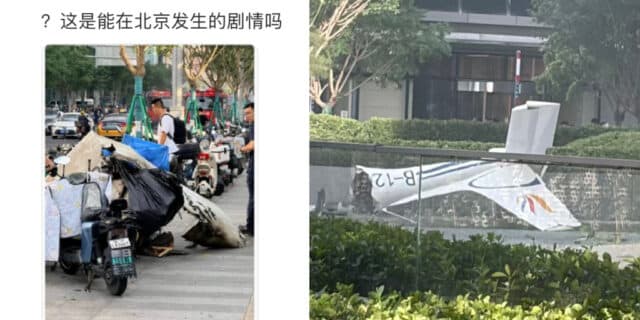
The story that never went trending was undoubtedly the biggest story of the week. On June 26, an incident at the Beijing landmark CITIC Tower (aka China Zun 中国尊) in the Chaoyang central business district sparked disbelief online. At 5:55 pm local time, a small plane, a Sunward SA60L Aurora, crashed into the tower, after which wreckage from the small aircraft fell to the street below (video).

For those who immediately responded to the incident on social media, it seemed unimaginable that this had happened in the capital. Beijing is one of the most heavily defended airspace zones in China. Since May of this year, recreational drones are also banned in Beijing, with outdoor flights requiring prior approval from authorities.



A small plane hit CITIC Tower??? How could something like this happen? What happened to the air defense capabilities in our core restricted zone???“ one Weibo commenter wrote on Friday night.

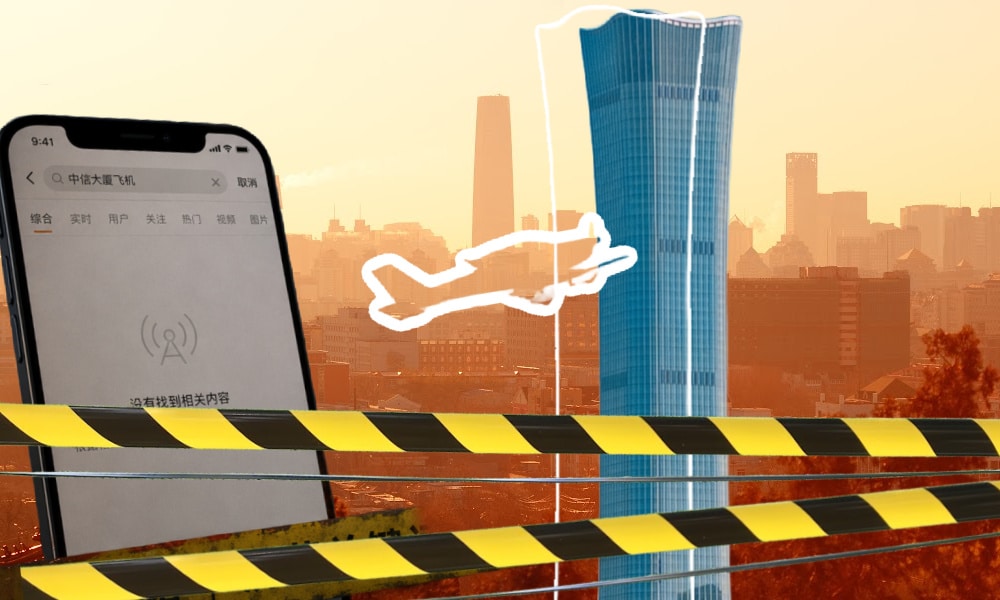
After videos and images of the incident spread, online discussions were swiftly and thoroughly censored. That same day, while media outlets around the world began reporting on the crash, it did not appear among the top 50 trending topics on Chinese platforms—in fact, it wasn’t reported anywhere at all. As related keywords and hashtags were taken offline, it quickly became clear that this was the “6.26 Incident That Shall Not Be Mentioned.”

Even the next day, when Chaoyang authorities issued a brief official notice, republished by state media, the name of the tower was never mentioned, just that “a single-engine, two-seat light sport aircraft collided with a high-rise building during flight,” and that an investigation was underway. The one person on board, the pilot, died in the crash. Thirteen others were injured.


Later, flight tracking data revealed that the aircraft had taken off from Shifosi Airport, northeast of Beijing, and had come close to a Hainan Airlines passenger jet, forcing at least two commercial flights to abort their landings.

For the five days following the incident, little to no official information was available on the highly unusual incident. Meanwhile, Chinese authorities reportedly ordered a nationwide suspension of most general aviation activities, including recreational flying.


Why the CITIC Tower Incident Triggered an Information Blackout


But why has the censorship surrounding this incident been so intense, leading online censors to scrub all footage and discussion of it from the internet?

This has to do with the nature of the incident.

It is not uncommon for major incidents to be heavily censored, especially when the details surrounding them are still unfolding. But this kind of information “blackout” generally occurs only when incidents are considered particularly sensitive, and the regular toolkits used to manage and control information are no longer deemed sufficient.

Some examples include:

▪️The 2011 Wenzhou Train Crash, which happened at a time when the prestige and reliability of China’s high-speed rail system was celebrated as a flagship national project.

▪️The 2013 Tiananmen SUV ‘Suicide Attack’, which happened in a tightly guarded, already politically sensitive public space and the symbolic heart of the state.

▪️The 2022 Anti-Party Protest Banner at Sitong Bridge, which happened just before the opening of the 20th Party Congress that confirmed Xi Jinping’s unprecedented third term.

▪️The 2024 Beishan Park Stabbings of American Tourists, which happened just as China’s inbound tourism was beginning to recover in the post-COVID era and “China is safe” narratives were playing an increasingly important role in official messaging.

All of these incidents are different in nature, but what they have in common is not just that they are examples of bad news being suppressed, but that they reflect a specific pattern in which news that is bad for the Party-state is suppressed. In their own ways, these incidents—and the discussions and speculation surrounding them—challenge one or more foundational narratives about the competence of China’s leadership, its modernization, its security, its stability, and its capacity to maintain social order.

📌 The 6.26 CITIC Tower incident is particularly sensitive because it touches on several of these core narratives. It immediately opened the door to a flood of politically sensitive questions: How could this happen in the capital? Were the authorities really in control? Were the security systems adequate? Was it a deliberate attack? This all directly contradicts the logic of “Safe China” (平安中国), a grand strategy for governance in the Xi era that seeks to project an image of a closely monitored society in which risks are anticipated and prevented through the integration of efficient public security, surveillance, and Party leadership (see Trevaskes & Lin 2024)1. A small aircraft striking Beijing’s tallest building—located in one of the country’s most tightly controlled airspaces—challenges precisely this claimed capacity to maintain order, guarantee security, and keep China safe.

📌 Another reason why incidents like the 6.26 one are censored so heavily is that they have the potential to snowball or even trigger copycat behavior. What begins as an isolated accident can quickly evolve into broader discussions about political dissatisfaction, which might spiral into social unrest – and protecting domestic stability is central to the Party-state’s legitimacy and maintenance of power.

📌 A third factor is the symbolic significance of the location. Unlike an ordinary office building, the CITIC Tower is a symbol of Beijing’s cosmopolitan skyline and of China’s economic rise and state-led modernization. Situated in the heart of the capital’s central business district, next to CCTV headquarters and visible across much of the city, it is one of Beijing’s most recognizable landmarks. An incident involving such a building inevitably carries far greater symbolic weight than one occurring in a less prominent location.

⮕ Taken together, these factors make the 6.26 incident unusually sensitive in political, social, and symbolic terms. It is not just a random aviation accident; it touches upon national security, state competence, political control, social stability, and the protection of one of the country’s most symbolic urban spaces. Rather than threatening a single Party narrative, as some of the other aforementioned incidents did, it threatens several at once. This helps explain why it was treated not as an ordinary censored event, but as one requiring an almost complete information blackout.


A Familiar Censorship Playbook


Although these top-censored news incidents are all unique, they follow a similar whack-a-mole-style playbook in suppressing discussion of these events, even though they had only just happened.2

The main playbook is always more or less the same: Sensitive incident occurs News disappears from front pages and trending search lists Popular videos and images are taken offline Incident-specific keywords and hashtags are scrubbed Censorship expands to generic category-level terms (such as “Beijing,” “Chaoyang District,” or “small plane”) that could lead users back to the incident) State media remain silent while shifting attention to other news.

(This week, the distraction might have been an otherwise arguably uninteresting controversy involving Chinese singer Han Hong.)3

Offline, the same pattern often plays out through physical scene control: bystanders are asked to delete their footage, journalists are kept away from the scene, or even entire street signs are removed (as happened after the protests on Wulumiqi Road and following the Sitong Bridge protest).

Meanwhile, selected commentary from permitted voices is sometimes allowed to appear online—for example, from former Global Times editor Hu Xijin—although even those posts are not immune from later deletion, as happened following the Beishan Park stabbings. This is often the first step in shaping the official narrative.

A brief authoritative news report may then be released, often ending with a statement that “the incident is under investigation,” which also buys time. Sometimes, however, no meaningful official explanation ever follows. After the 2022 China Eastern MU5735 crash, for example, authorities never released a full public investigation report, even though reports emerging in 2026 claimed the crash, which killed all 132 people on board, was deliberate.

Nevertheless, an official narrative and investigation outcome do usually follow. The 2013 Tiananmen attack, for example, was officially labeled a premeditated terrorist attack orchestrated by the East Turkestan Islamic Movement (ETIM), with Chinese authorities presenting it as evidence that Xinjiang-linked militancy had become part of a broader international terrorist threat. In doing so, the incident was reframed from a local security failure into part of a global fight against terrorism.

Finally, arrests often follow, and people are held accountable. At the same time, those accused of “spreading rumors” online may also face consequences, while foreign media are often criticized for biased reporting or double standards. These counterattacks further reinforce the official narrative while simultaneously shifting attention away from the original incident.


How AI Chatbots Are Part of the Censorship Ecosystem


For the 6.26 incident, the main narrative for the first five days after it happened was that nothing really happened. Even Hu Xijin posted nothing about the incident.

On Weibo, the hashtag “The Story Behind the CITIC Tower Crash Incident” (#中信集团大厦被撞事件始末#) was taken offline, along with many others.

Five days after the crash, Weibo’s Qwen-3 chatbot (powered by Alibaba) claimed it knew nothing about any incident involving CITIC Tower.

The Weibo chatbot responds to a question about the CITIC Tower incident, saying it knows nothing (July 1st).

Six days after the incident, on July 2nd, DeepSeek’s chatbot went a step further. Rather than simply claiming no information was available, it described reports about the crash as fake news, stating that there were no official records or media coverage and that such rumors originated on “overseas social media platforms.” Kimi refused to answer questions about the incident altogether, while Baidu’s ERNIE Bot said it had no information about the incident and warned users not to believe or spread unverified rumors.

[caption id="attachment_76508" align="aligncenter" width="484"] DeepSeek responded to what happened at CITIC Tower, claiming it’s “fake news” (July 2nd)

The 6.26 CITIC Tower incident illustrates a broader development in China’s online information ecosystem. A great deal has changed since the 2011 Wenzhou train crash. Social media control has become far more sophisticated—not only through better automated filtering, but also through platform regulation, agenda-setting, distraction strategies, and increasingly coordinated narrative management.

Now, AI chatbots have become part of that ecosystem.

Integrated AI assistants (LLM-powered chatbots embedded in platforms such as Weibo, Douyin, and other Chinese apps since 2025) are not merely additional tools subject to censorship. They have become an integral part of the online information environment and increasingly play a role in the handling of sensitive incidents.

Unlike Grok on X, these AI assistants are deeply integrated into the user experience and actively encourage people to ask questions, search for information, and receive summaries of ongoing events and controversies. What makes them particularly powerful from the perspective of propaganda and information control is that they can centralize official narratives at the platform level. Previously, that role was distributed across state media, government accounts, and other official actors.

Because these chatbots do not present themselves as state media or government authorities, they can appear more neutral and objective. Users may perceive them simply as AI-generated summaries with less media bias and greater factual accuracy.4 In the case of the 6.26 incident, they effectively conveyed a state-ordered message to social media users: that really, nothing happened, and that if something happened, it must be fake news.


“A Public Security Incident Caused by Personal Factors”


On July 2nd, Beijing Chaoyang’s verified official account issued a second short statement via its WeChat channel. This time, providing more details about what had happened on June 26.

According to the statement, the pilot was 66-year-old Mr. Liu (刘), a Beijing resident who was self-employed and lived alone. He obtained a sport pilot license in 2021 and a private pilot license in 2024.

Authorities said Liu deliberately deviated from his flight route, subsequently lost contact with the airport, and then intentionally crashed into the building, killing himself. They added that he had suffered from depression in recent years and that his diary contained multiple references to wanting to “end his life.” The incident was officially described as “a public security incident caused by personal factors” (个人原因造成的危害公共安全案件).

The second, July 2nd, statement.

It is noteworthy that such a short statement includes details about the pilot’s age, marital status, pilot licenses, mental health, and even diary entries, yet provides virtually no information about the building itself, the security response, or the broader circumstances of the incident. The statement never mentions the CITIC Tower by name, referring only to “a high-rise building near the East Third Ring Road.” It likewise omits any mention of the aircraft entering restricted airspace, the reported disruption to commercial air traffic, or the obvious questions the incident raises about security failures.

On Weibo, the statement was widely shared, but comment sections beneath those posts remained either hidden or only contained a selection of replies.

And so, six days after the incident, there is a slight opening in the media blackout—just enough to establish the official narrative. This framing reduces a wide range of sensitive questions to the story of one troubled individual. It is not about broader questions of public safety or governance, but about a lonely man’s suicide; it is not about the Party-state, but about personal circumstances; it minimizes a news event that received maximum attention and turns a possible mass attack into an isolated incident. And so the message subtly shifts from “nothing happened” to “it’s time to move on.” The playbook is complete. It’s almost as if nothing really happened.


By Manya Koetse

With contributions by Miranda Barnes


  1. See: Susan Trevaskes and Delia Lin, “Integrating Stability Maintenance into Comprehensive Governance: The Burgeoning ‘Safe China’ Behemoth,” Modern China 50, no. 6 (2024): 671–701. https://doi.org/10.1177/00977004241254709.
  2. Some might say the 2015 Tianjin explosions also belong here, but that disaster was so large and witnessed by so many people that, while the official narrative was tightly controlled, it did not receive the same near-total information blackout.
  3. This controversy involved Han Hong (韩红), a popular Chinese singer and philanthropist, who recently urged Beijing audiences in the local dialect to show up at the box office for the underperforming latest Feng Xiaogang film Catch the Spy (《抓特务》), for which she is the music producer. She used the colloquial expression zǒu ge miànr (走个面儿, roughly “show your face”), and was accused of inappropriately putting moral pressure on people to buy tickets, which also led to criticism of her charity work. She made the remarks at a June 17 premiere, and it didn’t become a dominant story until eleven days later.
  4. See also: Yan Li, “The Impact of Automated Journalism on Media Bias, Accuracy, and Public Trust: Evidence from Young Chinese News Consumers,” Humanities and Social Sciences Communications 13 (2026): 688. https://doi.org/10.1057/s41599-026-06612-6.

(follow on X, LinkedIn, or Instagram)

Spotted a mistake or want to add something? Please let us know in comments below or email us. First-time commenters, please be patient – we will have to manually approve your comment before it appears.

©2026 Eye on Digital China/Whatsonweibo. All rights reserved. Do not reproduce our content without permission – you can contact us at info@whatsonweibo.com.

Manya Koetse is a sinologist, writer, and public speaker specializing in China’s social trends, digital culture, and online media ecosystems. She founded What’s on Weibo in 2013 and now runs the Eye on Digital China newsletter. Learn more at manyakoetse.com or follow her on X, Instagram, or LinkedIn.

Continue Reading
Click to comment

Leave a Reply

Your email address will not be published. Required fields are marked *

China Brands, Marketing & Consumers

Quack Like a Goose: Why Beijing Street Vendor “Auntie Goose Legs” Sparked a Nationwide Debate

After the first complaints surfaced, Auntie Goose Legs admitted the truth about her business: she ha been selling duck legs all along.

Manya Koetse

Published

on

🔥 Originally published in Eye on Digital China.
My premium newsletter covering the stories, memes, debates, and viral moments shaping online conversations in China. Subscribe here to receive future editions.

If it walks like a duck and quacks like a duck, it might still be a goose – or the other way around. That, at least, is the takeaway from two stories that recently went viral on Chinese social media.

The woman at the center of it all is Beijing street-food vendor Chen Xiufeng (陈秀凤), better known as “Auntie Goose Legs” (鹅腿阿姨). Over the years, she became something of a local celebrity in Beijing’s university district. Originally from Jiangsu, the migrant vendor had been selling her famous roasted goose legs to students since 2011.

She skyrocketed to national fame in 2023 , but became the target of widespread criticism last week after it was revealed that her celebrated goose legs – sold for 16 yuan ($2.20) per piece – were actually duck meat all along.

The controversy came up after the vendor ventured beyond the university area into Beijing’s business district. At the universities, she enjoyed a loyal customer base and dedicated WeChat groups. In her new market, however, customers proved more skeptical. Some noticed that the meat looked suspiciously duck-like; others complained that the color seemed off.

In the university district, Auntie Goose Legs she enjoyed a loyal customer base and dedicated WeChat groups.

After the first complaints surfaced, Auntie Goose Legs admitted the truth on WeChat on June 9.

“The ingredients I originally used were goose legs,” she wrote, “but they have been out of stock for more than fifteen years. The current ingredient is duck legs.”

It turned out that she had only sold goose legs, the product that made her famous, for two months back in 2011 before switching to the much cheaper duck. “Did geese become extinct without us knowing?” some netizens joked.

The revelation quickly exploded online. The hashtag “What Auntie Goose Legs is Selling Turns Out to be Duck Legs” (#鹅腿阿姨卖的是鸭腿#) became the top trending on Weibo for an entire day, with millions of people discussing the topic.


Why did millions of people become so outraged over a single Beijing street vendor selling duck instead of goose?


Piggybacking on the debate, Anhui-based commentators pointed out that a beloved regional specialty has the exact opposite ‘problem.’ Wuwei smoked duck (无为板鸭) is branded as duck, but is usually goose. According to local standards, however, goose products may be sold under this name, prompting discussions about “hanging up a goat’s head, while selling dog meat“ (挂羊头卖狗肉): advertising one thing while selling another.

Because geese are more expensive than ducks in China, and generally considered tastier, the Anhui duck-is-goose story, unlike the Auntie Goose Legs controversy, did not provoke online anger. Instead, many people saw it as an example of sellers prioritizing flavor over cost. Auntie Goose Legs is seen as doing the exact opposite.

But why did millions of people actually become so outraged over a single Beijing street vendor selling duck instead of goose, especially when there were no indications that anyone became ill? The answer has little to do with poultry and everything to do with trust.

Auntie Goose Legs during the prime time in Beijing’s University District in late 2023 (image via Lianhe Zaobao 联合早报).

Food fraud and mislabeling have been longstanding concerns in China. Earlier surveys found that food safety worries even outweighed concerns about public security and environmental issues, and while China’s food safety record has improved in recent years, public trust remains fragile.

Part of these concerns are immediate and practical. Major scandals in the past involving melamine-tainted infant formula or recycled “gutter oil” have posed serious risks to public health. But the issue goes beyond health risks alone.


If a goose can be a duck, then what exactly is the duck?


Whereas food safety concerns in many Western countries often focus on contamination, Chinese consumers are frequently just as concerned with economic deception. It is unfair to pay for a more expensive goose and receive a duck. Even if no one gets sick, Chinese consumer law still treats it as fraud.

More important, however, is what such deception does to confidence in the broader food system. If a goose can be a duck, then what exactly is the duck?

As a major 2023 college canteen scandal demonstrated, the build-up of deceit can reach a breaking point among the public. During that somewhat Kafkaesque “rat head or duck neck” (鼠头or鸭脖”事件) controversy, officials insisted a rat head found in a student’s rice was merely a “duck neck,” even though everyone could clearly see the snout and teeth of a rodent.

This kind of gaslighting shatters social trust and reinforces a generalized sense that, as a consumer, you are entirely on your own. When regulators fail to step in honestly, even a seemingly isolated incident comes to symbolize more dangerous forms of systemic food fraud.

And this is where the Auntie Goose Legs story stings the most.

People did not come to her simply because her food was good. Over the years, she had become part of local student life, and she felt safe and authentic. Her pink scooter helmet, which she continued to wear while working, became an iconic symbol of her no-nonsense and humble image. Her success was built on word of mouth and, above all, on the trust her customers placed in her.

That this particular “auntie” deceived her customers by selling a different product than the one she advertised is no longer really about her. If duck is goose, goose is duck, and your local auntie has deceived you for years, then who can you trust anymore?


  • Read more about how Auntie Goose Legs rose to fame in 2023 here.


By Manya Koetse
(follow on X, LinkedIn, or Instagram)

Spotted a mistake or want to add something? Please let us know in comments below or email us. First-time commenters, please be patient – we will have to manually approve your comment before it appears.

©2026 Eye on Digital China/Whatsonweibo. All rights reserved. Do not reproduce our content without permission – you can contact us at info@whatsonweibo.com.

Continue Reading

Chapter Dive

“Going to Town to Handle Business”: How Adidas Went from Hated in China to a Chinamaxxing Brand

Why has Adidas regained cultural relevance in China while Nike is struggling despite its global strength?

Manya Koetse

Published

on

🔥 Originally published in Eye on Digital China.
My premium newsletter covering the stories, memes, debates, and viral moments shaping online conversations in China. Subscribe here to receive future editions.

A viral meme about “going to town to handle business” helped Adidas pull off one of the most successful brand turnarounds in China—and highlights why Nike is struggling to keep up.

Just five years ago, Adidas was one of the most criticized foreign brands in China. Now, it seems to have become one of the most celebrated. Ironically, the brand’s biggest success in China yet started with a mistake it made last month.

In 2021, Adidas – along with Nike and other foreign brands – faced severe backlash and boycotts in China for participating in the Better Cotton Initiative (BCI) move to stop sourcing cotton from the Xinjiang region, which Chinese consumers viewed as a hostile anti-Chinese political stance (and was framed that way by state media and official channels).

Chinese livestreamers for the brands were scolded online, Adidas employees were brought to tears, and stores across the country saw their sales drop. People began posting videos of themselves burning their Nike Air Jordans on Weibo. For the brands involved, it became a marketing nightmare.

Screenshot of SCMP report about the Nike sneakers being burnt, Adidas employees facing backlash back in 2021.

But now, Adidas has managed to completely turn its image around in mainland China, where it is being praised for its top-of-game PR skills.


Adidas: Heading to Town to Take Care of Business


Over the past few years, Adidas has increasingly embraced “New Chinese Style” (新中式), a design direction that blends Chinese aesthetics with contemporary fashion. The October 2025 launch of its “Chinese New Year Jacket”—combining tang suit-inspired elements with classic Adidas sportswear—became a huge hit, not just in China but globally.

The Adidas Chinese New Year collection became a huge hit in 2025. On the left: American influencer Hasan Piker wearing the jacket while visiting Tiananmen Square in Beijing.


But that was only the beginning of Adidas’s social media success in China.

In late May, some netizens spotted a machine-translated text on the Adidas website that immediately went viral for its unintentional humor.

A jacket promoted in English with the unremarkable phrase “pair it with jeans for errands around town“ appeared on the Chinese website as the clunky “pair it with jeans to handle business in the city“ (搭配牛仔裤,在城里办事 zài chénglǐ bàn shì).

The original English text and the clunky machine translation on the right.

More than a simple mistake, it was a cultural mistranslation. Running some errands is not the same as 办事 bàn shì in Chinese, which is more formal, bureaucratic language for handling affairs, such as going to the bank, notary, or police station—not a quick run to buy some eggs and milk.

For many Chinese netizens, the phrase evoked an image of an old villager cycling into the county town for official business, all while wearing an Adidas jacket.

Although the website was quickly adjusted, the meme was already snowballing and evolved into the more playful “off to town to take care of business” (进城办事 jìn chéng bàn shì).

One popular comment played on the rural-to-city associations of the phrase:

💬 “While you’re back in the village talking trash about me, I’m already wearing Adidas and heading into town to take care of business.”

Adidas responded with surprising speed and wit.

Instead of apologizing for the mistake, they posted a video showing their own “off to town to do business” T-shirt, which quickly became available for sale online and at flagship stores in Beijing, Shanghai, and Chengdu.

Chinese actor and Adidas ambassador Li Xian (李现) was later spotted wearing a “handling business” T-shirt, and the comment sections exploded.


Adidas read the room and went on to launch a marketing campaign featuring China’s popular possum meme wearing one of its jackets alongside slogans such as “Wear Adidas, Handle Serious Affairs” and “Wear Adi, Handle Big Things“—a nod to the original mistranslation and a series of viral wordplays built around the brand’s Chinese name (including “穿Adi办大事” and “穿Adi, 办das”, with das meaning dàshì 大事, “important business” here).

They also put up signs labeling some of their stores as “Adidas Errands Office” (阿迪办事处).

Rather than distancing itself from the joke, Adidas amplified it, becoming even funnier than the netizens themselves.

Other brands in China, from Lays to Alipay, saw the hype surrounding the meme and also started incorporating the “handle business” phrase into their online campaigns, referencing Adidas.

Various Chinese brands incorporated the Adidas meme into their own campaigns.

Because Adidas’s response felt effortless, authentic, and on-brand, it greatly boosted the brand’s popularity and appeal among young Chinese consumers.


Nike’s Grass is No Longer Greener


Sportswear giant Nike also became a major trending topic in China over the past week, but for entirely different reasons. Nike hasn’t been doing all that well recently, and the brand’s decline went viral in the same week that Adidas’s success was evident.

Nike became a top trending topic under the hashtag “Chinese consumers are abandoning Nike faster than anyone expected” (中国消费者抛弃耐克比想象中更快) after reports that a pair of sneakers originally sold for 899 yuan (US$132) are now selling for 429 yuan ($63) and still failing to attract buyers.

Nike’s decline is noteworthy because the brand was once booming in China. As with many other Western brands, it symbolized quality, prestige, and a cosmopolitan future for much of the 1990s and 2000s.

In a 2011 study of Chinese consumer aspirations, one respondent imagined a future in which she would drive a Mercedes-Benz, wear Nike, and eat KFC—a vision of modernity built around foreign brands. Another person dreamt of wearing “Nike clothes and Nike shoes (…) on the green grass, swinging golf clubs under the golden sunshine.”[1]

But Nike’s grass is no longer greener. Chinese commenters largely agree that much of the trust and desire surrounding the brand has eroded.

Many former Nike consumers now prefer Chinese brands such as Anta, Li-Ning or ERKE. Multiple posts on Chinese social media cite the Xinjiang cotton controversy as a turning point from which Nike never fully recovered.


The Localization Dilemma: A Strategic Catch-22?


The contrasting fortunes of Nike and Adidas reveal something important about the position of foreign brands in China today.

As domestic brands improved and narratives of national rejuvenation and the “Chinese Dream” gained prominence under Xi Jinping, consumer sentiment toward Western brands shifted dramatically, especially amid a growing number of controversies involving them.

From a Dolce & Gabbana campaign deemed racist to a witch hunt for Western brands listing Hong Kong and Taiwan as separate countries, international brands increasingly started struggling to find their place between politics, patriotism, and consumers who are choosing “Made in China” over global consumer culture.

As Zhihong Gao[2] observed as early as 2012, the rise of cultural confidence and renewed appreciation for Chinese traditions created a dilemma for foreign brands.

They find themselves caught in a strategic catch-22: if they localize too much, they risk losing the distinctiveness that made their brands attractive in the first place, while also reinforcing consumer preference for local cultural elements; yet if they remain too foreign, they risk appearing culturally tone-deaf and disconnected from Chinese consumers.

This is where Adidas appears to have found a sweet spot.

Unlike Nike, which seems to be living off its past success while showing little urgency in adapting to the Chinese market, Adidas has fully embraced Chinese digital culture, local humor, wordplay, and youth trends without abandoning its own identity.

Rather than pretending to be Chinese, Adidas is participating in Chinese culture as a distinctly foreign brand. By celebrating the unique elements of Chinese culture, both in tradition and modernity, it is boosting both its own image and the cultural pride it is tapping into. That is Chinamaxxing in a nutshell.


  • Read more about Chinamaxxing here.
  • Read more about the rise of ‘proudly made in China’ here.
  • Read more about Nike vs ERKE here


[1] Kelly Tian and Lily Dong, Consumer-Citizens of China: The Role of Foreign Brands in the Imagined Future China (London: Routledge, 2011), 70–71.

[2] Zhihong Gao, “Chinese Grassroots Nationalism and Its Impact on Foreign Brands,” Journal of Macromarketing 32, no. 2 (2012): 184–185.


By Manya Koetse
(follow on X, LinkedIn, or Instagram)

Spotted a mistake or want to add something? Please let us know in comments below or email us. First-time commenters, please be patient – we will have to manually approve your comment before it appears.

©2026 Eye on Digital China/Whatsonweibo. All rights reserved. Do not reproduce our content without permission – you can contact us at info@whatsonweibo.com.

Continue Reading

Subscribe

Eye on Digital China is a reader-supported publication by
Manya Koetse (@manyapan) and powered by What’s on Weibo.
It offers independent analysis of China’s online culture, media, and social trends.

To receive the newsletter and support this work, consider
becoming a paid subscriber.

Manya Koetse's Profile Picture

Get in touch

Have a tip, story lead, or book recommendation? Interested in contributing? For ideas, suggestions, or just a quick hello, reach out here.

Popular Reads