
China Insight
Modern-Day Yugong or Greedy Wolf? Critical Discussions after Ningxia Land Owner Goes Viral Begging for Water
Is Sun Guoyou the victim of bad coal mine practices or did he throw dust in netizens’ eyes? The viral Ningxia story is getting more complex.


This week, the story of Ningxia land owner Sun Guoyou (孙国友) went completely viral on Chinese social media.
Various Chinese media outlets, from Sina News to Beijing News and The Paper all covered the story of the old man who was seeing his enormous land destroyed because a nearby coal mine had cut off water supplies. Although they had allegedly promised Guo to resume water supplies on March 27, they did not follow through.
A video of Sun kneeling on the ground and begging for water went viral on Douyin and Weibo, where dozens of hashtags relating to the story received millions of views (read our earlier story here).

One crucial aspect of the story is how Sun Guoyou allegedly has been combating desertification and improving the soil conditions of the barren land through afforestation, by planting trees and irrigating the land.
This is one of the various reasons why netizens initially felt sorry for Sun and wanted to help him out. People were rooting for the underdog, supporting the seemingly weaker Sun against the more powerful coal mine company and local authorities.
He was also called the ‘modern-day Yugong’ by some, referring to the old Chinese fable about an old man who was called foolish for persistently trying to move a mountain, yet finally succeeded in doing so. The Chinese idiom about “the foolish old man moving a mountain” (愚公移山 yúgōng yíshān) is often used as a figure of speech for persisting despite hardship.
But the more viral Sun’s story went since March 29, the more people started doubting his story and called into question whether Sun was genuinely an underdog or just a business owner exploiting his land and, through the help of social media, manipulating the circumstances to his benefit.
On March 30, Weibo knowledge blogger ‘PYGZ’ (@平原公子赵胜) was among many other netizens accusing Sun of planting the wrong species of trees and raising cattle and sheep on his land, causing more soil erosion instead of improving soil quality. Rather than controlling desertification (“治沙”), Sun’s practices are creating sand dunes (“造沙”) instead, the blogger argued.

Why would Sun do such a thing? According to PYGZ, the state subsidizes windbreak forests that help prevent desertification (“防沙林”): 500-800 yuan ($72-$116) per Chinese “mu” (亩), which is about 666 square meters / 0.165 acre. With a land as big as Sun’s, the annual subsidy would be millions of yuan (or more than $1M per year).
“This is what combating desertification in Ningxia actually looks like,” charity blogger Sui Jiao (@碎叫) wrote, sharing photos of desert control work: “If you are concerned about desertification control, you can donate money to the China Green Foundation (中国绿化基金会) to plant trees.”

Desert control work in Ningxia, image via Weibo @碎叫

Desert control work in Ningxia, image via Weibo @碎叫
Another thing that came up in critical discussions on Sun’s case is how he previously received over seven million yuan (more than $1M) in compensation from the Shenhua Ningxia Coal Industry Group (神华宁夏煤业集团) for economic losses caused by them occupying forest land (#孙国友此前727万判决书曝光#).
As more netizens are starting to dive deeper into the facts behind Sun’s desperate kneeling video, Sun’s family stated that they did not want to further escalate the issue and were just focused on saving their trees for now (#跪地求水林场主家属称不想事情升级#).
The nationalist Weibo blogger Ziwuxiashi (@子午侠士), who has over one million followers, posted an image of a wolf sneaking away, writing: “They want to get away, but I’m afraid it’s too late, the [wolf’s ] tail has already been exposed.” The blogger suggested that the Sun family might have enjoyed the spotlight, but do not want people to dig deeper.
Many others agreed, suggesting that Sun and his family staged the dramatic video to draw attention to their case, but now want to retreat before more details come out showing that Sun might not be the underdog he made himself out to be.
“Netizens are not like toilet paper that you can wipe your ass with and get rid of once no longer needed,” one Weibo user wrote.
Chinese political commentator Hu Xijin (@胡锡进) also commented on the issue – as he does whenever social stories go viral like this, – and wrote that he understood why netizens would doubt Guo’s sincerity or even say the entire video was staged.
At the same time, he reminded people that issues such as these are never black and white, arguing it is understandable that Guo earns income from his land and that it would only be right for the coal mine company to supply water to Guo if that is what they legally agreed on.
Hu suggested that, while many details in this story still have not come out, netizens might want to wait to make an absolute judgment in the case since issues such as these are usually not clear-cut and can be more complex than they initially seem.
By Manya Koetse
Get the story behind the hashtag. Subscribe to What’s on Weibo here to receive our newsletter and get access to our latest articles:
Spotted a mistake or want to add something? Please let us know in comments below or email us. First-time commenters, please be patient – we will have to manually approve your comment before it appears.
©2023 Whatsonweibo. All rights reserved. Do not reproduce our content without permission – you can contact us at info@whatsonweibo.com.

China Insight
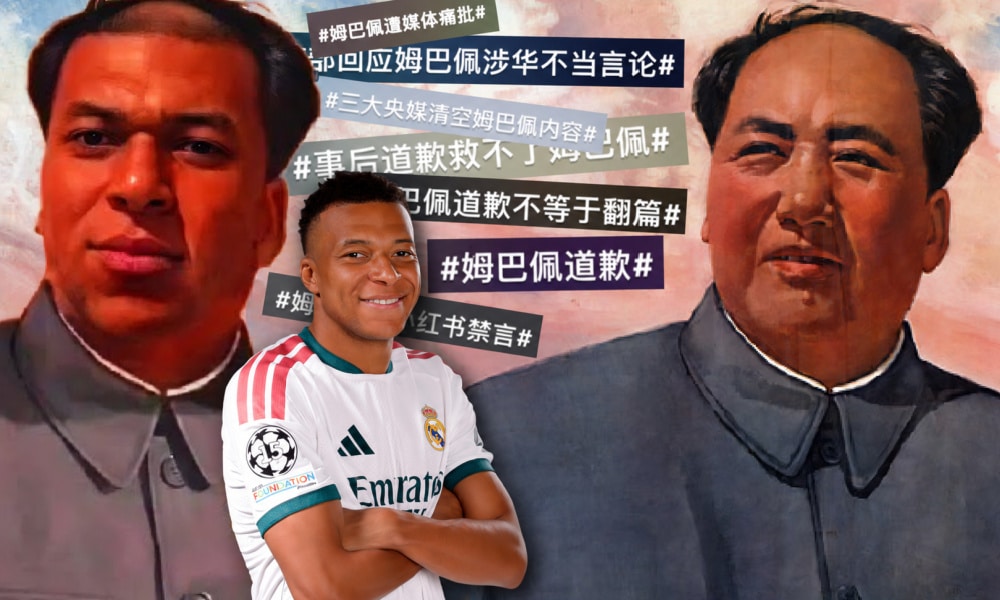
Mbappé, Mao, and the Joke That Shall Not Be Named
Mbappé’s favorite Mao meme sparked major backlash in China. More on what the controversy reveals about political red lines, online humor, and censorship.
RESOU 热搜 | What’s Trending in China, Explained
Here, I briefly unpack the stories making waves on Chinese social media and share what stands out to me. Don’t miss an update: become a subscriber to Eye on Digital China today.
Oh oh oh, Mbappé, all those goals, yet you lost so many points on Chinese social media over the past 48 hours.
Following his 100th goal for Real Madrid during El Clásico and finishing second on Ballon d’Or night, French football player Mbappé is all the talk on Chinese social media — not for his achievements, but for what is seen as crossing a major red line in an online interview.
On Tuesday night, a text came in from Ruixin: “I am wide awake tonight and somehow witnessed live how the footballer Kylian Mbappé was getting blocked and totally canceled on Chinese social media for his comments about Mao Zedong over the past, like, three hours 😅”
I quickly grabbed my phone and saw the flood of Mbappé posts rapidly coming in, and it was clear that people were very cross with him.
Although it was already clear that this might not blow over any time soon, by early Wednesday morning it became painfully clear how the controversy had snowballed. Dongpeng Beverage Group (东鹏), one of the many Chinese companies that signed the famous sportsman as its brand ambassador, publicly stated that it was cutting all commercial ties with Mbappé. Soon, others followed.
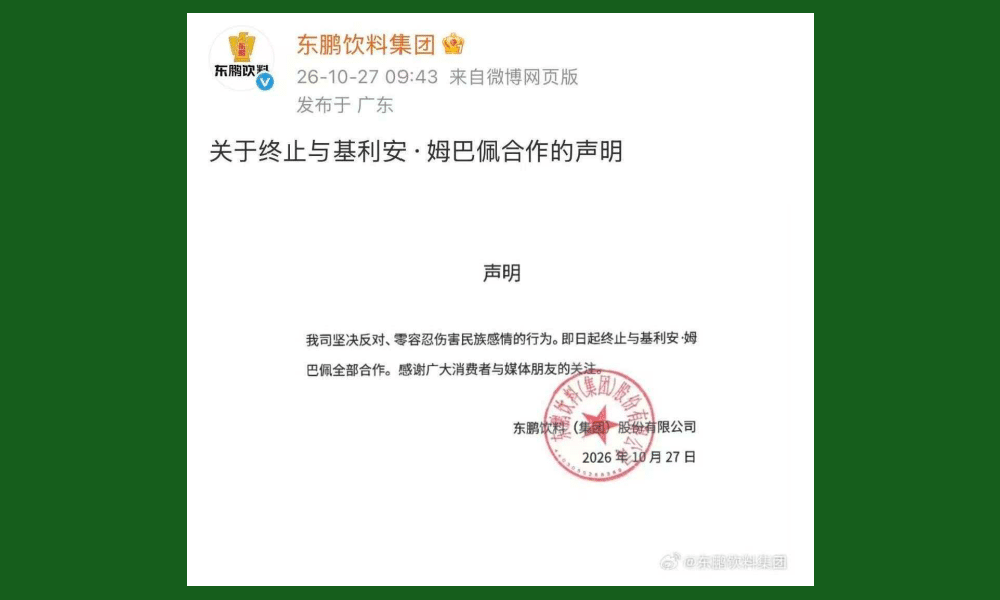
Dongpeng Beverage Group (东鹏): the first in a string of companies to cut ties with French footballer Kylian Mbappé.
Mbappé’s fall from grace in China has been sudden and spectacular, like a major avalanche of backlash that unfolded in one night, and it can all be traced back to one segment of an interview the footballer previously did on a French YouTube show (The Bridge) that resurfaced online — initially through Reddit and X, and then on Chinese social media apps, like football platform Dongqiudi (懂球帝).
In that segment, when asked about his favorite meme, Mbappé replied that one of the memes he finds funniest is:
🗣️ “the one where they put my face on some guy, a Chinese dictator. That really makes me laugh, I use it with my friends all the time.”
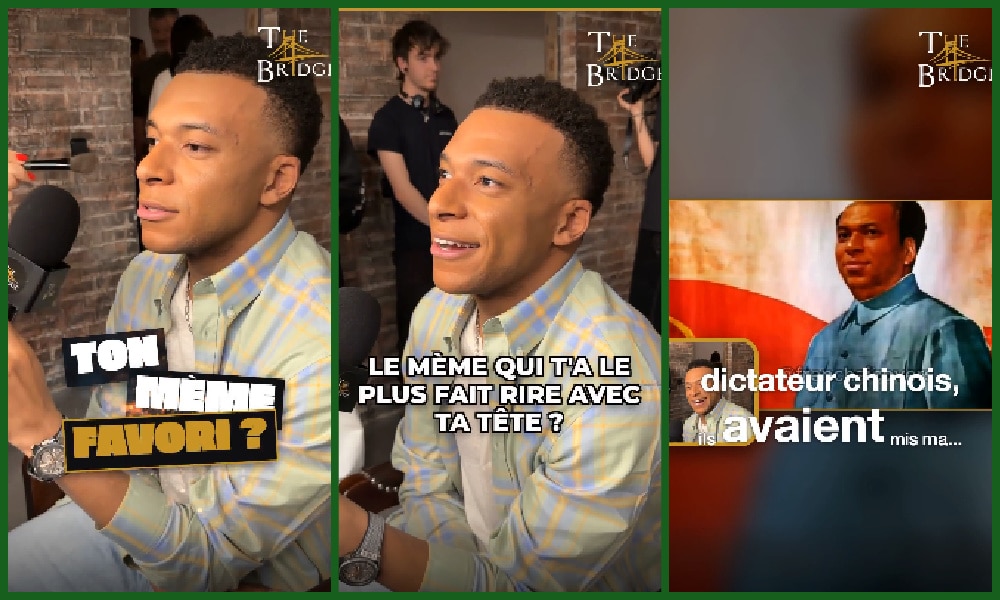
The interview segment where Mbappé shares his favorite meme: his face photoshopped onto the face of a “Chinese dictator.”
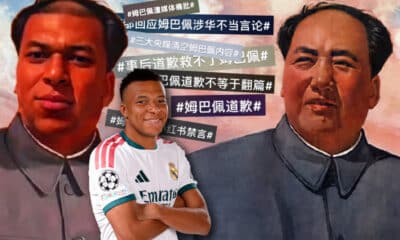
The show, created by Mbappé’s Real Madrid teammate Aurélien Tchouaméni, added the image Mbappé referred to: his face photoshopped on a Mao propaganda visual. It’s part of a series of memes that emerged in 2024 in which Mbappé’s face is edited onto the faces of dictators.1
Chapter Dive
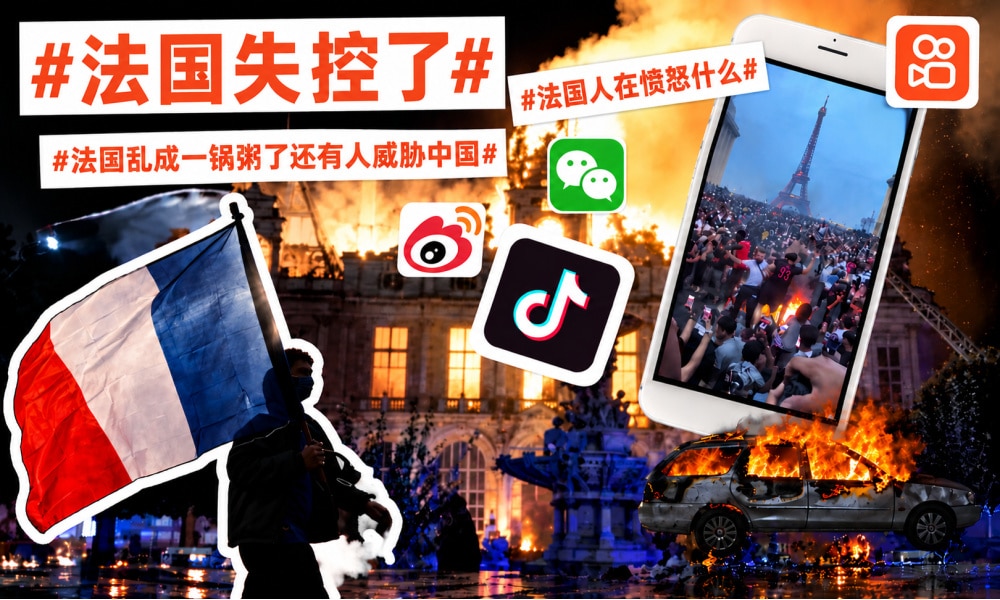
The French Protests, Viewed from China: Five Narratives on Chinese Social Media
From the decline of Europe to historical karma: these 5 narratives reveal how Chinese social media discusses the recent unrest in France.
Eye on Digital China is a reader-supported publication by
Manya Koetse (@manyapan) and powered by What’s on Weibo.
It offers independent analysis of China’s online culture, media, and social trends.
To receive the newsletter and support this work, consider
becoming a paid subscriber.

From “Pure Love Warrior” to Political Victim: Jensen Huang’s Fall on Chinese Social Media

China Trend Watch: Digital Dementia and Why Everyone Says ‘Li Na’

Mbappé, Mao & the Backlash on Chinese Social Media

Mbappé, Mao, and the Joke That Shall Not Be Named

The French Protests, Viewed from China: Five Narratives on Chinese Social Media

Why Japan Has So Many Surnames, China’s Back-to-School Shifts & Taiwan Pavilion Trouble

The Power of Ugly: Why Niu Lai Became China’s Unlikeliest Box-Office Hit

The Rise of “Shuaqi-ism,” Taking Starbucks to the Fields, and Pretending to Go to Work

Blame Games & Bad Signs: Nepal–Tibet Floods, Huawei’s Toilet Trouble, “Screwed” Graduates

Starbucks Goes Xinjiang & The Kardashians in China
-
 Chinese New Year9 months ago
Inside Chunwan 2026: China’s Spring Festival Gala
-
 China Brands, Marketing & Consumers12 months ago
Hasan Piker’s China Trip & the Unexpected Journey of a Chinese School Uniform to Angola
-

 Chapter Dive9 months ago
Inside the Great Chinese Debate Over the Iran War
-

 China Trend Watch12 months ago
Japan Tensions, Nexperia Fallout, Yunnan’s ‘Wild Child,’ & “Modern Opium”