
Featured
What’s on Weibo Blocked in China
What’s on Weibo is no longer accessible from within the PRC.


As of July 7, we’ve been notified by readers that What’s on Weibo is no longer accessible from within mainland China. After some testing, we have discovered that our site has indeed been blocked from all locations in the PRC now.

This is unfortunate for the many readers we have from mainland China. What’s on Weibo has been blocked before in late 2015, after which it was opened again in the summer of 2016. It is unsure if the current block is temporary and if the site will be accessible in China in the future again.
Too bad, What's on Weibo has been blocked in China, after the piece about online memes https://t.co/TNO9vBv1fe
— Manya Koetse (@manyapan) November 19, 2015
In the meantime, we will continue to report what is trending on Chinese social media. Follow What’s on Weibo on Twitter or Facebook to get daily updates on our latest articles.
In case you need a VPN, NordVPN currently has a very attractive $2.75 Summer deal (other recommended VPNs here and here).
By Manya Koetse
Follow @whatsonweibo
PS!: If you enjoy What’s on Weibo and support the way we report the latest trends in China, we welcome donations via Wechat or Paypal. We can use every penny to help pay for the upkeep, maintenance, and betterment of this site (read more).
Spotted a mistake or want to add something? Please let us know in comments below or email us.
©2018 Whatsonweibo. All rights reserved. Do not reproduce our content without permission – you can contact us at info@whatsonweibo.com.
China Trend Watch
China Trend Watch: Digital Dementia and Why Everyone Says ‘Li Na’
In this edition: Why Chinese netizens are talking about “digital dementia,” a viral Shenyang cleaner, the tragic Yading hike, and the reality TV meme taking over everyone’s feed.

Originally published in the Eye on Digital China newsletter on Sunday, November 8, 2026.
In this edition:
⚡ Lighter scrolls: A viral shopping mall cleaner & making unpopular studies great again.
🌍 Serious scrolls: A possible Xi–Trump–Putin meeting in Shenzhen??
📱 On the Feed: Everyone’s saying Li Na.
🀄 Word of the Week: Digital dementia.
⚡ QUICK SCROLLS
—The Lighter Side—
🦴 A new Chinese university college is entirely dedicated to unpopular studies. By launching its new “obscure and dying fields of study” college (冷门绝学), the Chinese Academy of Social Sciences hopes to preserve and revive research directions such as oracle-bone studies, bamboo-and-silk manuscript studies, Manchu, Tangut, and Old Turkic.
🏠 An apartment in Hegang was sold for just 11 yuan ($1.65) as part of a special Singles’ Day promotional auction on Alibaba’s asset auction platform Ali Asset (阿里资产). Singles’ Day (Nov 11) is China’s largest online shopping festival and often features doorbuster deals. The lucky new owner of the 60-plus-square-meter flat in Hegang says he will not move to the coal city, but will use it as a holiday home instead.
🗓️ 2027 is called “the most comfortable year” after the holiday arrangements for next year were released. China’s holiday design has been somewhat of a national obsession over recent years, and the Year of the Goat is going to be a good one: it will see a “longest-ever” Spring Festival break of nine consecutive days from Feb 5–Feb 13. New Year’s Day and Qingming fall on a Friday and Monday, giving people three days off twice without any swaps or make-up workdays. Some netizens call it “a step toward better holidays.”
Chen Jingfu, the viral shopping mall cleaner from Shenyang
Chen Jingfu (陈景福), the cleaner from Shenyang who went viral across Chinese social media for looking like an actor.
🧹 A 55-year-old shopping mall cleaner in Shenyang has become a viral hit after netizens noticed his striking looks and reserved demeanor – making him look more like a famous actor than a sanitation worker. It happens quite regularly that ordinary people go viral in China for something small, like a special look or funny style. The unexpected fame can put a serious strain on their lives. This time, the cleaner named Chen Jingfu (陈景福) isn’t doing sponsorship deals or livestreaming, but he did open a social media account. It’s called “Shenyang Cleaner Uncle” (沈阳保洁大叔) and features him wiping windows and mopping floors.
🤖 China’s most famous livestreamer, Li Jiaqi, used to sell lipsticks; now he’s selling AI tokens. During one of his Singles’ Day livestreams this past week, Li sold more than 100,000 membership cards for Alibaba’s Qwen model within thirty minutes. It’s a sign of the times: “tokens” have entered China’s biggest shopping festival as a new category, and are quickly becoming as popular as cosmetics and fashion.
—On a More Serious Note—
🌍 A first Xi–Trump–Putin meeting would not be a “Yalta 2.0,” argues Hu Xijin. China’s Foreign Ministry has confirmed that it is discussing a possible historic meeting of Xi Jinping, Vladimir Putin, and Donald Trump. The meeting could take place on the sidelines of the APEC Economic Leaders’ Meeting, which is scheduled for Nov. 18–19 in Shenzhen. Some have compared such a meeting to a “new Yalta,” but Chinese political commentator Hu Xijin (胡锡进) has pushed back. He argues that while Putin and Trump may have great-power politics in mind, China opposes letting a few major powers decide the world’s future.
🇯🇵 A year after Takaichi’s explosive Taiwan remarks, Sino-Japanese relations are still seriously strained. This week, Foreign Ministry spokesperson Guo Jiakun (郭嘉昆) said Japan is entirely responsible for the problematic bilateral relations. Hostile Japan coverage in Chinese media was also noticeable in the state media’s reports on a Japanese academic who called Takaichi’s cabinet “unprecedentedly dangerous” and blamed the Japanese Prime Minister for deliberately stirring up anti-Chinese feelings among the public for her own benefit.
📹 A reporter’s undercover investigation into the black market for tōupāi (偷拍, secret filming through spycams and more) has put a national figure on this voyeurism network for the first time: it is estimated that roughly 140,000 women have been secretly filmed in public bathrooms, changing rooms, or hotels across China. Victims include primary school students, with footage of minors reportedly selling at 5–10 times the price of adults.
⛰️ “Everyone watched him walk towards his death.” The death of a 21-year-old hiker on the Yading Grand Loop, at an altitude of more than 4,500 meters, has sparked online discussions on the risks people take on unofficial hiking routes and the heavy burden this places on those who have to rescue them. The man from Guangxi died of severe altitude sickness and hypothermia in spite of the rescue operation that was set up to save him, involving a nine-person team of firefighters, doctors, and guides.
🇭🇰 Joshua Wong, face of the 2019 Hong Kong pro-democracy protests, was sentenced to another 10 years in prison on November 5 for “collusion with foreign forces.” Wong, held since November 2020, has served time for protest-related offenses and “conspiracy to subvert state power.” The new sentence adds to the time he’s already serving. While this new sentence is drawing widespread condemnation in the West and also sees (quiet) solidarity in greater China, many on Chinese social media are also gloating, seeing Wong as a traitor and spy.
📱 ON MY FEED
Everyone’s Saying “Li Na”
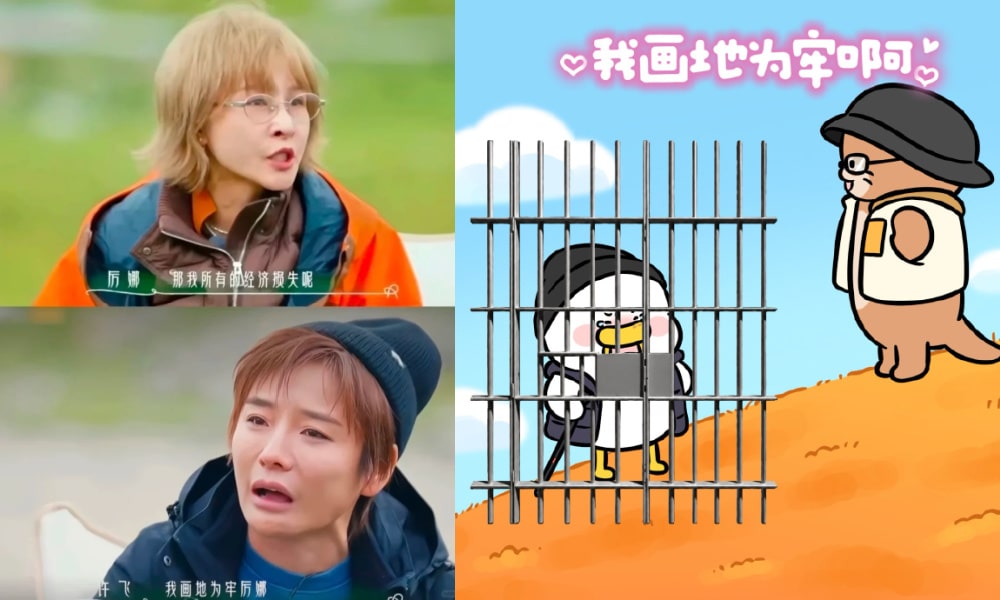
Not just on my feed, but practically everywhere, is Mango TV’s Hou Hui You Qi (后会友期). The Mango TV reality show, titled I Miss You in English, is creating a lot of noise on Chinese social media these days. The show follows four pairs of former friends, well-known celebrities who drifted apart through misunderstandings or controversy. During a trip through nature, they confront what went wrong.
One moment already ingrained in collective digital memory is the conversation between singer-songwriter Xu Fei (许飞) and singer/actress Li Na (厉娜), who became friends during the 2006 season of Super Girl (超女).
The line on everyone’s feeds is “I’ve drawn my own prison, Li Na” (我画地为牢啊,厉娜). Xu Fei says it when talking about how she just can’t move on from their friendship after all these years. Xu was blamed for leaking Li Na’s plans to leave her management company many years ago. Although the scene was emotional, Li Na didn’t really get what Xu meant. Back in her room, she was filmed asking AI, “What does it mean to ‘draw your own prison’?” and then she ordered McDonald’s.
It’s turned into a goldmine for memes, and suddenly everyone’s joking about being in their own self-drawn prison. The sentence “Xu Fei draws her own prison, Li Na eats McDonald’s” also became shorthand for one person overthinking everything in life while the other one just quickly jumps to everyday practicalities.
Because Xu Fei ended almost every sentence with “Li Na,” people started adding “Li Na” to their own sentences to make them sound deeper. Even a simple “I’m off work” sounds better when it’s “I’m off work, Li Na.”
Xu also recalled how she and Li Na, during their Super Girl days, would sit in their hotel room watching TV and eating duck tongue snacks together, a habit Li taught her to appreciate. After fans tracked down the brand, it quickly sold out all across China.
Viral social media posts claim an office worker even lost his job due to the meme. He set his WeChat status to “I’m drawing my own prison on Monday” (我画地为牢啊,周一). His manager read it as a negative attitude toward work and dismissed him.
A good reminder to be careful about what you post online, Li Na.
🀄 WORD OF THE WEEK
Doomscrolling and “Digital Dementia”
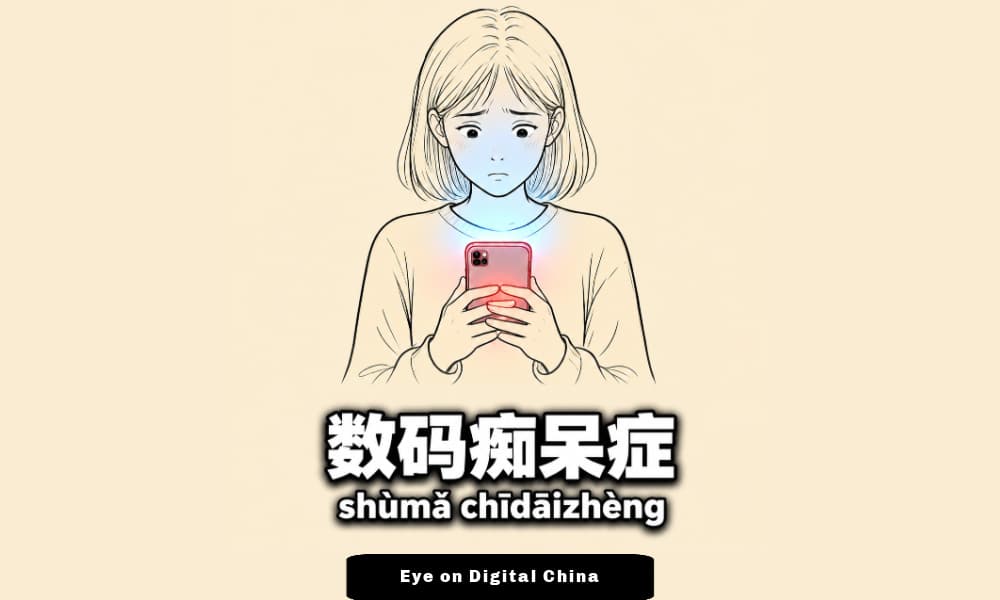
手机痴呆症: shǒujī chīdāi zhèng, “phone dementia”
数码痴呆症: shùmǎ chīdāi zhèng, “digital dementia”
The word of the week is “digital dementia” (数码痴呆症), also called “smartphone dementia” (手机痴呆症).
The topic reached number one on Weibo’s hot search list after Fuzhou Evening News reported that a 25-year-old woman from Fuzhou was diagnosed with “digital dementia” after using her phone for more than ten hours a day.
The woman reportedly spent days video-scrolling and drama-watching on her phone, while also scrolling on her phone for work, and ended up having more and more memory problems. She would lose her train of thought mid-sentence or forget tasks right after her boss assigned them. Once, when she got home from work, she even forgot which floor she lived on.
At the hospital, tests showed noticeable declines in memory and attention, but the other results were normal. Taking her work and phone habits into account, her doctor then described her symptoms as “digital dementia.”
Although this is not an official medical diagnosis and is very much different from actual types of dementia such as Alzheimer’s, spending too much time scrolling and screen watching can seriously interfere with attention and memory, with heavier short-video use being associated with poorer recognition memory and doomscrolling linked to anxiety and distress.
Other recent related online discussions are about the short drama app Hongguo (红果), which trended after users complained that the app’s design is addictive. They say it’s filled with short drama snippets with dramatic twists and cliffhangers, leading to constant dopamine stimulation that leaves them feeling mentally drained and “unable to stop” once they start.
This kind of digital behavior, especially in a year when short (AI) drama apps skyrocketed in popularity, also helps explain why “digital dementia” resonates with Chinese netizens who have noticed their own cognitive decline after excessive phone use.
“If that’s what 10 hours does to you, what am I supposed to do? I clock at least 13 a day,” one Weibo user commented.
On Xiaohongshu, another user wrote, “I get off work at five, get home at five-thirty, and spend the whole time on my phone until midnight.”
“I came back from a ten-day business trip and couldn’t remember what floor my office was on,” another Xiaohongshu user shared. Someone replied, “That’s happened to me, too. I hadn’t been to the office for a few days, and when I got in the elevator, I couldn’t remember what floor it was on.”
🔗 SEEN ELSEWHERE
🔹 Who owns a voice? As AI-generated voices become common, what remains uniquely human? When AI Learns to Speak, by Li Hang in Global Times.
🔹 China and Europe still need each other. This CASS scholar argues that as transatlantic relations face renewed strains and the international order shifts, China and Europe have strong reasons to deepen dialogue and cooperation. Via The East Is Read.
🔹 The danger of being a livestreamer in China. When a fan thinks he owns you, online entitlement can morph into real-world violence. By Lina Ma in The Diplomat.
🔹 War of words over Xinjiang erupts between Chinese and Turkish social media users. An explanation of how the debate over ethnic identity in Xinjiang has triggered an online clash between Chinese and Turkish social media users, by Laura Zhou in South China Morning Post.
🔹 Why Taipei said no to Pursuit Of Jade star Zhang Linghe. An explanation of how Chinese idol Zhang Linghe was denied entry to Taiwan after “belittling” Taiwan’s status. Via The Straits Times.
That’s a wrap, see you soon in the next one. Until then, have a great start to your week!
Best,
Manya
Eye on Digital China, by Manya Koetse, is co-published on Substack and What’s on Weibo. Both feature the same new content — so you can read and subscribe wherever you prefer. Substack offers community features, while What’s on Weibo provides full archive access.
Spotted a mistake or want to add something? Please let us know in comments below or email us. First-time commenters, please be patient – we will have to manually approve your comment before it appears.
©2026 Eye on Digital China/Whatsonweibo. All rights reserved. Do not reproduce our content without permission – you can contact us at info@whatsonweibo.com.
China Insight
Mbappé, Mao, and the Joke That Shall Not Be Named
Mbappé’s favorite Mao meme sparked major backlash in China. More on what the controversy reveals about political red lines, online humor, and censorship.
RESOU 热搜 | What’s Trending in China, Explained
Here, I briefly unpack the stories making waves on Chinese social media and share what stands out to me. Don’t miss an update: become a subscriber to Eye on Digital China today.
Oh oh oh, Mbappé, all those goals, yet you lost so many points on Chinese social media over the past 48 hours.
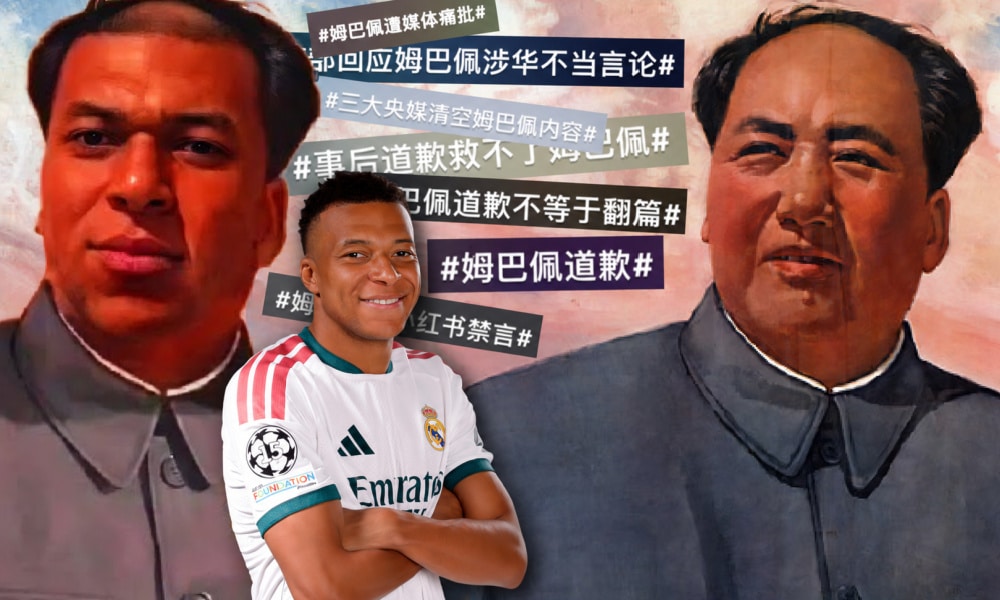
Following his 100th goal for Real Madrid during El Clásico and finishing second on Ballon d’Or night, French football player Mbappé is all the talk on Chinese social media — not for his achievements, but for what is seen as crossing a major red line in an online interview.
On Tuesday night, a text came in from Ruixin: “I am wide awake tonight and somehow witnessed live how the footballer Kylian Mbappé was getting blocked and totally canceled on Chinese social media for his comments about Mao Zedong over the past, like, three hours 😅”
I quickly grabbed my phone and saw the flood of Mbappé posts rapidly coming in, and it was clear that people were very cross with him.
Although it was already clear that this might not blow over any time soon, by early Wednesday morning it became painfully clear how the controversy had snowballed. Dongpeng Beverage Group (东鹏), one of the many Chinese companies that signed the famous sportsman as its brand ambassador, publicly stated that it was cutting all commercial ties with Mbappé. Soon, others followed.
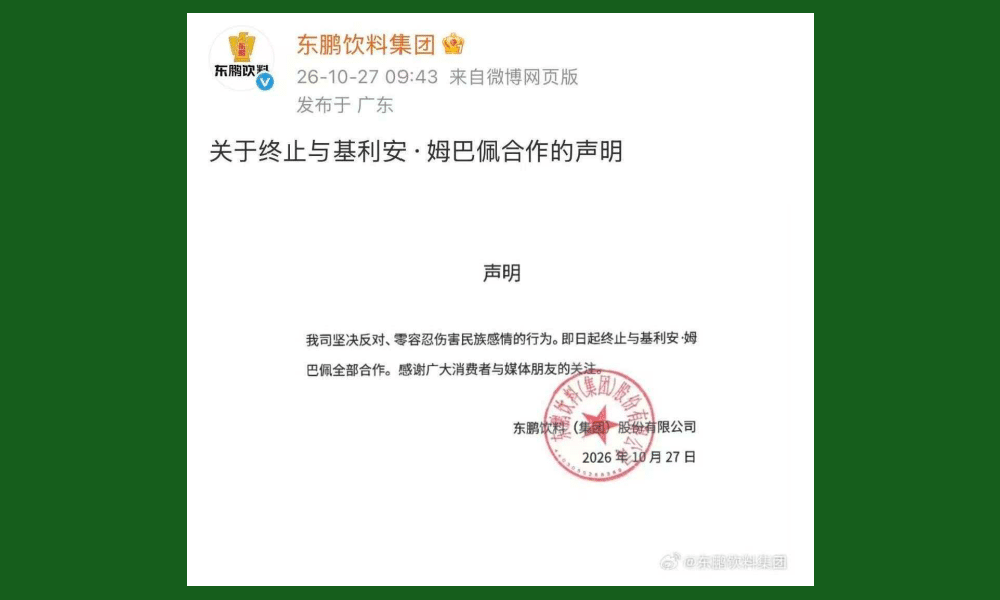
Dongpeng Beverage Group (东鹏): the first in a string of companies to cut ties with French footballer Kylian Mbappé.
Mbappé’s fall from grace in China has been sudden and spectacular, like a major avalanche of backlash that unfolded in one night, and it can all be traced back to one segment of an interview the footballer previously did on a French YouTube show (The Bridge) that resurfaced online — initially through Reddit and X, and then on Chinese social media apps, like football platform Dongqiudi (懂球帝).
In that segment, when asked about his favorite meme, Mbappé replied that one of the memes he finds funniest is:
🗣️ “the one where they put my face on some guy, a Chinese dictator. That really makes me laugh, I use it with my friends all the time.”

The interview segment where Mbappé shares his favorite meme: his face photoshopped onto the face of a “Chinese dictator.”
The show, created by Mbappé’s Real Madrid teammate Aurélien Tchouaméni, added the image Mbappé referred to: his face photoshopped on a Mao propaganda visual. It’s part of a series of memes that emerged in 2024 in which Mbappé’s face is edited onto the faces of dictators.1
Eye on Digital China is a reader-supported publication by
Manya Koetse (@manyapan) and powered by What’s on Weibo.
It offers independent analysis of China’s online culture, media, and social trends.
To receive the newsletter and support this work, consider
becoming a paid subscriber.


China Trend Watch: Digital Dementia and Why Everyone Says ‘Li Na’

Mbappé, Mao & the Backlash on Chinese Social Media

Mbappé, Mao, and the Joke That Shall Not Be Named

The French Protests, Viewed from China: Five Narratives on Chinese Social Media

What Does 20 Yuan ($3) Mean Anymore? China’s Disappearing Living Rooms & the Great Laundry Debate

Why Japan Has So Many Surnames, China’s Back-to-School Shifts & Taiwan Pavilion Trouble

The Power of Ugly: Why Niu Lai Became China’s Unlikeliest Box-Office Hit

The Rise of “Shuaqi-ism,” Taking Starbucks to the Fields, and Pretending to Go to Work

AI Actress Ad Pulled, Baihaitun Disrupts Shanghai and Cicada Meme Bugs Huawei

Blame Games & Bad Signs: Nepal–Tibet Floods, Huawei’s Toilet Trouble, “Screwed” Graduates
-

 Chinese New Year9 months ago
Inside Chunwan 2026: China’s Spring Festival Gala
-

 China Brands, Marketing & Consumers12 months ago
Hasan Piker’s China Trip & the Unexpected Journey of a Chinese School Uniform to Angola
-

 Chapter Dive8 months ago
Inside the Great Chinese Debate Over the Iran War
-

 China Trend Watch12 months ago
Japan Tensions, Nexperia Fallout, Yunnan’s ‘Wild Child,’ & “Modern Opium”
Mickey D
July 7, 2018 at 7:40 pm
CONGRATULATIONS! I’m sure you know, you should be honored to be blocked by the cult of Mao/Xi terrorist regime. The one and only thing I agree with Trump on is his tariffs on Maoland. If he keeps up the pressure, or once he’s impeached–hopefully very soon–the next administration, the people might finally take down “emperor-for-life” Mao-wannabe Xi’it-for-brains! The Chinese people will be free, and the world will have an honest government to trade with. The regime’s demise will bring a win-win era, not that cancerous One Belt BS!
love China
July 7, 2018 at 8:18 pm
CONGRATULATIONS! I’m sure you know, you should be blocked because your site is only read by LBH white losers who predictably only use it an avenue to hate Chinese and spout racist drivel about the cult of Mao/Xi terrorist regime. The one and only thing I agree with Xi on is his banning of LBH anti china hate groups like this one. If he keeps up the pressure, hopefully very soon, people might finally take down all anti china white LBH hate groups, then the Chinese people will be free, and the world will be more loving. The demise of western bigots will bring a win-win era and a wonderful One Belt century for China! Love China. Peace out!
unknow
July 10, 2018 at 12:02 am
it just dns pollution,netizen only use the dnscrypt-proxy can solve this problem,the ip is not blocked,just the domain name.
unkown
July 10, 2018 at 12:04 am
the major method is dns pollution and ip block which to block website that china rejeced.
Bruce Humes
July 11, 2018 at 7:41 am
Sorry to hear u have been blocked! But I do hope it will encourage u to cover sensitive topics more boldly.
Bruce Humes