SubscribeLog in
Connect with us

China Insight

“Can’t Watch the Fire Burn Across the River” – Xi’s Phone Call with Zelensky

China won’t “watch the fire from the other side of the river,” but it also will not “pour oil on the fire” of the Russia-Ukraine war.

Manya Koetse

Published

on

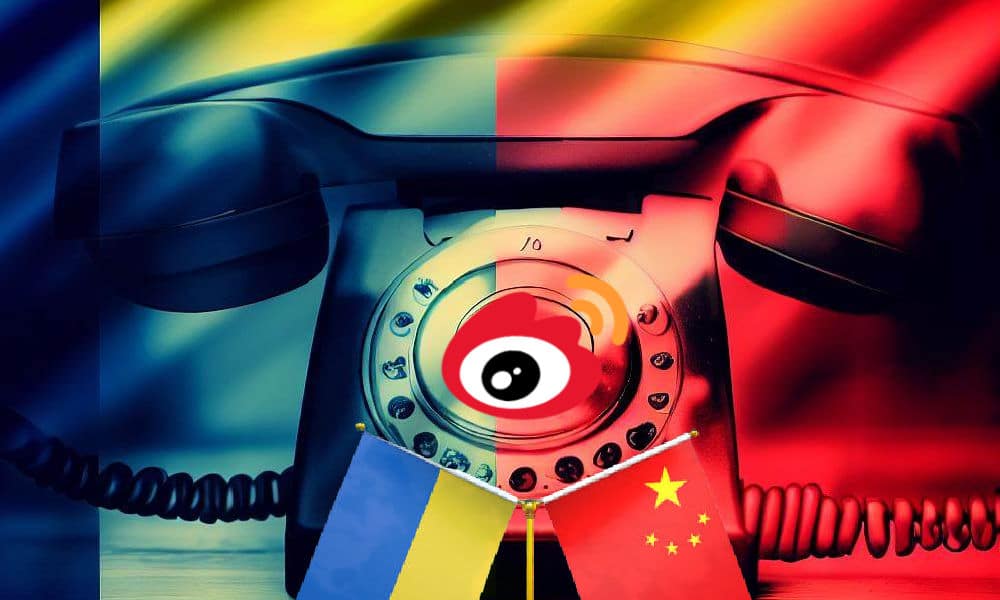
On April 26th, Chinese state media outlet CCTV posted a lengthy post on Weibo about the much-anticipated phone call between Chinese leader Xi Jinping and Ukrainian President Volodymyr Zelensky.

According to CCTV, the main point of the conversation was to exchange views on China-Ukrainian relations – based on “mutual respect for sovereignty and territorial integrity” – and the war in Ukraine.

The phone call is especially noteworthy because it is the first Xi-Zelensky conversation since the Russian invasion of Ukraine in 2022.

The phone call came after a number of noteworthy international developments, including Xi’s visit to Moscow in late March, French President Macron’s China visit in April, and that of Von der Leyen, President of the European Commission.

The momentous conversation also took place shortly after comments made by Lu Shaye (卢沙野), the Chinese ambassador to France, caused controversy. Last week, Lu questioned the independence of former Soviet countries like Ukraine in an interview with French television network LCI. He commented on Crimea being Russian and suggested that former Soviet countries have no “effective status” in international law. The interview sparked controversy and anger among former Soviet countries Estonia, Lithuania and Latvia, and other European countries.

Meanwhile, on the Chinese side, the Foreign Ministry stated it respects the sovereignty of ex-Soviet states. Various voices argued that Lu Shaye’s words were taken out of context and were the effect of a certain Western media strategy (see the take by Chinese scholar Zheng Ruolin here and that of commentator Hu Xijin here). However, Lu Shaye’s remarks regarding post-Soviet nations could have increased the urgency for Xi to reach out to Zelensky via phone.

Putting Out the Fire

One sentence from the phone call that was highlighted by Chinese state media and which was turned into a social media hashtag was that of how China “will neither watch the fire from across the river nor pour oil on the fire” (#我们既不会隔岸观火也不会拱火浇油#).

While the sentence reiterates China’s supposed neutrality in the Russia-Ukraine conflict, the conversation between Xi and Zelensky also signalled China’s desire to take on the role as a responsible global power and international peacemaker.

CCTV reported that China will insist on urging for peace and make its own efforts to stop the war. China reportedly will send an envoy (Special Representative of the Chinese Government for Eurasian Affairs/中国政府欧亚事务特别代表) to Ukraine and “other countries” to help seek a political settlement in the crisis through in-depth discussions with all parties.

Chinese official reports on the call also emphasized how Zelenskiy congratulated President Xi Jinping on his re-election and that Ukraine adheres to the one-China policy, hoping to “open a new chapter in Sino-Ukrainian relations and work together to maintain world peace and stability.”

Direct News headlined that the US was “sour” over China’s conversation with Ukraine.

News of the call was posted and promoted on Chinese social media by various media accounts. Direct News (直新闻) by Shenzhen Media Group even called the Xi-Zelensky call “the most significant international news of the entire week.”

The same media outlet also said that the U.S. response to the Xi-Zelensky call was “somewhat sour.” White House spokesman John Kirby called it “a good thing” but also said it was too early to know whether it would lead to “some sort of meaningful peace movement, or plan or proposal”.

Although most Chinese media accounts reporting on the phone call on Weibo had their comment sections turned off – leaving no room for online discussions, – pundit and former Global Times chief editor Hu Xijin also posted a lengthy commentary on Weibo about the issue on April 27th, which received over 900 (selected) replies.

Hu stressed the important role China has in a world where it is the only major country that maintains friendly relations with both Russia and Ukraine, with both leaders willing to listen to China’s views. Neverthless, Hu wrote that there is still a long road ahead for peace to be achieved.

Hu also suggested that Washington is playing a negative role in reaching a political settlement of the Russia-Ukraine crisis. The US has not shown “true willingness to push for a ceasefire” and moreover is also “utilizing the war for its own strategic objectives,” according to Hu.

In the comment section, many discussions were also focused on the role of the US. “They don’t want a ceasefire,” some wrote.

There were also other commenters who suggested that the key to solving the war in Ukraine eventually is not up to the US, nor to China, but to Russia and Ukraine alone.

Some still have the hope that China can make a difference in achieving peace: “China can do what other countries cannot. When it comes to it [reaching peace], we can do it.”

By Manya Koetse

Get the story behind the hashtag. Subscribe to What’s on Weibo here to receive our newsletter and get access to our latest articles:

Spotted a mistake or want to add something? Please let us know in comments below or email us. First-time commenters, please be patient – we will have to manually approve your comment before it appears.

©2023 Whatsonweibo. All rights reserved. Do not reproduce our content without permission – you can contact us at info@whatsonweibo.com.

Manya Koetse is a sinologist, writer, and public speaker specializing in China’s social trends, digital culture, and online media ecosystems. She founded What’s on Weibo in 2013 and now runs the Eye on Digital China newsletter. Learn more at manyakoetse.com or follow her on X, Instagram, or LinkedIn.

Continue Reading
Click to comment

Leave a Reply

Your email address will not be published. Required fields are marked *

China Digital

How Chinese AI Videos Turned Foreigners into Villains

How viral AI videos turn racialized outsiders into threats and violent Chinese heroes into defenders of social order, China’s first nationally broadcast AI drama, and why a newspaper is being sold for 50 times its original price.

Manya Koetse

Published

on

Welcome to China Trend Watch (Week 30–33 | 2026), where I bring you the latest trends, memes, and debates driving conversation across Chinese social media. Subscribe here to receive future editions.


Over the past few weeks, a noteworthy amount of AI-related news has been trending on Chinese social media, which is reflected in this week’s edition.

Now that AI has entered every corner of media consumption and online life, related discussions seem…

Continue Reading

China Insight

“Even Pigs Have AC”: The European Heatwave Through Chinese Eyes

As Europe struggles through record heat, Chinese social media is turning the story into something much bigger than the weather. Plus: the graduation speech everyone is talking about & more.

Manya Koetse

Published

on

🔥 China Trend Watch (week 26/27 | 2026) Part of Eye on Digital China, this is my premium newsletter where I explain the stories, memes, debates, and viral moments shaping online conversations in China. This edition was sent to paid subscribers — subscribe to receive the next issue in your inbox.


Here’s your weekly update on what’s been trending. In case you missed it, earlier this week I published a deep dive into the CITIC Tower plane crash and how its immediate aftermath was handled online. In this newsletter: Louis Vuitton’s victory in a noteworthy trademark case against a Chinese tea brand; how and why the European heatwave has become a major topic in China; a controversial gaming character; and an inspiring must-know phrase of the week.


🗞️ QUICK SCROLLS


🍉 Don’t buy precut watermelons. During these hot days, watermelons are a popular snack, but this stern warning went viral: avoid pre-cut watermelons sold by roadside vendors, as they’re a potential health hazard due to improper refrigeration and cross-contamination from cutting surfaces and knives —you have no idea what else they’ve been used for 😬.

🇯🇵 China blames Japan for ties hitting a new low. During a July 1st press briefing, China’s Foreign Ministry said Sino-Japanese relations are facing “severe difficulties,” blaming Tokyo’s stance on Taiwan and security issues. The remarks come amid renewed tensions, including Japan’s announcement that multiple Chinese naval vessels had transited waters near the country and the reported formal arrest of a Japanese citizen detained in Dalian.

🌾 No messing around with China’s heroes. A Chinese agricultural influencer with over 2 million followers has been permanently banned from Douyin after posting negative remarks about the hybrid rice breeding technology developed by the late Yuan Longping (袁隆平), China’s national hero and “Father of Hybrid Rice,” widely praised for his role in combating poverty and hunger.

🛎️ The 24-hour checkout as a new hotel standard? Check in at 3 pm, check out at 3 pm the next day—that’s the idea behind a viral checkout policy introduced by the Chinese hotel chain Qinzhu Hotel (沁住酒店). The policy breaks with the long-standing industry practice of requiring guests to check out before noon. Instead, checkout is calculated from the guest’s actual check-in time, allowing them to stay for a full 24 hours before checking out. The policy is generating discussions, with many wondering if this could point towards changing policies in the broader industry.

🎖️ The Party turns 105. July 1 marked the 105th founding anniversary of the Communist Party, an occasion heavily promoted across Chinese social media as eight Party members received the “July 1 Medal” (七一勋章), the Party’s highest honor. Among them was Henan village Party secretary Li Liancheng (李连成), who transformed a poor village into a model of rural development. July 1 also marks 29 years since Hong Kong’s return to Chinese sovereignty in 1997.

📅 Interesting fact: July 1 is not the Communist Party’s actual founding date. The 1st National Congress opened in Shanghai on July 23, 1921. The Party settled on July 1 as its anniversary in 1938 only because the Yan’an-based delegates who had attended the congress, including Mao Zedong and Dong Biwu, could remember that it had taken place in July, but not the exact day (and wartime conditions made archival verification difficult).

🌸 Whose flower is it anyway? The French luxury house Louis Vuitton won a first-instance trademark infringement case against the new Chinese tea chain Molly Tea (茉莉奶白) this week. The Chinese brand was sued over the four-petal flower symbol in its logo, similar to LV’s core floral element. But many netizens disagree with the judge’s decision, arguing that the flower can be traced to the iconic Baoxianghua (宝相花) motif that flourished during the Tang Dynasty (618-907).


👁️ WHAT STOOD OUT


Nationalism, Soft Power, and the European Heatwave in China

AI-generated images posted on Chinese social media showing Europeans suffering in the heat while Chinese pigs are relaxing with cool units (left) and Chinese manufacturers selling out (right).

The high temperatures in Europe have become a hot topic in China, where the heatwave across France, Belgium, Germany, and other countries has been one of the biggest international stories of the past two weeks, with China cast in a particularly prominent role.

In China, the European heatwave, with temperatures reaching 40–45°C and causing deaths across several countries, is discussed from various angles and is also used to make broader geopolitical, economic, and ideological points about Europe and China-EU relations. These are the three dominant ways in which the heatwave is currently being discussed on Chinese social media:

 
🌡️ 1. “China Is Keeping Europe Cool”: European Heat Through the Lens of Chinese Soft Power and Anti-”De-Risking” Narratives

Chinese state media have framed the European heatwave by emphasizing the role of Chinese-made air conditioners. In countries such as Spain, Germany, and France, air-conditioner sales have nearly doubled compared to last year, with Chinese manufacturers such as Haier and Midea reporting sales increases of up to 70% while ramping up production to meet demand.

A main narrative is that China is helping Europe by meeting demand at a critical time. A similar narrative emerged during the 2022 energy crisis, when Chinese media emphasized how made-in-China products, from blankets to heaters, were keeping Europeans warm.

As a recent Xinhua commentary argued, the current shortage demonstrates that Chinese manufacturers are filling a gap where European companies are falling short. While Europe increasingly frames China-EU trade in terms of “de-risking,” the article argues that Chinese manufacturing actually provides resilience during times of crisis and should therefore be seen as an asset rather than a risk.

 
🌡️ 2. “Even Pigs Have Air Conditioning in China”: Schadenfreude and Nationalism

The heatwave story and the fact that most European homes do not have air conditioning have also been met with ridicule and disbelief on Chinese social media, where one recurring joke is that while Europeans are suffering through extreme heat, even pigs have air conditioning in China.

The story partly originated on Chinese social media but was also fueled by posts on X. Around June 24, one tweet showing Chinese pigsties equipped with air conditioners received thousands of likes.

Chinese netizens also had plenty of banter over other X posts in which Europeans proudly showed off their newly purchased air conditioners, as though they had just discovered a new technology. For many Chinese commenters, it is simply unimaginable that air conditioning is still considered a luxury in much of Europe.

A local Hai’er account on Xiaohongshu joked:

💬 “Europeans spend hundreds of euros on an AC and still have to check the regulations; we spend a few thousand yuan (…) and enjoy wrapping ourselves in a quilt while eating watermelon in the middle of summer.”

A recurring theme in these discussions is that China once admired Western technology and modernity, whereas today the roles seem reversed. Now, some commenters say, Europeans are marveling at Chinese-made air conditioners. As one Weibo wrote: “It’s like our ancestors when they first saw cars.”

 
🌡️ 3. Europe Is Putting Climate Policy Ahead of Ordinary People: Criticism of EU Governance

Another dominant theme is the idea that Europe has become hypocritical—or excessively “politically correct”—in its environmental policies. Many commenters argue that the low prevalence of air conditioning in European homes is partly the result of regulators’ longstanding skepticism toward air conditioning on environmental grounds.

This has fueled the narrative, amplified by Chinese media this month, that Europeans are now suffering and even dying during heatwaves because green ideology has stigmatized air conditioning.

At the same time, many users mock what they see as the EU’s willingness to criticize other countries over greenhouse gas emissions while failing to protect its own citizens from extreme heat.

One AI-generated meme showed crying polar bears, monkeys, and penguins alongside the slogan:”Save nature! Save the animals! Oppose Europe installing air conditioning—this is a betrayal of Mother Nature.” One of the meme’s posters wrote on Weibo:

💬 “Europeans have been preaching the gospel of environmentalism (环保圣经). Now, it’s finally coming back to bite them.”

Another depicted Ursula von der Leyen relaxing beneath a powerful Midea air conditioner, comfortably enjoying the very equipment that her policies supposedly discourage.

All in all, for some, the debate over air conditioning is about something much bigger. The lack of air conditioning in many European countries—along with the regulations, infrastructure constraints, and electricity costs surrounding it—has become symbolic of a broader reassessment of Europe. For some Chinese netizens, it challenges the long-held idea that life in Europe is necessarily better or more idyllic than life in China.

One netizen even advised fellow Chinese against emigrating to Europe:

💬 “Over the next five to ten years, I think people in China will become much more clear-eyed, and many existing illusions about Europe will gradually disappear.”


📱ON THE FEEDS


No More Werewolves in the Love and Deepspace House

The Chinese mobile game Love and Deepspace (恋与深空) has been all over the feeds, with some Weibo discussions garnering nearly half a billion views after the game was hit by controversy.

The game, developed by Papergames, is a so-called otome game — a story-based romance video game aimed primarily at women. Recently, a new male character lead was introduced: Ao Yin (敖尹, English name: Valk0), introduced as a werewolf, who breaks into the home of a woman living alone as part of a romantic scenario, after which he says: “What’s wrong with inviting the wolf into the house?” (引狼入室有什么不好) — a line critics say romanticizes non-consensual home intrusion.

What also sparked outrage was a reference to an “A-0731” file number tied to an in-game human drug-trial dossier. Players connected “0731” to Unit 731, the biological and chemical weapons program operated by the Japanese Army in China during the Second Sino-Japanese War/WWII.

The developers apologized, and for now, Ao Yin is canceled entirely — no more werewolves coming in the house.


🀄 ONLINE PHRASE OF THE WEEK


“Move forward firmly amid the noise”

在众声喧哗中坚定前行 (zài zhòngshēng xuānhuá zhōng jiāndìng qiánxíng)

An unusual speech by a Peking University professor made waves over the past week. Cheng Lesong (程乐松), chair of Peking University’s Department of Philosophy, delivered a graduation speech on June 26 that sparked widespread discussion for breaking away from the usual clichés and generic commencement themes.

In the speech, Cheng captured the cultural mood and social pressures facing China’s younger generations today: a society where everything—from career choices to a cup of milk tea—needs to be meaningful, yet increasingly feels meaningless; and where everyone is expected to succeed while increasingly feeling like they’re falling short.

“The anticipatory anxiety about the ruthlessness of social competition leads us to plunge into an overwhelming fear of failure,” Cheng said. “Because we expect constant affirmation, we come to interpret every ordinary day as proof that our lives have failed. We become absorbed in the hope that one day we will ‘begin our real lives,’ forgetting that we are already living them.”

Life was never meant to be meticulously ordered, Cheng argues, and needs room for a certain amount of chaos and twists and turns that no one saw coming. A completely disordered life is unimaginable, but so too is a life of perfect precision. How we go through life depends on how we deal with it, how we understand ourselves, and how we learn to allow life to unfold.

The true mission in our lives, the lifelong task that philosophy presents to us according to Cheng, is therefore to carve out a unique spiritual path for ourselves, and “to move forward steadily amid the cacophony of many voices.”

That message has struck a chord among netizens, with some saying they replayed the speech over and over again because they felt Cheng was really talking about the predicament facing young people today.


That’s a wrap. Have a good week, and keep your head cool.

If you find these newsletters useful, please be sure to like them, and share them if you want. I only started out Eye on Digital China on Substack late last year and could use some help in making sure the right audiences – like you – find my work.

Best,

Manya


Eye on Digital China, by Manya Koetse, is co-published on Substack and What’s on Weibo. Both feature the same new content — so you can read and subscribe wherever you prefer. Substack offers community features, while What’s on Weibo provides full archive access. If you’re already subscribed and want to switch platforms, just get in touch for help. If you no longer wish to receive these newsletters, or are receiving duplicate editions, you can unsubscribe at any time.

Continue Reading

Subscribe

Eye on Digital China is a reader-supported publication by
Manya Koetse (@manyapan) and powered by What’s on Weibo.
It offers independent analysis of China’s online culture, media, and social trends.

To receive the newsletter and support this work, consider
becoming a paid subscriber.

Manya Koetse's Profile Picture

Get in touch

Have a tip, story lead, or book recommendation? Interested in contributing? For ideas, suggestions, or just a quick hello, reach out here.

Popular Reads