
China Animals
Outrage over Chinese Food Blogger Torturing Cat in Online Video
Chinese food vlogger Xu Zhihui (徐志辉) was part of a cat abuse chat group on QQ.


A shocking and extremely cruel video in which a Chinese wanghong (online influencer) tortures a stolen cat has sparked outrage on Chinese social media.
The person involved is the Anhui-based food blogger/vlogger Xu Zhihui (徐志辉), who runs multiple accounts, including a Bilibili account with more than 400,000 followers and a Weibo account with over 20,000 fans (@杰克辣条). Xu is mostly known for posting videos of himself cooking and eating food.

The cat abuse incident happened on April 15 in Funan County’s Lucheng, Anhui Province, where the 29-year-old Xu filmed his horrific acts, including tying up the cat, binding it to a tree, cutting its paws, and burning it alive. He then uploaded the video and shared it to a QQ group dedicated to cat abuse. It later circulated around social media, triggering outrage.
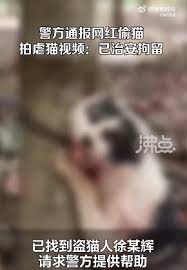
According to screenshots that leaked online and the very fact Xu was part of a cruel ‘cat abuse chat group,’ this probably was not the first time for him to torture animals.
According to a police statement, authorities received reports about the stolen cat and the abuse video on April 26th, after which they immediately launched an investigation.
On April 27th, Xu posted an apology on his Weibo channel, in which he said he felt ashamed and sorry for what he did and that he was willing to bear “all the consequences” of his actions. He also wrote that he was being criticized and held accountable by both the public security bureau and Internet authorities. “Please give me another chance,” he wrote. The comments on the post were switched off.
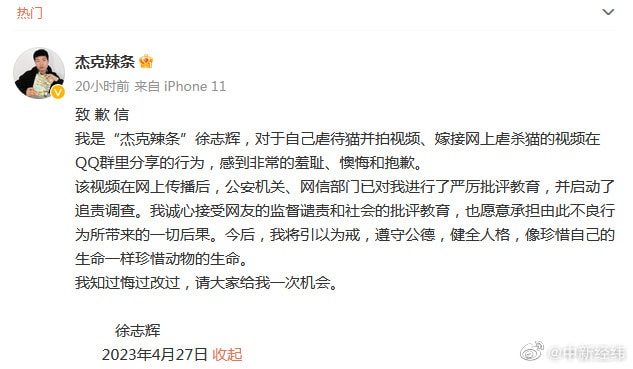
A noteworthy part of Xu’s online apology is that it has a dedicated Weibo hashtag page including a ‘topic summary’ in which Xu apologized. The hashtag page was hosted by Toutiao News. The mix of the personal message by Xu on a hashtag page hosted by Chinese media seems to indicate that these parties worked together in spreading Xu’s words about how remorseful he allegedly is (#偷猫拍虐猫视频网红道歉#).
The comment sections suggest that most people will not forgive Xu for what he did. Many people say the story makes them feel sick to their stomach, and that the idea of ‘cat abuse’ chat groups makes their skin crawl.
“People like this do not change,” one person wrote. “Give you another chance?! Did you give that kitty a chance?!”
“Today he abuses a cat, tomorrow he kills a person. Straight to hell with him,” others wrote: “Go die!”
Xu’s actions are regarded as “negatively impacting society” and he currently is detained in Funan in accordance with the Public Security Administrative Punishments Law. His Bilibili account currently also displays a message that it is getting banned.
Although there are various laws in China regarding wildlife and the protection of animals, there currently is no national law that is explicitly against animal cruelty for all animals. Some legal bloggers explored under which laws Xu could be punished for his actions other than the abuse itself, such as stealing a cat and also uploading such a video to the internet (#虐待无主流浪猫狗或不被处罚#, #公共场合虐待动物并传播视频或犯罪#).
In recent years, voices calling for better laws on animal abuse in China have grown louder. In 2020, after a horrific story of a Chinese security guard pouring scalding water over a cat went viral, Chinese media outlet CCTV called out for a rapid legislation against animal abuse. That same video was shared in light of this incident again.
In 2021, home security cameras captured how anti-epidemic workers beat a pet dog to death in Shangrao. This also caused an online storm over animal abuse during ‘zero Covid.’
“I strongly call for legislation, [we must] defend the bottom line of morality,” some commenters now write: “We will never forgive this.”
By Manya Koetse
Get the story behind the hashtag. Subscribe to What’s on Weibo here to receive our newsletter and get access to our latest articles:
Spotted a mistake or want to add something? Please let us know in comments below or email us. First-time commenters, please be patient – we will have to manually approve your comment before it appears.
©2023 Whatsonweibo. All rights reserved. Do not reproduce our content without permission – you can contact us at info@whatsonweibo.com.





China Animals
China Faces Unprecedented Donkey Shortage Crisis
“We have plenty of cattle and horses in China now — just not enough donkeys” (“目前我国牛马都不缺,就缺驴”).
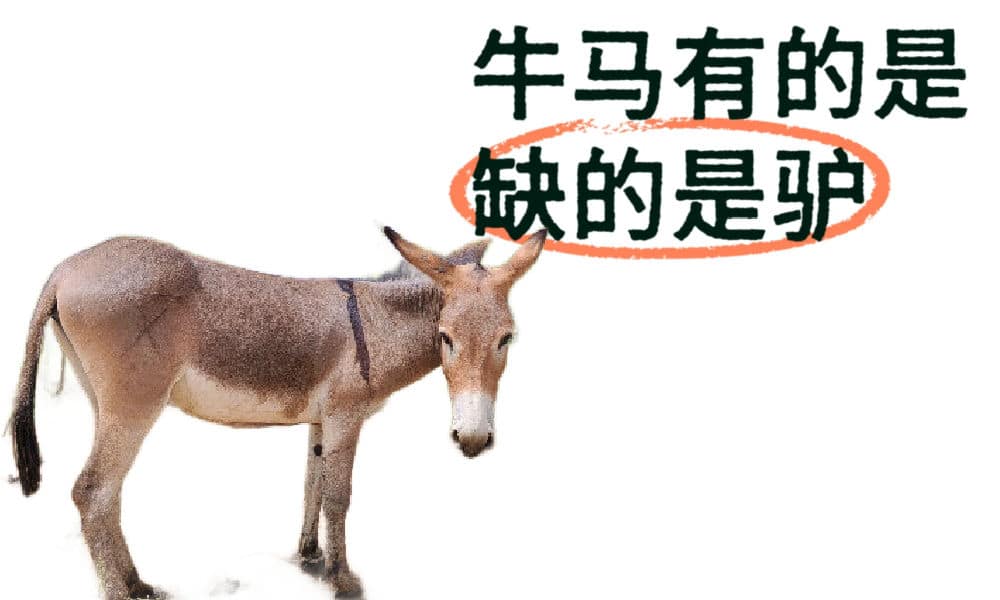
China is facing a serious donkey shortage. China’s donkey population is far below market demand, and the prices of donkey-related products continue to rise.
Recently, this issue went trending on Weibo under hashtags such as “China Currently Faces a Donkey Crisis” (#我国正面临缺驴危机#).
The Donkey Branch of China’s Livestock Association (中国畜牧业协会驴业分会) addressed this issue in Chinese media earlier last week, telling China News Weekly (中国新闻周刊): “We have plenty of cattle and horses in China now — just not enough donkeys” (“目前我国牛马都不缺,就缺驴”).
China’s donkey population has plummeted by nearly 90% over the past decades, from 11.2 million in 1990 to just 1.46 million in 2023.
The massive drop is related to the modernization of China’s agricultural industry, in which the traditional role of donkeys as farming helpers — “tractors” — has diminished. As agricultural machines took over, donkeys lost their role in Chinese villages and were “laid off.”
Donkeys also reproduce slowly, and breeding them is less profitable than pigs or sheep, partly due to their small body size.
Since 2008, Africa has surpassed Asia as the world’s largest donkey-producing region. Over the years, China has increasingly relied on imports to meet its demand for donkey products, with only about 20–30% of the donkey meat on the market coming from domestic sources.
China’s demand for donkeys mostly consists of meat and hides. As for the meat — donkey meat is both popular and culturally relevant in China, especially in northern provinces, where you’ll find many donkey meat dishes, from burgers to soups to donkey meat hotpot (驴肉火锅).
However, the main driver of donkey demand is the need for hides used to produce Ejiao (阿胶) — a traditional Chinese medicine made by stewing and concentrating donkey skin. Demand for Ejiao has surged in recent years, fueling a booming industry.
China’s dwindling donkey population has contributed to widespread overhunting and illegal killings across Africa. In response, the African Union imposed a 15-year ban on donkey skin exports in February 2023 to protect the continent’s remaining donkey population.
As a result of China’s ongoing “donkey crisis,” you’ll see increased prices for donkey hides and Ejiao products, and oh, those “donkey meat burgers” you order in China might actually be horse meat nowadays. Many vendors have switched — some secretly so (although that is officially illegal).
Efforts are underway to reverse the trend, including breeding incentives in Gansu and large-scale farms in Inner Mongolia and Xinjiang.
China is also cooperating with Pakistan, one of the world’s top donkey-producing nations, and will invest $37 million in donkey breeding.
However, experts say the shortage is unlikely to be resolved in the short term.
The quote that was featured by China News Weekly — “We have cows and horses, but no donkeys” (“牛马有的是,就缺驴”) — has sparked viral discussion online, not just because of the actual crisis but also due to some wordplay in Chinese, with “cows and horses” (“牛马”) often referring to hardworking, obedient workers, while “donkey” (“驴”) is used to describe more stubborn and less willing-to-comply individuals.

Not only is this quote making the shortage a metaphor for modern workplace dynamics in China, it also reflects on the state media editor who dared to feature this as the main header for the article. One Weibo user wrote: “It’s easy to be a cow or a horse. But being a donkey takes courage.”
By Manya Koetse
(follow on X, LinkedIn, or Instagram)
Spotted a mistake or want to add something? Please let us know in comments below or email us. First-time commenters, please be patient – we will have to manually approve your comment before it appears.
©2025 Whatsonweibo. All rights reserved. Do not reproduce our content without permission – you can contact us at info@whatsonweibo.com.
Chapter Dive
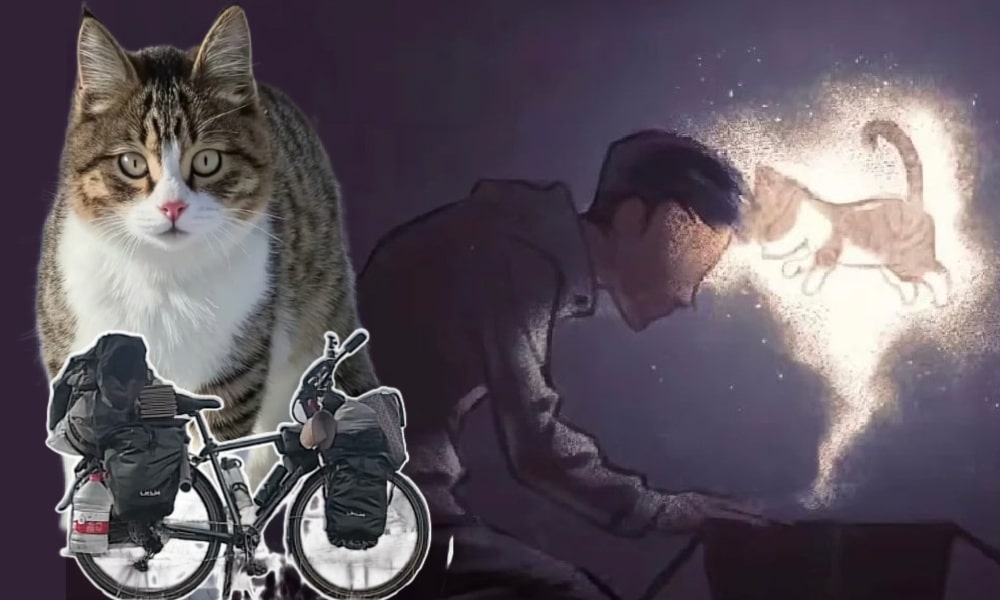
Behind the Mysterious Death of Chinese Internet Celebrity Cat Wukong
“Dont believe the media,” Zhao Shuo said: “And also don’t believe me.”
Eye on Digital China is a reader-supported publication by
Manya Koetse (@manyapan) and powered by What’s on Weibo.
It offers independent analysis of China’s online culture, media, and social trends.
To receive the newsletter and support this work, consider
becoming a paid subscriber.


Keeping Score of History: The Mukden Incident and China’s Basketball Defeat to Japan

The Rise of “Shuaqi-ism,” Taking Starbucks to the Fields, and Pretending to Go to Work

Why Japan Has So Many Surnames, China’s Back-to-School Shifts & Taiwan Pavilion Trouble

Blame Games & Bad Signs: Nepal–Tibet Floods, Huawei’s Toilet Trouble, “Screwed” Graduates

The Power of Ugly: Why Niu Lai Became China’s Unlikeliest Box-Office Hit

China’s CITIC Tower Crash: The Story That Never Trended

“Even Pigs Have AC”: The European Heatwave Through Chinese Eyes

“God Won’t Save Us, but the PLA Will”: Floods, Faith, and Kung Fu Soccer Nostalgia

How Chinese AI Videos Turned Foreigners into Villains
The Power of Ugly: Why Niu Lai Became China’s Unlikeliest Box-Office Hit
-

 China Arts & Entertainment12 months ago
The Wong Kar-wai Scandal Explained: The Dark Side of ‘Blossoms Shanghai’
-

 Chinese New Year7 months ago
Inside Chunwan 2026: China’s Spring Festival Gala
-

 China Brands, Marketing & Consumers10 months ago
Hasan Piker’s China Trip & the Unexpected Journey of a Chinese School Uniform to Angola
-

 Chapter Dive7 months ago
Inside the Great Chinese Debate Over the Iran War
mari
May 5, 2023 at 12:05 pm
only death penalty for this inhumane