
Featured
What’s on Weibo Blocked in China
What’s on Weibo is no longer accessible from within the PRC.


As of July 7, we’ve been notified by readers that What’s on Weibo is no longer accessible from within mainland China. After some testing, we have discovered that our site has indeed been blocked from all locations in the PRC now.

This is unfortunate for the many readers we have from mainland China. What’s on Weibo has been blocked before in late 2015, after which it was opened again in the summer of 2016. It is unsure if the current block is temporary and if the site will be accessible in China in the future again.
Too bad, What's on Weibo has been blocked in China, after the piece about online memes https://t.co/TNO9vBv1fe
— Manya Koetse (@manyapan) November 19, 2015
In the meantime, we will continue to report what is trending on Chinese social media. Follow What’s on Weibo on Twitter or Facebook to get daily updates on our latest articles.
In case you need a VPN, NordVPN currently has a very attractive $2.75 Summer deal (other recommended VPNs here and here).
By Manya Koetse
Follow @whatsonweibo
PS!: If you enjoy What’s on Weibo and support the way we report the latest trends in China, we welcome donations via Wechat or Paypal. We can use every penny to help pay for the upkeep, maintenance, and betterment of this site (read more).
Spotted a mistake or want to add something? Please let us know in comments below or email us.
©2018 Whatsonweibo. All rights reserved. Do not reproduce our content without permission – you can contact us at info@whatsonweibo.com.
China Insight
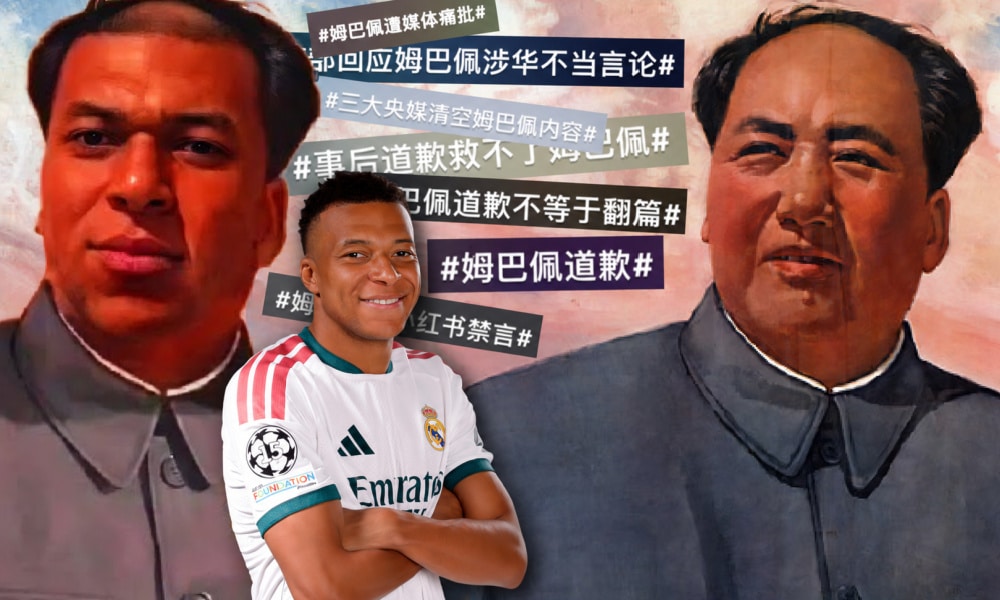
Mbappé, Mao, and the Joke That Shall Not Be Named
Mbappé’s favorite Mao meme sparked major backlash in China. More on what the controversy reveals about political red lines, online humor, and censorship.
RESOU 热搜 | What’s Trending in China, Explained
Here, I briefly unpack the stories making waves on Chinese social media and share what stands out to me. Don’t miss an update: become a subscriber to Eye on Digital China today.
Oh oh oh, Mbappé, all those goals, yet you lost so many points on Chinese social media over the past 48 hours.
Following his 100th goal for Real Madrid during El Clásico and finishing second on Ballon d’Or night, French football player Mbappé is all the talk on Chinese social media — not for his achievements, but for what is seen as crossing a major red line in an online interview.
On Tuesday night, a text came in from Ruixin: “I am wide awake tonight and somehow witnessed live how the footballer Kylian Mbappé was getting blocked and totally canceled on Chinese social media for his comments about Mao Zedong over the past, like, three hours 😅”
I quickly grabbed my phone and saw the flood of Mbappé posts rapidly coming in, and it was clear that people were very cross with him.
Although it was already clear that this might not blow over any time soon, by early Wednesday morning it became painfully clear how the controversy had snowballed. Dongpeng Beverage Group (东鹏), one of the many Chinese companies that signed the famous sportsman as its brand ambassador, publicly stated that it was cutting all commercial ties with Mbappé. Soon, others followed.
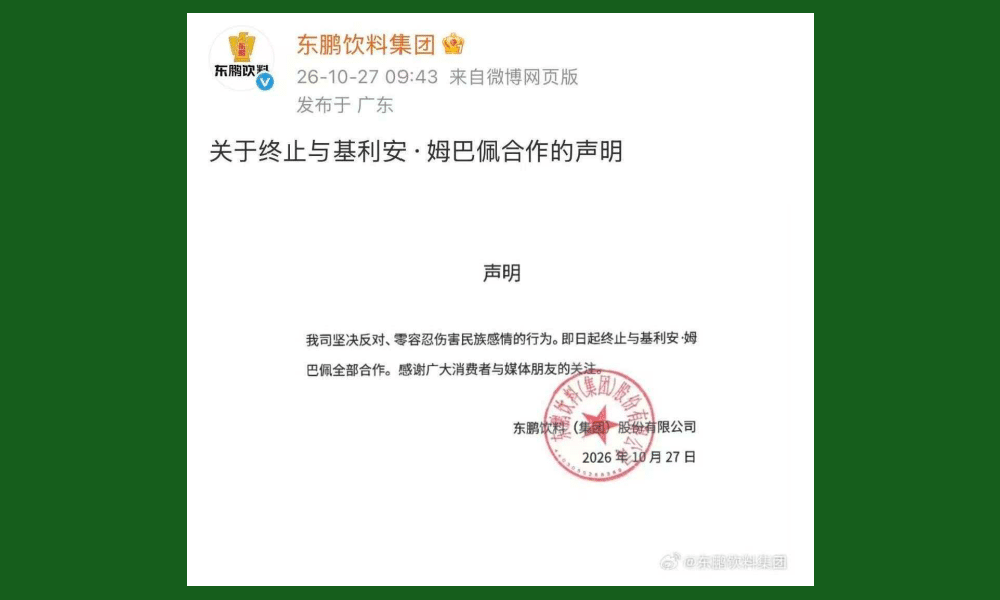
Dongpeng Beverage Group (东鹏): the first in a string of companies to cut ties with French footballer Kylian Mbappé.
Mbappé’s fall from grace in China has been sudden and spectacular, like a major avalanche of backlash that unfolded in one night, and it can all be traced back to one segment of an interview the footballer previously did on a French YouTube show (The Bridge) that resurfaced online — initially through Reddit and X, and then on Chinese social media apps, like football platform Dongqiudi (懂球帝).
In that segment, when asked about his favorite meme, Mbappé replied that one of the memes he finds funniest is:
🗣️ “the one where they put my face on some guy, a Chinese dictator. That really makes me laugh, I use it with my friends all the time.”

The interview segment where Mbappé shares his favorite meme: his face photoshopped onto the face of a “Chinese dictator.”
The show, created by Mbappé’s Real Madrid teammate Aurélien Tchouaméni, added the image Mbappé referred to: his face photoshopped on a Mao propaganda visual. It’s part of a series of memes that emerged in 2024 in which Mbappé’s face is edited onto the faces of dictators.1
Mbappé previously distanced himself from the trend, which makes it all the more noteworthy that he still seems to appreciate some of that banter later.
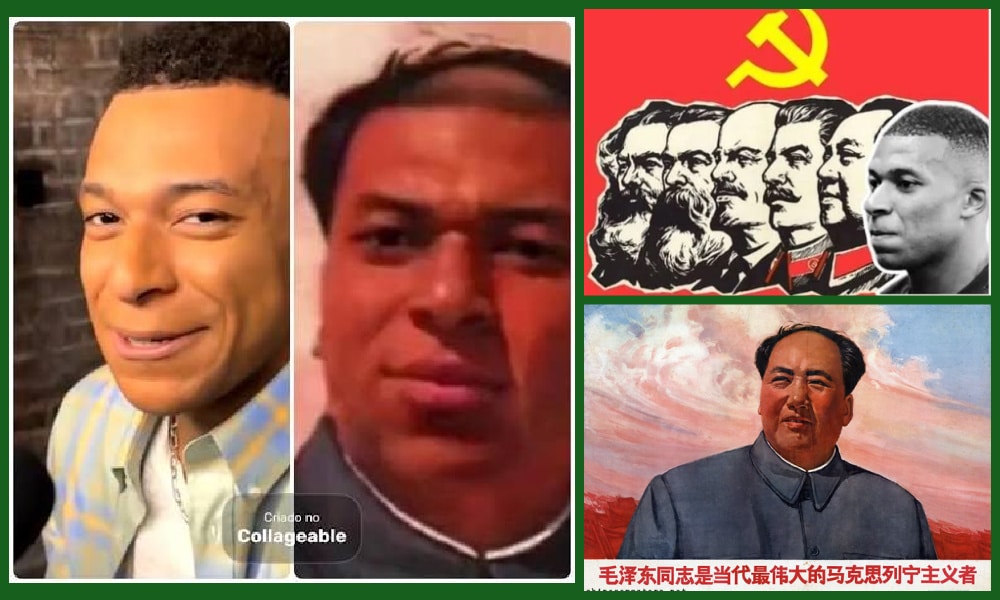
Left: an example of the Mbappé x Mao Zedong meme; top right: part of the meme series; below: the original propaganda poster of Mao Zedong.
Although the interview and the joke were lighthearted, this Mao meme backfired on Chinese social media, where jokes about Mao cross a major political red line. The backlash began on Monday after the interview recirculated online and further escalated when the Chinese football app Dongqiudi (懂球帝) said his remarks had “hurt the feelings of Chinese people.”
Chinese netizens responded with anger, turning against Mbappé because they felt he disrespected Chinese history and national feelings. The comments hurt all the more because Mbappé has a huge commercial presence in China (sometimes you can literally see him in every other online ad), which explains the widespread “you profit from China and yet do this” tone online.
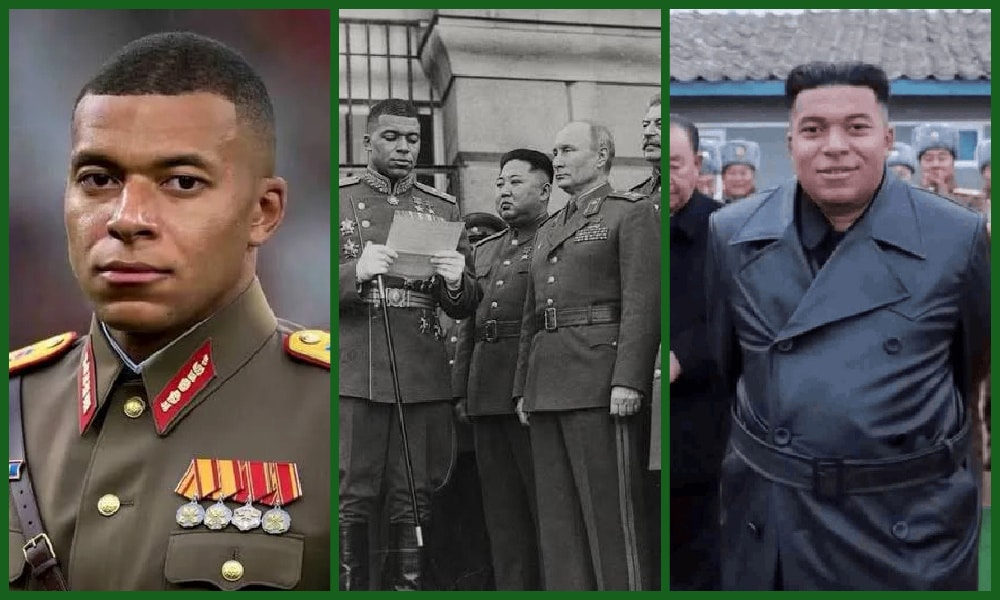
Other examples within the “Dictator Mbappé” meme series.
Mbappé quickly saw his reputation going up in smoke in China. China’s state broadcaster CCTV suspended LaLiga and Mbappé-related broadcasts, pulling his ads. China Mobile’s streaming platform Migu (咪咕) removed Mbappé videos. The Chinese Football Association condemned his words.
Following Dongpeng, other Chinese companies like dairy company Mengniu (蒙牛) and cheese brand Miaokelando (妙可蓝多) also publicly ended all cooperation with Mbappé.
Xiaohongshu, the social media platform where Mbappé was a brand representative, removed all material related to previous campaigns, then muted his account and blocked it from gaining new followers. Weibo, where the footballer had over one million followers, did the same.
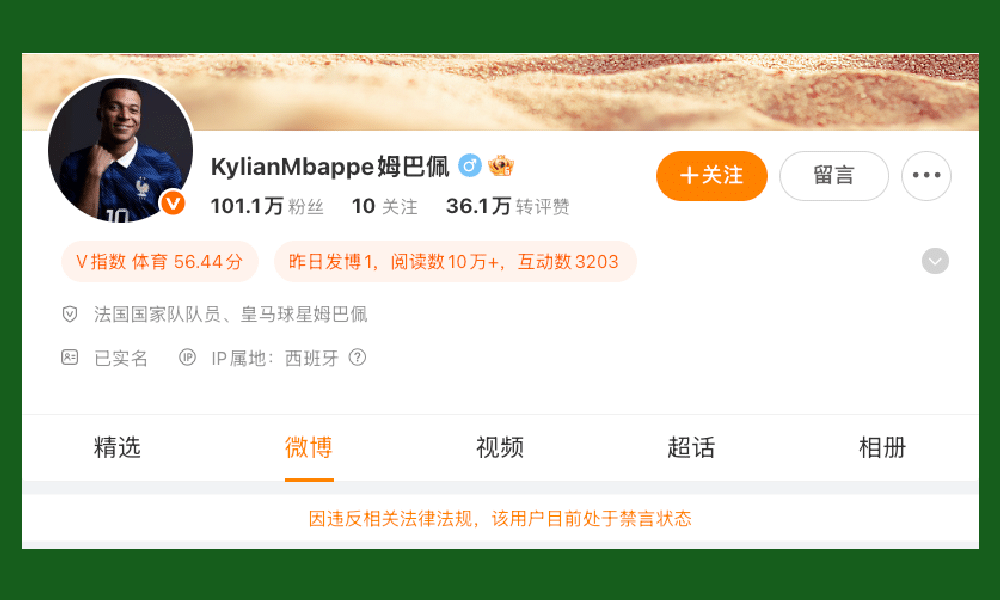
Weibo account of Mbappé, restricted.
On Wednesday, a Foreign Ministry spokesperson, asked about the case, said words and actions that hurt the feelings of the Chinese people will “naturally be met with joint opposition from all sectors of Chinese society.”
It did not take long for LaLiga to apologize on Weibo, followed by LaLiga president Javier Tebas, and finally, Kylian Mbappé himself — though not on his restricted Weibo account, but on X, saying:
🗣️ “During a recent interview, I reacted to an image of myself. My comment was ill-judged, and I now understand that it hurt many people in China and in Chinese communities around the world. I apologise to everyone my words have upset. This was absolutely not my intention. I have deep respect for the Chinese people and their history, and I am sincerely sorry.”
There are 3 things that stand out to me in this major debacle:
1. The Reach of China’s Red Lines
Over the past years, it has become clear time and time again that Chinese companies, celebrities, and comedians can face huge public and official backlash with far-reaching consequences for jokes they make, things they post, and language or visuals used whenever these cross political, historical, moral, and social red lines (although, because these lines are not always clear, they could sometimes also be called “gray” lines).
Once these companies or entertainers are canceled, it’s hard to come back from that. There may be legal consequences for them besides nationalist backlash; their social media accounts may be closed, and their access to Chinese audiences restricted.
Along with China’s rise on the world stage, Chinese authorities and other actors increasingly seek to enforce certain political sensitivities beyond China’s borders.
Although that may not have always been effective in the past, we now live in a time when more foreign companies and celebrities than ever are actively involved in the Chinese market, their activities entwined with Chinese entities, businesses, or market segments. Red lines that apply to Chinese companies and entertainers increasingly also apply to them, and the pressure on them to respect, especially, Party authority and state red lines is more effective because the adverse consequences have become so significant.
This is the internationalization of the costs of crossing Beijing’s red lines, and the Mbappé backlash is a clear sign of these dynamics. What Mbappé said in his interview was perfectly lawful within his own country, did not cross any moral lines in its own context, and fit the conventions of meme humor in its original context. Yet, due to the role Mbappé plays in the popular and commercial culture in China, it was not only deemed unacceptable by China and Chinese netizens, but Mbappé and LaLiga themselves also accepted these boundaries: they apologized, acknowledged the crossing of the red line, and, in doing so, further internalized the restrictions that are about avoiding offending Beijing.
2. This Isn’t About a Different Sense of Humor
At the heart of this issue is not just the international reach of China’s red lines, but a clash between online cultures with different boundaries around humor.
At first glance, this might suggest that the sense of humor on the Chinese internet is simply very different from humor in the European media context in which Mbappé made his remarks. But I’d argue that the difference lies less in contrasting national senses of humor and more in the political structures that shape what can be said, combined with culturally-coded expectations about who gets to joke about which subject.
What’s perhaps more remarkable is how similar online humor can be in the Western and Chinese social media spheres. Turning historical and political figures into memes is very much a thing on Chinese social media as well. There have been dozens of memes about Kim Jong-un or Putin. There’s even an entire meme culture surrounding former Chinese leader Jiang Zemin (江泽民).
Sometimes this kind of humor can get very sensitive. Most internet users, by now, are familiar with the fact that Chinese netizens previously compared Xi Jinping to Winnie-the-Pooh, a comparison subject to censorship on Chinese platforms, turning a seemingly innocent bear into a subversive symbol.
One of the other highly sensitive memes in China’s online culture concerns the son of Mao Zedong, Mao Anying (毛岸英, 1922–1950), who died during the Korean War in 1950. An unverified online story claims he disobeyed army rules and cooked egg fried rice at the Chinese headquarters, which supposedly alerted the enemy and led to that fatal bombing. This story sparked recurring, now-banned memes about “Egg Fried Rice Day” (蛋炒饭节) around the anniversary of his death.
For China’s cyberspace authorities, jokes about Mao Zedong and his revolutionary martyr son cross serious political red lines.
Mao Zedong is a highly sensitive subject, and humor about him is virtually always subject to censorship. He is an officially honored national hero, but also, for many, a figure tied to painful family memories. That does not mean people do not joke about him. Mao can serve as the vehicle for a pun without necessarily being its target, while more satirical humor can be a way for Chinese critics to engage with their own society’s history. (Neither exists outside the constraints of censorship.)
Although Mbappé’s meme also involves self-mockery, his casual reference to “some guy (…) I think he’s a Chinese dictator” can be interpreted as external ridicule. Beyond the political minefield that Mao jokes already are, it also matters who makes the joke and how they relate to it. His apparent unfamiliarity with Mao, for many, comes across as contempt for China and Chinese history, particularly when it comes from a foreign celebrity who makes a lot of money in China yet appears to know nothing about one of the country’s most important historical figures. That helps explain why the joke doesn’t just fall flat—even among those who privately enjoy making their own Mao jokes—but feels disrespectful, too.
3. It’s All About a Joke That Shall Not Be Named
One aspect of the Mbappé PR catastrophe that especially stands out is that although the topic has been trending all over Chinese social media, many netizens don’t know exactly what joke is at the center of the controversy. After all, explaining how he crossed a red line risks crossing that same line again.
Football app Dongqiudi was the first platform to point a finger at Mbappé for hurting the feelings of Chinese people, yet would not actually translate or explain his remarks. State media writing about the controversy did not get into the details either.2 Political commentator Hu Xijin (胡锡进) devoted an entire Weibo post to condemning the remarks and discussing their consequences, without explaining what Mbappé had actually said.
Even Chinese AI chatbots will not properly lay out what the fuss is about. At the time of writing, asking Weibo’s own chatbot what Mbappé said yields little more than that he “brought up a manipulated meme image that maliciously hurt Chinese national feelings.”
With so few details available, many netizens without a VPN are still left in the dark about why there are calls to boycott Mbappé. This has prompted popular search queries like “What did Mbappé actually say?” The same question appears throughout comment sections, with some asking, “So what did he say?” (“他说了啥?”), and others more insistently: “What did he actually say? I’ve searched for an entire night and still don’t know!”
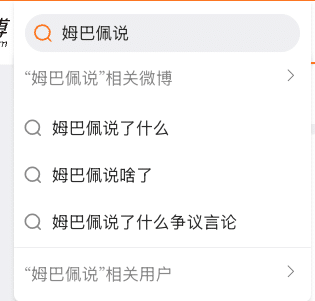
Examples of search queries on Weibo: What did Mbappé say?
And so some netizens try to explain the controversy without explicitly mentioning what was said, offering cryptic clues like:
💬 “Just look at a renminbi banknote and you’ll understand.”
Or:
💬 “You could think of it as a Chinese football star saying in an interview that he likes Photoshopping his own head onto President Washington’s head on the US dollar, and that it’s really funny.”
This also means that people can become angry at Mbappé without ever getting a clear account of his offense.
One Chinese blogging account put it bluntly:
💬 “There is no room for debate about the controversy itself. When a public figure with extensive commercial partnerships in China says something that hurts the feelings of Chinese football fans and the Chinese people, terminating the partnership is the only option for brands—and the correct one.”
In other words, the fact that everyone seemingly agrees that Mbappé “hurt Chinese national feelings” is presented as enough reason for far-reaching consequences, from boycotts to terminated partnerships, even though the remarks themselves remain unexplained in official coverage.
The result is something almost Kafkaesque: everyone is expected to recognize the offense, yet explaining it risks repeating it. It almost seems like a game of ‘Taboo’ is unfolding around Mbappé in China, leaving netizens guessing as to who or what he actually joked about, while the message is clear: hurting national feelings is wrong, and those responsible must face consequences.
Mbappé might have apologized, but it seems unlikely we’ll see him back in Chinese commercials any time soon.
– By Manya Koetse
Written with research assistance from Ruixin Zhang and Miranda Barnes.
1 Origins of this meme series: this dictator series blew up in 2024 following a legal dispute Mbappé had with a kebab shop owner in Marseille, as described by Tom Williams in The New York Times. The kebab shop sold bread “as round as Mbappé’s skull”, and then received a legal letter saying he was not allowed to use Mbappé for his kebab descriptions, after which the owner complained on Instagram that: “Mbappé has turned his name into a dictatorship!” This label stuck with him as some found it suitable to depict him as a bossy character who influences everyone around him, from coaches to teammates.↩
2Example of a typical way this entire incident is described in Chinese media: “(…) footage surfaced of his inappropriate remarks on an overseas podcast. When the host brought up internet memes, he volunteered a malicious, digitally altered meme that seriously hurt the national feelings of the Chinese people, publicly sharing it as “the funniest meme on the entire internet.” He also claimed that he regularly used the image to joke around and amuse himself with friends.” This is part of a a post by Guangming Daily 光明日报, in translation.↩
Eye on Digital China, by Manya Koetse, is co-published on Substack and What’s on Weibo. Both feature the same new content — so you can read and subscribe wherever you prefer. Substack offers community features, while What’s on Weibo provides full archive access.
Spotted a mistake or want to add something? Please let us know in comments below or email us. First-time commenters, please be patient – we will have to manually approve your comment before it appears.
©2026 Eye on Digital China/Whatsonweibo. All rights reserved. Do not reproduce our content without permission – you can contact us at info@whatsonweibo.com.
Chapter Dive
The French Protests, Viewed from China: Five Narratives on Chinese Social Media
From the decline of Europe to historical karma: these 5 narratives reveal how Chinese social media discusses the recent unrest in France.
Originally published in the Eye on Digital China newsletter on Sunday, October 25, 2026.
Over the past week, the widespread protests and unrest in France have been trending on Chinese social media. From October 18 to today, turmoil in Paris and other cities consistently appeared in the top trending lists on Weibo, Kuaishou, and other apps, with Chinese netizens and commentators discussing the situation in various ways under numerous hashtags.
The topic remained trending all week not only because of the October 17–18 riots and their aftermath, but also because of the new round of protests on October 24, for which French authorities deployed 70,000 police officers and the Chinese embassy in France issued new warnings.
Here, we’ll take a closer look at five dominant narratives surrounding the protests in France on Chinese social media, and what this says about Chinese perceptions of France and Europe, from common ideas about the decline of Europe to the protests being a form of “historical karma.”[1]
1. “France Has Lost Control”: A Nation in Crisis
How can a developed country like France fail to maintain basic order? One dominant framing of the recent protests on Chinese social media is that they demonstrate the French state’s inability to keep the situation under control, indicating a crisis of governance and security.
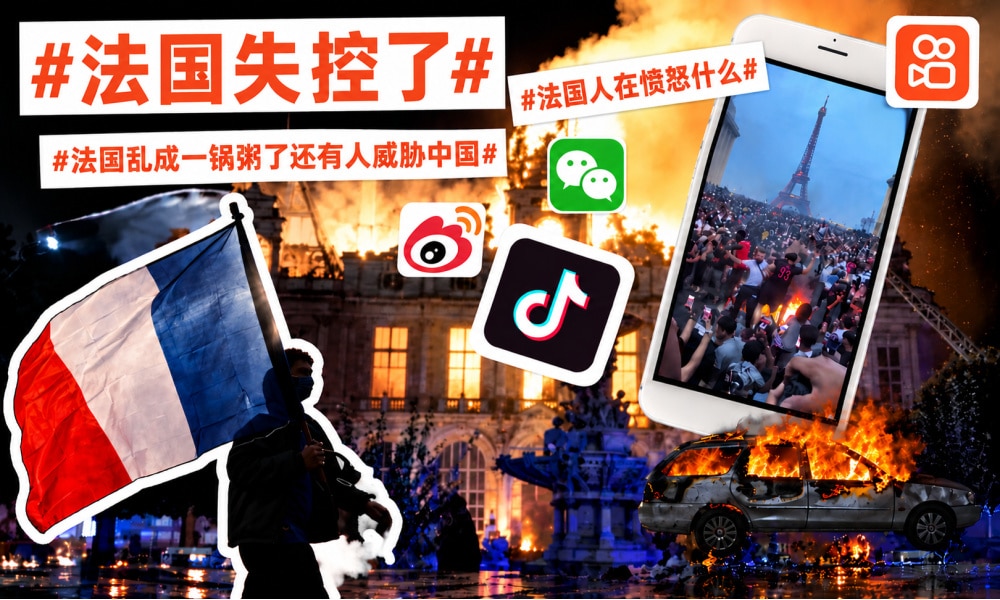
One of the highest-ranking hashtags among more than 300 trending topics on Chinese social media apps related to the unrest in France is: “France is out of control” (法国失控了). Along with hashtags like “France is in chaos again,” that hashtag first came up last Sunday on Weibo during a weekend filled with looting, arson, destruction, and violence by groups of rioters in Paris, Marseille, Lyon, Lille, and elsewhere.
The perceived weakness of President Macron’s leadership was highlighted on Chinese social media through memes and jokes mocking the leader for attending a Celine Dion concert right before the situation escalated. A commentary on Sina compared the concert to company executives holding a celebration banquet and handing out bonuses just before the firm collapses, framing the riots as a “run on trust” (信任挤兑) against the government.
Videos of the chaotic scenes on the streets spread to various platforms, where some described it as a “war zone.” Others suggested that
💬 “it looks like France is finished (..) The situation has spiraled completely out of control.”
💬 “If I didn’t see this with my own eyes, I never would’ve believed it,” one Douyin user wrote, with others stressing:
💬 “I’m so grateful to live in China.”
🔎 Background: How the unrest began
The unrest in France began as a school-based movement on September 17, when teachers in Créteil, a suburb of Paris, started a strike over staffing shortages and students began blockading the school in solidarity – an act that was copied by students at hundreds of other lycées across the country angered over poor facilities and teacher shortages.
By mid-October, the movement went far beyond protests over school conditions and involved broader grievances over underfunding of public services, inequality, rising living costs, and the forceful police response against minors.
The protests escalated into nationwide riots on October 17, the Saturday at the start of the school holidays, when the school-based movement marched alongside the CGT union, Yellow Vests (gilets jaunes), and others; some 550,000 people took to the streets nationwide, including about 110,000 in Paris alone.
But while many of these gatherings and marches were peaceful, that weekend erupted into waves of violence, including buildings being set on fire, home break-ins, and shops being looted. Designer goods stolen during the looting – from Louis Vuitton to Burberry – were later offered on street-side stalls and online platforms like Vinted and eBay.
October 24 saw a second round of major protests across French cities, with some 400,000 people mobilizing. In some instances, these demonstrations also ended with arson and clashes with police.
Many Chinese netizens wondered who would pay for the losses and who the victims of the riots could turn to. In some of these discussions, there was little understanding or sympathy for the protesters, with some Douyin users writing:
💬 “And yet there are still people trying to spin this as a revolution, as something righteous. I genuinely don’t understand. What kind of revolution involves smashing the doors of luxury stores and setting cars parked along the streets on fire? Isn’t this just outright rioting?”
But following videos showing the more peaceful protests, there are also voices that praise the French for standing up:
💬 “These are people who are expressing their demands and anger, they are far braver than the Chinese who remain silent.”
🔹 Revolutionary Spirit
At the same time, the protests also serve as an opportunity for sarcasm and jokes that echo the Chinese revolutionary spirit, writing:
💬 “The French people should sing The Internationale at the top of their lungs! Unite with the people of Germany, Italy, and Britain to fight (…) Smash the old world and create a new one! Keep going, keep going, and strive for even greater victories! Let the red flag fly across all of Europe!”
💬 “Who would’ve thought France would be the first country to enter a communist society?”
💬 “The Paris Commune is back! They’ve achieved communism ahead of schedule. Distribution according to need: whatever you want, just go and take it.”
By portraying the French protesters as though they are carrying out a glorious proletarian revolution, netizens may be mocking the protests, but are actually also implicitly poking fun at China’s own Mao-era revolutionary past.
🔹 Zero Yuan Shopping
As part of this online sarcasm and humor surrounding the protests, Chinese netizens refer to the looting as “Zero-Yuan Shopping” (líng yuán gòu, 零元购 or 0元购), joking that the riots are the French version of China’s Singles’ Day Shopping Festival.
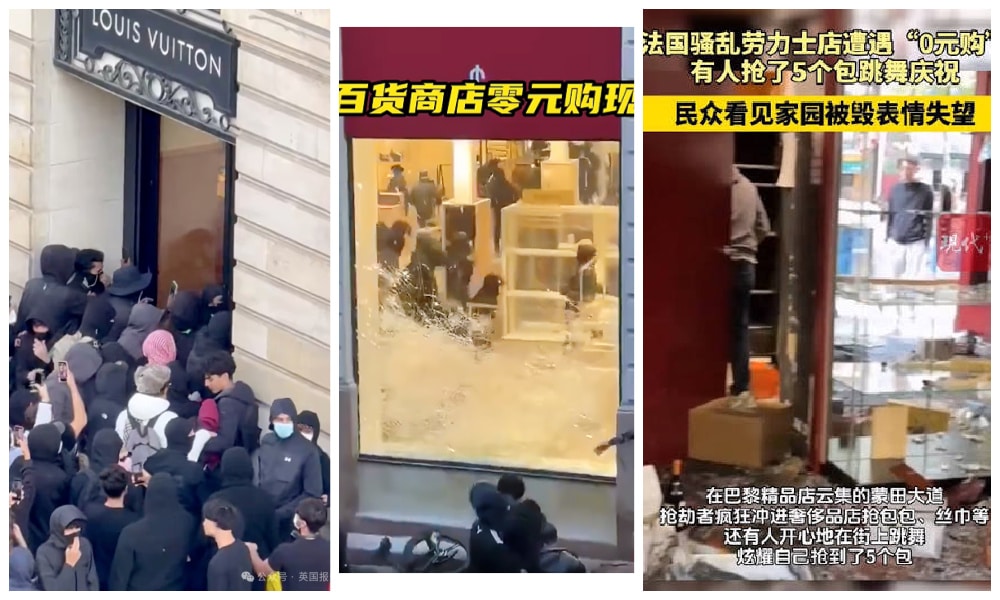
Zero Yuan Shopping on Chinese social media
“Zero-Yuan Shopping” was originally a livestream promotion term for getting a product for free, but it has become a sarcastic buzzword among netizens for flash mob-style looting in Western countries, especially since the plundering following the George Floyd protests in 2020.
Some netizens suggest that the protests are no longer about their original aims at all, but have just become a way to get free goods for masked rioters, while ordinary people and their livelihoods get hurt in the meantime.
🔹 Welcome to Paris
A globally viral AI-generated video by Dutch filmmaker Wytse Koetse, presented as an advertisement for the fictional “Paris City Tours,” also struck a humorous chord with Chinese netizens as it was shared on various platforms, including by a state media outlet on Kuaishou.
The video shows an upbeat French tour guide taking a group of Asian tourists through the “real Paris,” seemingly unfazed by the flames, looting, and fighting unfolding around them. She cheerfully continues the tour as though everything is business as usual. “Very passionate people, the French,” she remarks, before wishing the tourists a pleasant stay in Paris as explosions erupt around them.
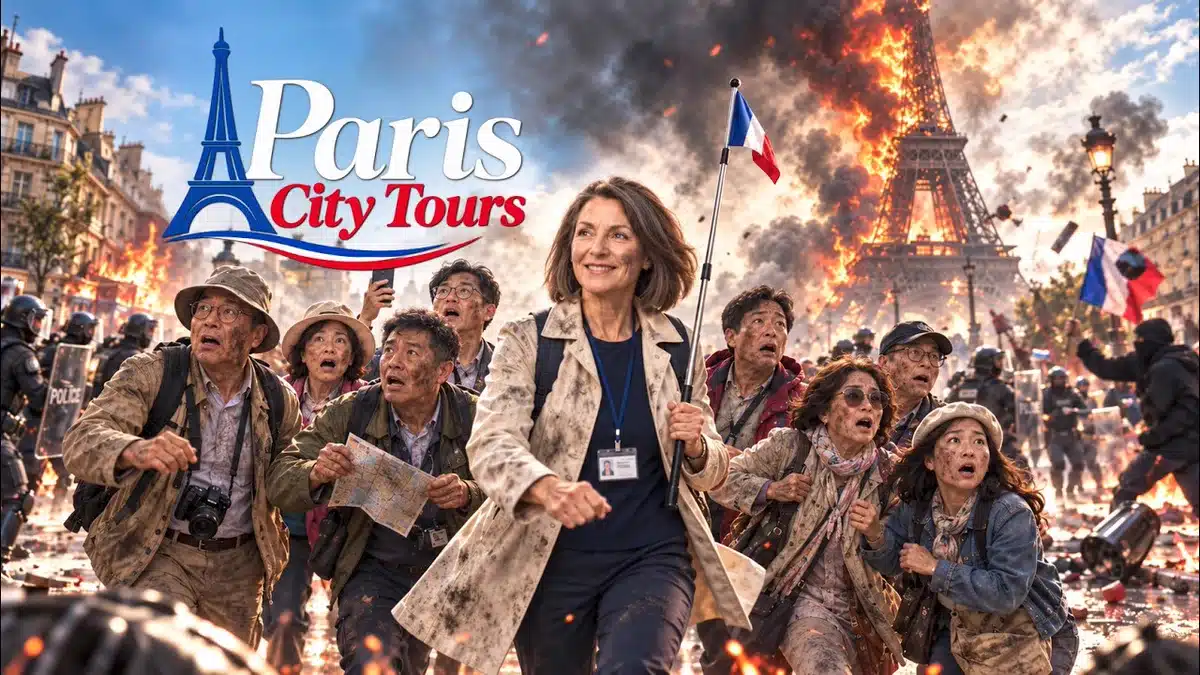
Featured image of the Paris City Tours AI video that went viral (see original)
“She’s giving these Chinese country bumpkins a taste of the free France,” some sarcastically commented. Others replied: “A tour to witness the European revolution,” and: “Now, this is real romance!”
The video, as well as the reactions to it, plays with the contrast between the old image of Paris, associated with romance, luxury, refinement, and intellectual life, and the current-day scenes of chaos, looting, disorder, and street confrontations.
💬 “It’s like the end of a civilization,” one Weibo user wrote.
2. “France Is the New Sick Man of Europe”: A Failure of the European Model
Another common way in which the French unrest has appeared in Chinese media and online discussions this week goes beyond framing it as just a French domestic issue. Instead, it’s framed as a broader European crisis where the same problems appear in various countries, from Spain to Belgium and Italy.
Everywhere, you see the same interconnected issues: growing public debt paired with slow economic groth, widening social inequality and increased pressure on social services, and more polarization among the people together with political distrust.[2]
In this context, the protests across France are merely treated as part of a much bigger crisis: “the decline of Europe.”
🔹 High Welfare Spending, Growing Social Discontent
According to the Xinhua article titled “How Will an ‘Aging’ Europe Confront the Anger of Its Young People?” (“老去”的欧洲如何面对年轻人的愤怒), an online video that showed boomers dancing by the Seine against the backdrop of the riots was emblematic of the situation, showing the unequal distribution of resources between different social groups/generations as a root problem of the unrest.
The Xinhua article suggests that France’s high welfare spending and rising social discontent is a European problem, quoting economics professor Rudolf Debord who described it as “a microcosm of Europe’s broader predicament.” Other European countries are also facing aging populations, generous welfare systems, and rising debt-to-GDP ratios, while their net population growth still depends on immigration.
An analysis by Dong Yifan (董一凡) in Chinese news outlet Global Times also argued that the fiscal instability behind the French protests is widespread across Europe, and that the EU’s Stability and Growth Pact has become ineffective. He writes:
💬 “Europe regards its systems of political participation and electoral democracy as a ‘global model.’ Yet amid overlapping domestic and international crises, limited fiscal resources, and restricted room for reform, it has become increasingly difficult for European countries to undertake deep reforms that directly address their underlying problems.”
🔹 A Vicious Cycle
Within this context, Chinese state-affiliated media have been amplifying the idea of France as “the new sick man of Europe” (欧洲新病夫). This phrase, attributed to investors quoted in British media, resonated in Chinese discourse because “the sick man of Asia” (东亚病夫) is historically associated with China’s perceived weakness and humiliation in the late nineteenth century.
Political commentator Hu Xijin (胡锡进) further expanded this idea, and suggested that “when Paris and other French cities develop a fever, other parts of Europe start coughing,” as the problems in France are dragging down the momentum for reform across the entire European Union.
In Hu’s column, he mostly focused on how France’s high welfare costs are draining the pond. High spending, low growth, and the difficulty of implementing reforms have accumulated to such an extent that there’s now a vicious cycle: protests obstruct reforms > leading to larger fiscal deficits and even scarcer resources > followed by more protests. Hu concluded:
💬 “France is not merely sick; it is seriously ill.”
🔹 Blaming the ‘Baizuo’
Besides Chinese state media and political commentators, nationalist bloggers also paint the French developments as part of a broader decline of Europe. Many of them, however, do not focus on economic troubles, but instead emphasize cultural issues across Europe, particularly in relation to the baizuo, immigration, and the European refugee crisis.
The term báizuǒ (白左), literally meaning “white left,” has been widely used on Chinese social media over the past decade (mainly since the 2015 European refugee crisis) to refer to Western liberals portrayed as overly politically correct, idealistic, and naively sympathetic toward immigrants.
In these kinds of discussions, European troubles are explained as a consequence of leftist policies and immigration, with typical comments appearing on various platforms being comparable to this one by a military blogger with over 170k followers on Weibo (浪涛万里铸星河):
💬 “Europe really is in complete chaos! The unrest in France hasn’t even ended, and now Belgium is kicking off, spreading further to Spain, and now Italy has joined in too. These European baizuo politicians must be completely out of their minds. They’ve brought in so many Middle Eastern and African immigrants whose cultures are incompatible with their own (..) that scenes of vandalism, looting, and arson will simply become the new normal in Europe.”
3. “My Uncle’s Restaurant Got Burned Down”: Chinese Victims of a French Crisis
Another lens brings the unrest in France closer to Chinese audiences by focusing on how it affects and threatens Chinese people and their businesses abroad. This makes the foreign crisis more immediately relevant to Chinese netizens, adding an emotional connection and, perhaps, also reinforcing the idea that French authorities are failing not only to protect their own citizens and their property, but also foreign residents and businesses.
This happens especially through stories of Chinese shopkeepers in France being affected by the riots.
One Douyin user wrote:
💬 “They’re just grabbing and looting anything they can get their hands on. My uncle runs a restaurant there, and it was completely burned down.”
The story that drew the most attention was that of Aline Li (阿琳), the 50-year-old Chinese-French owner of the café and tobacco store La Barrique in Paris, which she had run for seven years. Crowds of rioters broke into the café, where she and her husband had locked themselves inside, and beat her unconscious, after which they completely ransacked the place.

Business owner Aline Li after rioters looted her business and beat her unconscious.
The incident also reopened some old wounds regarding the vulnerability of Chinese people in France. An old DW interview resurfaced in this context, suggesting that Chinese people were deliberately targeted because they had become “too rich” in France. Even though those comments seemed related to the current riots, the context for that 2017 interview was actually the killing of a Chinese tailor Zhang Chaolin 张朝林 in the north of Paris. His death at the time led to large protests by the Chinese community over repeated robberies targeting Chinese residents.
One WeChat blogger commented:
💬 “If you want to live as well as Chinese people do, then work as hard as they do! These riots originally had absolutely nothing to do with us.”[3]
4. “France In Complete Chaos, Yet Some Still Threaten China”: Using Domestic Disorder to Delegitimize Criticism of China
Another theme within these discussions is that the ongoing unrest and riots undermine France’s credibility and authority to criticize, pressure, or threaten China. The underlying message is: you have no business pointing fingers when your own house is in disarray.
This line of argument, propagated by Chinese state media, explicitly links the turmoil in France to its position in the world and its relations with China, using the domestic unrest to challenge France’s position on bilateral issues.
One noteworthy post within this framing comes from Chinese Party-affiliated newspapers Beijing Daily and Global Times, headlined “France is in complete chaos, yet some still threaten China” (“法国乱成一锅粥了还有人威胁中国”).[4]
The original column focused on how French economist Philippe Aghion, winner of the 2025 Nobel Prize in Economics, had suggested that, in the automotive manufacturing sector, Chinese electric vehicles could be allowed to be produced in Europe by European workers. If China refuses, Europe should “take a tough stance and threaten to impose additional tariffs.”
The Global Times denounced his stance, calling it “absurd” and “regrettable” that a renowned French economist would openly advocate trade protectionism while, in the streets of France, even the most basic public order was difficult to maintain.
By setting his comments – which were actually made on October 16, before the violent weekend – against the backdrop of chaos in the streets, the Chinese media outlet implies that European elites have lost touch with reality: they’re pointing to China as if that is where Europe’s difficulties lie, while it’s their own structural failures that are causing the chaos at home.
5. “History Repeats Itself!”: France's Past Comes Back to Haunt It
A final prominent narrative, largely driven by nationalist bloggers, interprets the disorder and destruction that unfolded in France through the memory of France’s role in the burning and looting of the Old Summer Palace (Yuanmingyuan).
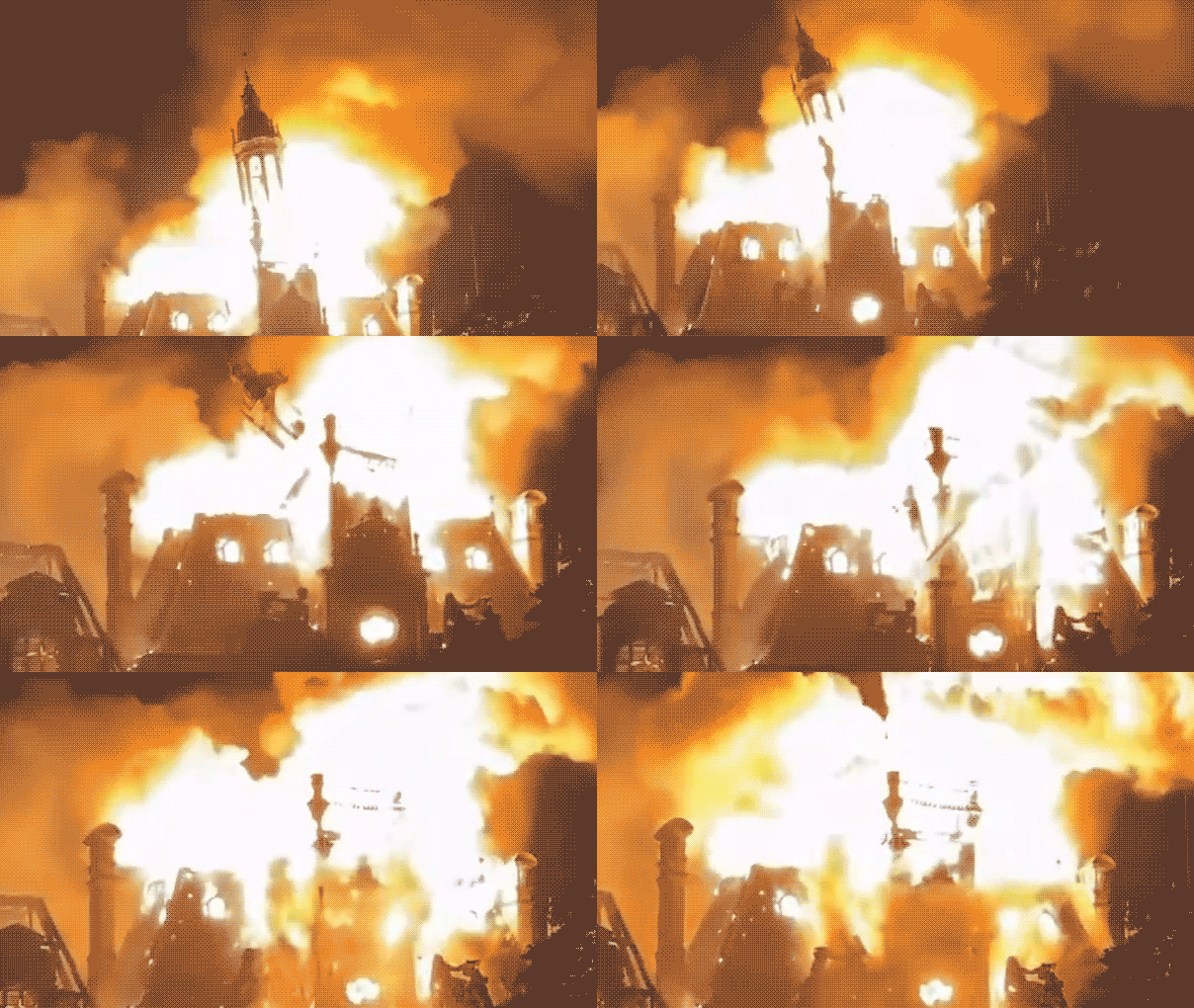
The violent riots here become a form of karma or historical payback, with France now suffering the same kind of destruction it once inflicted on others. This especially came up in light of the deliberate arson attack on the 143-year-old Limoges City Hall in central France.[5]
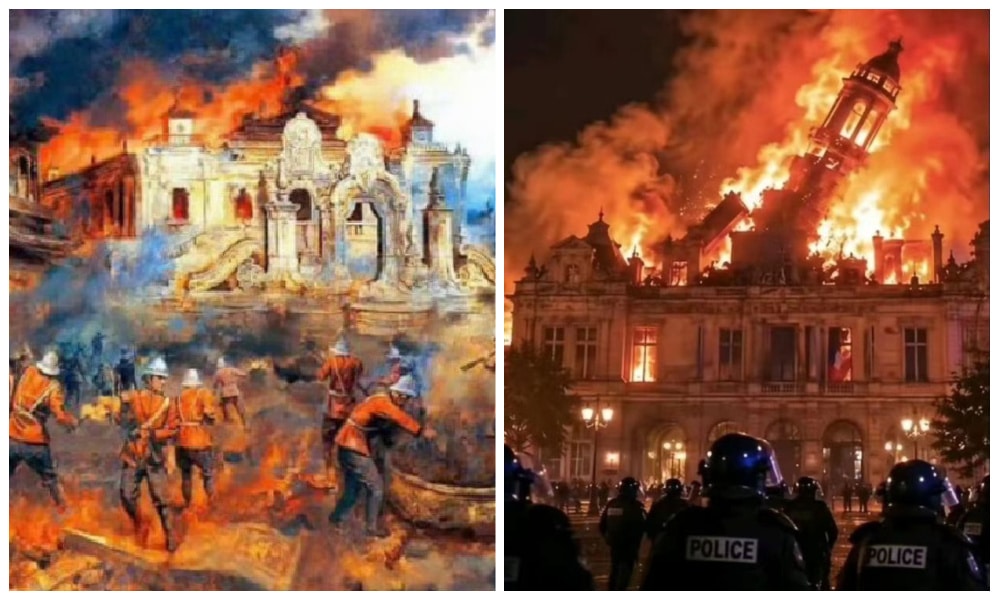
While comparisons to the looting of the Old Summer Palace have surfaced before, such as during the Notre-Dame fire, this time is different. Not only because it involves arson and looting in the center of France, just as the Old Summer Palace pillaging hurt the heart of China’s imperial power, but also because so much of the violence took place on October 18, the exact date on which, in 1860, Anglo-French forces burned the Yuanmingyuan to the ground during the Second Opium War (1856–1860).
For reference: The Yuanmingyuan was an imperial summer palace complex in Beijing’s suburbs and the Qianlong Emperor’s principal residence. In 1860, Anglo-French forces invaded Beijing during the Second Opium War, driven by demands for expanded trade access and other diplomatic concessions. They thoroughly plundered the Yuanmingyuan, a vast complex consisting of more than a hundred buildings and scenic sites filled with books, artworks, and other treasures.
The burning came afterward, understood in Chinese historical memory as an attempt to destroy the evidence of the looting. The fire blazed for three days and three nights, and left the enormous palace grounds in ruins.
It’s a historical episode so deeply ingrained in patriotic education and collective memory that it’s still very much a part of online discourse in China today. This helps explain why, in recent days, so many bloggers have portrayed the destruction in France as historical retribution for the destruction of the Old Summer Palace.
Nationalistic blogger Zhou Kelixiusi (周可莉修斯) described the situation as mere “karma” for France. Others put images of Anglo-French forces looting and burning down the Old Summer Palace side by side with images of the City Hall of Limoges being consumed by fire, writing:
💬 “History repeats itself on October 18!”
Others added:
💬 “Over the past century, China has learned that weakness invites aggression, and has worked hard to strengthen itself.”
The language of “karma” and “retribution” that recurringly comes up in these discussions carries a broader nationalist message: that the balance of power has shifted. France, once powerful enough to plunder China’s imperial palace, is now portrayed as being so weak that it can’t even keep order at home, while China has overcome its past weakness and become a global superpower. In this online narrative, the unrest in France is ultimately presented as a symbolic reversal of China’s own historical humiliation.
🔚
Notes & Footnotes
-
Examples of hashtags associated with each of the narrative ‘categories’ I set out. These hashtags appeared across multiple Chinese social media platforms.
1: “France has lost control” (Breakdown of order & governance) / Hashtag examples: [#法国失控了#] [#法国又乱了#] [#法国多地抗议引发骚乱#] [#法国多城实施宵禁防骚乱#] [#法国爆发近年来最严重暴力骚乱#] [#法国多地街头火光冲天#] [#法国骚乱赃物涌入二手平台#] [#法国多地LV门店被洗劫一空#] [#法国政坛极化撕裂#] [#马克龙夫妇看演唱会时法国骚乱#] [#法国骚乱超500警员受伤#] [法国骚乱巴黎警力不堪重负] [#特朗普说抗议者毁了法国#] [#法国乱到宵禁都没用#]
2: “The European model is failing” (France protests are a symptom of a European crisis) / Hashtag examples: [#法国抗议潮迅速蔓延欧洲多国#] [日媒称法国成欧洲新病夫][#欧洲多国爆发抗议示威 民众怎么看#] [#街头骚乱背后的欧洲治理困局#][“老去”的欧洲如何面对年轻人的愤怒][ 欧洲多国陷入混乱] [#法国成欧洲新病夫#] [#法国三条血管齐崩#] [#法国高福利模式难以为继#]
3: “Chinese victims of a French crisis” (Connecting French problems to Chinese vulnerability) / Hashtag examples: [#法国华人店主:毕生心血都没了#] [#法国多地骚乱中方发布提醒#] [#提醒赴法国中国公民加强安全防#][#中国游客亲历巴黎骚乱#][#中国驻法国使领馆再发领事提醒#][#刚开业一周中国店主亲历法国骚乱#]
4: “France in chaos, yet still threatening China” (Criticism of French politicians taking hard line on China while unable to contain own problems) / Hashtag examples: [法国乱成一锅粥了还有人] [法国骚乱下竟有人叫嚣对华强硬] [法国骚乱下竟有人叫嚣对华强硬]
5: “Historical retribution” (Trying French unrest to Chinese historical humiliation) / Hashtag examples: [法国骚乱百年市政厅被烧毁] [法国143年历史市政厅被烧毁] [法国骚乱致多处历史建筑损毁]
-
The phrase “France’s three blood vessels collapsing at once” (法国三血管齐崩) circulated on Weibo soon after the first round of protests as a media metaphor to refer to these three major interconnected issues: 1) growing public debt & slow economic growth, 2) widening social inequalities & pressure on public services, and 3) increasing social polarization & declining trust in government.
-
Worth mentioning here is that not everyone in these discussions see overseas Chinese business owners as truly “Chinese.” Different terms distinguish being Chinese by nationality, ethnicity, and ancestry, more on this discussion here.
-
Original article by Global Times (环球时报), “France is already in complete chaos, yet some are still clamoring for a hard line against China” (法国都乱成一锅粥了,还有人在叫嚣对华强硬), reposted by Beijing Daily on Weibo as “France is in complete chaos, yet some still threaten China” (法国乱成一锅粥了还有人威胁中国). The Global Times article is also available in English here.
-
The 143-year-old Limoges City Hall in central France was actually not set on fire on October 18 but on Saturday, October 17, 2026.
Eye on Digital China, by Manya Koetse, is co-published on Substack and What’s on Weibo. Both feature the same new content — so you can read and subscribe wherever you prefer. Substack offers community features, while What’s on Weibo provides full archive access.
Spotted a mistake or want to add something? Please let us know in comments below or email us. First-time commenters, please be patient – we will have to manually approve your comment before it appears.
©2026 Eye on Digital China/Whatsonweibo. All rights reserved. Do not reproduce our content without permission – you can contact us at info@whatsonweibo.com.
Eye on Digital China is a reader-supported publication by
Manya Koetse (@manyapan) and powered by What’s on Weibo.
It offers independent analysis of China’s online culture, media, and social trends.
To receive the newsletter and support this work, consider
becoming a paid subscriber.


Mbappé, Mao, and the Joke That Shall Not Be Named

The French Protests, Viewed from China: Five Narratives on Chinese Social Media

What Does 20 Yuan ($3) Mean Anymore? China’s Disappearing Living Rooms & the Great Laundry Debate

Starbucks Goes Xinjiang & The Kardashians in China

Red Carpet, Pandas, and Power: How China Read the Trump-Xi Summit

How Chinese AI Videos Turned Foreigners into Villains

Why Japan Has So Many Surnames, China’s Back-to-School Shifts & Taiwan Pavilion Trouble

The Power of Ugly: Why Niu Lai Became China’s Unlikeliest Box-Office Hit

The Rise of “Shuaqi-ism,” Taking Starbucks to the Fields, and Pretending to Go to Work

AI Actress Ad Pulled, Baihaitun Disrupts Shanghai and Cicada Meme Bugs Huawei
-
 Chinese New Year8 months ago
Inside Chunwan 2026: China’s Spring Festival Gala
-
 China Brands, Marketing & Consumers11 months ago
Hasan Piker’s China Trip & the Unexpected Journey of a Chinese School Uniform to Angola
-

 Chapter Dive8 months ago
Inside the Great Chinese Debate Over the Iran War
-

 China Trend Watch12 months ago
Japan Tensions, Nexperia Fallout, Yunnan’s ‘Wild Child,’ & “Modern Opium”
Mickey D
July 7, 2018 at 7:40 pm
CONGRATULATIONS! I’m sure you know, you should be honored to be blocked by the cult of Mao/Xi terrorist regime. The one and only thing I agree with Trump on is his tariffs on Maoland. If he keeps up the pressure, or once he’s impeached–hopefully very soon–the next administration, the people might finally take down “emperor-for-life” Mao-wannabe Xi’it-for-brains! The Chinese people will be free, and the world will have an honest government to trade with. The regime’s demise will bring a win-win era, not that cancerous One Belt BS!
love China
July 7, 2018 at 8:18 pm
CONGRATULATIONS! I’m sure you know, you should be blocked because your site is only read by LBH white losers who predictably only use it an avenue to hate Chinese and spout racist drivel about the cult of Mao/Xi terrorist regime. The one and only thing I agree with Xi on is his banning of LBH anti china hate groups like this one. If he keeps up the pressure, hopefully very soon, people might finally take down all anti china white LBH hate groups, then the Chinese people will be free, and the world will be more loving. The demise of western bigots will bring a win-win era and a wonderful One Belt century for China! Love China. Peace out!
unknow
July 10, 2018 at 12:02 am
it just dns pollution,netizen only use the dnscrypt-proxy can solve this problem,the ip is not blocked,just the domain name.
unkown
July 10, 2018 at 12:04 am
the major method is dns pollution and ip block which to block website that china rejeced.
Bruce Humes
July 11, 2018 at 7:41 am
Sorry to hear u have been blocked! But I do hope it will encourage u to cover sensitive topics more boldly.
Bruce Humes