
China Trend Watch
Japan Tensions, Nexperia Fallout, Yunnan’s ‘Wild Child,’ & “Modern Opium”
From quick scrolls to the discussions that matter, these are the topics trending in China this week.


🔥 China Trend Watch — Week 45-46 (2025)
Part of Eye on Digital China. This edition was sent to paid subscribers — subscribe to receive the next issue in your inbox.
Thank you for the kind reactions I received after the last newsletter, in which I took a bird’s-eye view of China’s evolving social media landscape and announced a soft goodbye to What’s on Weibo (if you haven’t read it yet, you can find it here).
I’m very grateful to everyone who has followed my journey with What’s on Weibo, and I’m excited to start this new chapter together.
Under the Eye on Digital China newsletter, you can expect updates in three categories: fast-moving trends, slower-burn signals, and longer thematic explorations — plus the occasional personal story, including from the road as I travel through China. (I’ll soon be covering roughly 3,000 miles across the country, so I’m sure I’ll run into plenty worth sharing.)
This is the China Trend Watch edition — a quick catch-up on real-time conversations. Let’s dive in.
- 🔺 A new 32-country survey by The Economist and GlobeScan found a sharp increase in the share of respondents who prefer China over the US as the world’s “leading power,” and younger people are driving much of this shift.
- 🛵 As Ele.me (China’s No.2 food-delivery platform) rebrands to “Taobao Flash Delivery” (淘宝闪购), competitor Meituan used it as the perfect marketing moment by bidding farewell to its long-time competitor with a virtual “memorial service,” complete with “farewell coupons.”
- 👀 Famous Chinese author and Nobel laureate Mo Yan (莫言) made his debut on the social media app Xiaohongshu this week, with a meme-ready video and posts. He’s been praised as a “meme king” for quickly adapting to the app’s community — gaining over 950,000 followers in just five days.
- 🏳️🌈 Two of China’s most popular gay apps, Blued and Finka (翻咔), have been removed from from Apple App Store in China as at the request of Chinese internet regulatory authorities. Last month, Blued – which has over 40 million registered users in China – temporarily suspended new user registrations after media reports accused the platform of facilitating encounters that led to HIV infections among minors.
- 🏆 A remarkable moment during the Golden Rooster Awards went viral after Ne Zha 2 won the award for Best Art Film — yet no one came to pick it up. Director Jiaozi (饺子) had already announced earlier in the year that he and his entire team would be too busy working on Ne Zha 3 to attend any events — and he, very clearly, is a man of his word.
- 🔻 Chinese-Canadian celebrity Kris Wu (吴亦凡), convicted in 2022 for rape and sentenced to 13 years in prison, keeps reappearing in online discussions — but only through rumors. This week, speculation about his possible death in prison spread across social media yet again (“What, did he die again?” some joked). Local authorities have denied the rumors.
1. Sino-Japanese Tensions Escalate After Takaichi’s Taiwan Remarks

Political cartoon circulating on Chinese social media, made by Jun Zhengping (钧正平), official social media name/persona used by the People’s Liberation Army.
With the recent appointment of conservative politician Sanae Takaichi (高市早苗) as the new prime minister of Japan, seen as the ideological successor to Shinzo Abe, many expected renewed Sino-Japanese tensions due to her stances on various sensitive bilateral issues, from wartime history to Taiwan. But perhaps few expected relations to escalate so quickly and so intensely.
This week, Japan and Takaichi have been top trending topics after she made provocative remarks during a hearing in the Diet about potential military intervention in Taiwan-related matters, suggesting Japan’s Self-Defense Forces could exercise the right of collective self-defense if such a situation were recognized as “survival-threatening.” She is also pushing defense-related policy changes, including exploring revisions to Japan’s “three non-nuclear principles.”
The remarks have set off a chain of events — and online trends — marking what may be the worst flare-up in ties since 2012, when major anti-Japanese protests erupted in China following Japan’s purchase of the disputed Senkaku/Diaoyu Islands. Chinese officials are sharpening their tone, issuing angry and escalatory diplomatic statements via X, domestic social media, and Foreign Ministry press briefings.
The recent escalations have also led to official warnings about safety risks for Chinese nationals in Japan. On Sunday, China’s Ministry of Education advised Chinese citizens to exercise caution when planning study-abroad arrangements in Japan.
Beyond nationalist discourse and general anti-Japanese sentiment on Chinese social media — and users vowing not to travel or study there — many discussions are also focusing on geopolitics and history rather than consumer boycotts. Well-known nationalist knowledge blogger Pingyuan Gongzi Zhao Sheng (@平原公子赵胜) posted a lengthy post on Weibo (crossposted to Xiaohongshu) suggesting that Japan is filled with ‘deadly energy’ (死气 sǐqì) – acting irrationally and aggressively because it is in complete decline — socially, economically, technologically, and militarily — but unable to accept it. He argues that a strong and stable country would never gamble its future like this, and that only a “zombie-like” nation in denial would provoke China unnecessarily. A related hashtag about Japan’s gloomy status-quo (#日本死气#) has also been used by other commentators across social media.
2. New Updates in Yunnan’s “Wild Child” Case Raise More Questions

Last month, I wrote about a distressing case involving a 3-year-old boy from Nanjian County (南涧县) in Yunnan who was seen walking on all fours, behaving dog-like with possible spinal deformities, naked and apparently neglected by his parents. Several netizens recorded the scene, and videos quickly spread online in mid October, with thousands referring to the boy as the “wild child” (野孩子 or “naked child” 赤裸小孩) of Yunnan and demanding that authorities intervene and hold the parents accountable.
What followed was a wave of confusing — and sometimes contradictory — media reports. Some outlets initially claimed the boy’s parents were impoverished and struggling, while others reported they were well-educated and financially stable, framing their dubious parenting approach as a deliberate and philosophical “lifestyle choice.”
The parents, who live a camper-van lifestyle, turned out to both hold university degrees (the mother even holds a post-graduate degree). They claimed they practice “natural education” (自然教育法) and said their son disliked wearing clothes because of eczema. Some reports said they refused to cooperate with local authorities; others said they agreed to stop letting their child crawl around naked. Neither the 3-year-old nor his younger brother had ever been registered for a household hukou (registered permanent residence), raising further concern.
Online, speculation intensified. Many netizens feared the child was being deliberately mistreated for profit, suggesting a dark-web content industry behind the scenes.
This week, local authorities and state media posted a new update, releasing a video of the boy — referred to as Pingping (平平, an alias) — walking and playing normally. According to officials, the parents are now receiving support and guidance in raising their children, and both boys are being issued official household registrations by local authorities. The investigation, they said, found no evidence that the parents were involved in “illegal online profit-making.”
But many netizens are anything but convinced. They argue the child shown in the video isn’t the same boy — his face is blurred, and his voice appears overdubbed. Posts questioning the official narrative are being censored. And although authorities say the case is now closed, with the family under ongoing guidance, many people online feel the story is anything but over, and that the real truth still hasn’t surfaced.
Some of the doubts about the veracity of the story and videos are being expressed in more subtle ways to avoid censorship. One Weibo commenter simply wrote that “mild spinal deformities in a 3-year-old may improve within 3–6 months through corrective treatment (…) while recovery from severe deformities may take 1–2 years or even longer” — subtly suggesting that it would be impossible for the boy to be walking and playing normally now if he had shown signs of spinal deformity just weeks earlier. On Douyin, users also questioned what happened to the supposedly severe eczema that had allegedly prevented the boy from wearing clothes. A Zhihu writer expressed frustration: “The official report is extremely fake, but there’s no way to talk about it.” Another commenter echoed the sentiment: “People today aren’t stupid. Even if you forbid them to speak, do you think they won’t know something is wrong?” For many, the case is troubling not only because of the child’s situation, but because the official handling of it has reinforced a growing sense that the public is being managed rather than informed.
3. Nexperia and Dutch ‘Pirate Gene’ Discussions

It wasn’t just bilateral relations with Japan that took a hit this week — tensions between China and the Netherlands have also deepened due to the ongoing dispute surrounding Dutch intervention in the chipmaker Nexperia. This is an issue I wrote about last month. After the incident made international headlines, China responded by blocking the export of Nexperia chips from its factory in China, putting major European automakers at risk of running short on critical components for vehicle electronics.
In brief: Nexperia (安世半导体), a Dutch semiconductor company based in Nijmegen and wholly owned by the Chinese conglomerate Wingtech (闻泰科技) since 2019, became the center of a major diplomatic clash after the Dutch government reportedly ordered a one-year freeze on strategic and governance changes within the company on September 30. Citing national security concerns and a desire to secure domestic chip production, the Dutch move came amid reports that Nexperia CEO Zhang Xuezheng was relocating production facilities and sensitive technology from Europe to China.
While tensions had previously seemed to ease, the conflict escalated again this week. The Dutch public broadcasting organization reported on a widening rift as Nexperia China accused the Dutch branch of disrupting production by refusing to send chip components to the Dongguan factory. Meanwhile, Nexperia Netherlands claimed the Chinese side had been urging customers to reroute payments away from the Netherlands and into Chinese bank accounts. A Dutch delegation is expected to travel to Beijing next week to discuss the situation and attempt to break the deadlock.
On Chinese social media, many users view the Dutch actions as an unfair use of a Cold-War-era law to target a modern, legally operating multinational company. The move is widely seen as another example of Western countries shifting rules to maintain technological dominance when faced with strong competition from Chinese firms. As a result, what began as a company-specific dispute has grown into a broader geopolitical struggle over global chip control and economic sovereignty.
Modern Opium [当代鸦片] (dāngdài yāpiàn)

Over the past year, the term “modern opium” has become more common on Chinese social media— used as a popular term to promote food or other products. It’s perhaps not unlike the famous “finger-licking good” slogan in the West, but applied far more broadly, also to refer to “addictive” online accounts, collector toys, or restaurants. In fact, it has become so commonplace that you can now find “modern-opium food recommendation” suggestions on platforms when searching for good places to eat in major Chinese cities.
Recently, the term began trending as a controversial expression after Chinese media focused on an official online complaint arguing that it “turns national trauma into entertainment” (将民族伤痛娱乐化) and trivializes a painful chapter of Chinese history, drawing a direct connection to the Opium Wars (1839–1842 and 1856–1860).
The complaint has put the term at the center of public attention — but how controversial is it, really? While Chinese media are eager to highlight how inappropriate the phrase is, given China’s collective memory of the “century of humiliation,” many Xiaohongshu users nevertheless seem to think it’s perfectly acceptable to describe their newfound addiction to a milky drink, a sweet dessert, or the perfect hotpot. (I can relate to the latter.)


During this year’s Single’s Day Shopping Festival (11.11), “Europe” was a popular item on shopping lists, not for its fashion or chocolate, but for anti-theft tools. Using “Europe is not safe” slogans and real footage of pickpockets in action, hundreds of Taobao sellers promoted handy anti-theft accessories for Chinese tourists traveling abroad, some even labeled for specific countries, from Spain to Germany.
This year’s shopping festival reportedly generated 1.695 trillion RMB ($238B) across platforms — still up 14.2% year-on-year, but with far slower growth than in previous years (2024: 26.6% growth). Jing Daily noted a noticeably more negative social media vibe surrounding the festival, with young consumers on Xiaohongshu growing more skeptical and questioning its purpose. Gen Z users are prioritizing timeless purchases over trend cycles and embracing more practical spending (like gadgets to avoid getting robbed in Europe).
Thanks for reading this Eye on Digital China China Trend Watch. For slower-moving trends and deeper structural analysis, keep an eye on the upcoming newsletters.
And if you happen to be reading this without a subscription and appreciate my work, consider joining to receive future issues straight in your inbox.
Many thanks to Miranda Barnes for helping curate some of the topics in this edition.
— Manya
Spotted an error or want to add something? Comment below or
email me.
First-time commenters require manual approval.
©2025 Eye on Digital China / What’s on Weibo. Do not reproduce without permission —
contact info@whatsonweibo.com.




China Digital
China Trend Watch: Takaichi’s Win, Olympic Tensions, and “Tapping Out”
From digital stress to “dangerous Japan,” here are the trends that stood out this week on Chinese social media.

🔥 China Trend Watch (week 6/7 | 2026) Part of Eye on Digital China by Manya Koetse, China Trend Watch is an overview of what’s trending and being discussed on Chinese social media. The previous newsletter was a chapter dive into the Becoming Chinese and Kill Line phenomena. This edition was sent to paid subscribers — subscribe to receive the next issue in your inbox.
It is hardly surprising that the mental health of many internet users is increasingly affected by media overload, closely tied to today’s never-ending news delivery & social media ecosystems accompanying us in busy lives, where our minds are also occupied with our own daily worries and pressures.
Lately, this became a topic of discussion in a digital group chat I share with my friends in Amsterdam. They found a practical way to distance themselves from the feeds on their phones: the Tap Out, an app blocker designed by two Dutch guys that only lets them access distracting apps by physically tapping a small “Tap Out Point,” a compact NFC-enabled puck available in different colors with fancy names like Sundried Limestone and Marbled Moon. By placing the puck in another room, or even leaving it at home while at work, a physical barrier prevents them from getting trapped in mindless doomscrolling and addictive swiping habits.

I found the sudden popularity of the tool somewhat bewildering, and vowed not to let anyone talk me into such a nonsensical hype. It made me uneasy that we have apparently reached a stage where we would pay $60 for a device to control something we should be able to control ourselves. We’re turning to a quick technological fix for a deeper problem created by technology, we’re buying a digital product to live less digitally, and we’re paying to escape social media through a device sold to us via targeted advertising on the very platforms we are trying to escape.
In China, superapps combine payment, utility, social, news, and e-commerce functions under one umbrella, making the Dutch “Tap Out” a product that would make little sense for the Chinese market — blocking yourself from WeChat would effectively mean locking yourself out of your phone and your wallet. Yet so-called temporary “mobile self-control tools” (手机自律神器) are still quite popular on Taobao these days, typically in the form of phone lockboxes with time-lock codes, mostly to help teenagers and students focus on their studies.
My friends in Beijing, however, were not discussing those tools. Earlier this month, instead, a photo of a fluffy toy with a cute face appeared in our WeChat group. Now that the success of Labubu is cooling down, the Pop Mart company has introduced another collectible blind-box toy: the “Pucky Tap Tap” series (PUCKY敲敲系列), also dubbed diànzǐ mùyú (电子木鱼), literally meaning “electronic wooden fish.”

A toy within the Pucky Tap Tap series.
The toy has nothing to do with actual fish, nor is it made from wood. A mùyú (木鱼) is a traditional percussion instrument, often carved from a single piece of wood and shaped like a fish. It is used in Buddhism during chanting, sutra recitation, or meditation to maintain rhythm, stay focused, and calm the mind.
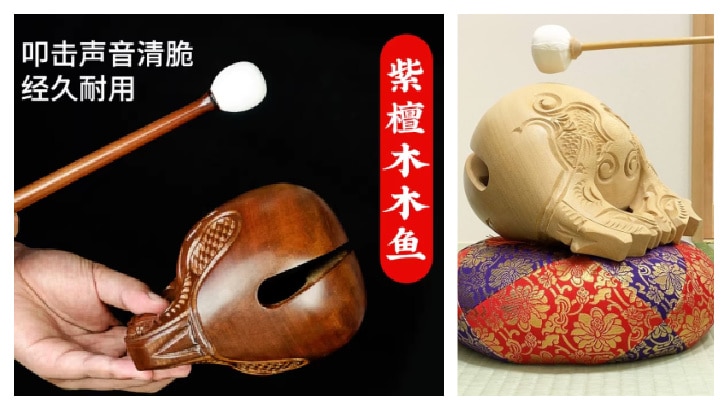
The traditional muyu sold on Taobao and Amazon.
Although the Pucky Tap Tap series is inspired by the mùyú, it is essentially a battery-powered plush keychain that makes a soothing sound when you tap its head. The Pucky Tap Tap has become hugely popular as a stress-relief tool among young Chinese consumers who believe the sound can quickly ease anxiety.
On apps like Xiaohongshu, videos show people frantically tapping the toy’s head, while an official Pop Mart ad features a young woman whispering a small prayer before tapping for good luck. Another video shows a girl shutting her laptop to take a breather and tap her toy.
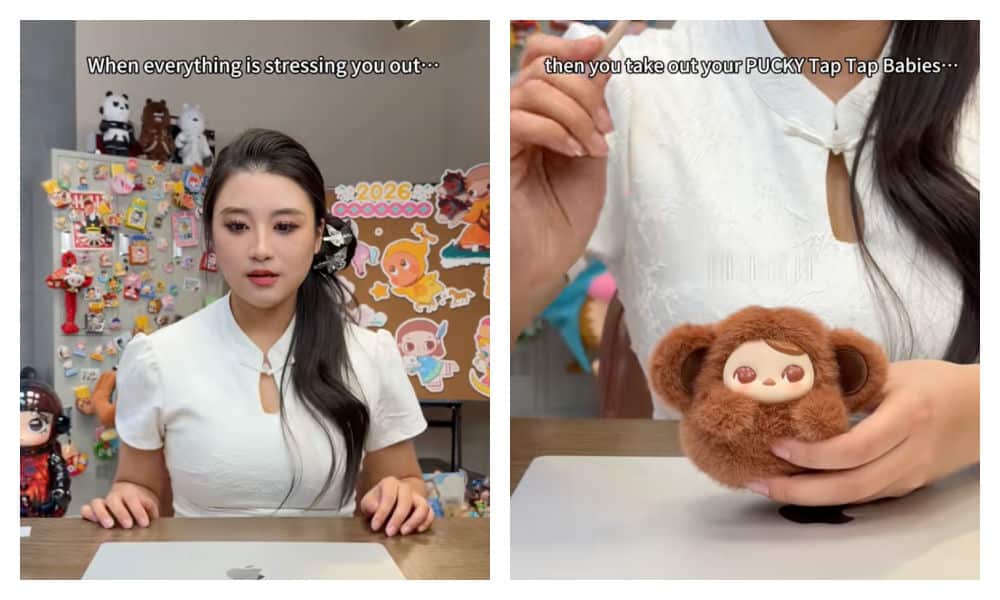
Video promoting the Pucky Tap Tap on Tiktok by Popmart US shop.
Some consider the toy tacky, but by now the keychain has become so wanted that resellers are asking more than double the original price, even helping to lift Pop Mart’s stock.
Another nonsensical hype, perhaps — tempting consumers to buy things they do not need by creating the illusion that peace of mind and happiness are products you can buy. A peaceful mind cannot be bought, though. It comes from within, and will not be attained through a $60 limestone “Tap Out,” nor a $25 Pop Mart “Pucky Tap Tap.” Since when did we all become so silly?
The only reason I ended up purchasing the Pucky Tap Tap is simple: it looks cute. And I am researching these trends for my work, am I not? Don’t mind me if I occasionally tap its head — just for fun. Or perhaps because it feels good to tap something other than a screen. And who knows, while I’m at it, it might bring me some good luck too. It is very different from “tapping out,” right?
Right?
Let’s dive into some of the other trends that have been especially noteworthy.
Quick Scroll
-
- 🚧 A road construction project in Wuxi, Jiangsu Province, has been halted after workers uncovered ruins dating back approximately 6000-7000 years. These are now the oldest known archaeological remains in the lower Yangtze region. The discovery rewrites the entire timeline of prehistoric civilization in the region, pushing it back by more than a 1000 years.
- 👶 “Is it worth spending the best 20 years of your life raising kids?” This ad on the back of a Shenzhen bus, part of a district-level campaign on marriage and child-rearing, raised eyebrows online. While it was likely meant to spark honest reflection on parenthood, it offered a rare contrast to the messaging typically seen in Chinese official communication encouraging people to have (more) children.
- 🚗 China is set to end the era of hidden door handles. Cars with concealed handles are popular in China, where EV makers have followed design trends popularized by Tesla. But amid growing safety concerns, including cases in which car doors couldn’t be opened in emergencies, China will now become the world’s first country to mandate mechanical backup systems for car door handles and ban fully hidden ones. The new standard will take effect on January 1, 2027.
- 🐆 The snow leopard in northwest China that recently mauled a tourist who approached it for a photo has now been captured, after it entered a local herder’s sheep pen and killed 35 sheep. The animal is now held at a wildlife rescue center and is expected to be released back into the wild once the weather warms and a scientific assessment is completed.
- 🎬 After 46 years, Stanley Kubrick’s The Shining made its debut on the Chinese mainland. Its first-ever theatrical release in China came just before the busy Spring Festival movie season, showing that old Hollywood classics can still draw new audiences (although not in their fully original form, as some scenes were still censored for violence).
- 🐍 Former Zhejiang Party Secretary Yi Lianhong (易炼红) is under investigation for suspected “serious violations of discipline and law.” This news comes about 2 weeks after probes into Zhang Youxia (张又侠) and Liu Zhenli (刘振立). Different roles (top military leadership vs. provincial governance), but together they point to an unusually aggressive purge cycle ahead of the 21st Party Congress. Some are calling Yi “the last tiger of the Snake Year.”
- x🎮 Time to start looking forward to Black Myth: Zhongkui (黑神话:钟馗), the sequel to Black Myth: Wukong (黑神话:悟空), the game that became a global sensation in 2024. Game Science, the Hangzhou-based studio behind the game, has just released a Chinese New Year trailer (link), offering a peek at the stunning visuals, colors, music, and narrative elements rooted in Chinese folklore.
What Really Stood Out This Week
Takaichi’s Win Seen from China: “A More Dangerous Japan”

Cartoon “Japan’s right wing on the rise” by Jin Ding 金鼎, China Daily. Feb 10, 2026.
After winning the Liberal Democratic Party leadership election in October, conservative politician and Shinzo Abe protégé Sanae Takaichi (高市早苗, in Chinese: Gāoshì Zǎomiáo) went on to secure a decisive victory in Japan’s lower house elections on Sunday, winning more than two-thirds of the seats in the snap election she called in January.
Sino-Japanese relations were a central theme in the campaign, as Takaichi’s leadership since October has already triggered one of the sharpest deteriorations in bilateral ties in recent years. This is not only due to her hardline stance on sensitive issues such as wartime history, but also because of her remarks in November on the possibility of military intervention in Taiwan-related matters. Those comments have had far-reaching consequences, ranging from import bans to Japanese performers seeing their China shows canceled.
Rather than weakening Takaichi, China’s pressure campaign appears to have boosted her popularity at home. She is not only the country’s first female prime minister, but it is also the first time the LDP — or any party in Japan, for that matter — has won such a large majority of the vote.
In China, the official response stressed that “the election is Japan’s internal affair” (“日本内政”), but reactions in state media and on social media told a different story. One general view on Takaichi’s win on Chinese social media is that it aligns with an overall decline of the center-left and a growing populism in Western societies.
Takaichi’s victory has been widely framed as a risky gamble, and her post-election comments about a possible visit to the controversial Yasukuni Shrine, where Japan’s war dead (including Class-A war criminals) are honored, further fueled online discussions portraying her not only as a threat to Sino-Japanese relations but also as a danger to Japan itself.
A political cartoon published by China Daily, in both its Chinese and international editions, depicts Takaichi rising above a field of graves belonging to war criminals, emphasizing how important wartime memory is in China’s official framing of her election win (see featured image).
From China’s perspective, Japan is a country that has never really reflected on its wartime aggressions, and Takaichi is viewed as particularly problematic in this regard for her previous remarks not just on Yasukuni, but also on other war-related topics, including denial of the comfort women issue and skepticism regarding the death toll of the Nanjing Massacre.
According to Niu Tanqin (牛弹琴), a Chinese veteran media commentator who posted on Zhihu, there are multiple risks associated with Takaichi’s win. Niu writes:
“Japan is no longer the Japan of the past. With an absolute two-thirds majority in the lower house, Takaichi has crossed the threshold required for constitutional revision. It cannot be ruled out that she may push to amend the pacifist constitution, transform the Self-Defense Forces into a “national defense army,” and accelerate Japan’s so-called “national normalization.””
“There are hidden dangers behind this path towards “normalization” for a country that has not fully reckoned with its history. Large-scale military expansion, sharply increased defense spending, and pursuit of offensive weapons may follow. It cannot be ruled out that Japan could abandon its “Three Non-Nuclear Principles” and seek to acquire nuclear weapons. On the Taiwan issue, Japan may become more provocative, and China–Japan relations will become more turbulent. What we face is a more dangerous (凶险) Japan.”
An Unfortunate Olympic Bump Between a Dutch and Chinese Athlete

The Winter Olympics have been a major topic of discussion this week, with many emotional moments being highlighted in the Chinese media.
One notable example that resonated with netizens is the interview given by the 32-year-old Chinese short track speed skater Fan Kexin (范可新). Coming from an impoverished background and dedicating years of her life to succeed in skating, now competing in her fourth Winter Olympics, Fan had an breakdown moment during an interview that suggested the end of two decades of competition when she tearfully said: “Everyone can see my hair is turning white, I’ve endured until the very end” (“大家看到我的头发已经白了,我已经熬到头了”).

Fan Kexin in her tearful interview with CCTV.
Another emotional incident specifically stood out. It was the dramatic moment during Wednesday’s men’s 1000 meter involving Dutch skater Joep Wennemars and China’s Lian Ziwen (廉子文). During the final lane change, Lian tangled with Wennemars even though the Dutch athlete, coming from the outside lane, had right of way during the exchange. The collision effectively ruined Wennemars’ medal chances. After reviewing the incident, officials disqualified the Chinese skater. Wennemars was given a re-skate thirty minutes later, but the fatigued and frustrated skater only recorded the ninth fastest time.
Lian Ziwen apologized to Joep Wennemars after the incident, according to his coach Jan Bos, who spoke to the Dutch press. Ziwen was reportedly devastated after his mistake and, according to Bos, “just cried” following his disqualification.
The topic became a major subject of discussion on Chinese social media and ranked number one on Kuaishou’s trending lists. What stands out in Chinese online reactions is that, although almost everyone seems to agree there was no intent involved, opinions clearly fall into three camps.
The first camp (most dominant) defends Lian and focuses mainly on the actions of an angry Wennemars after the finish, as the Dutch skater could be seen shouting at Lian and lashing out in his direction. In these reactions, Wennemars is insulted as an “uncivilized Dutch milk cow” or a “white pig” (or “Dutch pig”, which also means “guinea pig” in Chinese), and his reaction is framed as “anti-Chinese,” with the Nexperia affair being frequently mentioned. In these discussions, the Olympic moment takes on a clear nationalist tone and becomes symbolic of Dutch-Chinese relations at large.
The second camp views the situation primarily from an Olympic and sporting perspective and shows more understanding for Wennemars’ intense emotions. They consider Lian’s apology logical and Joep’s anger understandable. Some Douyin commenters wrote: “If you do something wrong, you should apologize. That the other person does not forgive you is perfectly normal,” and: “Whether intentional or not, four years of preparation were destroyed in an instant.” Some draw comparisons to a well-known Olympic incident in 1992, when Chinese skater Ye Qiaobo (叶乔波) also missed out on gold after being hindered by a Soviet skater during a lane change.
The third camp, a smaller but notable group, uses the discussion as a moment of reflection on Chinese social media itself, particularly on cyber-nationalism and the double standards of some internet users. As one Douyin comment put it: “When a foreigner commits a foul, people immediately start cursing. But when our own athlete makes a mistake, the foreigner gets blamed instead. That is how distorted it can be.”
An interesting detail: on Weibo, comment sections under some news posts about this incident appear to be heavily filtered. Possibly, too much geopolitics was beginning to overshadow the Olympic mood.
On the Feed
Draco Malfoy as the Lucky Chinese New Year Charm

The Year of the Horse is almost here, and celebrating the new year comes with a lot of red, a lot of ornaments, and a lot of lucky language. This year, it all came together in some surprising Spring Festival celebratory decorations focused on Draco Malfoy, the fictional villainous character from the Harry Potter series, which is also popular in China.

Malfoy in Chinese is phonetically rendered as Mǎ’ěrfú (马尔福), containing the characters 马 meaning “horse” and 福 meaning “luck” or “good fortune.” With Malfoy’s name thus associated with good luck in the new year, decorations featuring his face have shown up on front door banners and fridge magnets.
By now, the original lucky decorations have been picked up by international media, and Tom Felton, the actor who plays Malfoy in the movies, is now also more than aware that he became the most unexpected mascot of the Chinese New Year , as he himself reposted an image that highlighted his new status.
Seen Elsewhere
• In a China where pursuing an abundant career and life in the city has become increasingly competitive and stressful, embracing “ugly things” sparks empathy, humor, and nostalgia for simpler times. (BAIGUAN)
• Anti-Chinese sentiments are on the rise in South Korea. What makes the current wave of Sinophobia in South Korea different is not just its intensity, but the social media infrastructure through which it circulates. (THE DIPLOMAT)
• One year ago, an American couple discovered a peculiar typewriter in boxes cleared out from an Arizona basement. They later discovered that it was the long-lost prototype of the MingKwai typewriter, an invention that fundamentally redefined the logic of typing Chinese characters. (SIXTH TONE)
• Their most intimate moments had been captured by a camera hidden in their Chinese hotel room, and then “Eric” found out that the footage was made available to thousands of strangers when he logged in to watch p*rnography on the very same channel he was exposed in. (BBC)
—That’s a wrap. Keep an eye on the next newsletter, which will be all about the Chinese New Year!
See you next edition.
Best,
Manya
Eye on Digital China, by Manya Koetse, is co-published on Substack and What’s on Weibo. Both feature the same new content — so you can read and subscribe wherever you prefer. Substack offers community features, while What’s on Weibo provides full archive access. If you’re already subscribed and want to switch platforms, just get in touch for help. If you no longer wish to receive these newsletters, or are receiving duplicate editions, you can unsubscribe at any time.
China Society
From a Hospital in Crisis to Chaotic Pig Feasts
From 5,000 people crashing a rural pig feast in Chongqing to the collective effort to save Yanran Angel hospital.

🔥 China Trend Watch (1.22.26)
Part of Eye on Digital China by Manya Koetse, China Trend Watch is an overview of what’s trending and being discussed on Chinese social media. The previous newsletter was a deep dive into the Dead Yet? app phenomenon. This edition was sent to paid subscribers — subscribe to receive the next issue in your inbox.
However, there are dozens of other topics being discussed on Chinese social media that actually aren’t about the US or the shifting geopolitical landscape. From football to pig-slaughter feasts, from a Henan grandpa in Paris to the latest birth rates, there is an entire world of topics out there that’s blissfully unconnected to anything happening in Washington or Davos — with many of these discussions signaling bigger social stories unfolding in China today. Let’s dive in.
Quick Scroll
- 🐶 “Eat more dog meat,” a local Community Health Service Center in Ya’an advised in a seasonal health text, suggesting it would help people stay healthy & warm during cold weather. The message sparked controversy among dog lovers online. The center later apologized and issued a corrected version, replacing dog meat with lamb, beef, and chestnuts.
- ⚽ Chinese goalkeeper Li Hao (李昊) is the man of the moment after China’s under-23 national football team beat Vietnam (0-3) and advanced to the final of the AFC U23 Asian Cup. It marks the first time since 2004 that any Chinese men’s national team (at any level) has reached the final of a continental tournament. In the final, China will face Japan.
- 👶 China’s latest birth data for 2025 are in, showing yet another record low. The birth rate fell to 5.63 per 1,000 people, with 7.92 million babies born last year — a 17% year-on-year decline.
- 💸 An “underground” private tutoring operation in Beijing has been hit with a staggering fine of more than 67 million yuan (US$9.6 million) for offering after-school classes without official approval. It’s the highest fine so far under China’s “Double Reduction” policy, introduced in 2021 to curb private tutoring and ease academic pressure on students.
- 🕯️ He Jiaolong (贺娇龙), a Xinjiang local official who was at the forefront of Chinese officials livestreaming & promoting their regions in creative online ways, died this week after a fatal fall from a horse during work-related filming. She was 47 years old.
- 🎭 Another death that trended this week was that of renowned Chinese comedian Yang Zhenhua (杨振华, b. 1936), a crosstalk (相声) artist remembered for his classic performances and widely regarded as a cultural icon.
- 🏛️ A child abuse case that has haunted Chinese netizens for the past two years has come to a close. Xu Jinhua (许金花), the stepmother who tortured and starved her 12-year-old stepdaughter, known as “Qiqi,” to death, was executed on January 20. Xu was sentenced to death in April 2025, and her appeal was rejected last November.
What Really Stood Out This Week
1. Mass Shutdowns of Local Chinese Pig-Slaughter Feasts
Annual pig feasts are traditionally meant to be a source of community bonding and ritual exchange. But for many towns and districts, páozhūyàn (刨猪宴), traditional pig-slaughter feasts, have now become a source of concern, leading to shutdowns of local events across multiple provinces.
The story begins on January 9, when a farmer’s daughter nicknamed Daidai (呆呆) from Hezhou in Chongqing posted a lighthearted message on Douyin asking whether people could help with her family’s pig slaughter, saying her old dad would not be able to hold down the two pigs. In return, she promised to treat helpers to “pork soup and rice,” adding: “To be honest, I just want the road in front of my house to be packed with cars, even more than at a wedding. I want to finally prove myself in the village!”
Two days later, on January 11, when the pig feast took place, Daidai got more than she had asked for. Not only was the road in front of her home packed with cars — the entire village was completely blocked as over 1,000 cars and some 5,000 visitors arrived. With two pigs nowhere near enough, five pigs ended up being slaughtered. Livestreamers flooded the scene, Daidai’s name was quickly trademarked, and before she knew it, she had entered internet history — including her own Baidu page — as the girl who turned a local gathering into a national feast.

Daidai (middle) hadn’t expected her call for help with slaughtering two pigs would end up in 5000 people coming to her town.
By now, the incident has spiraled into a much bigger issue, as others in the Sichuan–Chongqing region want to replicate the viral success of Hechuan, creating chaos and sometimes unsafe situations by turning neighborhood moments into tourist activities. This has led to a series of events being canceled or shut down.
On January 14, a planned páozhūyàn, initiated by local influencer Jia Laolian (假老练) in Longquanyi District in Chengdu, had to be canceled at the last minute after thousands of people registered to attend. On January 17, an online influencer in Caijiagang Subdistrict, Chongqing, also held a free pig-slaughter feast that quickly led to potentially dangerous overcrowding. Police shut it down. Another event took place in Ziyang, where 8,000 people had registered to attend while there were only 200 parking spaces available. There were more.
The current hype surrounding these pig-slaughter events reflects a sense of urban–rural nostalgia for local traditions and human connections, but probably says more about how viral tourism in China has worked since the frenzy surrounding Zibo: at lightning speed, influencers and local tourism bureaus jump onto fast-moving trends, hoping to get their own viral moment and, quite literally, piggyback on it.
While these moments can create a moment of hype, the downsides are clear: a lack of oversight, weak crowd management, intrusion to local communities, and lives being suddenly disrupted. For now, ‘Daidai’ has gained about two million users on her social media account. She says she hopes to do “something meaningful” with her online influence and has become an organic ambassador for Hechuan. At the same time, she also wants some calm after the storm, saying:“The Zhaozhu Yan in Heichuan has concluded successfully. I hope everyone can return to their normal lives. I also hope my parents can go back to their previous life—I don’t want them dragged into the internet world.”
2. How a Hospital Crisis Won China’s Trust
Usually, when news emerges about Chinese celebrities facing debts or court papers, it signals a serious blow to their reputation. But in a case that trended over the past week involving Chinese actor/businessman Li Yapeng (李亚鹏) and singer/pop icon Faye Wong (Wang Fei 王菲), the opposite is true.
Li and Wong were previously married and are parents to a daughter born with a cleft lip and palate. Their experiences in getting treatment and surgery for their daughter led them to become deeply involved with the efforts to help other children. In 2006, they founded the Yanran Angel Foundation (嫣然天使基金). A few years later, they established the Yanran Angel Children’s Hospital (嫣然天使儿童医院), China’s first privately-operated non-profit children’s hospital, providing surgeries, orthodontics, speech therapy, and other support to thousands of children—many of them at no cost for underprivileged families.
For the first ten years that Li and his team leased the hospital location, the landlord provided them with heavily discounted rent as a sign of his goodwill. In 2019, that agreement ended, and the rent doubled to market value at 11 million yuan per year (over US$1.5 million). But then Covid hit, and while the hospital still had all of its staffing and lease costs, surgeries were postponed.
On January 14 this year, Li Yapeng posted a lengthy video on his Douyin account titled “The Final Confrontation” (最后的面对), in which he explains how they fell behind on their rent since 2022, now finding themselves in a debt of 26 million yuan (over US$1.5 million) and facing a court judgement that leaves them with little choice but to vacate the premises and shut the hospital down.
Something that struck a chord with netizens is how Li, who bears joint liability for the unpaid rent, made no excuses and openly acknowledged his legal obligations, while at the same time emphasizing his personal sense of responsibility to ensure that children waiting for surgery would still receive the help that had been promised to them.

Public perception of Li Yapeng, who was previously seen as a failed businessman, transformed overnight. He was suddenly hailed as a hero who had quietly devoted himself to charity all this time, while accumulating personal debts.
Donations started flooding in. Within two days, over 180,000 people had donated a total of 9 million yuan (US$1.3 million), and by January 19 this had grown to more than 310,000 people supporting the hospital with nearly 20 million yuan (US$2.8 million). Beyond direct donations, netizens also supported Li Yapeng by tuning into his e-commerce livestreams. One businessman from Jiangsu even offered 30,000 square meters of free space for the hospital to relocate.
Meanwhile, netizens began wondering why Faye Wong, Li’s ex-wife with whom he had founded the foundation and hospital, was staying quiet. Just as some started to label her a diva who no longer cared about the cause, a 2023 audit report revealed that since divorcing Li Yapeng in 2013, she had been anonymously donating to the fund every year for a decade, totaling more than 32.6 million yuan (US$4.6 million) to cover rent and staff salaries.
There are many aspects to this story that have caused it to go viral, and that make it particularly noteworthy. It is not just the turnaround in public sentiment regarding Li and Faye Wong, but also the fact that people are more willing to donate to a cause they genuinely believe in. Although Li and Wong’s foundation technically falls under the Red Cross system, that organization has faced significant criticism and public distrust in China over the years.
What also helps are the personal stories shared on social media by those who have had direct experience with the hospital, or who know people working there. These include deeply moving accounts from families who saw all their savings depleted while trying to get proper care for their three-year-old child born with a cleft lip, then traveling for days from Gansu to Beijing with little more than a sliver of hope—only to learn that their child would not only receive surgery for free, but that the hospital would also help cover temporary lodging and travel costs. Many feel that causes like this are rare, and deserve to continue.
After years of stories about celebrities evading taxes, good causes misspending money, and corruption getting mixed up with charity, this is a story that restores trust — showing that some celebrities truly care, that some charities do turn every penny into help for those in need, and that netizens can genuinely make a difference. “This is the most heartwarming news at the start of the year,” one Weibo commenter wrote.
For now, it remains unclear whether the hospital can remain at its current location, but operations continue, and negotiations are ongoing. Fundraising has been paused for the time being, as annual donation targets have already been exceeded.
3. The Sudden Death of a 32-Year-Old Programmer and the Renewed Debate Over China’s Tech Overtime Culture
The sudden death of a 32-year-old programmer who worked at a tech company in Guangzhou is sparking discussion these days, as his death is being linked to the extreme overtime work culture in China’s tech sector.
The story is attracting online attention mainly because his wife, using the nickname “Widow” (遗孀), has been documenting her grieving journey on social media, sharing stories about how she misses her late husband and the things she wishes had gone differently. He was always working late, and she often asked him to come home when he still hadn’t returned by 10:00, 11:00 p.m., or even midnight.
Gao Guanghui (高广辉) worked as a software engineer and department manager. Despite his “seriously overloaded” working schedule, his now-widowed wife describes their life together as “very happy.”
On Saturday, November 29, 2025, the day of his passing, Gao mentioned that although he was feeling unwell, he still had work matters with approaching deadlines to handle. Browser records show that he accessed the company’s internal system at least five times that morning before fainting and experiencing sudden urinary incontinence.
While preparing to go to the hospital, Gao reportedly urged his wife to bring his laptop with them so that he could finish his tasks. However, he collapsed before the two had even gotten into the car. Despite an ambulance arriving at 9:14 a.m. and efforts to save him, he passed away two hours later. He died of cardiac arrest, and hospital records note his high-pressure, long-hour work schedule.
Even in the final moments of his life, work continued to intrude. Gao was added to a work WeChat group at 10:48 a.m., while hospital staff were still attempting to resuscitate him. Hours after his death was declared, colleagues continued to send him work messages, including one at 9:09 p.m. asking him to urgently fix an issue.
Making matters worse, Gao’s widow says that in the second week after his death, his company had already processed his resignation and disposed of his belongings. The items that were sent to her were crushed and poorly packed. To this day, she says she has received no apology, no compensation, no replacement items, and none of her husband’s missing belongings.

Visuals dedicated to Gao, shared on Xiaohongshu.
On social media, people are angry. Reading about Gao’s life story — and how he was always a hard worker, sometimes working two jobs at a time — many comments indicate that it is often the most dedicated ones who get pressured the most. They see him as a victim of tech companies like CVTE that go against official guidelines and perpetuate a work culture where working overtime becomes the norm, only leading to more workload.
This is not the first time such a story has gone viral. In 2021, the death of an employee who worked at Pinduoduo triggered similar discussions about strenuous “996” schedules (working 9 a.m. to 9 p.m., six days per week).
Similar deaths include the 2011 case of 25-year-old PwC auditor Pan Jie, whose story went viral on Sina Weibo after doctors concluded that overwork may have played a crucial role in her death. Likewise, the at-desk death of a 24-year-old Ogilvy employee in Beijing and the 2016 death of Jin Bo, deputy editor-in-chief of one of China’s leading online forums, also prompted calls for greater public awareness of the risks of overwork — especially among young professionals.
On the Feed
“Paris Without the Filter”

“Filter-Free Paris,” or “Paris without a filter” (素颜巴黎), unexpectedly went viral after a grandpa from China’s Henan province, traveling with a senior tour group, shared his unfiltered and casual photos of rainy Paris. In an age when European travel photos are often heavily filtered and glamorized on Chinese social media, many found the grandpa’s grey, plain images of the “City of Romance” not only amusing but also refreshingly honest.
Seen Elsewhere
• A Chinese state media editorial framed the Greenland dispute as a “wake-up call” for Europe to reduce its reliance on the US. (CHINA DAILY)
• Why Western “Chinamaxxing” and “very Chinese time” memes say more about a “decay of the American dream” than about China itself. (WIRED)
• WIRED seems to be at a “very Chinese time” itself, and also launched its China issue, introducing 23 ways you’re already living in the ‘Chinese Century.’ (WIRED)

Title/Image via Wired, Andria Lo
• As Trump sows division, China says it’s the calm, dependable leader the world needs. (CNN)
• Nostalgia for the Cultural Revolution has become one of the few legally viable means of resistance, according to Shijie Wang. (CHINATALK)
That’s a wrap! Thanks for reading.
If you happen to be reading this without a subscription and appreciate my work, consider joining to receive future issues straight in your inbox.
See you next edition!
— Manya
Eye on Digital China, by Manya Koetse, is co-published on Substack and What’s on Weibo. Both feature the same new content — so you can read and subscribe wherever you prefer. Substack offers community features, while What’s on Weibo provides full archive access. If you’re already subscribed and want to switch platforms, just get in touch for help. If you no longer wish to receive these newsletters, or are receiving duplicate editions, you can unsubscribe at any time.
Eye on Digital China is a reader-supported publication by
Manya Koetse (@manyapan) and powered by What’s on Weibo.
It offers independent analysis of China’s online culture, media, and social trends.
To receive the newsletter and support this work, consider
becoming a paid subscriber.


China Trend Watch: Takaichi’s Win, Olympic Tensions, and “Tapping Out”

Spending the Day in China’s Wartime Capital

Chinamaxxing and the “Kill Line”: Why Two Viral Trends Took Off in the US and China

From a Hospital in Crisis to Chaotic Pig Feasts

The “Are You Dead Yet?” Phenomenon: How a Dark Satire Became China’s #1 Paid App

Hasan Piker’s China Trip & the Unexpected Journey of a Chinese School Uniform to Angola

Trump, Taiwan & The Three-Body Problem: How Chinese Social Media Frames the US Strike on Venezuela
From a Hospital in Crisis to Chaotic Pig Feasts

Hong Kong Fire Updates, Nantong’s Viral Moment & Japanese Concert Cancellations

About Eye on Digital China — Powered by What’s on Weibo
-

 Chapter Dive7 months ago
Hidden Cameras and Taboo Topics: The Many Layers of the “Nanjing Sister Hong” Scandal
-

 Chapter Dive10 months ago
Understanding the Dr. Xiao Medical Scandal
-

 China Insight6 months ago
“Jiangyou Bullying Incident”: From Online Outrage to Offline Protest
-

 Chapter Dive10 months ago
China Is Not Censoring Its Social Media to Please the West