
China Media
Meanwhile in Panda News: After More Than Two Decades, Yaya Returns to Beijing
From Memphis to Shanghai to Beijing: every step in Yaya’s journey is closely followed by China’s panda fans.


It is time for the third ‘Meanwhile in Panda News‘ by What’s on Weibo to keep you updated on the trending panda topics, from the cute to the controversial.
This time, it is all about Yaya (丫丫), the panda that is trending on Weibo in various hashtags these days:
- #丫丫从上海出发画面# – The Scene of Yaya’s Departure from Shanghai (7.4 million views)
- #丫丫专机从上海起飞# – Yaya’s Special Aircraft Takes Off from Shanghai (450,000 views)
- #丫丫离开上海回京# – Yaya Leaves Shanghai to Return to Beijing (160 million views)
- #一起等丫丫回北京# – Let’s Wait Together for Yaya’s Return to Beijing (4,3 million views)
Panda Yaya became one of the most discussed pandas of this year. This female panda resided in the Memphis Zoo in the United States for most of her life and attracted significant attention on Chinese social media platforms after netizens expressed concern about her seemingly thin and unhealthy appearance.

Many netizens were concerned about Yaya due to the condition of her fur. Photo via Weibo user @如皋老猫.
Even though the Memphis care team stated that Yaya’s fur condition is related to her hormones and immune system, these online discussions further intensified in light of escalating tensions between the United States and China.
The concerns surrounding Yaya prompted an online campaign, with netizens advocating for Yaya’s return to China. After residing at the Memphis Zoo in the United States for two decades as part of a conservation and research project, Yaya’s second ten-year term had concluded, and the 23-year-old panda was set to return to Shanghai, China.
Yaya’s return in late April became a true social media spectacle, fuelled by state media outlets that created special posters and videos welcoming Yaya home.
Panda propaganda is the best kind of propaganda 😅 Chinese state media are turning panda YY’s return to China from Memphis Zoo into a big media show. Many fans have been anticipating her return for months already. pic.twitter.com/AAGJpgQi2y
— Manya Koetse (@manyapan) April 27, 2023
Now, a month later, Yaya is trending again. This time, it is her move from Shanghai to Beijing that is hitting the trending lists. After finishing her quarantaine, Yaya’s new home will be in the Beijing Zoo. Yaya returned to China’s capital, where she was born, by airplane on May 28.

China’s flight home, via Chinese state media on Weibo.
While many people are cheering that Yaya has finally returned home, they are also sad that panda Lele is not with her. Lele (乐乐) was Yaya’s male partner, and the two arrived in Memphis together. Unfortunately, Lele passed away earlier this year due to heart disease.
Around 4 am in the morning on May 29, the official Weibo account of the Beijing Zoo posted a statement about Yaya’s return, confirming that the panda had arrived before 1 am on Monday morning.

A very early morning post by Beijing Zoo confirming the safe arrival of Yaya (screenshot of Weibo, via What’s on Weibo).
Beijing Zoo further wrote that Yaya has her own dedicated enclosure and will need some time to adjust to her new environment and will not be shown to the public for now. They did post a photo and a video of Yaya’s arrival, and promised to give more updates about Yaya via social media.
They also just posted this video 45 minutes ago, featuring Yaya's arrival. She's 23 and spent 20 years of her life in the US. Hope she'll soon get used to her new Beijing life.
PS in case you wondered, she was flying China Southern.🐼 pic.twitter.com/AAf5OVHQsF
— Manya Koetse (@manyapan) May 28, 2023
“Yaya has finally returned home,” some commenters said, “I hope she will have a happy and healthy life there.”
In the meantime, netizens have launched a new online campaign advocating for the repatriation of the pandas Xiao Qiji (小奇迹), Tiantian (添添), and Meixiang (美香), currently residing at the Washington National Zoo.

“They also wanna go home” poster advocating for the return of Chinese pandas Little Miracle, Tiantian, and Meixiang. Source: Weibo.com.
Those advocating for the return of the three pandas are also expressing concerns about their well-being and treatment at the Washington National Zoo. They worry that the pandas may not be receiving adequate food and are particularly concerned about Meixiang’s health.
In 2020, it was reported that the panda couple Meixiang and her partner Tiantian would minimally stay in Washington until December of 2023.

Another poster in the online campaign to advocate for the return home of the three pandas.
Concerned that Meixiang might face a similar fate to Yaya’s late partner Lele, panda enthusiasts on Weibo are urging for the prompt repatriation of the entire panda family. “I’m glad to hear good news about Yaya,” expressed one Weibo user, “Now, I hope we can get good news about Meixiang too.”
Read more panda news here.
By Manya Koetse
Get the story behind the hashtag. Subscribe to What’s on Weibo here to receive our newsletter and get access to our latest articles:
Spotted a mistake or want to add something? Please let us know in comments below or email us. First-time commenters, please be patient – we will have to manually approve your comment before it appears.
©2023 Whatsonweibo. All rights reserved. Do not reproduce our content without permission – you can contact us at info@whatsonweibo.com.


China Insight
Mbappé, Mao, and the Joke That Shall Not Be Named
Mbappé’s favorite Mao meme sparked major backlash in China. More on what the controversy reveals about political red lines, online humor, and censorship.
RESOU 热搜 | What’s Trending in China, Explained
Here, I briefly unpack the stories making waves on Chinese social media and share what stands out to me. Don’t miss an update: become a subscriber to Eye on Digital China today.
Oh oh oh, Mbappé, all those goals, yet you lost so many points on Chinese social media over the past 48 hours.
Following his 100th goal for Real Madrid during El Clásico and finishing second on Ballon d’Or night, French football player Mbappé is all the talk on Chinese social media — not for his achievements, but for what is seen as crossing a major red line in an online interview.
On Tuesday night, a text came in from Ruixin: “I am wide awake tonight and somehow witnessed live how the footballer Kylian Mbappé was getting blocked and totally canceled on Chinese social media for his comments about Mao Zedong over the past, like, three hours 😅”
I quickly grabbed my phone and saw the flood of Mbappé posts rapidly coming in, and it was clear that people were very cross with him.
Although it was already clear that this might not blow over any time soon, by early Wednesday morning it became painfully clear how the controversy had snowballed. Dongpeng Beverage Group (东鹏), one of the many Chinese companies that signed the famous sportsman as its brand ambassador, publicly stated that it was cutting all commercial ties with Mbappé. Soon, others followed.
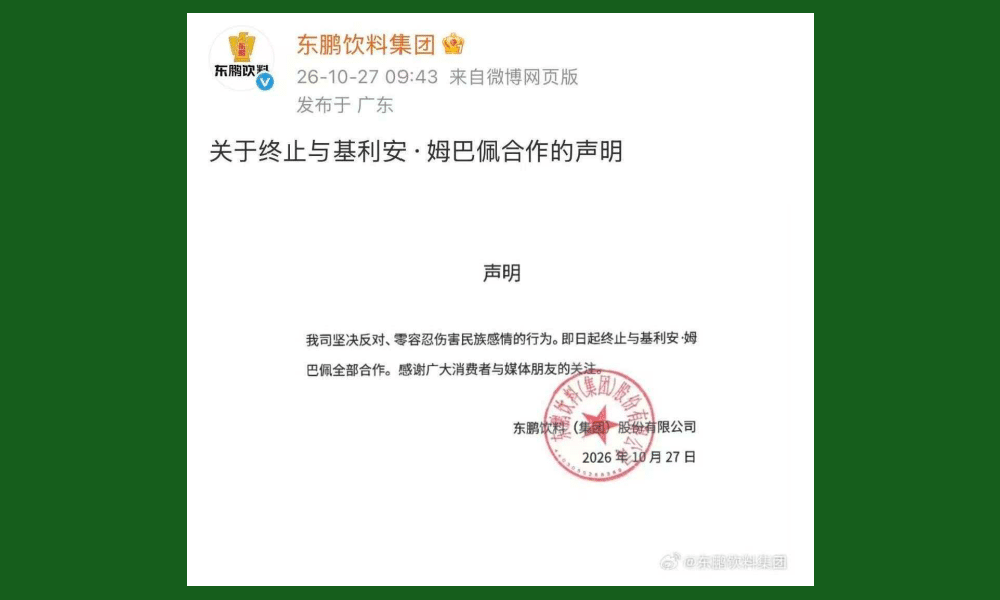
Dongpeng Beverage Group (东鹏): the first in a string of companies to cut ties with French footballer Kylian Mbappé.
Mbappé’s fall from grace in China has been sudden and spectacular, like a major avalanche of backlash that unfolded in one night, and it can all be traced back to one segment of an interview the footballer previously did on a French YouTube show (The Bridge) that resurfaced online — initially through Reddit and X, and then on Chinese social media apps, like football platform Dongqiudi (懂球帝).
In that segment, when asked about his favorite meme, Mbappé replied that one of the memes he finds funniest is:
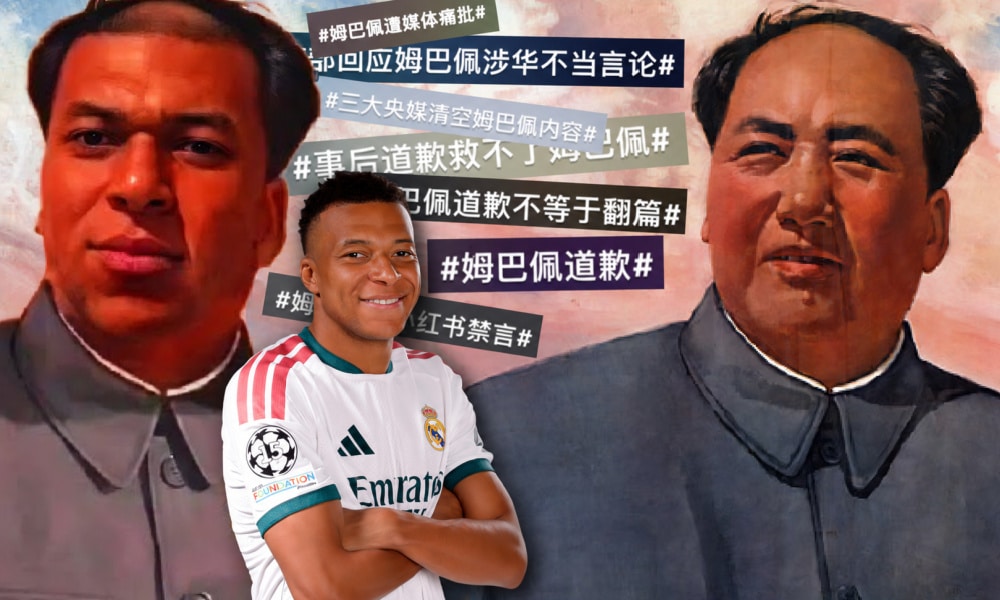
🗣️ “the one where they put my face on some guy, a Chinese dictator. That really makes me laugh, I use it with my friends all the time.”

The interview segment where Mbappé shares his favorite meme: his face photoshopped onto the face of a “Chinese dictator.”
The show, created by Mbappé’s Real Madrid teammate Aurélien Tchouaméni, added the image Mbappé referred to: his face photoshopped on a Mao propaganda visual. It’s part of a series of memes that emerged in 2024 in which Mbappé’s face is edited onto the faces of dictators.1
Chapter Dive
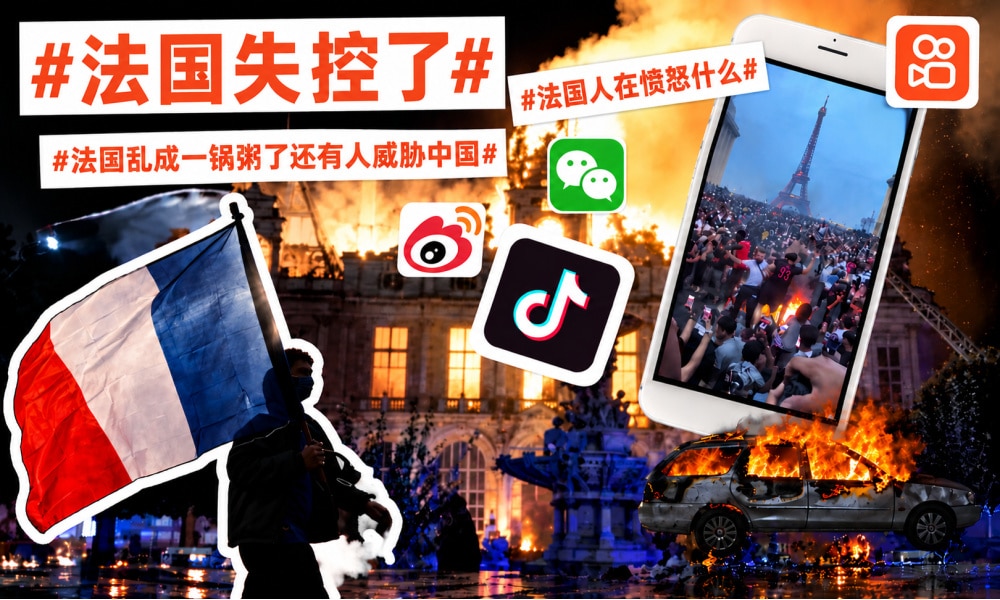
The French Protests, Viewed from China: Five Narratives on Chinese Social Media
From the decline of Europe to historical karma: these 5 narratives reveal how Chinese social media discusses the recent unrest in France.
Eye on Digital China is a reader-supported publication by
Manya Koetse (@manyapan) and powered by What’s on Weibo.
It offers independent analysis of China’s online culture, media, and social trends.
To receive the newsletter and support this work, consider
becoming a paid subscriber.

From “Pure Love Warrior” to Political Victim: Jensen Huang’s Fall on Chinese Social Media

China Trend Watch: Digital Dementia and Why Everyone Says ‘Li Na’

Mbappé, Mao & the Backlash on Chinese Social Media

Mbappé, Mao, and the Joke That Shall Not Be Named

The French Protests, Viewed from China: Five Narratives on Chinese Social Media

Why Japan Has So Many Surnames, China’s Back-to-School Shifts & Taiwan Pavilion Trouble

The Power of Ugly: Why Niu Lai Became China’s Unlikeliest Box-Office Hit

The Rise of “Shuaqi-ism,” Taking Starbucks to the Fields, and Pretending to Go to Work

Blame Games & Bad Signs: Nepal–Tibet Floods, Huawei’s Toilet Trouble, “Screwed” Graduates

Starbucks Goes Xinjiang & The Kardashians in China
-

 Chinese New Year9 months ago
Inside Chunwan 2026: China’s Spring Festival Gala
-

 China Brands, Marketing & Consumers12 months ago
Hasan Piker’s China Trip & the Unexpected Journey of a Chinese School Uniform to Angola
-

 Chapter Dive9 months ago
Inside the Great Chinese Debate Over the Iran War
-

 Chapter Dive10 months ago
Chinamaxxing and the “Kill Line”: Why Two Viral Trends Took Off in the US and China