China Trend Watch
Trending on Weibo: ‘731’ Movie, Actor Xie Mengwei Detained, Hangzhou Chemical Waste Death
Stay updated on China’s top social media trends this week (Sept 2025): “731” film record, Mukden anniversary, actor scandal, PKU probe & more.
Published
8 months agoon
🔥What’s Trending in China This Week (Week 38, 2025)? Stay updated with China Trend Watch by What’s on Weibo — your quick overview of what’s trending on Weibo and across other Chinese social media.
1. 94th Anniversary of September 18th “Mukden Incident” Commemorated Across China
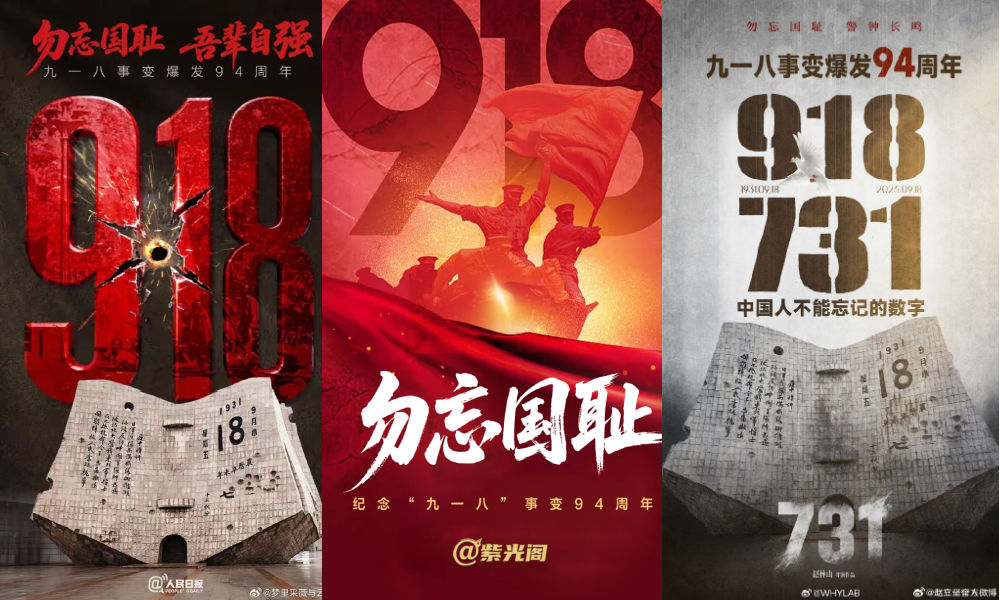
Official media posters commemorating the “Mukden Incident.”
This week, China is commemorating the 94th anniversary of the so-called September 18th Incident (九一八事变), also known as the Mukden Incident. The incident, which occurred in 1931, marked the beginning of Japan’s invasion of Northeast China and the start of 14 years of Chinese resistance against Japanese occupation. In Liaoning Province, sirens sounded at exactly 9:18 AM, with citizens stopping to observe moments of silence. Social media was flooded with posts using hashtags like “Never Forget National Humiliation” (勿忘国耻) and calls for national strength and unity. The commemoration comes as China continues to emphasize historical education and national defense awareness among its citizens.
Manya’s Take:
The widespread focus on this particular historical anniversary is part of a greater official campaign in China to bring the historical memories of World War II in China to the forefront of the public memory. From social media hashtags to the military parade to cinema movies, the repeated message is: “Never forget” and “Always remember”, emphasizing that China’s suffering has brought the victory that led to its current status in the world today.
2. Film “731” Breaks Multiple Box Office Records on Opening Day

The movie posters for 731.
The much-anticipated war movie “731” shattered 10 box office records on its opening day, rapidly surpassing 200 million yuan in ticket sales. The movie, directed by Zhao Linshan (赵林山), depicts the horrific human experiments conducted by Japan’s Unit 731 during World War II in Northeast China. The film features actor Jiang Wu (姜武) in a leading role and has sparked widespread discussion about this particularly dark chapter of Second Sino-Japanese War. The movie’s initial success reflects continued Chinese interest in wartime history and the ongoing effort to preserve historical memory of Japanese war crimes. More about this in the upcoming newsletter.
3. Actor Xie Mengwei Detained for Livestreaming in Police Uniform

The actor during his livestream and the police report.
Chinese actor Xie Mengwei (谢孟伟), popularly known as “Gazige” (嘎子哥) due to his childhood role in the patriotic war drama Little Soldier Zhang Ga (小兵张嘎), was “administratively detained” for seven days for hosting a commercial livestream on the Chinese app Kuaishou while wearing police uniform. The actor was reportedly livestreaming during a break while on the set of upcoming Chinese anti-drugs film Drug Storm (缉毒风暴). Legal experts emphasize that police uniforms and equipment are restricted to official use only, and unauthorized wear violates public security regulations.
Xie claimed the uniform was a costume for the movie, but authorities rejected the explanation, stating the attire was worn outside filming and without proper clearance. The public video apology he gave was also criticized for failing to acknowledge the actual legal violation. In response to the controversy, the film’s producers have announced a complete reshoot of Xie’s scenes with a new actor. The actor also saw his livestream account on Kuaishou banned (#嘎子谢孟伟账号被封#).
Manya’s Take:
It’s clear that Xie has been turned into an example for other livestreamers in China, as authorities have taken a series of measures over the past few years to contain this thriving industry and ensure content stays in line with official guidelines. Xie’s case is now a cautionary tale, highlighting the Chinese government’s zero-tolerance stance on the misuse of state symbols. For Xie, the punishment is particularly harsh—not just the detainment, but practically the end of his career, as his name is now ‘tainted’ because of this scandal (see our article on Chinese ‘tainted celebrities’ here).
4. Peking University Vice President Under Investigation for Serious Violations

Ren Yuzhong (任羽中), image via Guancha.
Ren Yuzhong (任羽中), Executive Vice President and Standing Committee Member of the Communist Party Committee at China’s renowned Peking University (北京大学), has voluntarily turned himself in and is currently under disciplinary and supervisory investigation by the Central Commission for Discipline Inspection (中央纪委) and the National Supervisory Commission (国家监委) for suspected serious violations of law and party discipline. The announcement was made public on September 17.
Ren, born in 1980, rose from being a top scorer in Sichuan’s college entrance exam to earning his PhD from Peking University, eventually becoming the university’s first post-1980s vice president. He had only held the position since March 2024. Analysts view this as a deepening of China’s anti-corruption push into the education sector. Notably, his profile was removed from Peking University’s website a month before the announcement, and he had been absent from official meetings since July.
Manya’s Take:
Is this going to be the year of tackling corruption in Chinese academic circles? Earlier this year, a major scandal at Peking Union Medical College, a prestigious medical institution in Beijing, already triggered nationwide anger about fairness in education and corruption in academia. The dismissal of Ren Yuzhong is applauded by many who see it as a sign that even those in the higher positions at such renowned institutions cannot get away with corruption. “Check them, check them all!” some popular comments said.
5. After Deadly Incident, Hangzhou Authorities Track Down Abandoned Chemical Source

The demolished site in Yuhang where the woman went farming when she stepped on the plastic constainer. Image via The Paper.
Earlier this week, the death of a 52-year-old woman from Hangzhou drew national attention in China after she died from exposure to hydrofluoric acid, a highly toxic industrial chemical that netizens also refer to as “bone-dissolving water” (化骨水). On September 9, while she was out in a an abandoned area in Yuhang District (余杭区), she stepped on an old plastic barrel, causing residual acid from the barrel to splash onto her leg. Despite emergency hospital treatment, the woman died five days later from poisoning and organ failure.
Hangzhou authorities have now successfully identified the owner of the abandoned hydrofluoric acid. The man, a wall-cleaning contractor, illegally abandoned three barrels containing the highly dangerous acids back in 2015, when his father lived in the area. He has been detained and faces charges under China’s environmental protection and criminal laws.
Manya’s Take:
This case has mainly attracted so much attention due to widespread worries over the public’s lack of awareness regarding toxic chemicals and the ease with which such substances can be purchased online. In this case, one woman died — but the consequences can impact many more families. In 2016, for example, dozens of children fell seriously ill after their school had moved to a new ground that later turned out to be affected by toxic chemicals from a nearby chemical plant. About the current suspect in the Yuhang case, some netizens say he didn’t just kill one woman: “He put all of us in danger.”
This is the China Trend Watch series: trending topics curated by Manya, with help from our What’s on Weibo AI sidekick. AI tools — set up and customized by What’s on Weibo — help identify top trends and draft outlines, while Manya Koetse selects what’s most noteworthy, fact-checks, rewrites, and edits for context.
Spotted a mistake or want to add something? Please let us know in comments below or email us. First-time commenters, please be patient – we will have to manually approve your comment before it appears.
©2025 Whatsonweibo. All rights reserved. Do not reproduce our content without permission – you can contact us at info@whatsonweibo.com.
Manya Koetse is a sinologist, writer, and public speaker specializing in China’s social trends, digital culture, and online media ecosystems. She founded What’s on Weibo in 2013 and now runs the Eye on Digital China newsletter. Learn more at manyakoetse.com or follow her on X, Instagram, or LinkedIn.
You may like
China Memes & Viral
The AI Actor Debate, Tragedy in China’s “Fireworks Capital,” and the Viral Labubu Fridge
From AI-generated film releases to popular “micro-vacations”, these are the digital & social trends shaping Chinese online conversations this May Day holiday.
Published
2 weeks agoon
May 6, 2026
In this China Trend Watch edition:
– AI actors vs human storytelling
– China’s deadly fireworks disaster
– Chengdu car attack controversy
– A blogger tracked down over pink river water
– The $1,900 Labubu fridge
– “Micro-vacations” & more
Everything seems to be about AI these days. Especially in China, where AI has permeated so many industries that it’s simply become part of the daily conversation.
Over the “Golden Week” holiday, Hangzhou deployed its first smart-robot traffic police teams. Demand for Huawei’s Ascend 950 AI chips surged following the release of DeepSeek’s V4 model (designed to run on the Huawei hardware). Across sectors, Chinese companies are racing to integrate AI into their factories, vehicles, and everyday services.
In recent weeks, AI’s role in China’s entertainment industry has particularly sparked intense discussion.
In late April, China’s major streaming platform iQIYI unveiled its “Nadou Pro” (拿豆Pro) AI film production initiative, alongside an “AI Artist Library” featuring dozens of actors whose likenesses could be used for AI-generated content. CEO Gong Yu (龚宇) suggested this could allow some actors to “appear” in up to 14 dramas per year, rather than only four.
The announcement immediately triggered online backlash. Some actors said they had not agreed to be included, while Gong’s remarks were widely seen as tone-deaf. Beyond concerns about consent, many netizens questioned the appeal: do audiences actually want 14 AI-generated performances more than a few real ones?
Although iQIYI later clarified that actors would remain involved in decision-making and that consent would be required for any AI scenes, skepticism remains strong. Many fear AI will gradually replace human actors and make films or dramas feel increasingly artificial.
Perhaps this is also one of the reasons why the “dark horse” hit of this May Day holiday box office season was a smaller local production with little pre-release buzz: Love Letters to Grandma (给阿嬷的情书, alternative English title: Dear You). With no big stars or special effects, the film stands out for its authenticity, featuring Chaoshan actors speaking their native dialect and telling an intimate, emotional story.

Still from Love Letters to Grandma (给阿嬷的情书, alternative English title: Dear You)
Set against the historical backdrop of the mass migration of southern Chinese to Southeast Asia, the film follows a grandson searching for the truth about his long-absent, supposedly wealthy grandfather, who continued sending letters and money home despite decades of separation from his family. (This type of family correspondence is called 潮汕僑批, Teochew Letters.)
What the grandson discovers in Thailand is unexpected: the letters his grandmother relied on for years were not sent by her husband, but by a stranger who chose to continue the correspondence on his behalf.
The film – that now scores a 9 on Douban – has been widely praised for its sincerity: the little details hidden in everyday life, the genuine emotions on the actor’s faces, and the fragile image of a grandmother reading love letters in the Chaoshan dialect.
As China moves deeper into the AI era, the film’s success highlights an interesting countercurrent: while major platforms push more toward AI-generated content, audiences are increasingly embracing stories that feel more human and emotionally real. There’s nothing artificial about that.
There’s much more trending news this week, so let’s dive into the other stories.
📌 PS: Also noteworthy this week: a Hangzhou court ruled that Chinese companies cannot fire workers simply because their jobs are replaced by AI. A 35-year-old tech worker sued his employer after being told his role would be handled by AI systems. The court was clear: adopting AI to reduce costs is not a lawful reason for dismissal.
Quick Scroll
- 🎬 China has approved the country’s first AI-generated film for theatrical release. The 90-minute sci-fi film Sanxingdui: Future Memories (三星堆:未来记忆) was made using tools from ByteDance.
- ❗ A 16-year-old female tourist died on May 3 after falling from a swing suspended above a waterfall at a scenic park in Sichuan, prompting discussions about safety regulations in China’s fast-growing adventure and thrill tourism sector.
- 🔬 Three Chinese female scientists simultaneously won awards at the 2026 Breakthrough Prize ceremony in Los Angeles — the ‘Oscars of science’ — for their exceptional contributions to mathematics.
- ✈️ Jackie Chan has been appointed as the new cultural ambassador for Chinese travel platform Trip.com, which has set a target of bringing 200 million foreign tourists to China over the next five years.
- 💬 Wechat has redesigned its app’s social “Moments” layout, with users calling it “ugly” and finding it hard to adapt.
- ☕ The Guangzhou Coffee Festival drew 37,000 visitors in one day, signaling strong consumer enthusiasm for cafe & coffee culture over this May Day holiday.
- 🍬 Most people are familiar with White Rabbit – that milky sticky white candy – and in China it’s a nostalgia staple. The brand has now opened a flagship store on Shanghai’s Nanjing Road, with many netizens being happy about how it brings back childhood memories.
- 🚗 After the 2026 Beijing Auto Show, commentators & car bloggers argue that many domestic high-end EVs are all look-alikes. As competition shifts from price wars to tech differentiation, this perceived lack of originality has drawn concern about brand identity and long-term innovation.
- 📱 American streamer IShowSpeed went viral after accidentally dropping his Huawei tri-fold phone into the ocean during a livestream. He had purchased the device last year during his famous China tour.
What Really Stood Out
Devastating Explosion in China’s “Fireworks Capital” Exposes Deep-Rooted Safety Risks
[#烟花爆炸#] [#花炮之都30万人的生计之困#]

Twenty-six people were killed and 61 injured in a major explosion at a fireworks plant in Guandu Township, Liuyang (Hunan Province). The incident exposes deeper structural safety risks in this so-called “fireworks capital of the world.”
The explosion occurred late in the afternoon of May 4 at Liuyang Huasheng Fireworks Manufacturing Company (浏阳华盛烟花制造有限公司), a mid-sized factory that had been operating for over 26 years. Shockwaves were reportedly felt up to 10 kilometers away, and windows shattered at distances of up to one kilometer from the blast site.
More than 480 emergency personnel were dispatched. A second round of searches on Tuesday raised the confirmed death toll to 26, though it remains unclear at this time how many people are still missing.
Beyond the tragic loss of life and damage, the explosion has far-reaching consequences for Liuyang, as all fireworks manufacturers have been ordered to halt production pending safety inspections and rectification.
As one of the world’s leading fireworks production hubs, the industry is the backbone of the local economy, with 431 factories directly employing around 300,000 people. A prolonged shutdown could leave thousands of workers and their families without income.
At the same time, safety issues at Liuyang factories have been a point of concern for at least two decades. The factory involved had been penalized earlier this year for storing industrial potassium perchlorate (高氯酸钾) together with phthalate compounds (苯二甲酸盐), materials that can trigger chain explosions from even minor sparks or static discharge.
While many commenters express sympathy for those affected, there is broad agreement that safety must come first. Many also note that such a major incident may have been preventable (investigations are ongoing) and should never happen again in Liuyang.
Chengdu Car Attack Sparks Anger Over “Accident” Framing
[#成都撞人#] [#成都男子驾车碰撞行人1死11伤#]

On the first day of the May Day holiday, a horrific hit-and-run incident at a busy Chengdu intersection triggered public frustration over the official framing of the incident.
At around 17:20, a 31-year-old male driver identified as Li (李某某) drove his sedan into a crosswalk full of pedestrians along Jiannan Avenue, striking multiple people. Videos from the scene showed at least five people lying motionless on the street. The driver then continued, hitting people at other locations, including a motorcycle and dragging one victim along the road.
The Li Laoshi X account reported that a bystander captured the driver exiting the vehicle while still holding a knife. According to official reports, the incident resulted in one death and 11 injuries. The driver was arrested at the scene and was reportedly not under the influence of alcohol or drugs.
In its statement, the Chengdu Public Security Bureau described the incident as a “road traffic accident” (道路交通事故), saying the driver had “collided with pedestrians” (与行人发生碰撞).
As videos were taken offline and some comment sections shut down, the wording of the official statement drew online criticism. Many argued this was not an “accident,” but a case of “intentionally endangering public safety” or “revenge against society” (bàofù shèhuì 报复社会).
“Bàofù shèhuì,” or “taking revenge on society,” is often used to describe violent incidents in China in which individuals with personal grievances or mental health issues commit extreme acts.
In such cases—whether car-ramming or knife attacks—online discussions are often tightly controlled, and detailed information about the incident tends to remain limited.
Earlier this year, there were two other fatal incidents in Chengdu involving cars ramming into crowds, involving a 38-year-old and a 19-year-old driver. In March 2024, a black Maybach sedan also drove into pedestrians in Chengdu, killing two. In that case, netizens likewise claimed the incident was suppressed and that there was little follow-up information.
The latest case is currently under investigation.
“This is a country where everything is always ‘under investigation,’” one Douyin commenter wrote sarcastically.
Chinese Environmental Blogger Harassed for Exposing Local Pollution
[#警方回应博主取样河水后被半夜敲门#] [#环保博主取样河水被半夜敲门#]

An environmental blogger known online as Dongbei Biaoge (东北彪哥, “Northeast Tough Guy,” 97k followers on Douyin) is at the center of a local scandal that has sparked nationwide discussion, shifting from conversations over pink water to a midnight knock on the door.
The story began with Dongbei Biaoge’s May 1 trip to Henan province after receiving tips from followers that river water in a Zhoukou waterway, next to farmland used by local residents, had turned bright pink and was covered in green algae. The blogger collected a sample of the pink water in Dancheng County, which is also home to a major industrial company.
Using a DIY rapid test kit, he recorded ammonia-nitrogen levels of approximately 5–10 mg/L, several times above national thresholds, and promised followers an update.
That next update, however, focused on something else: Dongbei Biaoge said he had been receiving nonstop harassing phone calls since posting his video. Despite using a friend’s out-of-province vehicle and not disclosing his location, unknown individuals were able to track him down. Around midnight / early morning on May 2, two men knocked on his hotel room door, asking to “have a talk” (谈一谈). He refused to open and called the police.
The following morning, local police confirmed by phone that the two men were township government officials and described the late-night visit as a “misunderstanding.”
Meanwhile, Dancheng County issued a statement saying it had launched an overnight investigation following online reports of possible pollution, claiming there was no evidence of industrial wastewater entering the water and announcing further investigation.
Online discussions have since shifted, with many focusing on how Dongbei Biaoge was tracked down, who leaked his personal details, and why his privacy was violated. Some commenters describe the situation as “terrifying,” seeing it as a worrying signal for others trying to expose local environmental issues.
On the Feed
The $1900 Labubu Mini Fridge

If you thought the Labubu hype had ended, I’m afraid to disappoint you. Labubu might start popping up in even more unexpected places now that Pop Mart, the company behind The Monsters series, has entered the world of home appliances.
First launch: the Labubu fridge, featuring original artwork by Hong Kong illustrator Kasing Lung. Two versions of the limited-edition mini fridge (just 999 units, each with a unique serial number) were officially priced at 5,999 yuan ($878). By April 29, nearly 38,000 preorders had been placed.

After selling out within seconds of the April 30 launch, the fridge quickly appeared on resale platforms for 12,999 yuan ($1,900).
Founder Wang Ning has said Pop Mart’s IP-driven small appliance line will expand to include electric kettles, coffee machines, electric toothbrushes, hair dryers, and more. Mass production is already underway, with a “China first, overseas later” rollout strategy. Are you ready for Labubu to move in with you?
Word of the Week
Go Slow, Stay Close: “Micro Vacations” (微度假 Wēi Dùjià) on the Rise in China

The word of the week is “Micro Vacation”: 微度假 Wēi Dùjià.
This year’s May Day holiday was extra long, making it the perfect time for travel. According to Chinese state media, the many trips made are proof of the country’s economic vitality.
But at the same time, economic pressures are showing in the way people are traveling: shorter distances and smaller budgets, combined with a quieter pace—very different from the busy city trips and do-and-see-as-much-as-possible travel boom following the immediate post-Covid years.
Many Chinese travelers are now gradually shifting away from traditional tourist hotspots toward more low-key, low-cost, and nearby destinations, where they spend 2–3 days to relax and slow down. These so-called “micro-vacations”—a term that has been around since about 2013—are gaining in popularity.
As part of this trend, farms and other rural destinations are seeing a sharp rise in visitors and revenue this year. People are going camping (often renting gear instead of buying it, called “travel light rentals” 轻装租用, qīngzhuāng zūyòng), enjoying outdoor cooking, fishing, and tea-picking, and bringing back fruit and vegetables in the trunk of their cars.
Featured image: consists of various images combined from China’s first AI film poster (三星堆:未来记忆); pink water scandal; Chengdu car attack; Liuyang explosion; and in the background, the AI artist library by IQIYI.
Eye on Digital China, by Manya Koetse, is co-published on Substack and What’s on Weibo. Both feature the same new content — so you can read and subscribe wherever you prefer. Substack offers community features, while What’s on Weibo provides full archive access.
China Arts & Entertainment
Su Chao Fever, Mo Yan’s “Scrollable” Book, and Why Li Xiaoran is China’s New Office Icon
This week in China: Grassroots football fever, a Nobel laureate writes for the TikTok era, France’s cultural relic bill, and a 19-year-old’s blind box obsession bankrupts her father’s company.
Published
4 weeks agoon
April 22, 2026
🔥 China Trend Watch (week 16/17 | 2026) Part of Eye on Digital China by Manya Koetse, China Trend Watch is an overview of what’s trending and being discussed on Chinese social media.
Dear reader,
Hope you’re having a good week. Time for an update on what’s been trending.
In this newsletter:
👉Victor Hugo’s day has come
👉China’s grassroots football couldn’t get more viral
👉A scrollable new book by Mo Yan
👉The Chinese office meme of the moment
..and more.
Let’s dive in.
Quick Scroll
-
- 📱 China’s National Security Ministry has joined Chinese Tiktok app Douyin. The high-profile Douyin debut is part of a broader trend of Chinese government agencies and security bodies joining the app.
- 🐺 A feel-good wildlife story from Inner Mongolia: a pregnant wild wolf descended from the mountains to give birth at a wildlife conservation station where she had been previously fed. The noteworthy move shows she had apparently developed trust in the station workers, and felt safe there.
- 🐖 Pork prices hit historic lows but spare ribs still cost 20 yuan (US$3) – this became a topic of discussion this week. Despite the drop in pig prices, retail pork still feels expensive because added costs across the supply chain haven’t changed.
- 🍿 Movie alert. The May Day (五一) cinema content explosion is incoming. Seventeen films have already been slotted for the Golden Week holiday window.
- 🚔 A 31-year-old man from Guangzhou has been detained under anti-cyberbullying regulations after repeatedly posting insulting comments targeting Olympic champion diver Quan Hongchan (全红婵) on WeChat.
- 🤖 Unitree’s humanoid robot is almost as fast as Usain Bolt. The company announced that the H1 humanoid robot achieved a peak sprint speed of 10 meters per second during a 100-meter test.
- ⚡️ Another robot, “Lightning” (闪电) by Honor, also went viral because he won the Beijing Yizhuang Half Marathon on Sunday, April 19, running a half-marathon distance faster than any human ever has, completing it in 50 minutes and 26 seconds (the human record: 56:42). (See video here).
- 🎁 A 19-year-old woman from Zhengzhou has made headlines for allegedly embezzling around 17 million yuan (nearly $2.5 million) from her father’s company, spending it on blind boxes and livestream tipping (dashang 打赏). Her father, now bankrupt, ended up taking his daughter to the police himself.
What Really Stood Out
The Jiangsu Super League (Su Chao) Fever

The Jiangsu Football City League, better known as the Su Chao (苏超: “the Su Super”), has become a major source of trending topics, memes, and news analyses over the past week.
The “Su Super” is a provincial amateur football tournament launched in 2025 that features 13 teams, one representing each of Jiangsu’s 13 prefecture-level cities. Teams consist predominantly of amateur players, from primary school teachers to office employees, but it’s been seriously successful: last year, some games regularly drew crowds of over 30,000, with a record 60,396 fans for a Nanjing–Suzhou match.
This year, the season’s opening on April 11 was sensational, almost like a mini Spring Festival Gala of its own, with 300 robots from tech company Magic Atom (魔法原子) performing a perfectly synchronized routine—unbothered by the heavy rain—and popular pop singer Zhou Shen (周深) delivering a much-discussed live performance where he hit some incredibly high notes.
It’s the entertainment and creative memes that seem to matter more than the sport itself.
⚽ When Changzhou won 3–0 in its opening match against Nantong, in a stadium filled with more than 40,800 people, the running joke was that the city of “Changzhou” (常州) could add more “strokes” to its name. This is all part of a bigger meme that started last year, when netizens would ‘deduct’ a character stroke from Changzhou’s name after every time it lost, with its Chinese name going from 常州 to 巾州 to 丨州, until netizens joked there were no strokes left to remove (0州)—Changzhou performed quite terribly.

The “chang” character kept losing strokes as Changzhou lost in the 2025 Su Chao (edited image by netizens).
But with this year’s unexpected win, Changzhou struck back, and the official city account flipped the joke by temporarily renaming itself 常洲, with the three-water-drop radical added to the zhou 州, symbolizing its three goals scored (#常州暂时改名常洲#).
⚽ More than that, Changzhou city officials announced a one-day citywide holiday on April 12, with free public buses and metro for all residents. It was almost like a New Year’s night: major landmarks also stayed lit throughout the night.
⚽ Another meme sprang from a giant inflatable dinosaur that was set up before the match, part of Changzhou’s dino-city branding (it is home to China Dinosaur Park). It was meant to look cool and majestic, but netizens thought it resembled a shiny, greasy, reddish-brown soy-braised duck (酱板鸭) instead, leading to the “Soy-braised dragon” meme (酱板龙).

The dino that looked more like a soy-braised duck and “soy-braised dragon” merchandise sold on Taobao.
⚽ During the Suqian vs. Nanjing match on April 18, another highlight featured actor He Rundong (何润东), who appeared dressed in full armor and surrounded by guards and horses, revisiting his famous role as the ancient warlord Xiang Yu (项羽)—the historical figure associated with Suqian as his birthplace. He shouted “Xiang Yu has returned!” (“我项羽回来啦”), a moment that became even more significant after Suqian won 2–0.
⚽ What also stands out in the marketing surrounding the Su Chao is how, alongside the official mascots, Jiangsu media, companies, and fans have been producing AI-generated “city personification” figures featured in images and short videos, with storylines about winning, losing, friendship, and rivalry between the 13 cities in a virtual world. Changzhou is a little dino, Nanjing is a little duck, Nantong is a wolf, etc.

The success of the Jiangsu Super League does not appear out of nowhere: for the past few years, China’s grassroots football has seen a wave of success, with local governments and companies using these leagues and matches to boost local cultural identity and community cohesion, while city-vs-city rivalry and banter consistently trends on social media.
Within this bigger picture, the Village Super League (村超, Cun Chao)—a community football tournament held in Rongjiang County in Guizhou—is a frontrunner. What started as a self-organized village event in 2023 became one of the most-watched grassroots sports stories in recent years.
With China’s national football plagued by underperformance, corruption, and other scandals, more voices are suggesting that the future of Chinese soccer might lie in regional and local super leagues.
Regardless of whether that is true, it is undeniable that phenomena like the Su Chao are bringing a lot of online fun, memes, banter, commercial success, and positive community energy. In doing so, they generate more authentic online engagement than any professional league matches currently do.
France Returning Cultural Relics: “Hugo’s Day Has Come”

It is not often that the French National Assembly goes trending in China, but it did after unanimously passing a cultural restitution bill that makes it easier to return looted colonial-era objects.
The new bill allows countries to request the return of objects taken between 1815 and 1972, provided they can show the items were acquired by force or other illegitimate means. It marks a shift from the previous, slower, case-by-case restitution system, where every single return required a separate parliamentary vote.
In Chinese media, the news was highlighted through a quote by French politician Jérémie Patrier-Leitus, who in his speech cited Victor Hugo’s famous 1861 letter about the sacking of the Old Summer Palace (Yuanmingyuan), in which he expressed hope that a renewed France would one day return the goods it had plundered from China. Patrier-Leitus said: “The day Hugo longed for has finally arrived.”

Screenshot of the tweet by Jérémie Patrier-Leitus, in translation.
For Chinese audiences, the story carries strong emotional resonance. The looting of the Old Summer Palace in 1860 by French and British forces is widely taught at school as part of the so-called “Century of Humiliation,” the period from the mid-1800s to the mid-1900s during which China was attacked, weakened, and torn by foreign powers. The four-character slogan “wù wàng guóchǐ” (勿忘国耻), “Never forget national humiliation”, is frequently repeated in Chinese media, museums, schools, documentaries, and popular culture.
Besides state media and nationalist commentary, other discussions also emerged online. Some threads focused on which artifacts could potentially be returned to China, mainly linked to the burning of the Old Summer Palace in 1860 and the 1908 Dunhuang removals (although this remains contested as “looting”: it concerns French scholar Paul Pelliot, who acquired thousands of invaluable ancient manuscripts and artworks from a monk guarding a cave at Dunhuang for very little money, and took them to Paris, where they have remained ever since).
Other comments expressed hope that France would set an example for other countries.
Although the news went big in China, French media coverage itself did not mention China at all and instead focused on Benin, Senegal, Côte d’Ivoire, Mexico, and Algeria.
On the Feed
A Scrollable New Book by Mo Yan

Mo Yan (莫言), China’s first Nobel laureate in literature, has been praised as a “meme king” for quickly adapting to China’s online Xiaohongshu community since joining the app in November 2025.
Now, the famous author—known for epic works like Red Sorghum (红高粱)—has again become a hot topic for publishing a new book inspired by his own social media and short-video scrolling “addiction.”
The novel, titled Oh, People (Rén Na 人呐), is his first new fiction in six years and immediately hit the top of major bestseller lists upon release. It’s a collection of 81 ultra-short pieces, the briefest of which runs just 200 characters, and is designed, in Mo Yan’s own description, so that readers can “scroll through it” the way they scroll TikTok.

This format is sparking discussion across Chinese social media, especially because it comes from a writer of Mo Yan’s stature.
One core question is whether a Nobel laureate should be writing “fast literature” that mimics short-video logic, and whether this suggests that even China’s most lauded authors are giving in to platform-driven attention economics.
Others argue that the book’s format is not entirely new, and could just as easily be traced back to classical Chinese literary traditions rather than the TikTok era.
These debates may be precisely the point of Mo Yan’s new book. Is it merely scrollable, or is it serious? Through these discussions, his work already engages with two important aspects of contemporary Chinese society: the country’s changing reading culture and the dominance of short-video platforms.
Word of the Week
The Office Li Xiaoran

The phrase of the week is “the Office Li Xiaoran” (Bàngōngshì Lǐ Xiǎorǎn 办公室李小冉).
The phrase comes from the 7th season of the super popular reality/talent show Sisters Who Make Waves (乘风2026), where the 50-year-old Chinese actress Li Xiaoran (李小冉) performed with her group, which also included Olympic skater Wang Meng (王濛).
Li Xiaoran was completely and painfully off-key, off-tempo, forgetting lyrics, and stiff in her choreography — but she stayed calm and cheerfully smiled through it all.
The dreadful performance of the song—officially titled “Wish Sticky Note” (心愿便利贴)—was soon dubbed Wantong Jingutai (万通筋骨贴) by netizens, referring to a Chinese medicinal patch for joint pain. (It’s a wordplay on the title, sharing the same final character: “这不是心愿便利贴,这是万通筋骨贴”).
Ironically, Li was professionally trained at the prestigious Beijing Dance Academy, but dropped out to become an actress—prompting some netizens to joke that instead of saying “the dance world lost a great talent,” it “lost someone completely irrelevant” (#舞蹈界失去了一个无关紧要的人#).
But it wasn’t all meant in a mean way. Because people actually very much appreciated Li Xiaoran’s performance. Although it didn’t go very well, she seemed unbothered and positive, which is why viewers eventually voted her to the number one spot on the show that night.
In the aftermath, office workers started collectively joking that they’ve been “diagnosed as the Office Li Xiaoran.”
The phrase “Office Li Xiaoran” (bàngōngshì Lǐ Xiǎorǎn, 办公室李小冉) has become a viral self-label for workers who feel they are underperforming and barely surviving, but maintain a smile and stoically carry on regardless.
There’s now also a trend where people in the office signal to colleagues that they’re “Office Li Xiaoran” by putting a sign on their chairs.
In the example below it says:
“Officially diagnosed as ‘Office Li Xiaoran’
First to arrive every day, last to leave. Submit my work, and the boss asks: ‘What is this even supposed to be?’
Me: ‘No lip-syncing, not afraid of the stage, not pretending, doesn’t sound good—but I really did try!’

In a way, Li Xiaoran has become the perfect vehicle for office emotional catharsis—an unexpected idol for how to carry on in stressful situations. The ultimate lesson she taught us: even if everything’s going wrong, a good attitude, a splash of confidence, and a bright smile can take you surprisingly far.
See the videos here.
—That’s a wrap.
See you next edition.
Best,
Manya
Eye on Digital China, by Manya Koetse, is co-published on Substack and What’s on Weibo. Both feature the same new content — so you can read and subscribe wherever you prefer. Substack offers community features, while What’s on Weibo provides full archive access. If you’re already subscribed and want to switch platforms, just get in touch for help. If you no longer wish to receive these newsletters, or are receiving duplicate editions, you can unsubscribe at any time.
Subscribe
Eye on Digital China is a reader-supported publication by
Manya Koetse (@manyapan) and powered by What’s on Weibo.
It offers independent analysis of China’s online culture, media, and social trends.
To receive the newsletter and support this work, consider
becoming a paid subscriber.

Get in touch
Have a tip, story lead, or book recommendation? Interested in contributing? For ideas, suggestions, or just a quick hello, reach out here.
Comrade Trump Returns: The 2026 Trump–Xi Summit on Chinese Social Media
My Mum Has Two Husbands: The OPPO Mother’s Day Fiasco and 7 Other Gender Marketing Fails in China
The AI Actor Debate, Tragedy in China’s “Fireworks Capital,” and the Viral Labubu Fridge
Quick Eye: AI Drama Takedowns, Meta’s Blocked Deal, and “Lying Flat” Conspiracy
Beyond the “Ching Chong” Controversy: The “Pocket Asian” in The Devil Wears Prada 2
Inside the Great Chinese Debate Over the Iran War
Spring Festival Trend Watch: Gala Highlights, Small-City Travel, and the Mazu Ritual Controversy
Two Sessions, a Celebrity Meltdown, and the Rise of China’s “Forget It” Mindset
Raising Lobsters, 6G Coming, and China’s DIY Deity Trend
“Auntie Mei” Captured After 20 Years, China’s Train-Stain Scandal, and Zhang Xuefeng’s Final Lesson
Popular Reads
-
Chapter Dive10 months agoHidden Cameras and Taboo Topics: The Many Layers of the “Nanjing Sister Hong” Scandal
-
China Insight10 months ago“Jiangyou Bullying Incident”: From Online Outrage to Offline Protest
-
China Arts & Entertainment8 months agoThe Wong Kar-wai Scandal Explained: The Dark Side of ‘Blossoms Shanghai’
-

Chapter Dive11 months agoInside the Labubu Craze and the Globalization of Chinese Designer Toys