SubscribeLog in
Connect with us

Chapter Dive

How ‘Chinese’ are China’s Muslims? Islam in China: An Overview

An overview of Islam in China and China’s relation to its Muslim minority.

Manya Koetse

Published

on

WHAT’S ON WEIBO ARCHIVE | PREMIUM CONTENT ARTICLE

This article is more than 10 years old. The information in this article may not be up-to-date.


As Muslim extremist attacks have ignited discussions on Islam in Europe, Chinese leaders increasingly expand restrictions on the Muslims within their borders. What’s on Weibo brings you an overview of Islam in China and China’s relation to its Muslim minorities.

The January attacks on the headquarters of Charlie Hebdo and a kosher supermarket in Paris by Muslim extremists have ignited heated discussions on radical Islam across Europe. From a distance, Chinese leaders watch Europe’s Islam debate and increasingly expand restrictions on the Muslims within their borders. Since this month, the burqa is banned, along with other garments that ‘promote religious extremist ideology’. “They see themselves as Muslim, we see them as Chinese,” says one Weibo netizen. What is the connection between Islam and China? What’s on Weibo brings you an overview of Islam in China and China’s relation to its Muslim minorities.

 
French Muslims: not ‘French’ enough?
 

After the Charlie Hebdo attacks, French Prime Minister Manuel Valls declared that France was now at war with “radical Islamism” (Economist 2015). In France, and Europe at large, hard questions have been emerging on Islam-inspired terrorism and the recruitment of people within European countries by radical groups such as Al-Qaeda and ISIS. France has the biggest Muslim minority in Europe, and the country’s relationship with them is not easy (Economist/Colchester 2015, 215). In response to the extremist attacks, U.S. President Obama stated that Europe has failed to integrate its Muslims (Francis 2015). About the U.S. he says: “Our biggest advantage is that our Muslim populations, they feel themselves to be Americans.” Europe has not had the same process of assimilation and immigration, according to Obama, suggesting that the identification of Muslims with their nation is crucial in combating radical Islam: French Muslims are simply not ‘French’ enough.

As Chinese President Xi Jinping expressed his sympathy for the victims of the Paris attacks, he said that terrorism was also an enemy to the People’s Republic of China (PRC) (SCMP 2015). China has a history of extremist terrorist attacks, linked to its Uyghur Muslim minority. What is the situation on Muslim integration in China? How ‘Chinese’ are China’s Muslims?

 
Islam in China: an overview
 

No burqa in Urumqi, no fasting for Ramadan, no niqabs, hijabs or large beards in buses. Since 2014, China has implemented several measures to keep religious expressions to a minimum after a string of attacks allegedly committed by Chinese Muslim extremists. In March 2014, a knife attack at the Kunming railway station left 29 civilians dead. In May, 43 were killed when a Urumqi market was bombed. On June 22, attackers drove into a Kashgar police building and set off explosives. The list continues. The government responded to the increasing violence in 2014 with a crackdown that resulted in more than 380 arrests within one month and public controls on religious expression (Tang 2014). The restrictions continued in 2015, when a ban on wearing burqa’s, or ‘face masking veils’ (面罩袍), was legally approved and went into effect on February 1st. The prohibition on burqa’s and other clothing ‘promoting religious extremism’ applies specifically to Urumqi, the capital of Xinjiang, which is home to the majority of China’s Muslims.

Few people in the West are aware of China’s large Muslim community. Yet Muslims are part of China’s history: they have lived in China from as early as the eighth century (Lipman 1997, xvii). Many Muslims came to China as soldiers, giving military aid to the Tang dynasty government during a rebellion uprise and then settling down afterwards. They also came as traders and diplomats along the Silk Road, setting up compact communities that maintained their own religion and lifestyle. Since intercultural marriages with local Chinese often occurred, the Muslim population increased, as non-Muslims had to convert to Islam before marrying (Mi & You 2004, 3-7). Although Muslims live all over China, the majority lives in the northwestern regions of Xinjiang, Ningxia, Gansu and the Qinghai provinces.

F213CE60-EEF4-484D-A13F-ED3019ED7EF3_w640_r1_s

Is there such a thing as a ‘Chinese Muslim’? Within the PRC, Muslims are not defined as a specific category. Chinese citizens are divided into 56 different ‘minzu’ or ethnic groups; a categorization that is separated from religion. The vast majority of Chinese belong to the ‘Han’, which is considered a ‘culturally Chinese’ group. Within the other 55 minzu, there are ten that take Islam as their faith: the Huis, Uyghurs, Kazaks, Dongxiangs, Khalkas, Salas, Tajiks, Uzbeks, Bao’ans and Tatars (Mi & You 2004). About half of China’s Muslims belong to the Hui, the ethnic minority that descents from the foreign Muslims of the Tang (Lipman 1997, xxiii).

The northwestern region of Xinjiang is almost entirely Muslim, and was only joined by non-Muslims since the last fifty years. Of the 20 million-something people who live there, around eight million belong to the Uyghur minority. Although there are no official government records of how many people practice Islam within the PRC, it is estimated that there are currently are around 23 million Muslims in China, a number that is expected to grow to almost 30 million in 2030 (Pew 2011).

XinjiangFood

China’s northwest has always been a region filled with unrest. While Muslim identity strengthened throughout the 17th and 18th century, other rulers (Arab, Mongols, Russians) were looking for new lands to expand their power in present-day Xinjiang. The situation reached a crisis point. In the 19th century, the Chinese Qing government ordered a suppression of Muslim rebels. It is estimated that 20 to 30 million lives were lost in this suppression (Jones-Leaning & Pratt 2012, 317). During the Mao years, Muslims in the northwestern regions suffered greatly from the Great Leap Forward and the Cultural Revolution (1966-1976), as the famine was especially severe in these provinces. Religious buildings and schools were destroyed by the Red Guards, Arabic script was prohibited, and Muslims were expected to rear pigs and eat pork (ibid., 318).

 
“Believe it, don’t show it”
 

After the Mao years, it was acknowledged that religious beliefs could not be completely abolished (ibid., 318). Freedom of religion was officially declared in 1949, but the Communist Party believed that theistic religion would ultimately disappear. Atheism was therefore propagated amongst the people. In current-day China, religion is more or less tolerated, as long as it conforms to state-approved principles and organization (Boyle & Sheen 2003, 179-180). Instead of guaranteeing free exercise of religion, the constitution only guarantees freedom of religious belief. In other words; you can believe what you want, but how you engage with your religion in everyday life has to comply with what the state deems right.

uyghurwomen

In the reform period of the 1980s, the PRC had a policy of cultural liberalization that also applied to China’s northwest. Mosques were reopened and religion was revived. But as extremist Islamic movements expanded internationally, radical groups mushroomed in China’s northwest. Muslim separatist groups called for Xinjiang to form an independent East Turkestan state. Especially after September 11, Chinese authorities focused on its northwest, that had by now become its most politically sensitive region – Western media were also watching the “Islamic terrorism” in Xinjiang (Dwyer 2005, 3). For the last decades, Beijing has been propagating Chinese monoculturalism, trying to assimilate the major minorities of the northwest (especially the Uyghurs) to the dominant Chinese culture (ibid., 2).

Amnesty International has reported harsh measures taken by Chinese authorities to suppress unrest in the northwest, including executions and unfair trials (Jones-Leaning & Pratt 2012, 328). “The fight against terrorism is no excuse for repression,” says Amnesty. In its crackdown on terrorism, the government has introduced several policies, including those on language: they prioritize Chinese language before minority language. It also also closed several mosques and islamic schools because of “anti-Chinese activity” (ibid., 328). Ramadan has been officially discouraged, religious dress restricted, and media freedom constrained.

 
How ‘Chinese’ are China’s Muslims?
 

The burqa ban has stirred online discussions on what does and does not belong to the identity of China’s Muslims. “I fully support the ban on face-covering veils,” says one netizen: “Uyghurs can wear authentic Uyghur clothing,  but the black veil definitely is not part of it – it belongs to terrorism.” Another netizen agrees: “The burqa is part of an evil cult, and has no place within the Uyghur community.”

Although there definitely are various traditional styles of clothing within the different Muslim communities of China, their clothing also follow the Quran’s instructions on moderate dress. Women in some parts of Xinjiang are expected to cover their heads and faces (ibid., 327). Chinese authorities have been trying to root out orthodox Islam wear within Muslim minorities by launching the ‘Beauty Project‘ (靓丽工程), discouraging men to grow beards and women to wear veils.

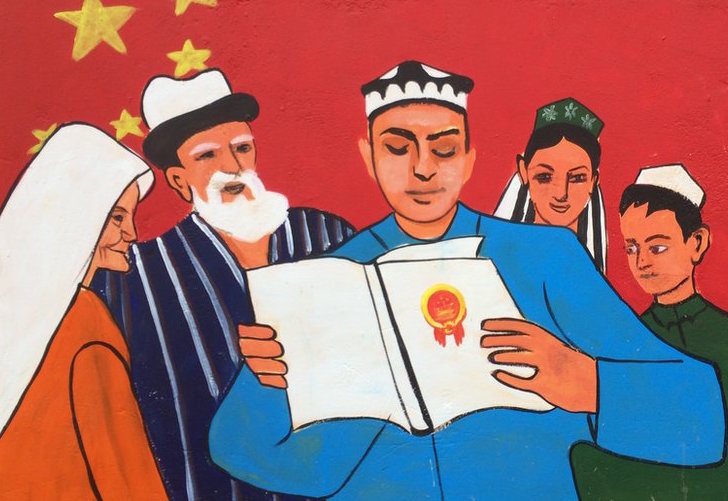
propaganda2Propaganda murals painted next to a mosque in Kashgar, Xinjiang, showing what the Chinese government deems as acceptable (BBC 2015).

“They identify themselves through their religion,” says a Weibo user about Chinese Muslims: “They only identify themselves with Islam. But we identify them as Chinese.” Is this the key to the problem of China’s relations with its Muslims? Does the majority of China really see their Muslim minorities as ‘Chinese’? Do the Muslim minorities see themselves only as ‘Muslim’? The truth probably lies in the middle, and relates to problematic questions on what it means to be ‘Chinese’ or what identifies a ‘Muslim’ in China.

The fact is that Muslims are part of modern-day China. It is their motherland; the only home they have ever known. Yet they are still working to make a place for themselves. Historically, they are more ‘Chinese’ than America’s Muslims are ‘American’. Culturally, they are less ‘Chinese’ than the Muslims of France are ‘French’.

The wider problem remains; China’s relations to its Muslim minorities in the northwest has no sign of progress. Meanwhile, Islam-related terrorist attacks continue. Not enough integration? Too much suppression? China’s government, propagating monoculturalism, does not hold the key to the Islam problem. Nor do European leaders, who have advocated multiculturalism. Obama emphasises the importance of Muslim integration, but it needs two things in order to be successful: a free society that protects faith, and a faith that protects free society. Unfortunately, there is still a long road ahead.

– by Manya Koetse

 
Did you know…? 
 

* The majority of China’s muslims are orthodox Sunni Muslim.

* The oldest mosque of China is the Great Mosque of Xi’an from 742, covering 130,000 square meters.

* Before 1884, present-day Xinjiang was divided in a northern part (Dzugaria) and southern part (Tarim Basim). It was designated as Xinjiang Uyghur Autonomous Region in 1955.

* Xinjiang borders on eight different countries: Afghanistan, Pakistan, India, Mongolia, Russia, Kazakstan, Kyrgystan and Tajikistan.

* Xinjiang literally means ‘new border’ in Chinese.

* Beijing has 40 mosques, whereas Kashgar currently has over 6000, which is only half of the number prior to the Cultural Revolution.

*China’s Hui Muslim minority has a long cultural tradition of female imams. There are hundreds of female imams leading mosques around the country.

References

Abe, Tetsuya. 2015. “Living with terror: China clamps down on Uighurs after Paris attacks.” Nikkei Asian Review, 15 January http://asia.nikkei.com/magazine/20150115-Living-with-terror/Politics-Economy/Living-with-terror-China-clamps-down-on-Uighurs-after-Paris-attacks  [17.1.15].

BBC. 2015. “The Colorful Propaganda of Xijiang.” BBC News, January 15 http://www.bbc.com/news/world-asia-china-30722268 [17.1.15].

Boyle, Kevin and Juliet Sheen. 2003 (1997). Freedom of Religion and Belief: A World Report. London: Routledge.

Cartillier, Jerome. 2015. “Obama: Europe should better integrate Muslims.” Yahoo News, 16
January http://news.yahoo.com/us-britain-vow-help-france-paris-attacks-obama-
175747690.html [18.1.15].

Colchester, Max. 2015. “France Mulls Deep-Rooted Problems Behind Attacks.” Wall Street
Journal, 9 January http://www.wsj.com/articles/france-mulls-deep-rooted-problems-behind-attacks-
1420824161 [17.1.15].

Dwyer, Arienne M. 2005. “The Xinjiang Conflict: Uyghur Identity, Language Policy, and Political Discourse.” Policy Studies: 15.

Economist. 2015. “Terror and Islam: After the Atrocities.” Economist, 17 January
http://www.economist.com/news/briefing/21639540-attacks-charlie-hebdo-and-kosher-supermarket-brought-french-together-unity [17.1.15].

Francis, David. 2015. “Obama Slaps Europe for Failing to Integrate Muslims.” Foreign
Policy, 16 January http://foreignpolicy.com/2015/01/16/obama-slaps-europe-for-failing-to-
integrate-muslims/ [18.1.15].

Jones-Leaning, Melanie and Douglas Pratt. 2012. “Islam in China, From Silk Road to Separatism.” Muslim World 102: 308-334.

Koetse, Manya. 2015. “Chinese reacties op de aanslag op Charlie Hebdo.” 360 Magazine, 15
January http://www.360magazine.nl/politiek/4274/chinese-reacties-op-de-aanslag-op-charlie-
hebdo#.VLvM-YrF_xg [18.1.15].

Lipman, Jonathan. 1997. Familiar Strangers, A History of Muslims in Northwest ChinaWashington: University of Washington Press.

Mi, Shoujiang and Jia You (translated by Min Chang). 2004. Islam in China. Beijing: China Intercontinental Press.

Pew 2011. “The Future of the Global Muslim Population.” Pew Research Center, January 27
http://www.pewforum.org/2011/01/27/the-future-of-the-global-muslim-population/ [18.1.15].

SCMP. 2015. “France mourns victims in Charlie Hebdo attack as police hunt gunmen.” South
China Morning Post, 9 January http://www.scmp.com/news/world/article/1677755/france-mourns-
police-hunt-charlie-hebdo-gunmen [18.1.15].

Tang, Didi. 2014. “China Bans Ramadan Fast In Schools.” The Huffington Post. June 2 http://www.huffingtonpost.com/2014/07/02/china-bans-ramadan_n_5551063.html [11.2.15]

Images

http://d.ibtimes.co.uk/en/full/1392110/xinjiang.jpg

http://www.bbc.com/news/world-asia-china-30722268

http://www.scmp.com/news/china/article/1567483/xinjiang-city-bans-muslim-clothing-and-large-beards-public-buses?page=all

©2014 Whatsonweibo. All rights reserved. Do not reproduce our content without permission – you can contact us at info@whatsonweibo.com.

Manya is the founder and editor-in-chief of What's on Weibo, offering independent analysis of social trends, online media, and digital culture in China for over a decade. Subscribe to gain access to content, including the Weibo Watch newsletter, which provides deeper insights into the China trends that matter. More about Manya at manyakoetse.com or follow on X.

Continue Reading
4 Comments

4 Comments

  1. goldie wan kenobi

    February 15, 2015 at 5:48 am

    Talking with Xinjiang person I learned that she did not consider herself Chinese she said ” I am Chinese when around ethnic Chinese people, and I am myself when they are gone. We don’t feel Chinese and barely look it.” Muslim is not an ethnicity the writer continually referred to these people of Xinjiang as an ethnic group called Muslims. Thats incorrect.

    • Manya Koetse

      Manya Koetse

      February 15, 2015 at 10:30 am

      Dear Goldie,
      Thanks for this comment, it is interesting and it shows that your Xinjiang acquaintance, although probably nationally Chinese, does not feel ‘Chinese’. About Muslims as an ethnicity, you are right. But the article also does not state that being ‘Muslim’ is an ethnicity. It says that there officially is no such a thing as a ‘Chinese Muslim’, because, within the PRC, Muslims are not defined as a specific category. Chinese citizens are divided into 56 different ‘minzu’ or ethnic groups; a categorization that is separated from religion. Nevertheless, within these minzu, there are ten that take Islam as their faith. This article is about Islam in China, and not specifically about Uyghurs or Hui etc, it therefore speaks about ‘Muslims’, meaning those ethnic minorities within the PRC that take Islam as their faith. The issue of Muslims in China is complex and cannot be oversimplified. Nowhere does the article state that all people in Xinjiang are Muslims, nor that they all belong to the same ethnicity. Regards, Manya

  2. Alec

    February 16, 2015 at 1:49 am

    In the last paragraph you wrote ‘China’s relations to its Muslim minorities in the northeast has no sign of progress’, did you mean ‘northwest’? 🙂

    • Manya Koetse

      Manya Koetse

      February 17, 2015 at 4:04 pm

      You’re right, thanks Alec, adjusted.

Leave a Reply

Your email address will not be published. Required fields are marked *

Chapter Dive

Inside the Great Chinese Debate Over the Iran War

From official reactions and armchair generals to women’s rights defenders: China’s online discourse surrounding the war in Iran.

Manya Koetse

Published

on

This is a deep dive into how the latest developments in Iran are being discussed and reflected on in China, focusing on four aspects: (1) China’s official response, (2) key dynamics within the online discourse, (3) clashing views among key opinion leaders, and (4) polarized reactions within grassroots online communities.


“We’re witnessing history.” That was one sentiment seemingly shared by almost everyone across Chinese social media as news broke of a joint US-Israeli strike on Iran on February 28. Over the past few days, military operations in Iran, Iran’s retaliatory strikes against US military bases across the Middle East, and the death of Supreme Leader Khamenei (哈梅内伊) have been top trending topics across virtually all Chinese social media platforms, from Kuaishou to Douyin and beyond.

Even with the Two Sessions about to start, roughly one in every five posts on Weibo’s main feed have been about Iran in the four days since the attack. Some hashtags there, such as “Khamanei Killed” (#哈梅内伊遇害#), have accumulated over a billion views in less than three days. News of a Chinese civilian killed in the attack reached over 250 million views in a day (#伊朗一名中国公民遇难#).

China’s online responses to the developments in Iran cannot be captured in a few sentences. Interpretations vary among netizens, online commentators, and official actors.

At the same time, sentiments have shifted in response to ongoing strikes and emerging reports, ranging from geopolitical and economic concerns to questions about what this war means for ordinary Chinese citizens.


● China’s Official Response and State Media Coverage


One element that has not changed over the past few days—and was to be expected—is China’s official disapproval of the US-Israeli strikes on Iran.

China-Iran relations have deepened since 1979, and the two countries have been economic and military allies for decades. China is Iran’s largest trading partner, and the Sino-Iranian partnership is strategically important to China, especially in light of the Belt and Road Initiative.

On Saturday, China’s Ministry of Foreign Affairs responded, stating that China was “highly concerned” about the military operations, calling for an immediate halt to attacks, urging against further escalation, and advocating a return to diplomatic negotiations. A day later, Beijing described the killing of Iran’s highest leader as a “severe violation of Iran’s sovereignty and security” and a trampling of the principles of the UN Charter.

In a phone conversation with Russian Foreign Minister Sergey Lavrov, Chinese Foreign Minister Wang Yi (王毅) called the attack “unacceptable” (‘不可接受”) and outlined China’s three-point position:

– Immediately cease military operations.

– Return to dialogue and negotiations as soon as possible.

– Jointly oppose these actions that ignore the rules-based order.

What’s particularly noticeable in the official Chinese hashtags surrounding developments in Iran is that they closely align with the perspective of Iranian media reports rather than Western coverage.

Beyond voicing China’s official expression of concern about the war and highlighting the safety and evacuation of Chinese citizens abroad, the majority of official media hashtags fall into four main categories. Although the reporting tone is relatively neutral, the selection of hashtags—and, because this is social media, the discussions they generate—reveals a clear editorial direction in how the US-Israel war on Iran is framed.


📢 1. Iranian Regime Shock: Continuity Over Collapse


State-media-backed narratives on Chinese social media frame the military attack on Iran as a systemic shock to the regime. While focusing on the leadership crisis, presented as directly caused by the US and indirectly fueled by “internal betrayal,” these stories ultimately prioritize themes of Iranian institutional continuity and the preservation of order, with no attention to popular resistance or potential grassroots power shifts.

Hashtag Examples:

  • CCTV: “How Will Iran’s New Supreme Leader Arise?” #伊朗新的最高领袖如何产生#
  • China News Service: “Iran Interim Leadership Committee Begins Work” #伊朗临时领导委员会开始工作#
  • Global Times: “Internal Traitors Are Iran’s Deadly Danger” #伊朗的致命隐患是内奸#
  • China News Service: “Iran’s Foreign Minister Says the US and Israel Cannot Overthrow the Iranian Regime” #伊外长称美以不可能推翻伊朗政权#


📢 2. Iran Fights Back: Agency & Retaliation

There is another set of hashtags that mainly focus on Tehran’s retaliation, military actions, and refusal to negotiate with the United States. These hashtags promote narratives about the agency and strength of Iran’s leadership, and its successful resistance to US-Israeli attacks.

Hashtag Examples:

  • Global Times: “Advisor to Iran’s Supreme Leader Promises Further Retaliation Against US and Israel” #伊朗最高领袖顾问承诺进一步报复美以#
  • CCTV: “Iranian President Says Enemies Will Be Driven to Despair” #伊朗总统称将让敌人绝望#
  • CCTV: “Iranian Missiles Break Through Israel’s Defense System” #伊朗导弹突破以色列防御系统#
  • Global Times: “Iran Says It Won’t Talk to US” #伊朗称不会与美国进行谈判#
  • CCTV: “Iran Says It’s Preparing for a Long-Term War” #伊朗称已准备好长期战争#
  • China Blue News: “Iranian Foreign Minister Says: Though the Leader Was Killed, Iran Will Not Fall” #伊朗外长称领袖虽遇难但伊朗不会倒下#


📢 3. Focus on Iranian Suffering and Human Impact

A third overarching narrative seen in the hashtags is a moral one that highlights death & destruction brought by US–Israeli strikes in Iran and beyond, and their impact on civilians. Especially on Saturday, this perspective became prominent through many hashtags emphasizing how a girls’ elementary school in Minab, southern Iran, was reportedly hit by missiles during the military operation, resulting in around 150 deaths, according to Iranian media.

Hashtag examples:

  • CCTV: “US–Israeli Attack Kills 555 People” #美以袭击致伊朗555人死亡#
  • China Blue News: “Hospital Bombed: Iranian Medics Rescue Baby from Incubator” #医院被炸伊朗医护抢出保温箱内婴儿#
  • Dazhong News: “Iranian People Do Their Best to Escort Chinese to Safety” #伊朗人民拼全力护送中国人安全离开#


📢 4. US–Israeli Actions as Global Destabilization

Another trend in Chinese media headlines over the past few days portrays US and Israeli actions as not only illegitimate and irresponsible but also as the trigger for wider global ripple effects. One post by People’s Daily claimed that the US and Israel are “undermining the foundations of peace established after World War II,” and a provocative AI video posted by China Daily, titled “The Bloody Arsenal,” suggested that the US only engages in bloody warfare for profit and power.

Hashtag examples:

  • China News Service: “US-Israel Strike May Lead to a Global Food Crisis” #美以袭击伊朗或引发全球粮食危机#
  • CCTV International: “America and Israel Can’t Attack Iran and then Walk Away” #美以不可能打了伊朗就一走了之#
  • The Paper: “U.S. Strikes Iran Without Congressional Authorization” #美国未经国会授权空袭伊朗#
  • Xinhua: “Iran Will Not Allow a Single Drop of Oil to Flow Out” #伊朗不允许一滴石油流出#
  • CCTV: “Protests in US Capital Against US–Israel Strikes on Iran” #美首都集会抗议美以对伊朗动武#

“The Bloody Arsenal” AI video cover, by China Daily. Editor-in-charge, He Si (何思)

Notably, none of the approximately 450 Chinese media hashtags I have gathered and analyzed from Feb 28-March 4 portray Iranians as welcoming American intervention or celebrating Khamenei’s death. Nor do they express any pro-US or pro-Israeli sentiment, directly or indirectly.

Besides Iranian women appearing as victims of strikes, there are also no trending headlines highlighting Iranian women’s voices or women’s rights in this context.

Another viewpoint missing from these official media talking points is how the conflict is directly affecting China, diplomatically or economically, and how China’s own interests are being harmed in this war.


● Beyond the Headlines: Debate, Skepticism, and China-Focused Concerns


Although the main online narratives surrounding the war in Iran are led by Chinese media outlets (mainly CCTV, Xinhua, and China News Service), a lot is happening in the comment sections of state media social posts.

I find three things particularly noteworthy about these comment sections in general:


📌 There is room for relatively open discussion, but within a geopolitical frame


There is room for discussion. For many major international events, especially when China itself is involved, comment sections are often limited or completely closed. Content surrounding the Iranian conflict, however, has become one of the biggest drivers of engagement on Chinese social media in recent days.

In the past, some Iran-related news was heavily censored in China. For example, in 2022, the death of Mahsa Amini—the young woman who died after being detained and beaten by Tehran police for not properly wearing a hijab—made international headlines. The incident sparked outrage and protests worldwide. In China, however, coverage was limited, and there were no hashtags about Mahsa Amini on Chinese social media.

This time, reporting on developments in Iran focuses mainly on geopolitical aspects. By omitting certain grassroots elements (anti-regime demonstrations, pro-American sentiments), the Iranian war becomes less sensitive for China.

At the same time, the story is shaped and amplified in ways that reinforce Chinese narratives portraying the United States and Israel as irresponsible, unreliable aggressors driven by hegemony, while positioning China as a stable and trustworthy great power calling for peace in a multipolar world order.


📌 Netizens push back against state media narratives and are critical of Iran’s regime


Another noteworthy aspect is the overall tone of the comments. Especially in the first two days after the attacks began, I’ve seen far less overwhelming anti-Americanism than one might expect. Compared to other major international news moments, such as the US military operation in Venezuela, there appears to be not only less overt anti-American sentiment but also more skepticism toward Chinese state media reporting on the war, with many comments going against state media narratives.

When initial reports confirmed Khamanei’s death and the Israeli military claimed it had also killed other top Iranian regime officials, state media emphasized official condemnation and mourning, yet waves of Douyin users responded with thumbs-up and applause emojis.

On Kuaishou, some highly upvoted comments under videos of missile attacks, such as the Minab schoolgirl airstrike, questioned the authenticity of the reported facts. Others simply concluded that “war is always cruel.”

Some social media users also called out the algorithms of these short video platforms (Douyin & Kuaishou) for excessively pushing and amplifying Iranian military claims. Some joked that if they believed what their feeds were showing them, not only had the USS Abraham Lincoln already been sunk by Iran, but the United States itself had already been destroyed.

Sarcastic Weibo post: “On Douyin, the USS Lincoln aircraft carrier is about to be sunk by Iran,” responding to fake viral war footage circulating on the platform..

Other videos posted by state media outlets, such as Beijing Times, showing Iranian state media footage of people mourning the death of Khamenei, received top comments such as: “Why cry? Stand up and revolt,” or “They must have hired these people to cry, right?”

Following reports on the death of former Iranian President Mahmoud Ahmadinejad, popular comments praised the US-Israeli intelligence system for its strength and efficiency, while also expressing surprise at the perceived fragility of Iran’s regime following the decapitation of its senior leadership.

The fact that public sentiment is not uniformly condemning the US—and that many comments openly push back against official narratives—does not necessarily indicate a decline in anti-American sentiment on Chinese social media. Rather, it reflects clear negative sentiment toward the Iranian regime, making public responses to recent developments more complex and less monolithic than in previous international crises.


📌 Chinese netizens want to know what the Iran war means for China


Although official media reports and hashtags avoid focusing on how the Iranian conflict directly affects China, the war’s direct consequences are top of mind for netizens – not only do they want to know what it means for China, but also how it could affect them personally.

Perhaps as part of a broader simmering economic anxiety, people immediately began discussing commodity prices and personal financial planning after the attacks were reported.

Besides oil prices and crypto crashes, there’s been a special focus on gold buying. China is seeing a “gold rush” among Chinese consumers. Gold jewelry prices (金饰克价) have soared to 1,600 yuan (US$232) per gram, a historic milestone widely discussed on Chinese social media. Silver and crude oil prices have also risen sharply, while the cryptocurrency market has suffered a major decline, much to the dismay of those who admitted they had just invested.

In response to a video posted on Douyin by Chinese journalist Li Rui (李睿) showing Iranians weeping over Khamenei’s death, people in the comment sections joked:

💬 “I’m also weeping. My gold investment hadn’t recovered yet, and now I’ve lost money on it all over again 😭😭😭” (9300+likes)

💬 “I’m crying more. I just bought oil😭”

💬 “I also wanna cry. I just went all in on tech stocks on Friday.”

Footage shared by journalist Li Rui on Douyin showing Iranians mourning the loss of their Supreme Leader, while many reactions joked that they were also weeping due to rising prices and dropping stocks. Some even joked they found the carpet pretty, and where to get it.

Another popular talking point in this context is energy vulnerability and how the Iranian military locked down the Strait of Hormuz, a critical chokepoint for global energy.

The Strait of Hormuz is important to China because of its reliance on energy imports. In 2025, over 80% of Iran’s shipped oil went to China. Although this represents only about 13.4% of China’s total oil imports, China’s dependence on imported crude oil exceeds 70%, and roughly 40% of its total oil imports pass through Hormuz.

One widely shared Sina Finance article by “Wangye Talks Finance” (王爷说财经讯) predicted “severe turbulence” for the global energy market, leading to dramatic price jumps, not just in China’s domestic fuel windows, but also in driving costs and logistics, adding that “even courier fees and vegetable prices may climb.”

Other sources (Phoenix News, now offline) also covered other risks of supply disruptions, including how the war affects China’s chemical industry. (Iran is the world’s second-largest methanol producer, and over 60% of China’s methanol imports reportedly come from Iran.)

At the same time, there are also voices (such as blogger 枫冷慕诗, with 640k+ followers) who argue that Iran is not nearly as important to China as many believe, and that its role is often overestimated while its relationship with China is misunderstood.

Pointing to Iran’s inconsistent foreign policy, its relative weakness, and China’s limited economic ties with Iran (as well as its diversified energy imports), they argue that China likely anticipated the conflict and would not suffer catastrophic damage, even under the most extreme circumstances.


● Competing Narratives Among China’s Online Commentators


The complexity of US–Israeli military operations in Iran—and what they could mean for China and the rest of the world—is also reflected in the responses of China’s online key opinion leaders (KOLs). Rather than presenting a single narrative, many prominent commentators have offered sharply differing interpretations of the conflict, at times sparking heated debates among their followers.


🗣️ “The only one who can beat Hu Xijin is the Hu Xijin of the next day”


▪️Hu Xijin (胡锡进, former Global Times editor-in-chief, 24.9 million followers) immediately took to Weibo after the first reports came out about strikes on Iran. In one post, he called it “Iran’s tragedy” (“伊朗的悲剧”) that its people have to pay a heavy price for ambitions that exceed its actual strength and for confronting powers much greater than itself. He also proposed that it would be better for Israel to “move to Mars to find a place of peace there,” as the nation is “bound to fight one party after the other in the Middle East.”

But his focus shifted with the news of Khamenei’s death, moving from military escalation to the possible political outcomes in Iran. He described it as a historic turning point and leadership transition that could push the country either toward a harder anti-US/anti-Israel stance to preserve regime unity and deter domestic revolt, or toward a more conciliatory, American-friendly approach.

At the same time, Hu became a target of online jokes. When the first rumors of Khamenei’s death surfaced, he suggested the Iranian leader was probably keeping a low profile and preparing a public address that would be a major blow to the US and Israel, only to acknowledge the next day that Khamenei had indeed died. Later, Hu predicted that Iran’s new leader would be swiftly elected. As none of his predictions seem to be aging well, some netizens joked: “The only one who can beat Hu Xijin is the Hu Xijin of the next day” (“能打败胡锡进的是第二天的胡锡进”).


🗣️ “This is warfare with warmth and humanity, a new realm of the art of war”


▪️Zhu Zhiyong (朱智勇, blogger / formerly an author at the now-defunct China Elections and Governance academic website, 中国选举与治理, 210k followers) also shared a controversial opinion on March 1. He initially suggested that “Iran has taken the wrong path and made the wrong choices, it’s time to correct course,” and then praised the US-Israeli strategy.

💬 “Khamenei was precisely targeted and killed. Israel and the United States are writing a new era in the history of warfare: targeted elimination with minimal civilian and military casualties – this is warfare with warmth and humanity, a new realm of the art of war.”

The framing drew sharp pushback in comments from users who pointed to the bombing of the elementary school and called Zhu’s comments a rationalization of political assassination under international law.

His comments seem to have been deleted at the time of writing.


🗣️ “Iran should concentrate more missiles on striking Israel”


Other key opinion leaders and influencers took a completely different stance. Instead of praising the US and Israel, they praised Iranian counterattacks and promoted anti-American and anti-Israeli aggression.

▪️Sima Pinbang (司马平邦, military blogger, 7 million followers) suggested that Iran should focus more on missiles aimed specifically at Israel, and speculated that confiscated Starlink (星链) devices could give Iran a more useful targeting capability.

▪️Korolev (科罗廖夫, military affairs blogger, 6 million followers) made a bold post suggesting that Iran had only “one single move” left to counter both America and Israel, which would be a full-blown attack on Israel’s city centers, writing:

💬 “Iran should (..) exhaust all means to strike Israel’s population centers and civilian infrastructure. It should strike airports, fuel depots, electric power plants, transportation hubs, and communications centers..”


🗣️ “Iran’s counterattack against the US and Israel is something that will rewrite global military history”


▪️Luosifen Ge (螺蛳粉哥, a commentary account with 330k followers) shared another popular thread, where he suggested that Iran’s ability to bypass Israeli missile defenses reveals their weakness and serves as a lesson for China on the shortcomings of US/Israel military power.

💬 “The harder Iran’s missiles strike, the more the United States fears the nation-destroying capabilities of China and Russia. Many people have not realized that Iran’s counterattack against the US and Israel is an event that will rewrite global military history. (..) The reason is that Iran’s strikes represent the largest-scale missile war in human history, and also the first comprehensive real-combat stress test of modern strategic and tactical air-defense systems. (..)  Iran used more than one hundred missiles to give the world a very real lesson. After this lesson, one conclusion is clear: the US homeland is no longer truly secure in the face of China and Russia.


● The Armchair Generals and Women’s Rights Defenders on Chinese Social Media


While official media outlets are shaping China’s online discourse in response to developments in Iran, and key opinion leaders are sharing their views on the future of the conflict, there are also large numbers of commentators who focus on specific and often polarized views of the war in Iran.


⚔️ China’s online army of military strategists

Chinese social media users like the aforementioned “Luosifen Ge” are part of a large group of nationalist commentators with a specific interest in military affairs, who believe they know the best strategies for handling the war. We’ve seen them in action before, such as during the outbreak of the Russia-Ukraine war and in the years afterward.

Now, these supposed “military strategists” (军师们) have appeared in various online discussions, such as in the comment section under the Douyin account of the Iranian Embassy in China, sharing detailed plans and strategic outlines for how Iran should build defense lines, strike civilian infrastructure, and eliminate its enemies.

Some commenters even went so far as to list the names and exact coordinates of major Israeli desalination plants, concluding: “Don’t stop, attack until the coast.” Others listed multiple US bases in Qatar, Bahrain, Kuwait, the UAE, Iraq, and Syria, including geolocations and troop numbers, and described their strategic functions.

These “armchair generals” seem to use the conflict as a way to fulfill militaristic fantasies while also showing Chinese nationalist feelings.

They are the ones who want Iran to retaliate against America for Chinese gains. Maybe because they believe that if Iran collapses, China loses a key strategic buffer in the broader Middle East, or because they see Iran as a counterweight to challenge US dominance. Or perhaps because they view Iran as a prime military learning example for China, especially given that its main vulnerability is said to be not just military capacity but also counterintelligence failures.

“The weak get beaten. I suggest we significantly increase military spending this year,” some wrote. Such messaging is also in part boosted by Chinese official military accounts, writing things like: “The law of the jungle still prevails across human history. The moment vigilance slackens, it may bring irreversible disaster upon the nation and the people.”

On Kuaishou, one of China’s official military accounts posted a video featuring Chinese armed forces, with the text reading, “Only by being able to fight can you stop war.” The video clearly conveyed that “if war breaks out today,” China is prepared for it.

Screenshots from the video posted by China’s military account on Kuaishou: “If war breaks out today, only those who are able to fight can stop it.”

China’s “armchair generals,” who are mostly found on Bilibili besides Douyin, show little empathy for ordinary Iranians. Instead, their discussions focus on military analysis, market watching, and a general sympathy for Iran as the party being attacked by the US and Israel — not for its people as potential beneficiaries of regime change.


⚔️ “A new era has begun”: Iran through a women’s rights lens

On the other end of the online spectrum, there’s a group of social media users whose voices have also become prominent over the past few days. They focus not on the military aspect but on women’s freedom, and are generally positive about the US-Israeli strikes as a possible liberation for Iranian women.

These days, one of the most-liked non-state-media posts on Weibo about Iran was a video shared by one Weibo user (光影总管) showing an Iranian woman crying tears of joy after hearing about the death of Khamenei, shouting: “Khamenei is dead! Finally! We are free! I can’t believe it!” It received at least 81,000 likes before being taken offline.

Many commenters expressed empathy for ordinary Iranians like her who lived under Khamenei’s theocratic rule, writing things like “Iranian women and children are [finally] seeing some light” (“伊朗女人,儿童看到光明了”) and: “In a country where women get killed for wearing the wrong headscarf, how could she not be glad?”

Examples of images shared by netizens: Iranian women in the 1970s, a meme about women in Islam being covered up, and a post with an AI image suggesting women in Iran lived under a regime that’s like a prison.

One Douyin user posted a photo showing women drinking beer and seemingly celebrating the death of the Iranian supreme leader, writing “Iranian girls tear off their face coverings and reveal their true faces, how beautiful.”

“A new era has begun,” others wrote, and some even called Khamenei’s death, which coincided with the end of the Spring Festival, the “first joy of the year” (“开年第一喜”).

Image posted on Douyin discussing Iranian women removing their headscarves and celebrating: ““Iranian girls tear off their face coverings and reveal their real faces.” (Original photo source unverified).

Others who expressed delight over the death of Khamenei called him “an enemy of civilization, the rule of law, openness, and progress,” and took this as an opportunity to remember Mahsa Amini.

Netease creator “Legal Classroom” (@法律学堂) expressed his hope that the death of the supreme leader represents a form of historical justice: “Today, the Iranian girl Mahsa Amini may finally be able to rest in peace.”

In comment sections, people cheer on women who celebrate a new beginning: “Iran, stand strong!”

One social media user (狮子头萌萌) wrote:

💬 “Iranian women are different, okay? They have always stood at the very front of resistance, whether during the struggle against the imperial monarchy back then, or later in opposition to the religious regime. The mistake they made was believing that religion and modern democracy could coexist.”

Meanwhile, there are also voices condemning these sentiments. One well-known nationalist account (@子午侠士) criticized a Chinese-speaking woman in Tehran who livestreamed, rejoicing during her broadcast. She said that because the United States and Israel launched a war against Iran, the political climate inside the country has changed. On the streets of Iran, fewer women are wearing headscarves, and Iranian women are moving toward greater freedom.

The Chinese blogger argued: “A headscarf does not represent everything, and the happiness of a people cannot be measured solely by whether they wear one,” and suggested the woman was an “anti-regime traitor.”

Those who disagree responded: “Did you go to Iran? Did you live there? Did you ask them? Do you know what they want?” Others echo this sentiment: “Go and ask Iranian women.”

Another commenter added: “There is nothing wrong with wanting to fight for freedom.”

Aside from detailed discussions regarding Iran, “armchair generals,” and women’s rights advocates, celebrity news continues as usual. Although the conflict in Iran remains a major topic, a juicy new scandal involving a popular Chinese singer has begun dominating headlines.

As the initial shock over the war in Iran subsides, it is becoming just another part of the daily news cycle. It now competes with Chinese celebrity gossip and is being shaped, reshaped, and contested in ways that, perhaps, reveal more about China’s online discourse than about the events in Iran themselves.

Many thanks to Miranda Barnes for her research contributions to this newsletter. Stay tuned for an overview of other trending news (including that juicy celebrity story) in our next edition.

Best,

Manya

Continue Reading

Chapter Dive

The Fake Patients of Xiangyang: Hospital Scandal Shakes Welfare System Trust

Han Futao’s explosive report on fake patients and systemic abuse has triggered a heated online debate over hospital malpractices, the fragility of the welfare system, and the vital role of investigative reporting.

Ruixin Zhang

Published

on

In early February, as China settled into the quiet anticipation of the Chinese New Year, one of the country’s leading investigative journalists, Han Futao (韩福涛), dropped a bombshell report that sent shockwaves of anger across the country.

Han Futao is known for breaking massive scandals. In 2024, he exposed how tank trucks that delivered chemical products also transported cooking oil, without being cleaned. That food safety scandal sparked waves of outrage and prompted a high-level official investigation, leading to criminal charges for those involved.

In his latest explosive report, published by Beijing News (新京报), Han has turned his lens to malpractice in China’s hospital sector. His investigation led him to Xiangyang, in Hubei province, a city with more than twenty psychiatric hospitals, cropping up on every corner “like beef noodle shops” over recent years.


Recruiting Patients


Han found that multiple private psychiatric hospitals lure people in under the guise of free care, promising treatment for little or no cost, along with medication and daily expenses. Some even dispatched staff to rural villages to recruit “patients.”

Troubled by the unusual marketing procedures of these psychiatric hospitals, Han went undercover at several facilities as a caregiver, and sometimes posing as a patient’s family member, only to expose a disturbing reality.

Except for a handful of genuine patients, these hospitals were filled with healthy people who actually received no treatment. Many were elderly citizens swayed by the promise of “free care,” checking in with the hope of finding a free retirement home.

When Han, posing as a patient’s family member, spoke to a hospital manager at Xiangyang Yangyiguang Psychiatric Hospital (襄阳阳一光精神病医院), the director enthusiastically pitched their “free hospitalization” by saying medical fees were completely waived and promising the potential patient a great stay: “Lots of patients stay here for years and don’t even go home for Chinese New Year!

Meanwhile, the hospitals’ own staff, including caregivers, nurses, and security guards, were also officially registered as patients, complete with admission and hospitalization procedures.

The motive was simple: insurance fraud (骗保 piànbǎo). In China, even after state medical insurance covers part of psychiatric care costs, patients are typically still responsible for a co-pay. These hospitals, both in Xiangyang and in the city of Yichang, exploited the financial vulnerability of those unwilling or unable to pay, using the lure of free accommodation to attract the misinformed. Once admitted, the hospitals used their identities to fabricate medical records and bill the state for non-existent treatments.

According to internal billing records, medication accounted for only a small fraction of patients’ costs. The bulk of the charges came from psychotherapy and behavioral correction therapy, which often leave little material trace and, in these cases, were never actually provided. Many of these hospitals even lacked basic medical equipment and qualified personnel.

Staff were essentially manufacturing invoices, generating around 4,000 yuan (US$580) in fraudulent charges per patient each month, with most funds diverted from the National Healthcare Security Administration (NHSA).

With each patient yielding thousands of yuan, profitability became a numbers game: the more bodies in beds, the higher the revenue. This perverse incentive gave rise to a specialized workforce of marketers who recruited ordinary people from rural areas, developing sales pitches and establishing referral-based kickback chains, offering bonuses of 400 ($58) to 1,000 yuan ($145) for every new “patient” successfully brought in.

To stay under the radar, hospitals periodically discharged patients on paper to avoid scrutiny from insurance auditors, only to readmit them immediately, or never actually let them leave at all. One story involved a patient who was discharged seven times, each time being readmitted on the same day he was “discharged.”

Day after day, the national medical insurance fund, built on the collective contributions and trust of the entire population, was drained through these calculated deceptions.


From Patients to Prisoners


Han uncovered more. Even more harrowing than the scale of the medical insurance fraud was the condition of those trapped inside. To maximize profit margins, these hospitals slashed costs to the bone. Living conditions were terrible: wards overcrowded, beds crammed side-by-side, and daily activities and food substandard at best.

The hospitals treated their patients more like profit-generating assets than human beings. Patients were subjected to a strict regime: they were forced to follow rigid schedules, restricted to designated zones, and faced physical violence if they did not comply.

During Han’s undercover research, he witnessed the horrific sight of patients being tied to a bed for not following orders, with some patients allegedly being restrained for up to three days and three nights.

Photo by Han Futao, in Beijing News, showing a hall filled with beds at the Yichang Yiling Kangning Psychiatric Hospital, where more than 160 people were housed in just one ward. The lower photo, also by Han Futao, shows elderly “patients” kept in their wheelchairs all day at Xiangyang Hong’an Psychiatric Hospital.

Some patients, despite technically being the ones receiving care, were forced to perform manual labor for the staff. They scrubbed pots, cleaned wards, mopped latrines, and moved supplies. Others even had to take on nursing tasks for fellow patients, such as feeding, bathing, and changing clothes, all in exchange for a few cents to buy a cigarette. Their personal freedom and quality of life were virtually non-existent.

Escape was also difficult. The hospitals had no intention of releasing their cash cows. Rarely was a patient discharged on the scheduled date. To ensure long-term residency, many hospitals confiscated patients’ phones and cut off contact with their families.

Some individuals spent nearly ten years in these prison-like conditions; some even died there. Meanwhile, those truly suffering from mental illness received no real treatment, often seeing their condition worsen or developing deep-seated trauma toward psychiatric care.


Fragile Public Trust in Welfare-Related Institutions


In China, there is a common belief that if you spot one cockroach in the room, there are already a hundred more hiding. As the story has gone viral over the past two weeks, netizens pointed out that Xiangyang and Yichang were likely not the only cities using such predatory tactics to cannibalize the national treasury. Han’s investigation struck a deeper nerve, and public anxiety over the security of social insurance once again bubbled to the surface.

China’s national health insurance is a cornerstone of the broader social insurance system and a vital part of life for nearly every citizen. It is generally divided into two categories: Employee Medical Insurance and Resident Medical Insurance. Employers are legally, at least in theory, required to contribute to the employee scheme, typically 6% to 9% of a worker’s salary. Non-employees, such as farmers, students, and freelancers, usually pay for Resident Insurance out of pocket, currently costing around 400 yuan ($58) annually. Under the employee scheme, inpatient reimbursement rates are roughly 80% to 85%; after approximately 25 years of contributions, members enjoy lifelong coverage without further payments. The Resident Insurance, however, offers significantly lower protection.

This system was designed as a fundamental safety net to alleviate the fear of falling into poverty due to illness or being left destitute in old age. For young Chinese job seekers, whether a company pays into social security used to be a non-negotiable criterion. However, as scandals shaking the foundation of this system have become more frequent, the mindset of the youth is shifting: Is it even worth paying into anymore?

Recent years have seen a steady stream of corruption scandals involving the embezzlement of social security funds.

Despite the authorities’ firm stance and high-profile punishments, 2025 was still marked by reports of officials — including the insurance bureau’s finance head — misappropriating funds to play the stock market. A June 2025 report even alleged that 40.6 billion yuan (US$5.8 billion) in national pension funds had been misappropriated or embezzled by local governments.

In one surreal case from Shanxi, a CDC employee’s records were doctored 14 times to create an absurd history of “starting work at age 1 and retiring at 22,” allowing them to pocket 690,000 yuan ($100,000) in pension while still drawing a salary at a new job.

These stories exposing large-scale abuse of the medical insurance system, combined with the extension of the minimum contribution period for retirement from 15 to 20 years amid a slowing job market and a gradually rising retirement age, are leading netizens to question the necessity of paying into the system. This is reflected in comments such as:

-“First it was 20 years, then 25, then 30. They move the goalposts whenever they want, but the benefits never improve.”
-“I won’t buy anything beyond the bare minimum resident insurance; who knows if there will even be a payout in the future?
-“With a deficit this large, whether we’ll ever see that money is a huge question mark.”
-“I’m not even sure I’ll live to see 65 anyway.”


Echoes of the Cuckoo’s Nest


In response to Han’s latest exposure, local authorities immediately launched investigations, and state-run media outlets issued sharp criticism. By now, fourteen hospital executives have been criminally detained on suspicion of fraud.

Although the official report, published on the night of February 13, acknowledged that there was widespread medical fraud, with patients remaining hospitalized after recovery or empty beds being registered without any patients there, it said no evidence was found that people without mental disorders were admitted, which was one major finding of Han’s undercover operation.

This led to new questions, because how could fraud, abuse, fake discharges, and official corruption be acknowledged while denying the central allegation: that healthy people were being locked up? And how could people prove they were not mentally ill, while being a patient inside a psychiatric hospital?

Political & social commentator Hu Xijin (胡锡进) wrote on Weibo that, while he applauded Han and his team for exposing the mismanagement at psychiatric hospitals in Hubei, he also saw the report’s conclusions about the patients as a reminder that journalists should exercise caution when making accusations. Some sarcastic commenters suggested that perhaps Han had not sacrificed enough and should have admitted himself as a patient instead.

And so, in a way, the debate has now slowly also shifted – from the initial shock over Han’s report, to the anger and distrust surrounding state institutions and social security abuse, to the role of investigative journalism in China today. “He’s a hero,” some commenters said about Han.

In the end, the entire story is so absurd that some commentators have drawn parallels to One Flew Over the Cuckoo’s Nest (飞越疯人院), where Randle P. McMurphy (Jack Nicholson) fakes insanity to serve his sentence in a mental hospital instead of a prison work farm, only to find out that the endless chain of control and abuse at the psych ward is much more brutal than a prison cell.

The question inescapably becomes who the sane ones actually are.

Meanwhile, the scandal shows that public anxiety about the future and distrust of state institutions tend to rise quickly and deepen slowly with each new controversy. As trust in the national welfare system appears fragile, one sentiment persists: that there is far more to uncover, and that there are far too few Han Futaos to do it.

By Ruixin Zhang


With additional reporting by Manya Koetse

Spotted a mistake or want to add something? Please let us know in comments below or email us. First-time commenters, please be patient – we will have to manually approve your comment before it appears.

©2026 Eye on Digital China/Powered by Whatsonweibo. All rights reserved. Do not reproduce our content without permission – you can contact us at info@whatsonweibo.com.

Continue Reading

Popular Reads