
Chinese Movies
Why Chinese Hit Movie “Her Story” is ‘Good Stuff’: Stirring Controversy and Celebrating Female Perspectives
China’s end-of-year movie hit, Her Story, is sparking debates and highlighting the rising influence of Chinese female directors.




China Arts & Entertainment
The Wong Kar-wai Scandal Explained: The Dark Side of ‘Blossoms Shanghai’
Whenever reports surfaced about the harsh conditions on Wong Kar-wai’s sets, mainstream media and fans often brushed off his tyrannical habits as the quirks of a genius. This time, it feels different.


Even if you don’t recognize him by face, you most likely know him by name: Wong Kar-wai (王家卫, 1958), the internationally acclaimed Hong Kong movie director.

Director Wong Kar-wai, characteristically in sunglasses. (Image via…
Chapter Dive
Evil Unbound (731): How a Chinese Anti-Japanese War Film Backfired
731 was China’s most anticipated war movie of the year — how could it fail so miserably to live up to public expectations?

🔥 This is premium content and also appeared in the Weibo Watch newsletter. Subscribe to stay in the loop.
731 and 918, those were the numbers dominating Chinese social media over the past week. Both numbers carry heavy historical weight, but the recent discussions surrounding them reveal two parallel worlds of the official narrative vs the audience experience of a controversial new World War II film.
It was “9.18” on Thursday, when China commemorated the 94th anniversary of the September 18th Incident (九一八事变). On that day in 1931, a small explosion on a Japanese-owned railway near Shenyang (Mukden) was used as a pretext to invade Manchuria.
While many older Chinese were taught in school that the war began in 1937, recent state-led campaigns increasingly emphasize 1931 as the true beginning of China’s “14-year-long war” (1931–1945). Over the past decade, the 918 commemorations have become more prominent online, shaping public memory through nationalistic messaging.
This year, the commemoration had an extra dimension, as it wove the release of Evil Unbound (English title), also known as 731, into the patriotic media narratives around 918.
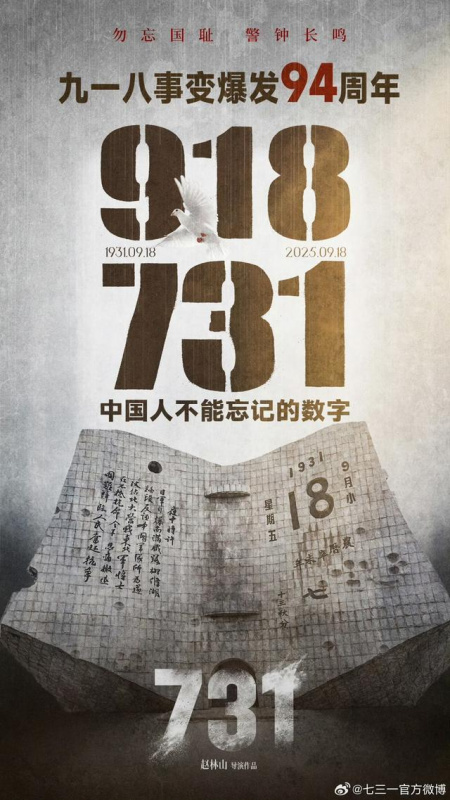
Patriotic film poster putting 918 and 731 together.
The much-anticipated war movie 731depicts the atrocities of Japan’s Unit 731 (731部队), notorious for conducting horrific biological warfare experiments in Harbin during World War II under Major General Shiro Ishii (石井四郎), a former army surgeon and biologist with a particular interest in historical plagues. Under his command, Japan’s biological warfare and human experimentation in China were carried out on a larger scale than anywhere…
Eye on Digital China is a reader-supported publication by
Manya Koetse (@manyapan) and powered by What’s on Weibo.
It offers independent analysis of China’s online culture, media, and social trends.
To receive the newsletter and support this work, consider
becoming a paid subscriber.


Mbappé, Mao & the Backlash on Chinese Social Media

Mbappé, Mao, and the Joke That Shall Not Be Named

The French Protests, Viewed from China: Five Narratives on Chinese Social Media

What Does 20 Yuan ($3) Mean Anymore? China’s Disappearing Living Rooms & the Great Laundry Debate

Starbucks Goes Xinjiang & The Kardashians in China

Why Japan Has So Many Surnames, China’s Back-to-School Shifts & Taiwan Pavilion Trouble

The Power of Ugly: Why Niu Lai Became China’s Unlikeliest Box-Office Hit

The Rise of “Shuaqi-ism,” Taking Starbucks to the Fields, and Pretending to Go to Work

AI Actress Ad Pulled, Baihaitun Disrupts Shanghai and Cicada Meme Bugs Huawei

Blame Games & Bad Signs: Nepal–Tibet Floods, Huawei’s Toilet Trouble, “Screwed” Graduates
-

 Chinese New Year9 months ago
Inside Chunwan 2026: China’s Spring Festival Gala
-

 China Brands, Marketing & Consumers12 months ago
Hasan Piker’s China Trip & the Unexpected Journey of a Chinese School Uniform to Angola
-

 Chapter Dive8 months ago
Inside the Great Chinese Debate Over the Iran War
-

 China Trend Watch12 months ago
Japan Tensions, Nexperia Fallout, Yunnan’s ‘Wild Child,’ & “Modern Opium”
Pingback: Féminisme à la chinoise : entre stratégie entrepreneuriale et refus de coopérer – Entre les lignes entre les mots