
China Insight
Writings on the Wall: Removing China’s One-Child Policy Propaganda
While there are more efforts to erase old propaganda slogans, some people don’t understand the rush: “It’s ingrained in our memories already.”


For decades, slogans written on walls all across China propagandized the country’s one-child policy.
In many places, especially in rural areas, these old slogans withstood the test of time and are still visible on brick walls or roadside signs.

Image via The Observer on Weibo @观察者网
China implemented its one-child policy in 1979, which lasted until the ‘two-child policy’ was introduced in 2016.
Especially in China’s rural areas, wall propaganda was an important way to disseminate the country’s one-child policy.
This year, these old propaganda slogans have been getting more attention in Chinese media. In February, Health Times (健康时报) noted how this kind of propaganda was still visible in many places in China, from Hebei to Gansu, from Shanxi to Hunan, despite their messages being completely outdated.
While the messages emphasize that it is better to have one child and that couples should not have a second or third child, Chinese authorities are now encouraging couples to have more than one child due to the country’s falling birthrates (see our recent article here).
The propaganda from the 1980s, 1990s, and 2000s, therefore, is not just outdated, it also goes against everything the government is currently promoting to citizens.

Image via Weibo user @冰霜里的火焰瓶.
These are some examples of well-known or common one-child policy propaganda slogans:
■ 超生者倾家荡产 Chāoshēngzhě qīng jiā dàng chǎn
“Those who have more children than allowed will lose a family fortune.”
■ 少生优生,幸福一生 Shǎo shēng yōushēng, xìngfú yīshēng
“Give birth to fewer but better [healthier] children, and you will have a happy life.”
■ 晚婚晚育,少生优生 Wǎnhūn wǎnyù, shǎo shēng yōushēng
“Late marriage and late childbearing, fewer and better births”
■ 一人超生,全村结扎 Yīrén chāoshēng, quán cūn jiézā
“One person bears one more child, and the whole village gets their tubes tied”
■ 宁可血流成河不可多生一个 Nìngkě xuè liú chénghé bùkě duō shēng yīgè
“Rather blood flowing like streams than have an extra child”

Image via Weibo user @冰霜里的火焰瓶.
In the article “Wall Slogans: the Communication of China’s Family Planning Policy in Rural Areas” by Guoyan Wang, the author notes how many of these ubiquitous slogans – especially the shocking ones – were “obvious misinterpretations” of China’s official family planning policy – locally widely used, but not part of the central slogans. Instead of giving warning or providing information, these bloody slogans actually provoked people’s antipathy and resistance instead of (p. 102, 2018).
Nevertheless, they lasted for years and became a “mirror of social times” (p. 99).
According to Wang, the campaign to clean up these slogans already started in 2007, long before the end of the one-child policy, because the National Population and Family Planning Commission wanted to get rid of those slogan that were not “people-oriented” (p. 105-106).
While getting rid of non-official slogans was already part of China’s “family planning efforts in the new age” in 2007, it is all the more important now in a time when China moved away from the one-child policy and also allows couples to have three children – or even more.

“Fewer and better births are good for the country and the people.” Image via Btime.
On Weibo, where the topic of the old slogans being removed was discussed under various hashtags (#计划生育宣传语应及时清理#, #多地清理计划生育过时宣传语#), some people think the slogans should not be removed because they have historical value or that they should be preserved in other ways.

Cleaning up old propaganda, image via Netease/Weibo @搜狐新闻.

Removing old propaganda posters or info boards, image via Sanlian Weekly 三联生活周刊.
“It does not matter [if they remove them or not],” another commenter wrote: “They’ve already become ingrained in our minds.”
“Is removing them like pretending it never happened?” others wondered: “Why the rush?”
By Manya Koetse
Get the story behind the hashtag. Subscribe to What’s on Weibo here to receive our newsletter and get access to our latest articles:
References:
Wang, Guoyan. 2018. “Wall Slogans: the Communication of China’s Family Planning Policy in Rural Areas.” Rural History 29 (1): 99-112.
Spotted a mistake or want to add something? Please let us know in comments below or email us. First-time commenters, please be patient – we will have to manually approve your comment before it appears.
©2023 Whatsonweibo. All rights reserved. Do not reproduce our content without permission – you can contact us at info@whatsonweibo.com.

China Insight
Mbappé, Mao, and the Joke That Shall Not Be Named
Mbappé’s favorite Mao meme sparked major backlash in China. More on what the controversy reveals about political red lines, online humor, and censorship.
RESOU 热搜 | What’s Trending in China, Explained
Here, I briefly unpack the stories making waves on Chinese social media and share what stands out to me. Don’t miss an update: become a subscriber to Eye on Digital China today.
Oh oh oh, Mbappé, all those goals, yet you lost so many points on Chinese social media over the past 48 hours.
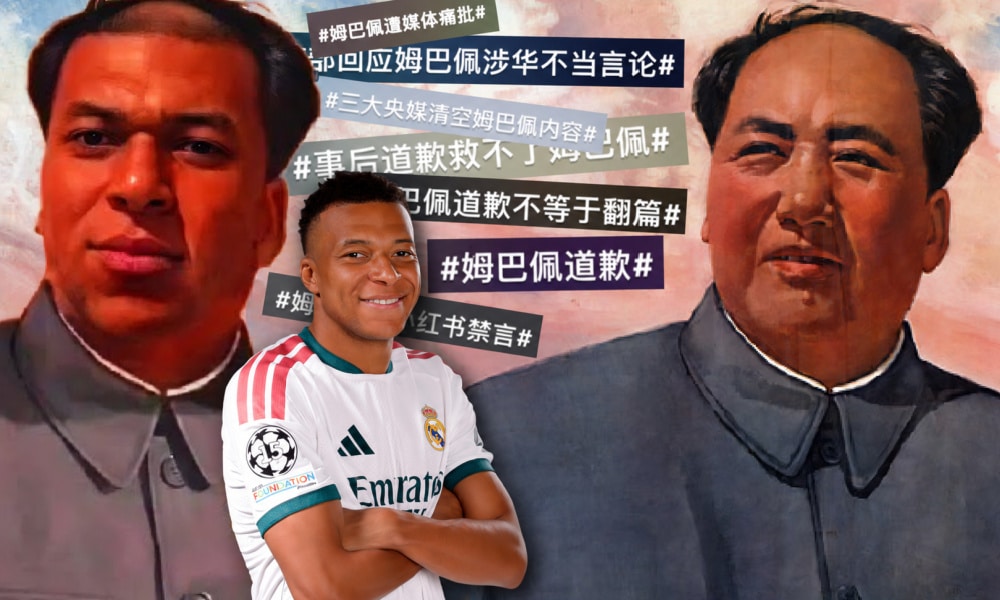
Following his 100th goal for Real Madrid during El Clásico and finishing second on Ballon d’Or night, French football player Mbappé is all the talk on Chinese social media — not for his achievements, but for what is seen as crossing a major red line in an online interview.
On Tuesday night, a text came in from Ruixin: “I am wide awake tonight and somehow witnessed live how the footballer Kylian Mbappé was getting blocked and totally canceled on Chinese social media for his comments about Mao Zedong over the past, like, three hours 😅”
I quickly grabbed my phone and saw the flood of Mbappé posts rapidly coming in, and it was clear that people were very cross with him.
Although it was already clear that this might not blow over any time soon, by early Wednesday morning it became painfully clear how the controversy had snowballed. Dongpeng Beverage Group (东鹏), one of the many Chinese companies that signed the famous sportsman as its brand ambassador, publicly stated that it was cutting all commercial ties with Mbappé. Soon, others followed.
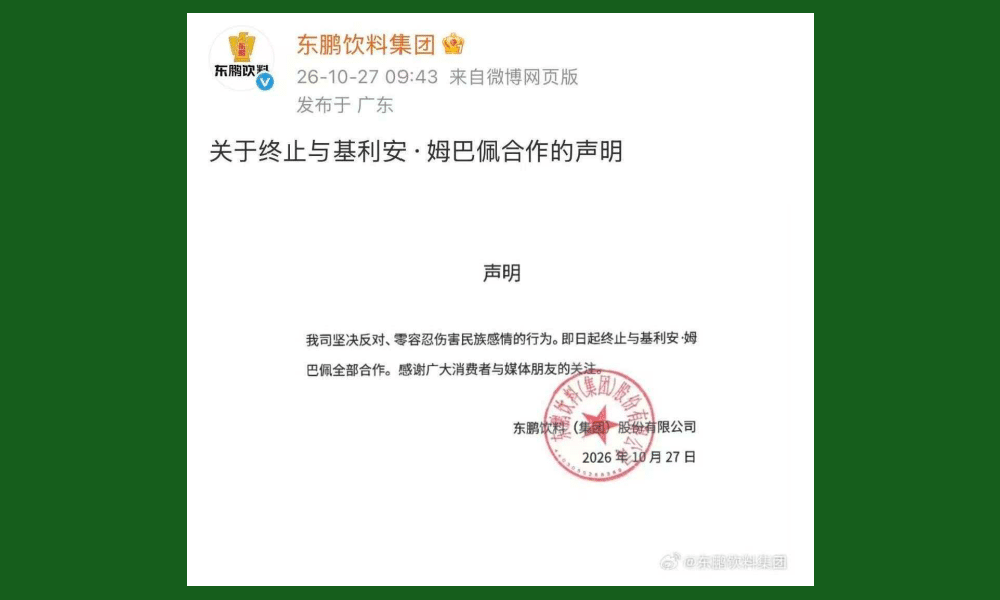
Dongpeng Beverage Group (东鹏): the first in a string of companies to cut ties with French footballer Kylian Mbappé.
Mbappé’s fall from grace in China has been sudden and spectacular, like a major avalanche of backlash that unfolded in one night, and it can all be traced back to one segment of an interview the footballer previously did on a French YouTube show (The Bridge) that resurfaced online — initially through Reddit and X, and then on Chinese social media apps, like football platform Dongqiudi (懂球帝).
In that segment, when asked about his favorite meme, Mbappé replied that one of the memes he finds funniest is:
🗣️ “the one where they put my face on some guy, a Chinese dictator. That really makes me laugh, I use it with my friends all the time.”

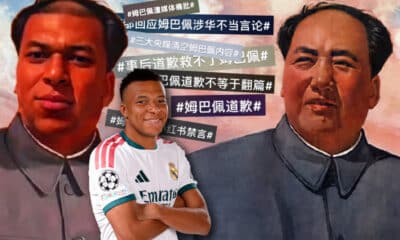
The interview segment where Mbappé shares his favorite meme: his face photoshopped onto the face of a “Chinese dictator.”
The show, created by Mbappé’s Real Madrid teammate Aurélien Tchouaméni, added the image Mbappé referred to: his face photoshopped on a Mao propaganda visual. It’s part of a series of memes that emerged in 2024 in which Mbappé’s face is edited onto the faces of dictators.1
Chapter Dive
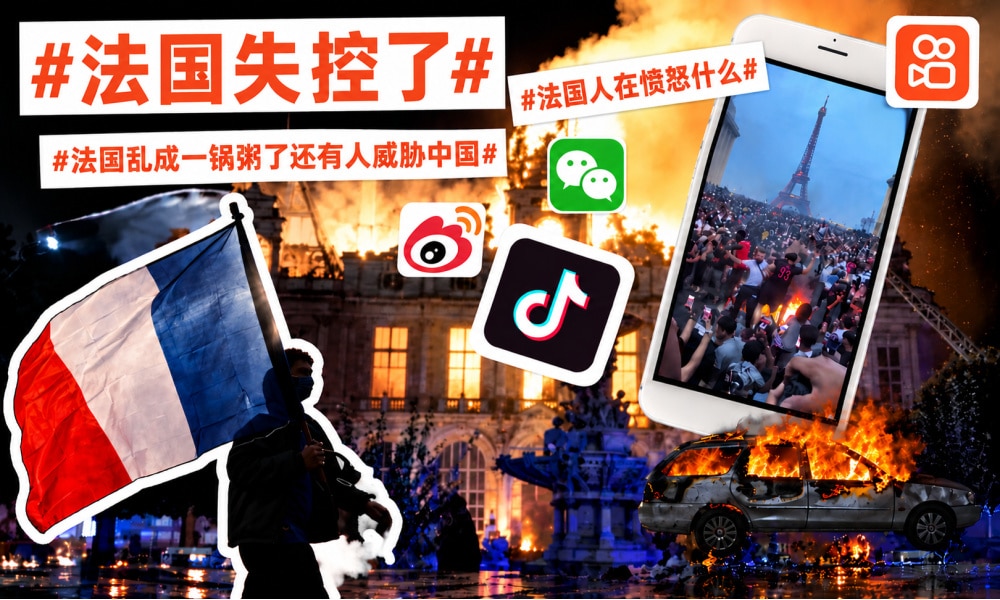
The French Protests, Viewed from China: Five Narratives on Chinese Social Media
From the decline of Europe to historical karma: these 5 narratives reveal how Chinese social media discusses the recent unrest in France.
Eye on Digital China is a reader-supported publication by
Manya Koetse (@manyapan) and powered by What’s on Weibo.
It offers independent analysis of China’s online culture, media, and social trends.
To receive the newsletter and support this work, consider
becoming a paid subscriber.

From “Pure Love Warrior” to Political Victim: Jensen Huang’s Fall on Chinese Social Media

China Trend Watch: Digital Dementia and Why Everyone Says ‘Li Na’

Mbappé, Mao & the Backlash on Chinese Social Media

Mbappé, Mao, and the Joke That Shall Not Be Named

The French Protests, Viewed from China: Five Narratives on Chinese Social Media

Why Japan Has So Many Surnames, China’s Back-to-School Shifts & Taiwan Pavilion Trouble

The Power of Ugly: Why Niu Lai Became China’s Unlikeliest Box-Office Hit

The Rise of “Shuaqi-ism,” Taking Starbucks to the Fields, and Pretending to Go to Work

Blame Games & Bad Signs: Nepal–Tibet Floods, Huawei’s Toilet Trouble, “Screwed” Graduates

Starbucks Goes Xinjiang & The Kardashians in China
-
 Chinese New Year9 months ago
Inside Chunwan 2026: China’s Spring Festival Gala
-
 China Brands, Marketing & Consumers12 months ago
Hasan Piker’s China Trip & the Unexpected Journey of a Chinese School Uniform to Angola
-

 Chapter Dive9 months ago
Inside the Great Chinese Debate Over the Iran War
-

 China Trend Watch12 months ago
Japan Tensions, Nexperia Fallout, Yunnan’s ‘Wild Child,’ & “Modern Opium”