SubscribeLog in
Connect with us

Chapter Dive

From Weibo to RedNote: The Ultimate Short Guide to China’s Top 10 Social Media Platforms

Weibo, Wechat, Douyin, or Xiaohongshu? Understanding China’s top 10 social media platforms.

Manya Koetse

Published

on

WHAT’S ON WEIBO CHAPTER: 15 YEARS OF WEIBO

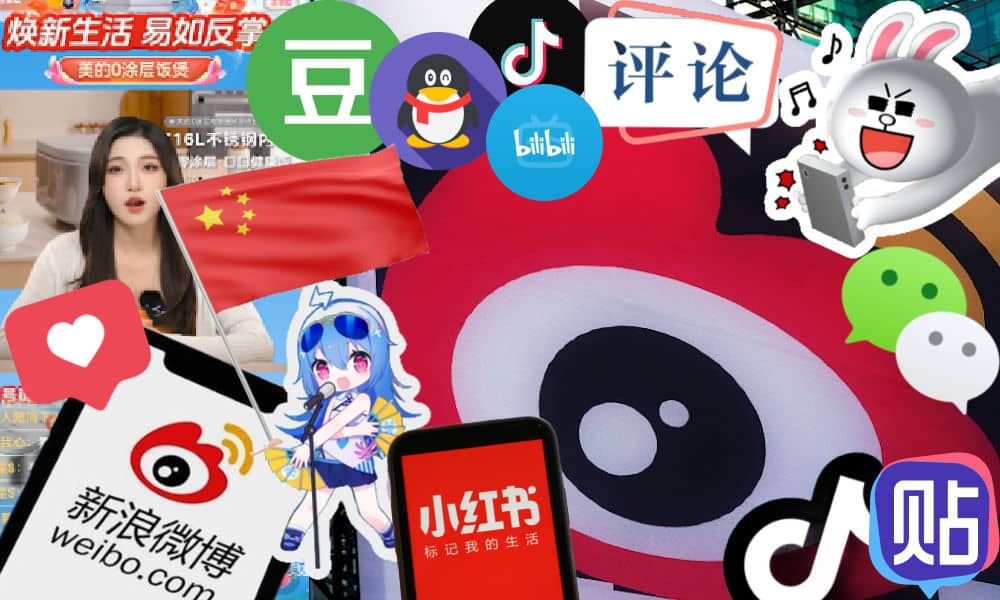
From Weibo to WeChat, from Rednote to Bilibili, China has a unique social media landscape that is constantly evolving with the times. In this short guide to China’s social media apps, we list the top 10 most popular platforms, explaining their names, origins, and the key features that have made them successful—some of them thriving for over 25 years (!) already.

These are complicated times for social media, as users around the world are jumping between different services while holding different views on what platforms should stand for, how they should be managed, and what their role should be.

In 2025, international media are more focused on Chinese social media apps than ever before, especially after January’s “Tiktok refugee” hype in which waves of US TikTok users migrated to to China’s Xiaohongshu app.

This foreign focus on China’s online landscape also highlights lingering misconceptions, with major media outlets still trying to label Chinese apps as “the Chinese Instagram,” “the Chinese Facebook,” and so on.

Some of these labels made sense around 2010, when Chinese companies were indeed creating domestic equivalents of Twitter or Pinterest. But those apps have since evolved into something much bigger.

Over the past month, we’ve been focusing on ‘15 years of Weibo‘ for our What’s on Weibo Chapters (check out our deep dive here and the expert insight here). The story of Weibo is an example of how China’s online landscape is constantly changing, even though some major social apps are already 15, 20, even 25 (!) years old. Their secret? It’s not copying Western apps—it’s avoiding a cookie-cutter approach and embracing change. As Xiaohongshu’s Charlwin Mao (毛文超) puts it: “We don’t ask ourselves if we’re a social or commerce company—we ask, what does the consumer want?”

Xiaohongshu is no Chinese Instagram. It also wasn’t a shopping site that added reviews—it was a review site that added shopping, completely flipping traditional e-commerce models on its head. One of China’s top livestreaming apps, Kuaishou, didn’t even start as a livestreaming platform. It began as a GIF-making tool, built its user base through other platforms, then evolved into a short-video app before taking off during the livestreaming boom. Today, the company is a major player in generative AI—its Sora competitor, Kling, was born from this adaptability.

These Chinese apps have become superapps by thinking outside the box, refusing to be confined by labels, and evolving like chameleons—adapting their functions to user needs.

In these rapidly changing social media times, I thought it was high time for a short “China Social Media for Dummies” guide. This short guide breaks down the top 10 Chinese social media platforms, what they stand for, and their core features.

For this article, I have selected ten platforms or apps that are generally the most well-known in China and have the highest number of monthly active users. While the first eight social media platforms are undoubtedly the biggest eight, the ranking becomes less clear beyond that. China has a diverse range of social apps across various categories, including dating, gaming, and livestreaming. In this case, I’ve chosen the apps that are the most widely recognized in the mainstream digital landscape.

Content:
1. WeChat (微信) ⎮ “It’s a Way of Life”
2. Douyin (抖音) ⎮ “Record a Beautiful Life”
3. Weibo (微博) ⎮ “Discover New Things, Anytime, Anywhere”
4. Tencent’s QQ (腾讯QQ) ⎮ “Relax and Be Yourself”
5. Kuaishou (快手) ⎮ “Embracing Every Way of Life”
6. Bilibili (B站) ⎮ “( ゜- ゜)つロ Cheers~”
7. Xiaohongshu (小红书) ⎮ “Your Guide to Life”
8. Zhihu (知乎) ⎮ “When There’s a Question, There’s an Answer”
9. Douban (豆瓣) ⎮ “Record Your Book, Film & Music Life”
10. Baidu Post Bar (百度贴吧) ⎮ “Discuss Your Interests, Join Tieba”


1. WeChat (微信)

🚀 Launched: January 2011 by Tencent

🀄 Chinese name: 微信 Wēixìn, literally meaning “micro message.”

💬 Tagline:”微信,是一个生活方式”
WeChat, it’s a way of life

🔍 WeChat at a Glance:

WeChat is one of the most famous Chinese apps and is the national multifunctional ‘superapp.’ It was developed by Tencent, a social-focused tech giant that has proven its ability to understand what Chinese internet users want. Tencent has been successful in the social networking and online gaming markets since the early 2000s, and WeChat is a product of strategies it developed between the late 1990s and early 2010s. WeChat (Weixin) was an instant hit. Within a year of its launch, it already had 100 million users. By January 2013, the number had reached 300 million. Today, WeChat has over 1.38 billion monthly active users, making it the most popular app in China.

More than just a social media platform, WeChat has become a digital key to navigating daily life in China. It is hard to label this app as anything other than a ‘superapp,’ as through the years it has added so many functions that it has become one of China’s most versatile platforms. It serves as a business card, payment method, news reader, and marketing platform. For personal users, WeChat is the go-to tool for staying in touch with friends and family. For brands and businesses, it is an essential tool for building and maintaining relationships with consumers.

🔑 Some Key Features of WeChat:

● Messaging (消息): Text and voice messaging, voice and video calls, group chats (up to 500 people), file transfers (videos/documents/images), gift-giving, sending red envelopes, built-in translation, and extensive use of emojis and stickers.
● Moments (朋友圈): WeChat’s social feed, where users can share photos, videos, and updates with friends—like a private social network.
● WeChat Pay (微信支付): Digital wallet for mobile payments in both online and offline purchases. WeChat is also expanding its palmprint payment services, allowing users to pay through palm recognition scannning technology for their cashless transactions.
● WeChat Official Accounts (公众号): Allows users to follow brands, news, and services for updates, acting as a hub for business and content distribution.
● Mini Programs (小程序): Embedded lightweight apps within WeChat, offering services like food delivery, ride-hailing, shopping, and games, eliminating the need for separate app downloads.
● WeChat Channels (视频号): A short-video and livestreaming feature within WeChat, allowing users to create, share, and discover video content.

🌍 Global Influence:

WeChat is one of the most popular messaging apps in the world (although it is banned in India). WeChat and Weixin are not just different names for the same app—they have distinct functionalities. WeChat serves the international market, while Weixin is designed for the Chinese market. The two versions are distinguished by mobile numbers and operate on separate servers. One key difference is official accounts: Weixin users may not be able to search for or subscribe to official WeChat accounts available to overseas users.

📌 Important to know:

WeChat launched its QR code payments (二维码支付) in 2012, a year after Alipay. With the rise of smartphones, QR code payments made digital transactions accessible to everyone, from store owners to street vendors. WeChat’s popularity played a key role in transforming China from a predominantly cash-based society in the early 2000s to a cashless society by the late 2010s (Ghose 2024).


2. Douyin (抖音)

🚀 Launched: September 2016 by Bytedance

🀄 Chinese name: 抖音 Dǒuyīn, literally meaning “shaking sound.”

💬 Tagline: 记录美好生活
Record a Beautiful Life

🔍 Douyin at a Glance:

Douyin is the Chinese mainland version of the globally popular app TikTok and the country’s most popular short-video platform. From the beginning, its parent company, ByteDance (字节跳动), founded in 2012 by Zhang Yiming (张一鸣), focused on two core elements: building innovative apps and using the power of AI for content personalization. Before launching Douyin, ByteDance had already found success with Toutiao (今日头条), a highly popular news aggregator app also relying on AI-powered content personalization. Although Douyin’s focus on music, influencer culture, and short, creative videos is quite different from Toutiao’s, its success has been largely built on the recommendation systems and operational expertise ByteDance had developed through Toutiao. Before building Toutiao, Zhang Yiming worked at Microsoft, among other companies, and co-founded the real estate search engine 99fang.com.
kuaishou
Beyond ByteDance’s expertise, Douyin thrived thanks to China’s advanced 4G/5G infrastructure and a booming e-commerce industry. While Douyin initially focused on user-generated entertainment content, it has gradually evolved into a powerful multi-functional platform where users also consume and discuss the latest news and current events.

Today, Douyin and Weibo are among the most influential social platforms in China for following and discussing breaking news. Douyin is more influential in terms of active users: there are more than 760 million active monthly users (Brennan 2020; Su 2024).

🔑 Some Key Features of Douyin:

● Follow (关注): Similar to Weibo and Xiaohongshu, Douyin operates on a follower-followee network model, where users can follow others without requiring mutual follow-backs. Not every Douyin user creates videos; many are solely viewers.
● Short Video Creation (快拍): Douyin’s primary function is short video creation, either by filming directly in the app or uploading pre-recorded content from the phone’s gallery.
● AI Templates and Filters (AI创作): Douyin offers a vast range of AR filters, stickers, and special effects to make videos more attractive, fun, or engaging.
● Live Streaming (直播): Users can host live streams, interact with viewers in real time, and receive virtual gifts that can be converted into real-world earnings.
● Front Page (首页): The endlessly scrollable front page features personalized content recommended by AI algorithms based on the user’s profile, location, preferences, and interactions.
● Friends (朋友): Users can import contacts from WeChat or QQ and see their videos directly within the app.
● Private Messaging (消息): Douyin supports private direct messaging with group chat options for private conversations and social interactions.
● Douyin Trending Lists (抖音热搜): Users can explore trending topics and hot searches. These lists are segmented into categories such as live streaming, films, brands, and music, offering insights into what’s currently popular.
● Douyin Mall (抖音商城): Douyin’s in-app e-commerce platform, which delivers a personalized shopping experience by recommending products based on user data and preferences.

🌍 Global Influence:

It is clear that ByteDance has significant international ambitions—and with great success. No other Chinese digital product has conquered the global market in the same way as TikTok, the international version of Douyin. In 2017, ByteDance acquired the app Musical.ly, which was already popular in the U.S. and Europe, in a strategic move to rapidly integrate TikTok into the Western market. Today, TikTok boasts over 1.5 billion users worldwide. However, the app’s global influence is not without controversy. TikTok has been banned in India, and since 2020, plans to ban it in the United States have repeatedly surfaced. TikTok sits at the center of geopolitical tensions between the U.S. and China, symbolizing broader concerns about China’s growing technological power and influence.

📌 Important to know:

TikTok and Douyin are similar in many ways, but they are two separate apps. Douyin is not available in foreign app stores like Google Play or the international Apple Store, while TikTok is not available in Chinese app stores. The apps feature different content and different popular creators. Content moderation on the two platforms also differs significantly. Internationally, TikTok’s moderation follows practices similar to other global platforms, with rules on hate speech, harassment, nudity, and other forms of inappropriate content. In contrast, Douyin adheres to strict Chinese internet regulations and censorship laws, enforcing different and much broader rules on what can be posted. These differences, along with varying cultural norms and regulatory environments, have transformed Douyin and TikTok into two distinct platforms in terms of content and user experience.


3. Weibo (微博)

🚀 Launched: August 2009 by Sina

🀄 Chinese name: 微博 Wēibó, literally meaning “micro blog.”

💬 Tagline: 随时随地发现新鲜事
Discover new things anytime, anywhere

🔍 Weibo at a Glance:

Weibo launched in 2009 as a Chinese equivalent of Twitter but quickly evolved into much more—a uniquely Chinese, versatile, and dynamic platform where users follow celebrities, media influencers, and stay up to date on the latest news. Over the past fifteen years, Weibo has become China’s primary digital space for public discourse on unfolding events. Even today, despite a more decentralized social media landscape in China, Weibo remains China’s online ‘living room’ where people follow and discuss news and entertainment, and the platform still has about 580 million monthly active users. To learn all about Weibo’s journey, check out our detailed report here.

🔑 Some Key Features of Weibo:

● Follow (关注): Unlike friend-based systems like Facebook or WeChat Moments, Weibo operates on a follower-followee model: users can follow others without requiring mutual follow-backs. This also means that some celebrities, such as Xie Na (谢娜), have accumulated over 120 million followers throughout the years.
● Microblogging (发微博): The core feature of Weibo is posting short messages, which can include videos and images. Initially limited to 140 characters, users can now post up to 5,000 Chinese characters. If longer than that, users can change a post into a separate blog article.
● Hot Topics (微博热搜): Weibo provides trending topic lists, hashtags, and rankings of popular influencers across different categories—from general hot lists and headlines to more niche areas such as entertainment, gaming, movies, sports, and more. This feature helps users stay up to date with the latest trends in their fields of interest.
● Video (视频): A video-only feed curates hot videos based on algorithms, comparable to YouTube Shorts or TikTok.
● Super Topics (超级话题): These are niche communities dedicated to specific interests, similar to subreddits. (Read more here.)
● Private Messaging (消息): Weibo supports private direct messaging with group chat options.

🌍 Global Influence:

Weibo is not very international. Although the platform allows international users to register, only a limited number of countries can do so based on their phone numbers. Eligible countries include Japan, South Korea, Malaysia, Thailand, India, the UK, USA, Spain, Italy, Germany, and a few others. Meanwhile, many countries are excluded—such as nearly all Northern European and African nations, along with most countries in South America. Despite these restrictions, Weibo remains a key platform for foreign entities engaged in China-focused marketing or diplomacy. As a result, most foreign embassies in China maintain official Weibo accounts, as do tourism bureaus, international brands, and major global celebrities, including actors, athletes, and DJs.

📌 Important to know:

Although trending topics on Weibo are often related to entertainment, society, and news events, Weibo is also highly Weibo-focused. Many of its trending topics originate on the platform itself—such as viral comments, new features or guidelines, celebrities’ posts, or Weibo-related events and contests (Weibo, as a company, frequently organizes and sponsors events ranging from entertainment to sports). This has created a distinct Weibo culture, more reminiscent of Western platforms like Reddit than X/Twitter or Facebook.


4. Tencent’s QQ (腾讯QQ)

🚀 Launched: February 1999 by Tencent

🀄 Chinese name: QQ: “Q” and “QQ” are also used for “cute.”

💬 Tagline: “轻松做自己”
Relax and be yourself

🔍 QQ at a Glance:

QQ has always been known as China’s most powerful instant messaging software. It is also one of China’s oldest social media platforms, and in many ways, its success paved the way for WeChat to thrive. Launched by Tencent in 1999 under the name OICQ, this instant messaging service was China’s counterpart to the Israeli software ICQ, developed in 1996 and later acquired by AOL. Following a lawsuit from AOL, Tencent rebranded the application as QQ. As the platform partnered with pager services and mobile communication companies, QQ was initially used on pagers, personal computers, and for SMS services. Over time, QQ evolved and is now primarily used on smart mobile devices. In 2005, Tencent introduced QZone (QQ空间), a social media platform integrated with QQ, where users can share updates, photos, videos, and more with friends.

For many people, QQ is a nostalgic part of their childhood—comparable to MSN Messenger in the West. As WeChat rose in popularity, many users migrated to it, particularly since Tencent made it easy to import all QQ contacts into WeChat. Despite this shift, QQ remains actively used, especially among young people and fans of ACG (anime, comics, and games), as well as older users who rely on it for work-related purposes such as file sharing and communication. In fact, according to Tencent’s 2024 financial report, QQ’s mobile monthly active users still reached 554 million, demonstrating its lasting influence in China’s social media landscape even after 25 years (Negro et al 2020; Yidong Huliangwang 2024)

🔑 Some Key Features of QQ:

● Messaging (消息): Text and voice messaging, voice and video calls, group chats, and customizable profile styles, chat decorations, and themes.
● Groups (QQ群): QQ Groups are like chatrooms for users with shared interests, managed and guided as community spaces.
● File Management/Online Storage (文件传输): Group file sharing, large file uploads, and permanent file storage—unlike WeChat, QQ stores files permanently and can handle larger files.
● Mail (QQ邮箱): An email service hosted by QQ.
● Wallet (QQ钱包): Top up phone credit, pay off credit card bills, and settle utility fees for water, electricity, and gas.
● Super QQ Show (QQ秀): A customizable avatar feature where users can dress up and design their online persona which can be used across QQ-related platforms, using accessories that can be purchased with QQ Coins (QQ币).
● QQ Games (QQ游戏): Access and play games directly within the app or through linked gaming platforms.

🌍 Global Influence:

QQ is very much a domestic app. It’s not particularly easy for foreigners to register either. If you use a foreign phone number, verification messages often fail to arrive, or the app may flag your number as “suspicious” or “not secure.” If you use a Chinese phone number, registration requires a Chinese name and ID number. While there are certainly foreigners on QQ, it’s clear that making the app more foreigner-friendly is not a priority for Tencent.

📌 Important to know:

Besides its file transfer feature, QQ’s group function is also quite popular, offering much larger group capacities compared to WeChat. QQ Groups cover a wide range of topics, from web novels to cryptocurrency, attracting communities of all kinds. Depending on the group type, VIP members can create groups with up to 2,000 members, while certified members can host groups with up to 5,000 members. In the past, QQ Groups have faced backlash for hosting vulgar or inappropriate content, leading to hefty fines for Tencent and increased moderation efforts.


5. Kuaishou (快手)

🚀 Launched: March 2011, but under different name (GIF快手) as a GIF-making tool.

🀄 Chinese name: 快手 Kuàishǒu, literally meaning “fast hand.” Its international name is “Kwai.”

💬 Tagline: 快手,拥抱每一种生活
Kuaishou, embracing every way of life

🔍 Kuaishou at a Glance:

China has many different apps for sharing videos and livestreaming, but Kuaishou holds a unique place in this crowded digital landscape. Why? Unlike most other popular social apps in China, Kuaishou’s content and user base are deeply rooted in the country’s smaller towns and rural areas—over 60% of its users come from rural communities. As a result, Kuaishou has become the go-to app for content related to authentic rural lifestyles and agriculture, setting it apart from apps like Douyin or Xiaohongshu, which primarily cater to urban, middle-class users in higher-tier cities (Ran 2024, 3). Kuaishou’s success story (the app has around 500 million monthly active users) reflects that of many other Chinese digital giants—it has evolved with the times, continuously adapting to user needs instead of following a cookie-cutter approach or a ready-made formula.

Launched in 2011 as a GIF-making tool during Weibo’s golden era, the platform later transformed into a short-video app.Founded by Su Hua (宿华) and Cheng Yixiao (程一笑), Kuaishou benefited from strong technical expertise. Before co-founding the platform, Su worked as a software engineer at both Google and Baidu. Kuaishou’s major mainstream breakthrough came in 2016, when it introduced livestreaming, which quickly became a core part of the platform. Since 2020, the platform has focused more on e-commerce and has integrated it into the app in various ways, making it an appealing option for rural merchants and aspiring influencers. By 2021, half of all rural creators on Kuaishou were generating income from the platform (Ran, 2024, 1).

🔑 Some Key Features of Kuaishou:

● Short Video Feed (短视频): Kuaishou’s main function is sharing and scrolling through short videos, covering everything from gaming and cooking to news events and memes. Through the app’s “Discovery” (发现) feature, you can find new creators and follow more people.
● Live Streaming (直播): Kuaishou offers a wide range of livestream channels available at all hours, from gaming to e-commerce, often blending shopping and entertainment.
● Special Filters: Like Douyin or Snapchat, Kuaishou provides a variety of video effects and templates so that users can post creative videos.
● Kuaishou Shop (快手小店): Kuaishou’s in-app e-commerce platform offers a wide selection of products, including household items, food, and cosmetics.
● Kuai Coins (快币): Kuaishou users can top up their accounts with ‘Kuai Coins’ (Kuaibi), the platform’s virtual currency. These can be used to purchase virtual gifts to support content creators or unlock paid content.

🌍 Global Influence:

Within mainland China, Kuaishou’s strength lies in its focus on second- and third-tier cities as well as rural areas, meaning it is not necessarily focused on expanding its global influence with this particular app. However, similar to the domestic vs. foreign approach of Douyin and TikTok, Kuaishou released an international version of its app called Kwai, though it did not achieve the same level of success as TikTok. Another Kuaishou product with a much greater international impact is its self-developed video generation model, Kling (可灵), also known as KLING AI. Initially, Kling started as a feature within Kuaishou’s video editing app, KuaiYing (快影), in China but was later launched internationally, gaining recognition as a powerful AI model and a possible alternative to OpenAI’s Sora.

📌 Important to know:

Kuaishou is known for increasing its market share by partnering up with other powerful platforms or brands. For example, the company has partnered with Chinese shopping/food delivery platform Meituan since 2021 in the local life services sector. For its e-commerce livestreaming, Kuaishou previously joined forces with JD.com. To drive more traffic to its platform, Kuaishou also established partnerships for copyright and content with various international sports events, including the NBA and the UEFA Champions League, as well as the Tokyo and Paris Summer Olympics, along with the Beijing 2022 Winter Olympics and the 19th Asian Games Hangzhou.


6. Bilibili (B站)

🚀 Launched: June 26, 2009 by Xu Yi (徐逸)

🀄 Chinese name: 哔哩哔哩 Bìlī Bìlī, doesn’t really mean anything but sounds cute and vibrant, like beep beep. Bilibili is more commonly referred to as “B站,” meaning “B-station.”

💬 Tagline: (゜-゜)つロ干杯~-bilibili
Cheers to Bilibili” [not literally, but that’s what this symbolic motto conveys]

🔍 Bilibili at a Glance:

Bilibili is China’s online home for fans of anime, comics, games (ACG), and technology. While the video streaming platform started as a niche community, it has since grown into one of the go-to video-sharing platforms for China’s Generation Z. Founder Xu Yi (徐逸) designed the earliest version as an improved alternative to existing video-sharing platforms, particularly the ACG hub ACfun (also known as A站, A-station). Although Bilibili remains heavily centered on anime, music, esports, and gaming culture, the platform now hosts a vast range of content, with creators covering topics such as culture, education, and social commentary. Bilibili allows both amateur and professional creators/channels to upload content, as well as producing in-house content, making it a diverse and dynamic platform where users can find everything from unpolished vlogs to Chinese anime series or BBC and History Channel documentaries. This has led to “B Station” becoming a versatile platform used by some 348 million users on a monthly basis. A unique aspect of Bilibili is its user engagement system. One way the platform helps maintain content quality is by requiring users to first answer a set of questions before posting comments and videos. Official members can also go through six membership levels, each unlocking various platform privileges, fostering a stronger sense of community and rewarding user engagement.

🔑 Some Key Features of Bilibili:

● Home of Video Streaming (首页): On Bilibili’s main page, users can explore the latest trending videos or discover new content across various categories, from anime series (番剧) to entertainment (娱乐) and music (音乐).
● Bullet Comments (弹幕评论): Bullet comments, or danmu, are real-time floating texts overlaid on videos, creating an interactive and communal viewing experience. Bilibili was the first Chinese platform to adopt this feature, which has since become its signature function.
● Livestreaming (直播): Users can browse Bilibili’s livestreaming rooms, where they’ll find a variety of live gaming streams, as well as study sessions, homework help, and other interactive content.
● Bilibili Game Center (游戏中心): A platform for game distribution, reviews, and gameplay videos, covering both mobile and PC gaming content.
● Bilibili Manga (哔哩哔哩漫画): A section dedicated to reading and discussing manga, including licensed and original works.
● Bilibili Classroom (哔哩哔哩公开课): Educational content featuring tutorials, lectures, and courses on a wide range of topics.
● Bilibili Shopping (会员购): An integrated e-commerce section where Bilibili members can purchase merchandise, anime goods, and other products related to content creators and the Bilibili platform.

🌍 Global Influence:

Since Bilibili is focused on ACG, it has some niche global appeal among those interested in anime, gaming, and East Asian pop culture. However, beyond these communities, its global influence remains quite limited. In addition to being primarily geared toward Chinese-speaking users, much of the platform’s content is also subject to copyright restrictions outside of China, making it difficult or even impossible for many international viewers to access professional channels on the site.

📌 Important to know:

Like Weibo, Bilibili is a company that focuses on building communities and fostering a unique “Bilibili Culture.” Since 2010, Bilibili has been the main initiator, host, and/or sponsor of various popular events, most famously its Bilibili Spring Festival Gala. Additionally, Bilibili actively contributes to the growth of the Chinese anime industry by financing and co-producing anime content while also making efforts to distribute Chinese anime globally.


7. Rednote/Xiaohongshu (小红书)

🚀 Launched: June 2013 by Charlwin Mao (毛文超) and Miranda Qu (瞿芳)

🀄 Chinese name: 小红书 Xiǎohóngshū, literally meaning “Little Red Book.”

💬 Tagline: 你的生活指南
Your Guide to Life

🔍 Xiaohongshu at a Glance:

Is it Xiaohongshu, Rednote, or RED? In China, there is actually only one name for this “little red app”: Xiaohongshu. The Shanghai-based platform began as an online international “shopping guide” where users posted independent reviews (videos, text, images) of luxury products and cosmetics they had purchased. Over time, it evolved into a broader lifestyle community focused on travel, fitness, fashion, and overseas experiences. As the app gained popularity, the products reviewed by users also started being distributed through the platform itself—flipping the traditional e-commerce model on its head. Instead of a shopping site with reviews, Xiaohongshu became a review site that seamlessly integrated e-commerce. “We don’t ask ourselves if we’re a social or a commerce company,” Xiaohongshu co-founder Charlwin Mao once said: “We ask, ‘what does the consumer want?’” (Rowan 2016).

By 2025, Xiaohongshu’s influence is undeniable. With over 300 million monthly active users, the majority of whom are young, urban, and female, it has become an essential part of China’s online ecosystem. What sets Xiaohongshu apart is its ability to blend genuine real-life experiences with online sharing and offline consumption, creating a truly unique digital space.

🔑 Some Key Features of Xiaohongshu:

● Discover (发现): the core function of Xiaohongsu is the personalized homepage (首页), where users can discover new user-generated content, either based on interest through data-driven algorithms, or based on location, giving an overview of content that was posted near to you.
● Post a Note (发布笔记): All users can create content Xiaohongshu and post either videos, images, text, writing reviews, sharing tips, or document experiences. In doing so, they can tag products and link directly to e-commerce listings.
● Shopping (购物): Xiaohngshu is both a social app and a shopping plaform: users can browse and buy products without leaving the app. The stores selling the products can also be ‘followed’ to stay in touch.
● Live Streaming (直播): Xiaohongshu has a livestream feed, where users can scroll through thousands of different livestreams happening simultaneously. These streams range from people singing and teaching English to selling products, cooking, or giving makeup tutorials.

🌍 Global Influence:

Since much of its content has always revolved around overseas shopping experiences, Xiaohongshu has been inherently global from the start, catering primarily to overseas Chinese users. As a result, the app has been available in foreign app stores and allowed international users to sign up. However, nobody expected Xiaohongshu to become a global sensation overnight in January 2025. With a potential TikTok ban looming in the U.S., millions of American TikTok users began seeking alternative platforms. The most notable destination for these users was Xiaohongshu/Rednote, which saw a massive influx of so-called “TikTok refugees” (TikTok难民). This sudden surge propelled Xiaohongshu to the #1 spot in app stores across the U.S. and beyond. The arrival of over three million foreign users marked an unprecedented milestone for a domestic Chinese app, bringing Xiaohongshu into the global spotlight. Though not all of these TikTok users may stay long-term, and TikTok wasn’t banned after all, the event cemented Rednote’s instant fame. In response, the platform has taken proactive steps to internationalize, including hiring foreign content moderators and launching a one-click translation feature for seamless cross-language interaction.

📌 Important to know:

Gender demographics inevitably play a role on all social media platforms, but this holds especially true for Xiaohongshu, as its user base is overwhelmingly female—approximately 80% of its users are women, while only about 20% are men. This is very different from platforms like Bilibili or Zhihu (which have more male users) or WeChat, where gender demographics are more balanced. Since the platform is targeted toward educated, wealthier, and predominantly female users, its content naturally reflects these demographics. When combined with its strong e-commerce aspect, Xiaohongshu stands out as a unique platform that is far more about lifestyle, shopping, and real-life experiences than it is about politics, economics, or news events.


8. Zhihu (知乎)

🚀 Launched: January 26 2011, with funding from, among others, Tencent and Sogou.

🀄 Chinese name: 知乎 Zhīhū, which is usually left untranslated, but with 知 (zhī) meaning knowledge and 乎 (hū) serving as a classical particle for a question or emphasis, the meaning could be loosely translated as “Do you know?”

💬 Tagline: 有问题,就会有答案
When there’s a question, there’s an answer

🔍 Zhihu at a Glance:

Zhihu is most commonly known as the Chinese version of the American question-and-answer website, Quora. While Quora was founded in 2009, Zhihu was launched in 2011 and has been growing steadily ever since. It is recognized for its relatively high-level discussions, often focusing on topics such as society, economy, business, history, law, and many other areas. Users can submit both questions and answers, with the best answers being upvoted and placed at the top of the thread. Some popular contributors have answered thousands of questions, with many responses resembling mini-essays. Zhihu has over 80 million monthly active users. Unlike many other Chinese social media platforms, it has a slight majority of male users (51.5%), with most of its users being highly educated. (Bao 2024, 1).

🔑 Some Key Features of Zhihu:

● Q&A: The core function of Zhihu is either posting a question (提个问题) or replying to a question (回答问题).
● Zhihu Homepage (首页): On the main homepage, users get an overview of recommended posts. They can also select from various categories—ranging from science to law—and view the most popular posts across different topics.
● Live Streaming (直播): Zhihu offers a livestreaming feature, where users can scroll through livestreams and post reactions or questions in real time.
● Zhihu Direct Answer (知乎直答): Zhihu has also introduced the “Zhihu Direct Answer” AI model, which integrates the DeepSeek-R1 model to allow users to ask questions and receive direct answers through a chatbot.
● Zhihu Podcast Square (播客广场): Zhihu’s opodcast squore’ is a place where Zhihu users can listen and subscribe to podcasts.

🌍 Global Influence:

Unlike many other Chinese apps, Zhihu is available on foreign app stores, such as Google Play, and allows users from a wide range of countries to sign up. Nevertheless, the platform remains primarily China-focused, with Chinese as the main language. While Zhihu is popular among overseas Chinese communities, it lacks significant global influence.

📌 Important to know:

In the AI era, where chatbots can quickly provide direct answers to almost any question, traditional question-and-answer platforms risk losing relevance. Zhihu, however, is using AI tools to its advantage by integrating an AI-powered search function and a DeepSeek-based chatbot to handle straightforward queries. By doing so, Zhihu is positioning itself as the go-to platform for reliable answers and diverse perspectives offered by both authentic users and AI.


9. Douban (豆瓣)

🚀 Launched: March 2005

🀄 Chinese name: 豆瓣 Dòu Bàn, literally means the “cotyledon of a bean” but the platform was actually named after a Beijing hutong (traditional alley) (Shen 2019).

💬 Tagline: 来豆瓣,记录你的书影音生活
Come to Douban, record your book, film & music life

🔍 Douban at a Glance:

Douban is China’s online home of books, music, movies, and more. The site has been around for two decades already, and thus was originally very much desktop-based. While Douban is primarily a review site, it has evolved into a vibrant online community of “Douban friends” (豆友们), where users can explore and discuss the latest films, connect with people who share similar interests, look up events, and seek advice on anything from work-related problems to love and relationships. Douban has approximately 60 million monthly active users and a much larger base of about 200 million registered users. Most importantly, it’s the go-to platform for checking the latest ratings and reviews on blockbuster movies and highly anticipated TV dramas.

🔑 Some Key Features of Douban:

● Movie Reviews and Ratings (豆瓣电影): ‘Douban Movie’ is one of Douban’s core features. Similar to IMDb, it enables users to explore reviews, blogs, and ratings for the latest films, discuss trending topics in the world of cinema, and search for the highest- or lowest-rated movies.
● Books and Music (豆瓣读书, 豆瓣音乐): In line with ‘Douban Movie,’ these sections offer similar functionalities for books and music, allowing users to post reviews and discover new titles or albums within their favorite genres.
● Groups and Forums (豆瓣小组): Douban Groups allow users to join or create communities centered on specific interests, such as hobbies, professions, or niche topics.
● Event Listings (同城活动): This feature helps users discover upcoming local events, from exhibitions and workshops to concerts and meetups.
● Douban Merchandise (豆瓣豆品): An online shop offering a range of unique products, including bookmarks, notebooks, sweaters, and umbrellas.

🌍 Global Influence:

Douban is open to international users, but with its community-driven approach, it remains heavily China-focused, particularly in its selection of books, movies, and event listings. In the English-language social media space, platforms like Goodreads, IMDb, and Reddit already offer many of the same functions as Douban.

📌 Important to know:

China has an incredibly vibrant TV drama industry. With so many new dramas released every month, many people rely on Douban ratings to decide which ones are worth watching and which they can skip.


10. Baidu Post Bar (百度贴吧)

🚀 Launched: December 2003 by Baidu

🀄 Chinese name: 百度贴吧 Bǎidù Tiēbā: Baidu Post Bar

💬 Tagline: 聊兴趣,上贴吧
Discuss interests, join Tieba

🔍 Baidu Tieba at a Glance:

Baidu Tieba is an online social media forum where users can explore various ‘bars’—online groups dedicated to specific topics. As a discussion platform divided into thousands of communities, it is somewhat similar to the American platform Reddit. On Baidu Tieba, people can follow and participate in all kinds of groups, from Beijing-focused ones to parenting groups, specific film and arts groups, or those dedicated to tech or business. There are thousands, even millions, of different topic boards to explore, with each ‘bar’ forming its own community.

In its heyday, Baidu Tieba had around 500 million monthly active users, but this number has decreased over the years. In 2021, there were reportedly only about 37 million monthly active users left (Sanyi Shenghuo). In China’s current social media era, Baidu Tieba might not have done enough to compete with newer and more innovative platforms. Although other platforms, such as the Chinese video livestreaming services Huya (虎牙) or YY (YY直播), likely have a stronger presence in terms of active users, Baidu Tieba remains more well-known because it has been around for so long and has become a household name when it comes to China’s internet.

🔑 Some Key Features of Baidu Tieba:

● Topic-Based Communities (贴吧): The core function of Baidu Tieba is its tieba (贴吧), which are topic boards or discussion-based communities. On the main page, users can explore trending topics across various major communities.
● Live Streaming (直播): Baidu Tieba also features a livestreaming function, allowing users to explore various ongoing livestreams. Many streamers broadcast simultaneously across multiple platforms to maximize their earnings through virtual gifts and monetization.
● Chat Rooms (聊天频道): Baidu Tieba’s communities include dedicated chat channels where members can engage in direct conversations.
● Topic Moderators (吧主): Each topic board has its own moderators (吧主), who are responsible for managing discussions and moderating content within the community.
● AI Square (AI广场): AI Square (AI广场) is a feature within Baidu Tieba that integrates AI-driven interactions across different topic boards. For example, in the parenting community, users can chat with AI-generated “mothers” to seek advice on child-rearing, feeding babies, and other parenting topics.

🌍 Global Influence:

Baidu Tieba is aimed at domestic audiences. Although Baidu as a company has global ambitions and international influence, its worldwide efforts do not extend to Baidu Tieba, which remains a classic representation of China’s Web 2.0 era.

📌 Important to know:

Baidu Tieba is an important part of China’s internet history. Many of the country’s most famous viral trends and memes from the 2005–2010 era originated on Baidu Tieba, which became an influential platform due to its decentralized structure—managed by communities rather than a central authority. Words like “diaosi” (屌丝, loser) and “tuhao” (土豪, filthy rich), both of which remain widely used today, first gained popularity on Baidu Tieba. Although Baidu Tieba has lost its relevance as a leading platform for online discussions in China, its impact on the country’s internet culture continues to this day (Edward Shuo 2024).

By Manya Koetse

(follow on X, LinkedIn, or Instagram)

References

◾ Brennan, Matthew. 2020. Attention Factory: The Story of TikTok and China’s ByteDance. ChinaChannel. https://amzn.to/3X2CEwS

◾ Edward Shuo/Edward说. 2024. “Baidu Tieba from Glory to Decline: Robin Li Abandoned Baidu Tieba [百度贴吧辉煌到没落,李彦宏放弃百度贴吧].” QQ News, August 26. Accessed February 18, 2025. https://news.qq.com/rain/a/20240826A04ZJT00

◾ Ghose, Ronit. 2024. Future Money: Fintech, AI, and Web3. London: Kogan Page.

◾ Negro, Gianluigi, Gabriele Balbi and Paolo Bory. 2020. “The Path to WeChat: How Tencent’s Culture Shaped the Most Popular Chinese App, 1998–2011.” Global Media and Communication 16 (2): 208-226.

◾ Yidong Huliangwang 移动互联网. 2024. “Why Are So Many People Still Using QQ [为什么还有那么多人在用QQ]?” Tencent Research Institute 腾讯研究院, March 27. Accessed February 13, 2025. https://www.tisi.org/27710/.

◾ Ran Xi. 2024. “Rural Chinese Youth on Kuaishou: Performing Gender, Labor, and Rurality.” Journal of Youth Studies, August 19.

◾ Rowan, David. 2016. “China’s $1bn Shopping App Turns Everyone Into Trendspotters.” WIRED Magazine, April. Accessed February 19. https://www.wired.com/story/little-red-book-xiaohongshu-crowdsourced-shopping-app/.

◾ Sanyi Shenghuo 三易生活. 2021. “Baidu Tieba’s User Loss of Nearly 90% in Five Years? The Past Is Gone, Let’s Look at Today—Is Baidu Tieba Exiting the Historical Stage? [百度贴吧五年用户流失近九成?前浪已过且看今朝——百度贴吧要退出历史舞台了吗?]” Jiemian, October 29. Accessed February 18, 2025. https://www.jiemian.com/article/6759080.html

◾ Shen, Xinmei. 2019. “How Douban Went from China’s IMDB to Its ‘Spiritual Corner’.” South China Morning Post, October 15. Accessed February 16, 2025. https://www.scmp.com/abacus/who-what/what/article/3100865/how-douban-went-chinas-imdb-its-spiritual-corner.

◾ Su, Chunmeizi. 2024. Douyin, TikTok and China’s Online Screen Industry: The Rise of Short-Video Platforms. London & New York: Routledge.

Spotted a mistake or want to add something? Please let us know in comments below or email us. First-time commenters, please be patient – we will have to manually approve your comment before it appears.

©2025 Whatsonweibo. All rights reserved. Do not reproduce our content without permission – you can contact us at info@whatsonweibo.com.

Follow What’s on Weibo on

Manya is the founder and editor-in-chief of What's on Weibo, offering independent analysis of social trends, online media, and digital culture in China for over a decade. Subscribe to gain access to content, including the Weibo Watch newsletter, which provides deeper insights into the China trends that matter. More about Manya at manyakoetse.com or follow on X.

Continue Reading
1 Comment

1 Comment

  1. Geometry Arrow

    February 21, 2025 at 9:01 am

    It’s interesting to see how China’s social media scene differs from the rest of the world.

Leave a Reply

Your email address will not be published. Required fields are marked *

China World

Trump, Taiwan & The Three-Body Problem: How Chinese Social Media Frames the US Strike on Venezuela

How Chinese social media is making sense of the first geopolitical shockwaves of 2026.

Manya Koetse

Published

on

2026 hasn’t exactly seen a peaceful start. In a shocking turn of geopolitical events, Venezuelan leader Nicolás Maduro was captured by the US on Saturday. Facing narco-terrorism charges, he was flown to New York, where he is still being held in custody alongside his wife, Cilia Flores. President Trump announced that the United States would be taking control in Venezuela, stating they are going to “get the oil flowing.”

Maduro has pleaded not guilty to the charges during an initial hearing in federal court. Meanwhile, Maduro ally Delcy Rodríguez was formally sworn in as Venezuela’s interim president, while up to 50 million barrels of oil resources are set to go to the US.

Further shaking up geopolitical tensions were Donald Trump’s comments suggesting an American takeover of Greenland, arguing that the US needs to control Greenland to ensure the security of the NATO territory in the face of rising threats from China and Russia in the Arctic.

On Chinese social media, these developments have been dominating trending lists, with “Greenland” (格陵兰岛), “military force” (武力), “Trump” (特朗普), “Venezuela” (委内瑞拉), and “Maduro” (马杜罗) among the hottest keywords across various platforms from January 6 to today.

So what is the main gist of these discussions? From official reactions to dominant interpretive frames used by Chinese commentators and bloggers, there are various angles that are highlighted the most. I’ll explore them here.


🔴 China’s Official Response: Stressing Sovereignty & Strategic Ties


Chinese officials strongly condemned the capture of the Venezuelan president. Foreign Minister Wang Yi (王毅) stated in Beijing on Sunday that China has never accepted the idea that any country has the right to act as an “international police” or an “international judge.” The Ministry of Foreign Affairs called for Maduro’s immediate release.

Spokesperson Lin Jian (林剑) described the strikes on Venezuela as “a grave violation of international law and the basic norms governing international relations,” while spokesperson Mao Ning (毛宁) condemned what she called the United States’ “long-standing and illegal sanctions” on Venezuela’s oil sector.

These statements match the broader trajectory of China–Venezuela relations.

Over the past decades, particularly since Xi Jinping’s leadership began, the relationship between the two countries has evolved from a basic economic partnership into a more strategically significant one.

During Maduro’s 2023 visit to Beijing, the two sides elevated China–Venezuela ties to a so-called “all-weather strategic partnership” (全天候战略伙伴关系), signaling close, deep, and broad bilateral relations that go beyond a general partnership, with oil cooperation as a central pillar. (In 2025 alone, Venezuela exported around 470,000 barrels per day of crude oil to China.)

Following China’s condemnation of the US actions, Venezuelan Foreign Minister Gil expressed gratitude for China’s support, underscoring their bilateral friendship.

Beyond the official response to the recent developments, there are three main frameworks within which the ‘Trump turmoil’ is discussed on Chinese social media.


🔴 Three Main Angles in China’s Online Debate


🔷 1. Major Power Politics & US Aggression


Chinese media commentators are calling Trump’s capture of Maduro a potential “major turning point” for the world. While many described the developments as a sign that “the world has gone crazy” (这个世界太疯狂了), those trying to make sense of what happened see the US move as a warning: that relatively weak countries may increasingly become playgrounds for major powers & potential targets of US aggression.

Within this reading, China is portrayed as the most stable and peaceful superpower, increasingly important in a future multipolar world order.

On the popular podcast Qiánliáng Hútòng FM (钱粮胡同), recent developments were discussed as part of America’s dominant behavior on the world stage over decades. The hosts argued that, unlike previous US leaders, Trump is far less secretive about his goals and, in this case, no longer even follows the process of seeking UN authorization or congressional approval.

Similar views appeared elsewhere, including in a trending Bilibili video by the political commentary channel Looking at America from the Inside (内部看美国), which described the Venezuela raid not as an endpoint, but as a “signal” of what is yet to come, as the US, sensing structural decline, increasingly acts reactively rather than strategically.

Zhihu author Fēng Lěng Mù Shī (枫冷慕诗), whose post rose in the platform’s popularity charts on Wednesday, also framed the moment as pivotal. While the US may once have held the upper hand, they argue, other countries now have an actual choice in which side to take in a world ruled by superpowers. They write:

💬 “If the US truly had the strength to crush everyone and dominate everything completely, it might still be able to control global affairs. But now, with the rise of China, countries bullied by the US have new choices. If you were one of them, what would you choose? To cooperate with a bandit who might kill you with an axe at any moment? Or to cooperate with a reasonable businessman who follows the rules? I believe any rational person would make the obvious choice.“1

Social media posts made with AI featuring “Know-It-All Trump” or “The King of Understanding.”

At the same time, US behavior also became a source of banter. Some netizens, from Bilibili to Xiaohongshu, posted about “The Know-It-All King” (懂王 Dǒng Wáng—a Chinese nickname for Trump reflecting his often-quoted claims to understand complex issues better than anyone) as a comical villain on a shopping spree for new territories to conquer.

Weibo post: a creative solution to the Greenland issue?

One poster offered a creative solution to the Greenland issue:

💬 “Regarding Greenland, a simple diplomatic solution would be for Barron Trump [Trump’s son, b. 2006] to marry Princess Isabella [of Denmark, b. 2007], with Greenland given to the United States as the dowry. 😁”


🔷 2. The Taiwan Parallel


Taiwan also quickly entered the discussion. In English-language media, some commentators suggested that the raid on Venezuela could smooth and accelerate Beijing’s path toward taking Taiwan.

China’s Taiwan Affairs Office firmly rejected such comparisons. Spokesperson Chen Binhua (陈斌华) emphasized that the Taiwan issue is China’s internal affair and fundamentally different from Venezuela’s situation. Many social media commenters also argued that comparing Venezuela to Taiwan makes little sense, stressing that Venezuela is a sovereign state while Taiwan is considered a province of China.

Even so, Taiwan continues to surface in discussions on Venezuela in various ways. Some users jokingly suggested that the US has now provided a “copy-paste example” of what a tactically impressive raid might look like, while others more seriously draw comparisons between the arrest of Maduro and a hypothetical arrest of Taiwanese President Lai Ching-te.

The central question in these debates, also raised by Taiwanese media commentator Hou Han-ting (侯汉廷), is this: if Lai Ching-te were captured alive in Beijing today, what right would the United States have to object? A common view in these discussions is that Trump’s actions lower the threshold for such scenarios and implicitly pave the way for China’s ‘reunification’ with Taiwan.

This reading seems to sharply contrast Washington’s own framing. In a speech on Monday, US Defense Secretary Hegseth described China as the US’s primary competitor and claimed that America is “reestablishing deterrence that’s so absolute and so unquestioned that our enemies will not dare to test us.”

On Chinese social media, however, this claim is openly questioned: does the raid on Venezuela actually deter China or Russia, or does it instead give them greater freedom of action?

💬 As political commentator Hu Xijin wrote on Weibo: “Americans might do well to ask the Taiwan authorities, and look at the global media commentaries, if the US military action in Venezuela has made the Democratic Progressive Party authorities pushing Taiwan independence feel more secure, or more anxious?2


🔷 3. Little Europe and the Big Striped Wolf


A third major angle centers on Europe’s role. Hu Xijin has been particularly active in commenting on these developments, especially after Tuesday’s joint statement by the leaders of seven European countries pushing back against Trump’s Greenland remarks.

Hu described the moment as one of “unprecedented turmoil within the Western bloc” and, with Denmark (including Greenland) being a NATO member, as a signal of “the collapse of the so-called ‘values alliance’.”3  This idea was further strengthened by Trump’s withdrawal from the UN Framework Convention on Climate Change, alongside exits from 65 other organizations, which he described as “contrary to the interests of the United States.”

On Chinese social media, Europe is, on the one hand, seen as one of the weakest actors in this geopolitical episode, while at the same time being criticized as the biggest “hypocrite.”

This week’s joint statement—and Europe’s broader position—are framed as weak due to Europe’s structural dependence on the US.

Weibo commentator Zhang Jun (@买家张俊) argues that Europe leans on a “rules-based international order” which, in reality, would amount to little more than a “US-based order” should Trump succeed in taking Greenland. At the same time, the European statement lacked economic sanctions or concrete follow-up measures, amounting to little more than mere rhetoric.

💬 As one nationalistic account put it: “Europe wonders why, even after kneeling down and licking America’s shoes, it still ends up getting hit.”4

Europe is mainly criticized for being “hypocritical” for remaining largely silent on Venezuela, while forcefully defending Greenland’s sovereignty once Trump turned his attention there.

Britain, in particular, has been singled out in Chinese media narratives surrounding the developments in Venezuela. Guancha ran a piece accusing the BBC of instructing journalists not to use the word “kidnap” when describing Maduro’s capture, suggesting the broadcaster was “whitewashing” the US’s illegal actions. It also pointed to Prime Minister Keir Starmer’s response in a BBC interview, describing his comments on US actions against Venezuela as “playing tai chi” (打起了太极)—a Chinese idiom for being evasive and dodging the question.

One Weibo user (@突破那一天) noted that a Jan 5 speech by Foreign Secretary Cooper appeared to frame US actions as contextually justified, while simultaneously stressing that Greenland’s future is a matter solely for Greenlanders and Danes—accusing her of applying a double standard on sovereignty and speaking out clearly only when the target is a Western ally.

Other users summed up Europe’s role as one of “deceiving others and deceiving themselves” (自欺欺人).

Another commenter suggested that Europe has been so focused on perceived threats from Russia and China while throwing itself into America’s arms, that it failed to notice the real danger. “Oh Europe, little piggy Europe,” they mocked. “You’ve let the wolf into the house.”


🔴 “You Think the US Invasion of Venezuela is None of Your Concern?”


How unexpected was the American military operation in Venezuela, really? One final aspect that trended online was how eerily familiar it all felt.

In the second book of the popular 2008 Chinese sci-fi trilogy The Three-Body Problem, author Liu Cixin (刘慈欣) described a scenario in which Venezuela, ruled by the fictional President Manuel Rey Diaz, is attacked by the US. That Venezuela storyline from the sci-fi novel has become widely discussed for its parallels to the current developments.

The Three Body Problem from 2008 featured a storyline about the US invading Venezuela.

The famous Japanese anime series Black Jack (怪医黑杰克) by Osamu Tezuka (1928–89) also went trending for featuring a fictional plot that many netizens see as strikingly similar to what happened in Venezuela.

It involves the president of the United Federation, named Kelly, citing “global justice” to justify cross-border airstrikes on the presidential residence of the small, oil-rich fictional country Republic of Aldiga, before arresting its leader, General Cruz. Some netizens noted how the blond President “Kelly” even somewhat resembles Trump.

Scenes from Black Jack (怪医黑杰克) by Osamu Tezuka

(Some commenters argued that Osamu Tezuka was not predicting the future so much as drawing on an already familiar pattern of US interventions abroad, and that the character “Kelly” was more likely modeled on Ronald Reagan.)

In Liu Cixin’s Three-Body Problem, there’s a classic line told by retired Beijing teacher Yang Jinwen to former construction worker Zhang Yuanchao, who dismisses world news as “irrelevant”. In the book, Yang tells him:

📖 “Every major national and international issue, every major national policy, and every UN resolution is connected to your life, through both direct and indirect channels. You think the US invasion of Venezuela is none of your concern? I say it has more than a penny’s worth of lasting implications for your pension.”5

In the current situation, some netizens think that the quote needs to be rewritten. In 2026, it would be:

💬“Do you really think the US arresting Venezuela’s president Maduro, conflicts in the Middle East, tensions across the Taiwan Strait, or Europe’s energy crisis are none of your concern? Don’t be naive. They drive up electricity bills, food prices, and mortgage rates. In the end, what gets drained is both your wallet and your future retirement security.

It’s clear that many people are, in fact, deeply concerned about these geopolitical developments. As some have noted, science fiction is not always about distant futures. Sometimes, it turns out, we are already living in them.

In Liu Cixin’s version of the story, ‘Rey Diaz’ drives the Americans away through a united fight of the people, breaking the streak of victories by major powers over developing countries and turning the Venezuelan president into a hero of his time.

This story, I suspect, is going to end very differently. For now, it is still being written.🔚

By Manya Koetse

(follow on X, LinkedIn, or Instagram)


1 “如果说美国人有实力碾压一切,彻底的一家独大,那或许他还可以继续操控世界的局势,但如今随着咱们的崛起,全世界被美国欺凌的国家就有了新的选择,假如你是他们,你会做出什么样的决定? 是和一个随时会砍死你的强盗合作?还是和一个讲道理讲规则的生意人合作?我觉得所有的正常人都会做出合理的判断.”

2 “美国人最好问一问台湾当局,也看一看世界媒体的评论:美军在委内瑞拉的行动究竟让推动“台独”的民进党当局更加安心了,还是更加惶恐不安了?”

3 “欧洲7国领导人和丹麦领导人共同发表声明,反对美国吞并格陵兰岛,这标志着西方集团前所未有的内乱以及 它们的所谓”价值同盟”面临崩溃.”

4 “欧洲:我都跪下舔美国鞋子了、你为什么还要打我.”

5 “我告诉你老张,所有的国家和世界大事,国家的每一项重大决策,联合国的每一项决议,都会通过各种直接或间接的渠道和你的生活发生关系。你以为美国入侵委内瑞拉与你没关系?我告诉你,这事儿对你退休金的长远影响可不止半分钱”

Spotted a mistake or want to add something? Please let us know in comments below or email us. First-time commenters, please be patient – we will have to manually approve your comment before it appears.

©2025 Eye on Digital China/What’s on Weibo. All rights reserved. Do not reproduce our content without permission – you can contact us at info@whatsonweibo.com.

Continue Reading

Chapter Dive

Why Were 100,000 Pregnant Women’s Blood Samples Smuggled Out of China?

How and why fetal sex testing became a national security story

Manya Koetse

Published

on

A noteworthy story in Chinese media recently, which also made it to the top trending lists on Kuaishou and Weibo, concerns the uncovering of a widespread criminal network that smuggled blood samples from over 100,000 pregnant women across the border, exposing a black-market chain active across all provinces of China. In this deeper dive, I look at what received far less attention: why so many pregnant women were willing to provide their blood in the first place.

The case was part of a major operation by Guangzhou’s anti-smuggling authorities following a year-long investigation and the mobilization of 265 officers. As part of the operation, two professional criminal groups specializing in the smuggling of pregnant women’s blood samples were dismantled, and a total of 26 people were arrested.

The groups earned a staggering 30 million yuan (US$4.2 million) from their blood-smuggling activities.

So far, the story reads almost like a vampire novel, especially with Chinese media detailing how the blood was smuggled: smugglers reportedly strapped tubes of blood to their bodies to cross the border. Others hid them in specially modified suitcases with concealed compartments.

Some commenters framed the story as the smuggling of “life samples carrying the genetic code of Chinese citizens,” and as the “poaching of ethnic genetic resources,” arguing that the data security implications could be serious if the blood were to be used for research by those with ulterior motives.

Other netizens suggested that “insiders within medical institutions must be involved,” possibly even through broader “cross-border project collaborations.” These suspicions were fueled by official reporting. Overall, the online media discourse surrounding the case focused on the risks these practices pose to national biosecurity, with fears that foreign entities could appropriate China’s human genetic information.

In reality, however, this story is about the widespread demand in China for prenatal blood testing for fetal sex determination.

The groups uncovered by Guangzhou authorities received blood from some 100,000 pregnant women because the women provided it themselves. The groups (illegally) advertised on social media that they offered non-invasive fetal sex identification and genetic disease screening, with clients paying fees of 2,000–3,000 yuan (US$285–US$426) for these blood tests.

According to Guancha.cn, the blood would be drawn by “acquaintances” or through online medical platforms, after which the samples would be mailed by courier to a designated address, where they were collected, concealed by smugglers, and delivered to overseas laboratories for testing.

Smuggled blood as seen in CCTV feature

Although none of the Chinese news reports on this case disclose where these “overseas labs” are actually located, the reports mention cooperation between authorities in Guangzhou, Foshan, and Shenzhen, and the details provided make it highly probable that the case concerns the mainland–Hong Kong border.

In a recent CCTV feature on the news, Zheng Zhong (郑重), Deputy Director of the Investigation Division of the Guangzhou Customs Anti-Smuggling Bureau, said:

China has explicitly prohibited the determination of fetal sex for non-medical needs, which is a protection of the fetus’s right to life. It is also to maintain a healthy population ratio. Blood sample smuggling poses a high potential risk to public interests and national biosecurity.

Fetal sex determination has been illegal in China since the first regulation in 1989, with later laws specifically outlawing the use of ultrasound imaging or other techniques to identify fetal sex.


Why Fetal Sex Determination Still Matters


Why did Zheng mention the prohibition of fetal sex determination tests in China to “maintain a healthy population ratio”?

Although abortion has generally been permitted in China—which has one of the most lenient abortion regimes in the world—strict controls on sex-selective abortions have been in place since the early 1990s.

One of the unintended effects of China’s one-child policy since 1979 has been the widespread occurrence of sex-selective pregnancy terminations, linked to traditional son preference. Fetal sex identification has been a precursor to these abortions, contributing to severe distortions in the country’s sex ratio. Non-medical fetal sex identification and sex-selective abortion came to be known as the “two illegitimates.”[1]

Now that China is entering its first decade since the end of the one-child policy, you might expect that these “two illegitimates” have become less pressing issues. After all, with couples now allowed to have more than one child (even three children or more), why would sex determination still be so relevant that 100,000 women would continue to submit blood samples despite the practice officially being illegal?

🔎 In reality, research suggests that the end of China’s one-child policy has not been the turning point it was perhaps expected to be. Although it has reduced pressures, its impact on son preference and sex-selective practices has been somewhat underwhelming.[2]

Since 2016, there has indeed been a rise in daughter preference and gender indifference, as well as a decline in male-to-female sex ratios at birth, but significant regional differences remain and son preference persists, alongside sex-selective abortion.[3] As a result, the sex ratio at birth remains skewed in certain provinces, especially for first births.[4]

👉 So what does this mean in practice? It means that, despite laws and regulations, expecting parents are still eager to find ways to identify fetal sex by whatever means possible (blood-based tests, ultrasound scans), and that agencies able to profit from this desire have been widespread for years.

In provinces like Jiangxi, Fujian, Guangdong, Guangxi, Hubei, and Hunan, which together with Hainan accounted for more than a third of all births in China in 2020, there is still a deeply rooted familism culture and an abnormally high number of male births.[5]

Even though Chinese authorities introduced specific measures more than a decade ago to ban the mailing of blood samples overseas for fetal sex identification, underground networks smuggling fetal blood samples to Hong Kong for gender testing have been rampant—and this goes well beyond 100,000 samples.


Framing Pregnant Women’s Blood Smuggling in Chinese State Media


It is noteworthy that Chinese coverage of this case leaves out issues related to fetal sex selection, the persistence of sex-selective practices in post–one-child China, and parents’ willingness to learn the sex of their fetus to such an extent that they are prepared to pay large sums of money for this information.

In the 8-minute CCTV feature on this case, as well as in other reports, the core narrative centers on how an organized criminal network that endangered national biological security by illegally smuggling pregnant women’s blood samples was successfully dismantled by Chinese authorities through state surveillance and coordinated law enforcement.

China has, in fact, strict laws on the protection of human genetic resources. Since 2019, regulations have specifically prohibited foreign entities from collecting genetic material within China and restricted the transfer of genetic material and related data out of China. Any research involving Chinese human genetic resources must be conducted through approved collaboration with a qualified Chinese institution (see China Law Translate).

In the CCTV report, fetal sex identification is mentioned only briefly: first, in describing how the criminal group attracted customers online, and second, by Zhong, to emphasize that the practice is illegal. This framing places the entire issue within the domains of legality, regulation, and security, while the ethical, socio-cultural, and gender dimensions that lie at the root of the practice are entirely ignored.

Word cloud generated with the assistance of AI, based on the fully transcribed and translated text of the main CCTV investigative report on the blood-smuggling case.

Instead, the case is narrated using dominant language such as “blood smuggling,” “genetic resources,” and “security.” This framing has led to some confusion online. One of the most popular search queries related to the story on Weibo was: “What is the purpose of smuggling pregnant women’s blood samples abroad?” (孕妇血液样本走私境外目的是什么).

On Xiaohongshu, some commenters similarly asked: “I just don’t understand what pregnant women’s blood is used for.” Another user replied: “They can extract genetic codes, create a virus, and kill us with it.”

There are, however, many commenters who directly connect the case to its underlying issue. One woman on Xiaohongshu asked: “Isn’t it possible to tell [the fetus’s sex] just by doing a B-ultrasound? Why would they spend so much money to draw blood?” Another commenter replied: “It takes several months before you can do an ultrasound. A blood test is faster, and you can know the result before the abortion deadline.” (In some regions of China, non-medical abortions are not permitted after 14 weeks of pregnancy.)


Demographic Anxiety and Shifts in Narratives


Chinese headlines about the uncovering of the blood-smuggling operations appeared in the same week when netizens discussed unofficial reports about China’s 2025 estimated birth rates, suggesting that the country’s fertility rate will hit another historic low and fall to second-lowest in the world (higher only than South Korea), with a total fertility rate of about 1.09.

“Let people with money have kids,” some commenters suggested. “Right now, it’s hard for young people to get a job. When you can’t even find a job, who would think of having kids?”

Another person on Weibo wrote: “I’m part of the elite social class with a PhD degree, and yet I’m miserable. I’m pessimistic and disappointed about the future. I won’t have kids, won’t buy [a house], and won’t get married.”

Over the past years, and especially recently, Chinese authorities have introduced numerous measures in attempts to boost the country’s birth rates, from child-rearing subsidies to taxes on contraceptives.

In this light, tackling illegal practices involving fetal sex identification is more relevant than ever—and pushing such news to the top of China’s trending lists, together with frightening narratives about blood thieves and biosecurity risks, serves as a warning as much to smugglers as to expecting mothers not to engage in such practices. In this context, expecting parents would not only be crossing legal red lines by testing the sex of their unborn child, but would also be framed as handing over China’s national DNA to potential foreign enemies.

🔴 In doing so, Chinese official narratives shift, yet also fall back into old habits: at a time when fertility is dramatically dropping and confidence among young people in love & marriage is eroding, the state does more than regulate or guide ideas about family planning and fetal sex determination; it changes the meanings attached to it.

But there’s also a side effect to these stories. Because official news coverage presents the case as one of potential risks of Chinese genetic data being stolen, while largely leaving out the relevant social context, some ordinary Chinese netizens have begun to worry about what happens to their blood samples at hospitals once they leave their check-up appointments.

“Can they profit from it?” some wonder, while others worry about unintentionally contributing to future biological warfare.

Ultimately, the story of “blood smuggling” is not just about smugglers or overseas laboratories. It is about how, in an era of increasing demographic anxiety, reproductive behavior is increasingly reframed through the language of security.

Luckily, many genuinely don’t see what all the fuss is about: “People would really smuggle pregnant women’s blood abroad for what? Is it really so important to know whether you’re having a boy or a girl?”🔚

📌🎬 Although I also published last week, I didn’t send that article as a newsletter. So, in case you missed it, here’s a short recap: the past year has been a tumultuous one for China’s entertainment industry, and especially for renowned director Wong Kar-wai. After the success of the TV drama Shanghai Blossoms, a former screenwriter accused Wong and his team of discrediting, exploiting, and abusing him.

The case was already explosive, but it became even more sensitive when audio recordings were leaked in which Wong criticised the Party. Almost any other celebrity would likely have been blacklisted for such remarks, yet Wong seems to have escaped that fate. Why? You can explore the case in this in-depth article by Ruixin Zhang. It’s worth the read.

👉 This piece is part of Chapters, the format I use for deeper, more analytical pieces. Alongside Chapters, I also publish Signals, which tracks slower-moving shifts in Chinese online culture and digital life, and China Trend Watch, which offers a regular overview of what has been trending across China’s digital platforms. Keep an eye on the upcoming editions to follow the thread.

By Manya Koetse

(follow on X, LinkedIn, or Instagram)

[1] Ruby Lai Yuen Shan, “The Transformation of Abortion Law in China,” in Research Handbook on International Abortion Law, edited by Mary Ziegler (Cheltenham, UK: Edward Elgar Publishing, 2023), 172–73.

[2] Xinyi Zhang, “Estimating the Effect on the Sex Ratio of the Two-Child Policy: Evidence from China,” Proceedings of the International Conference on Social Psychology and Humanity Studies 9 (2023): 1–8.

[3] Li Mei and Quanbao Jiang, “Sex-Selective Abortions over the Past Four Decades in China,” Population Health Metrics 23, no. 6 (2025): 1–16.

[4] Mengjun Tang and Jiawei Hou, “Changes of Sex Ratio at Birth and Son Preferences in China: A Mixed Method Study,” China Population and Development Studies 8 (2024): 1–27.

[5] Tang and Hou, “Changes of Sex Ratio at Birth,” 4–5.

Spotted a mistake or want to add something? Please let us know in comments below or email us. First-time commenters, please be patient – we will have to manually approve your comment before it appears.

©2025 Whatsonweibo. All rights reserved. Do not reproduce our content without permission – you can contact us at info@whatsonweibo.com.

Continue Reading

Subscribe

Eye on Digital China is a reader-supported publication by
Manya Koetse (@manyapan) and powered by What’s on Weibo.
It offers independent analysis of China’s online culture, media, and social trends.

To receive the newsletter and support this work, consider
becoming a paid subscriber.

Manya Koetse's Profile Picture

Get in touch

Have a tip, story lead, or book recommendation? Interested in contributing? For ideas, suggestions, or just a quick hello, reach out here.

Popular Reads