
China World
“It’s in the Details” – The Xi-Trump ‘G2’ Meeting on Chinese Social Media
“The tariff drama, directed by Trump himself with himself as the main actor, has finally come to an end.”


Last update 1 November 2025
The meeting between Xi Jinping and Donald Trump has been a major topic across Chinese social media, from the announcement of the big ‘G2’ summit to the actual meeting between the two nations, which have been caught up in trade tensions and rocky relations.
The announcement and actual meeting became the top trending topic across Chinese social media platforms over the past week.
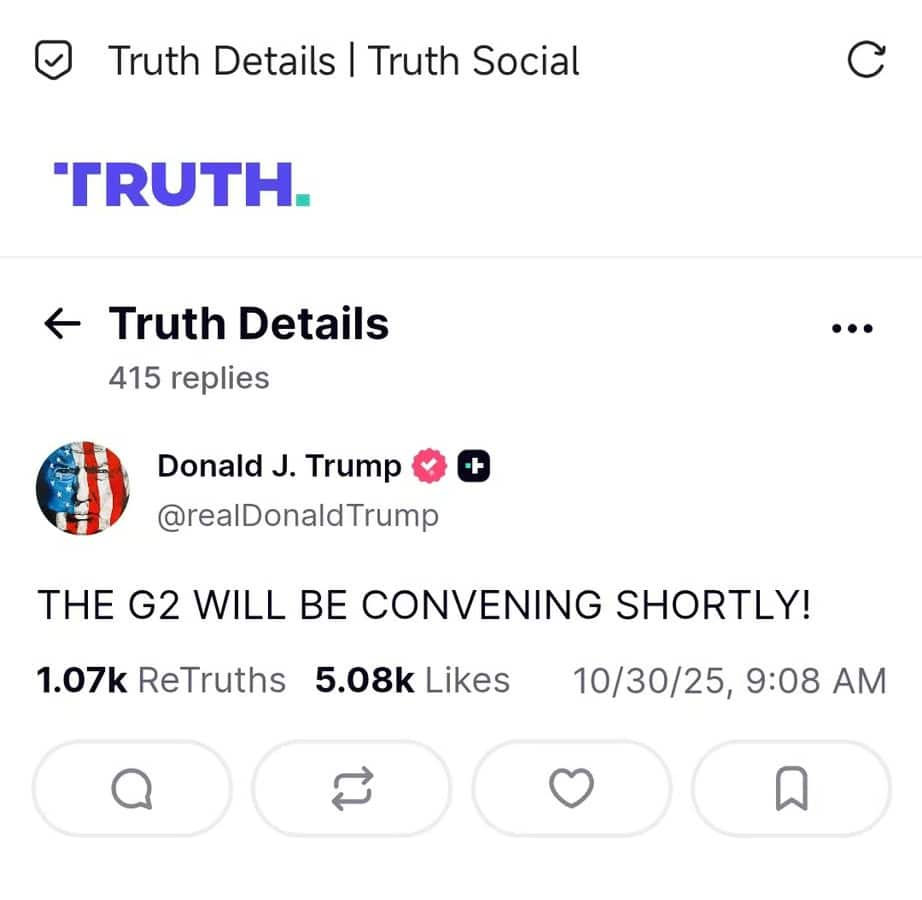
Trump announced the meeting with Xi as the ‘G2’ on his Truth Social platform.
The meeting, that lasted approximately 1 hour and 40 minutes inside Gimhae International Airport in Busan, South Korea, was the first in-person meeting between Trump and Xi since Trump began his second term in January 2025. The summit took place on the sidelines of the APEC (Asia-Pacific Economic Cooperation) meetings and concluded Trump’s ‘Asia tour’ that also included visits to Malaysia and Japan.
Chinese news reports about the meeting were overall positive, with Xinhua noting that the two leaders agreed to strengthen cooperation in various areas and promote “people-to-people exchanges.”
State-run media also reported Xi’s emphasis on dialogue over confrontation and highlighted Trump’s praise of China. Reports by CCTV and China Daily emphasized Xi Jinping’s remarks during the meeting on the important of stable US-China relations: “The partnership and friendship of our two countries, is a lesson from history, and also a necessity of the present” (“两国做伙伴、做朋友,这是历史的启示,也是现实的需要”).
During the meeting, Xi also said that, given the differences in national conditions, some US-China disagreements are inevitable, and as the world’s two largest economies, “occasional friction is normal” (“两国国情不同,难免有一些分歧,作为世界前两大经济体,时而也会有摩擦,这很正常”). He added: “To face rough waters and challenges, both heads of state should steer the right course and keep the larger picture in mind to ensure the steady sailing of China–US relations” (“面对风浪和挑战,两国元首作为掌舵人,应当把握好方向、驾驭住大局,让中美关系这艘大船平稳前行”).
Trump told reporters that he rated the meeting with Xi “a 12 out of 10.” On Truth Social, he also called it a “truly great meeting” that resulted in some major agreements.
Among others, the US cut fentanyl-related tariffs on China from 20% to 10%, China agreed to pause its October 9 export controls on rare earths for one year, while Washington suspended related controls, and Beijing authorized massive purchases of American soybeans and agricultural products.
The two sides also agreed to maintain regular contact. Trump expressed his hope to visit China in April 2026 and invited President Xi to visit the United States.
G2: Changing Power Dynamics
Video footage showing Trump escorting Xi to his vehicle after the meeting went viral across platforms from Toutiao to Douyin.
As often happens in a social media environment where in-depth discussions of high-level meetings are heavily restricted, it’s the visuals that matter — with netizens dissecting the gestures and body language of both leaders.
One image that circulated online focused on the difference in body language between the Trump-Xi meeting and the meeting between Trump and Japan’s new leader Takaichi, suggesting it translates to different power dynamics.

Trump and Takaichi versus Trump and Xi.
On October 28, when Trump met with Takaichi, he appeared to ignore cues to salute the Japanese flag, instead briskly walking past it. Takaichi looked visibly surprised. While some attributed it to poor etiquette guidance behind the scenes, most reactions framed it as a reflection of the power dynamics in the US–Japan relationship — with the US clearly on top.
The smaller meeting moments and visual gestures of respect that Trump showed toward Xi were seen by many — including this Zhihu commenter, 高山流水教育者 — as important signs and changing US-China dynamics.
These gestures ranged from Trump arriving at the venue early and “respectfully waiting” (恭候) for the Chinese delegation, to being the one who extended his hand first during the handshake. After the meeting, both leaders smiled and Trump courteously escorted Xi to his car and exchanged a few quiet words with him (#特朗普送习主席上车#).
The commenter writes: “The truth lies in the details!” (“细节见真章” xìjié jiàn zhēnzhāng).
Another issue that has repeatedly come up on social media is how Trump prioritized a one-on-one meeting with Xi Jinping while skipping the APEC meeting — suggesting a preference for major power dynamics and his so-called ‘G2’ US–China alignment over broader engagement with the Asia-Pacific bloc.
Trump’s initiative to call the US-China meeting a “G2” seemed well-received by the Foreign Ministry of China, which responded to a reporter’s question about the use of this term on October 31. Spokesperson Guo Jiakun (郭嘉昆) suggested that China and the United States could demonstrate “major power responsibility together” by cooperating on issues beneficial to both countries and the rest of the world (#中方回应特朗普所称G2会议#).
The fact that Trump called it a “G2” speaks volumes for many about China’s strong global leadership today — especially coming from someone often described as having a “mentality of worshipping the strong” (慕强心理 mù qiáng xīn lǐ).
The media campaign China launched ahead of the Xi–Trump meeting to assert its claims over Taiwan may also have played a role — with a series of state media commentaries emphasizing reunification and the declaration of October 25 as “Taiwan Restoration Day,” there appeared to be added pressure to ensure Taiwan would not be used as a bargaining chip.
Taken together, the meeting and the details surrounding it are taken as a sign that Trump now accepts China as a stronger power than he did during his first term.
At the same time, Trump’s eagerness is also seen as a reflection of how his foreign policy efforts have fallen short in resolving domestic challenges. In that sense, his use of “G2” underscores both China’s rising position and the domestic pressures facing the United States.
With the fruitful outcome of the meeting and Trump showing clear respect toward China — and, as many suggested, even more respect than toward Japan — there seems to be a generally positive attitude and a noticeable shift in sentiment toward the US president on Chinese social media.
“Old Trump is an honest guy,” one person wrote on Weibo. Others on Douyin wrote: “US–China cooperation is a win-win situation.”
One observer on Weibo wrote: “The tariff drama, directed by Trump himself with himself as the main actor, has finally come to an end after all his tossing and turning. Life is like a play and it all depends on your acting skills. Old Trump treats politics as a show, which has broadened our horizons and added a bit of extra amusement to the world.”
By Manya Koetse
with contributions by Miranda Barnes
(follow on X, LinkedIn, or Instagram)
Spotted a mistake or want to add something? Please let us know in comments below or email us. First-time commenters, please be patient – we will have to manually approve your comment before it appears.
©2025 Whatsonweibo. All rights reserved. Do not reproduce our content without permission – you can contact us at info@whatsonweibo.com.


Chapter Dive
Comrade Trump Returns: The 2026 Trump–Xi Summit on Chinese Social Media
A special deep dive into the 2026 Xi-Trump summit through Chinese social media, highlighting the top 15 viral moments, internet memes, main themes, and netizen commentary.

In This Special Edition:
🎭 The Top Cast: Who’s who in this geopolitical blockbuster
🎬 Dramatic Synopsis: The summit as a movie plot
🔍 Critical Review: Taiwan, the “Thucydides Trap,” & a Russian surprise
🧩 Memorable Scenes: The top 15 most viral memes & moments
🗣️ Quotes: Key remarks from leaders and netizens
🎬 Behind the Scenes: An unscripted moment
🎵 Soundtrack: The summit in songs
On Chinese social media, Trump’s visit to China started before he arrived and continued after he left.
The long-awaited meeting between Donald Trump and Xi Jinping, from May 13 to May 15, was the first visit by a sitting US president to China in nearly a decade – a major diplomatic event that has been closely followed by Chinese netizens.
Even before Trump’s Air Force One landed in Beijing, the Xi-Trump summit was top trending.
Alongside the more serious commentary, Chinese social media has been full of posts reflecting people’s curiosity, excitement, and amusement about Trump’s presence in Beijing this past week. That is not only because the meeting between the two leaders—and the issues on the table—is of major significance, but also because Trump has held a special place in China’s meme culture since the early days of his first presidency.
Trump’s first years in office catapulted him into China’s meme machine. When he remarked that Korea “used to be part of China,” and after a series of high-profile decisions—including withdrawing from the Trans-Pacific Partnership, exiting the Paris Climate Agreement, and announcing that the US would leave UNESCO—many Chinese netizens joked that the US president was inadvertently helping China by weakening America’s global influence.
The trade war and Trump’s hardline stance toward Chinese tech companies were also, paradoxically, seen as forcing China to accelerate its own push for technological self-reliance and domestic innovation.
Taken together, these developments earned Trump—whose Chinese name is commonly transliterated as 川普 (Chuānpǔ)—the nickname “Build-the-Nation Trump” (川建国, Chuān Jiànguó), fueling the tongue-in-cheek notion that he is actually China’s “secret agent” who is working to undermine American power while inadvertently advancing China’s rise on the world stage.
For the same reason, he is also often referred to as “Comrade Trump” (川普同志).
This often bantering approach to US politics, combined with China’s tightly controlled online environment, where more critical and open discussions of top-level political events are always limited, has given rise to alternative narratives around major diplomatic meetings that sometimes read like a movie script.
That dynamic was already evident the moment Trump landed in Beijing.
To some Chinese netizens, his appearance at the door of Air Force One looked like a scene from The Truman Show. One post making this comparison was reposted nearly 6800 times.

“It’s not the Truman show, but the Trump show,” one netizen added.
To stay on theme, I’ll take a similarly cinematic approach in this overview of Chinese social media reactions to the Xi-Trump meeting. From “top cast” to “dramatic synopsis” and the “most memorable scenes,” let’s recast this high-level rendezvous as a Beijing blockbuster.
🎭 The Top Cast
🇨🇳
⭐ Xi Jinping 习近平 – General Secretary of the Communist Party of China and President of the People’s Republic of China
• Li Qiang 李强 – Premier
• Wang Yi 王毅 – Foreign Minister
• Cai Qi 蔡奇 – Party’s organizational chief / Xi’s aide
• Yin Li 尹力 – Beijing Party chief
• He Lifeng 何立峰 – Vice Premier overseeing economic affairs
• Dong Jun 董军 – Defense Minister
• Zheng Shanjie 郑栅洁 – Chairman of the National Development and Reform Commission (NDRC)
• Han Zheng 韩正 – Vice President of China
• Ma Zhaoxu 马朝旭 — Executive Vice Minister of Foreign Affairs
• Xie Feng 谢锋 — Chinese Ambassador to the US
• Wang Wentao 王文涛 — Commerce Minister
• Zhao Leji 赵乐际 — Chairman of the National People’s Congress Standing Committee
• Lei Jun 雷军 — Founder and CEO of Xiaomi
🇺🇸
⭐ Donald Trump – The President of the United States of America
• Eric Trump — Trump’s son
• Lara Trump — daughter-in-law
• Marco Rubio – Secretary of State
• Pete Hegseth – Secretary of Defense
• Scott Bessent — Treasury Secretary
• David Perdue — US Ambassador to China
• Howard Lutnick — Commerce Secretary
• Jamieson Greer — US Trade Representative
• Steve Witkoff — Special Envoy
• Sean Hannity – Fox News
• Bret Baier – Fox News
Special Guest Appearances:
• Elon Musk — Tesla and X
• Tim Cook — Apple
• Larry Fink — BlackRock
• Kelly Ortberg — Boeing
• Stephen Schwarzman — Blackstone
• Brian Sikes — Cargill
• Jane Fraser — Citigroup
• Jim Anderson — Coherent
• H. Lawrence Culp Jr. — GE Aerospace
• David Solomon — Goldman Sachs
• Jacob Thaysen — Illumina
• Michael Miebach — Mastercard
• Dina Powell McCormick — Meta
• Sanjay Mehrotra — Micron Technology
• Cristiano Amon — Qualcomm
🎁 Surprise Appearance:
• Jensen Huang 黄仁勋 – CEO of Nvidia (aka “Old Boss Huang” 黄老板 aka “Leather Jacket Brother” 皮衣哥)
• X Æ A-12 Musk – Elon Musk’s 5-year-old son
Notable absence:
• Melania Trump – First Lady
• Peng Liyuan (彭丽媛) – First Lady
🎞️ Genre and Supporting Themes
Political Drama ⎮ Geopolitical suspense ⎮ Romance/Tragedy
▪️ War in Iran / the Strait of Hormuz crisis
▪️ Russia’s war in Ukraine
▪️ Taiwan
▪️ Trade and tariffs
▪️ AI and semiconductor export controls
▪️ Rare earths and critical mineral supply chains
🎬 Dramatic synopsis
Two powerful leaders. One increasingly unstable world.
The world’s most unpredictable dealmaker flies 13 hours to the capital of his greatest rival, his close friend, or “neither an ally nor a friend” (it changes), for a long-awaited “G2” moment aimed at stabilizing relations between two powers that publicly insist they can thrive without each other, while privately knowing the opposite may be true.
There is a lot at stake, from chips to oil and beyond. A $50 billion semiconductor market. A war in the Middle East. A rare earth supply chain. And an island of 23 million people that is on everyone’s minds.
As the flags wave in the Beijing wind, the tea is poured, and the lavish banquet is prepared, deep mistrust simmers behind carefully staged handshakes and smiles.
Will the protagonists talk their way toward a more peaceful next chapter? Will a surprise cameo by the “Leather Jacket Brother” (皮衣哥) Jensen Huang help move the plot forward? And, in an increasingly fragile global order, will the eagle and the dragon finally realize that they may need each other more than they are willing to admit?
📝 Production Schedule
📌 May 13 (Wednesday) – Arrival Day
🔹 Evening: Beijing Capital International Airport
– Trump and his delegation arrive in Beijing
– They are welcomed by Chinese Vice President Han Zheng (韩正)
📌 May 14 (Thursday) — The Main Day
🔹 Morning: The Great Hall of the People
– Welcome ceremony, military parade
– Bilateral talks between Trump and Xi for over two hours
🔹 Afternoon: Temple of Heaven (天坛)
– Joint tour of the Hall of Prayer for Good Harvests (祈年殿)
🔹 Evening: The Great Hall of the People
– State Banquet (国宴) hosted by Xi Jinping
📌 May 15 (Friday) — Working Sessions & Departure
🔹 Morning: Zhongnanhai (中南海)
– Zhongnanhai private garden tour
– Trump and Xi small-group talks
🔹 Afternoon: Beijing Capital International Airport
– Trump’s departure in the afternoon around 14:30
📝 The business delegation track ran in parallel with the CEOs having their own meetings with Chinese counterparts on the sidelines of the Xi-Trump meetings.
🧵 Critical Review
A lot has happened since Trump and Xi’s previous face-to-face meeting in Busan, making this major bilateral meeting one that the entire world watched.
As described by China’s foreign ministry, during their meeting, Trump and Xi “explored the correct way for two major powers to coexist,” while the White House stressed that the two sides mostly “discussed ways to enhance economic cooperation between our two countries.”
During their “G2” moment, Xi and Trump spent nearly nine hours together in total—from the formal talks at the Great Hall of the People to their walk-and-talk at the Temple of Heaven, the banquet, and the smaller-group session at Zhongnanhai.
One thing that stood out throughout the visit was the extent to which both sides went out of their way to flatter one another. From the moment Trump arrived at the airport until the second he departed, he received full VIP treatment: children waving flags, a 21-gun salute, a lavish state banquet, and even a PLA military band performing his unofficial YMCA anthem.
Trump, in turn, repeatedly praised Xi as a “great leader,” called China “a wonderful country,” described Beijing as “a great place,” and said he had received “a magnificent welcome like none other.” He also said that US–China relations had a “fantastic future together.”
During the 2025 Trump-Xi meeting in South Korea, a common observation was that “the truth lies in the details” (细节见真章), and the same was true this time. Chinese media and netizens paid close attention to small gestures: Trump being the first to extend his hand, his red tie (with red symbolizing success and good fortune in Chinese culture), and the way he worked his way down the receiving line of senior Chinese officials, shaking each of their hands outside the Great Hall of the People.
One widely discussed moment was Trump’s military-style salute to Chinese Defense Minister Dong Jun (董军). The gesture was warmly received online, with some netizens joking that “the comrade has returned home” (同志回家了).
It is clear that hospitality and warm rhetoric were not the problem. At least on the surface, this temporary US–China Beijing honeymoon looked picture-perfect, and became a true media spectacle. But behind the red carpets and blue skies, several deeper themes emerged.
🔍 The Thucydides Trap
An important narrative element on the Chinese side was the “Thucydides Trap” as mentioned by Xi Jinping during the formal bilateral meeting at the Great Hall of the People.
The “Thucydides Trap” (修昔底德陷阱) is a concept popularized by Harvard scholar Graham Allison, drawing on the ancient Greek historian Thucydides, which holds that war becomes highly likely when a rising power challenges the established ruling power.
“The world has come to a new crossroads,” Xi said: “Can China and the United States overcome the so-called ‘Thucydides Trap’ and create a new paradigm of major-country relations?”
This “new paradigm” and the new shape of US-China relations became one of the most important themes of this meeting. The broader message from the Chinese side was clear: China sees its growing role on the world stage as inevitable, and the United States is expected to make room for that reality. Or, put differently, the world order is changing, and there are now more captains on this ship.
🔍 Taiwan issue
The “Thucydides Trap: concept is also closely tied to “the Taiwan problem,” and China’s pre-summit warnings on the issue left little room for misunderstandings.
On the Chinese side, Taiwan was framed as its most important issue and a red line, with officials warning that the broader US–China relationship could be jeopardized if the “Taiwan question” were mishandled.
⚠️ “If it is handled properly, the bilateral relationship will enjoy overall stability,” Xi told Trump. “Otherwise, the two countries will have clashes and even conflicts, putting the entire relationship in great jeopardy.”
Xi emphasized that ‘Taiwan independence’ and cross-Strait peace are as “irreconcilable as fire and water” (水火不容), adding that maintaining peace and stability across the Strait represents the greatest common interest shared by China and the United States.
After the summit, it became clear that the US side understood China’s position. In an interview with Fox News, Trump acknowledged that Taiwan is “one of their [China’s] most important issues.” Stressing that China does not want to see Taiwan become independent, Trump said he preferred to maintain the status quo and cautioned Taiwan against formally declaring independence from China.
He also suggested that the United States has no interest in becoming involved in a war between Taiwan and mainland China. “Do we really have to travel 9,500 miles to fight a war? I’m not looking for that.”
His comments seemed to suggest that, for now, respecting China’s red lines while preserving the status quo may be sufficient to keep things stable.
Trump’s words seemed to raise alarm bells in Tapei, where a presidential spokesperson said it was “self-evident” that Taiwan is “a sovereign, independent democratic country”.
Meanwhile, on Chinese social media, official channels widely reported on Trump’s words, and a related Weibo hashtag (#特朗普警告台独#) received over 230 million views.
One Weibo commenter wrote:
💬 “The meal wasn’t eaten for nothing [饭没白吃]. Comrade Trump really did deliver!”
🔍 Historic Continuum
One notable aspect of this visit was the extent to which both sides emphasized the long historical continuum and importance of Sino–US relations.
The visit to the Temple of Heaven was symbolic in several ways. Beyond the site’s significance in Chinese history, it was also known to much appreciated by Henry Kissinger, who helped pave the way for the normalization of Sino-American relations in the 20th century.
During his state banquet speech, Trump also highlighted the deep historical roots of US–China relations, and drew a direct line from ancient Chinese philosophy to the intellectual roots of the United States.
He noted that Benjamin Franklin published sayings of Confucius as early as 1737, referenced Confucius’s depiction on the façade of the Supreme Court of the United States, and mentioned how President Theodore Roosevelt channeled Boxer Indemnity funds toward the founding of the prestigious Tsinghua University, Xi Jinping’s alma mater.
Also noteworthy is how Trump stressed that China and the US were “allies in World War II,” with Roosevelt’s mentions of “the brave people of China.”
The speech was praised on Chinese social media. One popular blogger wrote:
💬 “Holy sh*t. Trump’s toast was full of classical references and complex sentences. He actually did his homework.”
Taken together, Trump’s remarks and the historical framing in Chinese media conveyed a broader diplomatic message: Sino-American relations in 2026 were presented as part of a much longer history that had led to this moment. This gave the meeting added weight, framing it as a major turning point and the start of a new era in US–China relations, rather than just another bilateral talk.
🔍 Russian Surprise
While Xi and Trump were in the midst of the state banquet, media reports came out from Moscow that Kremlin spokesperson Peskov had announced that Putin’s will soon visit China, and that preparations were complete, with the date to be announced “soon” (later confirmed: May 19-20).
A related hashtag immediately reached the top trending lists, with many netizens responding to the Putin visit news with a mix of nationalistic pride and humor – joking just how popular and lively Beijing is as an international “hotspot.”
With China hosting both the US and Russian leaders within the same week, many suggested it underscored just how important China’s role in global diplomacy is.
💬 “Trump will be seated in front of the tv just to ensure Putin isn’t getting better treatment than him,” one commenter joked.
Despite the commotion over the accouncement, some commenters on Zhihu suggested that it actually was not such a big deal.
💬 “Don’t overthink it,” one Zhihu user wrote: “Trump’s itinerary was pushed back to May, it was originally scheduled for April.”
Others argued that these visits should be placed into a larger context of China playing a key diplomatic role for resolving the Iran war and the Hormuz crisis.
💬 “Don’t just focus on Putin coming — look at the sequence before him: first Iran’s Foreign Minister Araghchi, then Trump, then Putin, then Pakistan (already announced). Except for Israel, every party involved in the Hormuz Strait issue, and everyone with meaningful influence over it, has come.”
Then there were those who saw deeper meanings behind the dates:
💬 “Trump chose the 13th and 14th to visit China. Putin chose May 20th to visit China. Both are expressing their sincerity very directly! 1314520.”
In Chinese online culture, the numbers “1314” sound like 一生一世 (yīshēng yīshì), meaning “for a lifetime” or “always and forever,” while “520” sounds like 我爱你 (wǒ ài nǐ), or “I love you.” With Trump picking 13/14 (一生一世) and Putin choosing 5/20 (我爱你), they seemed to be spelling out a love confession to China, with Xi Jinping, apparently, as the most sought-after romantic partner in global diplomacy.
🔍 Uncertain Conclusions?
According to Chinese official sources, the summit’s main diplomatic outcome was the agreement to frame China–US relations as a “constructive strategic stability relationship” (中美建设性战略稳定关系) — a new official positioning of the bilateral friendship.
In Trump’s own words: “The relationship between the United States and China is going to be better than ever before.”
In the commentary that has emerged since the summit, opinions are divided over how much the nine hours of talks between Xi and Trump will change or impact the key issues at hand. Various international media wrote that there is little clarity about what was actually achieved.
What does seem clear, however, is that for the time being both sides got something they wanted: friendlier China–US relations, an America that appears more cautious in its wording on an “independent Taiwan,” and a China that agrees with the United States that Iran should never obtain nuclear weapons.
Whether this will amount to a true “happy ending” remains to be seen, but it does mark the beginning of a new phase in bilateral relations—one in which there appears to be greater understanding of each other’s positions.
Xi accepted Trump’s invitation to visit Washington this autumn and also promised to send him seeds from the roses he admired in the former imperial garden at Zhongnanhai. At the very least, something tangible will bloom from these meetings.
🧩 Memorable Scenes
📌 1. Memes in Anticipation
On Chinese social media, Trump’s China visit had already begun a day or more before the president’s arrival in Beijing, with various AI-generated memes imagining the trip. These ranged from images of Trump and Elon Musk enjoying Beijing street food and Tsingtao beer to scenes of Trump and his entourage solemnly visiting the Temple of Heaven and, in all earnestness, paying their respects there.


📌 2. The Grandson Coming to America
Before Trump’s arrival, rumors spread across Weibo and WeChat that CCTV-6, the movie channel of China’s state broadcaster, would air the Chinese film A Grandson from America (孙子从美国来) on the day he landed in Beijing. The 1990s feel-good film, about an elderly man in rural China who unexpectedly becomes the caregiver for his American grandson, was seen as a cheeky nod to the meeting between Xi Jinping and Donald Trump, with the American “grandson” cast as clearly inferior in status to his Chinese “grandfather.”
The rumor, however, turned out to be false.

The supposed CCTV-6 programming was itself a meme. Perhaps so many people were willing to believe it because CCTV-6 has occasionally made eyebrow-raising scheduling choices before—such as changing its lineup to air anti-American Korean War films for three consecutive days when the U.S.-China trade war was heating up.
📌3. Jensen Huang’s Surprise Attendance
When Jensen Huang (黄仁勋), the CEO of NVIDIA, boarded Air Force One during a stopover in Anchorage, Alaska, he instantly went viral.
Huang plays a special role in this story because he has become a symbol of the central technological dispute between China and the United States. China is one of NVIDIA’s most important potential markets, but the company’s most advanced AI chips are currently barred from being sold there under US export controls.
It was initially reported that Huang would not be joining the trip. When he appeared at the last minute after all, Chinese social media quickly responded with a wave of memes imagining all kinds of ways he might have boarded the presidential delegation in Alaska.
Like this video. Or the images below. Some people joked that “Leather Jacket Brother” (皮衣哥), as he is nicknamed in China for his signature black leather jacket, was invited so last-minute that he didn’t even have time to bring any luggage – explaining why he stood on the tarmack without any suitcases.
Various memes showed him chasing after the Air Force One plane, and others showed him ‘bribing” the delegation to pick him up with big packs of Maotai liquor or other goods.


📌 4. The “Chinese” Meals Served on Board of the Air Force One
Photos of the meals served aboard Air Force One quickly made their way onto Chinese social media. The menu consisted of sliced beef brisket, onions, bell peppers, bok choy, and lo mein noodles stir-fried in a sesame soy sauce and topped with chopped scallions, along with a spring roll, a fortune cookie, and a beverage of choice.
The photo was posted by Margo Martin, communications deputy director in the Trump administration, and reactions on Chinese social media were mixed. Some appreciated that the American side was already trying out something more “Chinese” ahead of the visit. Others argued that the meal had little to do with actual Chinese cuisine and instead reflected a stereotypical version of American Chinese food.

📌 5. Lonely Soldier in Front of Air Force One
When Air Force One arrived at Beijing Capital International Airport on the evening of May 13, and millions of people tuned into the livestreams of Trump’s arrival, a People’s Liberation Army honor guard soldier stood completely still at his post. The contrast of the enormous American presidential plane coming in and the Chinese soldier not moving a millimeter made an impression and went viral as a symbol of Chinese diligence and pride.


📌 6. Trump’s Visit Finally Gets Bumpy Road Fixed
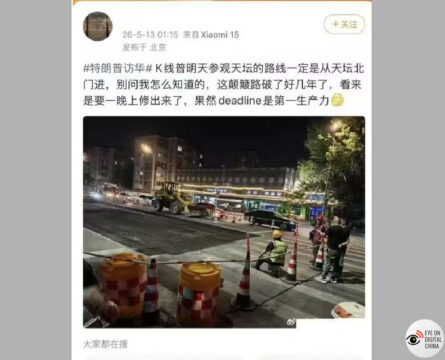
One viral post joked about a familiar phenomenon in China: infrastructure projects that have dragged on for years suddenly get completed at lightning speed when an important political event is about to happen. The post showed construction workers, just ahead of Trump’s visit, busy working on the road near the Temple of Heaven north gate – the route the US delegation would be taking.
💬 “This stretch of road has been in terrible condition for years, but it looks like they’re going to fix it overnight. Once again, the deadline proves to be the number one productive force.”
📌 7. Trump’s “Crazy Thursday”
A running joke on Chinese social media was that Donald Trump had deliberately arrived on a Wednesday night so he could be in China just in time for KFC’s “Crazy Thursday” (疯狂星期四).
Since its launch, the weekly KFC promotion has become deeply embedded in Chinese internet culture. So it was only natural for netizens to imagine Trump, Elon Musk, Jensen Huang, and Tim Cook heading out for a late-night snack after the state banquet.
What should he order? Since Trump’s Chinese name is Chuan-pu (川普, Chuānpǔ), the obvious choice would be a Chuan-Burger (川味汉堡, Chuānwèi Hànbǎo) — a Sichuan-style spicy burger, of course.

📌 8. The Magpie Moment
One of the most noteworthy moments of the morning of May 14 came when a magpie landed just behind Donald Trump as he stepped out of his car.
The moment, captured by a Hong Kong reporter, quickly created a buzz online. In Chinese culture, the magpie (喜鹊, xǐquè) is traditionally seen as a symbol of good news and prosperity — the first character, 喜 (xǐ), means “joy” or “happiness.” Netizens were quick to interpret the bird’s appearance as a sign that Trump’s visit had the approval of the heavens.

📌 9. Elon Musk “360-Degree Filming”
After the bilateral meeting, the American delegation posed for a group photo on the steps of the Great Hall of the People. Elon Musk — affectionately nicknamed “Old Musk” (老马, Lǎo Mǎ) by Chinese netizens — drew particular attention for his enthusiastic “360-degree filming.” Like an excited tourist, he spun in a full circle while recording everything around him.
“They were genuinely happy today,” was how Hong Kong media outlet Ta Kung Wen Wei framed the moment.
On Weibo, one related hashtag received over 80 million views, while another hashtag surpassed 99 million views.

📌 10. Lei Jun’s Selfie Moment with Elon Musk
One of the most-reposted moments of the state banquet was when Xiaomi CEO Lei Jun approached the table where Tesla CEO Elon Musk was seated before the start of the dinner, and snapped a quick selfie with him, while Musk was pulling some funny expressions.
Lei Jun’s spontaneous photo was jokingly called a sign of “star chasing” and “fan behavior.” The tech entrepreneur was one of the first Model S owners in China, and admired Musk long before the Xiaomi EV line. Some Xiaomi EV drivers joked that he was making them lose face.

Some netizens used AI to swap the situation around.

📌 11. Fox News Reporter Bret Baier Going Local
During the summit, many netizens snapped pictures and videos of Fox News reporter Bret Baier going around the city reporting, which created a funny unintended Droste effect with Beijing reports coming out on how he reported on Beijing.
🔹 Chinese media reported on how Bret Baier was reporting on China by ordering a sausage in English from a robot clerk at a convenience store (video).
🔹 Baier also reported on China as a surveillance state. Meanwhile, clips of him making that point were circulating widely on Chinese social media. In one segment, he told viewers that his crew’s driver received a parking fine on his phone just minutes after illegally parking, using it as a live example of China’s surveillance capabilities. Chinese netizens were quick to point out the irony, noting that Baier himself appeared to be violating traffic rules by filming while standing in an active traffic lane (video).
🔹 He was also spotted playing table tennis in a Beijing park in sweltering weather while wearing a full suit, much to the amusement of many netizens (video).

📌 12. Elon Musk’s 5-Year-Old Son Becomes Youngest Influencer
Jensen Huang wasn’t the only surprise guest at the summit. Elon Musk also brought along his five-year-old son, X Æ A-12 (in China, simply known as “Little X” 小X). The little boy appeared in a Chinese-style vest and carried a traditional tiger-head bag (虎头包), making him, quite possibly, the youngest person ever to attend a state-level U.S.–China summit.
One unexpected side effect of X’s appearance in summit footage was a surge of interest in his outfit. Chinese netizens quickly identified both the handmade tiger-head bag – from a Guangxi ethnic minority artisan brand – and the Chinese-style vest, and links to the items spread across social media. On Taobao, the bag was listed for 338 yuan (about US$49), while the vest sold for around 16 yuan (US$2.35).
The bag’s viral success became a major news story, framed as “traditional intangible cultural heritage going global.” Hand-stitched by Guangxi ethnic minority embroiderers, the tiger-head bag sold out within hours. (I also ordered one on Taobao, and received a notification today that they won’t be shipping out until late July).

📌 13. The Banquet Centerpiece
The centerpiece table at the welcoming banquet—which accompanied dishes such as lobster in golden broth, crispy spiced beef, Peking roast duck, salmon in mustard sauce, classic conch pastry, tiramisu, and more—was a spectacle in its own right and quickly became a topic of discussion online.
Designed as an elaborate miniature landscape, it featured a large pond, swans (traditional symbols of fidelity and harmony), white doves representing peace, flowers, garden pavilions, and a detailed replica of Beijing’s Temple of Heaven.

📌 14. Jensen Huang Has Noodles in the Hutongs
Jensen Huang went viral multiple times over the past week, but one standout moment was his noodle stop at a hutong in central Beijing. He was filmed standing outside eating while dozens of people watched and took pictures; other clips showed him strolling through the surrounding alleyways.
About the noodle place: the address is No. 83 Fangzhuanchang Hutong (方砖厂胡同83号院). It is a small Bib Gourmand-listed eatery that serves only zhajiangmian (Beijing fried sauce noodles). Waiting in line was already common, but with Jensen Huang’s visit going viral, queues are likely to get even longer. Located between Nanluoguxiang and Qianhai, it makes for a perfect stop for a late lunch and an afternoon stroll. (Worth noting for your next hutong trip.)

The restaurant, by the way, was remarkably quick to capitalize on the moment and establish itself as the Jensen Huang noodle spot. By May 15, it had already put up a poster featuring Jensen Huang enjoying a bowl of noodles there (image via @_FORAB on X).

📌 15. The KTV Night
Chinese netizens jokingly fantasized about what would happen after the Trump–Xi summit: a late-night KTV session in Beijing with Donald Trump, Tim Cook, Lei Jun, Elon Musk and Larry Fink.
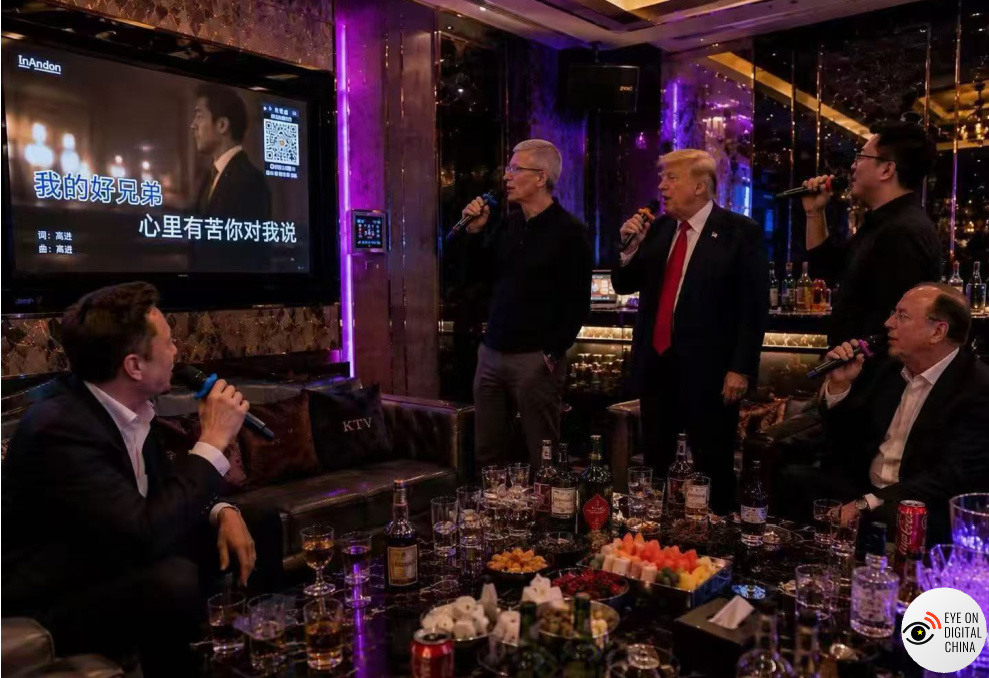
With the whisky bottles, fruit platters, and dim purple lighting, it is a classic Chinese KTV scene. The men sing “My Good Brother” (我的好兄弟) together, an appropriate song about friendship, loyalty, and supporting each other through difficult times.
🗣️ Quotes
🎙️ “The most important thing by far: Iran cannot have a nuclear weapon” (Donald Trump upon departure from D.C. to China).
🎙️ “There are those who say this is maybe the biggest summit ever. They can never remember anything like it. In the United States, people aren’t talking about anything else.” (Donald Trump during the bilateral meeting in the Great Hall of the People.)
-“It seems Trump was very happy with the welcome ceremony. This is a treatment he’s never enjoyed in the US, and the US probably could not organize a welcome ceremony on this scale.” (Popular Weibo comment after the welcome ceremony.)
🎙️ “The Taiwan issue is the most important issue in China–US relations. If it is handled properly, the overall relationship between the two countries can remain stable. If it is handled poorly, the two sides could face confrontation or even conflict, pushing the broader China–US relationship into a highly dangerous situation.” (Comments by Xi during bilateral meeting as reiterated by China’s Ministry of Foreign Affairs.)
🎙️ “This visit is a historic and landmark visit. Thus far, we have established a new bilateral relationship – a constructive strategic stable relationship – which constitutes a milestone event.” (Xi Jinping while hosting Trump in Zhongnanhai.)
🎙️ “The days of Trump’s visit to China were the most disciplined, most normal, and most presidential days since he took office.” (Blogger @许韬de微博 on May 15.)
🎙️ “The Chinese do not want to see this place—let’s just call it a place, because no one knows how to define it—go independent. I think they probably would do something pretty harsh, and then they would be met harshly and bad things will happen (..) But I’d like to stay the way it is (..) I don’t want anyone to become independent. Do we really have to travel 9500 miles to fight a war? I am not looking for that.” – (Trump in Fox News Special Report Spotlight, May 15.)
🎙️ “The great rejuvenation of the Chinese nation and making America great again can proceed in parallel, reinforce one another, and benefit the world.” (Chinese Foreign Minister Wang Yi on May 15 during a press briefing.)
🎬 Behind the Scenes
During a B-roll-style Fox News livestream that, for at least 90 minutes, showed little more than preparations and staff members walking around the Temple of Heaven grounds, one cameraman kept rolling during a notable confrontation between the U.S. press pool and Chinese security.
While Trump and Xi Jinping toured the historic site, journalists and some members of the U.S. delegation were directed into a holding room inside the temple complex. They protested, insisting they were part of the Trump motorcade. The four-minute clip—which I extracted from the two-hour livestream and posted here—ends with journalists physically pushing their way out to rejoin the motorcade, with one member of the group reportedly saying, “We’re leaving! Don’t treat others the way they treat us.”
The incident occurred around the same time that one of Trump’s Secret Service agents was reportedly denied entry to the complex because he was armed, causing a delay in the visit.
🎵 Soundtrack
During the banquet, the Military Band of the People’s Liberation Army (中国人民解放军军乐团), led by conductor Wang Dengmei (王登梅), performed a music program: the actual soundtrack of this trip, with some notable choices.

🎵 Yulin Folk Tune (榆林小曲) — Traditional northern Shaanxi folk music, highlighting Chinese regional culture.
🎵 America the Beautiful (美丽的阿美利坚) — Iconic patriotic song honoring the United States.
🎵 China in the Glow of Lights (灯火里的中国) — Contemporary song celebrating China’s prosperity and development.
🎵 Edelweiss (雪绒花) — Familiar American favorite from The Sound of Music, evoking warmth and nostalgia.
🎵 The Butterfly Lovers (梁山伯与祝英台) — Classic Chinese love story and one of China’s best-known orchestral works.
🎵 Sousa March Carnival (苏萨进行曲《童年华》) — Festive medley of classic American marches.
🎵 Under the Silver Moonlight (在银色月光下) — Beloved folk song symbolizing China’s ethnic diversity.
🎵 We Are the World (天下一家) — Message of global unity and cooperation.
🎵 As You Wish (如愿) — Popular modern Chinese ballad.
🎵 Can You Feel the Love Tonight (今夜爱无限) — Disney’s Lion King song emphasizing harmony and affection.
🎵 Ode to the Pear Blossom (梨花颂) — Peking opera-inspired piece showcasing traditional Chinese artistry.
🎵 Y.M.C.A. — Trump’s unofficial anthem and a lighthearted diplomatic gesture.
That’s a wrap!
Many thanks to Miranda Barnes for helping curate some of the most memorable memes.
By Manya Koetse
(follow on X, LinkedIn, or Instagram)
Spotted a mistake or want to add something? Please let us know in comments below or email us. First-time commenters, please be patient – we will have to manually approve your comment before it appears.
©2026 Eye on Digital China/Whatsonweibo. All rights reserved. Do not reproduce our content without permission – you can contact us at info@whatsonweibo.com.
Chapter Dive
Chinese Postdoc Death Raises Questions as Key Details Remain Missing
About a widely discussed “chilling effect”, the death of Chinese researcher Wang Danhao, and unanswered questions. (April 3 update included)

On March 27, news about a Chinese postdoctoral researcher based in the United States who allegedly died by suicide a day after being questioned by US law enforcement officials began trending on Chinese social media.
The news came out during the Friday regular press briefing, where a CCTV reporter asked China’s Ministry of Foreign Affairs (MFA) spokesperson Lin Jian (林剑):
🗣️ “We’ve learned [据了解] that recently, a Chinese postdoctoral scholar took their own life a day after being subjected to questioning by US law enforcement personnel. What’s the Foreign Ministry’s comment?”
Spokesperson Lin Jian responded that China is “deeply saddened by the tragedy,” and added that Chinese authorities have formally protested to the US, further commenting:
🗣️”For some time now, the US has been overstretching the concept of “national security” for political purposes, carrying out unwarranted questioning and harassment of Chinese students and scholars, infringing upon the legitimate rights and interests of Chinese citizens, undermining the normal atmosphere of China–US people-to-people exchanges, and creating a serious “chilling effect.””
Lin Jian emphasized that China urges American authorities to conduct a thorough investigation into the case, provide answers to the victim’s family and to China, and stop any “discriminatory law enforcement against Chinese students and scholars in the United States.”
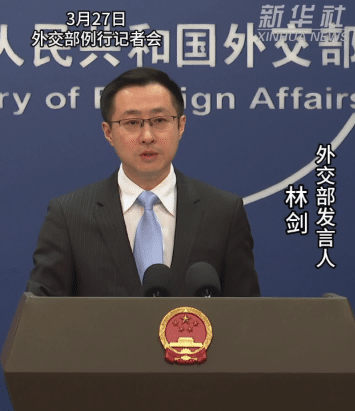
Lin Jian during the March 27 press briefing.
The “chilling effect” referenced by Lin Jian, in Chinese, is hán chán xiàoyìng (寒蝉效应), referring to a climate of fear in which people do not dare to speak out.
While xiàoyìng simply means “effect,” hán chán (寒蝉) literally means “a cicada in cold weather”—a metaphor for a repressive environment, as cicadas fall silent and become inactive in colder temperatures.
From MFA Briefing to Trending Topic
Following the press briefing, major Chinese news outlets like Xinhua and Global Times picked up the news and amplified the MFA statement across both their international and domestic channels, after which it quickly entered the top five “hot search” lists on platforms like Bilibili, Kuaishou, and Baidu. The MFA statement was also covered by Newsweek.
What is particularly noteworthy about how this news entered the online discourse is that it was reported solely through top-down, official channels. Unlike many incidents involving Chinese nationals overseas—particularly in cases of sudden death or personal tragedy—it did not first surface on social media through posts by friends or family members before prompting an official response. Nor were there any identifiable reports from local news or overseas Chinese community platforms that broke the story before the MFA did.
This left many questions about which university this researcher was affiliated with, where the incident occurred, and why the CCTV reporter asked this question on March 27 without any published news reports to go by.
Some have argued the Chinese government deliberately amplified the story to stir anti-American sentiment amid broader US-China tensions — a claim made, without supporting evidence, by the notoriously biased Epoch Times outlet.
🔍 Given the lack of details, Weibo’s own AI chatbot attributed the incident to the death of Li Haoran (李昊然). Li was a postdoctoral researcher at Princeton University who died at home in September 2025. On February 13, 2026, his death was officially ruled a suicide. Since this case predated the current report and has never been linked to law enforcement questioning, this appeared to be a hallucination error by the Weibo chatbot.
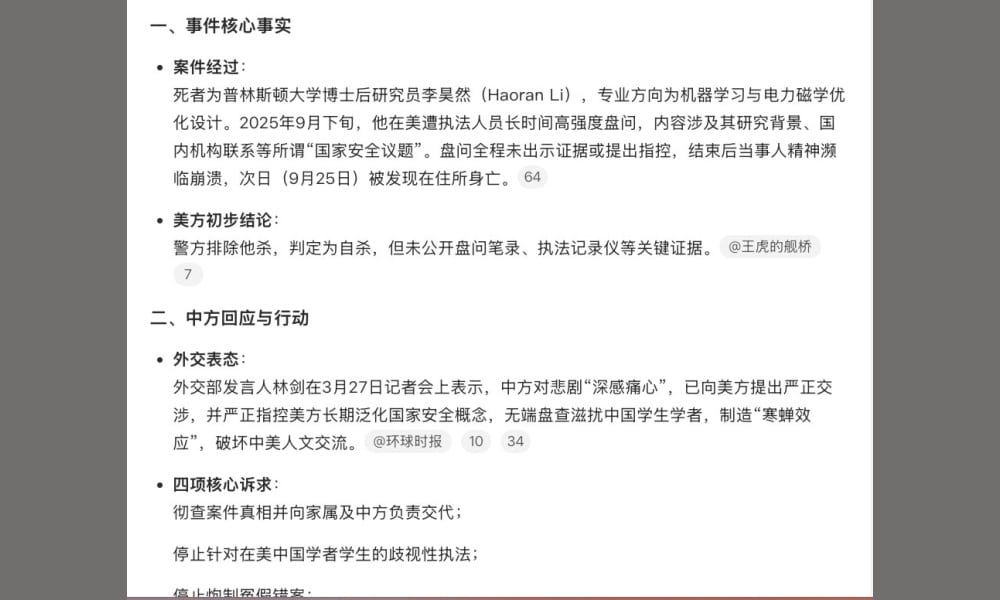
Weibo chatbot “hallucinating” and linking the current case to Li Haoran. Screenshot by author, March 27.
At the same time, claims popped up on social media regarding a recent suicide involving a researcher in the Department of Electrical & Computer Engineering (ECE) department at the University of Michigan.
One US-based Xiaohongshu user shared a screenshot of an email sent by University of Michigan staff on March 20 regarding the “sad news of the death of an Assistant Research Scientist (..) who fell from an upper story of the GG Brown building last night.”
The social media post, as well as an entire thread on another US-based Chinese community forum, had vanished by Monday, March 30, returning a “404” message.
The Michigan connection was also indirectly raised by some netizens (such as “Science Futurist” @科学未来人), who referenced earlier cases where Chinese researchers at the University of Michigan were allegedly “arrested, humiliated, and tormented.”
(🔍 Although there have been multiple incidents involving Chinese researchers at the university, this particular commenter referred to postdoctoral fellow Jian Yunqing (简云清), who was arrested by the FBI in June 2025 on charges including conspiracy and smuggling small samples of “toxic biological materials” into the US. This involved a crop-affecting fungus studied by Jian that, while also found in US fields, is illegal to import without a permit and is classified as a hazardous biological pathogen.)
Meanwhile, at the time of writing, few reports have emerged identifying any key details of the current case, and this lack of information surrounding the incident, both on the American and Chinese sides, is especially noteworthy for a case that has been framed as a major incident and a significant development in Sino-American academic exchanges.
The Michigan Connection
On March 31, the Chinese Consulate General in Chicago issued a statement via its WeChat account, responding to media inquiries regarding a Chinese scholar’s suicide following questioning by US law enforcement.
🗣️ The spokesperson confirmed that the case had occurred at a US university within its consular district, reiterating the sentiments expressed by the MFA and again using the term “chilling effect” (寒蝉效应, hán chán xiàoyìng). The statement criticized what it described as the US side’s use of “national security” to carry out unwarranted and politically motivated questioning and harassment of Chinese students and scholars.

Wechat post by Chinese Consulate in Chicago, March 31.
The Hong Kong newspaper Sing Tao Daily then connected the case to the University of Michigan’s ECE department, citing the aforementioned internal email and reporting that a local researcher died after falling from a height on the university’s North Campus.
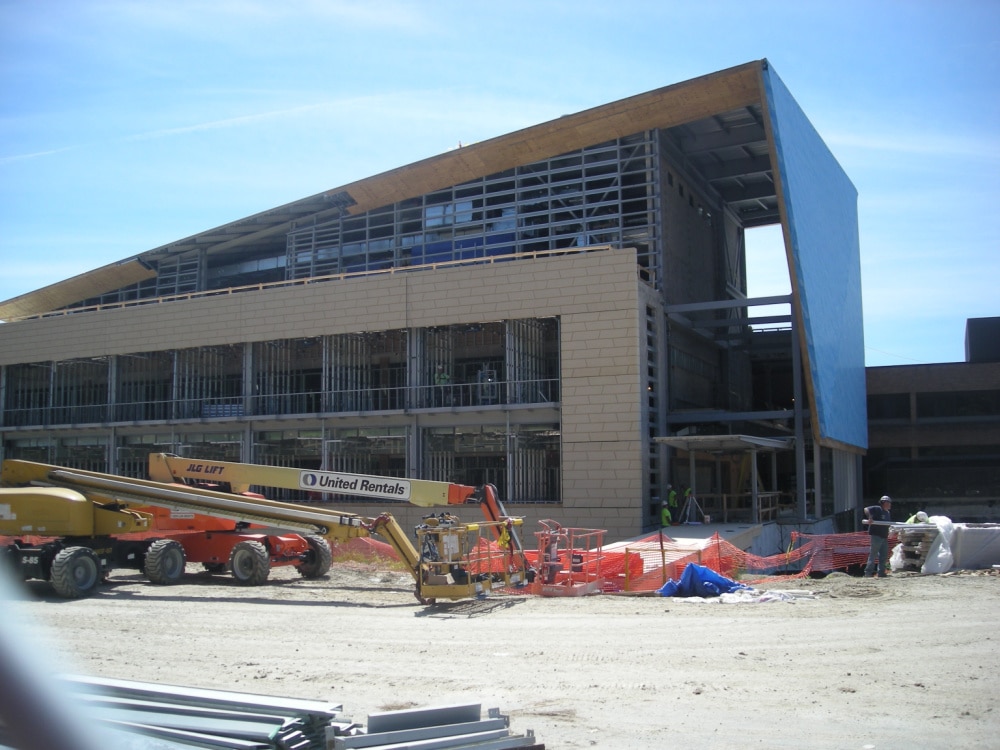
The G.G. Brown Building, where the incident allegedly happened, when it was still under construction in 2013, photo by Michael Barera via Wikimedia Commons.
The deceased researcher was reportedly an Assistant Research Scientist on the team of Professor Zetian Mi, who specializes in semiconductors, nanomaterials, and optoelectronic technologies.
Professor Mi has been previously honored for his contributions to the growth of wide bandgap semiconductor materials, and leads a top-tier semiconductor research group that has received millions of dollars in funding from the US Department of Defense, published groundbreaking research, and earned prestigious awards in photonics and semiconductor science.
A Researcher at the Intersection of US–China Science
One Assistant Research Scientist previously listed on the official ECE website—who worked in Mi’s lab but has now been removed from the public staff list—is Dr. Wang Danhao (汪丹浩).
Wang’s research focused on next-generation semiconductor materials, including ultra-thin and ferroelectric systems with applications in electronics and photonics. He was previously part of a University of Michigan research team that explained why a new class of ferroelectric semiconductors can sustain opposing electric states without breaking apart—work published in Nature and supported by US funding sources, including the Army Research Office.
Over the years, Wang has built an extensive body of research published in some of the most prestigious scientific journals, including Nature Electronics, Nature Communications, and Science Advances.
More recently, Wang was listed as a co-first author on a study—covered by various industry publications—regarding a neuromorphic vision sensor capable of sensing, storing, and classifying images without external circuits, reportedly achieving over 95% recognition accuracy. The research was led by Professor Sun Haiding’s iGaN lab at the University of Science and Technology of China (USTC) and funded by Chinese government sources, including the National Natural Science Foundation of China.
Various Chinese sources have described this research as a breakthrough, noting that USTC developed the first optoelectronic diode integrating sensing, memory, and computing in a single device (“中国科大研制出首个具有感存算三合一功能的光电二极管”) (USTC link and news sources here and here).
According to Washtenaw County vital records, Wang Danhao died on March 20, 2026.
On that very same day, the research he contributed to (“A single diode with integrated photosensing, memory and processing for neuromorphic image sensors”) was published in Nature Electronics.
Wang’s profile, spanning research of interest to military and defense institutions, reflects involvement in both US-funded semiconductor projects (including work supported by the Army Research Office & within a DARPA-funded lab), as well as collaboration on Chinese government-funded research with a Chinese state university. This cross-institutional, cross-funded research highlights the increasingly complex and sensitive position of researchers operating across the US–China scientific landscape.
From a Mysterious Case to Serious Concerns
For now, many questions still surround this case, with official reports—from both the American and Chinese sides—likely to follow. At the time of writing, neither US government agencies nor the University of Michigan have publicly responded to the MFA statement or the Chicago consulate statement.
What we do know, and what is supported by prior studies, is that many Chinese researchers feel pressured and unsafe while carrying out academic work in the US, partly due to concerns about government investigations targeting researchers of Chinese origin.
In this recent case, Chinese online responses reflect that sentiment.
In some of the more notable discussions on Zhihu (such as this thread), users comment on the case’s mysterious nature while also linking it to a broader pattern of scrutiny and pressure on Chinese researchers in the United States.
These discussions reference past FBI investigations of Chinese academics under the so-called “China Initiative,” a 2018–2022 program launched by the US Department of Justice to counter espionage and intellectual property theft involving China.
🔍 One case mentioned is the 2024 death of Northwestern University Chinese-American neuroscientist Jane Wu (吴瑛), who died by suicide following years of federal scrutiny over her China-related ties, during which her lab was shut down, and her academic presence was later removed online.
In this context, some commenters also express skepticism about the suicide narrative in the current case. One popular comment stated:
💬 “Former Boeing quality manager and whistleblower John Barnett once publicly stated that if anything were to happen to him, it would not be suicide. On March 9, 2024, he was found dead in his car in a hotel parking lot in Charleston, South Carolina. The official ruling was suicide. He had been scheduled to testify that day, exposing issues related to Boeing’s production quality.”
Another commenter—a graduate of Peking University—argued that the US is no longer seen as a safe destination for Chinese researchers:
💬 “No matter how you look at it, he had already made it to the postdoc level, traveled all the way across the ocean only for things to end like this, it’s so unfortunate. Looking back now, the three years of the pandemic mark a very clear turning point. The “Bald Eagle” (白头鹰 – the US) is no longer an ideal destination for Chinese students, and is gradually no longer an ideal place for academic exchange and research either.”
At the same time, institutional responses are also taking shape.
🗣️ Dr. Nick Geiser, leader of the University of Michigan Postdoctoral Researchers’ Organization (UM-PRO), the union representing 1,500 postdocs, told Eye on Digital China they are currently bargaining with the university.
The union is preparing a proposal on international scholar rights that would ensure foreign postdocs are supported by the university in cases of abrupt funding cuts or warrantless investigations by US federal authorities.
This is a developing story. At the time of writing, there is no official confirmation that Wang Danhao is the individual referenced in this case. Any important updates will be added here as more information becomes available.
UPDATE April 3:
A news report by local news website MLive has come out earlier today, including additional information on this case.
In an April 1 email, Deputy Police Chief and Public Information Officer Melissa Overton stated that the researcher “jumped from the third floor and fell to the second floor inside the atrium in the George G. Brown Building on March 19.” He was later pronounced dead, and police — first called about 11 p.m. on March 19 — are investigating his death as a “possible act of self-harm.”
Paul Corliss, assistant vice president for public affairs and internal communications at the University of Michigan, has also issued a statement in an April 3 email, writing that: “Our priority is to honor the wishes of the family and those affected while adhering to legal requirements and ensuring that any information shared is accurate and non-speculative.”
An earlier internal email, sent out to the Michigan Engineering community on April 1, confirmed the passing of Wang Danhao (Dr. Danhao Wang), and stated that there is an active police investigation going on, with no further information to share.
The statement described him as “a promising and brilliant young mind,” whose research into wide bandgap III-nitride semiconductor materials and devices published in Nature “stands as a landmark, uncovering for the first time the switching and charge compensation mechanisms of emerging ferroelectric nitrides.”
The UM Postdoctoral Researchers Organization, the union that represents postdoctoral researchers, is advising its membership not to speak with federal authorities.
If you or someone you know is struggling, international mental health and crisis support helplines can be found at www.befrienders.org.
By Manya Koetse
(follow on X, LinkedIn, or Instagram)
Note: In Chinese, names are written with the surname first, followed by the given name (e.g. Wang Danhao, Mi Zetian). In English-language contexts, this order is usually reversed (e.g. Dr. Zetian Mi, Dr. Danhao Wang).
©2026 Eye on Digital China/Whatsonweibo. All rights reserved. Do not reproduce our content without permission – you can contact us at info@whatsonweibo.com.
Eye on Digital China is a reader-supported publication by
Manya Koetse (@manyapan) and powered by What’s on Weibo.
It offers independent analysis of China’s online culture, media, and social trends.
To receive the newsletter and support this work, consider
becoming a paid subscriber.


“God Won’t Save Us, but the PLA Will”: Floods, Faith, and Kung Fu Soccer Nostalgia

“Even Pigs Have AC”: The European Heatwave Through Chinese Eyes

China’s CITIC Tower Crash: The Story That Never Trended

Quack Like a Goose: Why Beijing Street Vendor “Auntie Goose Legs” Sparked a Nationwide Debate

Auntie Goose Legs, China’s Shrinking Condom Market, and DeepSeek’s AI Blind Spot

Comrade Trump Returns: The 2026 Trump–Xi Summit on Chinese Social Media

My Mum Has Two Husbands: The OPPO Mother’s Day Fiasco and 7 Other Gender Marketing Fails in China
Auntie Goose Legs, China’s Shrinking Condom Market, and DeepSeek’s AI Blind Spot

The AI Actor Debate, Tragedy in China’s “Fireworks Capital,” and the Viral Labubu Fridge
China’s CITIC Tower Crash: The Story That Never Trended
-
 China Insight12 months ago
“Jiangyou Bullying Incident”: From Online Outrage to Offline Protest
-

 China Arts & Entertainment10 months ago
The Wong Kar-wai Scandal Explained: The Dark Side of ‘Blossoms Shanghai’
-

 Chinese New Year5 months ago
Inside Chunwan 2026: China’s Spring Festival Gala
-
 China Society12 months ago
The Rising Online Movement for Smoke-Free Public Spaces in China