
China Is Not Censoring Its Social Media to Please the West






Chapter Dive
Chinese Postdoc Death Raises Questions as Key Details Remain Missing
About a widely discussed “chilling effect”, the death of Chinese researcher Wang Danhao, and unanswered questions. (April 3 update included)

On March 27, news about a Chinese postdoctoral researcher based in the United States who allegedly died by suicide a day after being questioned by US law enforcement officials began trending on Chinese social media.
The news came out during the Friday regular press briefing, where a CCTV reporter asked China’s Ministry of Foreign Affairs (MFA) spokesperson Lin Jian (林剑):
🗣️ “We’ve learned [据了解] that recently, a Chinese postdoctoral scholar took their own life a day after being subjected to questioning by US law enforcement personnel. What’s the Foreign Ministry’s comment?”
Spokesperson Lin Jian responded that China is “deeply saddened by the tragedy,” and added that Chinese authorities have formally protested to the US, further commenting:
🗣️”For some time now, the US has been overstretching the concept of “national security” for political purposes, carrying out unwarranted questioning and harassment of Chinese students and scholars, infringing upon the legitimate rights and interests of Chinese citizens, undermining the normal atmosphere of China–US people-to-people exchanges, and creating a serious “chilling effect.””
Lin Jian emphasized that China urges American authorities to conduct a thorough investigation into the case, provide answers to the victim’s family and to China, and stop any “discriminatory law enforcement against Chinese students and scholars in the United States.”
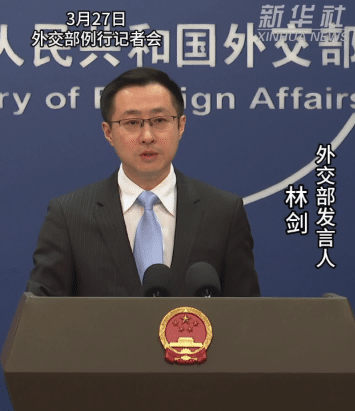
Lin Jian during the March 27 press briefing.
The “chilling effect” referenced by Lin Jian, in Chinese, is hán chán xiàoyìng (寒蝉效应), referring to a climate of fear in which people do not dare to speak out.
While xiàoyìng simply means “effect,” hán chán (寒蝉) literally means “a cicada in cold weather”—a metaphor for a repressive environment, as cicadas fall silent and become inactive in colder temperatures.
From MFA Briefing to Trending Topic
Following the press briefing, major Chinese news outlets like Xinhua and Global Times picked up the news and amplified the MFA statement across both their international and domestic channels, after which it quickly entered the top five “hot search” lists on platforms like Bilibili, Kuaishou, and Baidu. The MFA statement was also covered by Newsweek.
What is particularly noteworthy about how this news entered the online discourse is that it was reported solely through top-down, official channels. Unlike many incidents involving Chinese nationals overseas—particularly in cases of sudden death or personal tragedy—it did not first surface on social media through posts by friends or family members before prompting an official response. Nor were there any identifiable reports from local news or overseas Chinese community platforms that broke the story before the MFA did.
This left many questions about which university this researcher was affiliated with, where the incident occurred, and why the CCTV reporter asked this question on March 27 without any published news reports to go by.
Some have argued the Chinese government deliberately amplified the story to stir anti-American sentiment amid broader US-China tensions — a claim made, without supporting evidence, by the notoriously biased Epoch Times outlet.
🔍 Given the lack of details, Weibo’s own AI chatbot attributed the incident to the death of Li Haoran (李昊然). Li was a postdoctoral researcher at Princeton University who died at home in September 2025. On February 13, 2026, his death was officially ruled a suicide. Since this case predated the current report and has never been linked to law enforcement questioning, this appeared to be a hallucination error by the Weibo chatbot.
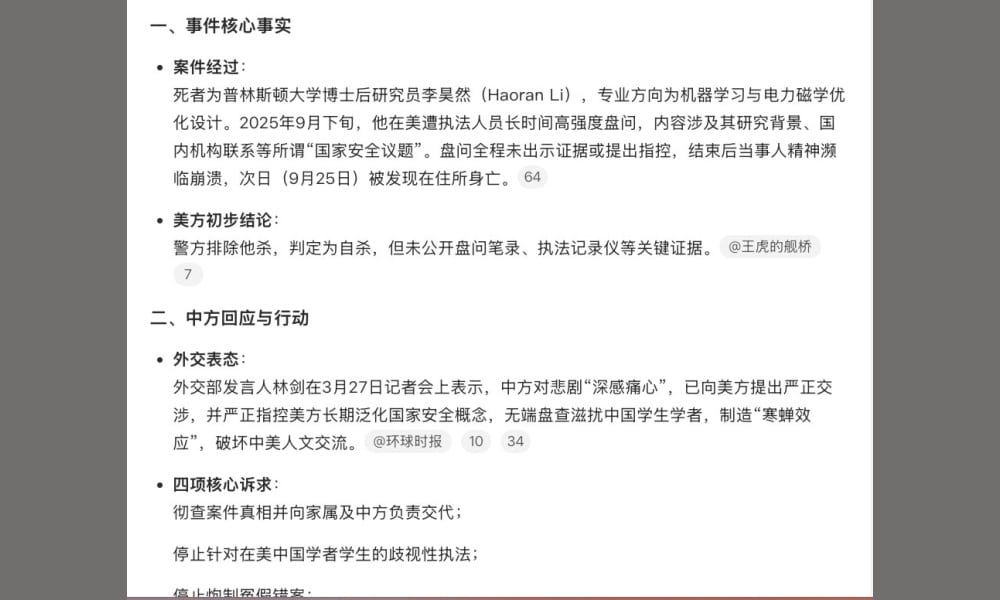
Weibo chatbot “hallucinating” and linking the current case to Li Haoran. Screenshot by author, March 27.
At the same time, claims popped up on social media regarding a recent suicide involving a researcher in the Department of Electrical & Computer Engineering (ECE) department at the University of Michigan.
One US-based Xiaohongshu user shared a screenshot of an email sent by University of Michigan staff on March 20 regarding the “sad news of the death of an Assistant Research Scientist (..) who fell from an upper story of the GG Brown building last night.”
The social media post, as well as an entire thread on another US-based Chinese community forum, had vanished by Monday, March 30, returning a “404” message.
The Michigan connection was also indirectly raised by some netizens (such as “Science Futurist” @科学未来人), who referenced earlier cases where Chinese researchers at the University of Michigan were allegedly “arrested, humiliated, and tormented.”
(🔍 Although there have been multiple incidents involving Chinese researchers at the university, this particular commenter referred to postdoctoral fellow Jian Yunqing (简云清), who was arrested by the FBI in June 2025 on charges including conspiracy and smuggling small samples of “toxic biological materials” into the US. This involved a crop-affecting fungus studied by Jian that, while also found in US fields, is illegal to import without a permit and is classified as a hazardous biological pathogen.)
Meanwhile, at the time of writing, few reports have emerged identifying any key details of the current case, and this lack of information surrounding the incident, both on the American and Chinese sides, is especially noteworthy for a case that has been framed as a major incident and a significant development in Sino-American academic exchanges.
The Michigan Connection
On March 31, the Chinese Consulate General in Chicago issued a statement via its WeChat account, responding to media inquiries regarding a Chinese scholar’s suicide following questioning by US law enforcement.
🗣️ The spokesperson confirmed that the case had occurred at a US university within its consular district, reiterating the sentiments expressed by the MFA and again using the term “chilling effect” (寒蝉效应, hán chán xiàoyìng). The statement criticized what it described as the US side’s use of “national security” to carry out unwarranted and politically motivated questioning and harassment of Chinese students and scholars.

Wechat post by Chinese Consulate in Chicago, March 31.
The Hong Kong newspaper Sing Tao Daily then connected the case to the University of Michigan’s ECE department, citing the aforementioned internal email and reporting that a local researcher died after falling from a height on the university’s North Campus.

The G.G. Brown Building, where the incident allegedly happened, when it was still under construction in 2013, photo by Michael Barera via Wikimedia Commons.
The deceased researcher was reportedly an Assistant Research Scientist on the team of Professor Zetian Mi, who specializes in semiconductors, nanomaterials, and optoelectronic technologies.
Professor Mi has been previously honored for his contributions to the growth of wide bandgap semiconductor materials, and leads a top-tier semiconductor research group that has received millions of dollars in funding from the US Department of Defense, published groundbreaking research, and earned prestigious awards in photonics and semiconductor science.
A Researcher at the Intersection of US–China Science
One Assistant Research Scientist previously listed on the official ECE website—who worked in Mi’s lab but has now been removed from the public staff list—is Dr. Wang Danhao (汪丹浩).
Wang’s research focused on next-generation semiconductor materials, including ultra-thin and ferroelectric systems with applications in electronics and photonics. He was previously part of a University of Michigan research team that explained why a new class of ferroelectric semiconductors can sustain opposing electric states without breaking apart—work published in Nature and supported by US funding sources, including the Army Research Office.
Over the years, Wang has built an extensive body of research published in some of the most prestigious scientific journals, including Nature Electronics, Nature Communications, and Science Advances.
More recently, Wang was listed as a co-first author on a study—covered by various industry publications—regarding a neuromorphic vision sensor capable of sensing, storing, and classifying images without external circuits, reportedly achieving over 95% recognition accuracy. The research was led by Professor Sun Haiding’s iGaN lab at the University of Science and Technology of China (USTC) and funded by Chinese government sources, including the National Natural Science Foundation of China.
Various Chinese sources have described this research as a breakthrough, noting that USTC developed the first optoelectronic diode integrating sensing, memory, and computing in a single device (“中国科大研制出首个具有感存算三合一功能的光电二极管”) (USTC link and news sources here and here).
According to Washtenaw County vital records, Wang Danhao died on March 20, 2026.
On that very same day, the research he contributed to (“A single diode with integrated photosensing, memory and processing for neuromorphic image sensors”) was published in Nature Electronics.
Wang’s profile, spanning research of interest to military and defense institutions, reflects involvement in both US-funded semiconductor projects (including work supported by the Army Research Office & within a DARPA-funded lab), as well as collaboration on Chinese government-funded research with a Chinese state university. This cross-institutional, cross-funded research highlights the increasingly complex and sensitive position of researchers operating across the US–China scientific landscape.
From a Mysterious Case to Serious Concerns
For now, many questions still surround this case, with official reports—from both the American and Chinese sides—likely to follow. At the time of writing, neither US government agencies nor the University of Michigan have publicly responded to the MFA statement or the Chicago consulate statement.
What we do know, and what is supported by prior studies, is that many Chinese researchers feel pressured and unsafe while carrying out academic work in the US, partly due to concerns about government investigations targeting researchers of Chinese origin.
In this recent case, Chinese online responses reflect that sentiment.
In some of the more notable discussions on Zhihu (such as this thread), users comment on the case’s mysterious nature while also linking it to a broader pattern of scrutiny and pressure on Chinese researchers in the United States.
These discussions reference past FBI investigations of Chinese academics under the so-called “China Initiative,” a 2018–2022 program launched by the US Department of Justice to counter espionage and intellectual property theft involving China.
🔍 One case mentioned is the 2024 death of Northwestern University Chinese-American neuroscientist Jane Wu (吴瑛), who died by suicide following years of federal scrutiny over her China-related ties, during which her lab was shut down, and her academic presence was later removed online.
In this context, some commenters also express skepticism about the suicide narrative in the current case. One popular comment stated:
💬 “Former Boeing quality manager and whistleblower John Barnett once publicly stated that if anything were to happen to him, it would not be suicide. On March 9, 2024, he was found dead in his car in a hotel parking lot in Charleston, South Carolina. The official ruling was suicide. He had been scheduled to testify that day, exposing issues related to Boeing’s production quality.”
Another commenter—a graduate of Peking University—argued that the US is no longer seen as a safe destination for Chinese researchers:
💬 “No matter how you look at it, he had already made it to the postdoc level, traveled all the way across the ocean only for things to end like this, it’s so unfortunate. Looking back now, the three years of the pandemic mark a very clear turning point. The “Bald Eagle” (白头鹰 – the US) is no longer an ideal destination for Chinese students, and is gradually no longer an ideal place for academic exchange and research either.”
At the same time, institutional responses are also taking shape.
🗣️ Dr. Nick Geiser, leader of the University of Michigan Postdoctoral Researchers’ Organization (UM-PRO), the union representing 1,500 postdocs, told Eye on Digital China they are currently bargaining with the university.
The union is preparing a proposal on international scholar rights that would ensure foreign postdocs are supported by the university in cases of abrupt funding cuts or warrantless investigations by US federal authorities.
This is a developing story. At the time of writing, there is no official confirmation that Wang Danhao is the individual referenced in this case. Any important updates will be added here as more information becomes available.
UPDATE April 3:
A news report by local news website MLive has come out earlier today, including additional information on this case.
In an April 1 email, Deputy Police Chief and Public Information Officer Melissa Overton stated that the researcher “jumped from the third floor and fell to the second floor inside the atrium in the George G. Brown Building on March 19.” He was later pronounced dead, and police — first called about 11 p.m. on March 19 — are investigating his death as a “possible act of self-harm.”
Paul Corliss, assistant vice president for public affairs and internal communications at the University of Michigan, has also issued a statement in an April 3 email, writing that: “Our priority is to honor the wishes of the family and those affected while adhering to legal requirements and ensuring that any information shared is accurate and non-speculative.”
An earlier internal email, sent out to the Michigan Engineering community on April 1, confirmed the passing of Wang Danhao (Dr. Danhao Wang), and stated that there is an active police investigation going on, with no further information to share.
The statement described him as “a promising and brilliant young mind,” whose research into wide bandgap III-nitride semiconductor materials and devices published in Nature “stands as a landmark, uncovering for the first time the switching and charge compensation mechanisms of emerging ferroelectric nitrides.”
The UM Postdoctoral Researchers Organization, the union that represents postdoctoral researchers, is advising its membership not to speak with federal authorities.
If you or someone you know is struggling, international mental health and crisis support helplines can be found at www.befrienders.org.
By Manya Koetse
(follow on X, LinkedIn, or Instagram)
Note: In Chinese, names are written with the surname first, followed by the given name (e.g. Wang Danhao, Mi Zetian). In English-language contexts, this order is usually reversed (e.g. Dr. Zetian Mi, Dr. Danhao Wang).
©2026 Eye on Digital China/Whatsonweibo. All rights reserved. Do not reproduce our content without permission – you can contact us at info@whatsonweibo.com.
China Arts & Entertainment
“Auntie Mei” Captured After 20 Years, China’s Train-Stain Scandal, and Zhang Xuefeng’s Final Lesson
The major talking points on Chinese social media this week: from the capture of a notorious child trafficker and unexpected death of Zhang Xuefeng, to one of the most expensive Chinese music video ever made.

🔥 China Trend Watch (week 12½ | 2026) Part of Eye on Digital China by Manya Koetse, China Trend Watch is an overview of what’s trending and being discussed on Chinese social media. This edition was sent to paid subscribers — subscribe to receive the next issue in your inbox.
This is about “Teacher Zhang Xuefeng” (张雪峰老师, 1984), the man who carved out a big place for himself in China’s online landscape over the past decade by focusing on a sweet spot that virtually all Chinese parents and their children care about: how to choose majors strategically to ensure future employment prospects.
Among Zhang’s common questions: “What kind of salary do you want your child to have in the future?”
Besides the relevance of his focus, Zhang’s northeastern accent, comic remarks, blunt criticism, and talent for triggering controversy also amplified his online appeal, ensuring that his name frequently became part of China’s public discourse.
Like that time when he advised China’s young people against studying journalism, even stating that if he were a parent, he would “definitely knock the child unconscious if they insisted on studying journalism,” deeming it a major that lacks depth and prospects. Although it became a major controversy at the time, a poll of 42,000 voters showed that 39,000 agreed with Zhang.
Zhang capitalized on the collective anxiety in China surrounding the gaokao (高考), the national university entrance exam that determines future paths, as well as concerns that even graduates from top universities may face unemployment if they choose majors with limited practical value. Zhang’s view: choice is more important than effort.

This Tuesday evening, news emerged that Zhang Xuefeng had died on the afternoon of March 24 at the age of 41, after suffering sudden cardiac arrest.
His death has had a huge impact on Chinese social media, where many people are responding with disbelief and shock.
It’s not just that Zhang was widely known (and while not everyone liked him, many respected him)—it’s perhaps also the fact that he spent so much of his life advising others on how to control their careers and income, building great personal wealth in the process, only to die so young, at the peak of his career, with no strategy to protect him.
Besides being “chronically overworked,” Zhang also pushed himself to exercise and run frequently. Adding to this, he had been under pressure since last fall, when he became a target of official criticism and platform regulators.
Isn’t it ironic that, in the end, the most important takeaway Zhang might leave behind is not his advice on choosing majors or making smart career moves, but rather the reminder to sometimes step away from the rat race and appreciate everyday life and health, because you never know when it might all end.
Zhang leaves behind his wife and 11-year-old daughter.
Let’s dive into some of the other trends that have been major talking points this week.
Quick Scroll
-
- 🧠 China has approved a coin-sized brain–computer implant for commercial use in people with spinal cord injuries. Developed by Shanghai-based company Neuracle Medical Technology (博睿康) in collaboration with Tsinghua University, the so-called “NEO” is the world’s first market-approved brain implant designed to help people with severe paralysis regain hand motor function.
- 🚨 Lei Siwei (雷思维), Vice-Governor of Gansu and member of the provincial Party Standing Committee, is under investigation as of March 17, with the notice issued by China’s top anti-corruption body citing “serious violations of discipline and law.” The case is the latest in an ongoing series of provincial-level anti-corruption actions that’ve been continuing into 2026.
- 📚 Several Chinese provinces and cities are removing biology and geography from high school entrance exams starting from next year, as part of a broader government-initiated campaign to reduce pressure on students and put a stop to “educational involution” (教育内卷).
- 👀 Taiwanese actor-singer Jerry Yan (言承旭), best known as Dao Mingsi from Meteor Garden and a member of F4, is at the center of somewhat of an authenticity crisis after fans photographed his concert teleprompter showing not just lyrics, but scripted emotional cues for his performance like “your eyes slightly reddening” and “now you take a deep breath.”
- 🎮 More than 100 Chinese universities are offering esports majors nowadays, sparking online discussions this week. These programmes go far beyond just playing video games, covering esports operations, management, data analytics, game design, etc, reflecting the growing professionalisation of China’s esports industry.
- 🎓 A feature by Chinese magazine Sanlian Life Weekly (三联生活周刊) went trending for highlighting a sharp gender shift in China’s higher education demographics, with female students now outnumbering men at universities. Female undergraduate enrollment grew by 348% between 2002 and 2022.
- 🧪 A laboratory explosion at Chongqing University on March 20 killed one student and injured three. Initial findings point to improper handling of chemicals.
- 💔 China’s superfamous actress Yao Chen (姚晨) and filmmaker Cao Yu (曹郁) jointly announced their separation on Weibo in a poetic way, using classical Chinese language: “A journey through mountains and rivers, a blessing for three lifetimes. Fate comes and goes, all is joy” (山水一程,三生有幸。缘来缘去,皆是欢喜). A related hashtag received 300 million views.
What Really Stood Out This Week
Chinese Woman Who Sold Abducted Toddlers Captured After Two Decades

A woman who played a key role in a series of China’s notorious child trafficking cases, causing relentless suffering for many families, has finally been caught after being on the run for two decades. The arrest of the woman, referred to as “Mei Yi” or “Auntie Mei” (梅姨), has dominated Chinese social media over the past week, ever since Guangzhou police announced on March 21 that they had finally captured her.
This story touches upon multiple issues that have turned it into such a major topic.
Mei Yi was involved in a series of child trafficking crimes carried out by a gang led by Zhang Weiping (张维平) and Zhou Rongping (周容平) across multiple areas in Guangdong province between 2003 and 2005. She acted as a middleman responsible for transferring and selling abducted children, mostly toddler boys. In just over two years, the group abducted and trafficked nine young children.
The parents of these boys never stopped searching for them, while Chinese authorities worked for years to crack the case. In 2016, eleven years after the last abduction, police arrested five core gang members, including Zhang, who later confessed and revealed that the person reselling the children was a local elderly woman nicknamed “Mei Yi.” However, her real identity and whereabouts remained unknown for years. Zhang Weiping and Zhou Rongping were both sentenced to death and executed in 2023.
Thanks to new technologies—from digital tracking systems to DNA matching—the abducted children were located one by one and reunited with their biological families over the years: the first in 2019 and the last in 2024. By then, the boys were roughly between 14 and 21 years old, meaning they had spent nearly their entire childhoods with the families who had bought them.
Evading Capture by Being Ordinary
One aspect of this case drawing attention is not just how Mei Yi was caught, but how she managed to evade arrest for so long. The crimes took place more than twenty years ago, in factories, rental housing, and other areas with dense migrant populations, leaving very little traceable evidence. It is also unclear how accurate the composite sketch of Mei Yi—circulating since 2017 and updated in 2019—actually was. Authorities have not released a confirmed photo following her arrest, and it is possible her real appearance differed significantly from the sketch.
A lawyer close to the case told Chinese media outlet The Paper that what made her so hard to catch was probably not how clever her tactics were, but that she appeared so normal to those around her, who might have never guessed she was a criminal. Besides arranging illegal “adoptions,” Mei Yi also acted as a local matchmaker and fortune teller, and she even lied about her identity and used aliases with someone who was her partner for two years.
Official media do not disclose exactly how Mei Yi was eventually tracked down, but it’s clear that the authorities got much closer after all the abducted children were found in October 2024, undoubtedly leading to important clues that connected all the cases.
Not Such a Happy Ending
Chinese state media have largely framed the case as a story of justice served: Mei Yi as a long-sought villain, the police as persistent heroes, and China’s advancing technology as the key to solving the case. A kind of “happy ending.”
But the truth seems more complicated, with a loud silence surrounding nine families where the abducted boys spent their entire childhoods. Their willingness to pay for a male child is part of a broader issue linked to China’s one-child policy, relatively light penalties for buyers of trafficked children (or even legal limitations due to statutes of limitation), and a deeply rooted son-preference culture that was especially strong in those years 2003- 2005.
Some online commentators did argue to “not let those hypocritical ‘adoptive parents’ off the hook.” Yet the situation is complicated by the fact that some of the boys still consider these families their parents, and in some cases choose to stay with them rather than return to biological families they barely remember.
The fact is that Mei Yu is just one chapter in a much larger story that is far from finished.
Just earlier this week, the story of another abduction case also went trending. It concerns a man named Du Jun (杜军), who was abducted in 1991 at the age of 3 while playing outside a shop with his sister. Du Jun, who spent 35 years separated from his biological family, finally reunited with his biological mother following a successful identification process that is part of a continuing series of long-separated family reunions facilitated by China’s expanding DNA-matching and digital tracking systems.
Du, now 38, had not known he was trafficked as a child, nor that his biological family had searched for him for years. He became an orphan at a young age and built a life for himself. He was found through online search efforts, the dedication of volunteers, DNA research, and a specific detail only his biological family knew: that he had a bend at the joint of his left middle finger because of an accident as a toddler.
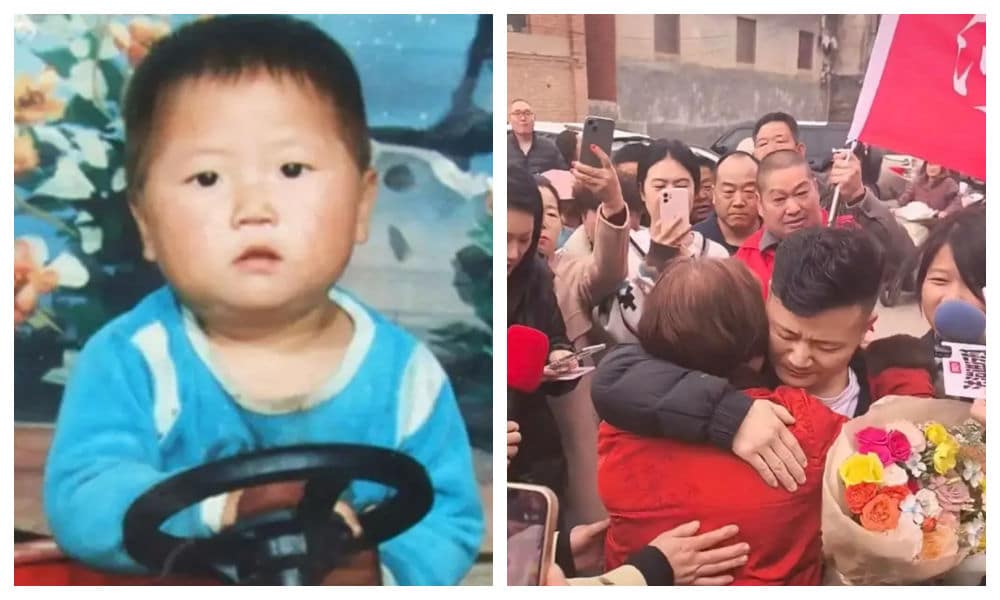
Du Jun as a young child before his abduction, and Du Jun reunited with his biological mother in 2026. Images via Hongxing Xinwen.
As with the nine abducted boys, Du Jun’s reunion with his family does bring light to a long, dark tunnel – but it doesn’t bring back the missed childhood, the shattered families, and the endless, tear-filled years.
Let’s hope many more “Mei Yis” will be brought to justice in the years ahead.
A Censored Menstruation Train-Incident

Another story that became a major talking point on Chinese social media this week involves a woman named Ms. Zhang, who was charged 180 yuan (US$26) after accidentally staining a bedsheet on a sleeper train. The woman unexpectedly got her period while traveling overnight to Lanzhou and was unable to obtain any sanitary products on board. A train attendant asked her to either wash the bedsheet herself or pay compensation.
The woman, who ended up washing the sheets herself by hand in cold water, later shared her experience on social media and suggested that all trains should sell sanitary pads. Her post resonated with many, and even though she took it offline, it was quickly picked up by Chinese media.
After the post went viral, Lanzhou Railway issued an official statement on March 20, presenting its version of events and challenging some of the woman’s claims.
The statement included details that depicted staff as helpful, such as an attendant allegedly offering to wash the sheets and a conductor searching for sanitary pads (but finding none). At the same time, it used seemingly accusatory language, repeatedly describing the woman’s menstruation as having “contaminated” (污染) the bedding as well as two other spots where she had sat.
Zhang did not accept this explanation and again turned to social media (under the username @勇敢小狐不怕困难) to reveal what she said had been happening behind the scenes. She shared that someone from Lanzhou Railway had repeatedly messaged her privately, asking her to delete her posts, claiming that employees’ jobs were at risk because of the incident, and even offering her money—which she refused, despite ultimately taking the post down.
Zhang further suggested that her posts were “disappearing as soon as they were published,” that the media narrative was being controlled, and that she had been pressured into silence.
On Xiaohongshu and Weibo, many users sided with Zhang. The wording used by Lanzhou Railway struck a chord, particularly the framing of menstruation as “contamination” while simultaneously blaming Zhang for staining multiple areas, despite not providing any sanitary products.
“Where exactly was she supposed to sit?” one Xiaohongshu user asked. “In the aisle? On a suitcase? Squatting by the toilet door? Lying on the floor?”
One major reason why this debate exploded online is not just the media discourse itself, but the way it taps into broader frustrations among Chinese women over social taboos and structural shortcomings surrounding menstruation in public spaces.
Over the years, various incidents involving menstrual products have gone viral and sparked grassroots efforts to change the current situation.
In 2022, a female passenger also expressed her frustration online about sanitary pads on high-speed trains, drawing online attention. Many commenters, mostly men, argued that pads weren’t “essential items” and shouldn’t take up retail space onboard. The railway authority’s official response—describing sanitary pads as “personal items” that don’t need to be sold—only worsened online outrage.
For many women, these kinds of incidents, from trains and schools to planes, highlight how little society apparently understands or respects their basic needs.
On the Feed
“The Most Expensive Music Video in the History of Mandopop”

Whenever there’s new music by the Taiwanese producer, actor, composer, singer-songwriter, and ‘King of Mandopop’ Jay Chou (周杰伦), it goes trending.
Not only does his music bring back memories of the early 2000s – when he first rose to prominence and became super popular – but his catchy tunes and lyrics also resonate with younger audiences.
But it’s not just the music that makes waves – it’s also the music videos that have become artistic and sometimes spectacular productions by themselves. “Other artists just make a music video, he turns it into a movie,” some commenters wrote after the release of his 2022 Greatest Work of Art video.
On March 24, the music video (MV) for the lead single Children of the Sun (太阳之子) dropped, a production made in collaboration with Wētā Workshop, the New Zealand-based visual effects studio known for its work on Avatar and The Lord of the Rings.
The music video shows Jay Chou in a fictional European world spanning from the 16th to the 20th century, filled with references to famous art, from Vincent van Gogh and Dali to Mona Lisa, Ophelia, and The Anatomy Lesson of Dr. Nicolaes Tulp by Rembrandt (Jay Chou appears in the painting himself).
The cost of the music video production reportedly exceeded 20 million yuan (US$2.9 million), and some commentaries described it as the most expensive MV in the history of Mandarin-language pop music.
Eye on Digital China is a reader-supported publication by
Manya Koetse (@manyapan) and powered by What’s on Weibo.
It offers independent analysis of China’s online culture, media, and social trends.
To receive the newsletter and support this work, consider
becoming a paid subscriber.


Chinese Postdoc Death Raises Questions as Key Details Remain Missing

“Auntie Mei” Captured After 20 Years, China’s Train-Stain Scandal, and Zhang Xuefeng’s Final Lesson

Raising Lobsters, 6G Coming, and China’s DIY Deity Trend

Two Sessions, a Celebrity Meltdown, and the Rise of China’s “Forget It” Mindset

Inside the Great Chinese Debate Over the Iran War

Inside Chunwan 2026: China’s Spring Festival Gala
Inside the Great Chinese Debate Over the Iran War

Spring Festival Trend Watch: Gala Highlights, Small-City Travel, and the Mazu Ritual Controversy

Chinamaxxing and the “Kill Line”: Why Two Viral Trends Took Off in the US and China

From a Hospital in Crisis to Chaotic Pig Feasts
-

 Chapter Dive9 months ago
Hidden Cameras and Taboo Topics: The Many Layers of the “Nanjing Sister Hong” Scandal
-
 China Insight8 months ago
“Jiangyou Bullying Incident”: From Online Outrage to Offline Protest
-
 Chapter Dive11 months ago
Understanding the Dr. Xiao Medical Scandal
-

 China Arts & Entertainment6 months ago
The Wong Kar-wai Scandal Explained: The Dark Side of ‘Blossoms Shanghai’