China Celebs
CCTV’s New Year’s Gala 2016 Liveblog
It is time for the CCTV New Year’s Gala, Chunwan in short, the special annual evening variety show that captures millions of viewers on the night of Chinese New Year. Read all about the ins and outs of the 2016 edition here.
Published
10 years agoon
WHAT’S ON WEIBO ARCHIVE | PREMIUM CONTENT ARTICLE
It is time for the CCTV New Year’s Gala, Chunwan; the special annual evening variety show that captures millions of viewers on the night of Chinese New Year. What’s on Weibo provides you with the ins & outs of the 2016 Gala and its social media frenzy, with updates before, during and after the show. *After the live stream of the Gala, we have added most of the videos of all the show’s acts (yes, also the robots) into this blog so you can (re)watch them. The live blog is now closed.* [Premium content]
CCTV Gala Liveblog Updates Chinese Time Zone UTC+8
17:00 Three hours before the show starts! What can we expect tonight? According to the directors, it will be all about singing and dancing today; about 80% of the show’s performances are music and dance. One of the Gala’s directors, Zou Wei, tells CCTV: “We’ve come up with some innovative approaches for the song and dance numbers. We’ll also be moving and changing the stage a lot. The audience will get a very refreshing take. Ninety percent of the song and dance programs are newly created; the remaining 10 percent are a salute to the gala’s past classics.” Besides dance and music, there will also be acrobatic performances and comedy sketches (‘crosstalk’).
17:30 2,5 hours to go. The theme of this year’s CCTV Gala is “You and Me, Our Chinese Dream – Building a Moderately Prosperous Society”. Every year the Gala has a different theme. Last year’s theme was “Family Harmony Yields Success”. The CCTV Gala is known for its political messages, as it is a way for the government to reach an audience of millions.
18:30 There will be a total of 37 acts in tonight’s gala. Amongst the performers are many veterans who have performed at the Gala before, but there are also newcomers, such as the TFBOYS, one of China’s most popular pop groups – they will be performing at the show for the first time. They have a fanbase of nearly 7.5 million on their official Weibo account.
18:45 The TFboys are in the building! The three boys looked somewhat nervous as they entered the Gala venue earlier today. The popular boy band will perform in tonight’s during the show as the 5th act. They told the host their families have all come to Beijing to celebrate the New Year together, eating and exchanging hongbao (red envelopes). When the host asked them how much money was in the hongbao they received from their parents, they did not really want to answer. They might be the ones giving their parents hongbao now..

19:00 One hour to go! This year’s gala will be extra special, because it has four extra venues apart from the main one at the CCTV Beijing studio. The additional venues are in southeast China’s Quanzhou city, northwest China’s Xi’an city, south China’s Guangzhou city and Hulun Buir city in Inner Mongolia Autonomous Region, representing the east, west, south and north of China: a gathering of the whole country.
19:30 Just thirty minutes before the start of the show. Tonight’s Gala will be presented by well-known CCTV faces. In the Beijing main venue the gala will be hosted by a total of six presenters, three men and three women, namely: Zhou Tao (周涛), Zhu Jun (朱军), Dong Qing (董卿), Sa Beining (撒贝宁), Li Sisi (李思思) and Nigel Amat. All of them presented the CCTV Gala before, the 51-year-old Mr. Zhu Jun has hosted the gala since 1997. The other venues in Xi’an, Guangzhou, Hulun Buir and Quanzhou will be hosted by, amongst others, Zhu Xun, Ma Yue, Li Jiaming and Ren Luyu, along with some newcomers from local TV stations.
19:50 The biggest show of the year is about to start! The chief director of today’s show is Lu Yitao. Just 38 years old, he is the youngest chief director of the Spring Festival Gala ever.
20:00 Here we go. The opening act is a dance performance called “Spring brings Good Fortune” by, amongst others, actress Yan Ni (闫妮, dressed in blue) and other movie stars. The dancers in the background just formed the shape of ‘fu’, the character for prosperity. The hosts of the night welcome the audiences to CCTV’s 2016 Spring Festival Gala.
20:15 Zhou Tao and Zhu Jun are the first hosts to welcome everybody. They represent the older CCTV generation, having presented the Gala multiple times since 1997.
The CCTV Gala is an annual event since 1983. This year is extra special for the several venues where the Gala is aired: Quanzhou city, Xi’an city, Guangzhou city and Hulun Buir city. Every city has its own hosts, welcoming the audiences in their own local dialect or language.
The second act tonight is a joined act by the two famous bands Phoenix Legend and Jiuye Qiji (玖月奇迹), who sing about “A Beautiful China Rises” (美丽中国走起来). Most of the songs presented tonight are new works made for the CCTV Gala. The performers on the left are the musical performers named ‘Phoenix Legend’, the right band is Jiuye Qiyi.
20.20 Most of the performances tonight are dance and singing, but there will be a total of 7 spoken acts. This short sketch is called ‘Happy grandpa’, performed by Feng Gong (冯巩) who is a familiar face at the CCTV Gala. The sketch is about spending New Year’s Eve, although some netizens seem to have no clue what it was actually about..
20.30 “Let’s Follow the Path of Peace” is a song sung by Chinese singer Zhang Ye (张也, 47 years old). She is especially famous in China for her song “Into a New Era” (走进新时代).
In the meantime, the Gala has become the number one trending topic on Weibo, together with the TFboys, who will soon perform in the show.
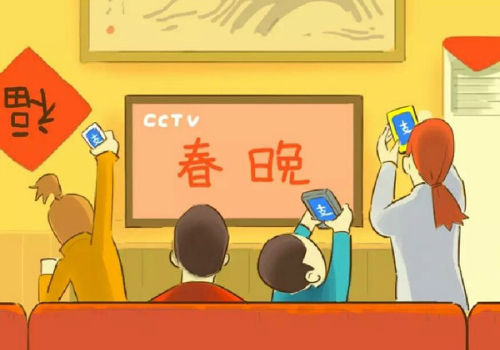
20.40 Time to shake your mobile phone! Viewers of the Gala can shake their smartphones to grab a hongbao (red envelope) from CCTV. This is a game that was first introduced last year as a cooperation between WeChat and CCTV.
Here we go for the much-anticipated act of the TFBoys. Aged around 13/14 years old, they are one of China’s most popular acts, often becoming a trending topic on Weibo. They perform together with Yueliang Jiejie, presenter of a children’s show. They are accompanied by dancing cartoons – all China-made.
I am not sure if everybody heard it, but during their act the sound went terribly off during the live broadcast.
20.50 The sixth act of the evening is a short sketch called “Don’t worry” by Sun Tao and other actors about scamming practices per phone in China, and people being oversensitive to being afraid of people cheating you- even when they are not. This act, that is liked by most netizens, is followed by a special performance by different singers from Mainland China, Hong Kong and Taiwan who sing about the ecological heritage of China in the song “Beautiful mountains and rivers of China” (山水中国美). Some of the singers sing in their local dialect. The woman in yellow is the famous Gigi Leung from Hong Kong.
During the show, there seem to be some problems with the sound system. If things would really go wrong, the show has a taped version of the full dress rehearsal. The tape runs together with the live broadcast, so that in the event of a problem or disruption, the producers can seamlessly switch to the taped version without TV audiences noticing anything. We would probably not even know if we were watching the live or the taped version!
21.10 The 8th act of the night will not be performed in the Beijing main location, but in southeast China’s Quanzhou city. It is a song called “Happy Thought of You” (快乐想念). The dancing puppets are typical for the region.
This puppet performance interesting change of pace. Usually when I see puppets perform on CCTV the strings are not so obvious.
— Jeremiah Jenne (@GraniteStudio) February 7, 2016
This performance is followed by a quite stunning dance act by the Atlanta Morningstar dance school by overseas Chinese.
21.30 2.5 hours to go until Chinese New Year! We first see a short film followed by the 11th act; one of the few short sketches of the night called “The General and the Soldiers”. The video of marching troops and the sketch about China’s troops and army life in preparation for the 2015 parade show a strong China. One of the actors is the famous actor Hou Yong (Weibo), who has performed at the Gala two times before. In the sketch, roles are reversed as the soldier teaches the general how to do it right – suggesting equality amongst the people of different positions and sending out a clear message to corrupt officials: don’t forget to be a good communist.
Presenter Dong Qing, in a beautiful red dress, honors China’s veterans, with one old veteran being honored on stage.
21.45 Singer Lei Jia (雷佳) performs the song “I want to tell you” (多想对你说). According to the CCTV, it has always been her dream to perform at the Gala. Her dream has already become a reality multiple times, as she has become a familiar face in the show. The song has been specially produced for the Gala. In the background, we see 55 different ethnic minorities of China in traditional dress, a recurring feature of the annual Chunwan.
The 13th act of the night takes place in Xi’an, one of the four alternate locations where the Gala is taking place tonight. Impressive drums, similar to what we saw during the opening act of the 2008 Beijing Olympics, are followed by the song “The Silk Road”, promoting the success of China’s Go West policy.
The only piece of Chinese opera in this year’s show is part of the Journey to the West (act number 14), in which the main character is the Monkey King.

22:00 We have arrived at the 15th act, are you still awake?! Two more hours before New Year’s! This act is shown as a part of showcasing Chinese cultural heritage, introducing the loud Huayin singing style (华阴老腔) at the Gala, with main performances by the pretty Tan Weiwei (谭维维) and Zhang Ximin (张喜民). The 34-year old Tan was the runner-up of the third season of Super Girl, a popular singing contest in China.
22.15 The next act is one of the seven spoken acts of the night, a comical skit about a courier played by several well-known actors.
Meanwhile, complaints about the show are pouring in through social media. It is somewhat of a tradition to comment on the show and complain about it; criticism on the Gala is actually so commonplace that the sentence “there’ll never be a ‘worst’, just ‘worse than last year‘ (央视春晚,没有最烂,只有更烂) has become a popular saying over the years. One of the current critiques is that Liu Xiao Ling Tong (六小龄童, see photo below), the most famous performer of the Monkey King, was not invited to participate in the Journey to the West act.

22:25 “Father and Son” (父子) is supposed to strike the audience’s emotional chord tonight. Singer Yang Yang is one of the more popular acts of the night, attracting younger audiences to watch the show, together with the TFboys. Yang Yang has become especially popular over the last two years. Here, he sings together with famous singer Tong Tiexin. The song is followed by a “public welfare commercial” (公益广告) about the bond between father and son.
*FYI: We are supposed to reflect on our lives and cry here*
22:35 This is the only martial arts act of the night by Donnie Yen or Zhen Zidan (甄子丹) and the Shandong martial arts group. Donnie Yen is a famous Hong Kong actor and martial artist.

22.45 Amazing display of communist nostalgia during the 20th act of the night, with a performance of different revolutionary songs including the old ‘Without the Communist Party, There is No New China’ (没有共产党就没有新中国), ‘The Bright Red Flowers of Shandan’ (山丹丹花开红艳艳) and ‘The Motherland’ (我祖国). Although the majority of tonight’s compositions are new songs, these are old songs that most Chinese will be very familiar with, especially those growing up during the cultural revolution.


22.50 We have moved from Beijing to Guangzhou for the 21st act of the CCTV Gala. Together with Quanzhou city, Xi’an city and Hulun Buir city, Guangzhou is one of the different alternate venues from which the show is broadcasted this year.
Don’t ask me why, but singer Sun Nan (孙楠) is now performing his song together with 540 dancing robots. He sings about the future ahead – this reinforces the image of Guangdong as the home of China’s tech startups.

23.00 While the noise of fireworks and crackers is starting to fill the streets all over China, we are seeing the only acrobatic act of tonight, performed by Li Tong and the Dengfeng Shaolin college.
23.15 In the final hour of the New Year’s Gala, there are some very famous performers on stage. In this comical sketch, we see actor Donglin Guo (郭冬临) – a Chinese actor and xiangsheng (comic dialogue) performer who always performs in the annual Gala. He has made appearances ever since the 1993 edition. The sketch is about 50,000 yuan that has ‘miraculously’ appeared on Donglin’s bank account, after which his wife accuses people of putting it there for favours. But then their daughters friend appears, and it turns out Donglin lend him money as he was setting up a software company, and this is the money he returned to him. This turns Donglin from a possible corrupt official into a good guy government official who believes in the future of China’s youth.
The comic dialogue is followed by one the night’s many dance performances. This one is title “In Your Embrace” by famous Uyghur dancer Mahire Emet (马依热·艾买提江). The dancers are dressed in traditional clothing, showcasing China’s many colorful & cheerful ethnic minority groups. They just seem to always be happy. It sometimes reminds me of Disneyland’s “It’s a small world after all…”

23.30 The last venue of the night is Inner Mongolia’s Hulun Buir city, where we see the hosts dressed in local traditional clothing and speaking some of the local language. It is interesting to see the contrast between the venue cities tonight, where some, such as Hulun Buit, are portrayed as being very ‘ethnical’ and others, such as Guangzhou (with the robots), is showcased as very modern, trendy and technical.
The act is followed by a performance of the famous Vicky Zhao. She is one of the bigger stars of tonight’s Gala. She is a Chinese actress, pop singer, and film director. An incredibly popular actress in various top TV shows in China, she is considered one of the top four actresses in China and is one of the most famous Weibo celebrities; she has over 73 million followers!
23.40 We have arrived at the 27th act of the night, and there are just twenty minutes left before the Year of the Monkey starts. Chen Sisi (陈思思) sings ‘Snow Love’ with performers from the Beijing Sports Academy – this, according to the hosts, is in honor of Beijing being the first city to host both the Summer and the Winter Olympics (2022).
23.45 This is the last spoken sketch for tonight, only followed by a xiangsheng (comic dialogue) just before the end of the show. This sketch is about internet shopping, and features Chinese skit actor Pan Changjiang. In his early years, he regularly appeared in the Gala.
23.55 Almost time for the New Year! The hosts first list all the country embassies wishing China a happy new year, before Yin Xiumei (殷秀梅) sings the song ‘Honor & Glory’: a moment to reflect on China, the great nation, and its leaders. In the video behind the singer, we see Mao Zedong and other leaders, with special focus on ‘Daddy Xi’.


0.00 Happy new year! The hosts wish everybody a Happy Year of the Monkey (and so does What’s on Weibo).
0.05 The New Year is welcomed with the song “Meeting Spring” by various famous singers such as the famous baritone Liao Changyong. The song is immediately followed by one of the evening’s “public welfare commercials”, in which the importance of family ties is emphasized – part of the China dream.
0.10 A young man named ‘Yif’ is tonight’s magician. Yif also seems to have done some magic on his own face. He is a professional magician from Taiwan. On his official Weibo account, he told his fans that he was incredibly nervous for tonight’s performance, as it is the first time he appears on the CCTV Gala.

The Gala’s hosts Zhu Jun and Zhou Tao announce the next act, which is a xiangsheng act. Xiangsheng, also known as ‘crosstalk’, is a traditional comic dialogue, which is mostly performed as a dialogue between two performers (in this case, by Li Yinfei 李寅飞 and Li Ding 李丁). The focus is on language jokes, which are sometimes hard to grasp for a laowai like myself. It is one of China’s most popular performing arts, and is typically performed in the Beijing accent. Some Chinese media wrote about the fact that this year’s Gala only features one xiangsheng act, as there previously were more. This year, the focus of the evening clearly is on song and dance.
0.20 We are nearing the end of the show, but not before the show puts more emphasis on the Gala’s theme: “You and Me, Our Chinese Dream – Building a Moderately Prosperous Society”. This song, titled “Small and Big Dreams” is sung by Wang Zineng and Ping An.
0.35 The last two acts of the night are the songs “Lucky Lucky” and “Unforgettable Night”. The first is sung by Sa Dingding 萨顶顶 who is joined by a dancing group from Yunnan.
The last song of the night is performed by various performers, bringing together some of the country’s major celebrities from different generations including the 71-year-old folk singer Li Guyi (李谷一) and the 8-year-old child star Zhou Anxin (周安信). They conclude the night with a song about their good homeland China. The hosts wish you all a happy new year.

0.45 That’s a wrap – happy new year 新年快乐!
About the Gala
The CCTV New Year’s Gala (中国中央电视台春节联欢晚会 or Chunwan 春晚) is an annual live television event that is broadcasted by state enterprise CCTV on the evening of Chinese New Year. It has been broadcasted since 1983, and is watched by over 700 million people. It is the most-watched variety shows in the world and is much anticipated every year – somewhat comparable to the Oscars or the Super Bowl. The Gala features different acts, including singing, dancing and comedy, in a time frame of around 4 hours.
It is a tradition for families to gather around the TV to watch the Gala before the New Year comes at midnight. It is also somewhat of a tradition to comment on the show and complain about it; criticism on the Gala is actually so commonplace that the sentence “there’ll never be a ‘worst’, just ‘worse than last year‘ (央视春晚,没有最烂,只有更烂) has become a popular saying over the years (Wang 2015, 192).
The 2016 Edition
This is the 34th edition of Chunwan (February 7th, 2016). This year the show lasts a total of 4 hours and 18 minutes, starting on 20.00 and ending 00.18.
This year’s show, like last year’s, has its own mascot. As this will be the Year of the Monkey, it is a colorful monkey named Kang Kang. The mascot was revealed on CCTV’s Weibo account on the evening of January 21st. The mascot was ridiculed by netizens, who thought it was ugly. The 3D design (image below, on the right) was different from the original sketch (left). According to the majority of Weibo’s netizens, the designers of the 3D version had mistaken Kang Kang’s paws for balls, resulting in a Kangkang with ‘tumors on his ears’.

The current version of Kang Kang as pictured below has been adjusted; he no longer has ‘tumors’ growing from his head.

Social Media
Chunwan is a hot topic on Sina Weibo and WeChat, as millions of people are watching and share their comments on the show through social media. The Gala’s official Weibo account has over 7,5 million followers. Sina Entertainment (17+ million followers) also writes about the show through their official Weibo account.
One important new feature of the show that links it to social media platforms is the exchange of hongbao, red envelopes with money, which is a Chinese New Year’s tradition (also read our article about Lucky Money). During the show, viewers are able to receive virtual hongbao by shaking their smartphones. This new cooperation between the CCTV Gala and the WeChat app first started in 2015. Last year, when the game was announced during the live broadcast, WeChat users shook their phones 11 billion times. The value of these monetary gifts was around 500 million RMB (76 million US dollar).
The hongbao game attracts more people to watch the show, which is often considered boring or old-fashioned by younger generations. This year the game will start again, increasing the Gala’s viewer ratings. One Weibo netizen comments: “Actually, there are many people who want to watch the Gala now. The reason is simple: it’s not for the show but for the red envelopes.”
The Live Show
Although the Gala is a live broadcast from CCTV’s No.1 Studio, every year’s show has a taped version of the full dress rehearsal. As described by Scocca (2011), the tape runs together with the live broadcast, so that in the event of a problem or disruption, the producers can seamlessly switch to the taped version without TV audiences noticing anything.
According to the CCTV, the committee members of the Politburo of the Communist Party of China already attended the full dress rehearsal on Friday night.
Please check out this blog on Sunday, February 7th, from 19.00 China Standard Time (CST) +0800 UTC (12.00 CET) for more information about the show and its programme. New updates will be added on the top of this page.
– By Manya Koetse
Follow @WhatsOnWeibo
References
Wang Ge. 2015. “Popular Spring Festival Gala language: Sociocultural Observations.” In Linda Tsung and Wei Wang, Contemporary Chinese Discourse and Social Practice in China, 185-200. Amsterdam/Philadelpia: John Benjamins Publishing Company.
Scocca, Tom. 2011. Beijing Welcomes You: Unveiling the Capital City of the Future. New York: Riverhead Books.
Featured image from ZZM3.com: http://www.zzm3.com/gear/rs/457.html
©2016 Whatsonweibo. All rights reserved. Do not reproduce our content without permission – you can contact us at info@whatsonweibo.com.
Manya is the founder and editor-in-chief of What's on Weibo, offering independent analysis of social trends, online media, and digital culture in China for over a decade. Subscribe to gain access to content, including the Weibo Watch newsletter, which provides deeper insights into the China trends that matter. More about Manya at manyakoetse.com or follow on X.
China Celebs
China Trend Watch: Quiet Nationalism, Loud Statements, and Nanjing Memorial Day
From war memory to viral eggs, salty cakes, an unfortunate dinner party and farewell to an iconic actress.
Published
2 months agoon
December 14, 2025
🔥 China Trend Watch — Week 50 (2025)
Part of Eye on Digital China. This edition was sent to paid subscribers — subscribe to receive the next issue in your inbox.
Welcome to the Eye on Digital China newsletter. This is the China Trend Watch edition — a quick catch-up on real-time conversations.
I’ve rounded up my latest China trip that brought me from Chongqing to Nanjing, Wuhan, Zaozhuang and Beijing, for some of my research on Chinese remembrances of war. Along the way, I have met many friendly people and had interesting converations, from hanging out with a group of Wuhan teenagers to lively conversations with retired seniors in Shandong.
A small and short personal observation, if I may, regarding the current tensions between China and Japan.
I vividly remember the atmosphere on the streets during earlier moments when tensions ran sky-high—most notably in 2012, after a major diplomatic crisis erupted over Japan’s nationalization of several disputed Senkaku/Diaoyu Islands. That episode triggered large-scale anti-Japanese protests across China and spilled unmistakably into everyday life. In Beijing’s Sanlitun area, for instance, there was a street food vendor who put up a large sign proclaiming, “The Diaoyu Islands belong to China.” In the hutong neighborhoods, it seemed as though virtually every household had hung a Chinese flag by its door. Books about Japan that I purchased locally later turned out to have entire pages ripped out. My favorite sushi restaurant suddenly displayed a sign explaining that its brand was, in fact, very Chinese and had nothing to do with Japan. Nearby, in the clothing markets around the Beijing Zoo, T-shirts bearing nationalistic slogans related to the islands dispute were on sale at multiple stalls.
By contrast, during my most recent stay in Nanjing and beyond—despite the increasingly militant tone of state media and social media campaigns surrounding Japan, and despite the undeniable persistence of anti-Japanese sentiment—I noticed far fewer visible expressions of it in daily life. There were no slogan T-shirts, no banners, no overt street-level signaling. While news came out that a string of Japanese performances in China were canceled, I noticed hotel waitress fully dressed in a Japanese kimono at an in-house Japanese restaurant. Local bookstores are filled with works by Japanese authors, and Japanese popular culture appear to be thriving and coexisting comfortably with China’s own flourishing ACG (anime, comics, and games) industry.
Is there simply less anti-Japanese sentiment than over a decade ago? Or is it, perhaps, that in today’s highly digitalized Xi Jinping era, nationalist narratives are more tightly managed and increasingly channeled online—making people more cautious, more restrained, or simply less inclined to express political sentiments openly in public space?
A cab driver in Chongqing told me he believed there was “something wrong” with Japanese Prime Minister Sanae Takaichi and the influence she has had on bilateral relations since her rise to power. While supporting his government’s tough stance and expressing sadness over the scars left by war, he also mentioned that he had enjoyed a pleasant conversation earlier that same morning with a young Japanese man he had driven to the train station.
“We didn’t talk about the latest clash,” he said. “If find that too sensitive to mention. He spoke Chinese, he studied Chinese, like you. I don’t hate today’s Japanese people at all. In the end, we’re all just people. What’s happening now is something between the leadership.”
He spoke at length while driving me to the station, signaling that the topic clearly weighed on him. It left me with the sense that the absence of banners or T-shirts does not mean the issue has faded from everyday life, only that it is not expressed as a mass spectacle like it was in earlier years. It has become quieter, more online, and more filtered through official narratives, but it is still very much alive.
There is a lot more to say, but it is Sunday after all, and there is plenty more to read here, so let’s dive in.
- 🍓 Chinese consumers were pretty salty this week when discovering their pricey strawberry cake from Alibaba supermarket chain Hema (盒马) tasted all wrong. Hema acknowledged a production issue (they didn’t say it outright, but salt was allegedly used instead of sugar) and the incident triggered discussions about food safety & quality control in automated food production, especially when such a major mistake happens at high-profile companies.
- 🌡️ China’s announced ban on mercury thermometers (as of Jan 1st 2026) has sparked a buying frenzy, as many consumers, reluctant to switch to electronic alternatives, still prefer mercury models for their perceived accuracy and convenience. Despite nearly half of annual mercury poisoning cases being linked to broken thermometers, prices have now surged from around 4 yuan ($0.6) to over 30 yuan ($4.25), and stores have reported complete sellouts.
- ❄️ Beijing welcomed its first snowfall of winter 2025 this week, leading to lovely social media pics and the Beijing Palace Museum tickets selling out instantly. Experiencing and capturing that first snowfall at the Forbidden City has become somewhat of a holy grail on social media.
- 🕵️♂️ A local construction site in Shanghai unexpectedly became the scene of a modern-day treasure hunt after dozens of residents armed with shovels and metal detectors rushed to the area following online rumors that silver coins (including valuable older ones) had been found. Authorities had to intervene and, while not confirming the rumors, emphasized that any buried cultural relics belong to the state.
- 🇷🇺 Since this month, Chinese citizens can enter Russia visa-free for up to 30 days, a policy that led Chinese state media to claim that “Russia is replacing Japan as a new favorite among Chinese tourists.” On social media, however, the vibe is different, with travelers complaining about high prices, poor internet, lack of online payments, unreliable ATMs, and the need for thorough trip preparation — all reasons why Russia is unlikely to become the go-to destination for the Chinese New Year.
- 🫏 An investigation by Beijing Evening News revealed that many of the capital’s popular donkey meat sandwich shops are actually serving horse meat without informing customers. China’s donkey shortage — driven by declining domestic supply, rising demand for the traditional Chinese medicine Ejiao (which uses donkey hides), and an African export ban — has been a hot topic this year. Now that it’s directly affecting a beloved delicacy, the issue is drawing even more public attention.
1. Why This Year’s Nanjing Memorial Day Felt Different

Posters published by various Chinese state media outlets to commemorate the Nanjing Massacre.
December 13 marked the 88th anniversary of the fall of Nanjing, and this year’s Nanjing Memorial Day (南京大屠杀难者国家公祭日), although described as a low-key commemoration by foreign media, was trending all over Chinese social media.
During the Second Sino-Japanese War, on December 12, 1937, the Japanese army attacked Nanjing from various directions, and defending Chinese forces suffered heavy casualties. A day later, the city was captured. It marked the beginning of a six-week-long massacre filled with looting, arson, and rape, during which, according to China’s official data, at least 300,000 residents, including children, elderly, and women, were brutally murdered.
This year, the Nanjing Massacre Memorial Day, which was first officially held as a state-level event in 2014, carried extra weight. This dark chapter of history has continuously been a sensitive topic in Sino-Japanese relations, but with recent diplomatic tensions between the two countries reaching new heights, the Memorial Day was especially tied to current-day relations between China and Japan and to Prime Minister Sanae Takaichi, who has been described by Chinese media as an “ultranationalist” with tendencies to downplay Japan’s wartime aggression. Takaichi’s November 2025 parliamentary statement that a Chinese military action against Taiwan could be considered a “survival-threatening situation” for Japan, allowing for the deployment of its Self-Defense Forces, continues to fuel Chinese anger.
The link between history and current-day bilateral relations was visible not only on social media, but also during the commemoration itself, where Shi Taifeng (石泰峰), head of the ruling Communist Party’s Organization Department, said that any attempt to revive militarism and challenge the postwar international order is “doomed to fail.”
Besides the many online posters disseminated by Chinese official accounts on social media focusing on mourning, quiet commemoration, and honoring the lives of the 300,000 Chinese compatriots killed in Nanjing, one official online visual stood out for displaying a louder and more aggressive message—namely that posted by the official Weibo account of the Eastern Theater Command of the Chinese People’s Liberation Army (@东部战区).

The visual posted by the PLA Eastern Theater Command, titled: Rite of the Great Saber (大刀祭).
The visual showed a strong hand holding a giant blood-stained blade that is beheading a skeleton wearing a helmet marked “militarism,” with images related to the Nanjing Massacre visible on the blade and, behind it, a map of East Asia. The number “300000” appears in red, dripping like blood. At the top, the characters read “Rite of the Great Saber” or “The Great Saber Sacrifice” (大刀祭).
The official account explained the visual, writing: “(…) 88 years have passed and the blood of the heroic dead has not yet dried, [yet] the ghost of militarism is making a comeback. Each year, on National Memorial Day, a deafening alarm is sounded, reminding us that we must—at all times hold high the great saber offered in blood sacrifice, resolutely cut off filthy heads, never allow militarism to return, and never allow historical tragedy to be repeated.”
The text’s “cut off filthy heads” phrasing is similar to part of a now-deleted tweet sent out last month by the Chinese Consul General in Osaka, Xue Jian (薛剑), who responded to Takaichi’s controversial Taiwan remarks by writing (in Japanese): “If you come charging in on your own like that, there’s nothing to do but cut that filthy neck down without a moment’s hesitation. Are you prepared?” (“勝手に突っ込んできたその汚い首は一瞬の躊躇もなく斬ってやるしかない。覚悟が出来ているのか。”)
The recent visuals, social media approach, and shifts in texts reflect a clear change in tone in Chinese official discourse regarding Japan and the memory of war, moving the narrative from victimhood toward a more confrontational and militant tone.
2. He Qing, China’s “No. 1 Classical Beauty”, Passes Away at 61

He Qing. Images on the sides: the four famous roles in China’s most iconic tv dramas.
China’s “No. 1 Classical Beauty” (古典第一美女), He Qing (何晴), who starred in all four of China’s most beloved and canonical television dramas, passed away on Saturday at the age of 61. On December 14, news of the famous actress’s passing was trending across virtually all Chinese social media apps.
Born in 1964 into an artistic family in Jiangshan, Zhejiang Province, He Qing received traditional Chinese opera (Kunqu) training at the Zhejiang Kunqu Opera Troupe. Her debut in the entertainment industry may have come by chance, as she reportedly once met Chinese director Yang Jie (杨洁) on a train, which led to her joining the production of Journey to the West (西游记), where she played Lingji Bodhisattva (灵吉菩萨).
In China, He Qing is remembered as a veteran actress in much the same way that some famous Hong Kong actresses became renowned for their beauty, iconic roles, and for essentially becoming household names. More than just glitter and glamour, He Qing was especially a symbol of classical Chinese beauty and literary culture. She was the only actress to star in screen adaptations of all four of China’s “Four Great Classical Novels” (演遍四大名著): besides Journey to the West (西游记, 1986), she also appeared in Dream of the Red Chamber (红楼梦, 1987), Romance of the Three Kingdoms (三国演义, 1994), and Water Margin (水浒传, 1998).
She was married to fellow actor Xu Yajun (许亚军), with whom she had a son, Xu He (许何). Although the two later divorced, she remained close to her ex-husband and even befriended his new (and fourth) wife, Zhang Shu (张澍).
In 2015, He Qing was diagnosed with a brain tumor. After her diagnosis, she withdrew from the entertainment industry to focus on her recovery and lived a low-key life in her later years.
Her passing has prompted an outpouring of tributes from Chinese netizens and colleagues in the entertainment industry. Mourning her loss comes with a sense of nostalgia for the past, and many have praised He Qing for her timeless beauty and authenticity, which will be remembered long after her passing.
3. And Then There Were None: Dinner Party of Ten Leaves One Man with the Bill

Ten dine together, nine slip away..one left for the bill, who he refused to pay…
Do you know that nursery rhyme where ten little soldiers disappear one by one until none remain at the end? That is more or less what happened earlier this month in Chongqing, when ten people dined together at a restaurant, but—once it came time to pay—nine people left one by one.
One had to answer a phone call, another had to use the restroom, and in the end, just before midnight, only Mr. Zhang was left, facing a bill of 1,262 yuan ($180), which he refused to pay. He argued that he could not afford it and that the dinner party hadn’t been initiated by him at all; as merely a participant, the bill shouldn’t have been his responsibility.
After the restaurant called the police, the organizer of the dinner was contacted. But he, too, said he couldn’t pay. Through police mediation, Mr. Zhang then wrote a written commitment promising to pay the bill the following day and left his ID as collateral, but he still failed to make the payment.
By now, the restaurant is planning to sue and has also contacted the Chinese media. According to Zhang, who apparently has been unable to contact his “friends” to collect the money: “I did make the promise, but if I pay the money, wouldn’t that make me a sucker?” (“我的确承诺了,但你说我把钱付了,我是不是冤大头啊”)
As the story went completely viral (by now, even Hu Xijin has weighed in) comment sections filled with broader social reflections on alcohol-fueled group gatherings and unclear payment rules, where one person sometimes ends up paying for everything despite feeling it wasn’t their role to do so. In this era of digital payments, many argue it should be easy enough to go Dutch and settle the bill immediately via a group payment app.
Although Zhang is seen by some as a victim, others argue that he is still a “sucker” for not paying after having promised to do so. As one commenter put it: “Out of the ten of them, not a single one is a good person.”
Real Person Vibes [活人感 (huóréngǎn)

Every December, the ten most popular buzzwords, key terms, or expressions of the year are listed by the Chinese linguistics magazine Yǎowén Jiáozì (咬文嚼字), selecting words that reflect present-day society and changing times. Each year, the list goes trending and is widely disseminated by Chinese media.
This week, the 2025 list was released, including terms such as Digital Nomads 数字游民 (shù zì yóu mín), Sū Chāo (苏超), referring to the hugely popular amateur Jiangsu Super League football competition, and “Pre-made ××” (预制, yù zhì), following a year filled with discussions about pre-fab and pre-made food (see article).
My favorite word on the list is “Real-Person Vibes” (活人感 huó rén gǎn). The term literally consists of three characters meaning “living – human – feeling,” and it describes people, stories, or things that feel unpolished, spontaneous, and unfiltered—something that has become increasingly relevant in a year dominated by AI-generated content and visuals.
Amid over-curated feeds and AI-produced text, we crave huóréngǎn: authenticity, small imperfections, and liveliness as an antidote to a digital, artificial world.
The 9:12 Boiled Egg That Took Over Douyin
How do you get a perfect boiled egg? A Douyin user known as “Loves Eating Eggs” (爱吃蛋) has become all the rage after leaving a precise comment on how to boil eggs. His advice: First boil the water, then add the eggs, boil for exactly 9 minutes and 12 seconds, remove, and immediately run under cold water.
That simple tip catapulted his follower count from around 200 to over 3.5 million in a single week (I just checked—he’s up to 4.2 million now).
The new viral hit is a 24-year-old self-proclaimed egg expert (of course, his English nickname should be the Eggxpert). He claims to have eaten 40 eggs a day for the past five years and knows exactly how every second of boiling, frying, or stirring affects an egg. He regularly posts videos showing eggs cooked for different lengths of time.
It has earned him the nicknames “Egg God” (蛋神) and “Boiled Egg Immortal” (煮蛋仙人), and has sent boiled eggs (9 minutes and 12 seconds exactly) all over social media feeds.
Thanks for reading this Eye on Digital China China Trend Watch. For slower-moving trends and deeper structural analysis, keep an eye on the upcoming newsletters.
And if you happen to be reading this without a subscription and appreciate my work, consider joining to receive future issues straight in your inbox.
Housekeeping reminder: if you’re receiving duplicate newsletters, it’s likely because you signed up on both the main What’s on Weibo website and the Eye on Digital China Substack. If you’re a paying member on one of the two, you may receive the premium newsletter twice. Please keep the one you’re paying for, and feel free to unsubscribe from the other.
Many thanks to Miranda Barnes for helping curate some of the topics in this edition.
— Manya
Spotted an error or want to add something? Comment below or
email me. First-time commenters require manual approval.
©2025 Eye on Digital China / What’s on Weibo. Do not reproduce without permission —
contact info@whatsonweibo.com.
China Celebs
He Qing, China’s “No. 1 Classical Beauty”, Passes Away at 61
He Qing is remembered as a veteran actress, a symbol of classical Chinese beauty and literary culture.
Published
2 months agoon
December 14, 2025
🔥China Trend Watch — Week 50 (2025) This text is part of the Eye on Digital China newsletter which was sent to paid subscribers — subscribe to receive the next issue in your inbox.
China’s “No. 1 Classical Beauty” (古典第一美女), He Qing (何晴), who starred in all four of China’s most beloved and canonical television dramas, passed away on Saturday at the age of 61. On December 14, news of the famous actress’s passing was trending across virtually all Chinese social media apps.
Born in 1964 into an artistic family in Jiangshan, Zhejiang Province, He Qing received traditional Chinese opera (Kunqu) training at the Zhejiang Kunqu Opera Troupe. Her debut in the entertainment industry may have come by chance, as she reportedly once met Chinese director Yang Jie (杨洁) on a train, which led to her joining the production of Journey to the West (西游记), where she played Lingji Bodhisattva (灵吉菩萨).
In China, He Qing is remembered as a veteran actress in much the same way that some famous Hong Kong actresses became renowned for their beauty, iconic roles, and for essentially becoming household names. More than just glitter and glamour, He Qing was especially a symbol of classical Chinese beauty and literary culture. She was the only actress to star in screen adaptations of all four of China’s “Four Great Classical Novels” (演遍四大名著): besides Journey to the West (西游记, 1986), she also appeared in Dream of the Red Chamber (红楼梦, 1987), Romance of the Three Kingdoms (三国演义, 1994), and Water Margin (水浒传, 1998).
She was married to fellow actor Xu Yajun (许亚军), with whom she had a son, Xu He (许何). Although the two later divorced, she remained close to her ex-husband and even befriended his new (and fourth) wife, Zhang Shu (张澍).
In 2015, He Qing was diagnosed with a brain tumor. After her diagnosis, she withdrew from the entertainment industry to focus on her recovery and lived a low-key life in her later years.
Her passing has prompted an outpouring of tributes from Chinese netizens and colleagues in the entertainment industry. Mourning her loss comes with a sense of nostalgia for the past, and many have praised He Qing for her timeless beauty and authenticity, which will be remembered long after her passing.
Read the entire newsletter here.
Spotted an error or want to add something? Comment below or email me. First-time commenters require manual approval.
©2025 Eye on Digital China / What’s on Weibo. Do not reproduce without permission — contact info@whatsonweibo.com.
Subscribe
Eye on Digital China is a reader-supported publication by
Manya Koetse (@manyapan) and powered by What’s on Weibo.
It offers independent analysis of China’s online culture, media, and social trends.
To receive the newsletter and support this work, consider
becoming a paid subscriber.
Get in touch
Have a tip, story lead, or book recommendation? Interested in contributing? For ideas, suggestions, or just a quick hello, reach out here.
China Trend Watch: From a Hospital in Crisis to Chaotic Pig Feasts
The “Are You Dead Yet?” Phenomenon: How a Dark Satire Became China’s #1 Paid App
Trump, Taiwan & The Three-Body Problem: How Chinese Social Media Frames the US Strike on Venezuela
China’s 2025 Year in Review in 12 Phrases
China’s 10 Biggest Social Media Stories of 2025
China Trend Watch: Japan Tensions, Nexperia Fallout, Yunnan’s ‘Wild Child,’ & “Modern Opium”
Eye on Digital China: How Chinese Social Media Evolved from the Blog Era to the AI-driven Age
Signals: Hasan Piker’s China Trip & the Unexpected Journey of a Chinese School Uniform to Angola
Trump and Takaichi: The Unexpected Love Affair
China Trend Watch: Hong Kong Fire Updates, Nantong’s Viral Moment & Japanese Concert Cancellations
Popular Reads
-
China Arts & Entertainment7 months agoHidden Cameras and Taboo Topics: The Many Layers of the “Nanjing Sister Hong” Scandal
-
China Insight9 months agoUnderstanding the Dr. Xiao Medical Scandal
-
China Insight6 months ago“Jiangyou Bullying Incident”: From Online Outrage to Offline Protest
-
China Insight9 months agoChina Is Not Censoring Its Social Media to Please the West

Joey
February 8, 2016 at 12:52 pm
Is it possible to publish a reverse version of the article? For those who want to read the liveblog after the fact 🙂 Now you have to go all the way down and scroll up.
Manya Koetse
February 8, 2016 at 12:54 pm
Ok Joey, check back in about an hour.
Joe
February 8, 2016 at 5:52 pm
Thank you so much for this!!!