
Weiblog
From Skyrocketing Rent Prices to Disappearing Share Bikes: Trending in Beijing This Week
Latest trends in Beijing, for the Beijinger.






China Brands, Marketing & Consumers
Quack Like a Goose: Why Beijing Street Vendor “Auntie Goose Legs” Sparked a Nationwide Debate
After the first complaints surfaced, Auntie Goose Legs admitted the truth about her business: she ha been selling duck legs all along.

My premium newsletter covering the stories, memes, debates, and viral moments shaping online conversations in China. Subscribe here to receive future editions.
If it walks like a duck and quacks like a duck, it might still be a goose – or the other way around. That, at least, is the takeaway from two stories that recently went viral on Chinese social media.
The woman at the center of it all is Beijing street-food vendor Chen Xiufeng (陈秀凤), better known as “Auntie Goose Legs” (鹅腿阿姨). Over the years, she became something of a local celebrity in Beijing’s university district. Originally from Jiangsu, the migrant vendor had been selling her famous roasted goose legs to students since 2011.
She skyrocketed to national fame in 2023 , but became the target of widespread criticism last week after it was revealed that her celebrated goose legs – sold for 16 yuan ($2.20) per piece – were actually duck meat all along.
The controversy came up after the vendor ventured beyond the university area into Beijing’s business district. At the universities, she enjoyed a loyal customer base and dedicated WeChat groups. In her new market, however, customers proved more skeptical. Some noticed that the meat looked suspiciously duck-like; others complained that the color seemed off.
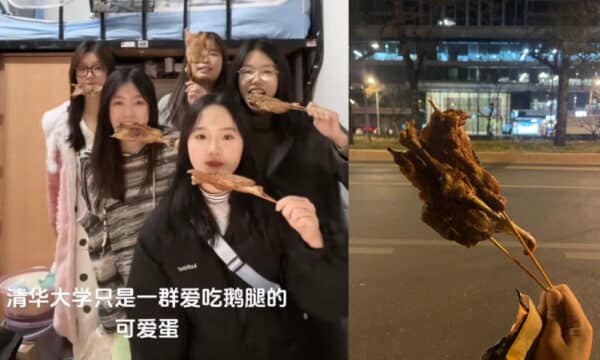
In the university district, Auntie Goose Legs she enjoyed a loyal customer base and dedicated WeChat groups.
After the first complaints surfaced, Auntie Goose Legs admitted the truth on WeChat on June 9.
“The ingredients I originally used were goose legs,” she wrote, “but they have been out of stock for more than fifteen years. The current ingredient is duck legs.”
It turned out that she had only sold goose legs, the product that made her famous, for two months back in 2011 before switching to the much cheaper duck. “Did geese become extinct without us knowing?” some netizens joked.
The revelation quickly exploded online. The hashtag “What Auntie Goose Legs is Selling Turns Out to be Duck Legs” (#鹅腿阿姨卖的是鸭腿#) became the top trending on Weibo for an entire day, with millions of people discussing the topic.
Why did millions of people become so outraged over a single Beijing street vendor selling duck instead of goose?
Piggybacking on the debate, Anhui-based commentators pointed out that a beloved regional specialty has the exact opposite ‘problem.’ Wuwei smoked duck (无为板鸭) is branded as duck, but is usually goose. According to local standards, however, goose products may be sold under this name, prompting discussions about “hanging up a goat’s head, while selling dog meat“ (挂羊头卖狗肉): advertising one thing while selling another.
Because geese are more expensive than ducks in China, and generally considered tastier, the Anhui duck-is-goose story, unlike the Auntie Goose Legs controversy, did not provoke online anger. Instead, many people saw it as an example of sellers prioritizing flavor over cost. Auntie Goose Legs is seen as doing the exact opposite.
But why did millions of people actually become so outraged over a single Beijing street vendor selling duck instead of goose, especially when there were no indications that anyone became ill? The answer has little to do with poultry and everything to do with trust.

Auntie Goose Legs during the prime time in Beijing’s University District in late 2023 (image via Lianhe Zaobao 联合早报).
Food fraud and mislabeling have been longstanding concerns in China. Earlier surveys found that food safety worries even outweighed concerns about public security and environmental issues, and while China’s food safety record has improved in recent years, public trust remains fragile.
Part of these concerns are immediate and practical. Major scandals in the past involving melamine-tainted infant formula or recycled “gutter oil” have posed serious risks to public health. But the issue goes beyond health risks alone.
If a goose can be a duck, then what exactly is the duck?
Whereas food safety concerns in many Western countries often focus on contamination, Chinese consumers are frequently just as concerned with economic deception. It is unfair to pay for a more expensive goose and receive a duck. Even if no one gets sick, Chinese consumer law still treats it as fraud.
More important, however, is what such deception does to confidence in the broader food system. If a goose can be a duck, then what exactly is the duck?
As a major 2023 college canteen scandal demonstrated, the build-up of deceit can reach a breaking point among the public. During that somewhat Kafkaesque “rat head or duck neck” (鼠头or鸭脖”事件) controversy, officials insisted a rat head found in a student’s rice was merely a “duck neck,” even though everyone could clearly see the snout and teeth of a rodent.
This kind of gaslighting shatters social trust and reinforces a generalized sense that, as a consumer, you are entirely on your own. When regulators fail to step in honestly, even a seemingly isolated incident comes to symbolize more dangerous forms of systemic food fraud.
And this is where the Auntie Goose Legs story stings the most.
People did not come to her simply because her food was good. Over the years, she had become part of local student life, and she felt safe and authentic. Her pink scooter helmet, which she continued to wear while working, became an iconic symbol of her no-nonsense and humble image. Her success was built on word of mouth and, above all, on the trust her customers placed in her.
That this particular “auntie” deceived her customers by selling a different product than the one she advertised is no longer really about her. If duck is goose, goose is duck, and your local auntie has deceived you for years, then who can you trust anymore?
- Read more about how Auntie Goose Legs rose to fame in 2023 here.
By Manya Koetse
(follow on X, LinkedIn, or Instagram)
Spotted a mistake or want to add something? Please let us know in comments below or email us. First-time commenters, please be patient – we will have to manually approve your comment before it appears.
©2026 Eye on Digital China/Whatsonweibo. All rights reserved. Do not reproduce our content without permission – you can contact us at info@whatsonweibo.com.
China Memes & Viral
Auntie Goose Legs, China’s Shrinking Condom Market, and DeepSeek’s AI Blind Spot
If it walks like a duck, it might just be Auntie Goose Legs. A wrap-up of noteworthy trending stories in China. From the real Rolex recruiting fake crowds to diaper scares & a funny Deepseek moment.
🔥 China Trend Watch (week 25 | 2026) Part of Eye on Digital China, this is my premium newsletter where I explain the stories, memes, debates, and viral moments shaping online conversations in China. This edition was sent to paid subscribers — subscribe to receive the next issue in your inbox.
China celebrated the more than 2,000-year-old Dragon Boat Festival (端午节) holiday this Friday, so I wish you health, good luck, and plenty of zongzi (sticky rice dumplings) and dragon boat races – they’re now held in many places around the world and are continuing into the weekend anywhere from Toronto to Dresden.
In this newsletter, you will find the trends and stories that caught my attention this week. This edition includes one longer read alongside a handful of shorter stories.
I always just start working on stories and noteworthy trends for the newsletter during the week, and often only discover an overarching theme later. This time, I realized that from the goose aunt who turned out to be suspiciously “quacky,” to Lululemon presenting Japanese drums as ‘truly Chinese,’ and trusted diaper brands being exposed for toxic chemicals, recent online discussions in China seem to revolve around similar questions: what is real, who can be trusted, and where do we find authenticity in a world where things are increasingly not what they seem? It is perhaps one of the reasons why the Chinese World Cup referee who is painfully straightforward in handing out red cards is now so beloved by the public.
With that in mind, here are the social media stories, debates, and internet moments you should know about this week 👇
🔍 EXPLAINER
Why One Beijing Street Vendor Sparked a Nationwide Debate

If it walks like a duck and quacks like a duck, it might still be a goose – or the other way around. That, at least, is the takeaway from two stories that recently went viral on Chinese social media.
The woman at the center of it all is Beijing street-food vendor Chen Xiufeng (陈秀凤), better known as “Auntie Goose Legs” (鹅腿阿姨). Over the years, she became something of a local celebrity in Beijing’s university district. Originally from Jiangsu, the migrant vendor had been selling her famous roasted goose legs to students since 2011.
She skyrocketed to national fame in 2023 , but became the target of widespread criticism last week after it was revealed that her celebrated goose legs – sold for 16 yuan ($2.20) per piece – were actually duck meat all along.
The controversy came up after the vendor ventured beyond the university area into Beijing’s business district. At the universities, she enjoyed a loyal customer base and dedicated WeChat groups. In her new market, however, customers proved more skeptical. Some noticed that the meat looked suspiciously duck-like; others complained that the color seemed off.
In the university district, Auntie Goose Legs she enjoyed a loyal customer base and dedicated WeChat groups.
After the first complaints surfaced, Auntie Goose Legs admitted the truth on WeChat on June 9.
“The ingredients I originally used were goose legs,” she wrote, “but they have been out of stock for more than fifteen years. The current ingredient is duck legs.”
It turned out that she had only sold goose legs, the product that made her famous, for two months back in 2011 before switching to the much cheaper duck. “Did geese become extinct without us knowing?” some netizens joked.
The revelation quickly exploded online. The hashtag “What Auntie Goose Legs is Selling Turns Out to be Duck Legs” (#鹅腿阿姨卖的是鸭腿#) became the top trending on Weibo for an entire day, with millions of people discussing the topic.
Why did millions of people become so outraged over a single Beijing street vendor selling duck instead of goose?
Piggybacking on the debate, Anhui-based commentators pointed out that a beloved regional specialty has the exact opposite ‘problem.’ Wuwei smoked duck (无为板鸭) is branded as duck, but is usually goose. According to local standards, however, goose products may be sold under this name, prompting discussions about “hanging up a goat’s head, while selling dog meat“ (挂羊头卖狗肉): advertising one thing while selling another.
Because geese are more expensive than ducks in China, and generally considered tastier, the Anhui duck-is-goose story, unlike the Auntie Goose Legs controversy, did not provoke online anger. Instead, many people saw it as an example of sellers prioritizing flavor over cost. Auntie Goose Legs is seen as doing the exact opposite.
But why did millions of people actually become so outraged over a single Beijing street vendor selling duck instead of goose, especially when there were no indications that anyone became ill? The answer has little to do with poultry and everything to do with trust.
Auntie Goose Legs during the prime time in Beijing’s University District in late 2023 (image via Lianhe Zaobao 联合早报).
Food fraud and mislabeling have been longstanding concerns in China. Earlier surveys found that food safety worries even outweighed concerns about public security and environmental issues, and while China’s food safety record has improved in recent years, public trust remains fragile.
Part of these concerns are immediate and practical. Major scandals in the past involving melamine-tainted infant formula or recycled “gutter oil” have posed serious risks to public health. But the issue goes beyond health risks alone.
If a goose can be a duck, then what exactly is the duck?
Whereas food safety concerns in many Western countries often focus on contamination, Chinese consumers are frequently just as concerned with economic deception. It is unfair to pay for a more expensive goose and receive a duck. Even if no one gets sick, Chinese consumer law still treats it as fraud.
More important, however, is what such deception does to confidence in the broader food system. If a goose can be a duck, then what exactly is the duck?
As a major 2023 college canteen scandal demonstrated, the build-up of deceit can reach a breaking point among the public. During that somewhat Kafkaesque “rat head or duck neck” (鼠头or鸭脖”事件) controversy, officials insisted a rat head found in a student’s rice was merely a “duck neck,” even though everyone could clearly see the snout and teeth of a rodent.
This kind of gaslighting shatters social trust and reinforces a generalized sense that, as a consumer, you are entirely on your own. When regulators fail to step in honestly, even a seemingly isolated incident comes to symbolize more dangerous forms of systemic food fraud.
And this is where the Auntie Goose Legs story stings the most.
People did not come to her simply because her food was good. Over the years, she had become part of local student life, and she felt safe and authentic. Her pink scooter helmet, which she continued to wear while working, became an iconic symbol of her no-nonsense and humble image. Her success was built on word of mouth and, above all, on the trust her customers placed in her.
That this particular “auntie” deceived her customers by selling a different product than the one she advertised is no longer really about her. If duck is goose, goose is duck, and your local auntie has deceived you for years, then who can you trust anymore?
👁️ WHAT STOOD OUT
1. China’s Condom Market Shrinks 25% in Four Years
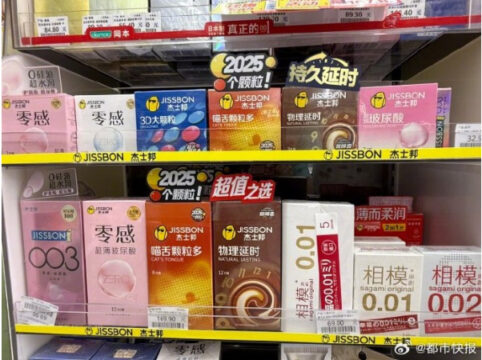
China’s biggest condom brand is being sold off, facing a market where fewer people are buying condoms. The brand is Jissbon (杰士), and the company behind it, Renfu Medical (人福医药), recently announced it would sell its stake in the international parent company that owns Jissbon and exit the condom business entirely.
Founded in 1998, Jissbon was once considered a “profit cash cow,” but this is already the third time it has been sold. As one commenter wrote, “Now even the parent company doesn’t want it anymore.” Jissbon is not the only brand struggling in China’s condom market, which shrank by 25% between 2020 and 2025, with all leading brands seeing sales drop by 15–20% (#避孕套销售缩水25%#).
The decline is linked to multiple factors, such as the rising popularity of oral contraceptives and other birth control methods. But alongside China’s rising single market, sex toys have been booming, reflecting a shift from two-person dating life to “private solo consumption,” as Chinese media outlet Dushi Kuaibao (都市快报) put it.
2. China’s World Cup Pride: Ma Ning, the Card Master
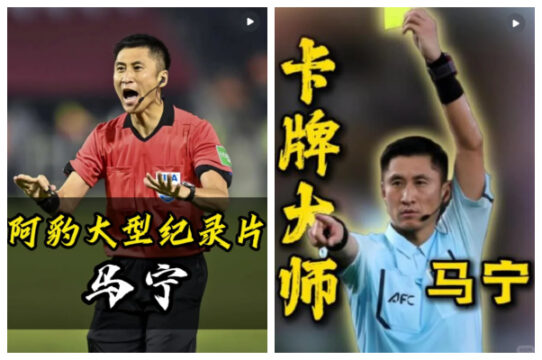
Even though Team China is not participating in the World Cup, Chinese referee Ma Ning (马宁) is, and he has become a viral talking point and a source of national pride. Ma is only the second Chinese central referee in World Cup history, 24 years after the lauded Chinese football referee Lu Jun (陆俊).
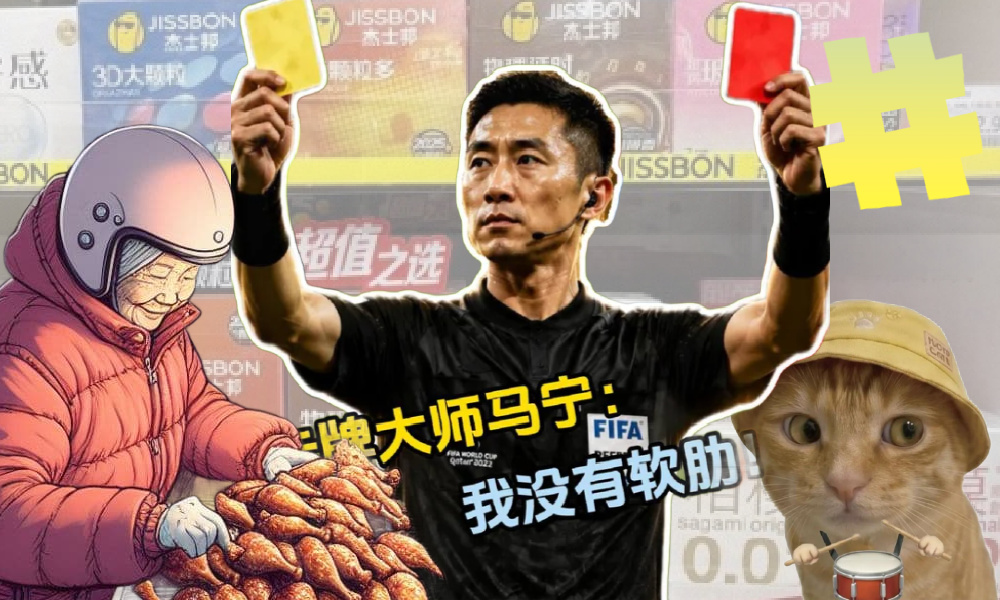
On Chinese social media, Ma is also nicknamed the “Grandmaster of Cards” (卡牌大师 kǎpái dàshī) for his strict, no-hesitation approach to handing out cards. During one infamous Shanghai match, he issued a total of nine yellow cards and three red cards.

AI-generated image of Ma Ning on Xiaohongshu, showing him arriving at the World Cup with his suitcases filled with red and yellow cards.
Chinese social media is now full of creative images celebrating Ma Ning, often depicting him handing out cards. Although strict referees are usually not that popular among football fans, for Ma it is the opposite: he is actually praised by Chinese fans for being honest, unyielding, and having “no soft spot” (没有软肋).
Ma has been assigned to referee Ecuador vs. Curaçao, scheduled for June 20 (this Saturday). Millions of Chinese fans are definitely tuning in.
3. Rolex Accused of Hiring 3,000 Paid Attendees

Rumors that Rolex recruited around 3,000 paid crowd extras to make its 100th-anniversary “Oyster Story” temporary exhibition in Shanghai, which opened on June 10, appear more popular than it actually was have sparked discussions on the Chinese internet.
The rumors surfaced after members of the so-called “crowd-filler” (群演 qúnyǎn) groups were allegedly promised 75 yuan (US$11) to attend, only to see the fee drop to 55 yuan (US$8.15) per person. Some claim they have not been paid at all, while others say they were removed from group chats after complaining.
It is not unusual for brands and companies in China to pay people to hype up an opening or stand in line to create queues that attract actual customers. But the idea that one of the world’s most prestigious watchmakers would need fake social engagement to drive exhibition attendance is being seen as another sign that the foreign luxury-brand boom in China has cooled down significantly. (I also wrote about this last week in the context of Nike’s declining popularity.)
4. Lululemon Beating the Wrong Drum
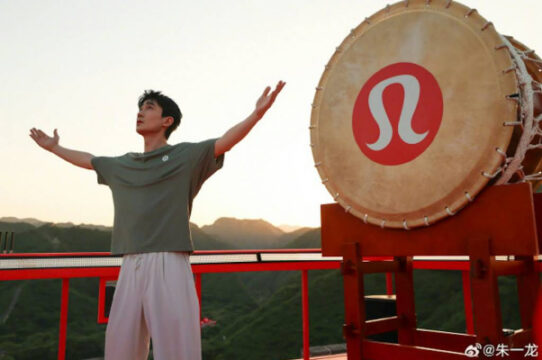
One of the most talked-about brand-related stories this week has been how Canadian athletic apparel brand Lululemon made a culturally sensitive faux pas. The company staged a yoga-themed event at the Great Wall of China featuring Chinese actor Zhu Yilong (朱一龙) and a giant drum. It was meant to represent a “Chinese grand drum” at one of the country’s most famous cultural landmarks – but it turned out to be Japanese taiko drums (日本太鼓).
A familiar playbook unfolded: netizens were outraged, online discussions exploded, and Lululemon scrambled to apologize. In this case, the mistake was especially sensitive. The Great Wall carries immense historical significance and is seen as a symbol of Chinese national identity, and using Japanese drums there – particularly at a time when Sino-Japanese political relations are tense – is viewed not as a simple prop mistake, but as a complete and “disrespectful” failure to get cultural symbolism right. Ouch.
5. China’s Diaper Safety Scandal
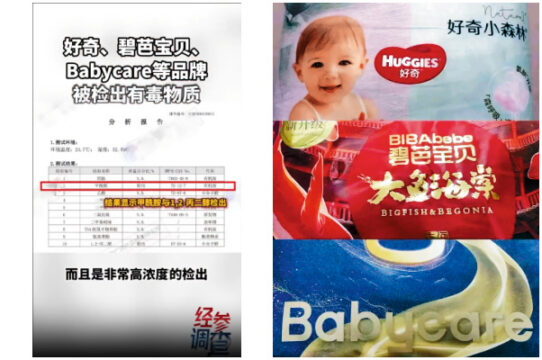
After this week, most parents in China will know what formamide is: a hazardous chemical classified as a reproductive toxin in the EU. The compound started trending after Chinese state media newspaper Economic Information Daily (经济参考报) reported that three popular diaper brands — Huggies (好奇), BIBAbebe (碧芭宝贝), and Babycare — contain the substance, with blood formamide levels reportedly doubling after wearing a diaper overnight (the reporter even wore one to test). The investigation followed online complaints from parents whose infants developed redness or skin irritation after diaper use.
Formamide (甲酰胺, jiǎ’án’àn), the chemical at the center of the controversy, is explicitly banned in China’s cosmetics regulations, but is not included in China’s mandatory national testing standards for infant hygiene products. Long-term exposure may affect the reproductive system while also causing chronic liver and kidney damage.
This story is still developing at the time of writing. The brands involved have all responded that they’re complying with relevant national standards for baby diapers and/or that their in-house testing could not detect formamide. Still, many questions are left unanswered. Although this story can be placed in a broader string of controversies surrounding food & product safety, this one hits especially hard because it concerns the safety and health of China’s most vulnerable: its babies.
📱ON THE FEEDS
Award-Winning Actress Uses Teleprompter on Stage
An award-winning Chinese actress using a teleprompter in her latest stage play at the Aranya Theatre Festival is sparking debate after audience members revealed that, in addition to relying on a teleprompter, she at times allegedly even read directly from a physical script.
The actress in question is Zhou Dongyu (周冬雨), considered one of the best actresses of China’s post-90s generation. With tickets for City of Fiction (文城) — a stage adaptation of the novel by Yu Hua — costing between 480 and 880 yuan (US$70–130), viewers took to Xiaohongshu and Weibo to voice their frustration after seeing the play.
“It’s simply not worth paying so much money to basically watch a rehearsal,” one commenter wrote.
Recently, there have been many discussions within China’s arts and entertainment world on what’s real and what’s not. In an age of AI-generated dramas and actors, audiences are increasingly looking for authenticity and genuine productions. The surprising success of the underdog local-dialect film Dear You (给阿嬷的情书, Love Letters to Grandma) is perhaps the best example of this trend. As for a stage performance starring one of China’s most celebrated actresses, audiences expect a higher standard and are disappointed when it feels “fake.”
DeepSeek Can’t Recognize Its Own Founder

China’s major AI startup DeepSeek (深度求索) made headlines this week after confirming its first-ever external funding round on June 16. The company reportedly raised over 50 billion RMB (approximately US$7.4 billion), making it the largest single funding round in Chinese AI history.
Alongside this serious news, however, a much more amusing story also started trending. On June 18, DeepSeek launched an image recognition feature on its web version, only for users to discover that it could not even recognize Liang Wenfeng (梁文锋) — the company’s own founder. In some cases, DeepSeek identified Liang as Moonshot AI founder Yang Zhilin (杨植麟) or even as a younger version of Tencent CEO Pony Ma (马化腾). Liang still has some work to do 😂.
🀄 ONLINE PHRASE OF THE WEEK
‘Shenzhen Airport Says Sorry’ Returns: “sorry全场” (sorry quánchǎng):
It’s that time for “Shenzhen Airport Says Sorry” (hashtag: #深圳机场sorry#): an ongoing joke on Chinese social media about Shenzhen Bao’an International Airport and its chronic flight delays during the rainy season, when one gate announcement after another says, “Sorry to inform you…” [that your flight has been delayed], and departure boards turn orange with delays and red with cancellations.
Because of the endless announcements and the airport’s PA system repeatedly saying “sorry” to passengers during mass flight delays, netizens have jokingly started referring to these airport-wide apologies as “sorry全场” (sorry quánchǎng), “sorry, everyone” or “apologies for everyone.”
It’s partly the force majeure nature of the delays and partly Shenzhen Airport’s proactive and overly apologetic response style that people have come to view with a sense of humor.
On June 18 alone, more than 400 flights were delayed due to thunderstorms and heavy rain. On June 19, netizens once again wrote: “It’s another ‘sorry全场’ day at Shenzhen Airport.”
By now, the phrase has become a meme. When Hong Kong Airport recently did not apologize for its delays, some netizens commented that the least it could do was to issue a “sorry全场.” The expression has also started appearing in unrelated contexts: if you want to jokingly apologize to an entire room in a routine and matter-of-fact way, it’s now perfectly acceptable to say “sorry全场.”
Also, perhaps it’s interesting to note what wasn’t necessarily trending this week. I found that the G7 summit hasn’t been a particularly big topic on Chinese social media. Meanwhile, the 618 shopping festival, now in its 16th year, still matters but no longer dominates online conversations as it once did.
Hope you all enjoy this weekend’s games, if you’re watching, and the remainder of the Dragon Boat Festival.
If you enjoyed this newsletter, please share it with your colleagues and China-focused friends, and encourage them to subscribe, too. Every new subscriber helps support my work. Thanks!
Best,
Manya
Eye on Digital China, by Manya Koetse, is co-published on Substack and What’s on Weibo. Both feature the same new content — so you can read and subscribe wherever you prefer. Substack offers community features, while What’s on Weibo provides full archive access. If you’re already subscribed and want to switch platforms, just get in touch for help. If you no longer wish to receive these newsletters, or are receiving duplicate editions, you can unsubscribe at any time.
Eye on Digital China is a reader-supported publication by
Manya Koetse (@manyapan) and powered by What’s on Weibo.
It offers independent analysis of China’s online culture, media, and social trends.
To receive the newsletter and support this work, consider
becoming a paid subscriber.


Quack Like a Goose: Why Beijing Street Vendor “Auntie Goose Legs” Sparked a Nationwide Debate

Auntie Goose Legs, China’s Shrinking Condom Market, and DeepSeek’s AI Blind Spot

A Chinamaxxing Brand, a Stressed-Out Possum, and Japan’s Lost Decades

“Going to Town to Handle Business”: How Adidas Went from Hated in China to a Chinamaxxing Brand

Look Only at the Ugly Sides, and You Won’t See China

“Auntie Mei” Captured After 20 Years, China’s Train-Stain Scandal, and Zhang Xuefeng’s Final Lesson

Comrade Trump Returns: The 2026 Trump–Xi Summit on Chinese Social Media

Chinese Postdoc Death Raises Questions as Key Details Remain Missing

My Mum Has Two Husbands: The OPPO Mother’s Day Fiasco and 7 Other Gender Marketing Fails in China

The AI Actor Debate, Tragedy in China’s “Fireworks Capital,” and the Viral Labubu Fridge
-

 Chapter Dive11 months ago
Hidden Cameras and Taboo Topics: The Many Layers of the “Nanjing Sister Hong” Scandal
-

 China Insight11 months ago
“Jiangyou Bullying Incident”: From Online Outrage to Offline Protest
-

 China Arts & Entertainment9 months ago
The Wong Kar-wai Scandal Explained: The Dark Side of ‘Blossoms Shanghai’
-

 Chapter Dive12 months ago
The Next Labubu: What the Rise of Wakuku Tells Us About China’s Collectible Toy Wave