
China Local News
“True Heroes of the City”: Sparks of Patriotism as Firefighters Contain Chongqing Wildfire
Chinese firefighters and volunteers are praised on Weibo for going above and beyond to control the Chongqing forest fire.


This week, the mountain fires raging in Chongqing have become a big topic on Chinese social media. On Friday, the topic attracted at least one billion views on Weibo after professional firefighters and volunteers worked around the clock to contain the wildfire in the city’s Beibei District (#重庆山火#).
The fight to contain the fire became a collective effort, with thousands of Chinese volunteers from Chongqing and beyond coming to the scene to help in any way they could. Professional firefighters from other regions also came to the rescue, including teams from Yunnan and Gansu Province that specialize in forest fires.
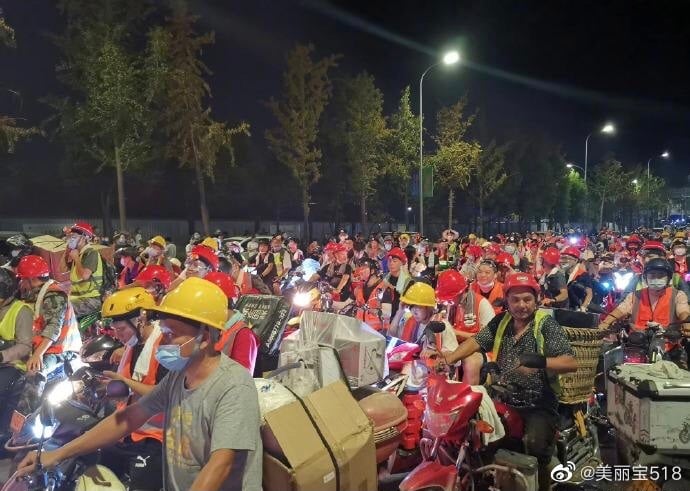
Videos taken at the scene on Jinyun Mountain on Thursday evening showed countless people helping out at the mountain, some footage captured how people were shouting out “come on!” (“雄起!”) at each other for encouragement.
The southwestern regions of Chongqing and Sichuan Province have been battling forest fires since mid-August after the region has been facing scorching temperatures and severe drought.
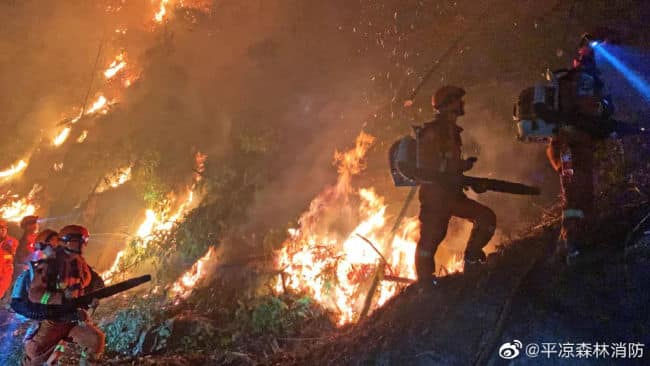
Meanwhile, there have also been power cuts in Sichuan and Chongqing due to power shortages during the extreme summer.
At the same time, the city is also handling an emerging Covid outbreak and rolled out a mass testing campaign in order to test about 10 million residents in the city.
Chongqing is dealing with a lot: the wildfires are burning, the power cuts are leaving parts of the city in the dark, meanwhile the Covid tests are ongoing. (Image on Weibo, it says: mountain fire – power restrictions – nucleic acid) pic.twitter.com/rNxU62iu1A
— Manya Koetse (@manyapan) August 25, 2022
One image that circulated on Weibo showed a photo of Chongqing dealing with mountain fires, power cuts, and Covid test lines all at the same time.
Nixingzhe: The Heroes Going Against the Current
On the early morning of August 26, when the Beibei District fire was under control, Chinese social media flooded with posts praising the “heroes of the city”: all the firefighters, officers, soldiers, and common citizens who joined hands to combat the fires under extreme weather conditions.
Dramatic photos and digital artworks also circulated on Chinese social media, including photoshopped images produced by netizens and state media.
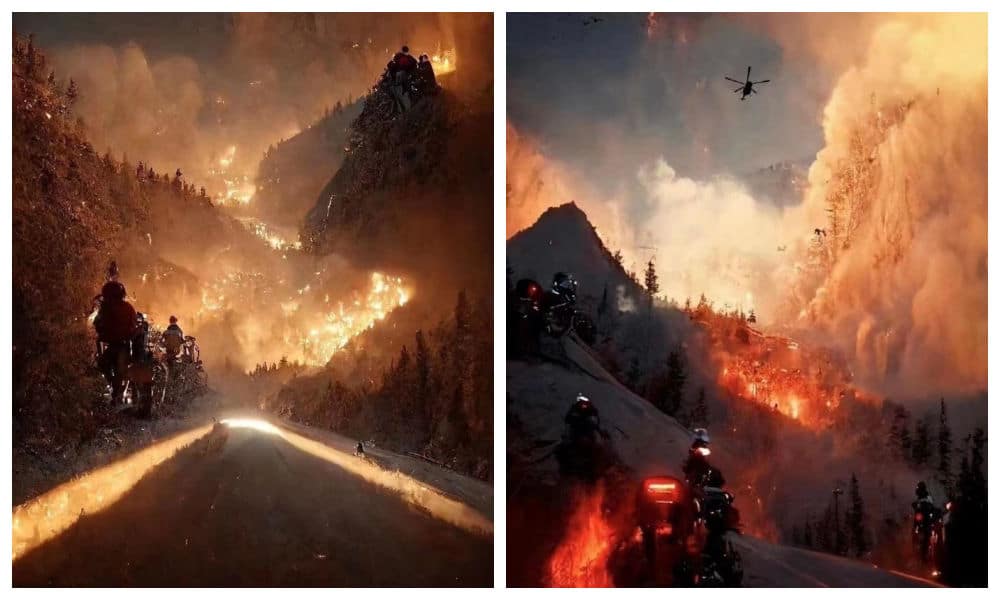
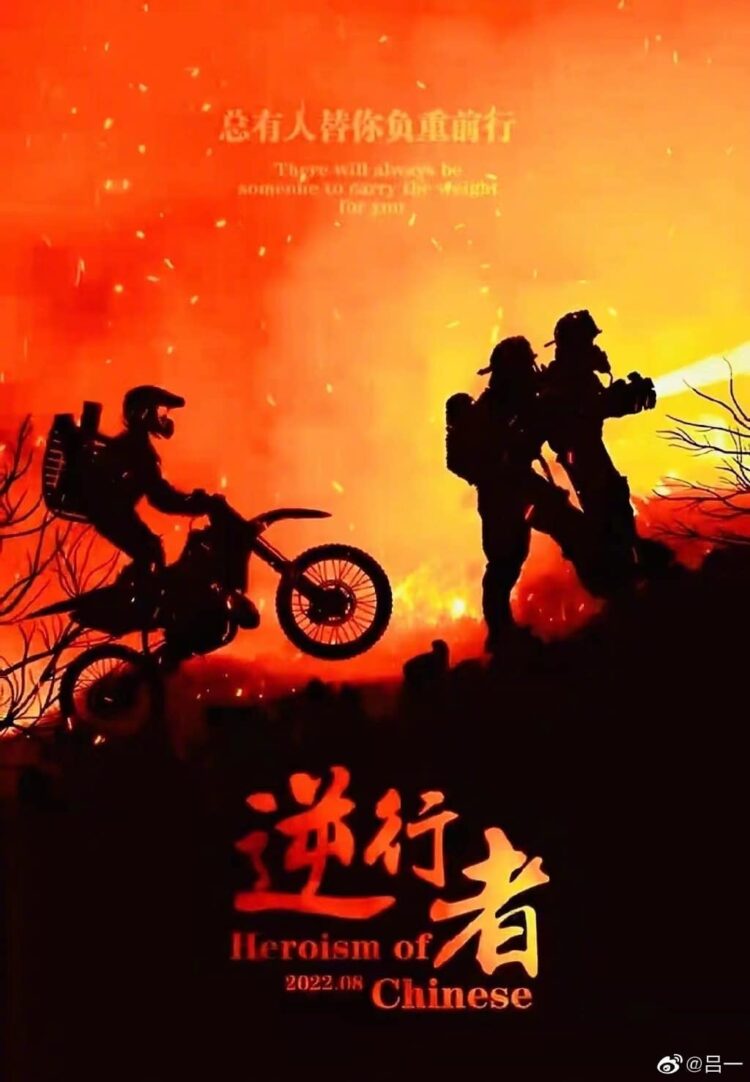
“Heroism of Chinese” image dedicated to Chongqing firefighters.
One photo from the scene (displayed below) served as an inspiration for other online posters and edited images, including one by state media outlet People’s Daily.
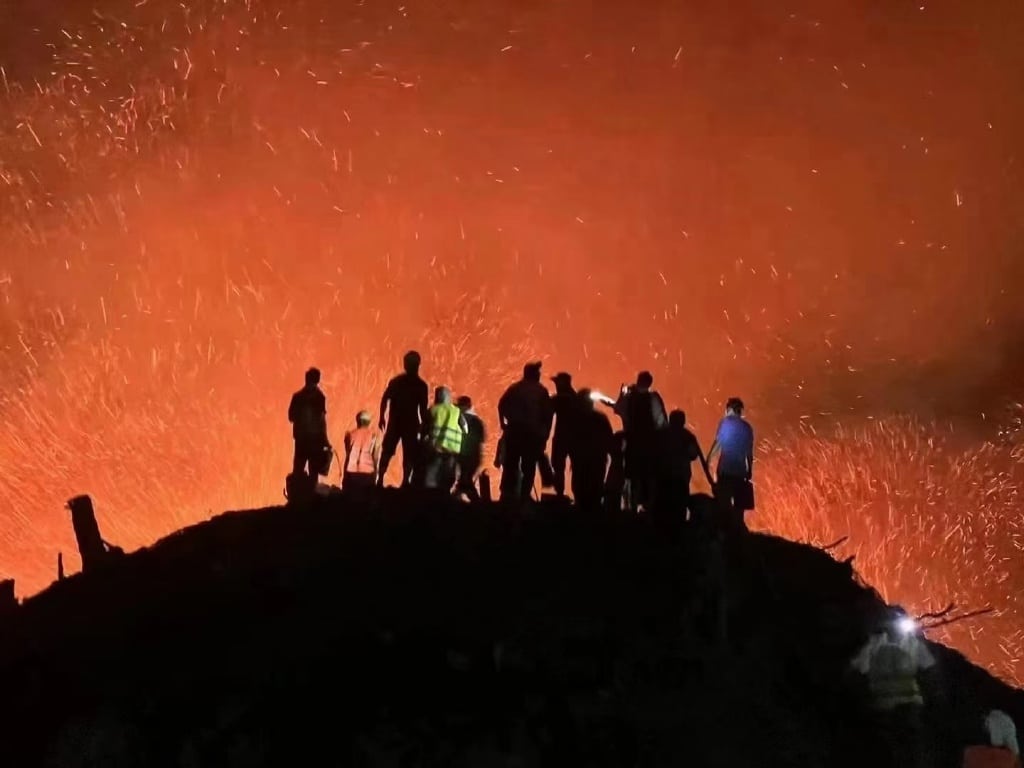
This image from the scene of the forest fires is one of the iconic photos that inspired others to edit and replicate it.
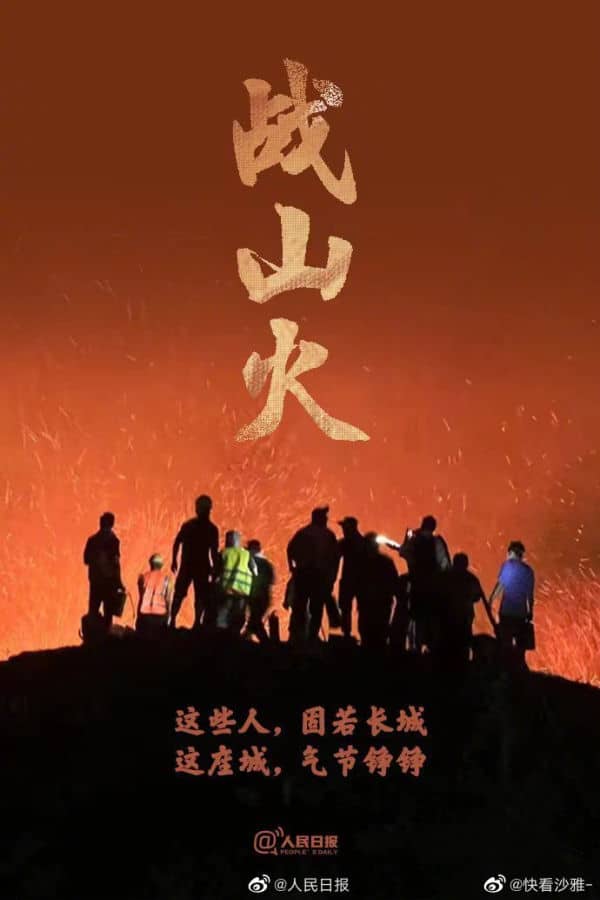
People’s Daily online poster.
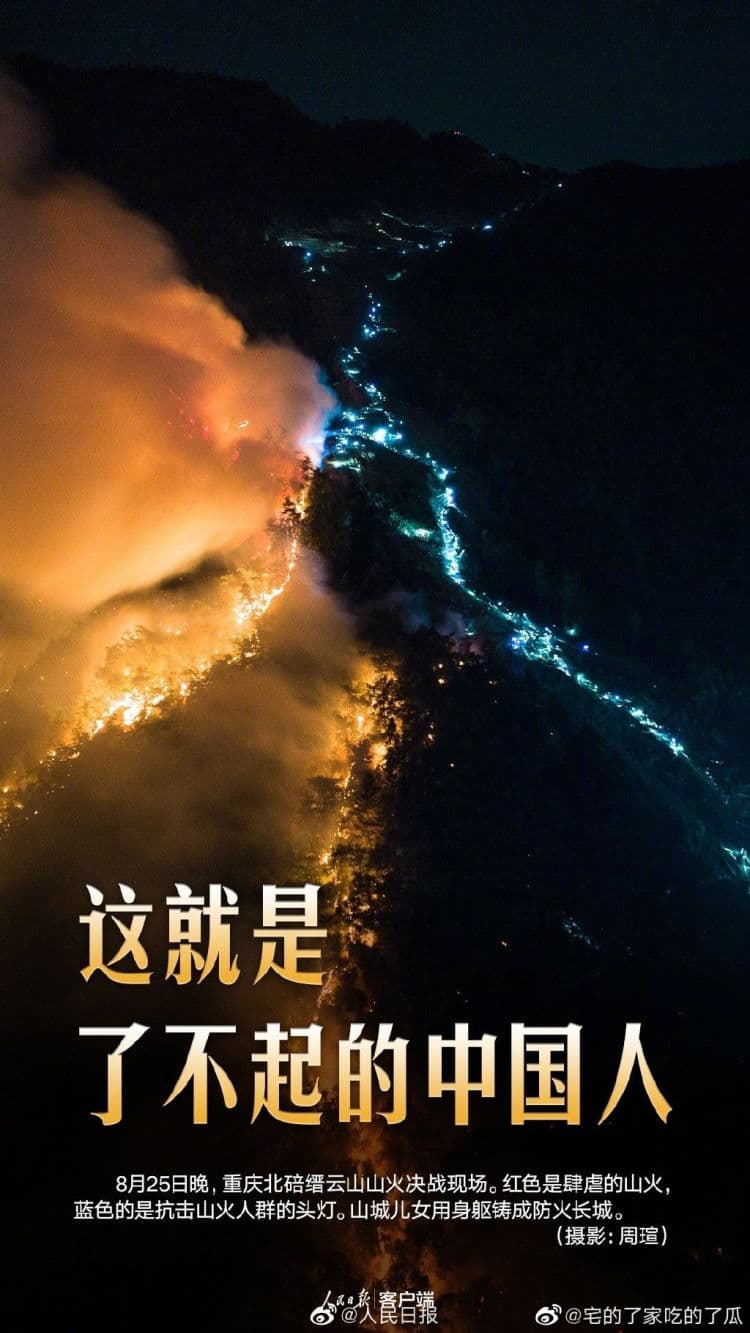
People’s Daily published multiple images evoking feelings of patriotism, such as a bird’s eye view photo of the mountain fire and the rescue efforts, writing: “These are the amazing Chinese people” (“这就是了不起的中国人”).
On social media, the Chongqing firefighters are referred to as nìxíngzhě (逆行者), “the ones going against the tide.” This term, describing those who go beyond their call of duty, has been used by state media since early 2020 to refer to frontline workers and individuals who made a significant contribution or sacrifice during China’s initial battle against the novel coronavirus (see 2020 Top 10 Buzzwords in China).
An important method used to contain the spreading wildfires in Chongqing is ‘fighting fire with fire.’ With the help of all the people at the scene, Chinese specialized teams used controlled fires to prevent more forest fires by burning the fuel that could feed another fire. People’s Daily dedicated a Weibo hashtag page to this special and sometimes risky tactic of controlled burning (“以火灭火”) (#重庆北碚山火中的反向点火战术#). According to Chinese media, this fire fighting tactic played a decisive role in containing the fire.

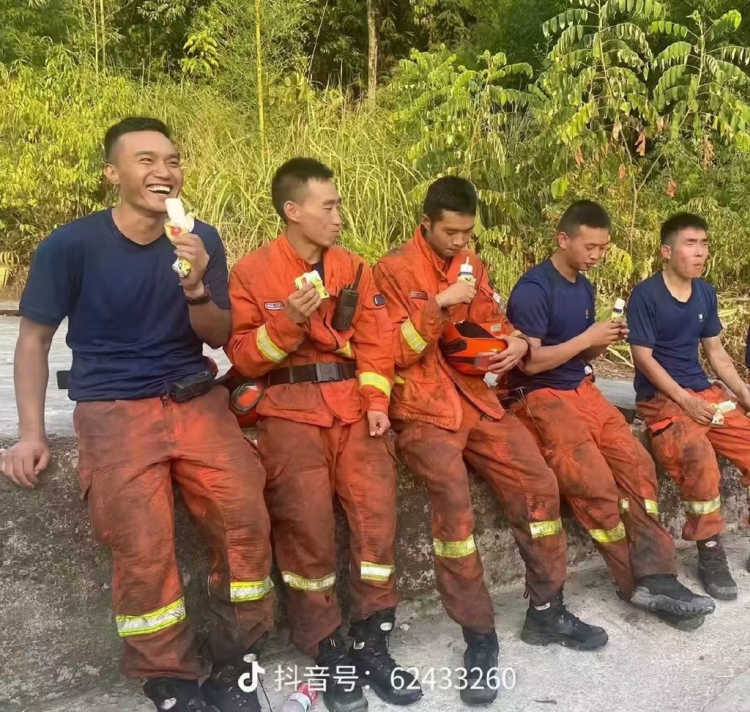
Screenshot via Douyin showing firefighters having ice cream after their hard work.
Videos circulating on Weibo showed how drained some local firefighters were after containing the fires in the stifling heat, dealing with heat stroke and exhaustion.
“I don’t know what else to say, thank you,” some commenters wrote, with others saluting Chongqing’s heroes (“致敬英雄”).
Many people expressed pride in how the wildfires in Chongqing were handled, drawing comparisons with forest fires in Australia and other countries.
One Hunan-based Weibo user wrote:
“Compared to last year’s mountain fires in Australia which burned for nearly two months, and the July 30 fire in America’s California that saw local people fleeing and leaving, the fires in Chongqing showed us the power of the Chinese people. People spontaneously donated money and goods, and young people rushed to the frontline. It reminded me of the major flood efforts in ’98, how prepared for battle the white clothes workers were during the Covid outbreak in Wuhan, the subway rescue scene that happened in Zhengzhou last year. It makes my eyes tear up. This power comes from the love for the homeland that is rooted in the bones and blood of all Chinese people, this is the benevolent ‘all for one, one for all’ power of the Chinese people.”
On Friday afternoon and evening, firefighters and officers returning from the mountain were welcomed by groups of locals applauding them, waving flags, and offering them bottles of water and lemonade. These scenes were shared by official media channels on Weibo and beyond.
Although the narrative of the movie-like Chongqing battle against the fire is largely directed by state media propaganda on Chinese social media, many netizens join in the online celebration of this positive outcome of a difficult firefight. At a time of zero-Covid, power cuts, and scorching heat, it seems that many people are glad to see a happy ending to an otherwise devastating natural disaster.
“The fire is finally out,” one Weibo user wrote: “Front-line troops, firefighters, veterans, people of Chongqing, you are heroes, thank you for your great work!”
The past 48 hours have been incredibly intense for those in Chongqing's Beibei District, where thousands of people joined the fight against the wildfires on Thursday. pic.twitter.com/nvuntFogAB
— Manya Koetse (@manyapan) August 26, 2022
By Manya Koetse
Get the story behind the hashtag. Subscribe to What’s on Weibo here to receive our weekly newsletter and get access to our latest articles:
Spotted a mistake or want to add something? Please let us know in comments below or email us. First-time commenters, please be patient – we will have to manually approve your comment before it appears.
©2022 Whatsonweibo. All rights reserved. Do not reproduce our content without permission – you can contact us at info@whatsonweibo.com.





China Local News
Six Chinese Students Dead After Falling Into Flotation Tank During Mine Visit
After six students drowned in a mine tank, social media users question safety precautions and media framing.

🔥 Quick Take: Trending in China
This is a brief update from our curated roundup of what’s trending in China this week. A version of this story also appears in the Weibo Watch newsletter. Subscribe to stay in the loop.
The tragic death of six Chinese students during a visit to the Wunugetushan Copper-Molybdenum Mine (乌努格吐山铜钼矿) in Inner Mongolia has been trending on Chinese social media this week.
The students, who study mineral processing engineering at the School of Resources & Civil Engineering Northeastern University (东北大学), visited the site as part of their studies on Wednesday, July 23.
The facility, which operates under the state-owned China National Gold Group Corporation (中国黄金集团), includes a mineral processing plant where ore is crushed and processed using flotation cells to separate copper and molybdenum concentrate from waste rock.
The students were standing on a metal grate above a deep industrial tank used for mineral processing. The grate then suddenly collapsed, and they fell into the flotation tank, which was filled with mineral slurry (see this video to better understand the situation).
The tank was deep, and once inside, the slurry made it impossible to swim.
By the time the students were taken out of the tank, they had already drowned. They were all aged between 20 and 22. One of their teachers was injured in the incident.
According to Sohu News, citing a preliminary accident investigation report, the direct cause of the incident was a pre-existing crack in the grate above the tank, which caused the entire panel to flip and fall off. The grates had been replaced in February but were not properly tested. The site also lacked warning signs about load capacity and reportedly did not restrict the number of people allowed to stand on it.
Three people responsible for safety measures at the site, including the deputy general manager, have now been placed under criminal detention.
Besides the many questions surfacing online about how such a gruesome accident could have occurred, there is also criticism of how the media has reported on the incident. Some outlets mentioned that the 45 other intern students—presumably also present during the visit—were “emotionally stable,” and that the teacher who was injured was in a “good mental state.”
One blogger criticized these phrases, which are often used in media reports following similar incidents. While they appear to describe the psychological condition of survivors or bystanders, the author argued that they are more political than psychological: their real function is to signal to readers that—despite the loss of life—the situation remains under control.
After the online criticism, the Weibo hashtag “45 Intern Students from Northeastern University Are Emotionally Stable” (#东北大学45名实习学生情绪平稳#) has since been taken offline.
At the time of writing, the official website of Northeastern University has been changed to black and white.
By Manya Koetse
(follow on X, LinkedIn, or Instagram)
Spotted a mistake or want to add something? Please let us know in comments below or email us. First-time commenters, please be patient – we will have to manually approve your comment before it appears.
©2025 Whatsonweibo. All rights reserved. Do not reproduce our content without permission – you can contact us at info@whatsonweibo.com.
Follow What’s on Weibo on


🔥 Quick Take: Trending in China – Week 18
This is a brief update from our curated roundup of what’s trending in China this week. A version of this story also appears in the Weibo Watch newsletter. Subscribe to stay in the loop.
An enormous fire that happened at a restaurant in Liaoning’s Liaoyang on the afternoon of April 29 (see video) has gone top trending on Chinese social media, mainly due to the fact that it caused so many fatalities.
By 7pm, Chinese official media reported that the fire, which happened at 12:25 in the city’s Baita district, had killed 22 people. Three people were injured.
The fire started on the second floor of the restaurant Sanli Chuniang (三里厨娘/Sanli Chef’s Daughter) on Minzhu Road (民主路) and quickly spread throughout the entire two-story brick-concrete structure, which covers an area of about 260 square meters. The windy weather also played a part in how quickly the fire spread. The fire broke out around lunchtime, when there were many customers.

The restaurant before and after the fire.
Some sources on Xiaohongshu report that, according to witnesses, toxic smoke filled the entire building in less than five minutes. The thick smoke, small spaces inside the two-story building, and limited escape routes — some of which were allegedly blocked — all contributed to the high number of fatalities. Some victims were reportedly just ten meters away from the exit, yet still failed to escape.
According to Caixin, the restaurant’s second floor had several private rooms without windows.
To make matters worse, some nearby vehicles were not moved in time, hindering the rescue operations.
Sanli Chuniang was a locally popular restaurant serving various Chinese dishes, snacks, and dumplings. It was in business since 2016.
On social media, many commenters are expressing shock and sadness over the deadly fire. They also want answers into why there seemed to have been little to no fire safety precautions at the establishment.
The last time a restaurant fire with many fatalities made major headlines in China was in 2023, when a gas explosion inside a BBQ restaurant in Yinchuan resulted in 31 deaths. Nine people, including the restaurant owner, were later arrested in connection with the fire and the lack of safety precautions.
Some reports on the Liaoyang restaurant fire have now been removed, but it appears that the restaurant had been operating illegally since 2023 and that its fire safety inspections were not up to date.
Guancha reported that while the cause of the fire is still under investigation, the restaurant owner has been taken into custody.
🔄 Update 1: Chinese leader Xi Jinping issued a statement regarding the devastating fire, calling on local authorities to hold those responsible accountable and to properly handle matters related to the victims and console their families.
Premier Li Qiang also emphasized that local authorities across China should screen for fire hazards and strengthen safety measures to prevent such major accidents from occurring.
🔄 Update 2: Preliminary investigations have ruled out arson or gas leakage as the cause of the fire. The specific cause of the incident is still under investigation, focusing on leftover cigarette butts that might have started the fire or possible electrical faults. The restaurant’s furniture and interior materials were highly flammable, and strong winds outside caused the fire to spread quickly and block the exits. This made it difficult for those trapped inside to escape. Most victims died from asphyxiation after inhaling large amounts of toxic smoke in a short time.
As definite results have not yet been issued at the time of writing (May 6), some netizens are wondering: “When can we expect to hear more?”
By Manya Koetse
(follow on X, LinkedIn, or Instagram)
Spotted a mistake or want to add something? Please let us know in comments below or email us. First-time commenters, please be patient – we will have to manually approve your comment before it appears.
©2025 Whatsonweibo. All rights reserved. Do not reproduce our content without permission – you can contact us at info@whatsonweibo.com.
Follow What’s on Weibo on
Eye on Digital China is a reader-supported publication by
Manya Koetse (@manyapan) and powered by What’s on Weibo.
It offers independent analysis of China’s online culture, media, and social trends.
To receive the newsletter and support this work, consider
becoming a paid subscriber.


Trump, Taiwan & The Three-Body Problem: How Chinese Social Media Frames the US Strike on Venezuela

China’s 2025 Year in Review in 12 Phrases

China’s 10 Biggest Social Media Stories of 2025

Why Were 100,000 Pregnant Women’s Blood Samples Smuggled Out of China?

When an Entertainment Scandal Gets Political: How Wong Kar-wai Survived a Nationalist Storm

From Nobel Farewell to ‘VIP Toilets’: What’s Trending in China

China Trend Watch: Japan Tensions, Nexperia Fallout, Yunnan’s ‘Wild Child,’ & “Modern Opium”

Eye on Digital China: How Chinese Social Media Evolved from the Blog Era to the AI-driven Age

From Tents to ‘Tangping Travel”: New Travel Trends among Young Chinese

Signals: Hasan Piker’s China Trip & the Unexpected Journey of a Chinese School Uniform to Angola
-

 China Arts & Entertainment6 months ago
Hidden Cameras and Taboo Topics: The Many Layers of the “Nanjing Sister Hong” Scandal
-

 China Insight8 months ago
Understanding the Dr. Xiao Medical Scandal
-

 China Digital12 months ago
“Dear Li Hua”: The TikTok/Xiaohongshu Honeymoon Explained
-

 China Insight5 months ago
“Jiangyou Bullying Incident”: From Online Outrage to Offline Protest