
China Memes & Viral
Chinese High-Altitude Stunt Performer Confirmed Dead after Fall off Building
The death-defying stunts of China’s self-proclaimed “first extreme heights challenger in the country” ended with a fatal fall.


Over the past two days, the death of a Chinese high-altitude stunt performer has become a major topic of discussion on Chinese social media. Rumors about the death of the young man, named Wu Yongning (吴咏宁), started when he had not updated his Weibo account (@极限-咏宁, ±38000 fans) since November 8. He then posted a video of him hanging on the rooftop of a high building in Changsha. That video has been viewed nearly 9 million times.
On Friday, the performer’s girlfriend posted on her Weibo: “It is December 8 today; a month since you left this world.” Chinese media reported today that Wu Yongning died after a slip off a 62-storey skyscraper during one his high-altitude challenges. One Weibo report about his death received around 37000 comments on Saturday and over 17000 shares.

Many commenters criticize Wu, even after his death, for “not taking life seriously.” Some also attack his fans for watching and liking his videos which encouraged him to continue stunting – ultimately leading to his death.
“Since seeing his first video, I knew the chances of him dying were high. I hope nobody will do the same,” one netizen wrote.
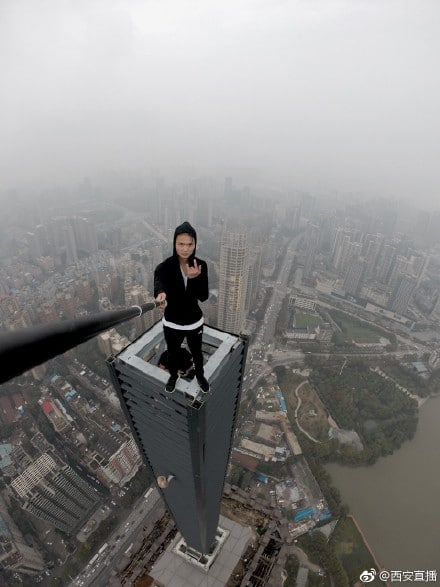
Wu Yongning was born in 1991 in Changsha, Hunan. He called himself “China’s first extreme height challenger” (“国内极限高空运动挑战第一人”) since he regularly began posting videos of his stunts in early 2017. Similar kinds of death-defying stunts have become more popular across the world over recent years.
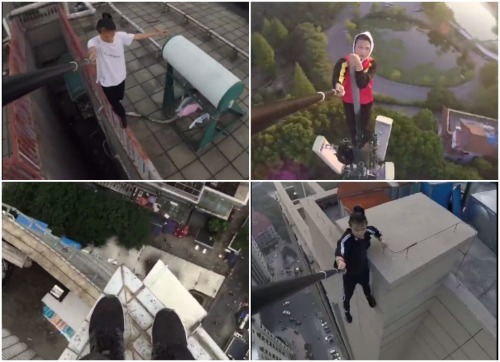

When posting his final video on Weibo on November 8, Wu did warn his fans: “This is dangerous, please do not imitate me.”

Despite all criticism, there are also many people on Weibo who hope Wu will “rest in peace.” One commenter says: “I hope you can continue to do what you love to do up there in heaven.”

– By Manya Koetse
Follow @WhatsOnWeibo
Spotted a mistake or want to add something? Please let us know in comments below or email us.
©2017 Whatsonweibo. All rights reserved. Do not reproduce our content without permission – you can contact us at info@whatsonweibo.com.




Chapter Dive
The Power of Ugly: Why Niu Lai Became China’s Unlikeliest Box-Office Hit
How the two-person animated film Niu Lai turned its “ugly” visuals, dreamcore nostalgia, and remarkable cinema journey into a nationwide participatory meme.

China Digital
How Chinese AI Videos Turned Foreigners into Villains
How viral AI videos turn racialized outsiders into threats and violent Chinese heroes into defenders of social order, China’s first nationally broadcast AI drama, and why a newspaper is being sold for 50 times its original price.

Over the past few weeks, a noteworthy amount of AI-related news has been trending on Chinese social media, which is reflected in this week’s edition.
Now that AI has entered every corner of media consumption and online life, related discussions seem to be reaching a new peak. While well-produced AI dramas are receiving more praise, low-effort AI slop is flooding video feeds and increasingly being used to stir controversy and generate clicks, fueling prejudice, hate, and cyber-nationalism. More about that further down in this newsletter.
🗞️ QUICK SCROLLS
🎬 A new AI-generated micro-drama has become all the rage on Chinese social media. While earlier AI dramas were criticized for being sloppy and repetitive, Laid-Off Girl (被裁掉的女孩) is praised for its quality and appealing protagonist, Fang Taozi (方桃子), a small-town woman pursuing her dream of becoming a model in Paris. She is so believable that viewers almost forget they are not watching a live-action production. This marks a real step up in quality for the industry, raising the bar for others. (If you want to get a taste of what it looks like, here’s a YouTube link).

Stills from the popular micro AI drama Laid-Off Girl (被裁掉的女孩).
📺 China’s national TV has now also aired its very first AI drama. While AI dramas mostly belonged to the realm of unofficial short-form online productions, the phenomenon has now made the leap to longer productions broadcast on national satellite television. Anhui TV is airing the Ming-dynasty drama The Tale of Peach Blossom Pool (桃花潭记), promoted as China’s first fully AI-produced medium-length drama centered on cultural heritage.
📱 China’s cheap & easy SIM-card era has ended. There was a time when you could get a SIM at any street corner in a Chinese city. That changed over a decade ago when real-name registration became strictly enforced. Now, as of 1 August, China Mobile, China Telecom and China Unicom will sell cards online only through their own apps and websites, cutting off all third-party internet sellers who have been the go-to source for cheap data plans. The move is meant to curb third-party SIM cards ending up in grey-market chains, being used for bulk account registration and telecom fraud. But most people just fear that plans are becoming less affordable.
🚇 “Half an hour queuing for a ten-minute ride” was a common complaint after Shenzhen Metro tightened its security checks on July 20. Much to the dismay of commuters, the stricter checks led to long lines, as all carry-on items must now pass through an X-ray machine, while every passenger is also subject to a handheld body scan. Some wondered why, in an era of AI-powered image screening, security couldn’t be handled more efficiently. Shenzhen is hosting the APEC Economic Leaders’ Meeting later this year, in November.
☀️ Summer childcare worries have been trending, as even dual-income families are reportedly struggling to arrange childcare during the school holidays. Summer programs often last only a month and still require pick-ups during hot afternoons, while private tutors sometimes charge around 200 yuan per hour ($30). More Chinese parents have therefore turned to hiring university students, offering 3,500 to 4,000 yuan per month ($520–$590) to look after their children during the summer break.
👁️ EXPLAINER
How Chinese AI Videos Turn Foreigners Into Villains
“I’m American! You can’t do anything to me!” says a young white man, moments before a strong Chinese man kicks him and throws him to the ground in a single move. A crowd of Chinese aunties standing nearby applauds as the foreigner hits the ground. “Don’t think we’re still the Chinese people of the past,” the Chinese man says. “You don’t want to mess with the Chinese people of today.”
This is just one example among hundreds of similar short videos flooding Chinese social media these days. Featuring various kinds of anti-foreign and racist content, they depict foreigners as threats to China’s social, moral, and national order. Strong, confident Chinese people confront, violently beat, and humiliate them in defense of their country.

Stills from AI videos showing Chinese men beating up misbehaving foreigners.
These videos, which often last between ten seconds and half a minute, are posted by online creators across platforms such as WeChat, Kuaishou, and Douyin. Many of these creators run content-farming accounts devoted entirely to this type of content, which attracts many likes and reactions: the videos are short, visually striking, emotionally powerful, and play into existing prejudices and racialized thinking.
Racist and anti-foreign content is nothing new on Chinese social media and dates back to the earliest days of China’s online video platforms. But the age of AI has brought new dynamics to such content. Last fall, Joshua Dummer reported in Foreign Policy on the growing popularity of AI-generated anti-Black videos presented as cautionary tales about Chinese women becoming involved with African men.
This time, it’s different.
The latest wave of anti-foreign content goes beyond gender dynamics and focuses more broadly on the negative influence foreigners supposedly have on Chinese people and society. Foreigners disrupt orderly Chinese public spaces or threaten the safety of Chinese women, security personnel, or lower-status workers, after which a morally upright Chinese person restores order through violence.
Four Types of Videos
In the dozens of AI videos I’ve analyzed, roughly four categories can be discerned, with different groups of foreigners performing different “narrative jobs.”
(See examples of these videos on my X here, or find them on Bluesky)
1️⃣ The Uncivilized Outsider
Roughly 40% of the videos show foreigners engaging in “uncivilized” behavior and disrupting China’s cleanliness, etiquette, and public order. In these scenes, foreigners are portrayed as dirty, smelly, and disorderly.
One example shows an entire plane of Chinese passengers holding handkerchiefs over their noses because of the smell from an Indian man’s bare feet. He refuses to comply with the flight attendant’s instructions, after which a strong Chinese man approaches and slaps him in the face.

AI video: An Indian passenger disrupts a Chinese flight with smelly feet.
Other examples include foreigners attempting to urinate in the street, occupying multiple seats on public transport, putting their bare feet up on a high-speed train, or otherwise disregarding public etiquette.
These videos predominantly feature Indian characters, but to a lesser extent also white/Western and Filipino characters.
2️⃣ The Entitled Foreign Bully
Roughly 30% of the videos depict foreigners as arrogant, entitled, and aggressive bullies who believe their nationality places them above Chinese rules.
Examples include foreign men and women skipping queues by invoking their foreign status or showing disrespect toward China’s vulnerable elderly or lower-status workers, until a Chinese person teaches them to “respect China’s rules.”

AI video: A Western woman is hit by a shop owner for using her foreign status as a reason to cut the line.
These videos mostly feature white people, but sometimes also Black, Indian, or Japanese characters.

AI video: entitled Indian man gets curry thrown in the face by waiter.
One scene shows an Indian man demanding that the Chinese waiter serving him curry kneel before him, after which the waiter scolds him and throws the curry in his face.
3️⃣ The Sexual and Demographic Threat
Roughly 20% of the videos fall into the category described in Foreign Policy last October, in which foreign men are portrayed as sexual and demographic intruders.
These videos often show Chinese women following foreign partners to Africa or India, only to end up living a nightmare of poverty, abuse, or infidelity. Some explicitly warn Chinese women not to marry foreigners.

AI video: A Chinese woman is first shown in a happy relationship with her African partner, and then shown in a state of desperation after she moved to Africa with him.
There are also many videos showing Chinese men as heroic protectors of women being harassed by foreign men. One recurring scenario shows a Black man harassing a Chinese woman in a shopping street before being beaten by a Chinese man who comes to her defense.

AI video: Chinese man saves Chinese woman from getting harassed by a foreigner.
Although these videos mainly feature Black African men, with Africa portrayed as a kind of dystopia, some also include white or Indian men.
4️⃣ The Undesirable/Dangerous Migrant
About 10% of the videos take place at airport immigration or border control, showing foreigners arriving without money, carrying drugs, or seeking to exploit Chinese hospitality.
One example shows Indian men arriving at the Chinese border and claiming that they want to “enjoy Chinese women.” They are refused entry after an official questions them about their finances.

AI video: Indians denied at the border.
The endgame is always the same: they are denied entry and sent back to their country. These stories predominantly feature Indian characters.
💡 To get a rough idea of which racialized groups appear most often, I analyzed a sample of 35 videos collected from my timeline: approximately 39% featured Indian characters, 28% White/Western characters, 24% Black/African characters, 6% Filipino characters, and 3% Japanese characters.
Reversed Humiliation
The xenophobic AI slop that we’re seeing is about more than just “foreigners behaving badly.” Besides the videos showing Chinese women moving to Africa, the basic formula running through most of them is:
Foreigners cross moral or social boundaries and violate rules → they victimize Chinese people or otherwise bring humiliation or inconvenience to others → forceful intervention by a morally upright Chinese person → punishment and restored order.
These videos do two things.
➡️ One important effect is that they produce a sense of “Chineseness” by constructing a threatening “Other” that is never Chinese (even though the foreigners all look different, they are never ethnically Chinese). In doing so, Chinese national identity is defined through contrast with how bad the Other is.
The foreign villain is deceptive, uncivilized, backward, and disruptive—a threat to women, public order, and social stability—whereas the Chinese characters are morally superior, embodying loyalty, civility, modernity, collective responsibility, and the protection of social and historical continuity. The foreigner therefore does more than play the villain: his imagined identity helps define who the Chinese are and what contemporary China is.
➡️ Another effect is that these videos offer a form of catharsis in China’s “new era.” They coincide with increasingly prominent narratives about China’s exceptional rise, its emerging superpower status, and the “decline of the West.” At the same time, they evoke the painful history of 19th China and the “century of humiliation”—a period portrayed in contemporary education as one in which foreign powers aggressively and violently imposed their rules on a weak China.
These AI fantasies symbolically reverse that history. The videos show that Chinese people are no longer passive victims, but strong and assertive defenders who fight back against foreigners who disrespect them or exploit Chinese hospitality. Through violence presented as morally justified, historical humiliation is transformed into national victory: China is no longer subjected to rules imposed by outsiders, but has become the country that sets the rules and possesses the strength to enforce them.
The Many Faces of Chinese Digital Nationalism
This recent trend shows that digital nationalism in China has many faces, and that this one in particular is not actively boosted by state media nor supported by official voices.
The timing of these videos does not just mark a new era of Chinese digital nationalism; it also coincides with a new wave of China tourism and a travel boom, with trips to China by foreign nationals rising sharply since the Covid era amid more lenient visa policies. This includes an increase in visas issued to Indians at a time when Indian and Chinese authorities have been working to normalize bilateral relations.
Earlier in July, Chinese newspaper The Paper published an article pushing back against growing online hostility toward Indians in China, arguing that individual misconduct should be addressed without stereotyping an entire nationality or turning it into xenophobic outrage. In a noteworthy move, the full article was republished on the website of the Chinese embassy in New Delhi—showing Chinese authorities pushing back against these trends and defending Indians to Chinese netizens.
At the same time, this is perhaps also a case of lead by example. An AI-animated video released by state media outlet China Daily which depicted the Philippines as a “ragged monkey” has also made international headlines recently, with the imagery called racist and unacceptable.
Even though the authorities might not be happy about the flood of racist or xenophobic AI videos at a time when state media are promoting just how welcoming China is to foreigners, official videos such as these can also fan the flames and provide examples for grassroots creators to draw on.
🔗 SEEN ELSEWHERE
🔹 Fresh “feet juice,” anyone? Chinese female cosplayers recently caused a stir at an anime convention in Guangzhou by selling cups of lemon water from the tubs in which they were soaking their feet. Read via SCMP.
🔹 China saw a new series of cyber crackdowns in July, including one targeting so-called companion bots—AI characters created to offer consumers emotional support as virtual friends. Having to bid farewell to these companions in light of the new ban has been really tough for users, with some even trying to “rescue” their virtual friends by downloading them. Read via Ginger River Review.
🔹 Earlier this year, Amsterdam-based cybersecurity researcher and journalist Marc Hofer came across a futuristic-looking dashboard that turned out to be an unsecured Zhangjiakou police dashboard, offering a rare window into how Chinese local authorities track foreigners by collecting and aggregating vast amounts of private data. Read via The New York Times.
🔹 People in China can now get paid US$15 to US$700 to license their faces for AI-generated entertainment productions. As the AI boom drives demand for an ever-wider range of human faces, Chinese companies have found a solution: buying the legal rights to people’s faces. Read via Rest of World.
🀄 ONLINE PHRASE OF THE WEEK
洛阳纸贵 Luòyáng zhǐ guì
Lit.:Paper has become expensive in Luoyang
Meaning:Flying off the shelves / selling like hotcakes

Who thought print media could still go viral in this digital age?
Just a few months ago, Chinese mathematician Wang Hong (王虹, b. 1991) from Guangxi became the first woman to win the top prize at China’s most prestigious math congress for her work on the three-dimensional Kakeya conjecture. On July 23, she was awarded the Fields Medal, also dubbed the “Nobel Prize of mathematics,” one of the highest and most prestigious international honors a mathematician can receive.
Together with fellow math talent Deng Yu (邓煜), she became one of the first two Chinese citizens to be awarded the Fields Medal and is only the third woman ever to win the prize.
After her win on July 23, the provincial Party newspaper Guangxi Daily (广西日报) featured her on its front page with a long article about her story and the headline “Wang’s Conjecture” (王的猜想, Wáng de Cāixiǎng). The article was praised for its “great title,” as it literally refers to her research but can also be read as “the conjecture of the king” (王 Wáng also means king), hinting at Wang’s ascension to the throne of mathematics.
Because of its unusual headline and prominent coverage—and because the Fields Medal wins were seen as confirmation of China’s status as a “strong mathematics country” (数学强国, shùxué qiángguó), especially since both mathematicians were educated in China until adulthood—the article went viral, turning that issue of Guangxi Daily into a must-have item.
This popular demand for physical copies created what Chinese commentators called a case of 洛阳纸贵 (luòyáng zhǐ guì), “paper has become expensive in Luoyang”—a classical idiom for a text so popular that it drives up the price of paper.
The idiom originated during the Western Jin dynasty (265–316 CE), when a work by writer Zuo Si (左思) became so popular that people across Luoyang rushed to make handwritten copies of it. The work’s popularity supposedly drove up the price of paper, giving rise to the expression 洛阳纸贵. It’s now an idiom used for written work that is in high demand.
Although a single copy of Guangxi Daily costs 1.35 yuan (about $0.19), the print edition’s resale price on e-commerce platforms initially jumped to 65 yuan ($9.60), with the going price now around 38 yuan ($5.60).

On apps like Xiaohongshu, showing off your own copy of the “Wang’s Conjecture” Guangxi Daily newspaper became a way for users to “check in” and show their support for Wang, Guangxi, and China’s mathematical talent. In doing so, Wang’s win unexpectedly also created one of the most viral moments in Chinese print media in a long time.
That’s a wrap! Thanks to Miranda Barnes, who contributed to topics discussed in this article. Also thanks to Ed Sander for sending in some of the videos that have helped me in my research of the main topic.
Eye on Digital China, by Manya Koetse, is co-published on Substack and What’s on Weibo. Both feature the same new content — so you can read and subscribe wherever you prefer. Substack offers community features, while What’s on Weibo provides full archive access.
Spotted a mistake or want to add something? Please let us know in comments below or email us. First-time commenters, please be patient – we will have to manually approve your comment before it appears.
©2026 Eye on Digital China/Whatsonweibo. All rights reserved. Do not reproduce our content without permission – you can contact us at info@whatsonweibo.com.
Eye on Digital China is a reader-supported publication by
Manya Koetse (@manyapan) and powered by What’s on Weibo.
It offers independent analysis of China’s online culture, media, and social trends.
To receive the newsletter and support this work, consider
becoming a paid subscriber.


What Does 20 Yuan ($3) Mean Anymore? China’s Disappearing Living Rooms & the Great Laundry Debate

Starbucks Goes Xinjiang & The Kardashians in China

Red Carpet, Pandas, and Power: How China Read the Trump-Xi Summit

Keeping Score of History: The Mukden Incident and China’s Basketball Defeat to Japan

The Rise of “Shuaqi-ism,” Taking Starbucks to the Fields, and Pretending to Go to Work

“God Won’t Save Us, but the PLA Will”: Floods, Faith, and Kung Fu Soccer Nostalgia

How Chinese AI Videos Turned Foreigners into Villains

Why Japan Has So Many Surnames, China’s Back-to-School Shifts & Taiwan Pavilion Trouble

The Power of Ugly: Why Niu Lai Became China’s Unlikeliest Box-Office Hit

AI Actress Ad Pulled, Baihaitun Disrupts Shanghai and Cicada Meme Bugs Huawei
-

 Chinese New Year8 months ago
Inside Chunwan 2026: China’s Spring Festival Gala
-

 China Brands, Marketing & Consumers11 months ago
Hasan Piker’s China Trip & the Unexpected Journey of a Chinese School Uniform to Angola
-

 Chapter Dive8 months ago
Inside the Great Chinese Debate Over the Iran War
-

 China Trend Watch11 months ago
Japan Tensions, Nexperia Fallout, Yunnan’s ‘Wild Child,’ & “Modern Opium”
N Waff
December 15, 2017 at 11:30 am
Translation
Wu Yongning = stupid