China Media
Courage, Camaraderie, and Criticism: The 2022 Sichuan Earthquake on Chinese Social Media
Hashtags and online stories shared on Chinese social media in the aftermath of the devastating earthquake in China’s Sichuan.
Published
3 years agoon
These are the hashtags and online stories that are shared on Chinese social media this week during the aftermath of the devastating earthquake in China’s Sichuan.
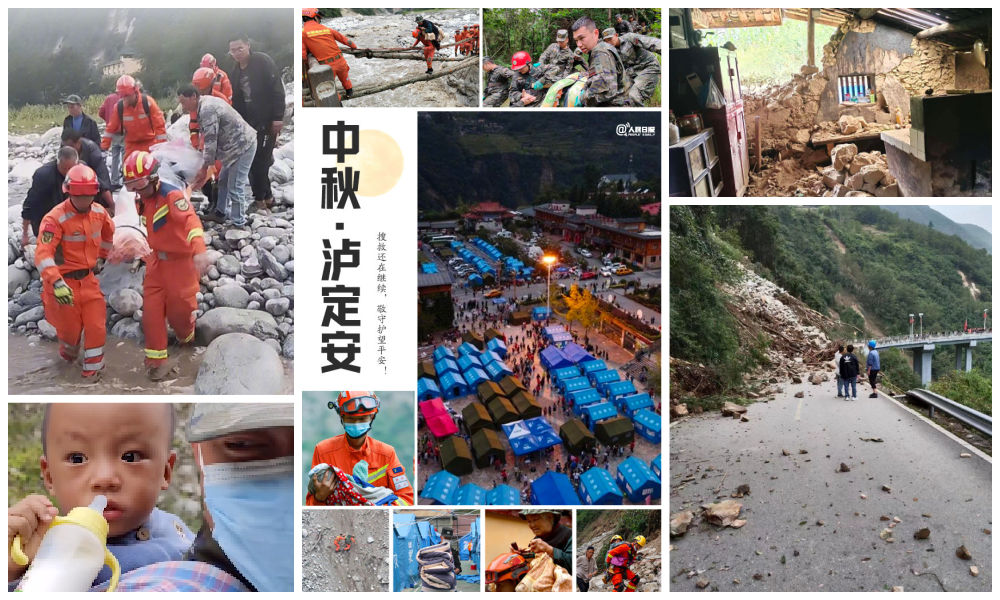
On Monday September 5, at 12:52 local time, a strong earthquake struck southwestern China’s Sichuan Province. The 6.8-magnitude earthquake jolted Luding County, Ganzi Tibetan Autonomous Prefecture, and killed at least 88 people.
The tremor could be felt miles away from the epicenter, including in the provincial capital Chengdu, which is about 220 kilometers from Luding. The earthquake injured more than 270 people, while 30 persons are still missing.
As many netizens shared videos of how they experienced the earthquake, dozens of hashtags went trending on Chinese social media relating to the earthquake and its aftermath, including the 2.9 magnitude aftershock Luding experienced on Wednesday.
There were many stories shared on Weibo relating to the extensive damage and devastation caused by the earthquake. But besides the solidarity statements expressed online, there was also criticism coming from netizens about local authorities prioritising the battle against Covid-19 at such a critical moment.
Sharing Stories of Compassion and Camaraderie after Earthquake
Bad times sometimes bring out the best in people, and this was shown in the many stories circulating online this week.
The 56-year-old Ms. Gao, who runs a local chicken noodle soup restaurant in the town of Moxi in Luding county, was not at her restaurant when the earthquake hit. But she soon rushed to the disaster area and used all she had left to provide free soup and noodles to local residents and rescue workers, even though Gao, who suffers from breast cancer, is struggling herself (#患癌女子用仅剩一罐气为震区居民做汤面#).
Another Luding country resident, a local farmer named Chen, reportedly spent 12,000 yuan ($1730) out of his own pocket to buy and butcher three giant pigs in order to provide the local residents and fire fighters with roast pork. Chen’s brother additionally donated 1000 kilos of rice so that people in the disaster zone could have some warm meals (#四川兄弟给震区捐3头猪2000斤米#).
On September 9, one Chinese TV reporter who was working in the disaster zone rescued a young child who was separated from his parents during the chaos. Videos showed how the reporter, determined to find the child’s parents, prioritized the child over his work. The little boy was eventually reunited with his mother, who had not slept for 48 hours (#记者受人之托紧抱孩子不撒手#).

Chinese TV reporter deterined to reunite this child with its mother.
These kind gestures and efforts were much needed for those dealing with grief and loss after the earthquake. One man in Luding smiled when a reporter approached him, but he broke down in tears the moment he started talking about losing his sister in the earthquake (#大哥微笑接受采访一开口泪崩了#).
Chinese media outlet Fengmian reported that the 26-year-old rescue worker Qin Xiaoqiang (秦晓强) worked around the clock to rescue and dig out three people who were trapped under the rubble. Afterward, he learned that his own father and sister were killed in the earthquake (#痛失家人特警说要让更多家庭团圆#).
Some families lost all they had in the earthquake. On Weibo, many people donated to various earthquake-related causes via the Weibo Public Good platform (微公益).


Besides the aid charities raising funds thanks to Weibo and Wechat users, there are also dozens of Chinese celebrities who stepped up and donated money to help rescue work in the region. Among them were Chinese actor Leo Wu (Wu Lei, 吴磊) and Chinese actress Rosy (Zhao Lusi, 赵露思) – both made headlines for their contributions to the rescue operation (#吴磊为四川震区捐赠物资#, #赵露思向四川泸定捐赠物资#).

There were also other celebrities, including names such as Zhang Tian’ai and Wang Yibo, who donated money to help fund five Sichuan rescue teams to go to the front lines and to transport basic necessities to Luding County and other affected regions (#王一博为四川震区捐赠物资#).
Official Media Accounts Highlight Compassionate & Courageous Rescue Efforts
Over the past week, Chinese official state media outlets such as People’s Daily, Xinhua, and CCTV published countless posts on Weibo relating to the earthquake. In covering the earthquake on social media, Chinese state media have a clear human interest angle and make a strong appeal to emotion as many of these posts specifically focus on the rescue and relief efforts and the bravery, compassion, and humanity shown by Chinese rescue workers (#消防武警民兵公安奔赴震区救援#).
On September 8, People’s Daily highlighted the moment an armed officer evacuated a baby from the disaster zone, the small child calmy drinking their milk while safely strapped on the soldier’s back (#震区宝宝在武警背上乖乖喝奶#).
People’s Daily also reported about several firefighters carrying an old lady and getting her out of the earthquake zone.

Global Times published a story and video about a firefighter whose feet were completely blistered and battered after working in the earthquake-hit zones (#震区消防员脚底被磨破#).
Official media published various propaganda posters showing emergency workers, including firefighters, paramedics, and police officers, during the rescue operations. One poster compared the ongoing relief efforts in Luding to those during the 2008 Great Sichuan earthquake or Wenchuan earthquake, during which a devastating 69,000 people lost their lives.

The China Fire and Rescue account shared a “Pray for Luding” poster on Weibo showing emergency workers carrying a special rescue stretcher with the help of volunteers. The hashtag “Pray for Luding” (#为泸定祈福#) received over 280 million clicks within four days time.

State media outlet Xinhua emphasized the bravery shown by young workers operating excavators on dangerously steep hills to clear roads of debris (#震区绝壁上的挖掘机手是90后# and #泸定地震中打通生命通道的孤勇者#).
The story of a team of 24 rescue workers who got stranded in the Hailuogou Scenic Area near Moxi Town also was covered a lot; the rescue workers were at the scene shortly after the earthquake hit but then were unable to get back to due to changing weather conditions. Their safe return was celebrated by various Chinese state media on September 10 (#24名滞留震区孤岛特警全部平安#).
Online Grassroots Criticism on Prioritizing Anti-Epidemic Efforts
But amid all the online stories and Chinese media narratives focusing on courage, compassion, and camaraderie, there was also criticism, as the strong earthquake put things into perspective regarding China’s ongoing fight against COVID-19 and the zero-Covid policy.
After local health authorities in the disaster area announced a strengthening of epidemic prevention and control measures on September 7, including daily nucleic acid testing for rescue workers and a stop on volunteer rescue workers coming into the area, many people showed little understanding.
“The earthquake is not as important as epidemic prevention,” some wrote.
“People’s lives are at stake and we’re still all about epidemic prevention. The earthquake [apparently] is not as powerful as the ‘big flu’ – it’s really hopeless.”
“Trivia. During the few years of epidemic in Sichuan, a total of three people died. During a few minutes of the earthquake, more than 70 died.” “By now, the mortality rate of this virus is less than the flu,” one person responded.
“The epidemic prevention comes first, people’s lives come second,” others wrote. “What happened to ‘putting people and life first?'” some wondered, mentioning the famous quote by Xi Jinping.

One Weibo user posted a photo of a dog getting tested for Covid, writing: “[China’s] major nucleic acid testing companies allegedly made $16 billion in the first half of this year, so it’s certainly wouldn’t be excessive if they donated some money to the earthquake area, right?”
By Manya Koetse
Get the story behind the hashtag. Subscribe to What’s on Weibo here to receive our weekly newsletter and get access to our latest articles:
Spotted a mistake or want to add something? Please let us know in comments below or email us. First-time commenters, please be patient – we will have to manually approve your comment before it appears.
©2022 Whatsonweibo. All rights reserved. Do not reproduce our content without permission – you can contact us at info@whatsonweibo.com.
Manya is the founder and editor-in-chief of What's on Weibo, offering independent analysis of social trends, online media, and digital culture in China for over a decade. Subscribe to gain access to content, including the Weibo Watch newsletter, which provides deeper insights into the China trends that matter. More about Manya at manyakoetse.com or follow on X.
China Media
China’s “AFP Filter” Meme: How Netizens Turned a Western Media Lens into Online Patriotism
Chinese netizens embraced a supposed “demonizing” Western gaze in AFP photos and made it their own.
Published
3 months agoon
September 10, 2025By
Ruixin Zhang
For a long time, Chinese netizens have criticized how photography of Chinese news events by Western outlets—from BBC and CNN to AFP—makes China look more gloomy or intimidating. During this year’s military parade, the so-called “AFP filter” once again became a hot topic—and perhaps not in the way you’d expect.
In the past week following the military parade, Chinese social media remained filled with discussions about the much-anticipated September 3 V-Day parade, a spectacle that had been hyped for weeks and watched by millions across the country.
That morning, Chinese leader Xi Jinping, accompanied by his wife Peng Liyuan, welcomed international guests on the red carpet. When Xi arrived at Tiananmen Square alongside Russian President Vladimir Putin and North Korean leader Kim Jong-un, office phone calls across the country quieted, and school classes paused to tune in to one of China’s largest-ever military parades along Chang’an Avenue in Beijing, held to commemorate China’s victory over Japan in the Second Sino-Japanese War and World War II.
As tanks rolled and jets thundered overhead, and state media outlets such as People’s Daily and Xinhua livestreamed the entire event, many different details—from what happened on Tiananmen Square to who attended, and what happened before and after, both online and offline—captured the attention of netizens.
Amid all the discussions online, one particularly hot conversation was about the visual coverage of the event, and focused on AFP (法新社), Agence France Press, the global news agency headquartered in Paris.
Typing “AFP” (法新社) into Weibo in the days after the parade pulled up a long list of hashtags:
- Has AFP released their shots yet?
- V-Day Parade through AFP’s lens
- AFP’s god-tier photo
- Did AFP show up for the parade?
The fixation may seem odd—why would Chinese netizens care so much about a French news agency?

Popular queries centered on AFP.
The story actually goes back to 2022.
In July of that year, on the anniversary of the Communist Party’s founding, one Weibo influencer (@Jokielicious) noted that while domestic photographers portrayed the celebrations as bright and triumphant, she personally preferred the darker, almost menacing image of Beijing captured by Western journalists. In her view, through their lens, China appeared more powerful—even a little terrifying.

The original post.
The post went viral. Soon, netizens began comparing more of China’s state media photos with those from Western outlets. One photo in particular stood out: Xinhua’s casual, cheerful shot of Chinese soldiers contrasted sharply with AFP’s cold, almost cinematic frame.

Same event, different vibe. Chinese social media users compared these photos of Xinhua (top) versus AFP (down). AFP photo shot by Fred Dufour.
Netizens joked that Xinhua had made the celebration look like the opening of a new hotel, while AFP had cast it as “the dawn of an empire.”
Gradually, what began as a dig at the bad aesthetics of state media turned into something else: a subtle shift in how Chinese netizens were rethinking their country’s international image.
Under the hashtag #ChinaThroughOthersLens (#老中他拍), netizens shared images of China as seen through the lenses of various Western media outlets.
This wasn’t the first time such talk had appeared. In the early days of the Chinese internet, people often spoke of the so-called “BBC filter.” The idea was that the BBC habitually put footage of China under a grayish filter, making its visuals give off a vibe of repression and doom, which many felt was at odds with the actual vibrancy on the ground. To them, it was proof that the West was bent on painting China as backward and gloomy.
These discussions have continued in recent years.
For example, on Weibo there were debates about a photo of the Wuhan Institute of Virology, shot by Peter Thomas for Reuters, and used in various Western media reports about Wuhan and Covid as early as 2021. The top image shows the photographer’s vantage point.
“Looks like a cockroach in the gutter,” one popular comment described it.

Top image by Chinese media, lower image by Peter Thomas/Reuters, and was used in various Western media reports about Wuhan and Covid since as early as 2021.
Another example is the alleged “smog filter” applied by Western media outlets to Beijing skies during the China visit of US Secretary of State Antony Blinken in 2024.

The alleged “smog filter” applied to Beijing skies during Blinken’s visit. Top image: Chinese media. Middle: BBC. Lower: Washington Post.
AFP, meanwhile, seemed to offer a different kind of ‘distortion.’
Netizens said AFP’s photos often had a low-saturation, high-contrast, solemn tone, with wide angles that made the scenes feel oppressive yet majestic. Over time, any photo with that look—whether taken by AFP or not—was dubbed the “AFP filter” (法新社滤镜).
AFP has clarified multiple times that many of the viral examples weren’t even theirs—or that they were, but had been altered with an extra dark filter. They also refuted claims that AFP had published a photo series of Chinese soldiers titled “Dawn of Empire” to discredit China’s army.

AFP refuted claims that their photos discredited the Chinese army.
Nevertheless, the “AFP filter” label stuck. It became shorthand for a Western gaze that cast China not as impoverished or broken—as some claimed the “BBC filter” did—but as formidable, like a looming supervillain.
One running joke summed it up neatly: domestic shots are the festive version; Western shots are the red-tyrant version. And increasingly, netizens admitted they preferred the latter, commenting that while AFP shots often emphasize red to suggest authoritarianism, they actually like the red and what it stands for.
So, when this year’s V-Day came around, many were eager to see how AFP and other Western outlets would frame China as the dark, dangerous empire.
But when the photos dropped, the reaction was muted. They looked average. Some called them “disappointing.” “Where are the dark angles? Not doing it this time?” one blogger wondered. “Where’s the AFP hotline? I’d like to file a complaint!”
“Xinhua actually beat you this time,” some commented on AFP’s official Weibo account. Others agreed, putting the AFP photos and Xinhua photos side by side.

AFP photos on the left versus Xinhua photos on the right.
To make up for the letdown, people began editing the photos themselves—darkening the tones, adding dramatic shadows, and proudly labeling them with the tag “AFP filter” or calling it “The September 3rd Military Parade Through a AFP Lens” (法新社滤镜下的9.3阅兵). “Now that’s the right vibe,” they said: “I fixed it for you!”

Netizen @哔哔机 “AFP-fied” photos of the military parade by AFP.

Official media quickly picked up on the trend. Xinhua rolled out its own hashtags—#XinhuaAlwaysDeliversEpicShots (#新华社必出神图的决心#) and #XinhuaWins (#新华社秒了#)—and positioned itself as the true master of a new aesthetic narrative.
The message was clear: China no longer needs the Western gaze to frame itself as powerful or intimidating; it can do that on its own.
The “AFP v Xinhua” contest, the online movement to “AFP-ify” visuals, and the Chinese fandom around AFP’s moodier shots may have been wrapped in jokes and memes, but they also pointed to something deeper: the once “demonized” image of China that Western media pushed as threatening is now not only accepted by Chinese netizens, it’s embraced. Many have made it part of a confident, playful form of online patriotism, applauding the idea of being seen by the West as fearsome, even villainous, believing it amplifies China’s global authority.
As one netizen wrote: “I like it when we look like we crawl straight into their nightmares.”
Chinese journalist Kai Lei (@凯雷) suggested that these kinds of trends showed how the Chinese public plays an increasingly proactive role in shaping China’s global image.
By now, the AFP meme has become so strong that it doesn’t even require AFP anymore. Ultra-dramatic shots are simply called “AFP-level photos” (法新社级别).
For now, as many are enjoying the “afterglow” of the military parade, their appreciation for the AFP-style only seems to grow. As one Weibo user summed it up: “AFP tried to create a sense of oppression with dark, low-angle shots, but instead only strengthened the Chinese military’s aura of majesty.”
– By Ruixin Zhang and Manya Koetse
Spotted a mistake or want to add something? Please let us know in comments below or email us. First-time commenters, please be patient – we will have to manually approve your comment before it appears.
©2025 Whatsonweibo. All rights reserved. Do not reproduce our content without permission – you can contact us at info@whatsonweibo.com.
China Arts & Entertainment
Yearnings, Dreamcore, and the Rise of AI Nostalgia in China
From China’s first soap opera Yearnings to the rise of AI-fueled nostalgia.
Published
6 months agoon
July 2, 2025
The year is 1990, and the streets of Beijing’s Fangshan District are eerily quiet. You can almost hear a pin drop in the petrochemical town, as tens of thousands of workers and their families huddle around their televisions, all tuned to the same channel for something groundbreaking: China’s very first soap opera, Yearnings (渴望 Kěwàng).
Yearnings tells the story of Liu Huifang (刘慧芳), a female factory worker from a traditional working-class family in Beijing, and her unlikely marriage to university graduate Wang Husheng (王沪生), who comes from a family of intellectuals. When Liu finds an abandoned baby girl, she adopts her and raises her as her own, against her husband’s wishes.
The couple is unaware that the foundling is actually the illegitimate child of Wang’s snobbish sister, Yaru. After Liu and Wang have a biological son, the marriage comes under further pressure, eventually leading to divorce. Liu is left as a single mother, raising two children on her own.

Still from Yearnings, via OurChinaStory.
Drawing inspiration from foreign dubbed television shows, Yearnings was produced as China’s first truly domestic, long-form indoor television drama. Spanning 50 episodes, the series traces a timeline from the onset of the Cultural Revolution in the 1960s through to the late 1980s—one of the most turbulent periods in modern Chinese history.
Before the series aired nationally on CCTV and achieved record viewership, the first station to air Yearnings in the Beijing region was the Yanshan Petrochemical TV Station (燕山石化电视台), China’s first major factory TV station (厂办电视台) located in Fangshan District.
Here, in this town of over 100,000, Yearnings garnered an astonishing and unprecedented 98% audience share. The series was truly groundbreaking and became a national sensation—not just because it was China’s first long-form television drama, or because it was a locally produced drama that challenged the long-standing monopoly of state broadcaster CCTV, but because Yearnings marked a major shift in television storytelling.
Until then, Chinese TV stories had always revolved around communist propaganda, or featured great heroes of the revolution. Yearnings, on the other hand, was devoid of political content and focused on the hopes and dreams of ordinary people and their everyday struggles—love, desire, marital tension, single motherhood—topics that had never before been so openly portrayed on Chinese television.
The show’s creators had perfectly tapped into what was changing: the Communist Party was slowly withdrawing from private life, and people were beginning to see themselves less defined by their work unit and more by their home life—as consumers, as partners and parents, as citizens of a new China filled with aspirations for the future. Yearnings’ storyline was a reflection of that.
Chinese-Style “Nostalgia Core”
Yearnings marked a cultural turning point, coinciding with the rapid spread of TV sets in Chinese households. In 1992, economic reforms triggered a new era in which Chinese media became increasingly commercialized and thriving, before the arrival of the internet, social media, and AI tools once again changed everything.
Today, Yearnings still is a topic that often comes up in Chinese online media. On apps like Douyin, old scenes from Yearnings are reposted and receive thousands of shares.
📌 It’s emblematic of a broader trend in which more netizens are turning to “nostalgia-core.” In Chinese, this trend is known as “中式梦核” (Zhōngshì Mènghé), which literally means “Chinese-style dreamcore.”
Dreamcore is an internet aesthetic and visual style—popular in online communities like Tumblr and Reddit—that blends elements of nostalgia, surrealism, and subconscious imagery. Mixing retro images with fantasy, it evokes a sense of familiarity, yet often feels unsettling and deserted.
The Chinese-style dreamcore (中式梦核), which has become increasingly popular on platforms like Bilibili since 2023-2024, is different from its Western counterpart in how it incorporates distinctly Chinese elements and specifically evokes the childhood experiences of the millennial generation. Content tagged as “Chinese-style dreamcore” on Chinese social media is often also labeled with terms like “nostalgia” (怀旧), “childhood memories” (童年回忆), “when we were little” (小时候), and “Millennial Dream” (千禧梦).
According to the blogging account Yatong Local Life Observer (娅桐本地生活观察), the focus on the millennial childhood can be explained because the formative years of this generation coincided with a decade of rapid social change in China —leaving little in today’s modern cities that still evokes that era.
🌀 Of course, millennials in the West also frequently look back at their childhood and teenage years, particularly the 1980s and 1990s—a trend also embraced by Gen Z, who romanticize these years through media and fashion. In China, however, Gen Z is at the forefront of the “nostalgia-core” trend, reflecting on the 1990s and early 2000s as a distant, almost dreamlike past. This sense of distance is heightened by China’s staggering pace of transformation, modernization, and digitalization over the past decades, which has made even the recent past feel remote and irretrievable.
🌀 Another factor contributing to the trend is that China’s younger generations are caught in a rat race of academic and professional competition, often feeling overwhelmed by the fast pace of life and the weight of societal expectations. In this high-pressure environment—captured by the concept of “involution” (内卷)—young people develop various coping mechanisms, and digital escapism, including nostalgia-core, is one of them. It’s like a cyber-utopia (赛博乌托邦).
🌀 Due to the rise of AI tools available to the general public, Chinese-style nostalgia core has hit the mainstream because it’s now possible for all social media users to create their own nostalgic videos and images—bringing back the 1990s and early 2000s through AI-generated tools, either by making real videos appear more nostalgic or by creating entirely fictional videos or images that recreate scenes from those days.
So what are we seeing? There are images and videos of stickers kids used to love, visuals showing old classrooms, furniture, and children playing outside, accompanied by captions such as “we’re already so far apart from our childhood years” (example).

Images displayed in Chinese Dreamcore.
And notably, there are videos and images showing family and friends gathering around those old big TVs as a cultural, ritualized activity (see some examples here).

Stills from ‘nostalgia core’ videos.
These kinds of AI-generated videos depict a pre-mobile-era family life, where families and communities would gather around the TV—both inside and outside—from classrooms to family homes. The wind blows through the windows, neighbors crack sunflower seeds, and children play on the ground. Ironically, it’s AI that is bringing back the memories of a society that was not yet digitalized.
Nowadays, with dozens of short video apps, streaming platforms, and livestream culture fully mainstream in China—and AI algorithms personalizing feeds to the extreme—it sometimes feels like everyone’s on a different channel, quite literally.
In times like these, people long for an era when life seemed less complicated—when, instead of everyone staring at their own screens, families and neighbors gathered around one screen together.
There’s not just irony in the fact that it took AI for netizens to visualize their longing for a bygone era; there’s also a deeper irony in how Yearnings once represented a time when people were looking forward to the future—only to find that the future is now looking back, yearning for the days of Yearnings.
It seems we’re always looking back, reminiscing about the years behind us with a touch of nostalgia. We’re more digitalized than ever, yet somehow less connected. We yearn for a time when everyone was watching the same screen, at the same time, together, just like in 1990. Perhaps it’s time for another Yearnings.
By Manya Koetse
(follow on X, LinkedIn, or Instagram)
Sources (other sources included in hyperlinks)
Koetse, Manya. 2016. “From Woman Warrior to Good Wife – Confucian Influences on the Portrayal of Women in China’s Television Drama.” In Stefania Travagnin (ed), Religion and Media in China. New York: Routledge.
Rofel, Lisa B. 1994. Yearnings: Televisual Love and Melodramatic Politics in Contemporary China. American Ethnologist 21(4):700-722.
Wang, Dan (汪丹). 2018. “《渴望》的艺术价值” [The Artistic Value of Yearnings].” Originally published in Beijing Daily (北京日报), October 12, 2018. Reprinted in Digest News (文摘报), October 20, 06 edition. Also see Sohu: 当年红遍大江南北的《渴望》.
Wang Min and Arvind Singhal. 1992. “Kewang, a Chinese television soap opera with a message.” Gazette 49: 177-192.
Zhuge Kanwu. 2021. “重温1990《渴望》:苦得“刘慧芳”希望被导演写“死” [Revisiting 1990’s Yearnings: The Suffering Liu Huifang Hoped to Be Written Off by the Director]. Zhuge Dushu Wu (诸葛读书屋), January 22. https://wapbaike.baidu.com/tashuo/browse/content?id=b699ee532cf79f862bfa14ad.
Spotted a mistake or want to add something? Please let us know in comments below or email us. First-time commenters, please be patient – we will have to manually approve your comment before it appears.
©2025 Whatsonweibo. All rights reserved. Do not reproduce our content without permission – you can contact us at info@whatsonweibo.com.
Subscribe
Eye on Digital China is a reader-supported publication by
Manya Koetse (@manyapan) and powered by What’s on Weibo.
It offers independent analysis of China’s online culture, media, and social trends.
To receive the newsletter and support this work, consider
becoming a paid subscriber.
Get in touch
Have a tip, story lead, or book recommendation? Interested in contributing? For ideas, suggestions, or just a quick hello, reach out here.
When an Entertainment Scandal Gets Political: How Wong Kar-wai Survived a Nationalist Storm
China Trend Watch: Quiet Nationalism, Loud Statements, and Nanjing Memorial Day
He Qing, China’s “No. 1 Classical Beauty”, Passes Away at 61
Why This Year’s Nanjing Memorial Day Felt Different
China Trend Watch: Hong Kong Fire Updates, Nantong’s Viral Moment & Japanese Concert Cancellations
The Wong Kar-wai Scandal Explained: The Dark Side of ‘Blossoms Shanghai’
From Nobel Farewell to ‘VIP Toilets’: What’s Trending in China
China Trend Watch: Japan Tensions, Nexperia Fallout, Yunnan’s ‘Wild Child,’ & “Modern Opium”
Eye on Digital China: How Chinese Social Media Evolved from the Blog Era to the AI-driven Age
From Tents to ‘Tangping Travel”: New Travel Trends among Young Chinese
Popular Reads
-
China Memes & Viral5 months agoHidden Cameras and Taboo Topics: The Many Layers of the “Nanjing Sister Hong” Scandal
-
China Memes & Viral12 months agoOur Picks: Top 10 Chinese Buzzwords and Phrases of 2024 Explained
-
China Insight8 months agoUnderstanding the Dr. Xiao Medical Scandal
-
China Digital11 months ago“Dear Li Hua”: The TikTok/Xiaohongshu Honeymoon Explained