
China Insight
“Why Aren’t You Getting Married?” – China’s Marriage Rates Keep Dropping
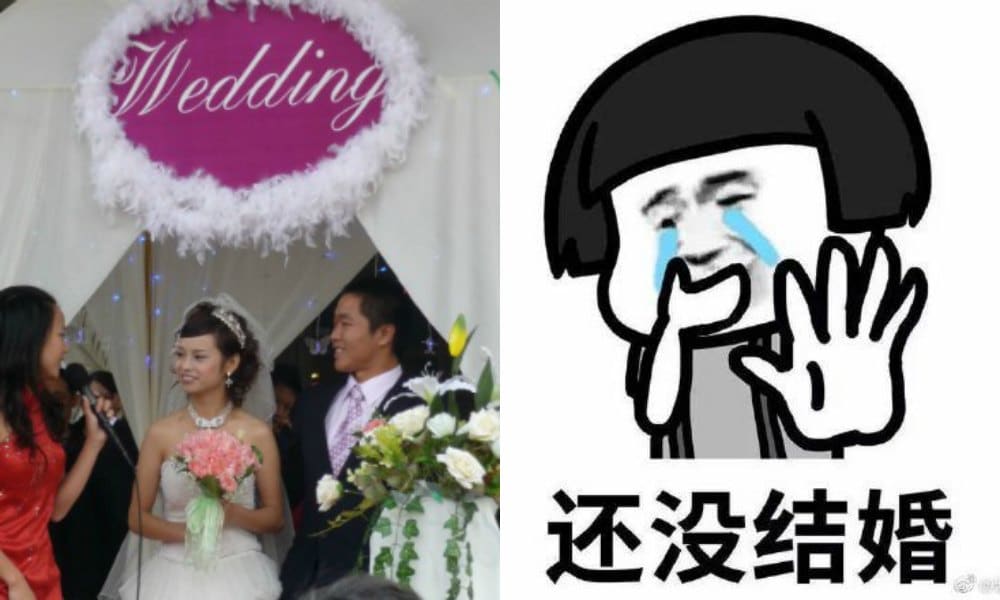
China’s marriage rates have hit a new low, but Weibo’s singletons blame their unmarried status on circumstances beyond their control.

First published
“Marriage rates are dropping year by year,” state media outlet People’s Daily writes on Weibo this week: “Statistics show that more and more people are less willing to get married every year (..). Experts point out that younger people are more focused on themselves and how they feel, rather than how they appear to others.”
“At the same time,” People’s Daily continues: “Marriage is no longer the sole option to obtain economic independence and a happy life for young people. Additionally, with the continuous development of societal standards, the costs of marriage have gone up, and many people don’t want to marry.”
With its social media post, People’s Daily introduced the Weibo hashtag “Why Aren’t You Getting Married?” (#你为啥不结婚#), which had received over 22 million views a day after it was posted.
Over recent weeks, many Chinese media have reported on how China’s marriage rates have hit a new low since 2013, with only 7.2 out of 1000 people getting married in 2018, according to the National Bureau of Statistics.
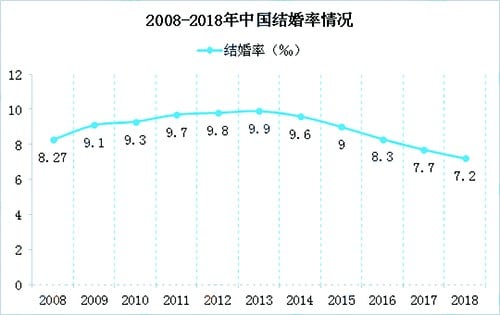
Marriage rates [per 1000 population] since 2008 (via China Business Industry Research Data Center 中商业产业研究大数据库).
With a rapidly aging population and dropping birth rates, China’s falling marriage rates are a source of worry for many experts.
In 2015, some well-known scholars already urged Chinese younger generations to get married and produce offspring, writing: “For the country, for society, for parents, can’t you let go a bit of personal happiness?”
The only places where the marriage rates are still going somewhat strong are in some of China’s more impoverished areas, including Tibet, Qinghai, Anhui, and Guizhou, suggesting that there’s a clear correlation between the rise in living standards and declining marriage rates.
Although Chinese state media outlets, such as People’s Daily, Xinhua, or China Women’s Daily, do mention the rising costs of living and the fact that many among Chinese younger generations “prefer to marry late,” with some not marrying at all, they do not mention other reasons that might explain the recent decline in marriage rates.
Leftover Men, Leftover Women, and Rising Bride Prices
Over recent years, various trends on Chinese social media have highlighted the existing social issues behind China’s dropping marriage rates. In 2015, it was China’s so-called ‘leftover’ single men who were pointed out as a “crisis,” with China having millions of more men than women of marriageable age – partly a consequence of the one-child policy and general preference for baby boys.
The fact that one survey, albeit small-scale, pointed out that 50% of Chinese single men think that women who are still single at the age of 25 are ‘leftovers’ might also not be helpful in boosting marriage rates.
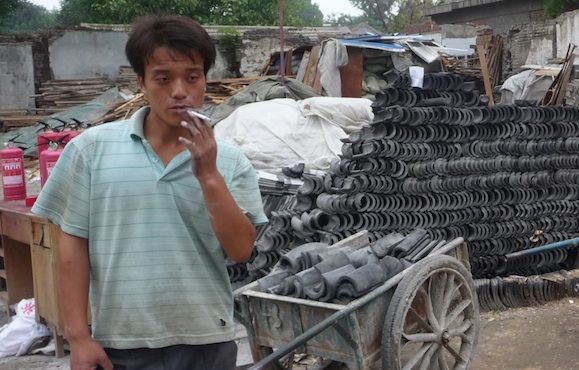
image by whatsonweibo.com
For some years, ‘leftover women’ were mentioned as a reason for China’s declining marriage rates; China’s well-educated, career-oriented, urban single women were sometimes singled out for making it harder for China’s unmarried men to find a wife because of their ‘choice’ to postpone marriage and family life. This has increased the pressure on China’s single women to get married, which has become a recurring topic of debate on Chinese social media.
And then there is the issue of staggering bride prices in those areas where ‘bride prices’ are still a custom: within a timeframe of 17 years, bride prices in China’s rural areas have increased more than sixty-fold. For many unmarried men in some Chinese provinces, marriage has simply become an unattainable goal.
All in all, with a surplus of (rural) men, more (urban) educated, career-oriented women, strong traditional views on the ‘right’ marriage age for women, a higher cost of living, and a rising bride price for the relatively few women of marriage age in rural areas, it is perhaps too easy to say that postponing marriage is simply a matter of ‘choice’ or ‘preference’ for China’s younger generations.
Changing Policies
The many comments on Weibo to the question “Why Aren’t You Getting Married?” also show that there is no straightforward answer to China’s dropping marriage rates, and that’s it is not merely a matter of preference.
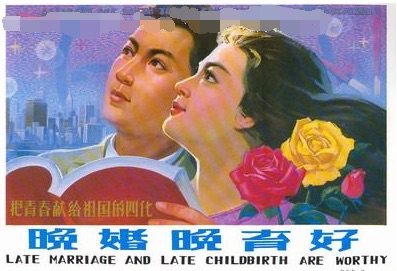
“You first propagated for years that we were supposed to ‘get married late and give birth late’ (晚婚晚育) in addition to ‘fewer and healthier births’ (少生优生), now you change your tune and we’re to blame?” one popular comment says.
At the time of the one-child policy, propaganda posters and state media encouraged people to postpone marriage and childbirth in order to help control China’s population growth. Various policies were introduced to make people marry later. The ‘late marriage leave,’ for example, allowed people to take a 30-day paid leave when getting married over the age of 25. That particular policy was canceled in 2016.
The aforementioned commenter is not the only one showing their frustration with changing policies on marriage and childbirth. “[I’m not married] because the government first told us to marry late and have children late,” another netizen writes: “I’m just being obedient.”
Similar sentiments were also expressed after the one-child policy was canceled, allowing couples, or even encouraging them, to have a second child. “The person who was forced to have an abortion then, is the same person who is pressured to have a baby now,” some people on Weibo said.
With some people joking that the government will arrange things for them anyway, their answer to the marriage question is: “I am waiting for the state to assign me to someone.”
“I am waiting for the state to bring me a handsome man. I’ve been searching for him all over, but can’t find him anywhere,” others say.
Apart from these comments, the most recurring answers to why people are not married yet include the following:
– “Young people doing 996 [working from 9am-9pm, 6 days a week] don’t have time for love and raising children.”
– “Why would I get married, I’m getting along fine by myself.”
– “I can’t afford a house, can’t afford to raise kids, can’t afford to get married.”
– “Get married if you like, stay single if you like, in the end, we’ll all regret it anyway.”
The most recurring and upvoted comments were also the shortest ones: “Because I’m poor.”
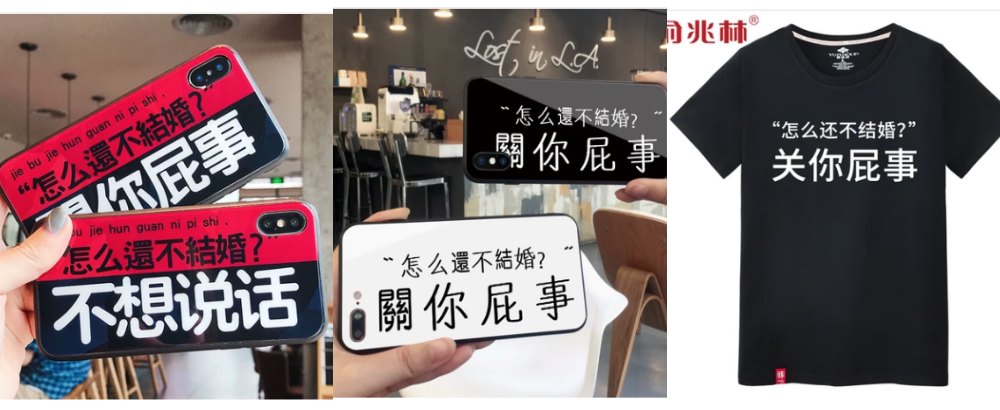
Meanwhile, on Chinese e-commerce platform Taobao, it seems that some are making a profit out of the dreaded “Why aren’t you married” question. Various sellers are selling phone covers and t-shirts with the question printed on it. The answer, underneath, is loud and clear: “Mind your own damn business.”
Also read: Mirror of Time: Chinese Weddings Through the Decades
By Manya Koetse
Spotted a mistake or want to add something? Please let us know in comments below or email us.
©2019 Whatsonweibo. All rights reserved. Do not reproduce our content without permission – you can contact us at info@whatsonweibo.com


China Insight
Mbappé, Mao, and the Joke That Shall Not Be Named
Mbappé’s favorite Mao meme sparked major backlash in China. More on what the controversy reveals about political red lines, online humor, and censorship.
RESOU 热搜 | What’s Trending in China, Explained
Here, I briefly unpack the stories making waves on Chinese social media and share what stands out to me. Don’t miss an update: become a subscriber to Eye on Digital China today.
Oh oh oh, Mbappé, all those goals, yet you lost so many points on Chinese social media over the past 48 hours.
Following his 100th goal for Real Madrid during El Clásico and finishing second on Ballon d’Or night, French football player Mbappé is all the talk on Chinese social media — not for his achievements, but for what is seen as crossing a major red line in an online interview.
On Tuesday night, a text came in from Ruixin: “I am wide awake tonight and somehow witnessed live how the footballer Kylian Mbappé was getting blocked and totally canceled on Chinese social media for his comments about Mao Zedong over the past, like, three hours 😅”
I quickly grabbed my phone and saw the flood of Mbappé posts rapidly coming in, and it was clear that people were very cross with him.
Although it was already clear that this might not blow over any time soon, by early Wednesday morning it became painfully clear how the controversy had snowballed. Dongpeng Beverage Group (东鹏), one of the many Chinese companies that signed the famous sportsman as its brand ambassador, publicly stated that it was cutting all commercial ties with Mbappé. Soon, others followed.
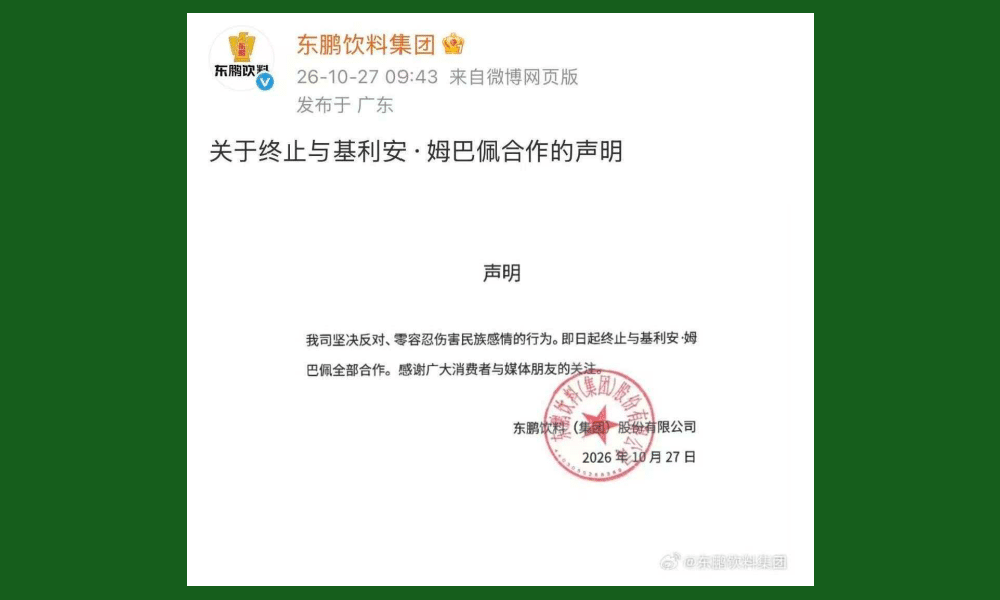
Dongpeng Beverage Group (东鹏): the first in a string of companies to cut ties with French footballer Kylian Mbappé.
Mbappé’s fall from grace in China has been sudden and spectacular, like a major avalanche of backlash that unfolded in one night, and it can all be traced back to one segment of an interview the footballer previously did on a French YouTube show (The Bridge) that resurfaced online — initially through Reddit and X, and then on Chinese social media apps, like football platform Dongqiudi (懂球帝).
In that segment, when asked about his favorite meme, Mbappé replied that one of the memes he finds funniest is:
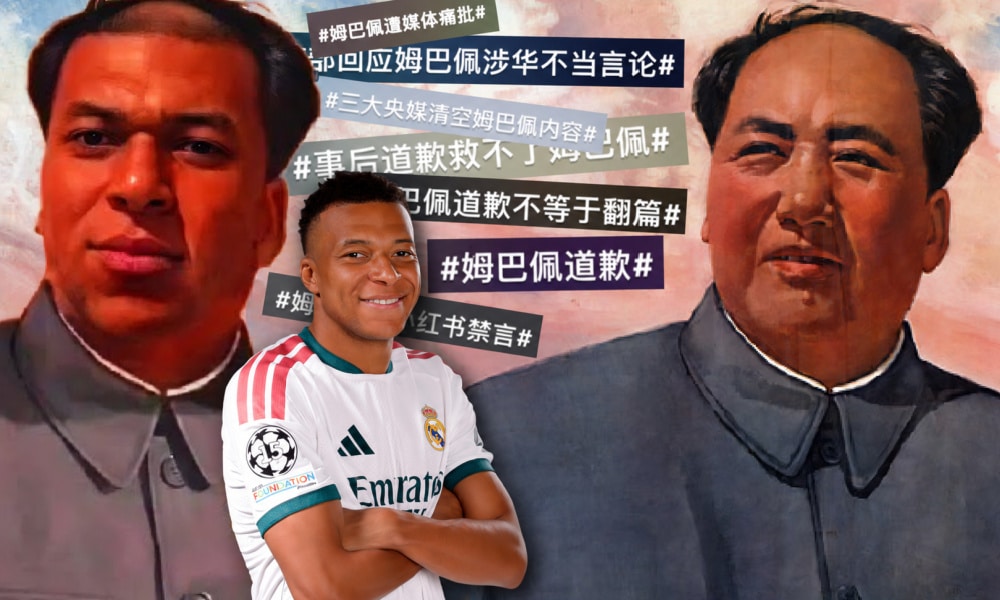
🗣️ “the one where they put my face on some guy, a Chinese dictator. That really makes me laugh, I use it with my friends all the time.”

The interview segment where Mbappé shares his favorite meme: his face photoshopped onto the face of a “Chinese dictator.”
The show, created by Mbappé’s Real Madrid teammate Aurélien Tchouaméni, added the image Mbappé referred to: his face photoshopped on a Mao propaganda visual. It’s part of a series of memes that emerged in 2024 in which Mbappé’s face is edited onto the faces of dictators.1
Chapter Dive
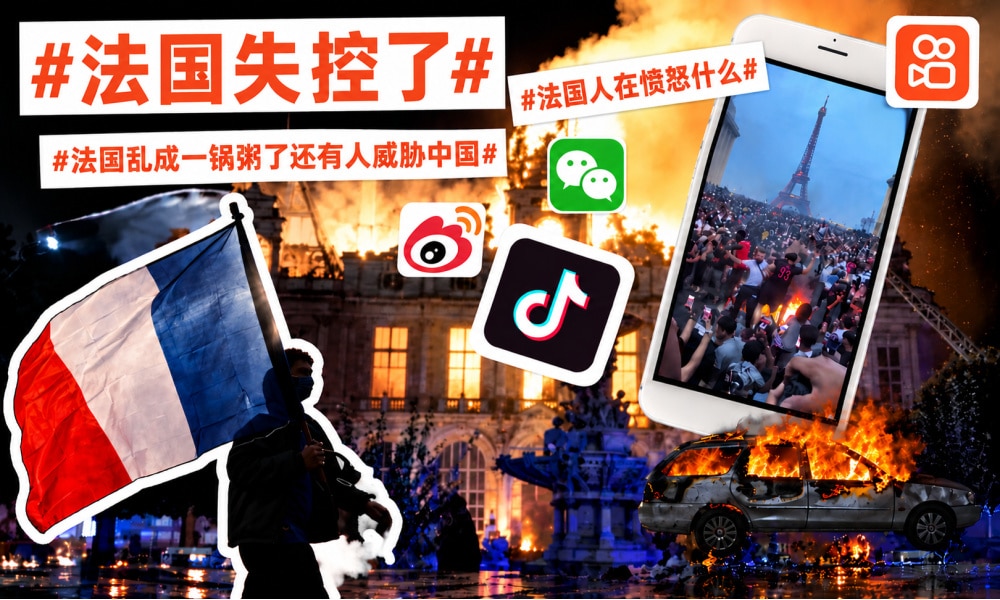
The French Protests, Viewed from China: Five Narratives on Chinese Social Media
From the decline of Europe to historical karma: these 5 narratives reveal how Chinese social media discusses the recent unrest in France.
Eye on Digital China is a reader-supported publication by
Manya Koetse (@manyapan) and powered by What’s on Weibo.
It offers independent analysis of China’s online culture, media, and social trends.
To receive the newsletter and support this work, consider
becoming a paid subscriber.


Mbappé, Mao & the Backlash on Chinese Social Media

Mbappé, Mao, and the Joke That Shall Not Be Named

The French Protests, Viewed from China: Five Narratives on Chinese Social Media

What Does 20 Yuan ($3) Mean Anymore? China’s Disappearing Living Rooms & the Great Laundry Debate

Starbucks Goes Xinjiang & The Kardashians in China

Why Japan Has So Many Surnames, China’s Back-to-School Shifts & Taiwan Pavilion Trouble

The Power of Ugly: Why Niu Lai Became China’s Unlikeliest Box-Office Hit

The Rise of “Shuaqi-ism,” Taking Starbucks to the Fields, and Pretending to Go to Work

AI Actress Ad Pulled, Baihaitun Disrupts Shanghai and Cicada Meme Bugs Huawei

Blame Games & Bad Signs: Nepal–Tibet Floods, Huawei’s Toilet Trouble, “Screwed” Graduates
-

 Chinese New Year9 months ago
Inside Chunwan 2026: China’s Spring Festival Gala
-

 China Brands, Marketing & Consumers12 months ago
Hasan Piker’s China Trip & the Unexpected Journey of a Chinese School Uniform to Angola
-

 Chapter Dive8 months ago
Inside the Great Chinese Debate Over the Iran War
-

 China Trend Watch12 months ago
Japan Tensions, Nexperia Fallout, Yunnan’s ‘Wild Child,’ & “Modern Opium”