
Weiblog
Chinese Government Declares New National Holiday
The year 2015 has a special meaning for Chinese People, as it has been 70 years since the end of the war. The Chinese Government Declares New National Holiday.


The year 2015 has a special meaning for Chinese People, as it has been 70 years since the end of the war.
The Chinese government has therefore declared a new national holiday on September 3th this year, commemorating the 70th Anniversary of the end of the Second Sino-Japanese War, that merged into WWII when China joined the Allies in 1941. This war, that is also called the Chinese People’s War of Resistance against Japan (中国人民抗日战争), ended in September 1945.
September 3th has been made into a holiday for the public to participate in the commemorations held by the central government and those organized by local departments in different cities around China. It follows directly after Victory over Japan Day on September 2.
According to the new schedule, Thursday, September 3th, will be observed as a national holiday, followed by two more days of vacation on Friday, September 4, and Saturday, September 5. Sunday, September 6, will be a make-up work day.
The State Council of China has pointed out that departments working in duty, security and safeguarding fields must be arranged well by in all places; they must prepare for unexpected big incidents, and proper measures must be taken to ensure all commemorations across the nation can be held smoothly.
The topic became trending on Sina Weibo (#9月3日全国放假#), with many netizens expressing their support for the commemoration and their joy with an extra free day. For some netizens, however, one day of commemoration is not enough: “I think that one day of commemoration is not enough to express our joy with the victory of war (..),” one netizens says*: “Aren’t August 15th [Japan’s surrender to the Allies in 1945] and September 18th [the Mukden Incident] also important dates? Won’t we commemorate them? I think we should have a holiday from August 15 until September 18, then we can really enjoy the happiness of peace..”
Tencent News published some historical pictures from the end of the war in 1945 China in the light of the news of the national commemorations this year.

Chinese crowds celebrating surrender of Japan on Victory over Japan Day in Chongqing (Photo by Jack Wilkes, Getty Images).
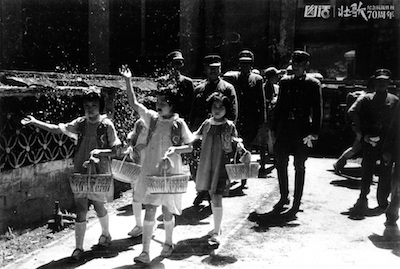

The celebrations of the end of the Second World War did not last long everywhere, as the nation erupted in civil war. On this picture, you can see the army troops entering Guangzhou after the Japanese have left.

Chinese Americans on Mott and Pell Streets in New York’s Chinatown celebrate after learning that the Japanese have surrendered to the Allies, on Victory over Japan Day, Aug. 14, 1945 (AP Photo/Tom Fitzsimmons).
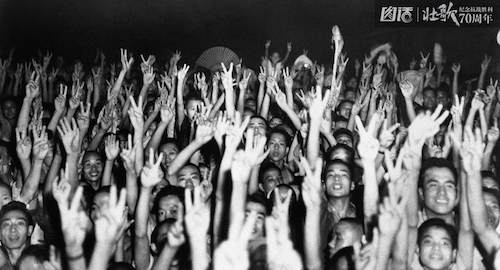
Crowds of joyous Chinese make a sea of hands as they wave their during Chongqing victory celebrations, after receiving the news that the Japanese in Chongqing surrendered (August 29, 1945). Many of them can be seen making the V- sign (AP Photo).

Celebrations in Shanghai: teahouses gave out free tea, merchants gave out free flags to celebrate the Japanese surrender (Photo by Fox Photos/Getty Images).


War correspondent Palmer Hoyt and his girlfriend Barbara Stephens, celebrating in Chongqing, October 1945. (Photo by Jack Wilkes/Getty Images)

Chinese crowds celebrate Victory over Japan Day in 1945, with some performing the Dragon Dance. (Photo by Jack Wilkes/Getty Images).
Featured Image:
Parade in Chongqing, Celebrations in China of Victory over Japan Day September 3, 1945: http://news.qq.com/original/tuhua/shengliri.html
*”我觉得吧,九月三日胜利纪念日当天放假并不足以表达我们对胜利的喜悦,以及对和平的祈愿,日本也很慢再着短短一天里吸取什么教训。而八月十五日和九月十八日难道不也是重要的日子吗?难道就不去铭记了?所以应该从八月十五日放到九月十八日,让我们在这一个月里好好感受和平的幸福与来之不易不更好吗~”
[box] This is Weiblog: the What’s on Weibo short-blog section. Brief daily updates on our blog and what is currently trending on China’s biggest social medium, Sina Weibo.[/box]
©2015 Whatsonweibo. All rights reserved. Do not reproduce our content without permission – you can contact us at info@whatsonweibo.com.




China Trend Watch
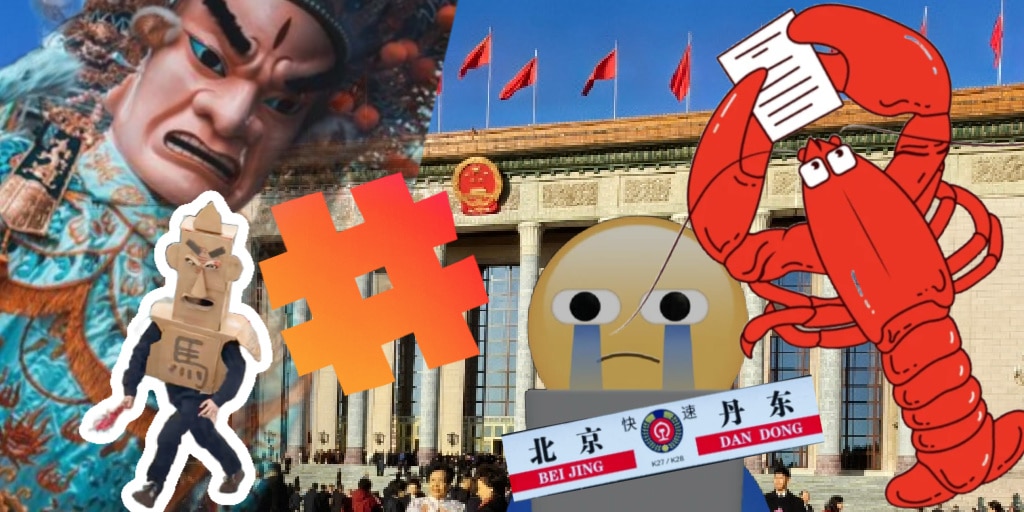
Raising Lobsters, 6G Coming, and China’s DIY Deity Trend
Chinese netizens “raising lobsters,” farmer pensions emerging as a key Two Sessions talking point, and humanoid robots running through Beijing — what you need to know about Chinese social media discussions this week.
🔥 China Trend Watch (week 11 | 2026) Part of Eye on Digital China by Manya Koetse, China Trend Watch is an overview of what’s trending and being discussed on Chinese social media. The previous newsletters covered last week’s main talking points & a chapter dive into the Chinese online discourse surrounding the Iran war. This edition was sent to paid subscribers — subscribe to receive the next issue in your inbox.

The scene, from a short-video series by Douyin creator Zhou Xiaonao (周小闹), unexpectedly made the Chinese restaurant chain Liu Wenxiang (刘文祥) go viral, turning it into an internet hit as the trend resonated with overworked young workers who enjoyed the mix of cathartic online meme culture & affordable comfort food.
The viral moment caused immediate chaos. Liu Wenxiang stores across the country were overwhelmed by two-hour queues, ingredients sold out, and the “order explosions” (爆单) forced some locations to temporarily suspend operations altogether.
Who could have expected a Douyin comedy creator to catapult a long-standing Chinese brand back into the spotlight so suddenly — not through its own marketing, not through a brand collaboration, but because a fictional online persona is obsessing over its malatang (spicy skewer soup)? It’s very much China’s online culture.

While I’m writing this newsletter, however, China’s 3.15 Consumer Rights Day is dominating Chinese social media. Earlier tonight, the 36th edition of China’s annual consumer rights show (3·15晚会) aired — a joint production by CCTV and government agencies that aims to educate the public on consumer rights while exposing violations and holding companies accountable.
Tonight, Liu Wenxiang suddenly saw its image crumble as the show exposed that multiple franchise locations across the country had been substituting duck meat for the advertised beef and pork in various menu items. According to the report, staff knowingly misled customers even when they knew beef or lamb was not actually being delivered — a practice reportedly involving thousands of orders per location each month.
The price gap helps explain why: pure beef rolls cost ¥28 (about US$4) per 500 grams, while duck rolls cost just ¥7 (about US$1) — a fourfold difference.
Public opinion is currently in full swing, rapidly turning against the brand that people had embraced so enthusiastically over the past few weeks.
And that, too, is a sign of this social media age. Unofficial sources can make you go viral in a minute, but when you’re officially exposed for essentially scamming customers, it becomes very difficult to recover. I wonder whether “Purple Potato Spirit” will still be treated to Liu Wenxiang malatang after this scandal.
(For more on China’s consumer day show, see last year’s post here.)
Let’s dive into the other trends that were widely discussed on Chinese social media this week.
(Short note: if you’re reading this and appreciate the newsletter but are not yet a paying subscriber, please consider supporting it. Eye on Digital China is fully independent and reader-funded. Your subscription helps keep this work going.)
Quick Scroll
-
- 🏎️ F1 Fever All eyes were on the F1 Chinese Grand Prix in Shanghai this weekend, especially given the cancellation of the Bahrain and Saudi Arabian races. The race was completely sold out, and Chinese media noted a marked increase in Chinese F1 fans, especially among women, with China’s current F1 fanbase exceeding 150 million.
- 🥢Swallowed Chopstick A 46-year-old man named Wang from Dalian gained attention after visiting the doctor for a sore throat, and it was found that a 12-centimeter metal chopstick had been lodged in his pharynx for eight years. Wang told the doctors he had accidentally swallowed it during a meal but was too afraid of surgery to seek treatment. The chopstick has now been removed, and Wang is fine — the chopstick remains intact as well.
- 📚 Iron Rice Bowl This weekend, 5.87 million people took the provincial civil service exams, known as the Shěngkǎo (省考), across 23 provinces, competing for 126,000 positions in provincial and local government offices — an average of 47 applicants per job (with some desirable positions attracting as many as 1,900 applicants for a single post!).
- 🚆 Boarding for Pyongyang Earlier this week, a train from China arrived in North Korea. As of March 12, the China–North Korea international passenger train operates four times a week between Beijing and Pyongyang. The train service, which remains highly restricted for ordinary travelers, had been suspended for years during and after the pandemic.
- 🏛️ Mao Under Construction From this week until the end of August, the Chairman Mao Memorial Hall (毛主席纪念堂) at Tiananmen Square, which houses the embalmed body of Mao Zedong, will undergo internal renovation and construction work and will be closed to the public. The site, opened in 1977, draws millions of domestic visitors each year.
- 🇨🇳🇺🇸 US–China Talks High-level US–China talks commenced in Paris on March 15. The discussions, led by US Treasury Secretary Scott Bessent and Chinese Vice Premier He Lifeng (何立峰), carry added significance because of their timing: right after the Two Sessions concluded and China’s 15th Five-Year Plan was approved, and before Trump’s anticipated China visit from March 31 to April 2 (although Beijing has not yet officially confirmed it).
- 🌹 Steel Roses Victory China’s women’s national football team, officially nicknamed the Steel Roses (钢铁玫瑰), became one of the most-discussed sports topics on Chinese social media this week after the team secured their spot at the 2026 FIFA Women’s World Cup in Brazil, defeating Chinese Taipei in the AFC Women’s Asian Cup. The celebration in football balanced the online disappointment over the elimination of China’s table tennis champion Wang Chuqin (王楚钦) from the World Table Tennis (WTT) Champions Chongqing tournament after losing 2–4 to 18-year-old Japanese player Matsushima Sora.
What Really Stood Out This Week
Why Everyone in China Is Talking About “Raising Lobsters”
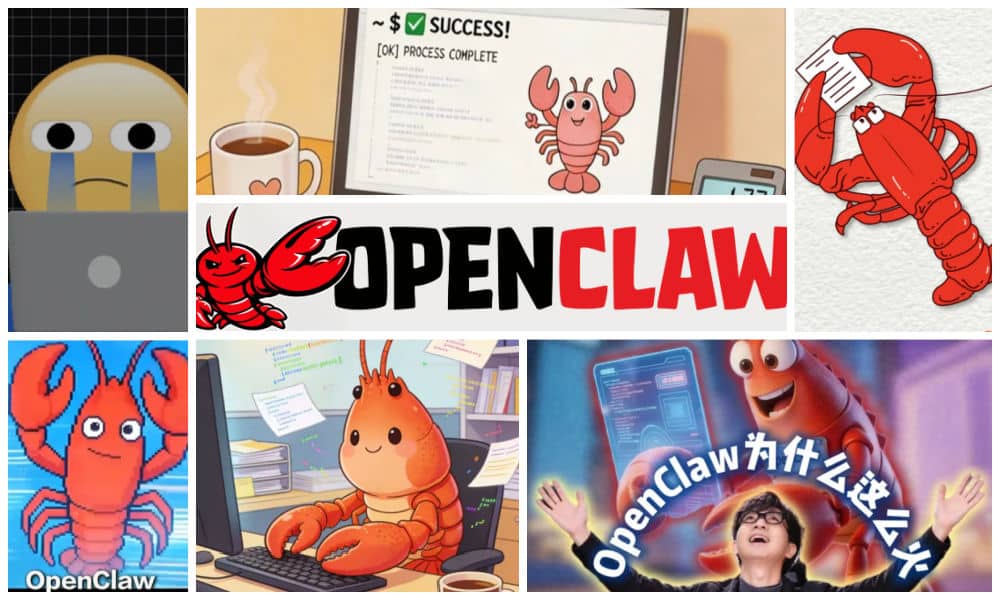
This week, everyone is talking about raising lobsters.
“Raising lobsters” in Chinese is yǎng lóngxiā (养龙虾), and it’s now widely used as a term for deploying AI agents. The reference to the lobster comes from the lobster-like creature that serves as the logo of the AI agent OpenClaw, formerly known as Clawdbot, developed by Austrian computer programmer Peter Steinberger and released in November 2025.
OpenClaw describes itself as a “Personal AI Assistant” or “the AI that actually does things,” such as sorting out your inbox, sending emails, managing your calendar, checking in for flights – all through the chat apps you already use.
So why is the open-source AI tool such a major success in China, going well beyond developer niche communities? One of the reasons so many people are talking about and using OpenClaw is that installing it has become a niche profession in itself.
Caiwei Chen at MIT Technology Review recently described how small companies and independent entrepreneurs in China, such as the young Chinese developer Feng Qingyang (冯庆阳), have directly contributed to the tool’s success by helping others install it. Feng began offering “OpenClaw installation support” in late January this year, and what started as a side gig has now grown into a full-fledged professional operation with more than 100 employees.
While in Western countries the comments by analyst firm Gartner, which described OpenClaw as an “unacceptable cybersecurity risk” last month, were still resonating, the AI tool’s popularity in China has surged in recent weeks. Companies like Feng’s have mushroomed across the country, with unofficial OpenClaw installation events drawing crowds in many cities. Larger corporate events are also attracting attention, such as a recent installation event at Tencent’s headquarters in Shenzhen that drew hundreds of participants.
By now, virtually all of China’s major tech companies have jumped on the hype. From ByteDance to JD.com, companies are offering a range of OpenClaw products and services.
Success stories quickly went viral, including a claim that an OpenClaw agent completed three weeks’ worth of work for six employees in just 24 hours. But the hype has also brought concerns, with online rumors circulating about people’s credit cards being charged unexpectedly or local files and emails being deleted.
Chinese authorities have now restricted state-run enterprises and government agencies from running OpenClaw AI apps on office computers, while official cybersecurity agencies have warned about potential security risks.
In the RealTime Mandarin newsletter, Andrew Methven explained the rise of the online phrase “one lobster, three ways” (龙虾三吃), a play on the name of a popular Chinese dish. With the latest security concerns, Chinese business-oriented programmers are spotting yet more money-making opportunities; In addition to OpenClaw installation services, some now also offer “uninstallation services.” In other words, people are now making lobster money in three ways with OpenClaw: installing the AI, training people how to use it, and uninstalling it when things go wrong.
Viral Weibo commentary from one blogger (@菜刀曦曦) neatly captured the hype cycle:
“How fast the world changes these days. Yesterday I was scrolling Weibo and everyone was raising lobsters, paying to get it installed, and honestly I was tempted too. Today what I’m seeing is that the lobster is basically a Trojan horse, and now people are paying to uninstall it. Install: 500 yuan [US$72]. Uninstall: 299 yuan [US$43]. Those of us who didn’t follow the trend have effectively saved 799 yuan [US$115].”
From 6G Dreams to Pension Debates: The Viral Topics of the Two Sessions

In last week’s newsletter, I already discussed some of the main social media trends coming out of the Two Sessions. In the final days of China’s annual parliamentary meetings, which ended on March 12, several more noteworthy topics went trending.
📍 “6G Is Coming” (#6G网要来了#) became a hot-search phrase, as 6G was explicitly included both in this year’s Government Work Report and in the 15th Five-Year Plan, which lays out China’s strategic vision for the period from 2026 to 2030.
The report stated that China would nurture future industries, including 6G, quantum technology, and embodied AI, positioning itself as a global leader in 6G development. In November 2025, news emerged that China had completed its first real-world testing trial of 6G applications. Being roughly 100 times faster than 5G (you’ll be able to download a 4K movie in just one second), 6G is expected to become the future mobile standard, with commercial use in China planned for around 2030.
Beyond what was mentioned in the official reports or what happened in the corridors, it was mostly the policy suggestions and proposals from NPC delegates and CPPCC members that trended in public online debates.
📍 NPC delegate Tang Lijun (唐利军) proposed a “nighttime silence” for short video platforms, calling for a mandatory break from scrolling during 1 AM-5 AM to protect both children and adults from “unhealthy” social media use.
Although I believe it’s unlikely that such a measure would be enforced for everyone (for one, it could harm China’s digital economy), it might suggest that China’s current social media rules for children could be further tightened or even expanded to include individuals over 18.
📍 Overall, it’s clear that rest was a recurring theme during the Two Sessions. As discussed last week, there were discussions about adjusting Chinese public holidays and working fewer hours. NPC delegate and Xiaomi CEO Lei Jun (雷军) triggered all kind of discussions, one of them related to a comment he made during an interview with China News Weekly (中国新闻周刊), where he suggested that in the AI era people might no longer need to work eight hours a day or five days a week, and could perhaps work three days a week, two hours a day—dramatically improving quality of life.
Another proposal came from NPC delegate Zhong Baoshen (钟宝申), who suggested reducing the standard workday from 8 hours to 7 hours while significantly increasing overtime pay standards. This idea was not necessarily applauded online; many commenters argued that an extra day off would make more sense and expressed skepticism about whether shorter hours would actually happen, given that the current eight-hour day already often results in overwork.
📍Then there were the welfare-related proposals that went viral. Delegate Zheng Gongcheng (郑功成), also president of the China Social Security Society (中国社会保障学会), called for establishing a “Mother’s Pension System” (母亲养老金制度).
The proposal suggests that during child-rearing years, mothers would continue to accrue pension benefits for old age without reductions for time spent away from work.
This proposal resonated with many female netizens. One popular comment said:
“Having children, raising them, caring for them… we spend countless sleepless nights and give up many work opportunities and personal time for it. Most of a lifetime’s energy ends up devoted to family and children. (…) Giving women who have given birth an additional pension subsidy is not an extra privilege; it is a recognition of the many years of sacrifice and effort we have made.”
📍Other popular proposals were not about the gender pension gap, but about the rural–urban pension gap. At least nine proposals focused on how China’s farmers contributed enormously to the country’s development over the decades—submitting grain to the state even when hungry during the Mao years, or performing obligatory labor (义务工) building railways, reservoirs, and other infrastructure through the commune system.
Despite these contributions, many argue that rural residents have historically not been treated fairly under China’s national welfare system, and that their contributions mean the state now owes them a decent safety net in old age.
These proposals received waves of support online. China Digital Times archived one post from WeChat public account “Reflections on the Past” (往事随想录) by author Peng Yuanwen (彭远文), who called China’s rural pension dilemma “the hottest issue at this year’s Two Sessions,” one that “overshadowed everything else, almost giving the impression that this year’s Two Sessions had only one real topic.” He added: “In my twenty years of observation, this is unprecedented.”
Although the pension was raised by only 20 yuan (about US$2.90) this year, there is now a growing wave of voices—from politics, academia, and the media- calling for substantial increases to bring pensions for urban and rural residents closer to the lower level of the urban employee pension.
Peng sees this as the clearest signal that change may be coming:
“Look around—the fields are already lush and green. Friends, can the autumn harvest still be far away?”
On the Feed
DIY Deities

A traditional Fujianese folk ritual in which deity figures are paraded through the streets, accompanied by music, drums, crowds, and incense smoke, has been popping up on Chinese feeds in unexpected ways.
Recently (still ongoing today), dozens of netizens have gone viral on Douyin by jokingly recreating the Fujian “deity parade” (福建游神) ritual at home, at their workplace, or even in parking lots, using DIY deities and creative ways of throwing the “divination cups” (for example, tossing slippers instead).
From Sichuan to Henan, these creative netizens joke that “you don’t need to go to Fujian to see the deity procession.”
This year, a controversy over the selection of a spirit medium at a Mazu goddess procession—which I also covered in a previous newsletter—pushed these kinds of deity processions further into the mainstream than ever before. Suddenly, millions of people who had never paid close attention to these rituals were reading about divination cups, spirit possession, and the rules surrounding sacred selection.
Although that incident likely helped spark the current playful DIY deity trend, other figures appearing in these rural parades—also called “tagu” (塔骨)—had already gone viral before. One example is Zhang Shizi (张世子), a handsome figure in a rural deity procession who gained a sizable online fanbase, along with the subordinate “divine generals” (神将) that appear before and after the main deity, swaying and swinging their arms with attitude, and sometimes even bumping into spectators.
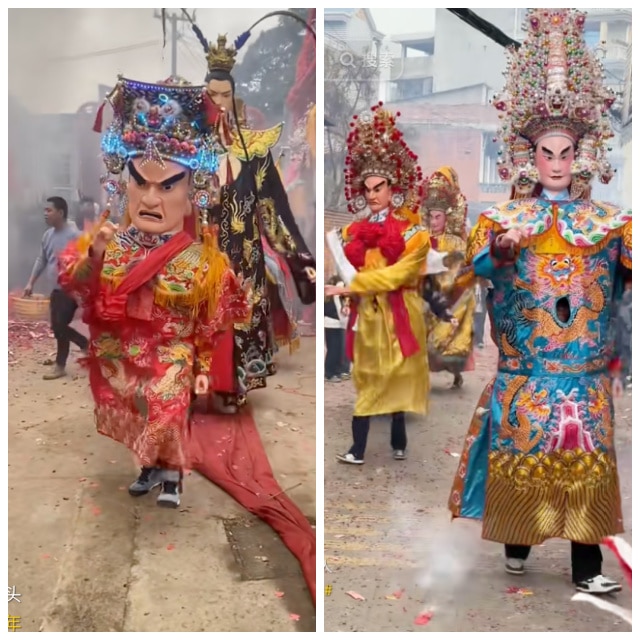
Going even further back is the trend of the “Electric-Techno Neon Gods” (电音三太子), which began years ago when Taiwanese temple youth groups started mixing sacred imagery with pop culture. They used the Nezha figure (哪吒, the Third Prince, 三太子) with a giant head, dancing to techno and house music instead of traditional percussion.

These current memes similarly blend religious ritual with pop culture, gamifying old customs in the social media age by treating participation in the folk ritual trend as a “cultivation path toward godhood.” Although it is all very tongue-in-cheek, there is also a clear appreciation of folk ritual aesthetics and spiritual customs behind it.
One More Thing
Humanoid Robots Spotted Running in Beijing Streets
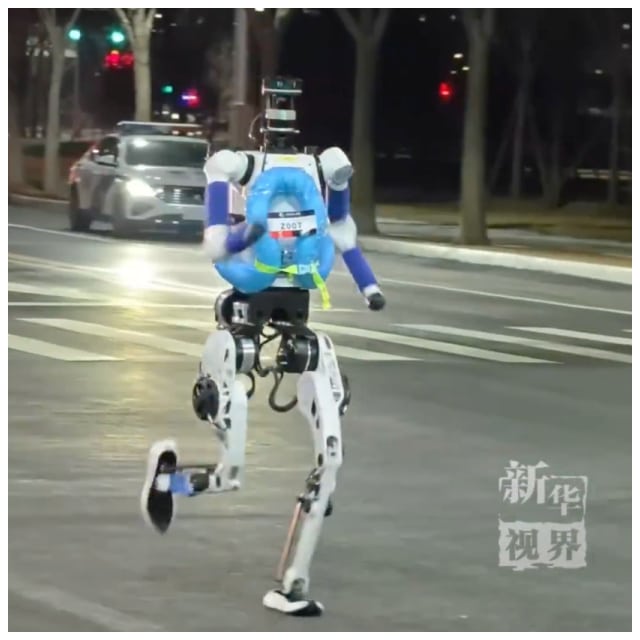
Some Beijingers who were up and about early this weekend witnessed a surreal scene: humanoid robots walking through the streets of Beijing. From the evening of March 14 to the early morning of March 15, the humanoid robot half marathon held its first test run.
The robots will participate in the 2026 Beijing Yizhuang Half Marathon, scheduled for April 19 in Beijing’s Yizhuang Economic Development Zone. The race features a “human-robot co-run” (人机共跑) format: human athletes and humanoid robots will start together on the same route, with robots running in a separate designated lane.
See video of the early morning practice here.
—That’s a wrap.
See you next edition!
Best,
Manya
Eye on Digital China, by Manya Koetse, is co-published on Substack and What’s on Weibo. Both feature the same new content — so you can read and subscribe wherever you prefer. Substack offers community features, while What’s on Weibo provides full archive access. If you’re already subscribed and want to switch platforms, just get in touch for help. If you no longer wish to receive these newsletters, or are receiving duplicate editions, you can unsubscribe at any time.
China Memes & Viral
Two Sessions, a Celebrity Meltdown, and the Rise of China’s “Forget It” Mindset
Inside this week’s trends: Two Sessions talking points, a massive celebrity meltdown, and a pet gym in Shanghai charging $275 a month.

🔥 China Trend Watch (week 10 | 2026) Part of Eye on Digital China by Manya Koetse, China Trend Watch is an overview of what’s trending and being discussed on Chinese social media. The previous newsletter was a chapter dive into the Chinese online discourse surrounding the Iran war. This edition was sent to paid subscribers — subscribe to receive the next issue in your inbox.
Besides Taiwan, Wang Yi spoke about the Iran war (“should not have happened”), Palestine (“two-state solution”), Sino-American relations (“mutual respect”), and more. Although there are undoubtedly many things to disagree on, one thing Wang mentioned more than once is just how turbulent the world we live in today has become – I think we all agree about that.
If you missed Wednesday’s newsletter about China’s online discourse on the Iran war, you can find it here. In this edition, let’s dive into other trending topics beyond that conflict, which dominated much of the discussion this week.
Quick Scroll
-
- 🌸 Women’s Day, March 8, falls on a Sunday in 2026, which ironically means women are not entitled to their usual half-day off under China’s national holiday regulations this time.
- 🤖 China has released its first national standards framework for humanoid robots and embodied AI, unveiled at an industry conference in Beijing. The move signals Beijing’s push to accelerate commercialization and large-scale production as China positions itself as a global leader in humanoid robotics.
- 🎬 Zhang Yimou’s latest crime thriller Scare Out (惊蛰无声), about national security officers battling enemy spies and produced under the guidance of China’s Ministry of State Security, has become the highest-grossing crime film of the Spring Festival season at the Chinese box office.
- 🚗 A Chinese Lynk & Co Z20 car owner recently crashed into a road divider at night after asking the car’s voice assistant to turn off all reading lights, but the system mistakenly turned off the headlights instead. When he tried to turn them back on, the AI assistant replied, “I can’t do that yet.” The company has since apologized, but the incident has sparked criticism of automakers putting smart features ahead of safety.
- 🐶 A pet gym in Shanghai charging around 2,000 yuan ($275) for a monthly membership shows just how hot China’s pet economy is becoming. At the upscale gym, dogs can walk on treadmills, swim, get massages, and receive one-on-one training.
- 🍑 The latest costume drama Pursuit of Jade (逐玉), which premiered on iQIYI and Tencent Video on March 6, has become a breakout success during its opening weekend, setting a record for the fastest-rising drama on Weibo, driven by a massive fandom known as the “Peach Blossom Chasers” (桃花逐理人).
- 🚆 A Chinese student suffered cardiac arrest after traveling 31 hours in a hard-seat train back to school after Spring Festival. She survived, with doctors diagnosing ‘economy-class syndrome’ (经济舱综合征): blood clots caused by prolonged immobile sitting.
- 📱 The Chinese Honor brand came out with the world’s thinnest Android tablet this week. The MagicPad 4 measures just 4.8mm thick, making it thinner than the iPad Pro or Samsung Galaxy Tab. As it also debuted OpenClaw collaboration technology, becoming the first commercial device to officially support running open-source AI agents, the device became a much-discussed ‘wannahave.’
What Really Stood Out This Week
Holiday Debt, Bride Prices, and Meme CEOs: What’s Trending from China’s Two Sessions

The annual Two Sessions—China’s National People’s Congress (NPC) plenary and the Chinese People’s Political Consultative Conference (CPPCC)—are convening from March 4 to March 11. As usual, they’ve become a major topic of discussion on Chinese social media this week, alongside the ongoing developments in Iran.
This year, topics such as pensions, holidays, healthcare, tech, and AI have been receiving special attention. Here are three talking points that have generated considerable online discussion.
📍 One issue that netizens especially seemed to care about is the phenomenon of China’s “compensatory working day” system (调休 tiáoxiū), which allows people longer holiday blocks (such as seven days for the National Day holiday, or nine days for the recent Spring Festival) but requires people to make up for some of those days by working weekend days on either side of the holiday.
NPC delegate Tian Xuan (田轩) has proposed reducing or avoiding the use of these “make-up days,” and instead increasing the number of public holidays. The proposal is receiving strong support from workers who have long been frustrated by this system of “borrowing” free days, which creates a sense of being in holiday “debt.”
📍 Another proposal that went viral concerns child safety and stricter punishment for sex offenders. Female NPC delegate Fang Yan (方燕) suggested that convicted sex offenders against minors should be banned from professions involving close contact with children, prohibited from entering kindergartens and schools, and subjected to mandatory electronic location monitoring after serving their sentence.
📍 NPC delegate Zhang Qiang (张强) put forward another proposal that generated online discussions, focusing on the topic of China’s bride prices (彩礼 cǎilǐ), payments made by the groom’s family to the bride’s family. The issue has been widely debated for years as bride prices have been skyrocketing in rural China, where there are more men of marriageable age than women.
Zhang proposes that, in line with village rules, bride prices should be capped at no more than 20,000 yuan (US$ 2,900). Zhang spoke from experiences from his own village, where some bride prices rose to a staggering 188,000 yuan (US$27,260) – which allegedly almost made the marriage fall apart before it even started. Although many agree that there should be measures to break the cycle that puts rural families in debt, others think that the government shouldn’t intervene in private family customs.
📍 The most discussed NPC delegates are Xiaomi CEO Lei Jun (雷军) and Zhou Yunjie (周云杰), top executive at the Haier Group. Xiaomi is one of China’s leading smartphone and electronics makers, while Haier is one of the country’s largest home-appliance groups. The two delegates already appeared together at the Two Sessions last year, when their contrasting roles drew attention: one representing China’s younger, fast-moving digital companies, the other the face of China’s older, traditional manufacturing industry.
This year, the two appearing together has become a source of memes, often portraying Lei Jun as the more playful, younger figure leading Zhou Yunjie into the world of social media. The stark difference between the two business leaders is what strikes a chord—Zhou is seen as the more serious, traditional senior business leader. The pair is affectionately called the “HaiMi Brothers” (海米兄弟) by netizens.

Many netizens hope that beyond the Two Sessions, Lei and Zhou will continue to hang out and collaborate more by combining their strengths and expertise.
The Celebrity Drama Taking Over Chinese Social Media

Earlier this week, I promised to update you on the juicy celebrity story that almost managed to rival the Iran war as one of the most talked-about topics of the week—despite being entirely insignificant in comparison (which, of course, is exactly what makes it so irresistible🍿).
At the heart of the story is a decade-old celebrity feud involving singer Joker Xue (薛之谦 Xue Zhiqian) that was reignited by his messy former girlfriend Li Yutong (李雨桐). On March 2, she posted a chaotic online rant filled with grievances against Xue, who left her in 2017 before reconciling with his ex-wife. Apparently, there is still a lot of unprocessed grief from those days, because there is no other obvious reason to explain why Li decided to share her since-deleted meltdown with millions of Chinese netizens earlier this week.
In more than 20 posts of threats and dirty laundry—from “I will expose everything” to accusing Xue of forcing her into an abortion and filing a public police report against him for bigamy—Li dragged her ex down while also mentioning details about Xue being nasty toward celebrity colleagues. Among them, she referenced mean remarks about Chinese pop star Zhang Jie (张杰), also known as Jason Zhang. With more than 81 million Weibo followers and record-breaking ticket sales for 12 consecutive concerts at Beijing’s National Stadium, he is about as famous as you can get. His wife, Xie Na (谢娜), is arguably the most recognizable female television host in China.
The situation then spiraled into a much bigger controversy when fans began linking Li’s claims about Joker Xue’s remarks to a 2017 comedy roast program (吐槽大会 Tǔcáo Dàhuì). Soon after, Xie Na published an open letter on her personal Weibo directly addressing Joker Xue and demanding a formal apology to her husband Zhang Jie for the remarks—essentially accusing him of belittling Zhang’s supposedly “low-class” singing style.
As if that wasn’t enough, another ex-girlfriend entered the scene with a Weibo post. Duan Xi (段曦), seemingly triggered by Xie Na’s intervention, asked: if people are publicly demanding apologies now—“can I have one too?” In a lengthy message, she recounted how she fell into loneliness and depression after Xie Na entered the life she had shared with Zhang Jie more than two decades ago, suggesting that their past behavior might not have been entirely clean either.
Should we care about this story? Not at all. But it contains all the elements of a soap drama. Former lovers seeking revenge, bitter jealousy, and long-standing feuds. Reality, in this case, is hardly less dramatic than a scripted series. Above all, it offers a glimpse into the lives of China’s rich and famous. Although they often seem far removed from ordinary netizens, these occasional meltdown moments reveal something much more familiar: fragile egos, messy relationships, and very public outbursts.
There is also a commercial side to it. Besides other celebrities jumping in to boost their own online visibility and renew their relevance, the entire spectacle is lucrative for Weibo, once the central stage of China’s celebrity culture. Even though regulators have spent years trying to curb celebrity gossip and “vulgar” online content on platforms like Weibo, it remains exactly the kind of content that generates the most traffic and clicks.
In between news about the war in Iran and China’s Two Sessions, it is stories like these that keep people returning to social media—not for foreign news or state media narratives, but for drama.
On the Feed
The Little “Coal Mining” Panda
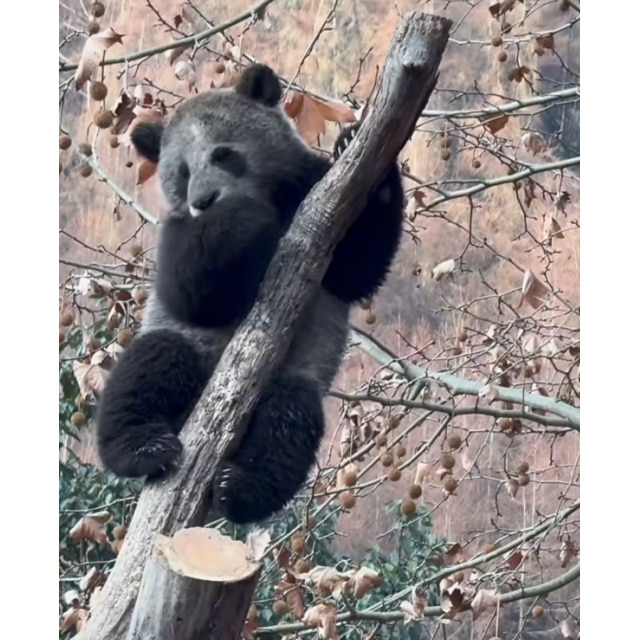
One little panda cub born last summer at a conservation base in Sichuan has recently gone viral for its muddy black appearance, with some joking that it’s “cosplaying” a black bear and others calling it the “coal mining bear” (挖煤小熊). The cub, now often referred to as the “Su Jin cub” (苏锦崽) since giant panda Su Jin is its mother, has quickly become a crowd favorite. Although there has been a lot of speculation about its color, the explanation is simple: even though staff wipe it down every day, little Su Jin just loves rolling through the mud.
Word of the Week
“算了型人格” (suànle xíng rénge — “forget-it personality type”)
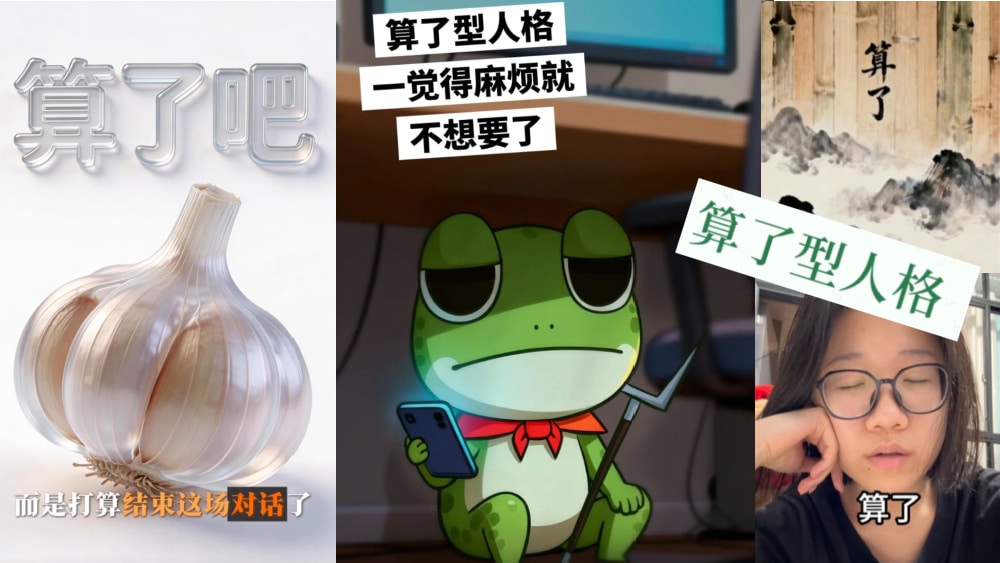
The “forget-it personality” can be seen as a kind of coping strategy for younger generations navigating modern life, where they face information overload and decision fatigue. In that sense, it can be added to the list of other self-labeling terms we’ve seen in Chinese youth culture before, from “lying flat” (躺平 tǎng píng) to “rat people” (老鼠人 lǎoshǔrén).
The “forget-it personality,” however, is somewhat more pragmatic: it reflects a day-to-day attitude in which someone decides it’s simply not worth the trouble to fuss over something. You say “forget it” because you already have enough on your plate.
One thing these terms have in common is a sense of emotional exhaustion, yet adopting such an attitude is not necessarily about giving up; for some people it has even become something to aspire to.
One Douyin user wrote:
“I like browsing online, but sometimes comments make me so angry that I want to reply. Then I think about how many words I’d have to type and how much I’d have to think about the response, and suddenly I’m too lazy to comment. My temper is bad, but I also hate hassle.”
—That’s a wrap.
See you next edition.
Best,
Manya
Eye on Digital China, by Manya Koetse, is co-published on Substack and What’s on Weibo. Both feature the same new content — so you can read and subscribe wherever you prefer. Substack offers community features, while What’s on Weibo provides full archive access. If you’re already subscribed and want to switch platforms, just get in touch for help. If you no longer wish to receive these newsletters, or are receiving duplicate editions, you can unsubscribe at any time.
Eye on Digital China is a reader-supported publication by
Manya Koetse (@manyapan) and powered by What’s on Weibo.
It offers independent analysis of China’s online culture, media, and social trends.
To receive the newsletter and support this work, consider
becoming a paid subscriber.


Raising Lobsters, 6G Coming, and China’s DIY Deity Trend

Two Sessions, a Celebrity Meltdown, and the Rise of China’s “Forget It” Mindset

Inside the Great Chinese Debate Over the Iran War

Spring Festival Trend Watch: Gala Highlights, Small-City Travel, and the Mazu Ritual Controversy

Inside Chunwan 2026: China’s Spring Festival Gala
Inside Chunwan 2026: China’s Spring Festival Gala

Chinamaxxing and the “Kill Line”: Why Two Viral Trends Took Off in the US and China

From a Hospital in Crisis to Chaotic Pig Feasts

Trump, Taiwan & The Three-Body Problem: How Chinese Social Media Frames the US Strike on Venezuela

China’s 2025 Year in Review in 12 Phrases
-

 Chapter Dive8 months ago
Hidden Cameras and Taboo Topics: The Many Layers of the “Nanjing Sister Hong” Scandal
-

 China Insight7 months ago
“Jiangyou Bullying Incident”: From Online Outrage to Offline Protest
-

 Chapter Dive11 months ago
Understanding the Dr. Xiao Medical Scandal
-

 China Arts & Entertainment6 months ago
The Wong Kar-wai Scandal Explained: The Dark Side of ‘Blossoms Shanghai’