
China Arts & Entertainment
A Joke Too Far: 3 Social Media Views on Chinese Comedian Li Haoshi Getting Canceled over PLA Pun
From Weibo to WeChat, from Douyin to Zhihu, Li Haoshi’s joke has sparked widespread conversations, and opinions vary.

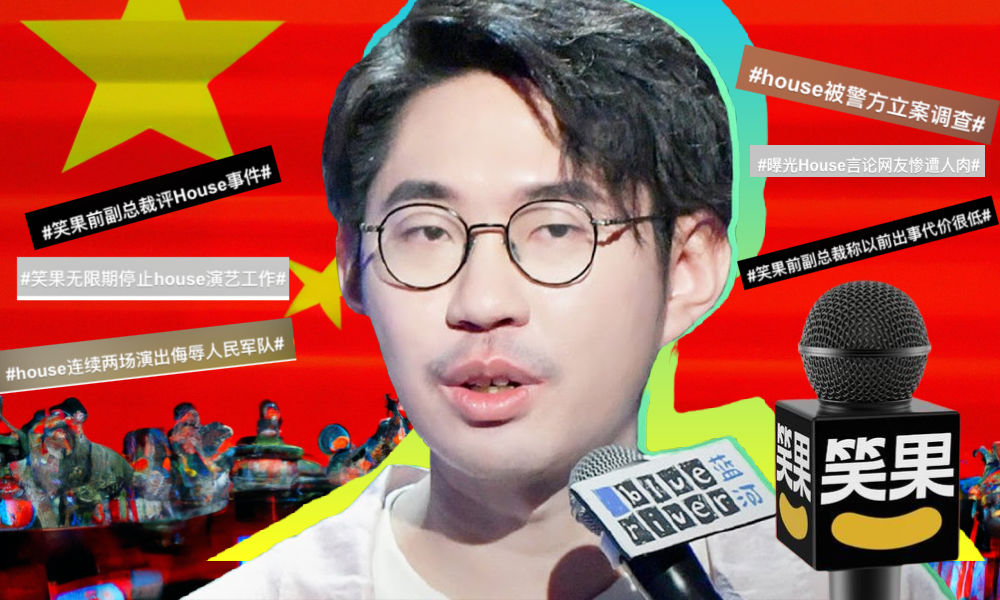
A Chinese comedian’s politically incorrect joke is the topic that everyone has been talking about this week, even making international headlines.
Li Haoshi (李昊石), a comedian who performed under the stage name ‘House’ with the famous Chinese comedy company Xiao Guo company (笑果文化), recently faced accusations of making offensive remarks towards the Chinese army during one of his shows. As a result, he has been subjected to a ban on social media platforms and has also been prohibited from participating in future performances.
The show in question took place on May 13th and while the performance officially was not allowed to be filmed, some attendees recorded the particular joke that caused controversy and then exposed House on social media. According to a Zhihu user who claimed to have secretly recorded the entire show, the joke went as follows:
“Shanghai is an international metropolis where everything is aligned with international standards. After I moved to Shanghai, I adopted two stray dogs. Strictly speaking, they weren’t stray dogs. We found them on a nearby mountain, and they were wild dogs. We can’t really say we rescued them because they were at the top of the food chain in the mountains and didn’t need our help. We were more like a makeover show, experiencing city life. These two dogs were indeed the top predators on the mountain. When I first saw them, it felt like I was witnessing a wildlife documentary. The two dogs would chase a squirrel like a missile launched into the air. Normally, when you see dogs, you find them cute, and your heart melts. You think of these words. But when I saw these two dogs, only eight words flashed in my mind: ‘Good discipline, capable of winning battles’ (作风优良, 能打胜仗). They were truly exceptional. I walked proudly on the streets of Shanghai with these two dogs. The only problem was that they had so much energy. My physical fitness couldn’t keep up.”
The triggering aspect of this joke lies in the eight words “zuò fēng yōu liáng, néng dǎ shèng zhàng” (“作风优良, 能打胜仗”: “Good discipline, capable of winning battles”). This slogan has long been associated with the Chinese People’s Liberation Army (中国人民解放军, PLA) as a standard used to describe and motivate the army. The lines, used by Xi Jinping in 2013, are used together with another phrase, namely that of “tīng dǎng zhǐhuī” (“听党指挥”), meaning “to obey the Party’s command” or “follow the Party’s leadership,” together encapsulating the principles of the Chinese military.
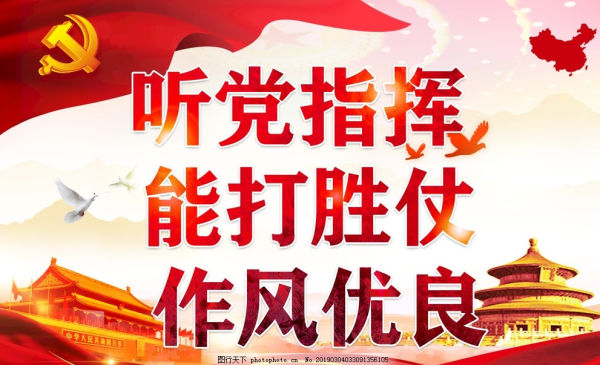
“Obeying the Party’s command – Capable of winning battles – positive work ethic” – these famous phrases were used in a comical context by Chinese comedian House. (Image source).
Using the army’s slogan to describe two wild dogs is considered offensive to the PLA’s “sacred and inviolable” image.
The joke was considered such a serious faux pas that Party newspaper People’s Daily posted about it on social media platform Weibo two days later, claiming that performers in talkshows should be cautious with their words and be careful to stay within appropriate boundaries.
They also suggested that there should be consensus within the industry on where the bottom line is on which jokes can and cannot be made. People’s Daily used the phrase “tuōkǒu mò tuōguǐ, wán gěng xū yǒu dù” (“脱口莫脱轨,玩梗须有度”), which can be translated as: “Do not deviate when speaking freely, and use jokes [memes/punch lines] with moderation.”
The word used for ‘talkshow’ is tuōkǒuxiù 脱口秀, a Chinese term that literally translates to “talk show” but actually mostly refers to stand-up comedy shows and a type of popular form of entertainment in which performers showcase their humorous storytelling skills in an engaging and often improvisational manner.
Li Haosi’s controversial joke garnered more significant attention from Chinese state media. After People’s Daily initial post, they made another Weibo post addressing the issue. The post began with the hashtag “There is a sense of security called the soldier sons of the people” (#有一种安全感叫人民子弟兵#), which is a widely used phrase to describe the People’s Liberation Army (PLA) and highlight the close relationship between the military and the Chinese people.
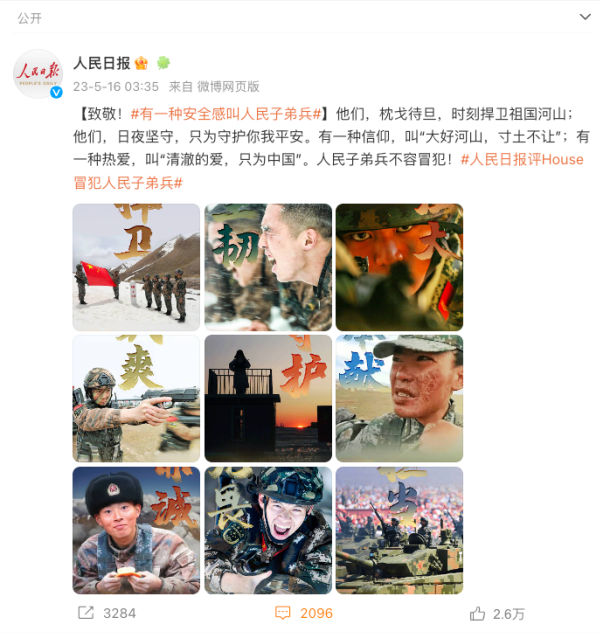
A second post by People’s Daily about the Li Haoshi controversy paid tribute to China’s PLA soldiers.
In the post, People’s Daily expressed their support for the PLA and condemned any action or statement that might be seen as disrespectful or offensive towards the military and the soldiers who serve as the guardians of the Chinese people (“人民子弟兵不容冒犯”). They tagged their post with the hashtag “People’s Daily Discusses ‘House’ Offending the Soldiers Sons of the People” (#人民日报评House冒犯人民子弟兵#), which has since received over 670 million views on Weibo.
As the controversy surrounding Li Haoshi escalated, fuelled in part by Chinese state media, it has also became a prominent topic of discussion among the general social media userbase. From Weibo to WeChat, from Douyin to Zhihu, Li Haoshi’s joke has sparked widespread conversations. Within these online discussions, there are three prominent and recurring viewpoints that we will explore here.
1: TOLERANCE & MORE FREEDOM OF SPEECH
“You ‘wolf warriors’ and ‘little pinkies’ are only good at conducting witch hunts! It is actually you who should be canceled.”
The notion of talk shows being regarded as “an art of offense” (“一种冒犯的艺术”) is widely discussed on Chinese social media these days. Evaluating the boundaries between ‘acceptable humor’ and ‘crossing the boundaries’ continues to be a topic of discussion, with some advocating for performers’ artistic freedom of expression and speech, arguing that “there is no offensive art, but all kinds of genuine art can be offensive.”
In a since-deleted WeChat article, one Chinese blogging account expressed readers’ concerns regarding the Li Haoshi controversy. A major concern raised was not just about freedom of expression for performers, but about freedom of expression within this topic itself, suggesting that the online discourse surrounding the ‘House controversy’ allows very limited space for actual debate and offers no opportunity for people to discuss the different perspectives of the story.
On Weibo, some individuals express similar concerns about the lack of nuance in the discussion. Apart from censorship or top-down control, they worry about a general discussion environment that leaves no space for opposing opinions. One person commented: “You ‘wolf warriors’ and ‘little pinkies’ are only good at conducting witch hunts! It is actually you who should be canceled.”
“The more people comment, the more extreme they get,” another person wrote. Meanwhile, the comment sections of various popular posts discussing the issue were either disabled or heavily filtered, to the extent that none of the 244 listed comments were visible.
2: CROSSING A RED LINE
“It is very simple. Making jokes is not the same as malicious slander.”
Many people do not agree with those advocating for a more tolerant approach to the Li Haoshi controversy. A seeming majority of Weibo users argue that ‘talk shows’ should not serve as a sanctuary for “inappropriate speech.” They assert that public speeches have inherent “bottom lines” that cannot be crossed. Performers should be aware of these existing red lines, and should not use their profession as an excuse to express problematic statements.
One popular blogger (@胜利主义章北海) argued that comedians are already well aware that they have certain boundaries; offending their audience would rob them of their income, and they are also careful not to insult their boss or colleagues: “They would not dare to [offend them]. They are conscious of these boundaries. So why would they dare to offend the PLA?”
Many agree with this stance: “It is very simple. Making jokes is not the same as malicious slander.”
In these online discussions, the United States is often cited as an example due to its strong emphasis on free speech. Some Chinese netizens note that even in the U.S. and other Western countries, there are also topics or jokes that would be considered off-limits and could lead to consequences such as being canceled.
The Weibo account “Xu Ji Observation” (@徐记观察, previously recognized for positive online content and the promotion of the “mass line”) mentions how some people in America were condemned for even hinting at disrespecting the military. American quarterback Tom Brady was widely criticized in 2021 after comparing playing football to military deployment, and Pete Davidson was slammed for making fun of an American representative and war veteran who had lost one eye during his deployment in Afghanistan. Both Brady and Davidson had to apologize.
Although many people agree with Xu Ji’s observation, others argue that the comparison is not entirely fair, as the consequences faced by Chinese performers who get ‘canceled’ go beyond a simple apology. In China, as exemplified by Li Haoshi’s current situation, an apology alone is unlikely to resolve the matter (read more about China’s canceled celebrities here).
3: ALWAYS HONOR OUR SOLDIERS
“”We can do without talk show hosts or celebrities, but we cannot do without our soldier sons of the people!”
There is also a large group of netizens who argue that this discussion should not be about ‘freedom’ versus ‘boundaries’ at all, but instead should focus on the mere fact that the Chinese comedian deliberately insulted the “soldier sons of the people,” and in doing so, committing a crime according to the “Heroes and Martyrs Protection Law.”
Although Chinese state media have led narratives surrounding this controversy in which they stress the ‘sacredness’ of the PLA, its mission, and duties, there are many netizens who say they feel the same. House’s joke has triggered anger among Chinese social media users who emphasize the dedication of the PLA and condemn any jokes targeting them.
In many online posts, bloggers highlight the heroic actions of the PLA in the past and, using patriotic images of soldiers with national flags, remind people about how they selflessly rescued people during the Wenchuan Earthquake or persistently guarded the South China Sea.
One popular comment said: “We can do without talk show hosts or celebrities, but we cannot do without our soldier sons of the people!”
While online discussions surrounding the Li Haoshi controversy are ongoing, Chinese authorities have concluded that the joke constitutes a legal violation. As of May 18th, House’s social media account has been suspended, he has been boycotted by the China Association of Performing Arts, and the Beijing Police have announced their intention to investigate the case due to House’s alleged “severe insult to the People’s Liberation Army during his performance, causing a highly negative societal impact.”
Furthermore, Xiao Guo, the company representing House, has received an official warning and has had over 1.35 million yuan ($190,000) in “illegal gains” confiscated, along with a fine of 13.35 million yuan ($1.8 million) imposed by the police. In response to this penalty, the company has canceled all scheduled performances in China and terminated their contract with Li Haoshi.
Read more related articles:
◼︎ “Love the Motherland” – New Moral Guidelines for Chinese Performers Come Into Force
◼︎ Chinese Comedian Li Dan under Fire for Promoting Lingerie Brand with Sexist Slogan
◼︎ Female Comedian Yang Li and the Intel Controversy
◼︎ 25 ‘Tainted Celebrities’: What Happens When Chinese Entertainers Get Canceled?
By Zilan Qian and Manya Koetse, with contributions by Miranda Barnes
Get the story behind the hashtag. Subscribe to What’s on Weibo here to receive our newsletter and get access to our latest articles:
Spotted a mistake or want to add something? Please let us know in comments below or email us. First-time commenters, please be patient – we will have to manually approve your comment before it appears.
©2023 Whatsonweibo. All rights reserved. Do not reproduce our content without permission – you can contact us at info@whatsonweibo.com.




China Arts & Entertainment
When an Entertainment Scandal Gets Political: How Wong Kar-wai Survived a Nationalist Storm
The 2025 scandal surrounding Wong Kar-wai shows that public outrage only produces consequences when it aligns with official interests.


It’s safe to say that 2025 wasn’t the best year for Wong Kar-wai (王家卫, 1958), one of the most famous Chinese-language film directors in the world. The Hong Kong movie director is known for classic works like Chungking Express and In the Mood for Love. Besides his work, his iconic sunglasses are also famous – he rarely goes without them and is even nicknamed ‘Sunglasses’ (墨镜) or ‘Sunglass King’ (墨镜王) on Chinese social media.
But this year, discussions about Wong Kar-wai have gone well beyond his talent and looks. He became embroiled in what would turn into one of China’s biggest entertainment scandals of the year after a former staff member set out to expose him for exploitation and misconduct. Once the controversy spilled from entertainment into political territory, however, the dynamics of the story changed entirely.
A Fight for Credit
This story begins with the young Chinese screenwriter Gu Er (古二, real name Cheng Junnian 程骏年). He is the one who publicly accused Wong of exploitation and unethical work standards on social media (a story which we previously covered here).
Gu Er, a New York Film Academy graduate, returned to China after his studies and began building a career. In 2019, he joined the production team of Wong’s popular TV series Blossoms Shanghai, working long hours for meager pay, despite suffering from Kennedy’s disease, a motor neuron illness similar to ALS.

Cheng Junnian 程骏年, better known as Gu Er
In 2023, after the show premiered, Gu posted an article on Chinese social media titled “The Truth Behind the Writing of Blossoms” (《繁花》剧本的创作真相). He argued that he should have been credited as one of the principal writers but was instead listed only as a “preliminary editor,” buried at the end of the credits. The post sparked some discussion, but the controversy quickly faded.
It was not until last September that Gu Er released another essay titled “My Experience as a Screenwriter for Blossoms: A Summary” (我给《繁花》做编剧的经历——小结), which drew widespread attention. In the piece, he accused Wong Kar-wai of exploitation and detailed his creative work on the series, while also claiming that he was required to cook meals and run personal errands for Wong.
At one point, Gu Er describes how lead screenwriter Qin Wen (秦雯) allegedly tried to remove him from the production team after presenting his draft script as her own. According to Gu, Wong Kar-wai responded dismissively: “It’s just a few thousand yuan; he’s an assistant and can also write the script, it’s a bargain!”
Throughout 2025, Gu Er used his WeChat account to document his experiences and to upload audio recordings of conversations with members of the production team, including Wong Kar-wai and Qin Wen. These recordings were presented as evidence supporting his claims of exploitation, verbal abuse, and the denial of screenwriting credit.
In response to the controversy, the official account of the Blossoms Shanghai television series issued multiple statements denying that Gu Er deserved screenwriting credit and accusing him of abusing his position to secretly record private conversations among staff. The production team vowed to take legal action, and Gu Er’s entire WeChat account was soon shut down.
Leaked Recordings and Growing Backlash
Although his WeChat presence was erased, Gu Er refused to stay silent. In early November of 2025, he opened a new Weibo account (@古二新语) and, seemingly burning all of his bridges, continued releasing recordings involving Wong Kar-wai and members of the Blossoms Shanghai production team, triggering an unexpected shockwave over the past few weeks.
Gu Er released a series of audio recordings featuring Wong Kar-wai and others, including screenwriter Qin Wen and her assistant Xu Siyao (许思窈). In some of these recordings, they are heard mocking Gu Er; Qin appears to struggle to recall plot details she allegedly wrote herself; and Xu Siyao openly admits that an important storyline in Blossoms Shanghai originated from Gu Er’s writing.

Visuals from Blossoms Shanghai.
Wong Kar-wai and Qin Wen also spend a surprising amount of time ridiculing figures across the Chinese film and television industry, from respected senior veterans to obscure streaming-film directors, dismissively labeling them as “fake.”
What stunned the public even more were Wong Kar-wai’s crude remarks about actresses. In one recording, he comments on actress Jin Jing’s breasts and jokes, “I must get her” (“我一定要搞金靖”). Jin is not a major star, and in the final cut of Blossoms Shanghai, all of her scenes were removed. In another clip, Wong addresses screenwriter Qin Wen in a sexually suggestive and harassing tone, saying that if she had a body like Jin’s, she would not have “survived” her early years in the industry as a writer, because “I would definitely have taken you” (“我一定收你”).
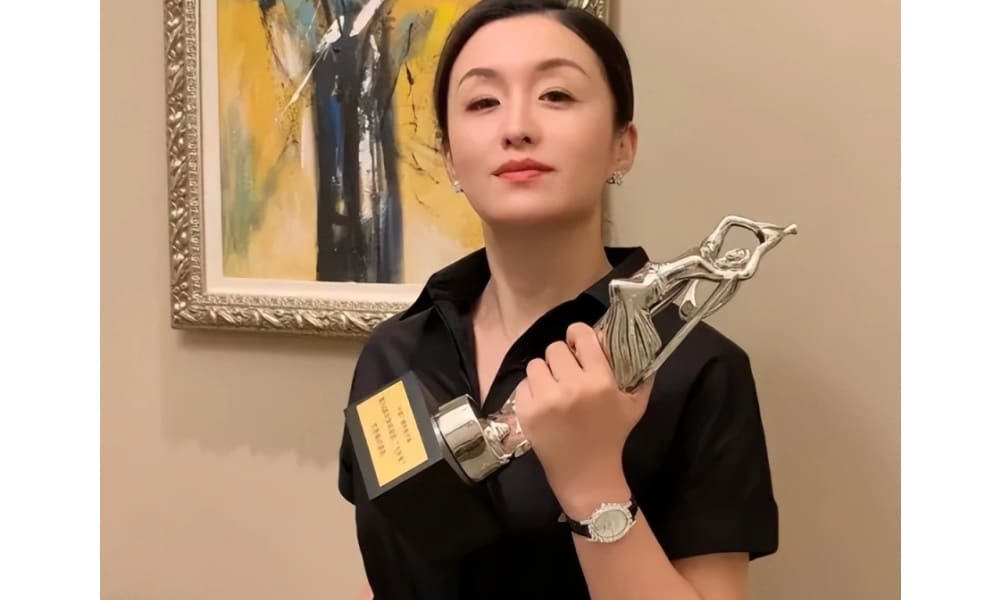
Qin Wen
After this wave of leaks, the recordings—together with Gu Er’s earlier accusations—spread widely across major Chinese social media platforms. Many netizens expressed disapproval of the misogyny, gossip, and backbiting revealed in the recordings and began reevaluating Wong Kar-wai as a person, as well as his past works. Others questioned the legitimacy of Gu Er’s methods, particularly the recordings and leaks. Legal experts noted that secretly recording conversations could violate privacy laws, and that selectively edited clips might even constitute defamation.
Crossing the Red Line
Then, on November 8, Gu Er released a new recording that fundamentally altered the nature of the incident. The audio features a conversation among Wong Kar-wai, Blossoms Shanghai co-director Li Shuang (李爽), and producer Peng Qihua (彭绮华), in which they discuss COVID controls, Japan, and China’s political system.
In the recording, Wong says that the Communist Party only wants “chives” (jiǔcài, 韭菜) to harvest and describes China as a “greedy one-party state.” In Chinese internet slang, jiǔcài refers to ordinary people who are repeatedly exploited, compared to chives that are cut and grow back, only to be harvested again. When Li mentions his collection of Japanese katanas and samurai outfits, Wong jokes that, given China’s current tensions with Japan, if the collection were discovered, Li would be publicly denounced and paraded, much like during the Cultural Revolution.
Wong even suggested: “If they find [the samurai swords], just put a Chinese flag on them and say you really hate those Japanese devils.”
The Weibo post was deleted within minutes, but the recordings spread quickly.
Nationalist netizens flooded Wong’s comment section, calling him a hànjiān (汉奸, traitor to the Chinese nation), and demanding that he “get out of China.” Some conspiracy-minded users even claimed that the title of Wong’s famous TV series Blossoms (繁花 fánhuā) was intentionally chosen because it sounds like “anti-China” (反华 fǎnhuá), alleging that Wong had embedded a subversive message in the title.
Suddenly, many who had previously viewed the scandal as mere entertainment began taking sides—calling for the show to be taken down and for investigations into Wong, Li, and others involved.
Unusual Twist in a Familiar Script
In China’s public sphere, once criticism touches on the state or the Party, everything becomes more complicated. Many began questioning whether Gu Er had gone too far in leaking these conversations, and whether this was a political terror tactic disguised as personal justice.
Weaponizing nationalism to ruin a public figure is actually nothing new.
Ten years ago, CCTV host Bi Fujian (毕福剑) was recorded at a private dinner mocking Mao Zedong and was immediately fired, vanishing from public life. In 2021, actor Zhang Zhehan (张哲瀚) was canceled after taking photos near the controversial Yasukuni Shrine in Tokyo—a site that honors Japan’s war dead, including convicted war criminals. In 2022, writer Yan Geling (严歌苓) was erased from the Chinese internet almost overnight after calling Xi Jinping a “human trafficker” in commentary about a trafficking case.
Given this history, and the fact that Wong has remained silent since the leaks began, mainland audiences now fear that Wong Kar-wai could join China’s celebrity “blacklist.” Some even worry they might never see In the Mood for Love again, others fear a broadcast ban for Blossoms.
Will Wong Kar-wai become the Next Bi Fujian? All past punishment-for-speech cases have followed a familiar script: a leak emerges, nationalists erupt, official mouthpieces like Xinhua step in to shape the narrative, and punishment follows swiftly. In Bi Fujian’s case, for example, the Central Commission for Discipline Inspection issued a public condemnation within a week.
But this time, although nationalists are already outraged on social media and calling for Wong’s “anti-China” remarks to be punished, not a single major central media outlet has echoed their anger. In fact, shortly after Gu released the new recordings, the Blossoms team issued a statement accusing him of fabrication and malicious slander—and The Paper, a state-affiliated Shanghai outlet, amplified it. That was the first signal of how authorities might lean.
Too Valuable to Cancel?
Does this all mean China has become more tolerant of political criticism? Is the red line for what can and can’t be said shifting? Some believe the only reason Wong escaped harsher consequences is that he didn’t mention specific leaders by name, which is the quickest way to get into serious trouble. While that’s plausible, another reason may carry more weight: Wong Kar-wai is useful to the state’s cultural agenda.
Despite the comments in the recordings, Wong’s stance toward the authorities is not overtly hostile. In recent years, he has cooperated with state-backed projects. Blossoms, in particular, is part of Shanghai’s cultural branding campaign, with full support from Party-led propaganda departments. It received major state funding and was included as a central project on CCTV’s 2024 slate.
Wong is also a globally recognized auteur with real prestige in the West, making him valuable to China’s propaganda strategy of “telling China’s story well” (讲好中国故事).
Dropping such a cultural asset over a scandal stirred up by a disgruntled writer would be politically and culturally costly. This might explain why the official response has been unusually mild.
Many observers mistakenly assume that in China, once public outrage reaches a certain level, authorities will respond accordingly. But that’s only true when popular opinion and official interests are aligned. When they’re not—when the Party-state sees strategic value in protecting someone—public outcry changes nothing. If the Party believes Wong is worth keeping, then some of his comments will simply be forgiven.
The Cost of Speaking Out
At the center of this entire story is Gu Er. Was he wrong to weaponize nationalist outrage? Were his methods excessive or dangerous? Reactions are mixed. Some argue that leaking private recordings (especially political ones) is troubling and contributes to a climate of fear and self-censorship. Others sympathize, believing that Gu Er, who has suffered so much both physically and emotionally, shouldn’t be judged too harshly.
In the well-known Fanpai Yingping (反派影评) podcast, film journalist Bomi argued that Gu didn’t intentionally politicize the conflict; rather, he was responding within a system that had already politicized his case. Wong’s team never approached the issue as a civil labor dispute. They had enough opportunities to negotiate or settle, but instead, but chose not to . Perhaps it was arrogance. Or perhaps a confidence that the show, backed as a state-supported “main melody” (主旋律) production tied to enormous interests, would never be abandoned.
There seems to have been a clear mission to silence Gu Er. After shutting down his WeChat account, members of staff allegedly tried to intimidate him by visiting the house of his 90-year-old grandmother to deliver legal letters.
In the November 8 statement by the team, they accused him of “inciting social division” (“煽动社会对立”) and “manipulating negative emotions” (“诱导负面情绪”) and claimed he was “evading domestic legal investigation” (“逃避国内司法调查和认定”) by staying overseas—all language that is reminiscent of official state announcements. Some netizens even suggested it evoked the tone of old-school ideological and political denunciation—strong on rhetoric but lacking in substantive legal action. They frame this entire story into the context of a powerful production crew violating labor law treating a powerless writer like a political criminal.
The repercussions of this controversy are far from over, and to what extent it will have consequences for both Wong Kar-wai and Gu Er remains to be seen. Will Wong ever speak out? Will Gu Er be silenced forever?
Regardless, it is clear that Wong’s reputation has suffered. Long regarded as a “hero” of Chinese cinema, this incident has changed how many in mainland China now perceive the famous “Sunglasses.” Some call him a misogynist; others denounce him for exploiting staff. Still others see him as a hypocrite, suggesting that although he criticizes authoritarianism in the leaked recordings, he operates and thrives within that very system. One Weibo commenter wrote that the “Sunglasses King turned out to be the villain of the story.”
Although Gu Er has also received criticism for his actions, he has encouraged others through his insistence on standing up to those in power who bullied and discredited him. Recently, another screenwriter posted on Xiaohongshu about a similar experience: after independently completing the full script for a Chinese drama, he discovered that the boss had listed themself as Head Screenwriter in the end credits. The post was tagged “Gu Er” and received hundreds of comments, with many users sharing their own stories of being exploited as scriptwriters.
Even turning the dispute into a political issue failed to bring Gu Er any justice or revenge on his exploitative former employer. Still, he has gained something else: recognition from others, for whom his resistance has become a source of inspiration. Even if it was not the kind of recognition he originally sought, Gu Er still gets his credit in the end.
By Ruixin Zhang edited for clarity by Manya Koetse
Independently covering digital China for over a decade. Like what we do? Support us and get the story behind the hashtag by subscribing:
Spotted a mistake or want to add something? Please let us know in comments below or email us. First-time commenters, please be patient – we will have to manually approve your comment before it appears.
©2025 Eye on Digital China, powered by Whatsonweibo. All rights reserved. Do not reproduce our content without permission – you can contact us at info@whatsonweibo.com.
China Celebs
China Trend Watch: Quiet Nationalism, Loud Statements, and Nanjing Memorial Day
From war memory to viral eggs, salty cakes, an unfortunate dinner party and farewell to an iconic actress.


🔥 China Trend Watch — Week 50 (2025)
Part of Eye on Digital China. This edition was sent to paid subscribers — subscribe to receive the next issue in your inbox.
I’ve rounded up my latest China trip that brought me from Chongqing to Nanjing, Wuhan, Zaozhuang and Beijing, for some of my research on Chinese remembrances of war. Along the way, I have met many friendly people and had interesting converations, from hanging out with a group of Wuhan teenagers to lively conversations with retired seniors in Shandong.
A small and short personal observation, if I may, regarding the current tensions between China and Japan.
I vividly remember the atmosphere on the streets during earlier moments when tensions ran sky-high—most notably in 2012, after a major diplomatic crisis erupted over Japan’s nationalization of several disputed Senkaku/Diaoyu Islands. That episode triggered large-scale anti-Japanese protests across China and spilled unmistakably into everyday life. In Beijing’s Sanlitun area, for instance, there was a street food vendor who put up a large sign proclaiming, “The Diaoyu Islands belong to China.” In the hutong neighborhoods, it seemed as though virtually every household had hung a Chinese flag by its door. Books about Japan that I purchased locally later turned out to have entire pages ripped out. My favorite sushi restaurant suddenly displayed a sign explaining that its brand was, in fact, very Chinese and had nothing to do with Japan. Nearby, in the clothing markets around the Beijing Zoo, T-shirts bearing nationalistic slogans related to the islands dispute were on sale at multiple stalls.
By contrast, during my most recent stay in Nanjing and beyond—despite the increasingly militant tone of state media and social media campaigns surrounding Japan, and despite the undeniable persistence of anti-Japanese sentiment—I noticed far fewer visible expressions of it in daily life. There were no slogan T-shirts, no banners, no overt street-level signaling. While news came out that a string of Japanese performances in China were canceled, I noticed hotel waitress fully dressed in a Japanese kimono at an in-house Japanese restaurant. Local bookstores are filled with works by Japanese authors, and Japanese popular culture appear to be thriving and coexisting comfortably with China’s own flourishing ACG (anime, comics, and games) industry.
Is there simply less anti-Japanese sentiment than over a decade ago? Or is it, perhaps, that in today’s highly digitalized Xi Jinping era, nationalist narratives are more tightly managed and increasingly channeled online—making people more cautious, more restrained, or simply less inclined to express political sentiments openly in public space?
A cab driver in Chongqing told me he believed there was “something wrong” with Japanese Prime Minister Sanae Takaichi and the influence she has had on bilateral relations since her rise to power. While supporting his government’s tough stance and expressing sadness over the scars left by war, he also mentioned that he had enjoyed a pleasant conversation earlier that same morning with a young Japanese man he had driven to the train station.
“We didn’t talk about the latest clash,” he said. “If find that too sensitive to mention. He spoke Chinese, he studied Chinese, like you. I don’t hate today’s Japanese people at all. In the end, we’re all just people. What’s happening now is something between the leadership.”
He spoke at length while driving me to the station, signaling that the topic clearly weighed on him. It left me with the sense that the absence of banners or T-shirts does not mean the issue has faded from everyday life, only that it is not expressed as a mass spectacle like it was in earlier years. It has become quieter, more online, and more filtered through official narratives, but it is still very much alive.
There is a lot more to say, but it is Sunday after all, and there is plenty more to read here, so let’s dive in.
- 🍓 Chinese consumers were pretty salty this week when discovering their pricey strawberry cake from Alibaba supermarket chain Hema (盒马) tasted all wrong. Hema acknowledged a production issue (they didn’t say it outright, but salt was allegedly used instead of sugar) and the incident triggered discussions about food safety & quality control in automated food production, especially when such a major mistake happens at high-profile companies.
- 🌡️ China’s announced ban on mercury thermometers (as of Jan 1st 2026) has sparked a buying frenzy, as many consumers, reluctant to switch to electronic alternatives, still prefer mercury models for their perceived accuracy and convenience. Despite nearly half of annual mercury poisoning cases being linked to broken thermometers, prices have now surged from around 4 yuan ($0.6) to over 30 yuan ($4.25), and stores have reported complete sellouts.
- ❄️ Beijing welcomed its first snowfall of winter 2025 this week, leading to lovely social media pics and the Beijing Palace Museum tickets selling out instantly. Experiencing and capturing that first snowfall at the Forbidden City has become somewhat of a holy grail on social media.
- 🕵️♂️ A local construction site in Shanghai unexpectedly became the scene of a modern-day treasure hunt after dozens of residents armed with shovels and metal detectors rushed to the area following online rumors that silver coins (including valuable older ones) had been found. Authorities had to intervene and, while not confirming the rumors, emphasized that any buried cultural relics belong to the state.
- 🇷🇺 Since this month, Chinese citizens can enter Russia visa-free for up to 30 days, a policy that led Chinese state media to claim that “Russia is replacing Japan as a new favorite among Chinese tourists.” On social media, however, the vibe is different, with travelers complaining about high prices, poor internet, lack of online payments, unreliable ATMs, and the need for thorough trip preparation — all reasons why Russia is unlikely to become the go-to destination for the Chinese New Year.
- 🫏 An investigation by Beijing Evening News revealed that many of the capital’s popular donkey meat sandwich shops are actually serving horse meat without informing customers. China’s donkey shortage — driven by declining domestic supply, rising demand for the traditional Chinese medicine Ejiao (which uses donkey hides), and an African export ban — has been a hot topic this year. Now that it’s directly affecting a beloved delicacy, the issue is drawing even more public attention.
1. Why This Year’s Nanjing Memorial Day Felt Different

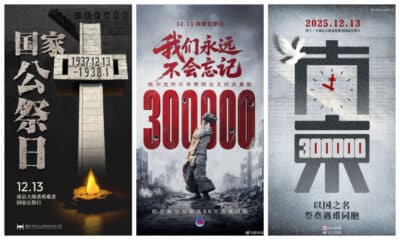
Posters published by various Chinese state media outlets to commemorate the Nanjing Massacre.
December 13 marked the 88th anniversary of the fall of Nanjing, and this year’s Nanjing Memorial Day (南京大屠杀难者国家公祭日), although described as a low-key commemoration by foreign media, was trending all over Chinese social media.
During the Second Sino-Japanese War, on December 12, 1937, the Japanese army attacked Nanjing from various directions, and defending Chinese forces suffered heavy casualties. A day later, the city was captured. It marked the beginning of a six-week-long massacre filled with looting, arson, and rape, during which, according to China’s official data, at least 300,000 residents, including children, elderly, and women, were brutally murdered.
This year, the Nanjing Massacre Memorial Day, which was first officially held as a state-level event in 2014, carried extra weight. This dark chapter of history has continuously been a sensitive topic in Sino-Japanese relations, but with recent diplomatic tensions between the two countries reaching new heights, the Memorial Day was especially tied to current-day relations between China and Japan and to Prime Minister Sanae Takaichi, who has been described by Chinese media as an “ultranationalist” with tendencies to downplay Japan’s wartime aggression. Takaichi’s November 2025 parliamentary statement that a Chinese military action against Taiwan could be considered a “survival-threatening situation” for Japan, allowing for the deployment of its Self-Defense Forces, continues to fuel Chinese anger.
The link between history and current-day bilateral relations was visible not only on social media, but also during the commemoration itself, where Shi Taifeng (石泰峰), head of the ruling Communist Party’s Organization Department, said that any attempt to revive militarism and challenge the postwar international order is “doomed to fail.”
Besides the many online posters disseminated by Chinese official accounts on social media focusing on mourning, quiet commemoration, and honoring the lives of the 300,000 Chinese compatriots killed in Nanjing, one official online visual stood out for displaying a louder and more aggressive message—namely that posted by the official Weibo account of the Eastern Theater Command of the Chinese People’s Liberation Army (@东部战区).

The visual posted by the PLA Eastern Theater Command, titled: Rite of the Great Saber (大刀祭).
The visual showed a strong hand holding a giant blood-stained blade that is beheading a skeleton wearing a helmet marked “militarism,” with images related to the Nanjing Massacre visible on the blade and, behind it, a map of East Asia. The number “300000” appears in red, dripping like blood. At the top, the characters read “Rite of the Great Saber” or “The Great Saber Sacrifice” (大刀祭).
The official account explained the visual, writing: “(…) 88 years have passed and the blood of the heroic dead has not yet dried, [yet] the ghost of militarism is making a comeback. Each year, on National Memorial Day, a deafening alarm is sounded, reminding us that we must—at all times hold high the great saber offered in blood sacrifice, resolutely cut off filthy heads, never allow militarism to return, and never allow historical tragedy to be repeated.”
The text’s “cut off filthy heads” phrasing is similar to part of a now-deleted tweet sent out last month by the Chinese Consul General in Osaka, Xue Jian (薛剑), who responded to Takaichi’s controversial Taiwan remarks by writing (in Japanese): “If you come charging in on your own like that, there’s nothing to do but cut that filthy neck down without a moment’s hesitation. Are you prepared?” (“勝手に突っ込んできたその汚い首は一瞬の躊躇もなく斬ってやるしかない。覚悟が出来ているのか。”)
The recent visuals, social media approach, and shifts in texts reflect a clear change in tone in Chinese official discourse regarding Japan and the memory of war, moving the narrative from victimhood toward a more confrontational and militant tone.
2. He Qing, China’s “No. 1 Classical Beauty”, Passes Away at 61

He Qing. Images on the sides: the four famous roles in China’s most iconic tv dramas.
China’s “No. 1 Classical Beauty” (古典第一美女), He Qing (何晴), who starred in all four of China’s most beloved and canonical television dramas, passed away on Saturday at the age of 61. On December 14, news of the famous actress’s passing was trending across virtually all Chinese social media apps.
Born in 1964 into an artistic family in Jiangshan, Zhejiang Province, He Qing received traditional Chinese opera (Kunqu) training at the Zhejiang Kunqu Opera Troupe. Her debut in the entertainment industry may have come by chance, as she reportedly once met Chinese director Yang Jie (杨洁) on a train, which led to her joining the production of Journey to the West (西游记), where she played Lingji Bodhisattva (灵吉菩萨).
In China, He Qing is remembered as a veteran actress in much the same way that some famous Hong Kong actresses became renowned for their beauty, iconic roles, and for essentially becoming household names. More than just glitter and glamour, He Qing was especially a symbol of classical Chinese beauty and literary culture. She was the only actress to star in screen adaptations of all four of China’s “Four Great Classical Novels” (演遍四大名著): besides Journey to the West (西游记, 1986), she also appeared in Dream of the Red Chamber (红楼梦, 1987), Romance of the Three Kingdoms (三国演义, 1994), and Water Margin (水浒传, 1998).
She was married to fellow actor Xu Yajun (许亚军), with whom she had a son, Xu He (许何). Although the two later divorced, she remained close to her ex-husband and even befriended his new (and fourth) wife, Zhang Shu (张澍).
In 2015, He Qing was diagnosed with a brain tumor. After her diagnosis, she withdrew from the entertainment industry to focus on her recovery and lived a low-key life in her later years.
Her passing has prompted an outpouring of tributes from Chinese netizens and colleagues in the entertainment industry. Mourning her loss comes with a sense of nostalgia for the past, and many have praised He Qing for her timeless beauty and authenticity, which will be remembered long after her passing.
3. And Then There Were None: Dinner Party of Ten Leaves One Man with the Bill

Ten dine together, nine slip away..one left for the bill, who he refused to pay…
Do you know that nursery rhyme where ten little soldiers disappear one by one until none remain at the end? That is more or less what happened earlier this month in Chongqing, when ten people dined together at a restaurant, but—once it came time to pay—nine people left one by one.
One had to answer a phone call, another had to use the restroom, and in the end, just before midnight, only Mr. Zhang was left, facing a bill of 1,262 yuan ($180), which he refused to pay. He argued that he could not afford it and that the dinner party hadn’t been initiated by him at all; as merely a participant, the bill shouldn’t have been his responsibility.
After the restaurant called the police, the organizer of the dinner was contacted. But he, too, said he couldn’t pay. Through police mediation, Mr. Zhang then wrote a written commitment promising to pay the bill the following day and left his ID as collateral, but he still failed to make the payment.
By now, the restaurant is planning to sue and has also contacted the Chinese media. According to Zhang, who apparently has been unable to contact his “friends” to collect the money: “I did make the promise, but if I pay the money, wouldn’t that make me a sucker?” (“我的确承诺了,但你说我把钱付了,我是不是冤大头啊”)
As the story went completely viral (by now, even Hu Xijin has weighed in) comment sections filled with broader social reflections on alcohol-fueled group gatherings and unclear payment rules, where one person sometimes ends up paying for everything despite feeling it wasn’t their role to do so. In this era of digital payments, many argue it should be easy enough to go Dutch and settle the bill immediately via a group payment app.
Although Zhang is seen by some as a victim, others argue that he is still a “sucker” for not paying after having promised to do so. As one commenter put it: “Out of the ten of them, not a single one is a good person.”
Real Person Vibes [活人感 (huóréngǎn)

Every December, the ten most popular buzzwords, key terms, or expressions of the year are listed by the Chinese linguistics magazine Yǎowén Jiáozì (咬文嚼字), selecting words that reflect present-day society and changing times. Each year, the list goes trending and is widely disseminated by Chinese media.
This week, the 2025 list was released, including terms such as Digital Nomads 数字游民 (shù zì yóu mín), Sū Chāo (苏超), referring to the hugely popular amateur Jiangsu Super League football competition, and “Pre-made ××” (预制, yù zhì), following a year filled with discussions about pre-fab and pre-made food (see article).
My favorite word on the list is “Real-Person Vibes” (活人感 huó rén gǎn). The term literally consists of three characters meaning “living – human – feeling,” and it describes people, stories, or things that feel unpolished, spontaneous, and unfiltered—something that has become increasingly relevant in a year dominated by AI-generated content and visuals.
Amid over-curated feeds and AI-produced text, we crave huóréngǎn: authenticity, small imperfections, and liveliness as an antidote to a digital, artificial world.
The 9:12 Boiled Egg That Took Over Douyin
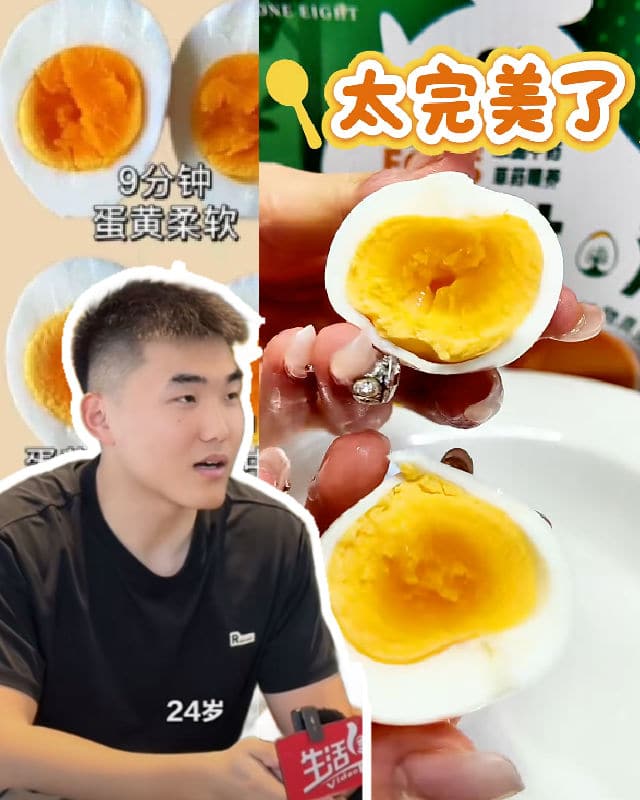
How do you get a perfect boiled egg? A Douyin user known as “Loves Eating Eggs” (爱吃蛋) has become all the rage after leaving a precise comment on how to boil eggs. His advice: First boil the water, then add the eggs, boil for exactly 9 minutes and 12 seconds, remove, and immediately run under cold water.
That simple tip catapulted his follower count from around 200 to over 3.5 million in a single week (I just checked—he’s up to 4.2 million now).
The new viral hit is a 24-year-old self-proclaimed egg expert (of course, his English nickname should be the Eggxpert). He claims to have eaten 40 eggs a day for the past five years and knows exactly how every second of boiling, frying, or stirring affects an egg. He regularly posts videos showing eggs cooked for different lengths of time.
It has earned him the nicknames “Egg God” (蛋神) and “Boiled Egg Immortal” (煮蛋仙人), and has sent boiled eggs (9 minutes and 12 seconds exactly) all over social media feeds.
Thanks for reading this Eye on Digital China China Trend Watch. For slower-moving trends and deeper structural analysis, keep an eye on the upcoming newsletters.
And if you happen to be reading this without a subscription and appreciate my work, consider joining to receive future issues straight in your inbox.
Housekeeping reminder: if you’re receiving duplicate newsletters, it’s likely because you signed up on both the main What’s on Weibo website and the Eye on Digital China Substack. If you’re a paying member on one of the two, you may receive the premium newsletter twice. Please keep the one you’re paying for, and feel free to unsubscribe from the other.
Many thanks to Miranda Barnes for helping curate some of the topics in this edition.
— Manya
Spotted an error or want to add something? Comment below or
email me. First-time commenters require manual approval.
©2025 Eye on Digital China / What’s on Weibo. Do not reproduce without permission —
contact info@whatsonweibo.com.
Eye on Digital China is a reader-supported publication by
Manya Koetse (@manyapan) and powered by What’s on Weibo.
It offers independent analysis of China’s online culture, media, and social trends.
To receive the newsletter and support this work, consider
becoming a paid subscriber.


Why Were 100,000 Pregnant Women’s Blood Samples Smuggled Out of China?

When an Entertainment Scandal Gets Political: How Wong Kar-wai Survived a Nationalist Storm

China Trend Watch: Quiet Nationalism, Loud Statements, and Nanjing Memorial Day

He Qing, China’s “No. 1 Classical Beauty”, Passes Away at 61

Why This Year’s Nanjing Memorial Day Felt Different

The Wong Kar-wai Scandal Explained: The Dark Side of ‘Blossoms Shanghai’

From Nobel Farewell to ‘VIP Toilets’: What’s Trending in China

China Trend Watch: Japan Tensions, Nexperia Fallout, Yunnan’s ‘Wild Child,’ & “Modern Opium”

Eye on Digital China: How Chinese Social Media Evolved from the Blog Era to the AI-driven Age

From Tents to ‘Tangping Travel”: New Travel Trends among Young Chinese
-

 China Arts & Entertainment6 months ago
Hidden Cameras and Taboo Topics: The Many Layers of the “Nanjing Sister Hong” Scandal
-
 China Memes & Viral12 months ago
Our Picks: Top 10 Chinese Buzzwords and Phrases of 2024 Explained
-
 China Insight8 months ago
Understanding the Dr. Xiao Medical Scandal
-

 China Digital11 months ago
“Dear Li Hua”: The TikTok/Xiaohongshu Honeymoon Explained