SubscribeLog in
Connect with us

China Insight

Chinese Blogger Addresses Weibo’s “Elephant in the Room”

A recent noteworthy Weibo post says intellectual discussions are dying on Chinese social media.

Manya Koetse

Published

on

A recent popular post on Weibo suggests that intellectual discussions are dying on Weibo and that Chinese web users can no longer ignore ‘the elephant in the room,’ triggering discussions on the status quo of social media in China.

Recently, a post by one popular Weibo blogger has attracted the attention of Chinese netizens.

On June 6, blogger ‘V2’ [alias], who often changes Weibo accounts, wrote about censorship on Chinese social media and ‘the elephant in the room.’

The post started making its rounds this week shortly after a severe crackdown on Chinese social media during the 30th anniversary of Tiananmen, while protests in Hong Kong over the extradition bill were also taking off.

The poster, who has over 12270 fans on Weibo, wrote the following post [translation by What’s on Weibo]:


“The intellectual density on Weibo is getting lower and lower. Scrolling through my timeline has already become somewhat worthless. One reason for that is temporary. This month they started to close down on overseas IP addresses, for example.

Another reason is more long term. Intellectuals around the world are increasingly focusing on China issues, from international relations scholars to economists to lawyers. There are already enough discussions about China to fill entire libraries with, and it’s rapidly increasing; this period is a happy time for China watchers, with new reports and comments coming out every day.

But all these hot issues (including the Belt & Road Initiative, the modernization of the army, the future of Taiwan, IP theft, and the China-US trade war) are like an elephant in the room on Weibo.

We can’t watch them, we can’t discuss them. But because this elephant is getting bigger and bigger, ignoring its presence in this room is getting increasingly strange.

This strange feeling reached a peak these days [addressing June 4th, the commemoration of Tiananmen]. The whole world was discussing China, but China was like a tranquil lake. The top trending topic here was Produce Camp 2019 [a Chinese reality show]. Some people, including me, were silenced, while the rest was excited to talk about celebrities smoking, getting married, getting divorced or cheating – pretending that these topics are really worth discussing.

The truth is, that these are the only topics that are allowed to be discussed.

Reviewing the parallel world of millions of people, Weibo has become a crowded place within a tiny snail shell.”


Since its publication on June 6th, this post received more than 22700 shares, 15500 likes, and hundreds of comments, with the post especially gaining traction since June 10.


“I want to see more, I want to think more, I want to express more.“


Among hundreds of commenters, many people agreed with ‘V2,’ writing: “Even the early rulers in Rome knew that if they’d give the people enough bread to eat and the entertainment of an arena, they wouldn’t be bothered about the rest.”

Others commented: “Actually, people do want to discuss these issues, but how can we when the news sources are blocked?”

“This has really become more of an entertainment app. It’s no longer a place to share news and knowledge, nor a place for open debate.”

“I want to go to a wider place, I want to access more information, I want to see more, I want to think more, I want to express more,” one commenter from Beijing writes.

“Not everything you read outside of the wall [Great Firewall] is true and Western media have been demonizing us for quite some time. But inside the wall, young people only pay attention to who is marrying who and who is divorcing now and this kind of entertainment news. They are numb; the intellect of the people is not developing.”

“We’re pretending everything is going well,” another person says: “and [we’re] creating a utopia that is isolated from the world.”


“Just because it doesn’t exist on Weibo, doesn’t mean it’s not there.“


But some also disagreed with the critical post.

“Why don’t you see that Weibo is just a small part of life?”, one commenter writes: “Just because it doesn’t exist on Weibo, doesn’t mean it’s not there. Don’t Chinese intellectuals pay attention to the issues you just mentioned? Weibo’s audience is really wide, but it is also quite narrow.”

Other commenters also suggest that the author’s expectations of Weibo are “too high”:

“Weibo was meant for entertainment, it’s not necessarily a news platform. The news about Hong Kong [protests] was reported on various websites. What is this blogger talking about, and then all these strange comments? As if we’re just foolishly spending our days on Weibo without having any other information channels; as if all the people in this country are locked in a dark room? Stupid.”

“It’s not the room that’s dark,” one person writes: “It’s the people who are blind.”


“Viewing the sky from the bottom of the well.”


There are also commenters who defend the strict control of Chinese social media, writing: “China has the largest population in the world. Think about it. Public opinion is really important. Isn’t a stable popular sentiment more important than confronting people with terrible incidents? If 1.3 billion people don’t trust their government, what kind of chaos do you think the country will end up in?”

Others jokingly say: “You can discuss these taboo topics all you want, I still am more interested in the latest celebrity divorce!”

One Weibo commenter uses a Chinese idiom to convey his thoughts, writing: “I’m just viewing the sky from the bottom of the well here.”

Despite the critique of the blogger on the decline of more intellectual discussions on Weibo, their post shows that there still seems to space for some deeper discussions on Weibo. At the time of writing, the post has attracted over 4000 comments and counting.

Update June 11, 2019:

As some commenters in the thread already feared, this post has now been deleted.

By Manya Koetse

Featured image by 广博郝. Featured image not related to the blogger in this article.

Spotted a mistake or want to add something? Please let us know in comments below or email us. Please note that your comment below will need to be manually approved if you’re a first-time poster here.

©2019 Whatsonweibo. All rights reserved. Do not reproduce our content without permission – you can contact us at info@whatsonweibo.com

Manya Koetse is a sinologist, writer, and public speaker specializing in China’s social trends, digital culture, and online media ecosystems. She founded What’s on Weibo in 2013 and now runs the Eye on Digital China newsletter. Learn more at manyakoetse.com or follow her on X, Instagram, or LinkedIn.

Continue Reading
Click to comment

Leave a Reply

Your email address will not be published. Required fields are marked *

China Insight

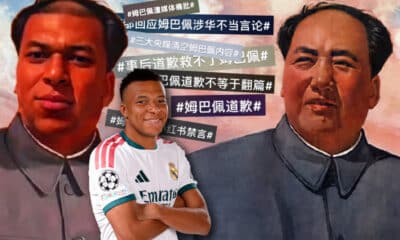
Mbappé, Mao, and the Joke That Shall Not Be Named

Mbappé’s favorite Mao meme sparked major backlash in China. More on what the controversy reveals about political red lines, online humor, and censorship.
Manya Koetse

Published

on

RESOU 热搜 | What’s Trending in China, Explained

Here, I briefly unpack the stories making waves on Chinese social media and share what stands out to me. Don’t miss an update: become a subscriber to Eye on Digital China today.

Oh oh oh, Mbappé, all those goals, yet you lost so many points on Chinese social media over the past 48 hours.

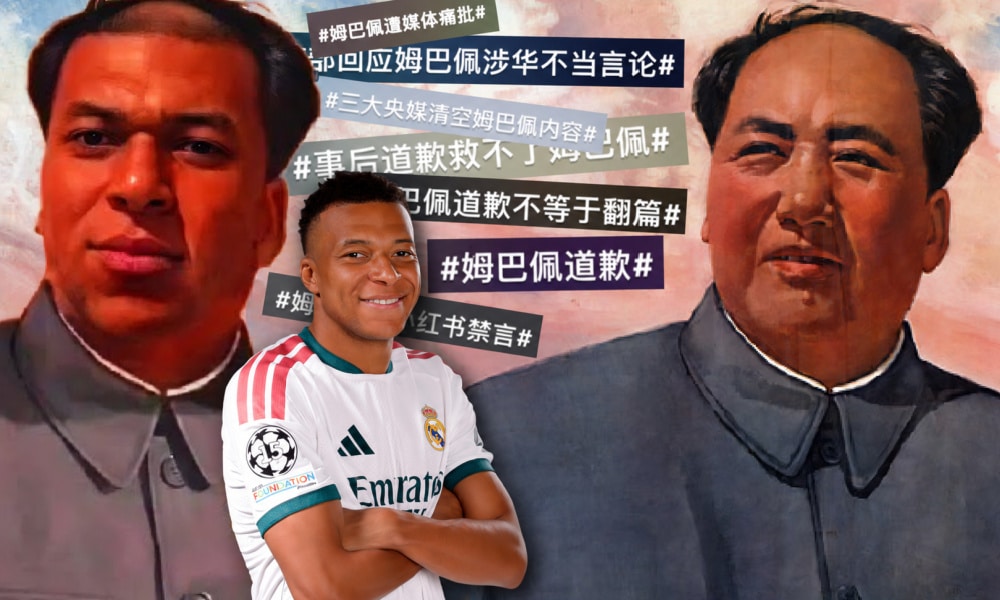
Following his 100th goal for Real Madrid during El Clásico and finishing second on Ballon d’Or night, French football player Mbappé is all the talk on Chinese social media — not for his achievements, but for what is seen as crossing a major red line in an online interview.

On Tuesday night, a text came in from Ruixin: “I am wide awake tonight and somehow witnessed live how the footballer Kylian Mbappé was getting blocked and totally canceled on Chinese social media for his comments about Mao Zedong over the past, like, three hours 😅”

I quickly grabbed my phone and saw the flood of Mbappé posts rapidly coming in, and it was clear that people were very cross with him.

Although it was already clear that this might not blow over any time soon, by early Wednesday morning it became painfully clear how the controversy had snowballed. Dongpeng Beverage Group (东鹏), one of the many Chinese companies that signed the famous sportsman as its brand ambassador, publicly stated that it was cutting all commercial ties with Mbappé. Soon, others followed.
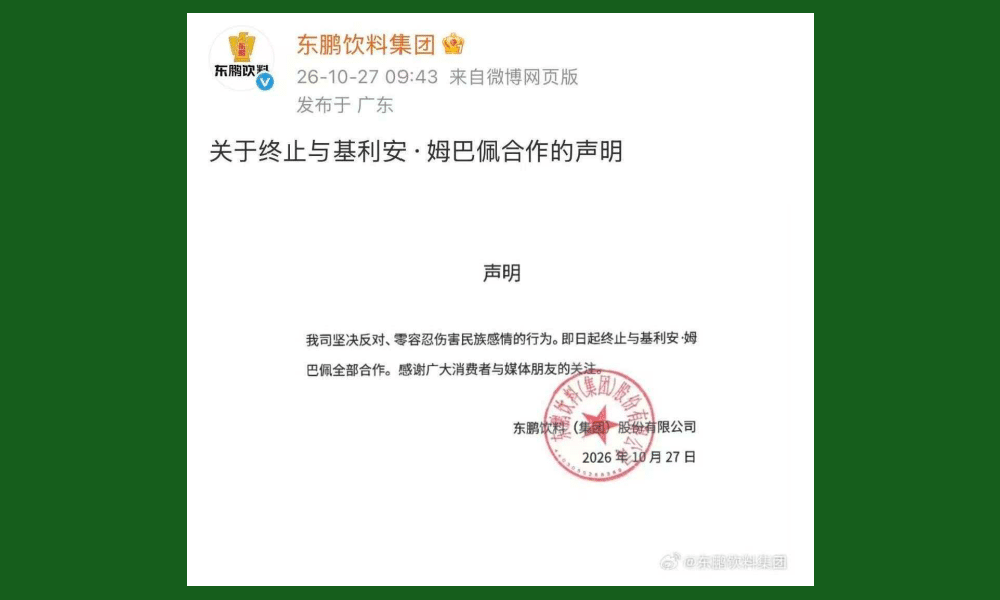
Dongpeng Beverage Group (东鹏): the first in a string of companies to cut ties with French footballer Kylian Mbappé.

Mbappé’s fall from grace in China has been sudden and spectacular, like a major avalanche of backlash that unfolded in one night, and it can all be traced back to one segment of an interview the footballer previously did on a French YouTube show (The Bridge) that resurfaced online — initially through Reddit and X, and then on Chinese social media apps, like football platform Dongqiudi (懂球帝).

In that segment, when asked about his favorite meme, Mbappé replied that one of the memes he finds funniest is:

🗣️ “the one where they put my face on some guy, a Chinese dictator. That really makes me laugh, I use it with my friends all the time.”

The interview segment where Mbappé shares his favorite meme: his face photoshopped onto the face of a “Chinese dictator.”

The show, created by Mbappé’s Real Madrid teammate Aurélien Tchouaméni, added the image Mbappé referred to: his face photoshopped on a Mao propaganda visual. It’s part of a series of memes that emerged in 2024 in which Mbappé’s face is edited onto the faces of dictators.1

Continue Reading

Chapter Dive

The French Protests, Viewed from China: Five Narratives on Chinese Social Media

From the decline of Europe to historical karma: these 5 narratives reveal how Chinese social media discusses the recent unrest in France.
Manya Koetse

Published

on

Originally published in the Eye on Digital China newsletter on Sunday, October 25, 2026.

The protests in France have been trending in China all week. The ways in which they are being discussed perhaps reveal more about Chinese views of France and Europe—and about China’s own place in the world today—than about the protests themselves. Here are five of the main narratives shaping the discussion.

Over the past week, the widespread protests and unrest in France have been trending on Chinese social media. From October 18 to today, turmoil in Paris and other cities consistently appeared in the top trending lists on Weibo, Kuaishou, and other apps, with Chinese netizens and commentators discussing the situation in various ways under numerous hashtags.

The topic remained trending all week not only because of the October 17–18 riots and their aftermath, but also because of the new round of protests on October 24, for which French authorities deployed 70,000 police officers and the Chinese embassy in France issued new warnings.

Here, we’ll take a closer look at five dominant narratives surrounding the protests in France on Chinese social media, and what this says about Chinese perceptions of France and Europe, from common ideas about the decline of Europe to the protests being a form of “historical karma.”[1]


1. “France Has Lost Control”: A Nation in Crisis


How can a developed country like France fail to maintain basic order? One dominant framing of the recent protests on Chinese social media is that they demonstrate the French state’s inability to keep the situation under control, indicating a crisis of governance and security.

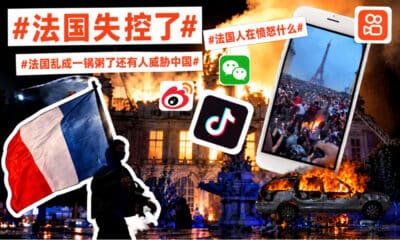
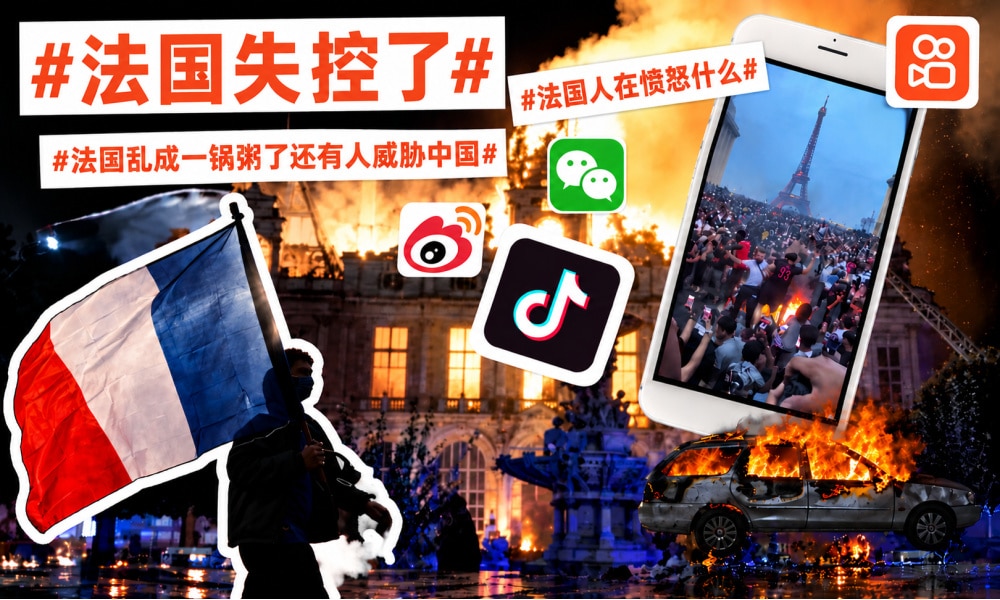
One of the highest-ranking hashtags among more than 300 trending topics on Chinese social media apps related to the unrest in France is: “France is out of control” (法国失控了). Along with hashtags like “France is in chaos again,” that hashtag first came up last Sunday on Weibo during a weekend filled with looting, arson, destruction, and violence by groups of rioters in Paris, Marseille, Lyon, Lille, and elsewhere.

The perceived weakness of President Macron’s leadership was highlighted on Chinese social media through memes and jokes mocking the leader for attending a Celine Dion concert right before the situation escalated. A commentary on Sina compared the concert to company executives holding a celebration banquet and handing out bonuses just before the firm collapses, framing the riots as a “run on…

Continue Reading

Subscribe

Eye on Digital China is a reader-supported publication by
Manya Koetse (@manyapan) and powered by What’s on Weibo.
It offers independent analysis of China’s online culture, media, and social trends.

To receive the newsletter and support this work, consider
becoming a paid subscriber.
Manya Koetse's Profile Picture

Get in touch

Have a tip, story lead, or book recommendation? Interested in contributing? For ideas, suggestions, or just a quick hello, reach out here.

Popular Reads