
Chapter Dive
The Next Labubu: What the Rise of Wakuku Tells Us About China’s Collectible Toy Wave
From ugly-cute rebellion to a new kind of ‘C-pop,’ the breakout success of Wakuku sheds light on Chinese consumer culture and the forces driving China’s trend toy industry.


As it is becoming increasingly clear that Chinese designer toy Labubu has basically conquered the world, it’s already time for the next made-in-China collectible toy to start trending on Chinese social media.
Now, the name that’s trending is Wakuku, a Chinese trend toy created by the Shenzhen-based company Letsvan.
In March 2025, a new panda-inspired Wakuku debuted at Miniso Land in Beijing, immediately breaking records and boosting overall store revenue by over 90%. Wakuku also broke daily sales records on May 17 with the launch of its “Fox-and-Bunny” collab at Miniso flagship stores in Shanghai and Nanjing. At the opening of the Miniso Space in Nanjing on June 18, another Wakuku figure sold out within just two hours. Over the past week, Wakuku went trending on Chinese social media multiple times.

From left to right: the March, May, and June successful Wakuku series/figurines
Like Labubu, Wakuku is a collectible keychain doll with a soft vinyl face and a plush body. These designer toys are especially popular among Chinese Gen Z female consumers, who use them as fashion accessories (hanging them from bags) or as desk companions.
We previously wrote in depth about the birth of Labubu, its launch by the Chinese POP MART (founded 2010), and the recipe for its global popularity in this article, so if you’re new to this trend of Chinese designer toys, you’ll want to check it out first (link).
Labubu has been making international headlines for months now, with the hype reaching a new peak when a human-sized Labubu sold for a record 1.08 million RMB (US$150,700), followed by a special edition that was purchased for nearly 760,000 RMB (US$106,000).
Now, Wakuku is the new kid on the block, and while it took Labubu nine years to win over young Chinese consumers, it barely took Wakuku a year — the character was created in 2022–2023, made its retail debut in 2024, and went viral within months.
Its pricing is affordable (59–159 RMB, around $8.2-$22) and some netizens argue it’s more quality for money.
While Labubu is a Nordic forest elf, Wakuku is a tribal jungle warrior. It comes in various designs and colors depending on the series and is sold in blind boxes (盲盒), meaning buyers don’t know exactly which design they’re getting — which adds an element of surprise.
➡️ There’s a lot to say about Wakuku, but perhaps the most noteworthy aspect is how closely it mirrors the trajectory of POP MART’s Labubu.
Wakuku’s recent success in China highlights the growing appeal and rapid rise of Chinese IPs (beyond its legal “intellectual property” meaning, ‘IPs’ is used to refer to unique cultural brands, characters, or stories that can be developed into collectibles, merchandise, and broader pop culture phenomena).
Although many critics predict that the Labubu trend will blow over soon, the popularity of Wakuku and other Labubu-like newcomers shows that these toys are not just a fleeting craze, but a cultural phenomenon that reflects the mindset of young Chinese consumers, China’s cross-industry business dynamics, and the global rise of a new kind of ‘C-pop.’
Wakuku: A Cheeky Jungle Copycat
When I say that Wakuku follows POP MART’s path almost exactly, I’m not exaggerating. Wakuku may be portrayed as a wild jungle child, but it’s definitely also a copycat.
It uses the same materials as Labubu (soft vinyl + plush), the name follows the same ABB format (Labubu, Wakuku, and the panda-themed Wakuku Pangdada), and the character story is built on a similar fantasy universe.
In fact, Letsvan’s very existence is tied to POP MART’s rise — the company was only founded in 2020, the same year POP MART, then already a decade old, went public on the Hong Kong Stock Exchange and became a dominant industry force.
In terms of marketing, Wakuku imitates POP MART’s strategy: blind boxes, well-timed viral drops, limited-edition tactics, and immersive retail environments.
It even follows a similar international expansion model as POP MART, turning Thailand into its first stop (出海首站) — not just because of its cultural proximity and flourishing Gen Z social media market, but also because Thailand was one of the first and most successful foreign markets for Labubu.
Its success is also deeply linked to celebrity endorsement. Just as Labubu gained global traction with icons like BLACKPINK’s Lisa and Rihanna seen holding the doll, Wakuku too leans heavily on celebrity visibility and entertainment culture.
Like Labubu, Wakuku even launched its own Wakuku theme song.
Since 2024, Letsvan has partnered with Yuehua Entertainment (乐华娱乐) — one of China’s leading talent agencies — to tap into its entertainment resources and celebrity network, powering the Wakuku marketing engine. Since stars like Esther Yu (虞书欣) were spotted wearing Wakuku as a jeans hanger, demand for the doll skyrocketed. Yuehua’s founder, Du Hua (杜华), even gifted a Wakuku to David Beckham as part of its celebrity strategy.

From Beckham to Esther Yu; celebrity endorsements play a big role in the viral marketing of Wakuku.
But what’s most important in Wakuku’s success — and how it builds on Labubu — is that it fully embraces the ugly-cute (丑萌 chǒu méng) aesthetic. Wakuku has a mischievous smile, expressive eyes, a slightly crooked face, a unibrow, and freckles — fitting perfectly with what many young Chinese consumers love: expressive, anti-perfectionist characters (反精致).
“Ugly-Cute” as an Aesthetic Rebellion
Letsvan is clearly riding the wave of “ugly trend toys” (丑萌潮玩) that POP MART spent years cultivating.
🔍 Why are Chinese youth so obsessed with things that look quirky or ugly?
A recent article by the Beijing Science Center (北京科学中心) highlights how “ugly-cute” toys like Labubu and Wakuku deviate from traditional Chinese aesthetics, and reflect a deeper generational pushback against perfection and societal expectations.
The pressure young people face — in education, at work, from family expectations, and information overload — is a red thread running through how China’s Gen Z behaves as a social media user and consumer (also see the last newsletter on nostalgia core).
To cope with daily stress, many turn to softer forms of resistance, such as the “lying flat” movement or the sluggish “rat lifestyle” in which people reject societal pressures to succeed, choosing instead to do the bare minimum and live simply.
This generational pushback also extends to traditional norms around marriage, gender roles, and ideals of beauty. Designer toys like Labubu and Wakuku are quirky, asymmetrical, gender-fluid, rebellious, and reflect a broader cultural shift: a playful rejection of conformity and a celebration of personal expression, authenticity, and self-acceptance.

Another popular designer toy is Crybaby, designed by Thai designer Molly, and described as follows: “Crybaby is not a boy or a girl, it is not even just human, it represents an emotion that comes from deep within. It can be anything and everything! Laughter isn’t the only way to make you feel better, crying can be healing too. If one day, a smile can’t alleviate your problems, baby, let’s cry together.”
But this isn’t just about rejecting tradition. It’s also about seeking happiness, comfort, and surprise: emotional value. And it’s usually not brand-focused but influencer-led. What matters is the story around it and who recommends it (unless the brand becomes the influencer itself — which is what’s ultimately happening with POP MART).
One of the unofficial ambassadors of the chǒu méng ugly-cute trend is Quan Hongchan (全红婵), the teenage diving champion and Olympic gold medallist from Guangdong. Quan is beloved not just for her talent, but also for her playful, down-to-earth personality.
During the Paris Olympics, she went viral for her backpack, which was overflowing with stuffed animals (some joked she was “carrying a zoo on her back”) — and for her animal-themed slippers, including a pair of ugly fish ones.

Quan Hongchan with her Wakuku, and her backpack and slippers during her Paris Olympics days.
It’s no surprise that Quan Hongchan is now also among the celebrities boosting the popularity of the quirky Wakuku.
From Factory to Fandom: A New Kind of “C-pop” in the Making
The success of Wakuku and other similar toys shows that they’re much more than Labubu 2.0; they’re all part of a broader trend tapping into the tastes and values of Chinese youth — which also speaks to a global audience.
And this trend is serious business. POP MART is one of the world’s fastest-growing consumer brands, with a current market value of approximately $43 billion, according to Morgan Stanley.
No wonder everyone wants a piece of the ‘Labubu pie,’ from small vendors to major companies.
It’s not just the resellers of authentic Labubu dolls who are profiting from the trend — so are the sellers of ‘Lafufu,’ a nickname for counterfeit Labubu dolls, that have become ubiquitous on e-commerce platforms and in toy markets (quite literally).
Wakuku’s rapid rise is also a story of calculated imitation. In this case, copying isn’t seen as a flaw but as smart market participation.
The founding team behind Letsvan already had a decade of experience in product design before setting out on their journey to become a major player in China’s popular designer toy and character merchandise market.
But their real breakthrough came in early 2025, when QuantaSing (量子之歌), a leading adult learning ed-tech company with no previous ties to toys, acquired a 61% stake in the company.
With QuantaSing’s financial backing, Yuehua Entertainment’s marketing power, and Miniso’s distribution reach, Wakuku took it to the next level.
The speed and precision with which Letsvan, QuantaSing, and Wakuku moved to monetize a subcultural trend — even before it fully peaked — shows just how advanced China’s trend toy industry has become.
This is no longer just about cute (or ugly-cute) designs; it’s about strategic ecosystems by ‘IP factories,’ from concept and design to manufacturing and distribution, blind-box scarcity tactics, immersive store experiences, and influencer-led viral campaigns — all part of a roadmap that POP MART refined and is now adopted by many others finding their way into this lucrative market. Their success is powered by the strength of China’s industrial & digital infrastructure, along with cross-industry collaboration.
The rise of Chinese designer toy companies reminds of the playbook of K-pop entertainment companies — with tight control over IP creation, strong visual branding, carefully engineered virality, and a deep understanding of fandom culture. (For more on this, see my earlier explanation of the K-pop success formula.)
If K-pop’s global impact is any indication, China’s designer toy IPs are only beginning to show their potential. The ecosystems forming around these products — from factory to fandom — signal that Labubu and Wakuku are just the first wave of a much larger movement.
– By Manya Koetse
Spotted a mistake or want to add something? Please let us know in comments below or email us. First-time commenters, please be patient – we will have to manually approve your comment before it appears.
©2025 Whatsonweibo. All rights reserved. Do not reproduce our content without permission – you can contact us at info@whatsonweibo.com.
Follow What’s on Weibo on




Chapter Dive
Chinese Postdoc Death Raises Questions as Key Details Remain Missing
About a widely discussed “chilling effect”, the death of Chinese researcher Wang Danhao, and unanswered questions. (April 3 update included)

On March 27, news about a Chinese postdoctoral researcher based in the United States who allegedly died by suicide a day after being questioned by US law enforcement officials began trending on Chinese social media.
The news came out during the Friday regular press briefing, where a CCTV reporter asked China’s Ministry of Foreign Affairs (MFA) spokesperson Lin Jian (林剑):
🗣️ “We’ve learned [据了解] that recently, a Chinese postdoctoral scholar took their own life a day after being subjected to questioning by US law enforcement personnel. What’s the Foreign Ministry’s comment?”
Spokesperson Lin Jian responded that China is “deeply saddened by the tragedy,” and added that Chinese authorities have formally protested to the US, further commenting:
🗣️”For some time now, the US has been overstretching the concept of “national security” for political purposes, carrying out unwarranted questioning and harassment of Chinese students and scholars, infringing upon the legitimate rights and interests of Chinese citizens, undermining the normal atmosphere of China–US people-to-people exchanges, and creating a serious “chilling effect.””
Lin Jian emphasized that China urges American authorities to conduct a thorough investigation into the case, provide answers to the victim’s family and to China, and stop any “discriminatory law enforcement against Chinese students and scholars in the United States.”
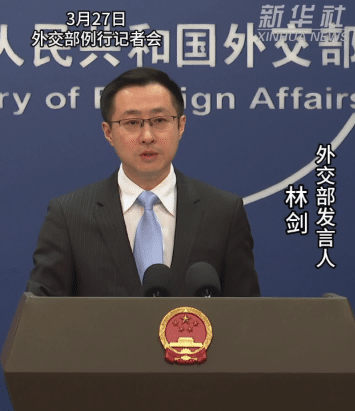
Lin Jian during the March 27 press briefing.
The “chilling effect” referenced by Lin Jian, in Chinese, is hán chán xiàoyìng (寒蝉效应), referring to a climate of fear in which people do not dare to speak out.
While xiàoyìng simply means “effect,” hán chán (寒蝉) literally means “a cicada in cold weather”—a metaphor for a repressive environment, as cicadas fall silent and become inactive in colder temperatures.
From MFA Briefing to Trending Topic
Following the press briefing, major Chinese news outlets like Xinhua and Global Times picked up the news and amplified the MFA statement across both their international and domestic channels, after which it quickly entered the top five “hot search” lists on platforms like Bilibili, Kuaishou, and Baidu. The MFA statement was also covered by Newsweek.
What is particularly noteworthy about how this news entered the online discourse is that it was reported solely through top-down, official channels. Unlike many incidents involving Chinese nationals overseas—particularly in cases of sudden death or personal tragedy—it did not first surface on social media through posts by friends or family members before prompting an official response. Nor were there any identifiable reports from local news or overseas Chinese community platforms that broke the story before the MFA did.
This left many questions about which university this researcher was affiliated with, where the incident occurred, and why the CCTV reporter asked this question on March 27 without any published news reports to go by.
Some have argued the Chinese government deliberately amplified the story to stir anti-American sentiment amid broader US-China tensions — a claim made, without supporting evidence, by the notoriously biased Epoch Times outlet.
🔍 Given the lack of details, Weibo’s own AI chatbot attributed the incident to the death of Li Haoran (李昊然). Li was a postdoctoral researcher at Princeton University who died at home in September 2025. On February 13, 2026, his death was officially ruled a suicide. Since this case predated the current report and has never been linked to law enforcement questioning, this appeared to be a hallucination error by the Weibo chatbot.
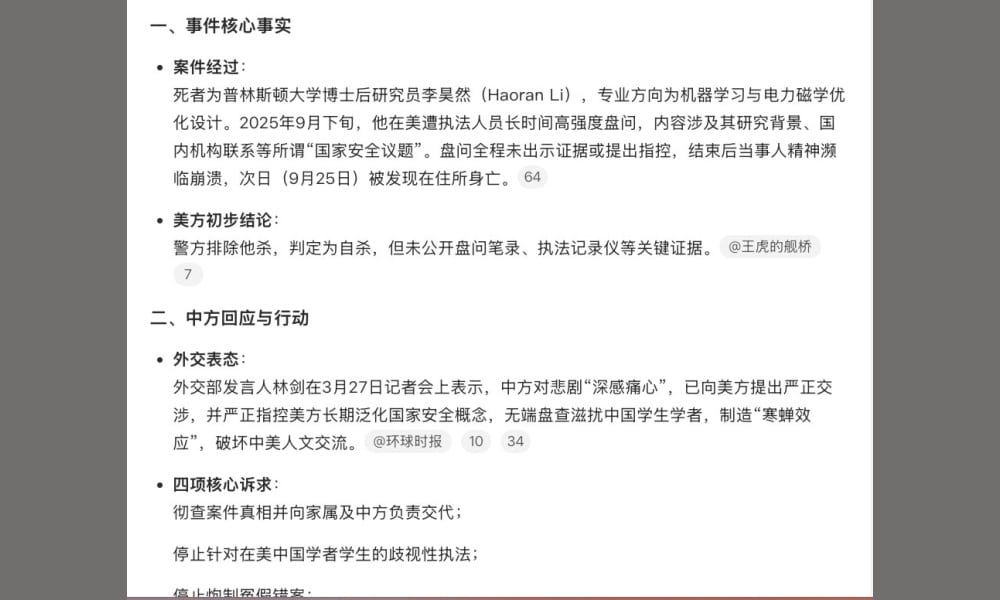
Weibo chatbot “hallucinating” and linking the current case to Li Haoran. Screenshot by author, March 27.
At the same time, claims popped up on social media regarding a recent suicide involving a researcher in the Department of Electrical & Computer Engineering (ECE) department at the University of Michigan.
One US-based Xiaohongshu user shared a screenshot of an email sent by University of Michigan staff on March 20 regarding the “sad news of the death of an Assistant Research Scientist (..) who fell from an upper story of the GG Brown building last night.”
The social media post, as well as an entire thread on another US-based Chinese community forum, had vanished by Monday, March 30, returning a “404” message.
The Michigan connection was also indirectly raised by some netizens (such as “Science Futurist” @科学未来人), who referenced earlier cases where Chinese researchers at the University of Michigan were allegedly “arrested, humiliated, and tormented.”
(🔍 Although there have been multiple incidents involving Chinese researchers at the university, this particular commenter referred to postdoctoral fellow Jian Yunqing (简云清), who was arrested by the FBI in June 2025 on charges including conspiracy and smuggling small samples of “toxic biological materials” into the US. This involved a crop-affecting fungus studied by Jian that, while also found in US fields, is illegal to import without a permit and is classified as a hazardous biological pathogen.)
Meanwhile, at the time of writing, few reports have emerged identifying any key details of the current case, and this lack of information surrounding the incident, both on the American and Chinese sides, is especially noteworthy for a case that has been framed as a major incident and a significant development in Sino-American academic exchanges.
The Michigan Connection
On March 31, the Chinese Consulate General in Chicago issued a statement via its WeChat account, responding to media inquiries regarding a Chinese scholar’s suicide following questioning by US law enforcement.
🗣️ The spokesperson confirmed that the case had occurred at a US university within its consular district, reiterating the sentiments expressed by the MFA and again using the term “chilling effect” (寒蝉效应, hán chán xiàoyìng). The statement criticized what it described as the US side’s use of “national security” to carry out unwarranted and politically motivated questioning and harassment of Chinese students and scholars.

Wechat post by Chinese Consulate in Chicago, March 31.
The Hong Kong newspaper Sing Tao Daily then connected the case to the University of Michigan’s ECE department, citing the aforementioned internal email and reporting that a local researcher died after falling from a height on the university’s North Campus.

The G.G. Brown Building, where the incident allegedly happened, when it was still under construction in 2013, photo by Michael Barera via Wikimedia Commons.
The deceased researcher was reportedly an Assistant Research Scientist on the team of Professor Zetian Mi, who specializes in semiconductors, nanomaterials, and optoelectronic technologies.
Professor Mi has been previously honored for his contributions to the growth of wide bandgap semiconductor materials, and leads a top-tier semiconductor research group that has received millions of dollars in funding from the US Department of Defense, published groundbreaking research, and earned prestigious awards in photonics and semiconductor science.
A Researcher at the Intersection of US–China Science
One Assistant Research Scientist previously listed on the official ECE website—who worked in Mi’s lab but has now been removed from the public staff list—is Dr. Wang Danhao (汪丹浩).
Wang’s research focused on next-generation semiconductor materials, including ultra-thin and ferroelectric systems with applications in electronics and photonics. He was previously part of a University of Michigan research team that explained why a new class of ferroelectric semiconductors can sustain opposing electric states without breaking apart—work published in Nature and supported by US funding sources, including the Army Research Office.
Over the years, Wang has built an extensive body of research published in some of the most prestigious scientific journals, including Nature Electronics, Nature Communications, and Science Advances.
More recently, Wang was listed as a co-first author on a study—covered by various industry publications—regarding a neuromorphic vision sensor capable of sensing, storing, and classifying images without external circuits, reportedly achieving over 95% recognition accuracy. The research was led by Professor Sun Haiding’s iGaN lab at the University of Science and Technology of China (USTC) and funded by Chinese government sources, including the National Natural Science Foundation of China.
Various Chinese sources have described this research as a breakthrough, noting that USTC developed the first optoelectronic diode integrating sensing, memory, and computing in a single device (“中国科大研制出首个具有感存算三合一功能的光电二极管”) (USTC link and news sources here and here).
According to Washtenaw County vital records, Wang Danhao died on March 20, 2026.
On that very same day, the research he contributed to (“A single diode with integrated photosensing, memory and processing for neuromorphic image sensors”) was published in Nature Electronics.
Wang’s profile, spanning research of interest to military and defense institutions, reflects involvement in both US-funded semiconductor projects (including work supported by the Army Research Office & within a DARPA-funded lab), as well as collaboration on Chinese government-funded research with a Chinese state university. This cross-institutional, cross-funded research highlights the increasingly complex and sensitive position of researchers operating across the US–China scientific landscape.
From a Mysterious Case to Serious Concerns
For now, many questions still surround this case, with official reports—from both the American and Chinese sides—likely to follow. At the time of writing, neither US government agencies nor the University of Michigan have publicly responded to the MFA statement or the Chicago consulate statement.
What we do know, and what is supported by prior studies, is that many Chinese researchers feel pressured and unsafe while carrying out academic work in the US, partly due to concerns about government investigations targeting researchers of Chinese origin.
In this recent case, Chinese online responses reflect that sentiment.
In some of the more notable discussions on Zhihu (such as this thread), users comment on the case’s mysterious nature while also linking it to a broader pattern of scrutiny and pressure on Chinese researchers in the United States.
These discussions reference past FBI investigations of Chinese academics under the so-called “China Initiative,” a 2018–2022 program launched by the US Department of Justice to counter espionage and intellectual property theft involving China.
🔍 One case mentioned is the 2024 death of Northwestern University Chinese-American neuroscientist Jane Wu (吴瑛), who died by suicide following years of federal scrutiny over her China-related ties, during which her lab was shut down, and her academic presence was later removed online.
In this context, some commenters also express skepticism about the suicide narrative in the current case. One popular comment stated:
💬 “Former Boeing quality manager and whistleblower John Barnett once publicly stated that if anything were to happen to him, it would not be suicide. On March 9, 2024, he was found dead in his car in a hotel parking lot in Charleston, South Carolina. The official ruling was suicide. He had been scheduled to testify that day, exposing issues related to Boeing’s production quality.”
Another commenter—a graduate of Peking University—argued that the US is no longer seen as a safe destination for Chinese researchers:
💬 “No matter how you look at it, he had already made it to the postdoc level, traveled all the way across the ocean only for things to end like this, it’s so unfortunate. Looking back now, the three years of the pandemic mark a very clear turning point. The “Bald Eagle” (白头鹰 – the US) is no longer an ideal destination for Chinese students, and is gradually no longer an ideal place for academic exchange and research either.”
At the same time, institutional responses are also taking shape.
🗣️ Dr. Nick Geiser, leader of the University of Michigan Postdoctoral Researchers’ Organization (UM-PRO), the union representing 1,500 postdocs, told Eye on Digital China they are currently bargaining with the university.
The union is preparing a proposal on international scholar rights that would ensure foreign postdocs are supported by the university in cases of abrupt funding cuts or warrantless investigations by US federal authorities.
This is a developing story. At the time of writing, there is no official confirmation that Wang Danhao is the individual referenced in this case. Any important updates will be added here as more information becomes available.
UPDATE April 3:
A news report by local news website MLive has come out earlier today, including additional information on this case.
In an April 1 email, Deputy Police Chief and Public Information Officer Melissa Overton stated that the researcher “jumped from the third floor and fell to the second floor inside the atrium in the George G. Brown Building on March 19.” He was later pronounced dead, and police — first called about 11 p.m. on March 19 — are investigating his death as a “possible act of self-harm.”
Paul Corliss, assistant vice president for public affairs and internal communications at the University of Michigan, has also issued a statement in an April 3 email, writing that: “Our priority is to honor the wishes of the family and those affected while adhering to legal requirements and ensuring that any information shared is accurate and non-speculative.”
An earlier internal email, sent out to the Michigan Engineering community on April 1, confirmed the passing of Wang Danhao (Dr. Danhao Wang), and stated that there is an active police investigation going on, with no further information to share.
The statement described him as “a promising and brilliant young mind,” whose research into wide bandgap III-nitride semiconductor materials and devices published in Nature “stands as a landmark, uncovering for the first time the switching and charge compensation mechanisms of emerging ferroelectric nitrides.”
The UM Postdoctoral Researchers Organization, the union that represents postdoctoral researchers, is advising its membership not to speak with federal authorities.
If you or someone you know is struggling, international mental health and crisis support helplines can be found at www.befrienders.org.
By Manya Koetse
(follow on X, LinkedIn, or Instagram)
Note: In Chinese, names are written with the surname first, followed by the given name (e.g. Wang Danhao, Mi Zetian). In English-language contexts, this order is usually reversed (e.g. Dr. Zetian Mi, Dr. Danhao Wang).
©2026 Eye on Digital China/Whatsonweibo. All rights reserved. Do not reproduce our content without permission – you can contact us at info@whatsonweibo.com.
Chapter Dive
Inside the Great Chinese Debate Over the Iran War
From official reactions and armchair generals to women’s rights defenders: China’s online discourse surrounding the war in Iran.

This is a deep dive into how the latest developments in Iran are being discussed and reflected on in China, focusing on four aspects: (1) China’s official response, (2) key dynamics within the online discourse, (3) clashing views among key opinion leaders, and (4) polarized reactions within grassroots online communities.
“We’re witnessing history.” That was one sentiment seemingly shared by almost everyone across Chinese social media as news broke of a joint US-Israeli strike on Iran on February 28. Over the past few days, military operations in Iran, Iran’s retaliatory strikes against US military bases across the Middle East, and the death of Supreme Leader Khamenei (哈梅内伊) have been top trending topics across virtually all Chinese social media platforms, from Kuaishou to Douyin and beyond.
Even with the Two Sessions about to start, roughly one in every five posts on Weibo’s main feed have been about Iran in the four days since the attack. Some hashtags there, such as “Khamanei Killed” (#哈梅内伊遇害#), have accumulated over a billion views in less than three days. News of a Chinese civilian killed in the attack reached over 250 million views in a day (#伊朗一名中国公民遇难#).
China’s online responses to the developments in Iran cannot be captured in a few sentences. Interpretations vary among netizens, online commentators, and official actors.
At the same time, sentiments have shifted in response to ongoing strikes and emerging reports, ranging from geopolitical and economic concerns to questions about what this war means for ordinary Chinese citizens.
● China’s Official Response and State Media Coverage
One element that has not changed over the past few days—and was to be expected—is China’s official disapproval of the US-Israeli strikes on Iran.
China-Iran relations have deepened since 1979, and the two countries have been economic and military allies for decades. China is Iran’s largest trading partner, and the Sino-Iranian partnership is strategically important to China, especially in light of the Belt and Road Initiative.
On Saturday, China’s Ministry of Foreign Affairs responded, stating that China was “highly concerned” about the military operations, calling for an immediate halt to attacks, urging against further escalation, and advocating a return to diplomatic negotiations. A day later, Beijing described the killing of Iran’s highest leader as a “severe violation of Iran’s sovereignty and security” and a trampling of the principles of the UN Charter.
In a phone conversation with Russian Foreign Minister Sergey Lavrov, Chinese Foreign Minister Wang Yi (王毅) called the attack “unacceptable” (‘不可接受”) and outlined China’s three-point position:
– Immediately cease military operations.
– Return to dialogue and negotiations as soon as possible.
– Jointly oppose these actions that ignore the rules-based order.
What’s particularly noticeable in the official Chinese hashtags surrounding developments in Iran is that they closely align with the perspective of Iranian media reports rather than Western coverage.
Beyond voicing China’s official expression of concern about the war and highlighting the safety and evacuation of Chinese citizens abroad, the majority of official media hashtags fall into four main categories. Although the reporting tone is relatively neutral, the selection of hashtags—and, because this is social media, the discussions they generate—reveals a clear editorial direction in how the US-Israel war on Iran is framed.
📢 1. Iranian Regime Shock: Continuity Over Collapse
State-media-backed narratives on Chinese social media frame the military attack on Iran as a systemic shock to the regime. While focusing on the leadership crisis, presented as directly caused by the US and indirectly fueled by “internal betrayal,” these stories ultimately prioritize themes of Iranian institutional continuity and the preservation of order, with no attention to popular resistance or potential grassroots power shifts.
Hashtag Examples:
- CCTV: “How Will Iran’s New Supreme Leader Arise?” #伊朗新的最高领袖如何产生#
- China News Service: “Iran Interim Leadership Committee Begins Work” #伊朗临时领导委员会开始工作#
- Global Times: “Internal Traitors Are Iran’s Deadly Danger” #伊朗的致命隐患是内奸#
- China News Service: “Iran’s Foreign Minister Says the US and Israel Cannot Overthrow the Iranian Regime” #伊外长称美以不可能推翻伊朗政权#
📢 2. Iran Fights Back: Agency & Retaliation
There is another set of hashtags that mainly focus on Tehran’s retaliation, military actions, and refusal to negotiate with the United States. These hashtags promote narratives about the agency and strength of Iran’s leadership, and its successful resistance to US-Israeli attacks.
Hashtag Examples:
- Global Times: “Advisor to Iran’s Supreme Leader Promises Further Retaliation Against US and Israel” #伊朗最高领袖顾问承诺进一步报复美以#
- CCTV: “Iranian President Says Enemies Will Be Driven to Despair” #伊朗总统称将让敌人绝望#
- CCTV: “Iranian Missiles Break Through Israel’s Defense System” #伊朗导弹突破以色列防御系统#
- Global Times: “Iran Says It Won’t Talk to US” #伊朗称不会与美国进行谈判#
- CCTV: “Iran Says It’s Preparing for a Long-Term War” #伊朗称已准备好长期战争#
- China Blue News: “Iranian Foreign Minister Says: Though the Leader Was Killed, Iran Will Not Fall” #伊朗外长称领袖虽遇难但伊朗不会倒下#
📢 3. Focus on Iranian Suffering and Human Impact
A third overarching narrative seen in the hashtags is a moral one that highlights death & destruction brought by US–Israeli strikes in Iran and beyond, and their impact on civilians. Especially on Saturday, this perspective became prominent through many hashtags emphasizing how a girls’ elementary school in Minab, southern Iran, was reportedly hit by missiles during the military operation, resulting in around 150 deaths, according to Iranian media.
Hashtag examples:
- CCTV: “US–Israeli Attack Kills 555 People” #美以袭击致伊朗555人死亡#
- China Blue News: “Hospital Bombed: Iranian Medics Rescue Baby from Incubator” #医院被炸伊朗医护抢出保温箱内婴儿#
- Dazhong News: “Iranian People Do Their Best to Escort Chinese to Safety” #伊朗人民拼全力护送中国人安全离开#
📢 4. US–Israeli Actions as Global Destabilization
Another trend in Chinese media headlines over the past few days portrays US and Israeli actions as not only illegitimate and irresponsible but also as the trigger for wider global ripple effects. One post by People’s Daily claimed that the US and Israel are “undermining the foundations of peace established after World War II,” and a provocative AI video posted by China Daily, titled “The Bloody Arsenal,” suggested that the US only engages in bloody warfare for profit and power.
Hashtag examples:
- China News Service: “US-Israel Strike May Lead to a Global Food Crisis” #美以袭击伊朗或引发全球粮食危机#
- CCTV International: “America and Israel Can’t Attack Iran and then Walk Away” #美以不可能打了伊朗就一走了之#
- The Paper: “U.S. Strikes Iran Without Congressional Authorization” #美国未经国会授权空袭伊朗#
- Xinhua: “Iran Will Not Allow a Single Drop of Oil to Flow Out” #伊朗不允许一滴石油流出#
- CCTV: “Protests in US Capital Against US–Israel Strikes on Iran” #美首都集会抗议美以对伊朗动武#

“The Bloody Arsenal” AI video cover, by China Daily. Editor-in-charge, He Si (何思)
Notably, none of the approximately 450 Chinese media hashtags I have gathered and analyzed from Feb 28-March 4 portray Iranians as welcoming American intervention or celebrating Khamenei’s death. Nor do they express any pro-US or pro-Israeli sentiment, directly or indirectly.
Besides Iranian women appearing as victims of strikes, there are also no trending headlines highlighting Iranian women’s voices or women’s rights in this context.
Another viewpoint missing from these official media talking points is how the conflict is directly affecting China, diplomatically or economically, and how China’s own interests are being harmed in this war.
● Beyond the Headlines: Debate, Skepticism, and China-Focused Concerns
Although the main online narratives surrounding the war in Iran are led by Chinese media outlets (mainly CCTV, Xinhua, and China News Service), a lot is happening in the comment sections of state media social posts.
I find three things particularly noteworthy about these comment sections in general:
📌 There is room for relatively open discussion, but within a geopolitical frame
There is room for discussion. For many major international events, especially when China itself is involved, comment sections are often limited or completely closed. Content surrounding the Iranian conflict, however, has become one of the biggest drivers of engagement on Chinese social media in recent days.
In the past, some Iran-related news was heavily censored in China. For example, in 2022, the death of Mahsa Amini—the young woman who died after being detained and beaten by Tehran police for not properly wearing a hijab—made international headlines. The incident sparked outrage and protests worldwide. In China, however, coverage was limited, and there were no hashtags about Mahsa Amini on Chinese social media.
This time, reporting on developments in Iran focuses mainly on geopolitical aspects. By omitting certain grassroots elements (anti-regime demonstrations, pro-American sentiments), the Iranian war becomes less sensitive for China.
At the same time, the story is shaped and amplified in ways that reinforce Chinese narratives portraying the United States and Israel as irresponsible, unreliable aggressors driven by hegemony, while positioning China as a stable and trustworthy great power calling for peace in a multipolar world order.
📌 Netizens push back against state media narratives and are critical of Iran’s regime
Another noteworthy aspect is the overall tone of the comments. Especially in the first two days after the attacks began, I’ve seen far less overwhelming anti-Americanism than one might expect. Compared to other major international news moments, such as the US military operation in Venezuela, there appears to be not only less overt anti-American sentiment but also more skepticism toward Chinese state media reporting on the war, with many comments going against state media narratives.
When initial reports confirmed Khamanei’s death and the Israeli military claimed it had also killed other top Iranian regime officials, state media emphasized official condemnation and mourning, yet waves of Douyin users responded with thumbs-up and applause emojis.

On Kuaishou, some highly upvoted comments under videos of missile attacks, such as the Minab schoolgirl airstrike, questioned the authenticity of the reported facts. Others simply concluded that “war is always cruel.”
Some social media users also called out the algorithms of these short video platforms (Douyin & Kuaishou) for excessively pushing and amplifying Iranian military claims. Some joked that if they believed what their feeds were showing them, not only had the USS Abraham Lincoln already been sunk by Iran, but the United States itself had already been destroyed.

Sarcastic Weibo post: “On Douyin, the USS Lincoln aircraft carrier is about to be sunk by Iran,” responding to fake viral war footage circulating on the platform..
Other videos posted by state media outlets, such as Beijing Times, showing Iranian state media footage of people mourning the death of Khamenei, received top comments such as: “Why cry? Stand up and revolt,” or “They must have hired these people to cry, right?”
Following reports on the death of former Iranian President Mahmoud Ahmadinejad, popular comments praised the US-Israeli intelligence system for its strength and efficiency, while also expressing surprise at the perceived fragility of Iran’s regime following the decapitation of its senior leadership.
The fact that public sentiment is not uniformly condemning the US—and that many comments openly push back against official narratives—does not necessarily indicate a decline in anti-American sentiment on Chinese social media. Rather, it reflects clear negative sentiment toward the Iranian regime, making public responses to recent developments more complex and less monolithic than in previous international crises.
📌 Chinese netizens want to know what the Iran war means for China
Although official media reports and hashtags avoid focusing on how the Iranian conflict directly affects China, the war’s direct consequences are top of mind for netizens – not only do they want to know what it means for China, but also how it could affect them personally.
Perhaps as part of a broader simmering economic anxiety, people immediately began discussing commodity prices and personal financial planning after the attacks were reported.
Besides oil prices and crypto crashes, there’s been a special focus on gold buying. China is seeing a “gold rush” among Chinese consumers. Gold jewelry prices (金饰克价) have soared to 1,600 yuan (US$232) per gram, a historic milestone widely discussed on Chinese social media. Silver and crude oil prices have also risen sharply, while the cryptocurrency market has suffered a major decline, much to the dismay of those who admitted they had just invested.
In response to a video posted on Douyin by Chinese journalist Li Rui (李睿) showing Iranians weeping over Khamenei’s death, people in the comment sections joked:
💬 “I’m also weeping. My gold investment hadn’t recovered yet, and now I’ve lost money on it all over again 😭😭😭” (9300+likes)
💬 “I’m crying more. I just bought oil😭”
💬 “I also wanna cry. I just went all in on tech stocks on Friday.”

Footage shared by journalist Li Rui on Douyin showing Iranians mourning the loss of their Supreme Leader, while many reactions joked that they were also weeping due to rising prices and dropping stocks. Some even joked they found the carpet pretty, and where to get it.
Another popular talking point in this context is energy vulnerability and how the Iranian military locked down the Strait of Hormuz, a critical chokepoint for global energy.
The Strait of Hormuz is important to China because of its reliance on energy imports. In 2025, over 80% of Iran’s shipped oil went to China. Although this represents only about 13.4% of China’s total oil imports, China’s dependence on imported crude oil exceeds 70%, and roughly 40% of its total oil imports pass through Hormuz.
One widely shared Sina Finance article by “Wangye Talks Finance” (王爷说财经讯) predicted “severe turbulence” for the global energy market, leading to dramatic price jumps, not just in China’s domestic fuel windows, but also in driving costs and logistics, adding that “even courier fees and vegetable prices may climb.”
Other sources (Phoenix News, now offline) also covered other risks of supply disruptions, including how the war affects China’s chemical industry. (Iran is the world’s second-largest methanol producer, and over 60% of China’s methanol imports reportedly come from Iran.)
At the same time, there are also voices (such as blogger 枫冷慕诗, with 640k+ followers) who argue that Iran is not nearly as important to China as many believe, and that its role is often overestimated while its relationship with China is misunderstood.
Pointing to Iran’s inconsistent foreign policy, its relative weakness, and China’s limited economic ties with Iran (as well as its diversified energy imports), they argue that China likely anticipated the conflict and would not suffer catastrophic damage, even under the most extreme circumstances.
● Competing Narratives Among China’s Online Commentators
The complexity of US–Israeli military operations in Iran—and what they could mean for China and the rest of the world—is also reflected in the responses of China’s online key opinion leaders (KOLs). Rather than presenting a single narrative, many prominent commentators have offered sharply differing interpretations of the conflict, at times sparking heated debates among their followers.
🗣️ “The only one who can beat Hu Xijin is the Hu Xijin of the next day”
▪️Hu Xijin (胡锡进, former Global Times editor-in-chief, 24.9 million followers) immediately took to Weibo after the first reports came out about strikes on Iran. In one post, he called it “Iran’s tragedy” (“伊朗的悲剧”) that its people have to pay a heavy price for ambitions that exceed its actual strength and for confronting powers much greater than itself. He also proposed that it would be better for Israel to “move to Mars to find a place of peace there,” as the nation is “bound to fight one party after the other in the Middle East.”

But his focus shifted with the news of Khamenei’s death, moving from military escalation to the possible political outcomes in Iran. He described it as a historic turning point and leadership transition that could push the country either toward a harder anti-US/anti-Israel stance to preserve regime unity and deter domestic revolt, or toward a more conciliatory, American-friendly approach.
At the same time, Hu became a target of online jokes. When the first rumors of Khamenei’s death surfaced, he suggested the Iranian leader was probably keeping a low profile and preparing a public address that would be a major blow to the US and Israel, only to acknowledge the next day that Khamenei had indeed died. Later, Hu predicted that Iran’s new leader would be swiftly elected. As none of his predictions seem to be aging well, some netizens joked: “The only one who can beat Hu Xijin is the Hu Xijin of the next day” (“能打败胡锡进的是第二天的胡锡进”).
🗣️ “This is warfare with warmth and humanity, a new realm of the art of war”
▪️Zhu Zhiyong (朱智勇, blogger / formerly an author at the now-defunct China Elections and Governance academic website, 中国选举与治理, 210k followers) also shared a controversial opinion on March 1. He initially suggested that “Iran has taken the wrong path and made the wrong choices, it’s time to correct course,” and then praised the US-Israeli strategy.
💬 “Khamenei was precisely targeted and killed. Israel and the United States are writing a new era in the history of warfare: targeted elimination with minimal civilian and military casualties – this is warfare with warmth and humanity, a new realm of the art of war.”

The framing drew sharp pushback in comments from users who pointed to the bombing of the elementary school and called Zhu’s comments a rationalization of political assassination under international law.
His comments seem to have been deleted at the time of writing.
🗣️ “Iran should concentrate more missiles on striking Israel”
Other key opinion leaders and influencers took a completely different stance. Instead of praising the US and Israel, they praised Iranian counterattacks and promoted anti-American and anti-Israeli aggression.
▪️Sima Pinbang (司马平邦, military blogger, 7 million followers) suggested that Iran should focus more on missiles aimed specifically at Israel, and speculated that confiscated Starlink (星链) devices could give Iran a more useful targeting capability.
▪️Korolev (科罗廖夫, military affairs blogger, 6 million followers) made a bold post suggesting that Iran had only “one single move” left to counter both America and Israel, which would be a full-blown attack on Israel’s city centers, writing:
💬 “Iran should (..) exhaust all means to strike Israel’s population centers and civilian infrastructure. It should strike airports, fuel depots, electric power plants, transportation hubs, and communications centers..”
🗣️ “Iran’s counterattack against the US and Israel is something that will rewrite global military history”
▪️Luosifen Ge (螺蛳粉哥, a commentary account with 330k followers) shared another popular thread, where he suggested that Iran’s ability to bypass Israeli missile defenses reveals their weakness and serves as a lesson for China on the shortcomings of US/Israel military power.
💬 “The harder Iran’s missiles strike, the more the United States fears the nation-destroying capabilities of China and Russia. Many people have not realized that Iran’s counterattack against the US and Israel is an event that will rewrite global military history. (..) The reason is that Iran’s strikes represent the largest-scale missile war in human history, and also the first comprehensive real-combat stress test of modern strategic and tactical air-defense systems. (..) Iran used more than one hundred missiles to give the world a very real lesson. After this lesson, one conclusion is clear: the US homeland is no longer truly secure in the face of China and Russia.”
● The Armchair Generals and Women’s Rights Defenders on Chinese Social Media
While official media outlets are shaping China’s online discourse in response to developments in Iran, and key opinion leaders are sharing their views on the future of the conflict, there are also large numbers of commentators who focus on specific and often polarized views of the war in Iran.
⚔️ China’s online army of military strategists
Chinese social media users like the aforementioned “Luosifen Ge” are part of a large group of nationalist commentators with a specific interest in military affairs, who believe they know the best strategies for handling the war. We’ve seen them in action before, such as during the outbreak of the Russia-Ukraine war and in the years afterward.
Now, these supposed “military strategists” (军师们) have appeared in various online discussions, such as in the comment section under the Douyin account of the Iranian Embassy in China, sharing detailed plans and strategic outlines for how Iran should build defense lines, strike civilian infrastructure, and eliminate its enemies.
Some commenters even went so far as to list the names and exact coordinates of major Israeli desalination plants, concluding: “Don’t stop, attack until the coast.” Others listed multiple US bases in Qatar, Bahrain, Kuwait, the UAE, Iraq, and Syria, including geolocations and troop numbers, and described their strategic functions.
These “armchair generals” seem to use the conflict as a way to fulfill militaristic fantasies while also showing Chinese nationalist feelings.
They are the ones who want Iran to retaliate against America for Chinese gains. Maybe because they believe that if Iran collapses, China loses a key strategic buffer in the broader Middle East, or because they see Iran as a counterweight to challenge US dominance. Or perhaps because they view Iran as a prime military learning example for China, especially given that its main vulnerability is said to be not just military capacity but also counterintelligence failures.
“The weak get beaten. I suggest we significantly increase military spending this year,” some wrote. Such messaging is also in part boosted by Chinese official military accounts, writing things like: “The law of the jungle still prevails across human history. The moment vigilance slackens, it may bring irreversible disaster upon the nation and the people.”
On Kuaishou, one of China’s official military accounts posted a video featuring Chinese armed forces, with the text reading, “Only by being able to fight can you stop war.” The video clearly conveyed that “if war breaks out today,” China is prepared for it.
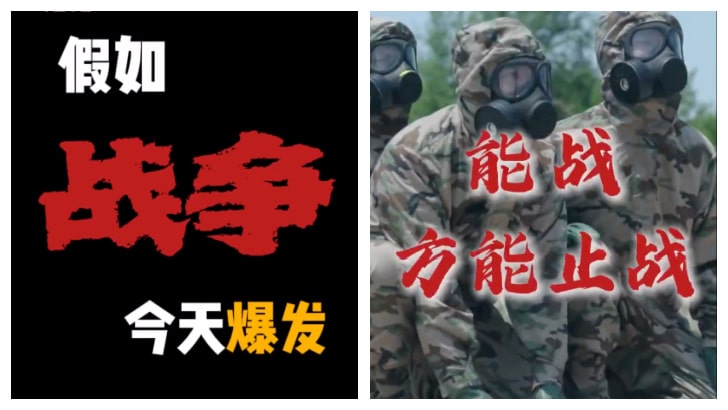
Screenshots from the video posted by China’s military account on Kuaishou: “If war breaks out today, only those who are able to fight can stop it.”
China’s “armchair generals,” who are mostly found on Bilibili besides Douyin, show little empathy for ordinary Iranians. Instead, their discussions focus on military analysis, market watching, and a general sympathy for Iran as the party being attacked by the US and Israel — not for its people as potential beneficiaries of regime change.
⚔️ “A new era has begun”: Iran through a women’s rights lens
On the other end of the online spectrum, there’s a group of social media users whose voices have also become prominent over the past few days. They focus not on the military aspect but on women’s freedom, and are generally positive about the US-Israeli strikes as a possible liberation for Iranian women.
These days, one of the most-liked non-state-media posts on Weibo about Iran was a video shared by one Weibo user (光影总管) showing an Iranian woman crying tears of joy after hearing about the death of Khamenei, shouting: “Khamenei is dead! Finally! We are free! I can’t believe it!” It received at least 81,000 likes before being taken offline.
Many commenters expressed empathy for ordinary Iranians like her who lived under Khamenei’s theocratic rule, writing things like “Iranian women and children are [finally] seeing some light” (“伊朗女人,儿童看到光明了”) and: “In a country where women get killed for wearing the wrong headscarf, how could she not be glad?”

Examples of images shared by netizens: Iranian women in the 1970s, a meme about women in Islam being covered up, and a post with an AI image suggesting women in Iran lived under a regime that’s like a prison.
One Douyin user posted a photo showing women drinking beer and seemingly celebrating the death of the Iranian supreme leader, writing “Iranian girls tear off their face coverings and reveal their true faces, how beautiful.”
“A new era has begun,” others wrote, and some even called Khamenei’s death, which coincided with the end of the Spring Festival, the “first joy of the year” (“开年第一喜”).

Image posted on Douyin discussing Iranian women removing their headscarves and celebrating: ““Iranian girls tear off their face coverings and reveal their real faces.” (Original photo source unverified).
Others who expressed delight over the death of Khamenei called him “an enemy of civilization, the rule of law, openness, and progress,” and took this as an opportunity to remember Mahsa Amini.
Netease creator “Legal Classroom” (@法律学堂) expressed his hope that the death of the supreme leader represents a form of historical justice: “Today, the Iranian girl Mahsa Amini may finally be able to rest in peace.”
In comment sections, people cheer on women who celebrate a new beginning: “Iran, stand strong!”
One social media user (狮子头萌萌) wrote:
💬 “Iranian women are different, okay? They have always stood at the very front of resistance, whether during the struggle against the imperial monarchy back then, or later in opposition to the religious regime. The mistake they made was believing that religion and modern democracy could coexist.”
Meanwhile, there are also voices condemning these sentiments. One well-known nationalist account (@子午侠士) criticized a Chinese-speaking woman in Tehran who livestreamed, rejoicing during her broadcast. She said that because the United States and Israel launched a war against Iran, the political climate inside the country has changed. On the streets of Iran, fewer women are wearing headscarves, and Iranian women are moving toward greater freedom.
The Chinese blogger argued: “A headscarf does not represent everything, and the happiness of a people cannot be measured solely by whether they wear one,” and suggested the woman was an “anti-regime traitor.”
Those who disagree responded: “Did you go to Iran? Did you live there? Did you ask them? Do you know what they want?” Others echo this sentiment: “Go and ask Iranian women.”
Another commenter added: “There is nothing wrong with wanting to fight for freedom.”
Aside from detailed discussions regarding Iran, “armchair generals,” and women’s rights advocates, celebrity news continues as usual. Although the conflict in Iran remains a major topic, a juicy new scandal involving a popular Chinese singer has begun dominating headlines.
As the initial shock over the war in Iran subsides, it is becoming just another part of the daily news cycle. It now competes with Chinese celebrity gossip and is being shaped, reshaped, and contested in ways that, perhaps, reveal more about China’s online discourse than about the events in Iran themselves.
Many thanks to Miranda Barnes for her research contributions to this newsletter. Stay tuned for an overview of other trending news (including that juicy celebrity story) in our next edition.
Best,
Manya
Eye on Digital China is a reader-supported publication by
Manya Koetse (@manyapan) and powered by What’s on Weibo.
It offers independent analysis of China’s online culture, media, and social trends.
To receive the newsletter and support this work, consider
becoming a paid subscriber.


Chinese Postdoc Death Raises Questions as Key Details Remain Missing

“Auntie Mei” Captured After 20 Years, China’s Train-Stain Scandal, and Zhang Xuefeng’s Final Lesson

Raising Lobsters, 6G Coming, and China’s DIY Deity Trend

Two Sessions, a Celebrity Meltdown, and the Rise of China’s “Forget It” Mindset

Inside the Great Chinese Debate Over the Iran War

Inside Chunwan 2026: China’s Spring Festival Gala
Inside the Great Chinese Debate Over the Iran War

Spring Festival Trend Watch: Gala Highlights, Small-City Travel, and the Mazu Ritual Controversy

Chinamaxxing and the “Kill Line”: Why Two Viral Trends Took Off in the US and China

From a Hospital in Crisis to Chaotic Pig Feasts
-

 Chapter Dive9 months ago
Hidden Cameras and Taboo Topics: The Many Layers of the “Nanjing Sister Hong” Scandal
-
 China Insight8 months ago
“Jiangyou Bullying Incident”: From Online Outrage to Offline Protest
-
 Chapter Dive11 months ago
Understanding the Dr. Xiao Medical Scandal
-

 China Arts & Entertainment6 months ago
The Wong Kar-wai Scandal Explained: The Dark Side of ‘Blossoms Shanghai’