China Arts & Entertainment
Why the Gay Kisses in ‘Bohemian Rhapsody’ Won’t Make It to Chinese Cinemas
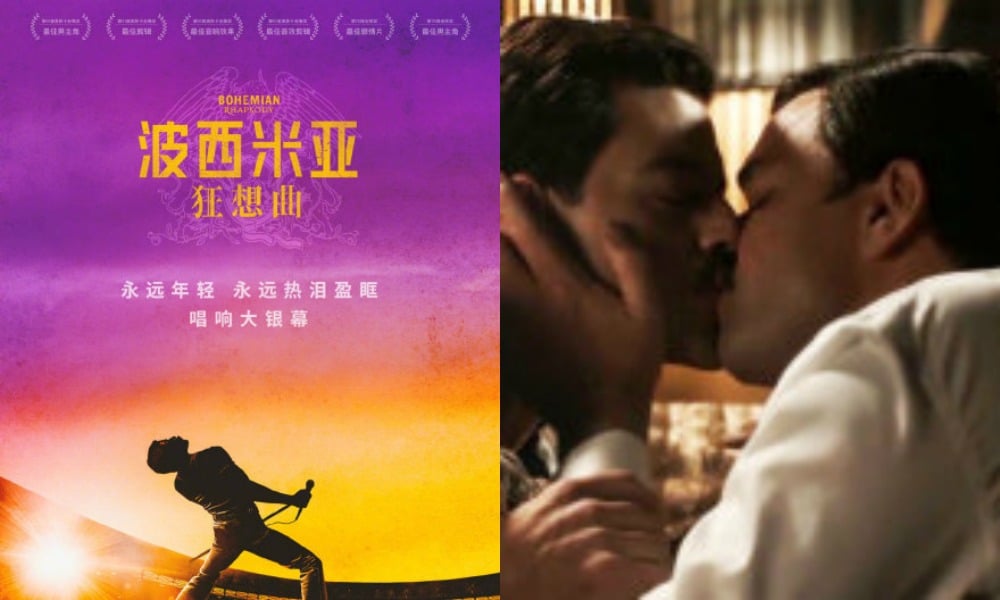
Fresh off its Oscar wins, “Bohemian Rhapsody” will hit theaters in China, but some scenes won’t make it to the Mainland.
Published
7 years agoon
First published
The award-winning movie Bohemian Rhapsody is set to debut in mainland China later this month but foreign media reports on censorship of gay scenes within the movie have prompted animated discussion on Chinese social media. Why are these scenes being cut at all? What’s on Weibo explains.
In March 2019, Bohemian Rhapsody, a biopic on the life and career of Freddie Mercury, will be released in theatres across mainland China, with various Chinese news outlets identifying the Chinese National Alliance of Arthouse Cinema (全国艺术电影联盟) as the movie’s distributor.
The National Alliance of Arthouse Cinema is a non-profit film distribution organization established in 2016. According to QDaily, the organization cooperates with major Chinese cinemas in distributing films throughout the country and has some 1500 member cinemas – about 3% of the country’s total number of movie theatres.
Various foreign media outlets, including The Guardian and The Hollywood Reporter, report that portrayals of drug use and several intimate kisses between Mercury and other male characters will be cut from the Chinese version of the film, a decision that has been regarded as controversial by social media users both inside and outside of China.
Film Censorship in China
The Chinese movie industry is an area that has always been subjected to strict control and censorship. The first movie censorship laws in China were implemented as early as the 1930s, carried out by the Central Film Inspection Committee since 1931, with the purpose of legally prohibiting movies deemed “offensive to the Chinese public” (Pang 2011, 463; Zhu 2003, 202).
Theatrical releases in China are controlled by the SARFT (State Administration for Radio, Film, and Television), which is overseen by the Propaganda Department of the Communist Party (Grimm 162-163).
Throughout the years, China’s censorship apparatus has affected the screening of hundreds of foreign films in the PRC in a multitude of ways. The famous Titanic scene in which Rose (Kate Winslet) poses naked for Jack (Leonardo DiCaprio), for instance, was cut from the Chinese version. In Mission: Impossible III a scene in which Ethan Hunt (Tom Cruise) distracts two Chinese henchmen and kills one was also eliminated in China.
In March 2017, a new film censorship law came into force in mainland China, officially titled the ‘Film Industry Promotion Law of the People’s Republic of China’ (中华人民共和国电影产业促进法), laying out the regulations for prohibited content and content that must be cut. The law applies to the various pre-shooting and pre-screening stages, and is meant to “promote the healthy and prosperous development of the film industry.”

The law, as outlined here, stipulates that, among other things, movies cannot contain any elements that, for example:
- violate, resist, or undermine the basic principles of the constitution
- “harm national unity, sovereignty, or territorial integrity” or “damage the national dignity”
- “slander ethnic cultural traditions” or “instigate hostility towards ethnic groups”
- damage the “mental health of minors”
- harm China’s “social morality” or disturb the “order of society”
- promote “obscenities,” “gambling,” “drug abuse,” or “violence”
Although some of the stipulations in the law are straightforward, there are also many parts that are vague. How does one determine what is harmful to the “mental health of minors”? Is there an objective way to judge whether a film is “hurting the feelings of ethnic groups”? What is the censors’ definition of “obscene”?
In the end, these regulations leave ample room for the main censorship body, the SARFT, to determine case-by-case how and if foreign films that have been allowed to be screened in mainland China should be altered to stay ‘in line’ with the country’s strict censorship policies.
Banning Gay Content?
Homosexuality is no longer illegal in mainland China since 1997, and has been removed from a list of mental illnesses since 2001, but bans on content displaying homosexuality have made headlines over the years, highlighting the general discomfort of Chinese regulators towards gay-themed dramas and films.
In early 2016, Chinese State Administration released new regulations banning “homosexuality” in filmography for conveying “unnatural” values of love (Guangming Online). That same year, China’s popular gay-themed web series Addiction (上瘾) was yanked by censors due to disapproval at the plot’s lengthy exploration of homosexuality. A year later, Chinese regulators laid out rules stating that online videos showing “displays of homosexuality” were no longer allowed. In 2018, gay romance Call Me by Your Name was suddenly pulled from the Beijing film festival.
At the same time, there is no shortage of examples that show homosexuality has some leeway in China’s (online) film and media landscape. Last year, 2018, saw the mainland release of gay movie Seek McCartney (Looking for Rohmer) (寻找罗麦). Thai gay-themed film Fathers was released on popular video platform Bilibili in 2017.

Chinese version of Thai gay-themed film “Fathers” or “Two Fathers”
An online video showing a young Chinese man coming out to his parents as gay became an online hit in 2015. And now, in 2019, Bohemian Rhapsody, centered around one of the LGBT community’s most global cultural icons, is set to hit the big screen in China – albeit censored.
Mixed signals? Confused censors? Not necessarily. According to renowned Chinese sexologist Li Yinhe, the Chinese government is not against homosexuality per se. At an Amsterdam symposium in 2014, the LGBT rights activist stated that “the government is not against homosexuality, but against sex in general.”
Such a stance was made explicit with the March 2017 Film Industry Promotion Law, which, in the words of a Beijing-based film director, has since forced many in the industry to “prioritize education over art” so that their work can get past the censors. Any scenes including (explicit) portrayals of prostitution, LGBT relations, extramarital affairs, polyamory, or pornography, will generally not be permitted to reach a large Chinese audience, wrapped in conservative rhetoric that accuses such scenes of “promoting obscenities” or being “harmful to the healthy development of Chinese minors.”

At a time of a rapidly transforming (and aging) China, “healthy content” is mostly the kind of content that depicts the conventional family – marriage and children – as the cornerstone of a stable Chinese society. Depictions of Freddy Mercury kissing other men, apparently, does not fit the ideal family model propagated by Chinese authorities; with the government’s ongoing trumpeting of the two-child policy, homosexuality’s refusal to be dictated by the laws of biological fertility may also be one of the many reasons motivating the censors’ decision to tone down the ‘gayness’ of Bohemian Rhapsody.
Weibo Responses
On Weibo, news about censorship of the Chinese release of Bohemian Rhapsody became a trending topic.
Although a large number of netizens are happy that the movie will be released in China, there are also many dissatisfied with the censorship that comes with it.

Some people argue that the selective cutting of scenes will be detrimental to the overall quality of the movie. Popular Weibo user ‘Gongyuan 1874’ (@公元1874), a self-proclaimed ‘author’ and ‘cultural critic’ with more than 3 million online followers, wrote a lengthy post on February 28 in which he describes Freddie Mercury as a “rebel fighter” whose life was defined by freedom. The author argues that the “artistic value of the movie is “greatly reduced” by censoring those parts that show Mercury letting himself go.
Some commenters are so disgruntled at the movie’s censorship that they are boycotting it. One Weibo user wrote: “Because I want to protest against the unfair treatment of LGBT by authorities, I will not go and see the edited version of Bohemian Rhapsody.”
“I’d advise everyone to go and get a pirated version of the movie,” another commenter writes: “Homosexuality and drugs were a part of Freddie Mercury’s life, to ‘castrate’ this movie is disrespectful [to his memory].”
There are also some more moderate netizens, well aware of the current restrictions placed on the film and TV industry, who argue that cutting some scenes – total scene time cut from the Chinese release is alleged to be no longer than two minutes – will leave the message conveyed by the movie unharmed, and that viewers should be grateful such a film is being screened in China at all.
“I have been watching the comments about Bohemian Rhapsody and the deleted gay scenes,” one music blogger writes: “Some people think it’s an insult to Freddie Mercury, and say we should boycott the movie. I think this kind of reasoning doesn’t show much goodwill.”
The blogger argues: “I think Freddie Mercury is a great singer, a well-respected artist, and an icon of his time – not just a representative for gays. The exploration of his own identity was a major influence in his life and artistic work, but if you insist on discussing the content of the film, the legendary experiences of the band…their artistic achievements and rock ‘n roll spirit are all relevant – all in all, don’t hold on to sexual orientation [as the most crucial theme].”
There are some who might agree, asking “is it necessary to screen those deleted gay scenes in China?”
Amid hundreds of comments on the issue, there is no clear consensus. While some point out that the Chinese release of a movie such as Bohemian Rhapsody is a sign of ‘progress’ in a strictly controlled media environment, others see its censorship as doing a disservice to the film’s main themes of artistic freedom and LGBT emancipation.
However, in an age where censors even go after heterosexual, ancient Chinese dramas, the mere entry of Bohemian Rhapsody into the Mainland perhaps suggests an atypical loosening of the stranglehold being placed on China’s TV and film industry. Any way the wind blows, apparently, does really matter to Chinese netizens.
By Manya Koetse , edited by Eduardo Baptista
References [online sources via in-text hyperlinks]
Grimm, Jessica. 2015. “The Import of Hollywood Films in China: Censorship and Quotas.” Syracuse J. Int’l L. & Com. 43 (1): 155-190.
Pang, Laikwan. 2011. “The State Against Ghosts: A Genealogy of China’s Film Censorship Policy.” Screen 52 (4): 461-476.
Zhu, Ying. 2003. Chinese Cinema During the Era of Reform: The Ingenuity of the System. Westport, Connecticut, London: Prager.
Spotted a mistake or want to add something? Please email us.
©2019 Whatsonweibo. All rights reserved. Do not reproduce our content without permission – you can contact us at info@whatsonweibo.com.
Manya Koetse is a sinologist, writer, and public speaker specializing in China’s social trends, digital culture, and online media ecosystems. She founded What’s on Weibo in 2013 and now runs the Eye on Digital China newsletter. Learn more at manyakoetse.com or follow her on X, Instagram, or LinkedIn.
You may like
China Arts & Entertainment
Su Chao Fever, Mo Yan’s “Scrollable” Book, and Why Li Xiaoran is China’s New Office Icon
This week in China: Grassroots football fever, a Nobel laureate writes for the TikTok era, France’s cultural relic bill, and a 19-year-old’s blind box obsession bankrupts her father’s company.
Published
4 weeks agoon
April 22, 2026
🔥 China Trend Watch (week 16/17 | 2026) Part of Eye on Digital China by Manya Koetse, China Trend Watch is an overview of what’s trending and being discussed on Chinese social media.
Dear reader,
Hope you’re having a good week. Time for an update on what’s been trending.
In this newsletter:
👉Victor Hugo’s day has come
👉China’s grassroots football couldn’t get more viral
👉A scrollable new book by Mo Yan
👉The Chinese office meme of the moment
..and more.
Let’s dive in.
Quick Scroll
-
- 📱 China’s National Security Ministry has joined Chinese Tiktok app Douyin. The high-profile Douyin debut is part of a broader trend of Chinese government agencies and security bodies joining the app.
- 🐺 A feel-good wildlife story from Inner Mongolia: a pregnant wild wolf descended from the mountains to give birth at a wildlife conservation station where she had been previously fed. The noteworthy move shows she had apparently developed trust in the station workers, and felt safe there.
- 🐖 Pork prices hit historic lows but spare ribs still cost 20 yuan (US$3) – this became a topic of discussion this week. Despite the drop in pig prices, retail pork still feels expensive because added costs across the supply chain haven’t changed.
- 🍿 Movie alert. The May Day (五一) cinema content explosion is incoming. Seventeen films have already been slotted for the Golden Week holiday window.
- 🚔 A 31-year-old man from Guangzhou has been detained under anti-cyberbullying regulations after repeatedly posting insulting comments targeting Olympic champion diver Quan Hongchan (全红婵) on WeChat.
- 🤖 Unitree’s humanoid robot is almost as fast as Usain Bolt. The company announced that the H1 humanoid robot achieved a peak sprint speed of 10 meters per second during a 100-meter test.
- ⚡️ Another robot, “Lightning” (闪电) by Honor, also went viral because he won the Beijing Yizhuang Half Marathon on Sunday, April 19, running a half-marathon distance faster than any human ever has, completing it in 50 minutes and 26 seconds (the human record: 56:42). (See video here).
- 🎁 A 19-year-old woman from Zhengzhou has made headlines for allegedly embezzling around 17 million yuan (nearly $2.5 million) from her father’s company, spending it on blind boxes and livestream tipping (dashang 打赏). Her father, now bankrupt, ended up taking his daughter to the police himself.
What Really Stood Out
The Jiangsu Super League (Su Chao) Fever

The Jiangsu Football City League, better known as the Su Chao (苏超: “the Su Super”), has become a major source of trending topics, memes, and news analyses over the past week.
The “Su Super” is a provincial amateur football tournament launched in 2025 that features 13 teams, one representing each of Jiangsu’s 13 prefecture-level cities. Teams consist predominantly of amateur players, from primary school teachers to office employees, but it’s been seriously successful: last year, some games regularly drew crowds of over 30,000, with a record 60,396 fans for a Nanjing–Suzhou match.
This year, the season’s opening on April 11 was sensational, almost like a mini Spring Festival Gala of its own, with 300 robots from tech company Magic Atom (魔法原子) performing a perfectly synchronized routine—unbothered by the heavy rain—and popular pop singer Zhou Shen (周深) delivering a much-discussed live performance where he hit some incredibly high notes.
It’s the entertainment and creative memes that seem to matter more than the sport itself.
⚽ When Changzhou won 3–0 in its opening match against Nantong, in a stadium filled with more than 40,800 people, the running joke was that the city of “Changzhou” (常州) could add more “strokes” to its name. This is all part of a bigger meme that started last year, when netizens would ‘deduct’ a character stroke from Changzhou’s name after every time it lost, with its Chinese name going from 常州 to 巾州 to 丨州, until netizens joked there were no strokes left to remove (0州)—Changzhou performed quite terribly.

The “chang” character kept losing strokes as Changzhou lost in the 2025 Su Chao (edited image by netizens).
But with this year’s unexpected win, Changzhou struck back, and the official city account flipped the joke by temporarily renaming itself 常洲, with the three-water-drop radical added to the zhou 州, symbolizing its three goals scored (#常州暂时改名常洲#).
⚽ More than that, Changzhou city officials announced a one-day citywide holiday on April 12, with free public buses and metro for all residents. It was almost like a New Year’s night: major landmarks also stayed lit throughout the night.
⚽ Another meme sprang from a giant inflatable dinosaur that was set up before the match, part of Changzhou’s dino-city branding (it is home to China Dinosaur Park). It was meant to look cool and majestic, but netizens thought it resembled a shiny, greasy, reddish-brown soy-braised duck (酱板鸭) instead, leading to the “Soy-braised dragon” meme (酱板龙).

The dino that looked more like a soy-braised duck and “soy-braised dragon” merchandise sold on Taobao.
⚽ During the Suqian vs. Nanjing match on April 18, another highlight featured actor He Rundong (何润东), who appeared dressed in full armor and surrounded by guards and horses, revisiting his famous role as the ancient warlord Xiang Yu (项羽)—the historical figure associated with Suqian as his birthplace. He shouted “Xiang Yu has returned!” (“我项羽回来啦”), a moment that became even more significant after Suqian won 2–0.
⚽ What also stands out in the marketing surrounding the Su Chao is how, alongside the official mascots, Jiangsu media, companies, and fans have been producing AI-generated “city personification” figures featured in images and short videos, with storylines about winning, losing, friendship, and rivalry between the 13 cities in a virtual world. Changzhou is a little dino, Nanjing is a little duck, Nantong is a wolf, etc.

The success of the Jiangsu Super League does not appear out of nowhere: for the past few years, China’s grassroots football has seen a wave of success, with local governments and companies using these leagues and matches to boost local cultural identity and community cohesion, while city-vs-city rivalry and banter consistently trends on social media.
Within this bigger picture, the Village Super League (村超, Cun Chao)—a community football tournament held in Rongjiang County in Guizhou—is a frontrunner. What started as a self-organized village event in 2023 became one of the most-watched grassroots sports stories in recent years.
With China’s national football plagued by underperformance, corruption, and other scandals, more voices are suggesting that the future of Chinese soccer might lie in regional and local super leagues.
Regardless of whether that is true, it is undeniable that phenomena like the Su Chao are bringing a lot of online fun, memes, banter, commercial success, and positive community energy. In doing so, they generate more authentic online engagement than any professional league matches currently do.
France Returning Cultural Relics: “Hugo’s Day Has Come”

It is not often that the French National Assembly goes trending in China, but it did after unanimously passing a cultural restitution bill that makes it easier to return looted colonial-era objects.
The new bill allows countries to request the return of objects taken between 1815 and 1972, provided they can show the items were acquired by force or other illegitimate means. It marks a shift from the previous, slower, case-by-case restitution system, where every single return required a separate parliamentary vote.
In Chinese media, the news was highlighted through a quote by French politician Jérémie Patrier-Leitus, who in his speech cited Victor Hugo’s famous 1861 letter about the sacking of the Old Summer Palace (Yuanmingyuan), in which he expressed hope that a renewed France would one day return the goods it had plundered from China. Patrier-Leitus said: “The day Hugo longed for has finally arrived.”

Screenshot of the tweet by Jérémie Patrier-Leitus, in translation.
For Chinese audiences, the story carries strong emotional resonance. The looting of the Old Summer Palace in 1860 by French and British forces is widely taught at school as part of the so-called “Century of Humiliation,” the period from the mid-1800s to the mid-1900s during which China was attacked, weakened, and torn by foreign powers. The four-character slogan “wù wàng guóchǐ” (勿忘国耻), “Never forget national humiliation”, is frequently repeated in Chinese media, museums, schools, documentaries, and popular culture.
Besides state media and nationalist commentary, other discussions also emerged online. Some threads focused on which artifacts could potentially be returned to China, mainly linked to the burning of the Old Summer Palace in 1860 and the 1908 Dunhuang removals (although this remains contested as “looting”: it concerns French scholar Paul Pelliot, who acquired thousands of invaluable ancient manuscripts and artworks from a monk guarding a cave at Dunhuang for very little money, and took them to Paris, where they have remained ever since).
Other comments expressed hope that France would set an example for other countries.
Although the news went big in China, French media coverage itself did not mention China at all and instead focused on Benin, Senegal, Côte d’Ivoire, Mexico, and Algeria.
On the Feed
A Scrollable New Book by Mo Yan

Mo Yan (莫言), China’s first Nobel laureate in literature, has been praised as a “meme king” for quickly adapting to China’s online Xiaohongshu community since joining the app in November 2025.
Now, the famous author—known for epic works like Red Sorghum (红高粱)—has again become a hot topic for publishing a new book inspired by his own social media and short-video scrolling “addiction.”
The novel, titled Oh, People (Rén Na 人呐), is his first new fiction in six years and immediately hit the top of major bestseller lists upon release. It’s a collection of 81 ultra-short pieces, the briefest of which runs just 200 characters, and is designed, in Mo Yan’s own description, so that readers can “scroll through it” the way they scroll TikTok.

This format is sparking discussion across Chinese social media, especially because it comes from a writer of Mo Yan’s stature.
One core question is whether a Nobel laureate should be writing “fast literature” that mimics short-video logic, and whether this suggests that even China’s most lauded authors are giving in to platform-driven attention economics.
Others argue that the book’s format is not entirely new, and could just as easily be traced back to classical Chinese literary traditions rather than the TikTok era.
These debates may be precisely the point of Mo Yan’s new book. Is it merely scrollable, or is it serious? Through these discussions, his work already engages with two important aspects of contemporary Chinese society: the country’s changing reading culture and the dominance of short-video platforms.
Word of the Week
The Office Li Xiaoran

The phrase of the week is “the Office Li Xiaoran” (Bàngōngshì Lǐ Xiǎorǎn 办公室李小冉).
The phrase comes from the 7th season of the super popular reality/talent show Sisters Who Make Waves (乘风2026), where the 50-year-old Chinese actress Li Xiaoran (李小冉) performed with her group, which also included Olympic skater Wang Meng (王濛).
Li Xiaoran was completely and painfully off-key, off-tempo, forgetting lyrics, and stiff in her choreography — but she stayed calm and cheerfully smiled through it all.
The dreadful performance of the song—officially titled “Wish Sticky Note” (心愿便利贴)—was soon dubbed Wantong Jingutai (万通筋骨贴) by netizens, referring to a Chinese medicinal patch for joint pain. (It’s a wordplay on the title, sharing the same final character: “这不是心愿便利贴,这是万通筋骨贴”).
Ironically, Li was professionally trained at the prestigious Beijing Dance Academy, but dropped out to become an actress—prompting some netizens to joke that instead of saying “the dance world lost a great talent,” it “lost someone completely irrelevant” (#舞蹈界失去了一个无关紧要的人#).
But it wasn’t all meant in a mean way. Because people actually very much appreciated Li Xiaoran’s performance. Although it didn’t go very well, she seemed unbothered and positive, which is why viewers eventually voted her to the number one spot on the show that night.
In the aftermath, office workers started collectively joking that they’ve been “diagnosed as the Office Li Xiaoran.”
The phrase “Office Li Xiaoran” (bàngōngshì Lǐ Xiǎorǎn, 办公室李小冉) has become a viral self-label for workers who feel they are underperforming and barely surviving, but maintain a smile and stoically carry on regardless.
There’s now also a trend where people in the office signal to colleagues that they’re “Office Li Xiaoran” by putting a sign on their chairs.
In the example below it says:
“Officially diagnosed as ‘Office Li Xiaoran’
First to arrive every day, last to leave. Submit my work, and the boss asks: ‘What is this even supposed to be?’
Me: ‘No lip-syncing, not afraid of the stage, not pretending, doesn’t sound good—but I really did try!’

In a way, Li Xiaoran has become the perfect vehicle for office emotional catharsis—an unexpected idol for how to carry on in stressful situations. The ultimate lesson she taught us: even if everything’s going wrong, a good attitude, a splash of confidence, and a bright smile can take you surprisingly far.
See the videos here.
—That’s a wrap.
See you next edition.
Best,
Manya
Eye on Digital China, by Manya Koetse, is co-published on Substack and What’s on Weibo. Both feature the same new content — so you can read and subscribe wherever you prefer. Substack offers community features, while What’s on Weibo provides full archive access. If you’re already subscribed and want to switch platforms, just get in touch for help. If you no longer wish to receive these newsletters, or are receiving duplicate editions, you can unsubscribe at any time.
China Arts & Entertainment
“Auntie Mei” Captured After 20 Years, China’s Train-Stain Scandal, and Zhang Xuefeng’s Final Lesson
The major talking points on Chinese social media this week: from the capture of a notorious child trafficker and unexpected death of Zhang Xuefeng, to one of the most expensive Chinese music video ever made.
Published
2 months agoon
March 24, 2026
🔥 China Trend Watch (week 12½ | 2026) Part of Eye on Digital China by Manya Koetse, China Trend Watch is an overview of what’s trending and being discussed on Chinese social media. This edition was sent to paid subscribers — subscribe to receive the next issue in your inbox.
On Tuesday, March 24, rumors that something had happened to China’s most popular educational influencer were flying across Chinese social media. Some said he had collapsed, others said he was barely hanging on, while others still were refuting the rumors.
This is about “Teacher Zhang Xuefeng” (张雪峰老师, 1984), the man who carved out a big place for himself in China’s online landscape over the past decade by focusing on a sweet spot that virtually all Chinese parents and their children care about: how to choose majors strategically to ensure future employment prospects.
Among Zhang’s common questions: “What kind of salary do you want your child to have in the future?”
Besides the relevance of his focus, Zhang’s northeastern accent, comic remarks, blunt criticism, and talent for triggering controversy also amplified his online appeal, ensuring that his name frequently became part of China’s public discourse.
Like that time when he advised China’s young people against studying journalism, even stating that if he were a parent, he would “definitely knock the child unconscious if they insisted on studying journalism,” deeming it a major that lacks depth and prospects. Although it became a major controversy at the time, a poll of 42,000 voters showed that 39,000 agreed with Zhang.
Zhang capitalized on the collective anxiety in China surrounding the gaokao (高考), the national university entrance exam that determines future paths, as well as concerns that even graduates from top universities may face unemployment if they choose majors with limited practical value. Zhang’s view: choice is more important than effort.

This Tuesday evening, news emerged that Zhang Xuefeng had died on the afternoon of March 24 at the age of 41, after suffering sudden cardiac arrest.
His death has had a huge impact on Chinese social media, where many people are responding with disbelief and shock.
It’s not just that Zhang was widely known (and while not everyone liked him, many respected him)—it’s perhaps also the fact that he spent so much of his life advising others on how to control their careers and income, building great personal wealth in the process, only to die so young, at the peak of his career, with no strategy to protect him.
Besides being “chronically overworked,” Zhang also pushed himself to exercise and run frequently. Adding to this, he had been under pressure since last fall, when he became a target of official criticism and platform regulators.
Isn’t it ironic that, in the end, the most important takeaway Zhang might leave behind is not his advice on choosing majors or making smart career moves, but rather the reminder to sometimes step away from the rat race and appreciate everyday life and health, because you never know when it might all end.
Zhang leaves behind his wife and 11-year-old daughter.
Let’s dive into some of the other trends that have been major talking points this week.
Quick Scroll
-
- 🧠 China has approved a coin-sized brain–computer implant for commercial use in people with spinal cord injuries. Developed by Shanghai-based company Neuracle Medical Technology (博睿康) in collaboration with Tsinghua University, the so-called “NEO” is the world’s first market-approved brain implant designed to help people with severe paralysis regain hand motor function.
- 🚨 Lei Siwei (雷思维), Vice-Governor of Gansu and member of the provincial Party Standing Committee, is under investigation as of March 17, with the notice issued by China’s top anti-corruption body citing “serious violations of discipline and law.” The case is the latest in an ongoing series of provincial-level anti-corruption actions that’ve been continuing into 2026.
- 📚 Several Chinese provinces and cities are removing biology and geography from high school entrance exams starting from next year, as part of a broader government-initiated campaign to reduce pressure on students and put a stop to “educational involution” (教育内卷).
- 👀 Taiwanese actor-singer Jerry Yan (言承旭), best known as Dao Mingsi from Meteor Garden and a member of F4, is at the center of somewhat of an authenticity crisis after fans photographed his concert teleprompter showing not just lyrics, but scripted emotional cues for his performance like “your eyes slightly reddening” and “now you take a deep breath.”
- 🎮 More than 100 Chinese universities are offering esports majors nowadays, sparking online discussions this week. These programmes go far beyond just playing video games, covering esports operations, management, data analytics, game design, etc, reflecting the growing professionalisation of China’s esports industry.
- 🎓 A feature by Chinese magazine Sanlian Life Weekly (三联生活周刊) went trending for highlighting a sharp gender shift in China’s higher education demographics, with female students now outnumbering men at universities. Female undergraduate enrollment grew by 348% between 2002 and 2022.
- 🧪 A laboratory explosion at Chongqing University on March 20 killed one student and injured three. Initial findings point to improper handling of chemicals.
- 💔 China’s superfamous actress Yao Chen (姚晨) and filmmaker Cao Yu (曹郁) jointly announced their separation on Weibo in a poetic way, using classical Chinese language: “A journey through mountains and rivers, a blessing for three lifetimes. Fate comes and goes, all is joy” (山水一程,三生有幸。缘来缘去,皆是欢喜). A related hashtag received 300 million views.
What Really Stood Out This Week
Chinese Woman Who Sold Abducted Toddlers Captured After Two Decades

A woman who played a key role in a series of China’s notorious child trafficking cases, causing relentless suffering for many families, has finally been caught after being on the run for two decades. The arrest of the woman, referred to as “Mei Yi” or “Auntie Mei” (梅姨), has dominated Chinese social media over the past week, ever since Guangzhou police announced on March 21 that they had finally captured her.
This story touches upon multiple issues that have turned it into such a major topic.
Mei Yi was involved in a series of child trafficking crimes carried out by a gang led by Zhang Weiping (张维平) and Zhou Rongping (周容平) across multiple areas in Guangdong province between 2003 and 2005. She acted as a middleman responsible for transferring and selling abducted children, mostly toddler boys. In just over two years, the group abducted and trafficked nine young children.
The parents of these boys never stopped searching for them, while Chinese authorities worked for years to crack the case. In 2016, eleven years after the last abduction, police arrested five core gang members, including Zhang, who later confessed and revealed that the person reselling the children was a local elderly woman nicknamed “Mei Yi.” However, her real identity and whereabouts remained unknown for years. Zhang Weiping and Zhou Rongping were both sentenced to death and executed in 2023.
Thanks to new technologies—from digital tracking systems to DNA matching—the abducted children were located one by one and reunited with their biological families over the years: the first in 2019 and the last in 2024. By then, the boys were roughly between 14 and 21 years old, meaning they had spent nearly their entire childhoods with the families who had bought them.
Evading Capture by Being Ordinary
One aspect of this case drawing attention is not just how Mei Yi was caught, but how she managed to evade arrest for so long. The crimes took place more than twenty years ago, in factories, rental housing, and other areas with dense migrant populations, leaving very little traceable evidence. It is also unclear how accurate the composite sketch of Mei Yi—circulating since 2017 and updated in 2019—actually was. Authorities have not released a confirmed photo following her arrest, and it is possible her real appearance differed significantly from the sketch.
A lawyer close to the case told Chinese media outlet The Paper that what made her so hard to catch was probably not how clever her tactics were, but that she appeared so normal to those around her, who might have never guessed she was a criminal. Besides arranging illegal “adoptions,” Mei Yi also acted as a local matchmaker and fortune teller, and she even lied about her identity and used aliases with someone who was her partner for two years.
Official media do not disclose exactly how Mei Yi was eventually tracked down, but it’s clear that the authorities got much closer after all the abducted children were found in October 2024, undoubtedly leading to important clues that connected all the cases.
Not Such a Happy Ending
Chinese state media have largely framed the case as a story of justice served: Mei Yi as a long-sought villain, the police as persistent heroes, and China’s advancing technology as the key to solving the case. A kind of “happy ending.”
But the truth seems more complicated, with a loud silence surrounding nine families where the abducted boys spent their entire childhoods. Their willingness to pay for a male child is part of a broader issue linked to China’s one-child policy, relatively light penalties for buyers of trafficked children (or even legal limitations due to statutes of limitation), and a deeply rooted son-preference culture that was especially strong in those years 2003- 2005.
Some online commentators did argue to “not let those hypocritical ‘adoptive parents’ off the hook.” Yet the situation is complicated by the fact that some of the boys still consider these families their parents, and in some cases choose to stay with them rather than return to biological families they barely remember.
The fact is that Mei Yu is just one chapter in a much larger story that is far from finished.
Just earlier this week, the story of another abduction case also went trending. It concerns a man named Du Jun (杜军), who was abducted in 1991 at the age of 3 while playing outside a shop with his sister. Du Jun, who spent 35 years separated from his biological family, finally reunited with his biological mother following a successful identification process that is part of a continuing series of long-separated family reunions facilitated by China’s expanding DNA-matching and digital tracking systems.
Du, now 38, had not known he was trafficked as a child, nor that his biological family had searched for him for years. He became an orphan at a young age and built a life for himself. He was found through online search efforts, the dedication of volunteers, DNA research, and a specific detail only his biological family knew: that he had a bend at the joint of his left middle finger because of an accident as a toddler.

Du Jun as a young child before his abduction, and Du Jun reunited with his biological mother in 2026. Images via Hongxing Xinwen.
As with the nine abducted boys, Du Jun’s reunion with his family does bring light to a long, dark tunnel – but it doesn’t bring back the missed childhood, the shattered families, and the endless, tear-filled years.
Let’s hope many more “Mei Yis” will be brought to justice in the years ahead.
A Censored Menstruation Train-Incident

Another story that became a major talking point on Chinese social media this week involves a woman named Ms. Zhang, who was charged 180 yuan (US$26) after accidentally staining a bedsheet on a sleeper train. The woman unexpectedly got her period while traveling overnight to Lanzhou and was unable to obtain any sanitary products on board. A train attendant asked her to either wash the bedsheet herself or pay compensation.
The woman, who ended up washing the sheets herself by hand in cold water, later shared her experience on social media and suggested that all trains should sell sanitary pads. Her post resonated with many, and even though she took it offline, it was quickly picked up by Chinese media.
After the post went viral, Lanzhou Railway issued an official statement on March 20, presenting its version of events and challenging some of the woman’s claims.
The statement included details that depicted staff as helpful, such as an attendant allegedly offering to wash the sheets and a conductor searching for sanitary pads (but finding none). At the same time, it used seemingly accusatory language, repeatedly describing the woman’s menstruation as having “contaminated” (污染) the bedding as well as two other spots where she had sat.
Zhang did not accept this explanation and again turned to social media (under the username @勇敢小狐不怕困难) to reveal what she said had been happening behind the scenes. She shared that someone from Lanzhou Railway had repeatedly messaged her privately, asking her to delete her posts, claiming that employees’ jobs were at risk because of the incident, and even offering her money—which she refused, despite ultimately taking the post down.
Zhang further suggested that her posts were “disappearing as soon as they were published,” that the media narrative was being controlled, and that she had been pressured into silence.
On Xiaohongshu and Weibo, many users sided with Zhang. The wording used by Lanzhou Railway struck a chord, particularly the framing of menstruation as “contamination” while simultaneously blaming Zhang for staining multiple areas, despite not providing any sanitary products.
“Where exactly was she supposed to sit?” one Xiaohongshu user asked. “In the aisle? On a suitcase? Squatting by the toilet door? Lying on the floor?”
One major reason why this debate exploded online is not just the media discourse itself, but the way it taps into broader frustrations among Chinese women over social taboos and structural shortcomings surrounding menstruation in public spaces.
Over the years, various incidents involving menstrual products have gone viral and sparked grassroots efforts to change the current situation.
In 2022, a female passenger also expressed her frustration online about sanitary pads on high-speed trains, drawing online attention. Many commenters, mostly men, argued that pads weren’t “essential items” and shouldn’t take up retail space onboard. The railway authority’s official response—describing sanitary pads as “personal items” that don’t need to be sold—only worsened online outrage.
For many women, these kinds of incidents, from trains and schools to planes, highlight how little society apparently understands or respects their basic needs.
In this case, the way Zhang was seemingly framed as if she had deliberately stained the sheets (and was somehow expected to stop menstruating) triggered widespread anger. Although some of the more outspoken posts were censored on Weibo, more nuanced criticism remained: “Menstrual blood is treated as dirty, described as ‘contamination.’ But this is just menstruation—something that half of all people experience.”
On the Feed
“The Most Expensive Music Video in the History of Mandopop”

Whenever there’s new music by the Taiwanese producer, actor, composer, singer-songwriter, and ‘King of Mandopop’ Jay Chou (周杰伦), it goes trending.
Not only does his music bring back memories of the early 2000s – when he first rose to prominence and became super popular – but his catchy tunes and lyrics also resonate with younger audiences.
But it’s not just the music that makes waves – it’s also the music videos that have become artistic and sometimes spectacular productions by themselves. “Other artists just make a music video, he turns it into a movie,” some commenters wrote after the release of his 2022 Greatest Work of Art video.
On March 24, the music video (MV) for the lead single Children of the Sun (太阳之子) dropped, a production made in collaboration with Wētā Workshop, the New Zealand-based visual effects studio known for its work on Avatar and The Lord of the Rings.
The music video shows Jay Chou in a fictional European world spanning from the 16th to the 20th century, filled with references to famous art, from Vincent van Gogh and Dali to Mona Lisa, Ophelia, and The Anatomy Lesson of Dr. Nicolaes Tulp by Rembrandt (Jay Chou appears in the painting himself).
The cost of the music video production reportedly exceeded 20 million yuan (US$2.9 million), and some commentaries described it as the most expensive MV in the history of Mandarin-language pop music.
Subscribe
Eye on Digital China is a reader-supported publication by
Manya Koetse (@manyapan) and powered by What’s on Weibo.
It offers independent analysis of China’s online culture, media, and social trends.
To receive the newsletter and support this work, consider
becoming a paid subscriber.

Get in touch
Have a tip, story lead, or book recommendation? Interested in contributing? For ideas, suggestions, or just a quick hello, reach out here.
Behind the Banquet, Beyond the Hashtags: The 2026 Trump–Xi Summit on Chinese Social Media
My Mum Has Two Husbands: The OPPO Mother’s Day Fiasco and 7 Other Gender Marketing Fails in China
The AI Actor Debate, Tragedy in China’s “Fireworks Capital,” and the Viral Labubu Fridge
Quick Eye: AI Drama Takedowns, Meta’s Blocked Deal, and “Lying Flat” Conspiracy
Beyond the “Ching Chong” Controversy: The “Pocket Asian” in The Devil Wears Prada 2
Inside the Great Chinese Debate Over the Iran War
Spring Festival Trend Watch: Gala Highlights, Small-City Travel, and the Mazu Ritual Controversy
Two Sessions, a Celebrity Meltdown, and the Rise of China’s “Forget It” Mindset
Raising Lobsters, 6G Coming, and China’s DIY Deity Trend
“Auntie Mei” Captured After 20 Years, China’s Train-Stain Scandal, and Zhang Xuefeng’s Final Lesson
Popular Reads
-
Chapter Dive10 months agoHidden Cameras and Taboo Topics: The Many Layers of the “Nanjing Sister Hong” Scandal
-
China Insight9 months ago“Jiangyou Bullying Incident”: From Online Outrage to Offline Protest
-
China Arts & Entertainment8 months agoThe Wong Kar-wai Scandal Explained: The Dark Side of ‘Blossoms Shanghai’
-
Chapter Dive11 months agoInside the Labubu Craze and the Globalization of Chinese Designer Toys