
Newsletter
Five Trending Proposals at the Two Sessions 🔍
From noteworthy proposals at the Two Sessions to Chinese online reactions to Trump’s policy shifts on Ukraine and surprising Hu Xijin news.

PREMIUM NEWSLETTER | ISSUE #48
Dear Reader,
“It’s not that I don’t understand, it’s just that the world is changing so quickly,” one Weibo blogger commented this week, after yet another major news development hit the breaking news section.
Chinese social media has been flooded with discussions about the geopolitical shake-ups triggered by the Russia-Ukraine War and Trump’s policy shifts.
From the Oval Office clash to Trump’s ‘pivot’ to Russia, I’ve been monitoring the public sentiment on Chinese social media. You can read how Chinese netizens are interpreting the rapidly changing geopolitical landscape in our latest update here.
At the same time, the Two Sessions (liǎnghuì 两会), China’s largest annual parliamentary meetings, are also taking place. These meetings, which outline policy priorities, economic targets, and development plans for the upcoming year, commenced at the Great Hall of the People in Beijing on March 4 and will continue until March 11.
This includes the annual meeting of the National Committee of the Chinese People’s Political Consultative Conference (CPPCC) advisory body and the meeting of the National People’s Congress (NPC), China’s legislative assembly—often described as a rubber-stamp parliament. This major political event is heavily propagated on Chinese social media, mainly on Weibo and Douyin.
Beyond providing insight into China’s strategic direction, the Two Sessions are also significant because they give delegates from across the country the opportunity to make their voices heard by China’s top leaders. These proposals and “suggestions” (建议)—essentially influential recommendations to government departments—often reflect public concerns and frequently go viral on Chinese social media.
For example, in previous years, a proposal to prohibit single women from freezing their eggs in an attempt to encourage marriage and childbirth sparked heated discussions on Weibo. Last year, another noteworthy proposal suggested that China’s online influencers—whether celebrities or e-commerce stars—should face harsher penalties than the general public for engaging in illegal activities, due to their influence on society.
This year, several new proposals have gained significant online attention. Here are five trending proposals from the past few days:
1. Integrating Sexual Assault Prevention into the School Curriculum
Hashtag: #建议将防性侵教育纳入义务教育课程体系#
🔹 In recent years, sexual assault against minors has become a frequently discussed topic in Chinese media. During this year’s Two Sessions, NPC delegate Fang Yan (方燕) is advocating for stronger protections for minors against sexual violence.
Among her key proposals, Fang suggests that school staff should be specifically screened for prior sexual assault offenses and calls for harsher penalties for those who commit such crimes. She also proposes that sexual assault prevention be integrated into the compulsory education curriculum through lesson plans and textbooks.
In the past, Chinese official media have launched awareness campaigns to help parents teach their children about sexual education and self-protection. However, these campaigns have also sparked online debate, with some arguing that sexual education should not be solely the parents’ responsibility—the education system should play a bigger role in addressing this issue.
2. Ban on Age Discrimination in Employment
Hashtag: 建议将禁止就业年龄歧视纳入法律
🔹 If you’re familiar with Chinese job advertisements, you’ll know how common it is to see age restrictions across different industries. Job listings often include requirements like “must be under 35”—or even physical requirements like “over 170 cm tall.”
This week, NPC delegate Meng Yuan (蒙媛) proposed officially banning age discrimination in hiring, aiming to tackle the “35+ job predicament” (“35岁+ 就业困境”) that many job seekers face. Although age discrimination is not yet officially recognized as employment discrimination in China, it remains widespread. Many companies prioritize younger workers for their lower salaries and perceived trainability, often overlooking the value of experience that older employees bring. In some industries, age discrimination starts as early as 30.
While there is strong online support for such a labor law, many doubt that it will effectively change hiring practices, as job seekers over 35 continue to face widespread discrimination in the Chinese job market.
3. Addressing “Involution” in Chinese Education
Hashtag: #建议破除教育内卷#
🔹 You might remember an image that went viral during flu season, showing Chinese schoolchildren doing homework while hooked up to an IV in a hospital. These images, in many ways, embodied the concept of nèijuǎn (内卷), or “involution”—a term representing the intense academic pressures in China.
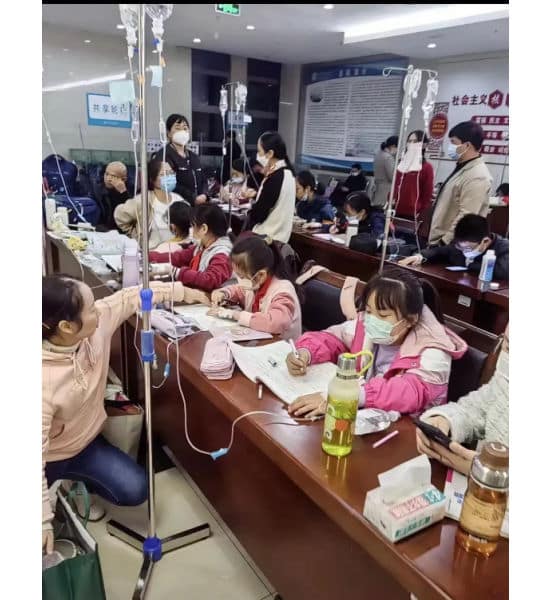
The image that went viral during flu season in winter of 2023.
This buzzword has been widely discussed on Chinese social media and reflects China’s highly competitive education system. One well-known cram school slogan summed up the rat race perfectly: “If you come to us, we will train your kids. If you don’t come to us, we will train the competitors of your kids.”
Now, “involution” has officially moved from online discussions to government reports, as the prevention of “involution-style” competition has been included in the Government Work Report. Delegate Yan Meirong (阎美蓉) also advocates for a better learning environment for children. Instead of focusing solely on numerical scores, he suggests introducing a grading evaluation system in classrooms and shifting the emphasis to critical thinking, innovation, practical skills, and emotional awareness.
Similarly, NPC delegate Liu Xiya (刘希娅) proposed shifting away from China’s “top-student selection” model and focusing more on children’s overall well-being, by emphasizing daily exercise and eliminating extra tutoring (#代表说0补课0月考孩子成绩都是A#).
4. The Impact of Short Videos on Children’s Attention Spans
Hashtag: #姚明建议开展未成年人息屏24小时行动#
🔹 Another noteworthy trending proposal comes from NPC delegate Yao Ming (姚明), China’s basketball icon. Yao wants to raise awareness about the impact of short videos on children’s attention spans, arguing that excessive screen time weakens deep-thinking abilities and makes it harder for kids to focus on reading long texts.
To tackle this issue, he proposed a “24-hour screen-free challenge”, endorsed by schools every semester, encouraging children to engage in alternative activities like music, sports, and the arts.
Another delegate, Bai Yansong (白岩松), suggested taking it even further, advocating for one screen-free day per month in all Chinese schools.
Some commenters jokingly suggested that it wouldn’t be a bad idea to implement this for adults, too.
5. Strengthening Governance Over AI Deepfakes and Voice Cloning
Hashtag: #雷军5个建议4个和汽车有关#
🔹 Lei Jun is the founder and CEO of Xiaomi, but made the news as a delegate submitting five proposals this week, which he also published on his public WeChat account.
Four of Lei Jun’s suggestions focus on the development of China’s automotive industry. He proposed creating a standardized system for AI-powered devices, as they play an important role in the future of AI in China. He believes China should lead the world in this industry by 2030, and to get there, stronger industrial collaboration, a clear standards system (since AI-enabled devices are rapidly emerging with different functions and qualities), and increased support from central and local authorities for R&D and everyday applications are needed.
He also proposed accelerating the commercialization of autonomous driving in China, improving the license plate design of New Energy Vehicles (NEVs) to better suit changing times (by, for example, adding smart features), and enhancing the overall NEV ecosystem.
But perhaps the proposal most popular with netizens was his call to strengthen governance over AI deepfakes and voice cloning to combat the illegal use of such technologies. Lately, there’ve been more stories involving fraudulent practices and scams that involve such technologies, and Chinese official channels have been trying to create more awareness on the abuse of such technologies.
🚀 There’ll be more Two Sessions news on the site soon, as Ruixin Zhang is currently working on an insightful piece about some noteworthy feminist issues related to the meetings.
I’ve sent this newsletter out through a new system integrated into my platform, so if there are any hiccups or you’re experiencing difficulties reading, opening links, etc., please let me know! If you receive this newsletter twice, my apologies in advance. Also, if you’re not receiving this newsletter in your inbox but should be, and are only reading it on the site, drop me a line and I’ll fix it asap.
As always, thanks for your support—every subscriber helps keep What’s on Weibo running. If you enjoy what we do, please recommend us to your friends. And if your colleagues would be interested in staying on top of the latest trends and deep dives into digital China, reach out—I offer discounted group subscriptions 🙌.
Warm greetings,
Manya Koetse
(@manyapan)
China’s Online Discourse on the Russia-Ukraine War

Why are some Weibo commentators calling Zelensky a ‘saint’? How are Trump’s policy shifts on Russia and Ukraine being received by Chinese netizens? And where does Taiwan fit into the bigger picture?
As the Russia-Ukraine war enters its third year, Chinese social media is once again flooded with discussions about the geopolitical shifts triggered by Trump’s policies. From the Oval Office clash to Trump’s ‘pivot’ to Russia, this article explores how Chinese netizens are interpreting the rapidly changing geopolitical landscape.
This article is part of the current focus topic for our What’s on Weibo Chapters: China’s Online Discourse on the Russia-Ukraine War.

A video has been making the rounds around the internet recently suggesting that Chinese nationals are fighting for Russia in the Donetsk region. The source is unknown, but some Chinese bloggers commented on the rumors.
➡️ Just because they speak Chinese doesn’t mean they’re Chinese nationals. There’s skepticism over the handwriting on the wall ( “Li Jingjing was here” “李晶晶到此一游”)—some argue the Chinese characters look poorly written, possibly by non-Chinese (such as Koreans).
➡️ Cosplay theory: Many believe it shows Chinese military fans or vloggers staging content, not real soldiers. There’s a lot of realistic military cosplay content on platforms like Kuaishou and Bilibili.
➡️ And then there are those wondering, “Who is Li Jingjing?!” Plus the Chinese blogger who jokingly pleaded: “Li Jingjing, come home—it’s not worth dying on the Russian battlefield.” Check out more on this below, including link to video:
What’s Trending

🎬 Ne Zha 2 Not in Taiwanese Cinemas
Ne Zha 2 continues to be a major topic of discussion on Chinese social media. Earlier this week, a top hashtag on Weibo (#哪吒2闯进全球前7却闯不进宝岛台湾#) highlighted the fact that Ne Zha 2 is not being released in Taiwanese cinemas. Taiwan enforces a strict quota of 10 mainland films per year, selected randomly by drawing lots—though exceptions are sometimes made. Despite the film becoming one of the highest-grossing animations worldwide, it remains absent from Taiwan’s screens. This has sparked some nationalistic responses, with many netizens suggesting that once Taiwan is “reunited with the motherland,” such quotas on mainland movies will no longer exist. Read more on Ne Zha 2 here.

🕯️ Death of Singer-songwriter Khalil Fong
Over the past week, Chinese netizens have been mourning Mandopop artist Khalil Fong (Fang Datong 方大同), who passed away at just 41. The American-born, Hong Kong–based R&B singer was widely seen as an inspiring figure who made a lasting impact on the mainland market by introducing fresh sounds. He won acclaim for his 2017 Journey to the West album and had only recently released a new album, despite battling illness for the past five years. The hashtag “Fang Datong Passed Away” (#方大同去世#) has garnered over 1.7 billion views on Weibo, where many are expressing their sadness over the loss of yet another young icon — with the death of Barbie Hsu still also being widely discussed.

🔪 Farewell to “Brother Knife”
Another beloved person who recently passed away is Li Kunpeng (李坤朋), better known as “Brother Knife” (菜刀哥) on the Chinese internet. During the devastating floods in Zhengzhou, Henan, in July 2021, Li became a local hero after a bystander’s video went viral showing him climbing onto the hood of a car that was being submerged in floodwaters, attempting to break the windshield with a kitchen knife, and calling on others to help. Thanks to his efforts, a grandfather and two children were successfully rescued from the sinking vehicle. Li, along with seven others, later received an award for their bravery—an act that stood out not only because of the tragic circumstances of the 2021 floods but also in a society where the “bystander effect” is a widely discussed phenomenon. Li passed away on March 3 at the age of just 39, after falling unexpectedly ill.

⭐ Xiaomi’s Lei Jun Shines at Two Sessions
Lei Jun (雷军), Xiaomi’s founder & CEO, isn’t just making headlines for his proposals at the Two Sessions this week—his cheerful presence and humble demeanor are also capturing public attention.
While speaking to the media at the “Deputies’ Corridor” before the opening of the third session of the 14th NPC on March 5, Lei Jun gave a speech highlighting Xiaomi’s commitment to contributing to “Chinese-style modernization” by pursuing high-end development strategies and continuing to innovate, applying the latest AI technologies.
More than the content of the speech—which largely follows the core ideas of China’s national AI plans—it’s Lei Jun’s delivery that’s popular with netizens. “It’s like I’m seeing a friend speaking,” some said. Social media users from Hubei, in particular, are expressing pride in Lei Jun (he was born in Xiantao, Hubei): “Aren’t we Hubei people particularly handsome?” “Who actually doesn’t like Lei Jun?” (“谁会不喜欢雷军呢”), another Weibo commenter wondered. Lei Jun’s popularity highlights how China’s tech entrepreneurs—at least some of them—are seen as modern idols, inspiring the public with their success stories.

🇨🇳 Tough Taiwan Language During Two Sessions
During the Two Sessions this week, Taiwan was a key topic, accompanied by a coordinated online propaganda campaign by Chinese official channels. The hashtag “Taiwan, Province of China” (#中国台湾省#) topped the trending list. CCTV posted an image on Weibo showing “China” in red with the text “Taiwan must return” below, stating: “Forward this! Taiwan Province, China—this is the only correct name for Taiwan! Taiwan has never been a country; it never was and never will be.” People’s Daily shared another version, declaring: “China will eventually achieve reunification; it is destined to be unified.”
The slogan “Taiwan was never a country” (“台湾从来不是一个国家”) has been ubiquitous across Chinese social media this week. It echoes a statement made by Foreign Minister Wang Yi during his March 7 press conference at the Two Sessions, where he stressed that the only official reference to Taiwan within the United Nations is “Taiwan, Province of China.” 📢 In our latest article, we provide more context.
What’s Noteworthy

We haven’t heard much from the well-known political and social commentator Hu Xijin lately. For those of you who’ve been following What’s on Weibo for a while, you might recall that I have often mentioned Hu Xijin’s perspectives in articles. With over 24 million followers on Weibo alone, the former editor-in-chief of the Global Times is one of those influential voices capable of shaping public opinion or sparking heated debates. He’s typically a daily presence on social media, always in the public eye.
However, since Hu Xijin abruptly went silent on Weibo in the fall of 2024 and stayed off social media for 100 days, his online presence seems to have lost some of its usual momentum.
The Weibo algorithms don’t appear to be boosting his posts as much anymore. He used to frequently dominate the trending hot lists, but I’m not seeing that happen lately.
Perhaps Hu himself sensed that things on Weibo weren’t going his way either, which might explain why he announced this week that he’s launching a new account on Xiaohongshu (also known as Rednote), the Chinese social app focused on lifestyle, fashion, and food—and not particularly on politics.
This shift to Xiaohongshu is funny for multiple reasons. This is the same man who, ahead of Pelosi’s controversial Taiwan visit, suggested it would be okay to shoot down her plane if Chinese fighter jets couldn’t stop it from landing in Taipei. He’s not exactly the kind of person you’d expect to see cheerfully talking about his favorite foods. Yet here he is, chatting about snacks, showing off his workout routine, and sharing his international experiences.
In his first video on the platform, Hu Xijin vowed not to discuss politics, but instead to focus on his everyday life. So far, he’s doing just that—and seems to be smiling a lot more. At the same time, Hu doesn’t seem too concerned—or perhaps just doesn’t care—whether Xiaohongshu’s typical user base (mostly young, educated female consumers) is thrilled about his presence on the platform. After his first video, he received plenty of sarcastic comments and jokes. “Gosh, this scared me,” some wrote, while others asked: “Who let their dog out?”

An image on Xiaohongshu mocking Hu Xijin.
In the end, some wonder whether ‘Old Hu’ is really on the app to share his lifestyle, or if he’s simply looking for an extra stream of monetization now that his career as a political commentator seems more vulnerable. He may be muted when it comes to talking about Beijing’s politics and economy—but when it comes to Beijing dumplings, he won’t be silenced anytime soon.
This is an on-site version of the Weibo Watch newsletter by What’s on Weibo. Missed last week’s newsletter? Find it here. If you are already subscribed to What’s on Weibo but are not yet receiving this newsletter in your inbox, please contact us directly to let us know.


Editorial
Look Only at the Ugly Sides, and You Won’t See China
A response to a Dutch debate on China, and why nuance matters in an age of geopolitical polarization.

Chapter Dive
Eye on Digital China: How Chinese Social Media Evolved from the Blog Era to the AI-driven Age
A look back at the three major phases of China’s social media — and why What’s on Weibo is evolving into Eye on Digital China.

This edition of the Eye on Digital China newsletter by Manya Koetse was sent to premium subscribers. Subscribe now to receive future issues in your inbox.
“Do you still remember going to the internet cafe, paying 2 yuan ($0.30) per hour during the day or 7 yuan ($1) for an all-nighter? Staying up playing games and surfing around?”
It’s the kind of content you’ll often see today on platforms like Douyin or Bilibili — nostalgic videos showing smoky internet cafes (wangba 网吧) from the early 2000s, where people chatted on QQ or played World of Warcraft on old Windows PCs while eating instant noodles. These clips trigger waves of nostalgia, even among internet users too young to remember that era themselves.

Internetcafe in 2005, image via 021zhaopin.com
The current nostalgia wave you see on Chinese social media is indicative of how China’s digital world has evolved over the past 25 years, shifting from one era to the next.
As I welcome a new name for this newsletter and say goodbye to ‘Weibo Watch’— and, in the longer run, to the ‘What’s on Weibo’ title, I’m feeling a bit nostalgic myself. It seems like a good moment to look back at the three major stages of Chinese social media, and at the reason I started What’s on Weibo in the first place.
1. The Blogging Boom (2002–2009): The Early Rise of Chinese Social Media
When I first came to China and became particularly interested in its online environment, it was the final phase of the early era of Chinese social media — a period that followed soon after the country had laid the foundations for its internet revolution. By 1999, the first generation of Chinese internet giants — Alibaba, Tencent, Baidu, and Sina — had already been founded.
China’s blogging era began with the 2002 launch of the platform BlogChina.com (博客中国), followed by a wave of new platforms and online communities, among them Baidu Tieba and Renren. By around 2005, there were roughly 111 million internet users and 16 million bloggers, and the social impact was undeniable. 2005 was even dubbed China’s “year of blogging.” 1
Chinese writer Han Han (韩寒, born 1982), a high-school-dropout-turned–rally car racer, became one of the most-read figures on the Chinese internet with his sharp and witty blogs. He was just one among many who rose to fame during the blog era, becoming the voice of China’s post-1980s youth.
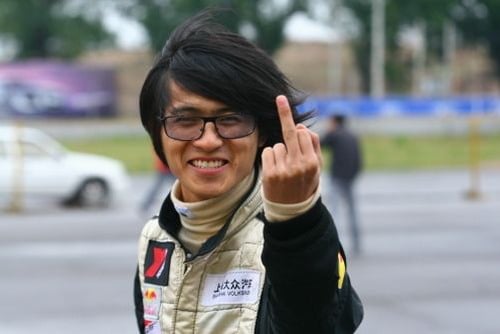
The rebel of China’s blog era, Han Han, became of voice of his generation.
When I moved to Beijing in 2008, I had a friend who was always out of money and practically lived in an internet cafe in the city’s Wudaokou district, not far from where I studied. We would visit him there as if it were his living room — the wangba was a local hangout for many of us.
Not only online forums and blogging sites were flourishing at the time, but there was also instant messaging through QQ (腾讯QQ), online news reading, and gaming. Platforms like the YouTube equivalents Tudou (土豆) and Youku (优酷) were launched, and soon Chinese companies began developing more successful products inspired by American digital platforms, such as Fanfou (饭否), Zuosa (做啥), Jiwai (叽歪), and Taotao (滔滔), creating an online space that was increasingly, and uniquely, Chinese.
That trajectory only accelerated after 2009, when popular Western internet services, including Twitter, Facebook, and YouTube, became inaccessible from within mainland China.
⚡ The launch of Sina Weibo in 2009 came at a crossroads for China’s social media landscape: it was not only a time when many foreign platforms exited China, but also when internet cafes faced major crackdowns.
As a foreigner, I don’t think I ever visited internet bars in Beijing anymore by that point — internet use had largely shifted to home connections. Laptop ownership was rising, and we all had (pre-smartphone) mobile phones, which we used to text each other constantly, since texting was cheaper than calling.

Some of the mobile phones in China’s 2009 top 10 lists.
Weibo came at just the right time. It filled the vacuum left by the online crackdowns across China’s internet while still benefiting from the popularity of blogging. Weibo (微博), after all, literally means “micro-blog” — micro because the number of characters was limited, just like Twitter, making short-form posts the main way of communication.
Weibo quickly became hugely successful, for many more reasons than just timing. Its impact on society was so palpable that its trending discussions often seeped into everyday conversations I had with friends in China.
In English-language media, I kept reading about what was being censored on the Chinese internet, but that wasn’t necessarily what I wanted to know — I also wanted to know what was on Weibo, so I could keep up with my social circles.
That question planted the seed for What’s on Weibo: the simple curiosity of “What are people talking about?” What TV series are popular? What jokes and controversies are everyone discussing (but that I never fully grasped)? I wanted to get a sense of an online world that was, in many ways, intangible to outsiders — including myself. As I had moved back to Europe by then, it was also a way for me to stay connected to those everyday conversations unfolding online in China.
With scissors, glue, and some paper, I started sketching out what a future website might look like.
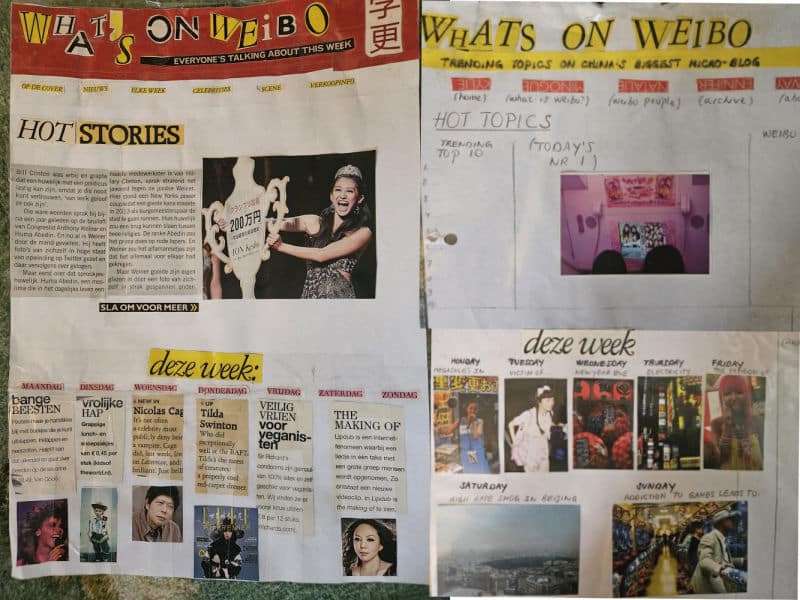
Papercrafting the idea for a website named ‘What’s on Weibo’ in 2012.
And in March 2013, after doing my best to piece it together, I launched What’s on Weibo and began writing — about all kinds of trends, like the milk powder crisis, about China’s many unmarried “leftover men” (shengnan 剩男), and about the word of the moment, “Green Tea Bitch” (lǜchá biǎo 绿茶婊) — a term used to stereotype ambitious women who act sweet and innocent while being seen as calculating or cunning.
2. From Weibo to the Taobao Moment: China’s Mobile Social Era: (2010–2019)
Around 2014–2015, people started saying Weibo was dead. In fact, it hadn’t died at all — some of its most vibrant years were still ahead. It had simply stumbled into the mobile era, along with China’s entire social media landscape.
As mobile internet became more widespread and everyone started using WeChat (launched in 2011), new mobile-first platforms began to emerge.2 In 2012–2013, for example, apps like Toutiao and Xiaohongshu (小红书, RED) were launched as mobile community platforms. With the rapid rise of China’s new tech giants — Bytedance, Meituan, and Didi — a new mobile era was blossoming, leaving the PC-based social media world far behind.
Spending another summer in Beijing in 2014, I called it the “Taobao Moment” — Taobao being China’s most successful online marketplace, a platform for buying and selling practically everything from clothes and furniture to insurance and even Bitcoins. At the time, I thought Taobao captured everything Beijing was at that moment: a world of opportunities, quick decisions, and endless ways to earn and spend money.
On weekends, some of my friends would head to the markets near the Beijing Zoo to buy the latest dresses, purses, jeans, or shoes. They’d buy stock on Saturday, do a photo shoot on Sunday, and sell the goods online by Monday. You could often spot young people on the streets of Beijing staging their own fashion shoots for Taobao — friends posing as models, Canon cameras in hand.
During that period, What’s on Weibo gradually found its audience, as more people became curious about what was happening on Chinese social media.
Around 2016, Weibo entered another prime era as the “celebrity economy” took off and a wave of “super influencers” (超级红人) emerged on the platform. Papi Jiang stood out among them — her humorous videos on everyday social issues made her one of China’s most recognizable online personalities, helping to drive Weibo’s renewed popularity.

Witty Papi Jiang was a breath of fresh air on Weibo in 2016.
People were hooked on social media. Between 2015 and 2018, China entered the age of algorithm- & interest-driven multimedia platforms. The popularity of Kuaishou’s livestreaming and Bytedance’s Douyin signaled the start of an entirely new era.
3. The New Social Era of AI-fication and Diversification (2020–Current)
China’s social media shifts over the past 25 years go hand in hand with broader technological, social, and geopolitical changes. Although this holds true elsewhere too, it’s especially the case in China, where central leadership is deeply involved in how social media should be managed and which direction the country’s digital development should take.
Since the late 2010s, China’s focus on AI has permeated every layer of society. AI-driven recommendation systems have fundamentally changed how Chinese users consume information. Far more than Weibo, platforms like Douyin, Kuaishou, and Xiaohongshu have become popular for using machine-learning algorithms to tailor feeds based on user behavior.
China’s social media boom has put pressure on traditional media outlets, which are now increasingly weaving themselves into social media infrastructure to broaden their impact. This has blurred the line between social media and state media, creating a complex online media ecosystem.
At the same time, it’s not just AI and media convergence that are reshaping China’s online landscape — social relationships now dominate both information flows and influence flows. 3 Not everyone is reading the same headlines anymore; people spend more time within their own interest-based niches. It’s no longer about microblogging but about micro-communities.
China now has 1.12 billion internet users. Among new users, young people (aged 10–19) and the elderly (60+) account for 49% and nearly 21%, respectively. The country’s digital environment has never been more lively, and social media has never been more booming.
As a bit of a dinosaur in China’s social media world, Weibo still stands tall — and its trending topics still matter. But the community that was once at the heart of the Chinese internet has dispersed across other apps, where people now engage in more diverse ways than ever.
In China, I notice this shift: where I once saw the rise of Weibo, the Taobao boom, or the Douyin craze, I now see online and offline media increasingly converging. Social media shapes real-life experiences and vice versa, and AI has become integrated into nearly every part of the media ecosystem — changing how content is made, distributed, consumed, and controlled.
In this changing landscape, the mission of What’s on Weibo — to explain China’s digital culture, media, and social trends, and to build a bridge between Western and Chinese online spaces — has stayed the same. But the name no longer fits that mission.
Over the past few years, my work has naturally evolved from Weibo-focused coverage to exploring China’s digital culture through a broader lens. The analysis and trend updates will continue, but under a new name that better reflects a time when Weibo is no longer at the center of China’s social media world: Eye on Digital China.
For you as a subscriber (subscribe here), this means you can expect more newsletter-based coverage: shorter China Trend Watch editions to keep you up to date with the latest trends, along with other thematic features and ‘Chapter’ deep dives that explore the depth behind fleeting moments.
For now, the main website will remain What’s on Weibo, but it will gradually transition into Eye on Digital China. I’ll keep the full archive alive — more than twelve years of coverage that helps trace the digital patterns we’re still seeing today. After all, the story of China’s past online moments often tells us more about the future than the trends of the day.
Thank you for following along on this new journey.
By Manya Koetse
(follow on X, LinkedIn, or Instagram)
1 Liu, Fengshu. 2011. Urban Youth in China: Modernity, the Internet and the Self. New York: Routledge, 50.
2 Mao Lin (Michael). 2020. “中国互联网25年变迁:两次跃迁,四次浪潮,一次赌未来” [25 Years of China’s Internet: Two Leaps, Four Waves, and a Gamble on the Future]. 人人都是产品经理 (Everyone Is a Product Manager), January 3. https://www.woshipm.com/it/3282708.html.
3 Yang, Shaoli (杨绍丽). 2025. “研判2025!中国社交媒体行业发展历程、重点企业分析及未来前景展望:随着移动互联网兴起,社交媒体开始向移动端转移 [Outlook for 2025! The Development History, Key Enterprises, and Future Prospects of China’s Social Media Industry: With the Rise of Mobile Internet, Social Media Has Shifted to Mobile Platforms].” Zhiyan Consulting (智研咨询), February 7. https://www.chyxx.com/industry/1211618.html.
Spotted a mistake or want to add something? Please let us know in the comments below or email us. First-time commenters, please be patient — we will have to manually approve your comment before it appears.
Eye on Digital China, by Manya Koetse, is co-published on Substack and What’s on Weibo.
Both feature the same new content — so you can read and subscribe wherever you prefer. Substack offers community features, while What’s on Weibo provides full archive access. If you’re already subscribed and want to switch platforms, just get in touch for help. Both feature the same new content — so you can subscribe or read wherever you prefer. If you’re already subscribed on one platform and would like to move your subscription over, just let me know and I’ll help you get set up.
© 2025 Manya Koetse. All rights reserved.
-

 Chapter Dive12 months ago
Hidden Cameras and Taboo Topics: The Many Layers of the “Nanjing Sister Hong” Scandal
-

 China Insight11 months ago
“Jiangyou Bullying Incident”: From Online Outrage to Offline Protest
-

 China Arts & Entertainment9 months ago
The Wong Kar-wai Scandal Explained: The Dark Side of ‘Blossoms Shanghai’
-

 Chapter Dive12 months ago
The Next Labubu: What the Rise of Wakuku Tells Us About China’s Collectible Toy Wave