
China ACG Culture
Game On: 4 Made-in-China Console Games to Watch in 2016
Now that China’s ban on console games has been lifted, the first entirely made-in-China video games are entering the gaming market – finally giving domestic developers the time to come to the forefront and get their game on.

China has a booming gaming industry. Despite different market hurdles, such as rampant software piracy and governmental measures to control game content, China’s game industry is estimated to be worth approximately $22 billion – the largest in the world.
In 2000, China banned console games due to fears that the devices would have a negative effect on the mental and physical development of Chinese children. As stated by China’s Ministry of Culture in July last year, the ban on console game came to an official end, allowing systems such as PlayStation 4, Xbox One, and Wii U into the Chinese market.
#1 SHIO: a glimpse of ancient China
One of the games that will be released on the Xbox One in the fourth quarter of 2016 is Shio (汐). Shio is a game developed by the Shanghai-based Coconut Island Studio.
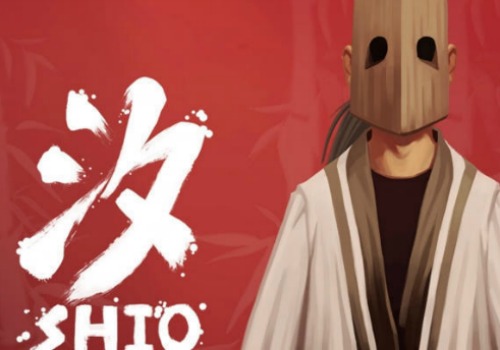
By the end of last year, Shio was put up on game distribution platform Steam, allowing netizens to vote on whether or not to give it the green light for development. The game was given a ‘go’ after only seven days. Many Chinese netizens on Steam have left comments to express their support for the game.
“I hope that the best independent games will become the foundation for the revival of domestic games in China,” commented Jeffcao1996.
Shio revolves around a mysterious warrior with a hidden past. Player use their gaming skills to work their way through a maze of ancient Chinese villages. Over time, the story unfolds and players find out more about the main character’s past, helping him to find a way out of the maze.
Shio is a challenging 2D platformer that features responsive, fluid and action-packed gameplay. The game has an atmospheric and unique design that gives a glimpse of the architecture found in ancient China. Shio uses a chain-jumping mechanic that reminds you of the martial arts that can only be seen in Wuxia films. As the game progresses, mechanics and elements from previous levels are combined to make each level more difficult.
#2 CANDLE MAN: relight your fire
Candle Man (蜡烛人) is another made-in-China console game for the Xbox One. In 2013, the game was first created by the independent game developer Spotlightor Interactive, which is based in Beijing. It was first released as a free-to-play web browser game, but it is now being developed for the Xbox One and is expected to be released later in 2016.
Candle Man is a simple 3D platformer that uses the famous Unity game engine. In the game you play as a robot candle and you have to help navigate it out of dungeon-like levels. The idea of the game is that you can light yourself on fire to provide the needed light to be able to see the pitfalls and layout of the path ahead – but the light only burns for a total of 10 seconds per level. The levels have low lighting and are full of the typical obstacles like holes, fireballs and spinning saw blades.
“A lot of work went into this game, and it shows. I like the artistic approach of a low-light game. It definitely adds suspense,” said one of the netizens after having played the game.
#3 HIDDEN DRAGON: Chinese palaces and bamboo forests
Megafun Games is a relatively young company with their first game still in development. The Shenzhen-based company is hard at work developing Hidden Dragon: Shadow Trace (隐龙传:影踪). The game is set to be released in 2016 for the PS4.
Hidden Dragon is a 3D side-scrolling game with beautiful sceneries from ancient Chinese palaces and bamboo forests. The game is a beat ‘em up style game with a story of vengeance that takes place during China’s Tang Dynasty (唐朝). Like any other action game, in Hidden Dragon players will make use of combos to fight their way to the end of each level where they need to defeat the Boss. The game is expected to contain 20 hours’ worth of gameplay with eight main levels and also DLCs later on.
The development team of Hidden Dragon released a demo to the public last year. After playing the demo, many netizens had a lot of negative comments about the game. Some complained that the gameplay was too simple with too little combos available for use. Others pointed out that the movements in the game were too rigid. However, there is still time for the development team to improve the game seeing that the game is only scheduled to be released in the latter half of 2016.
#4 KOI: Purifying a koi fish pond
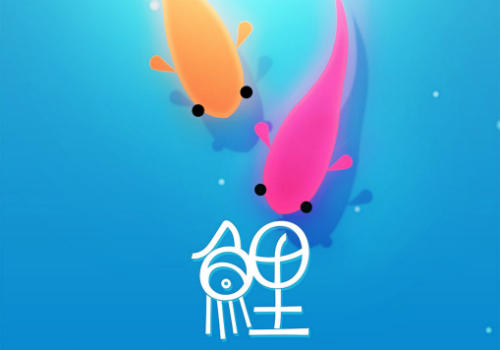
Another PS4 game to come out of China is Koi (鲤). The game is set to be released the Shanghai-based Oasis Games for the PlayStation Store at the end of March.
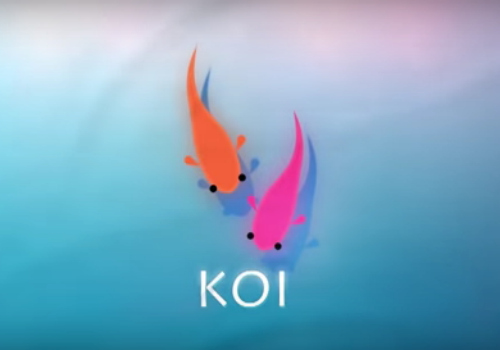
The game is an intriguing and philosophical title that has you purifying a koi fish pond by solving puzzles, opening lotus flowers and dodging predators. It also appropriately makes use of a “hypnotic” Chinese piano score to soothe your mind as you guide your koi through the pond. When released, Koi will be the first ever console game to be entirely have been made in China (engadget.com).
As of now, there is not one single console game on the market that was entirely produced by Chinese game developers. Japan has since long been the dominant console game producer in the Asian-Pacific arena. But the release of these four games might just be the beginning of a new generation of made-in-China console games, finally giving Chinese developers a chance to get their game on the global market.
–By Chi Wen
Follow @WhatsOnWeibo
Images:
Shio – http://www.jianshu.com/p/739ebaf4f5f6
Koi – http://www.engadget.com/2016/03/05/first-chinese-made-ps4-game/
http://news.gao7.com/article/619546-20151228-1
©2016 Whatsonweibo. All rights reserved. Do not reproduce our content without permission – you can contact us at info@whatsonweibo.com




In our last article, we’ve determined how Wakuku’s rise is not just about copying & following in Labubu’s footsteps and more about how China is setting the pace for global pop culture IPs. I now want to give you a small peek into the main characters in the field that are currently relevant.
Even if these dolls aren’t really your thing, you’ll inevitably run into them and everything happening around them.
Before diving into the top trending characters, a quick word on the challenges ahead for Labubu & co:
🚩 Bloomberg Opinion columnist Shuli Ren recently argued that Labubu’s biggest threat isn’t competition from Wakuku or knockoffs like “Lafufu,” but the fragility of its resale ecosystem — particularly how POP MART balances supply, scarcity, and reseller control.
Scarcity is part of what makes Labubu feel premium. But if too many dolls go to scalpers, it alienates real fans. If scalpers can’t profit, Labubu risks losing its luxury edge. Managing this dynamic may be POP MART’s greatest long-term challenge.
🚩 Chinese Gen Z consumers value authenticity — and that’s something money can’t manufacture. If China’s booming IP toy industry prioritizes speed and profit over soul, the hype may die out at a certain point.
🚩 The same goes for storytelling. Characters need a solid universe to grow in. Labubu had years to build out its fantasy universe. Cute alone isn’t enough — characterless toys don’t leave a lasting impression and don’t resonate with consumers.

Examples of popularity rankings of Chinese IP toys on Xiaohongshu.
With that in mind… let’s meet the main players.
On platforms like Xiaohongshu, Douyin, and Weibo, users regularly rank the hottest collectible IPs. Based on those rankings, here’s a quick who’s-who of China’s current trend toy universe:

1. Labubu (拉布布)
Brand: POP MART
Creator: Kasing Lung
Year launched: 2015 (independent), 2019 with POP MART.
The undisputed icon of China’s trend toy world, Labubu is a mischievous Nordic forest troll with big eyes, nine pointy teeth, and bunny ears. Its quirky, ugly-cute design, endless possibilities of DIY costume changes, and viral celebrity endorsements have made it a must-have collectible and a global pop culture phenomenon.

2. Wakuku (哇库库)
Brand & Creator: Letsvan, backed by QuantaSing Group
Year launched: 2024 with first blind box
Wakuku, a “tribal jungle hunter” with a cheeky grin and unibrow, is seen as the rising star in China’s trend toy market. Wakuku’s rapid rise is fueled by celebrity marketing, pop-up launches, and its strong appeal among Gen Z, especially considering Wakuku is more affordable than Labubu.

3. Molly (茉莉)
Brand: POP MART
Designer: Kenny Wong (王信明)
Year launched: 2006 (creator concept); POP MART 2014, first blind boxes in 2016
Molly is a classic trend toy IP, one of POP MART’s favorites, with a massive fanbase and long-lasting popularity. The character was allegedly inspired by a chance encounter with a determined young kid at a charity fundraiser event, after which Kenny Wong created Molly as a blue-eyed girl with short hair, a bit of a temperament, and an iconic pouting expression that never leaves her face.

4. SKULLPANDA (骷髅熊猫)
Brand: POP MART
Creator: Chinese designer Xiong Miao
Year launched: 2018 (creator concept); POP MART 2020
Skullpanda is one of POP MART’s flagship IPs —it’s a goth-inspired fantasy design. According to POP MART, SKULLPANDA journeys through different worlds, taking on various personas and living out myriad lives. On this grand adventure, it’s on a quest to find its truest self and break new ground all while contemplating the shape of infinity.
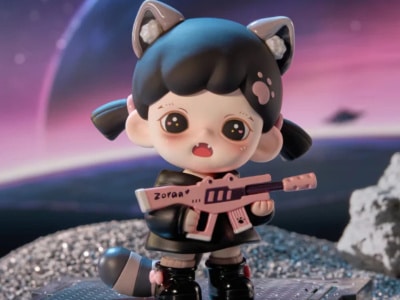
5. Baby Zoraa
Brand: TNT SPACE
Creator: Wang Zequn, CEO of TNT SPACE
Year launched: 2022, same year as company launch
Baby Zoraa is cute yet devlish fierce and is one of the most popular IPs under TNT SPACE. Baby Zoraa is the sister of Boy Rayan, another popular character under the same brand. Baby Zoraa’s first blind box edition reached #1 on Tmall’s trend toy sales charts and sold over 500,000 units.

6. Dora (大表姐)
Brand: TNT SPACE
Year Launched: 2023
Dora is a cool, rebellious “big sister” figure, instantly recognizable for her bold attitude and expressive style. She’s a Gen Z favorite for her gender-fluid, empowering persona, and became a breakout sucess under TNT when it launched its bigger blind boxes in 2023.

7. Twinkle Twinkle [Star Man] (星星人)
Brand: POP MART
Creator: Illustrators Daxin and Ali
Year launched: In 2024 with POP MART
This character has recently skyrocketed in popularity as a “healing star character” inspired by how stars shine even in darkness. POP MART markets this character as being full of innocence and fantasy to provide some relaxation in this modern society full of busyness and pressure.

8. Hirono (小野)
Brand: POP MART
Creator: Lang
Year launched: In 2024 with POP MART
This freckled, perpetually grumpy boy has a wild spirit combining introversion and playful defiance. Hirono highlights the subtle fluctuations of life, its ups and downs, incorporating joy, sadness, fear, and more – a personification of profound human emotions.

9. Crybaby (哭娃)
Brand: POP MART
Creator: Thai artist Molly Yllom (aka Nisa “Mod” Srikamdee)
Year launched: 2017 (creator concept), 2023 POP MART launch
Like Wakuku, Crybaby suddenly went from a niche IP to a new hot trend toy in 2025. Together with Wakuku, it is called the “next Labubu.” Thai artist Molly Yllom created the character after the loss of her beloved dog. Crybaby is a symbol of emotional expression, particularly the idea that it’s okay to cry and express feelings.

10. Pouka Pouka (波卡波卡)
Brand: 52TOYS
Creator: Ma Xiaoben
Year launched: 2025
With its round, chubby face, squirrel cheeks, playful smile, and soft, comforting appearance, Pouka Pouka aims to evoke feelings of warmth, healing, and emotional comfort.
Other characters to watch: CiciLu, Panda Roll (胖哒幼), NANCI (囡茜), FARMER BOB (农夫鲍勃), Rayan, Ozai (哦崽), Lulu the Piggy (LuLu猪), Pucky (毕奇).
By Manya Koetse
(follow on X, LinkedIn, or Instagram)
Spotted a mistake or want to add something? Please let us know in comments below or email us. First-time commenters, please be patient – we will have to manually approve your comment before it appears.
©2025 Whatsonweibo. All rights reserved. Do not reproduce our content without permission – you can contact us at info@whatsonweibo.com.
Follow What’s on Weibo on


Chapter Dive
The Next Labubu: What the Rise of Wakuku Tells Us About China’s Collectible Toy Wave
From ugly-cute rebellion to a new kind of ‘C-pop,’ the breakout success of Wakuku sheds light on Chinese consumer culture and the forces driving China’s trend toy industry.


As it is becoming increasingly clear that Chinese designer toy Labubu has basically conquered the world, it’s already time for the next made-in-China collectible toy to start trending on Chinese social media.
Now, the name that’s trending is Wakuku, a Chinese trend toy created by the Shenzhen-based company Letsvan.
In March 2025, a new panda-inspired Wakuku debuted at Miniso Land in Beijing, immediately breaking records and boosting overall store revenue by over 90%. Wakuku also broke daily sales records on May 17 with the launch of its “Fox-and-Bunny” collab at Miniso flagship stores in Shanghai and Nanjing. At the opening of the Miniso Space in Nanjing on June 18, another Wakuku figure sold out within just two hours. Over the past week, Wakuku went trending on Chinese social media multiple times.

From left to right: the March, May, and June successful Wakuku series/figurines
Like Labubu, Wakuku is a collectible keychain doll with a soft vinyl face and a plush body. These designer toys are especially popular among Chinese Gen Z female consumers, who use them as fashion accessories (hanging them from bags) or as desk companions.
We previously wrote in depth about the birth of Labubu, its launch by the Chinese POP MART (founded 2010), and the recipe for its global popularity in this article, so if you’re new to this trend of Chinese designer toys, you’ll want to check it out first (link).
Labubu has been making international headlines for months now, with the hype reaching a new peak when a human-sized Labubu sold for a record 1.08 million RMB (US$150,700), followed by a special edition that was purchased for nearly 760,000 RMB (US$106,000).
Now, Wakuku is the new kid on the block, and while it took Labubu nine years to win over young Chinese consumers, it barely took Wakuku a year — the character was created in 2022–2023, made its retail debut in 2024, and went viral within months.
Its pricing is affordable (59–159 RMB, around $8.2-$22) and some netizens argue it’s more quality for money.
While Labubu is a Nordic forest elf, Wakuku is a tribal jungle warrior. It comes in various designs and colors depending on the series and is sold in blind boxes (盲盒), meaning buyers don’t know exactly which design they’re getting — which adds an element of surprise.
➡️ There’s a lot to say about Wakuku, but perhaps the most noteworthy aspect is how closely it mirrors the trajectory of POP MART’s Labubu.
Wakuku’s recent success in China highlights the growing appeal and rapid rise of Chinese IPs (beyond its legal “intellectual property” meaning, ‘IPs’ is used to refer to unique cultural brands, characters, or stories that can be developed into collectibles, merchandise, and broader pop culture phenomena).
Although many critics predict that the Labubu trend will blow over soon, the popularity of Wakuku and other Labubu-like newcomers shows that these toys are not just a fleeting craze, but a cultural phenomenon that reflects the mindset of young Chinese consumers, China’s cross-industry business dynamics, and the global rise of a new kind of ‘C-pop.’
Wakuku: A Cheeky Jungle Copycat
When I say that Wakuku follows POP MART’s path almost exactly, I’m not exaggerating. Wakuku may be portrayed as a wild jungle child, but it’s definitely also a copycat.
It uses the same materials as Labubu (soft vinyl + plush), the name follows the same ABB format (Labubu, Wakuku, and the panda-themed Wakuku Pangdada), and the character story is built on a similar fantasy universe.
In fact, Letsvan’s very existence is tied to POP MART’s rise — the company was only founded in 2020, the same year POP MART, then already a decade old, went public on the Hong Kong Stock Exchange and became a dominant industry force.
In terms of marketing, Wakuku imitates POP MART’s strategy: blind boxes, well-timed viral drops, limited-edition tactics, and immersive retail environments.
It even follows a similar international expansion model as POP MART, turning Thailand into its first stop (出海首站) — not just because of its cultural proximity and flourishing Gen Z social media market, but also because Thailand was one of the first and most successful foreign markets for Labubu.
Its success is also deeply linked to celebrity endorsement. Just as Labubu gained global traction with icons like BLACKPINK’s Lisa and Rihanna seen holding the doll, Wakuku too leans heavily on celebrity visibility and entertainment culture.
Like Labubu, Wakuku even launched its own Wakuku theme song.
Since 2024, Letsvan has partnered with Yuehua Entertainment (乐华娱乐) — one of China’s leading talent agencies — to tap into its entertainment resources and celebrity network, powering the Wakuku marketing engine. Since stars like Esther Yu (虞书欣) were spotted wearing Wakuku as a jeans hanger, demand for the doll skyrocketed. Yuehua’s founder, Du Hua (杜华), even gifted a Wakuku to David Beckham as part of its celebrity strategy.

From Beckham to Esther Yu; celebrity endorsements play a big role in the viral marketing of Wakuku.
But what’s most important in Wakuku’s success — and how it builds on Labubu — is that it fully embraces the ugly-cute (丑萌 chǒu méng) aesthetic. Wakuku has a mischievous smile, expressive eyes, a slightly crooked face, a unibrow, and freckles — fitting perfectly with what many young Chinese consumers love: expressive, anti-perfectionist characters (反精致).
“Ugly-Cute” as an Aesthetic Rebellion
Letsvan is clearly riding the wave of “ugly trend toys” (丑萌潮玩) that POP MART spent years cultivating.
🔍 Why are Chinese youth so obsessed with things that look quirky or ugly?
A recent article by the Beijing Science Center (北京科学中心) highlights how “ugly-cute” toys like Labubu and Wakuku deviate from traditional Chinese aesthetics, and reflect a deeper generational pushback against perfection and societal expectations.
The pressure young people face — in education, at work, from family expectations, and information overload — is a red thread running through how China’s Gen Z behaves as a social media user and consumer (also see the last newsletter on nostalgia core).
To cope with daily stress, many turn to softer forms of resistance, such as the “lying flat” movement or the sluggish “rat lifestyle” in which people reject societal pressures to succeed, choosing instead to do the bare minimum and live simply.
This generational pushback also extends to traditional norms around marriage, gender roles, and ideals of beauty. Designer toys like Labubu and Wakuku are quirky, asymmetrical, gender-fluid, rebellious, and reflect a broader cultural shift: a playful rejection of conformity and a celebration of personal expression, authenticity, and self-acceptance.

Another popular designer toy is Crybaby, designed by Thai designer Molly, and described as follows: “Crybaby is not a boy or a girl, it is not even just human, it represents an emotion that comes from deep within. It can be anything and everything! Laughter isn’t the only way to make you feel better, crying can be healing too. If one day, a smile can’t alleviate your problems, baby, let’s cry together.”
But this isn’t just about rejecting tradition. It’s also about seeking happiness, comfort, and surprise: emotional value. And it’s usually not brand-focused but influencer-led. What matters is the story around it and who recommends it (unless the brand becomes the influencer itself — which is what’s ultimately happening with POP MART).
One of the unofficial ambassadors of the chǒu méng ugly-cute trend is Quan Hongchan (全红婵), the teenage diving champion and Olympic gold medallist from Guangdong. Quan is beloved not just for her talent, but also for her playful, down-to-earth personality.
During the Paris Olympics, she went viral for her backpack, which was overflowing with stuffed animals (some joked she was “carrying a zoo on her back”) — and for her animal-themed slippers, including a pair of ugly fish ones.

Quan Hongchan with her Wakuku, and her backpack and slippers during her Paris Olympics days.
It’s no surprise that Quan Hongchan is now also among the celebrities boosting the popularity of the quirky Wakuku.
From Factory to Fandom: A New Kind of “C-pop” in the Making
The success of Wakuku and other similar toys shows that they’re much more than Labubu 2.0; they’re all part of a broader trend tapping into the tastes and values of Chinese youth — which also speaks to a global audience.
And this trend is serious business. POP MART is one of the world’s fastest-growing consumer brands, with a current market value of approximately $43 billion, according to Morgan Stanley.
No wonder everyone wants a piece of the ‘Labubu pie,’ from small vendors to major companies.
It’s not just the resellers of authentic Labubu dolls who are profiting from the trend — so are the sellers of ‘Lafufu,’ a nickname for counterfeit Labubu dolls, that have become ubiquitous on e-commerce platforms and in toy markets (quite literally).
Wakuku’s rapid rise is also a story of calculated imitation. In this case, copying isn’t seen as a flaw but as smart market participation.
The founding team behind Letsvan already had a decade of experience in product design before setting out on their journey to become a major player in China’s popular designer toy and character merchandise market.
But their real breakthrough came in early 2025, when QuantaSing (量子之歌), a leading adult learning ed-tech company with no previous ties to toys, acquired a 61% stake in the company.
With QuantaSing’s financial backing, Yuehua Entertainment’s marketing power, and Miniso’s distribution reach, Wakuku took it to the next level.
The speed and precision with which Letsvan, QuantaSing, and Wakuku moved to monetize a subcultural trend — even before it fully peaked — shows just how advanced China’s trend toy industry has become.
This is no longer just about cute (or ugly-cute) designs; it’s about strategic ecosystems by ‘IP factories,’ from concept and design to manufacturing and distribution, blind-box scarcity tactics, immersive store experiences, and influencer-led viral campaigns — all part of a roadmap that POP MART refined and is now adopted by many others finding their way into this lucrative market. Their success is powered by the strength of China’s industrial & digital infrastructure, along with cross-industry collaboration.
The rise of Chinese designer toy companies reminds of the playbook of K-pop entertainment companies — with tight control over IP creation, strong visual branding, carefully engineered virality, and a deep understanding of fandom culture. (For more on this, see my earlier explanation of the K-pop success formula.)
If K-pop’s global impact is any indication, China’s designer toy IPs are only beginning to show their potential. The ecosystems forming around these products — from factory to fandom — signal that Labubu and Wakuku are just the first wave of a much larger movement.
– By Manya Koetse
Spotted a mistake or want to add something? Please let us know in comments below or email us. First-time commenters, please be patient – we will have to manually approve your comment before it appears.
©2025 Whatsonweibo. All rights reserved. Do not reproduce our content without permission – you can contact us at info@whatsonweibo.com.
Follow What’s on Weibo on
Eye on Digital China is a reader-supported publication by
Manya Koetse (@manyapan) and powered by What’s on Weibo.
It offers independent analysis of China’s online culture, media, and social trends.
To receive the newsletter and support this work, consider
becoming a paid subscriber.


Quack Like a Goose: Why Beijing Street Vendor “Auntie Goose Legs” Sparked a Nationwide Debate

Auntie Goose Legs, China’s Shrinking Condom Market, and DeepSeek’s AI Blind Spot

A Chinamaxxing Brand, a Stressed-Out Possum, and Japan’s Lost Decades

“Going to Town to Handle Business”: How Adidas Went from Hated in China to a Chinamaxxing Brand

Look Only at the Ugly Sides, and You Won’t See China

Comrade Trump Returns: The 2026 Trump–Xi Summit on Chinese Social Media

My Mum Has Two Husbands: The OPPO Mother’s Day Fiasco and 7 Other Gender Marketing Fails in China

The AI Actor Debate, Tragedy in China’s “Fireworks Capital,” and the Viral Labubu Fridge

Cancel-Proof: The Rise of China’s AI Actors

Beyond the “Ching Chong” Controversy: The “Pocket Asian” in The Devil Wears Prada 2
-

 Chapter Dive12 months ago
Hidden Cameras and Taboo Topics: The Many Layers of the “Nanjing Sister Hong” Scandal
-

 China Insight11 months ago
“Jiangyou Bullying Incident”: From Online Outrage to Offline Protest
-

 China Arts & Entertainment9 months ago
The Wong Kar-wai Scandal Explained: The Dark Side of ‘Blossoms Shanghai’
-

 Chapter Dive12 months ago
The Next Labubu: What the Rise of Wakuku Tells Us About China’s Collectible Toy Wave