The topic of “First Wave of Peak Infections per Province” (#各省第一波感染高峰#) was a trending topic on the Chinese social media platform Weibo this week.
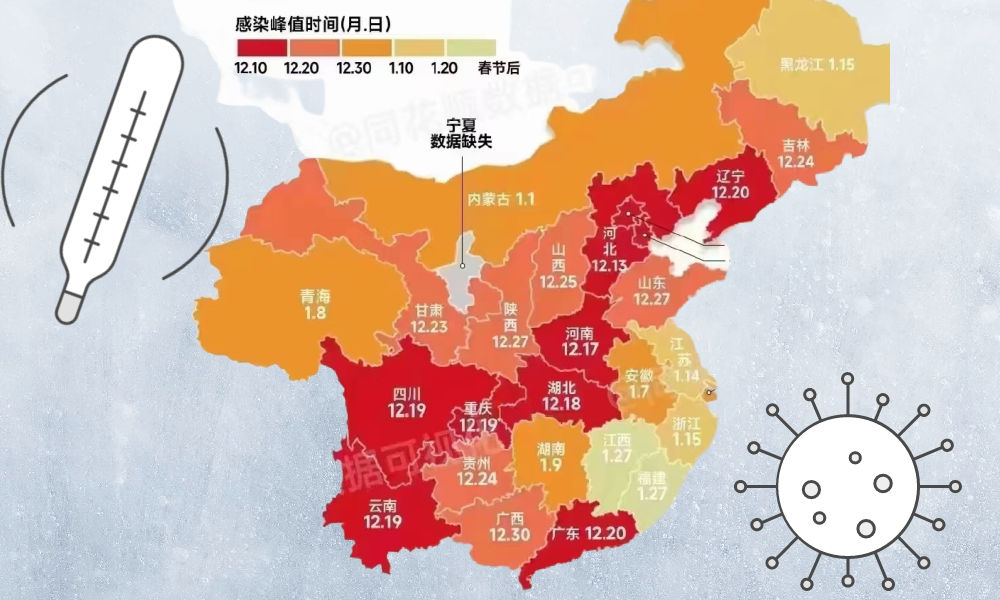
A big data expert and economist by the name of ChenQin, a Zhihu user, used Baidu Index and existing mathematical models to predict the peak dates of the Covid outbreak in various provinces and cities across mainland China (excluding Hainan, Ningxia Tibet, Xinjiang, due to lack of data).
The data and the visualized map were shared by many big channels on Weibo, including some media accounts such as Phoenix News.
According to a map that was created based on the data provided:
– Beijing and Hebei’s peak happened around 13 December
– Hunan will see its peak: 17 December
– Hubei: 18 December
– Tianjin, Sichuan, Yunnan, Chongqing: 19 December
– Guangdong, Liaoning: 20 December
– Gansu: 23 December
– Guizhou, Jilin: 24 December
– Shanxi: 25 December
– Shaanxi: 27 December
– Guangxi: 30 December
– Inner Mongolia: 1 January
– Shanghai: 6 January
– Anhui: 7 January
– Qinghai: 8 January
– Hunan: 9 January
– Jiangsu: 14 January
– Heilongjiang, Zhejiang: 15 January
– Fuijian, Jiangxi: 27 January
“Can we just celebrate the Spring Festival normally?” some on Weibo wondered.
Since Chinese New Year 2023 will fall on January 22nd, 2023, with the Spring Festival holiday taking place from 21 January to 27 January. If the predictions are correct, this means that a few provinces will still be at the height of a local Covid outbreak by that time while many other provinces will have overcome the first big wave.
According to the latest data, Beijing’s wave will end by 12 January, Shanghai will see an end to the big outbreak by 15 January.
“The amount of people that are now getting infected is scary, I just hope this can all be over quickly,” one Weibo commenter from Jiangxi wrote.
Search engine data models have previously been used by other researchers to predict major waves of Covid outbreaks in Canada, the US and Europe. According to Medical News Today, search engine data can accurately predict regional increases and decreases in Covid-19 cases.
“Before, we were buying food and waited for lockdowns. Now, we are buying medicine and wait for infections,” one Weibo blogger wrote.
Although some commenters on Weibo are relieved that there is light at the end of this Covid tunnel, others are worried about what the near future will bring. “The key word is the ‘first wave’,” one popular comment said, with another person replying: “There is no first wave, there’s only one wave after the other.”
Get the story behind the hashtag. Subscribe to What’s on Weibo here to receive our newsletter and get access to our latest articles:
Spotted a mistake or want to add something? Please let us know in comments below or email us. First-time commenters, please be patient – we will have to manually approve your comment before it appears.
Manya Koetse is a sinologist, writer, and public speaker specializing in China’s social trends, digital culture, and online media ecosystems. She founded What’s on Weibo in 2013 and now runs the Eye on Digital China newsletter. Learn more at manyakoetse.com or follow her on X, Instagram, or LinkedIn.
How Wuhan is shaking off its past with a new wave of innovation, the hot topics to know, and the Weibo catchphrase of the week: ‘the Three Questions of Patriotism.’
“Wuhan Earthquake” (#武汉地震#) momentarily became the number one trending topic on Weibo this Friday night, after residents of Jiangxia District reported feeling their homes and buildings shake. “Was there an earthquake, or am I drunk?” some wondered.
I also felt a bit tipsy in Wuhan this month. Neon signs, dancing livestreamers, flying drones, bustling night markets, and holographic lights. On my first night in…
Sick Kids, Worried Parents, Overcrowded Hospitals: China’s Peak Flu Season on the Way
“Besides Mycoplasma infections, cases include influenza, Covid-19, Norovirus, and Adenovirus. Heading straight to the hospital could mean entering a cesspool of viruses.”
In the early morning of November 21, parents are already queuing up at Xi’an Children’s Hospital with their sons and daughters. It’s not even the line for a doctor’s appointment, but rather for the removal of IV needles.
The scene was captured in a recent video, only one among many videos and images that have been making their rounds on Chinese social media these days (#凌晨的儿童医院拔针也要排队#).
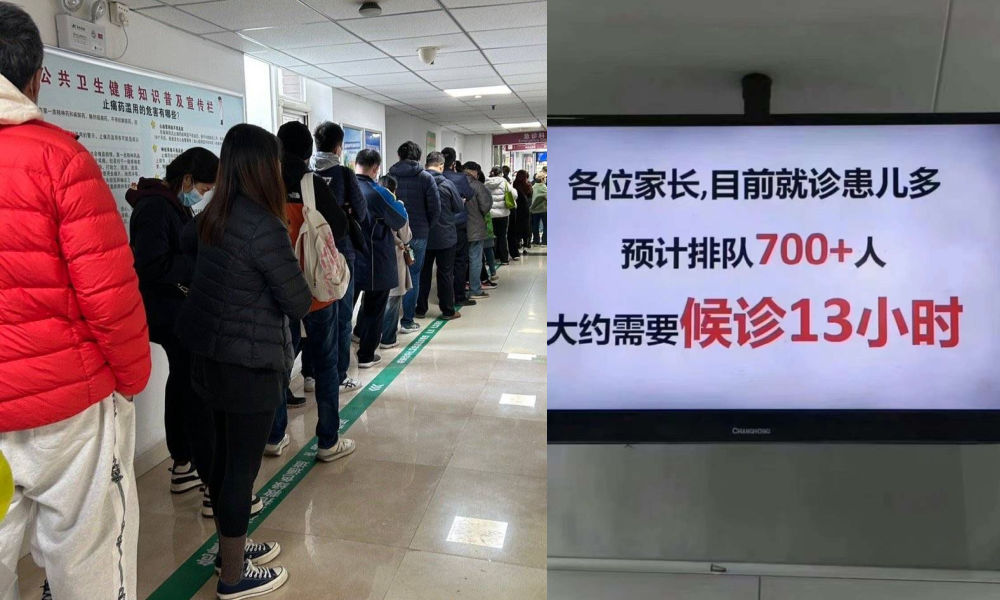
One photo shows a bulletin board at a local hospital warning parents that over 700 patients are waiting in line, estimating a waiting time of more than 13 hours to see a doctor.
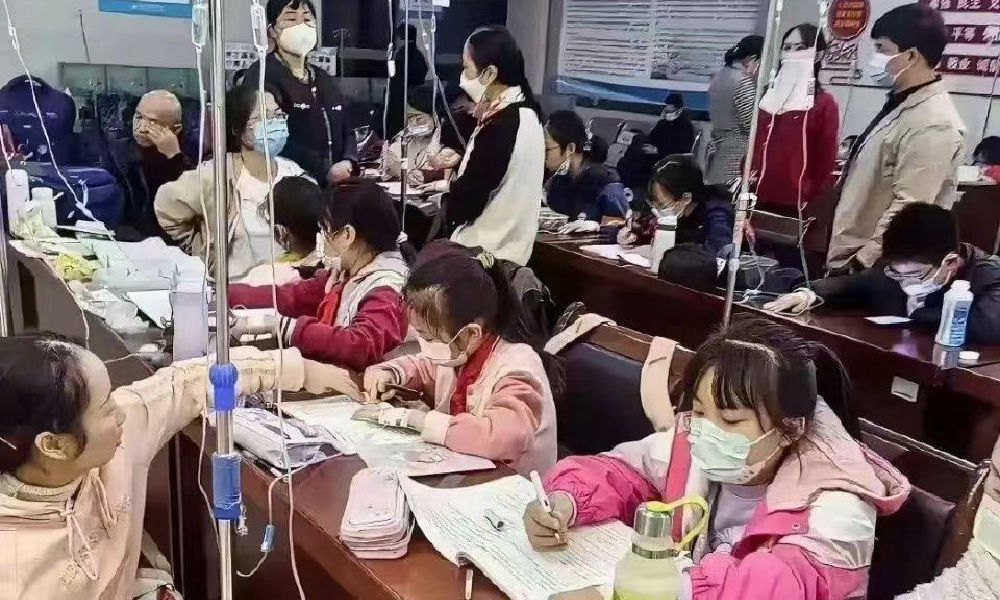
Another image shows children doing their homework while hooked up on an IV.
Recent discussions on Chinese social media platforms have highlighted a notable surge in flu cases. The ongoing flu season is particularly impacting children, with multiple viruses concurrently circulating and contributing to a high incidence of respiratory infections.
Among the prevalent respiratory infections affecting children are Mycoplasma pneumoniae infections, influenza, and Adenovirus infection.
The spike in flu cases has resulted in overcrowded children’s hospitals in Beijing and other Chinese cities. Parents sometimes have to wait in line for hours to get an appointment or pick up medication.
According to one reporter at Haibao News (海报新闻), there were so many patients at the Children’s Hospital of Capital Institute of Pediatrics (首都儿科研究所) on November 21st that the outpatient desk stopped accepting new patients by the afternoon. Meanwhile, 628 people were waiting in line to see a doctor at the emergency department.
Reflecting on the past few years, the current flu season marks China’s first ‘normal’ flu peak season since the outbreak of Covid-19 in late 2019 / early 2020 and the end of its stringent zero-Covid policies in December 2022. Compared to many other countries, wearing masks was also commonplace for much longer following the relaxation of Covid policies.
Hu Xijin, the well-known political commentator, noted on Weibo that this year’s flu season seems to be far worse than that of the years before. He also shared that his own granddaughter was suffering from a 40 degrees fever.
“We’re all running a fever in our home. But I didn’t dare to go to the hospital today, although I want my child to go to the hospital tomorrow. I heard waiting times are up to five hours now,” one Weibo user wrote.
“Half of the kids in my child’s class are sick now. The hospital is overflowing with people,” another person commented.
One mother described how her 7-year-old child had been running a fever for eight days already. Seeking medical attention on the first day, the initial diagnosis was a cold. As the fever persisted, daily visits to the hospital ensued, involving multiple hours for IV fluid administration.
While this account stems from a single Weibo post within a fever-advice community, it highlights a broader trend: many parents swiftly resort to hospital visits at the first signs of flu or fever. Several factors contribute to this, including a lack of General Practitioners in China, making hospitals the primary choice for medical consultations also in non-urgent cases.
There is also a strong belief in the efficacy of IV infusion therapy, whether fluid-based or containing medication, as the quickest path to recovery. Multiple factors contribute to the widespread and sometimes irrational use of IV infusions in China. Some clinics are profit-driven and see IV infusions as a way to make more money. Widespread expectations among Chinese patients that IV infusions will make them feel better also play a role, along with some physicians’ lacking knowledge of IV therapy or their uncertainty to distinguish bacterial from viral infections (read more here)
To prevent an overwhelming influx of patients to hospitals, Chinese state media, citing specialists, advise parents to seek medical attention at the hospital only for sick infants under three months old displaying clear signs of fever (with or without cough). For older children, it is recommended to consult a doctor if a high fever persists for 3 to 5 days or if there is a deterioration in respiratory symptoms. Children dealing with fever and (mild) respiratory symptoms can otherwise recover at home.
One Weibo blogger (@奶霸知道) warned parents that taking their child straight to the hospital on the first day of them getting sick could actually be a bad idea. They write:
“(..) pediatric departments are already packed with patients, and it’s not just Mycoplasma infections anymore. Cases include influenza, Covid-19, Norovirus, and Adenovirus. And then, of course, those with bad luck are cross-infected with multiple viruses at the same time, leading to endless cycles. Therefore, if your child experiences mild coughing or a slight fever, consider observing at home first. Heading straight to the hospital could mean entering a cesspool of viruses.”
The hashtag for “fever” saw over 350 million clicks on Weibo within one day on November 22.
Meanwhile, there are also other ongoing discussions on Weibo surrounding the current flu season. One topic revolves around whether children should continue doing their homework while receiving IV fluids in the hospital. Some hospitals have designated special desks and study areas for children.
Although some commenters commend the hospitals for being so considerate, others also remind the parents not to pressure their kids too much and to let them rest when they are not feeling well.
Opinions vary: although some on Chinese social media say it's very thoughtful for hospitals to set up areas where kids can study and read, others blame parents for pressuring their kids to do homework at the hospital instead of resting when not feeling well. pic.twitter.com/gnQD9tFW2c
Get the story behind the hashtag. Subscribe to What’s on Weibo here to receive our newsletter and get access to our latest articles:
Spotted a mistake or want to add something? Please let us know in comments below or email us. First-time commenters, please be patient – we will have to manually approve your comment before it appears.
Eye on Digital China is a reader-supported publication by
Manya Koetse (@manyapan) and powered by What’s on Weibo.
It offers independent analysis of China’s online culture, media, and social trends.