
China Insight
“6 Things Chinese People Should Know About the US-China Trade War”
Chinese state media say: “We don’t want a trade war with America – but we certainly do not fear it.”


After Trump announced plans to impose tariffs on Chinese goods last Thursday, Chinese social media users have been feverishly discussing this topic, with some calling for a boycott of American goods.
In a telephone conversation between China’s vice premier Liu He and US Treasury secretary Steven Mnuchin on Saturday, Liu reportedly said that he hoped the two countries would be able to maintain stable trade relations, but that China is also ready to defend its interests and take countermeasures.
One online movement dubbed ‘Counterattack the Trade War’ (#反击贸易战), initiated by state-run media platform Xinhua, had received over 55 million views on Sina Weibo by Saturday night (Beijing time). The hashtag intro states: “We do not want a trade war with America, but we certainly do not fear it.”

Counterattack the Trade War Hashtag on Weibo.
On March 24, China’s Communist Youth League posted a lengthy article on Weibo addressing the alleged US-China Trade War. The post is titled “Six Things Chinese Persons Should Know About the Sino-US Trade War” (“关于中美贸易战,作为中国人,这六个问题是你应该知道的……”).
In the article, the Communist Youth League writes that it seems that “at the society level,” “some ordinary Chinese do not have a clear understanding of what a ‘Sino-US Trade War’ actually is.” It, therefore, lists six points to clarify the nearing trade war and China’s position in it.

Wirhin 30 minutes after posting, the Communist Youth League article was shared 4775 times, receiving over 9600 likes.
In its first point, the Communist Youth League compares the US trade war to the Japanese invasion of China:
1. CHINA IS UNDER ATTACK BY THE US AND WE CAN’T APPEASE
“The Sino-Us trade war is a unilateral and provocative trade war that damages international trade regulations. Clarifying this issue should be the basis of all discussions: this is not what China provoked, this is not what China wanted, it is the US Trump administration that has violated international rules and has forced this on China. In other words, it is like the Japanese invasion in the past*; it is not something we could have solved through Manchuria or North China. We are only deceiving ourselves if we think we can reach peace through appeasement or by surrendering. In the face of interests, the desire of a businessman can never be satisfied.”
*”这就好比是当年日本的侵华战争”

The photo posted by Communist Youth League accompanying its article, writing: History proves that appeasement does not bring peace”.
2. CHINA IS READY FOR WAR, AND YOU SHOULD TRUST THE GOVERNMENT
“China is fully prepared for a trade war,” is the second main point made in this article, in which is stated that China has done its homework and is ready to face any challenges a trade war might bring. “Trusting and supporting the Chinese government is the right thing to do know for us,” the Youth League writes.
3. CHINA WILL FOLLOW INTERNATIONAL RULES DURING (ECONOMIC) WAR
The third point made here is that for China, “the law is the bottom line,” claiming that China will counterattack any actions made by the US, but that it will strictly follow international laws in doing so. The article also says that “Chinese and American citizens should not suffer due to the short-sightedness of its politicians.”
4. CHINA IS NOT THE ONLY COUNTRY VICTIMIZED BY TRUMP
The fourth point stressed here is that it is not just China that is victimized by Trump’s decision to impose import tariffs on foreign goods; other countries will also have to deal with these measures and their consequences – and they are China’s allies. China Youth League states: “This [action] may benefit the [US] commercial economy in the short term, but in the long run, it is just a sign of the continued decline of the American Empire,” which is doomed to fail.
5. A TRADE WAR WILL EVENTUALLY BACKFIRE ON THE PEOPLE OF THE US
“The outcome of any economic war, but especially one between world leading countries such as China and the US, will impact the wellbeing of the Chinese and American people, and can even bring a blow to the global population,” the fifth point says, stressing that Trump is making a wrong choice by initiating this ‘war’, which will cause economic disaster. If China is affected, the article says, then it will unavoidably reciprocate in the US and seriously impact its people. “The Chinese government will do its best to avoid this situation,” it says: “But if it does happen, then let’s please choose the same enemy and support the Chinese government because, as stated in the first point, this war is not what we want. It is what the Americans want.”
6. THE CHINA THREAT IS AT THE ROOT OF THIS ATTACK
In the last point, the Communist Youth League writes that behind the “China-US trade war” lies American fear over the rise of China. This US fear of a changing international community where China plays an increasingly more important role will keep on surfacing, the article says. It will show itself through the South China Sea dispute, an economic war, or Taiwan travel laws. “China needs to be prepared for this mentality,” it concludes.
By Saturday night, the article was viewed more than 3,7 million times and received thousands of comments – many supporting the “firm stance” of the article. “You can’t bully China,” a typical comment read: “We have a strong country.”
By Manya Koetse
Follow @whatsonweibo
Copyright for featured image belongs to the artist Sharpwriter. Prints for sale: via Etsy.
Spotted a mistake or want to add something? Please let us know in comments below or email us.
©2018 Whatsonweibo. All rights reserved. Do not reproduce our content without permission – you can contact us at info@whatsonweibo.com.


Chapter Dive
Red Carpet, Pandas, and Power: How China Read the Trump-Xi Summit
On Chinese social media, Washington’s red-carpet reception wasn’t just diplomacy but read as recognition of China’s restored status on the global stage.
Originally published in the Eye on Digital China newsletter on Sunday, September 27, 2026. Want to receive the next edition in your inbox? Become a paid subscriber here.
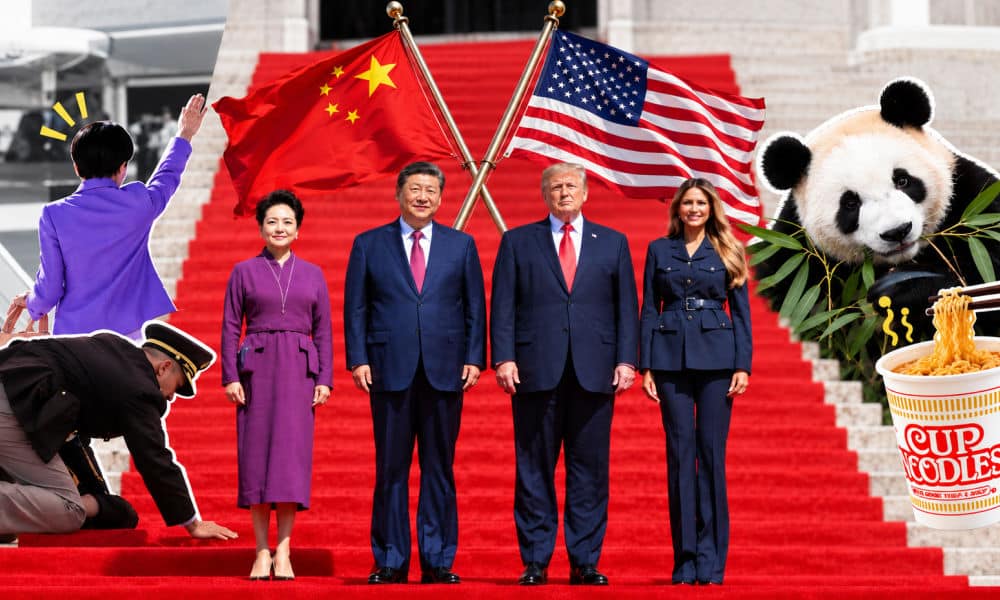
The past week was all about the Trump-Xi meeting in Washington. On mainstream Chinese social media feeds, much of the focus wasn’t on what was discussed, who gained what, or what was promised. It was about: How was China welcomed? How far did they go? How exceptional was the reception? And what does this say about China’s status as a major power on the world stage today?
Symbolic moments mattered more than strategic talks. Within that framework, President Trump, along with First Lady Melania Trump, hit the right notes.
The US visit by Xi Jinping and First Lady Peng Liyuan began on Wednesday (Sep 23), with Donald Trump and the First Lady personally welcoming them at Joint Base Andrews, a highly unusual move. Presidents typically receive foreign leaders at the White House; in recent decades, airport welcomes at Andrews have been reserved almost exclusively for popes. The last comparable presidential welcome was Kennedy’s 1962 greeting of British Prime Minister Harold Macmillan, a particularly close US ally at the time.
Wednesday’s welcome came with a red carpet, which members of the US military meticulously inspected and cleaned on their hands and knees right before Xi and Peng’s arrival. A photo of that scene was widely shared on Chinese social media, where many netizens seemed both bemused and struck by the sight of Americans quite literally bending over backward for their Chinese guests, with one popular Weibo account (@提刀探花在缅北) writing: “This is a scene that we will remember for decades.”
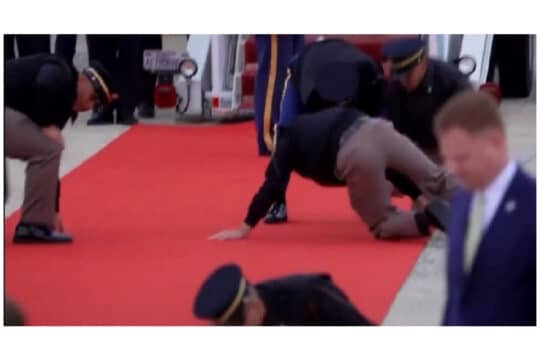
Red-carpet preparation at Joint Base Andrews
At the White House welcome ceremony on Thursday (Sep 24), where both leaders delivered remarks, Trump touched on the history of war and mentioned the American volunteer fighter group in China — the Flying Tigers — saying:
🗣️ “If we focus on our common interest, I’m confident there is much we can achieve. Throughout history, the pursuit of those common interests has connected our people across the vast oceans, across big, tremendous distances and many differences, and even made us allies in World War II. Look at the greatness we had together fighting in World War II.”
After the Washington summit concluded, Trump posted on Truth Social, calling the meeting one of “Friendship, Strength, and Success, for both China and the U.S.A.,” and adding that he looked forward to the next US-China meeting in November.
Historical Memory at the White House
But why did the special treatment given to the Chinese delegation in the US seem to matter so much in China, especially considering the ubiquitous anti-American sentiment of recent years? Not only did official media highlight it, but it also resonated strongly with netizens and became the defining story about this meeting on social media.
It goes much deeper than flattery.
Narratives of “never…
China Insight
Blame Games & Bad Signs: Nepal–Tibet Floods, Huawei’s Toilet Trouble, “Screwed” Graduates
How the Nepal–Tibet floods are being discussed on Chinese social media. From solidarity and sadness over Gyirong to censorship and anger at Taiwanese, Indian, and Western media.

In this edition:
- Teachers get shamed for their students’ bad grades
- Why the Nepal–Tibet floods sparked arguments about blame, BBC reporting, and Chinese censorship
- Huawei doesn’t appreciate viral toilet humor
- Dads are carrying mattresses into Peking University
- Chinese graduates are getting “screwed” by a million-dollar company
🗞️ QUICK SCROLLS
🧑🏫 A teacher “shame photo” taken at a local education meeting in Liangshan, Sichuan, has sparked nationwide outrage. A group of primary school teachers was forced to pose in front of a giant “SHAME” sign because their classes’ average final exam scores were below 30. “This isn’t merely ‘shame’—it’s outright public humiliation,” one commenter wrote. Liangshan’s education bureau confirmed the photo was real and said it was “puzzled” by the practice; the Leibo County government has apologized and launched an investigation.

Teachers lined up in front of a big screen that says: “Group photo of primary-school teachers whose classes averaged below 30 points in the 2025–2026 end-of-year examinations”
🥬 “Chemical cabbages” (药水白菜) or “formaldehyde cabbages” (甲醛白菜) have been a major topic on Chinese social media after a Chinese investigative vlogger captured workers in Kangbao, Hebei, dipping cabbages into formaldehyde solution before loading them onto trucks. This procedure, which allegedly adds 2–3 extra days of shelf life, is illegal: formaldehyde is a Group 1 carcinogen.
🍫 It’s been a bad week for Mars-owned chocolate brand Dove. A marketing campaign suggesting that a girl received a box of chocolates from a man she was flirting with while her boyfriend was away (“趁男友不在”) drew anger online. Then the brand’s apology also became a massive failure: when it was flagged as 100% AI-generated, Chinese netizens had little sympathy left for the brand.
💸 A “century-old” shark fin soup served by a Shanghai restaurant for no less than 4,800 yuan (US$715) per bowl (!) has gone viral for its exorbitant price and claims that it has been “simmering for more than 100 years,” since the late Qing dynasty. There was plenty of skepticism about the soup, but also disbelief that anyone would spend an ordinary person’s entire monthly living budget on a single bowl of soup.
👩💻 An eighth-grader from Shanghai earned 18,000 yuan (US$2,678) in three days using AI. Despite her limited programming experience, the 13-year-old placed third in a marketing hackathon, where teams had 48 hours to develop and market an entire AI product. She launched a study-companion app called “Being There” (在场) that 92 people bought. Although Chinese media praised her, commenters were critical, suggesting she received help from her mother, an influencer on Douyin.
💍 In an aging society where marriage rates have AGAIN dropped, more and more places are making it easier than ever to tie the knot. Registration services are popping up in…
Eye on Digital China is a reader-supported publication by
Manya Koetse (@manyapan) and powered by What’s on Weibo.
It offers independent analysis of China’s online culture, media, and social trends.
To receive the newsletter and support this work, consider
becoming a paid subscriber.


Starbucks Goes Xinjiang & The Kardashians in China

Red Carpet, Pandas, and Power: How China Read the Trump-Xi Summit

Keeping Score of History: The Mukden Incident and China’s Basketball Defeat to Japan

The Rise of “Shuaqi-ism,” Taking Starbucks to the Fields, and Pretending to Go to Work

Why Japan Has So Many Surnames, China’s Back-to-School Shifts & Taiwan Pavilion Trouble

“God Won’t Save Us, but the PLA Will”: Floods, Faith, and Kung Fu Soccer Nostalgia

How Chinese AI Videos Turned Foreigners into Villains
Why Japan Has So Many Surnames, China’s Back-to-School Shifts & Taiwan Pavilion Trouble

The Power of Ugly: Why Niu Lai Became China’s Unlikeliest Box-Office Hit

AI Actress Ad Pulled, Baihaitun Disrupts Shanghai and Cicada Meme Bugs Huawei
-
 Chinese New Year8 months ago
Inside Chunwan 2026: China’s Spring Festival Gala
-
 China Brands, Marketing & Consumers11 months ago
Hasan Piker’s China Trip & the Unexpected Journey of a Chinese School Uniform to Angola
-

 Chapter Dive7 months ago
Inside the Great Chinese Debate Over the Iran War
-

 China Trend Watch11 months ago
Japan Tensions, Nexperia Fallout, Yunnan’s ‘Wild Child,’ & “Modern Opium”
Hongli Lai
March 25, 2018 at 4:00 pm
I know the Chinese netizens didn’t do it either, but I think it would be a good idea if you credit the artist that made the Trump portrait: https://sharpwriter.deviantart.com/art/The-Donald-605337203
Trent Emerick
July 22, 2018 at 6:55 am
Lol to say China is under attack by the US Government is absurd. It’s as if Chinese citizens dont Realize how much Manufacturing they’ve taken from the US and all the Pollution China gets away with while the Americans are forced to follow ecosystem rules. Trump Tarriffs may not be great for the US but its definitely Not an economy killer for China or the US. China owns all these Hollywood studios and owns the largest movie theater corporation in the US and own all these US Farms, and they Have a huge Trade Imbalance with the US. The US is not going to get bullied by China or Any one else anymore. Americans are sick of being told to get over it When our leaders Refuse to use any leverage for Americans during trade policymaking. Trump is finally Using leverage as China has done to us for decades.