
China Insight
Kids for Sale: Child Abduction on the Rise in Fujian, China
Several Chinese media, including CCTV and People’s Daily, report that trade in children is on the rise in China’s Fujian province. Young children and newborns are being sold for 100.000 RMB (boys), girls are half the price.


Recently, the popular 2014 Chinese movie Dearest (亲爱的) has increased public interest in the topic of children’s abduction and trafficking. Dearest centers around a couple living in a remote village of China, dealing with the disappearance of their son. The little boy turns out to be abducted and the parents go on a lengthy mission to get him back. The tragic story has turned media’s attention to the growing problem of child trafficking in the province of Fujian, China.

Several Chinese media, including CCTV and People’s Daily, report that trade in children is on the rise in Tongfang town in Longyan prefecture, where cases have been reported of the trafficking of young children and even newborns. According to one journalist’s investigation, as can be seen in the CCTV report, the “market price for a boy is about 100k RMB (about 16.300 US$) and 40-50k RMB (about 8000 US$) for a girl”. Official statistics are saying there are about 10,000 kids abducted every year. Research by third party institutions estimates a number that is seven times as high, reaching 70,000 yearly cases. Most netizens believe it is the old Chinese preference for boys in thinking “boys are more important than girls” (重男轻女) that causes the illegal market demand where boys are bought and girls are sold.
According to the national statistics report, the trafficking of boys is usually related to illegal adoption, whereas kidnapping of girls often involves sex trade. The lack of a national tracking system for missing people in China makes it hard to track and rescue missing persons.
Many netizens suggest that the government should create a national online database to record the DNA information of all newborns in order to make it easier for authorities and parents to know if a missing child is theirs when it is found years after it is reported missing.
Children abduction has been a hot topic in China since 2011. Activities by non-governmental organizations such as “Against Abduction via Weibo” (微博打拐) and “Come Home Baby Forum” (宝贝回家论坛) are well known and widely supported by netizens. The Chinese government is criticized online for its lack of supervision, bad management of the ID card registration process, and the light penalty for criminals involved in child trafficking. If the government would enhance its public administration, the number of missing children could be reduced, netizens agree.
– by Fan Bai & Manya Koetse
Images:
Hong Kong Asian Film Festival 2014
©2014 Whatsonweibo. All rights reserved. Do not reproduce without permission – you can contact us at info@whatsonweibo.com.




China Insight
Mbappé, Mao, and the Joke That Shall Not Be Named
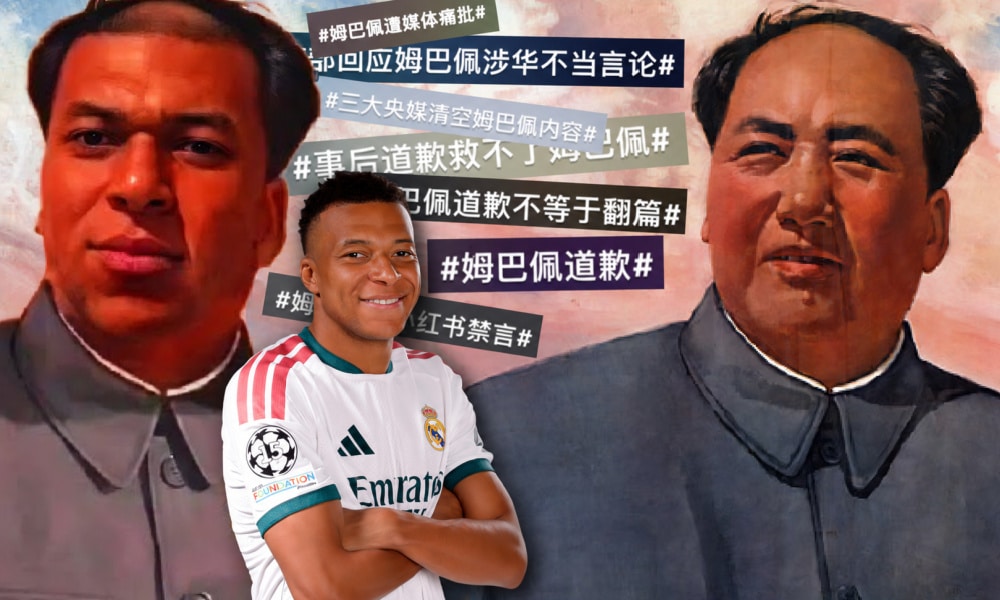
Mbappé’s favorite Mao meme sparked major backlash in China. More on what the controversy reveals about political red lines, online humor, and censorship.

RESOU 热搜 | What’s Trending in China, Explained
Here, I briefly unpack the stories making waves on Chinese social media and share what stands out to me. Don’t miss an update: become a subscriber to Eye on Digital China today.
Oh oh oh, Mbappé, all those goals, yet you lost so many points on Chinese social media over the past 48 hours.
Following his 100th goal for Real Madrid during El Clásico and finishing second on Ballon d’Or night, French football player Mbappé is all the talk on Chinese social media — not for his achievements, but for what is seen as crossing a major red line in an online interview.
On Tuesday night, a text came in from Ruixin: “I am wide awake tonight and somehow witnessed live how the footballer Kylian Mbappé was getting blocked and totally canceled on Chinese social media for his comments about Mao Zedong over the past, like, three hours 😅”
I quickly grabbed my phone and saw the flood of Mbappé posts rapidly coming in, and it was clear that people were very cross with him.
Although it was already clear that this might not blow over any time soon, by early Wednesday morning it became painfully clear how the controversy had snowballed. Dongpeng Beverage Group (东鹏), one of the many Chinese companies that signed the famous sportsman as its brand ambassador, publicly stated that it was cutting all commercial ties with Mbappé. Soon, others followed.
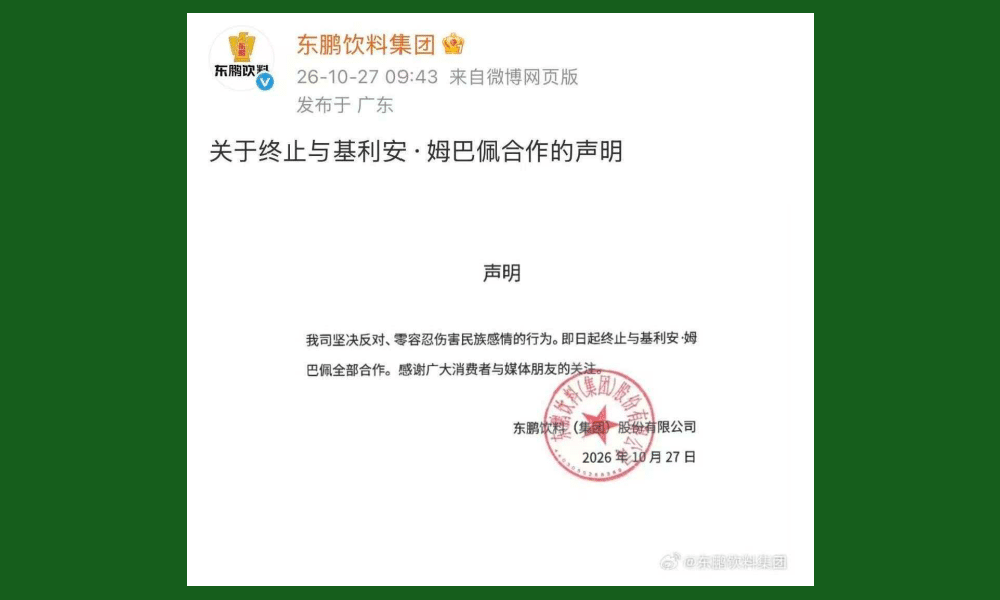
Dongpeng Beverage Group (东鹏): the first in a string of companies to cut ties with French footballer Kylian Mbappé.
Mbappé’s fall from grace in China has been sudden and spectacular, like a major avalanche of backlash that unfolded in one night, and it can all be traced back to one segment of an interview the footballer previously did on a French YouTube show (The Bridge) that resurfaced online — initially through Reddit and X, and then on Chinese social media apps, like football platform Dongqiudi (懂球帝).
In that segment, when asked about his favorite meme, Mbappé replied that one of the memes he finds funniest is:
🗣️ “the one where they put my face on some guy, a Chinese dictator. That really makes me laugh, I use it with my friends all the time.”

The interview segment where Mbappé shares his favorite meme: his face photoshopped onto the face of a “Chinese dictator.”
The show, created by Mbappé’s Real Madrid teammate Aurélien Tchouaméni, added the image Mbappé referred to: his face photoshopped on a Mao propaganda visual. It’s part of a series of memes that emerged in 2024 in which Mbappé’s face is edited onto the faces of dictators.1
Chapter Dive
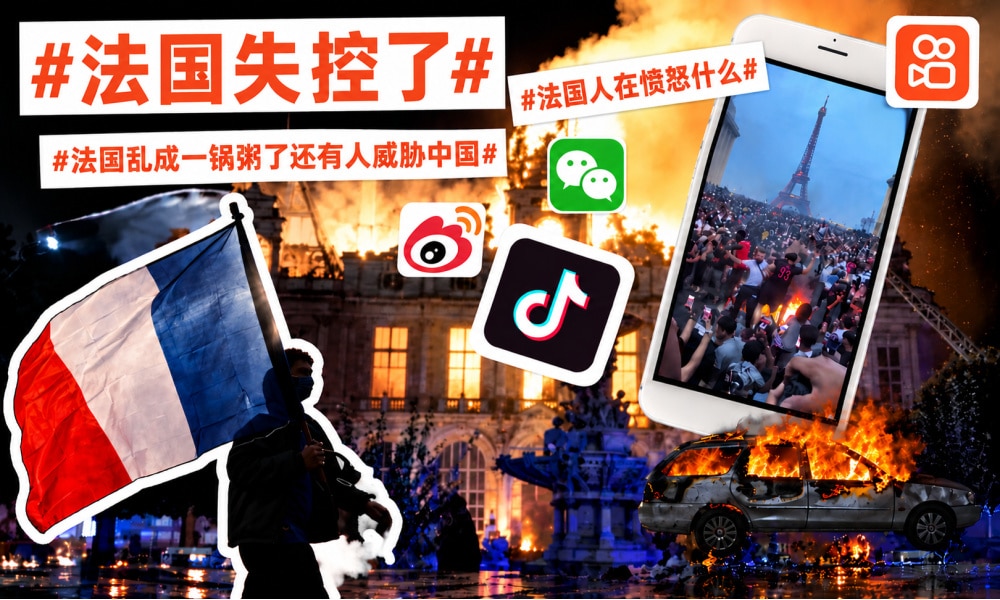
The French Protests, Viewed from China: Five Narratives on Chinese Social Media
From the decline of Europe to historical karma: these 5 narratives reveal how Chinese social media discusses the recent unrest in France.
Eye on Digital China is a reader-supported publication by
Manya Koetse (@manyapan) and powered by What’s on Weibo.
It offers independent analysis of China’s online culture, media, and social trends.
To receive the newsletter and support this work, consider
becoming a paid subscriber.


From “Pure Love Warrior” to Political Victim: Jensen Huang’s Fall on Chinese Social Media

China Trend Watch: Digital Dementia and Why Everyone Says ‘Li Na’

Mbappé, Mao & the Backlash on Chinese Social Media

Mbappé, Mao, and the Joke That Shall Not Be Named

The French Protests, Viewed from China: Five Narratives on Chinese Social Media

Why Japan Has So Many Surnames, China’s Back-to-School Shifts & Taiwan Pavilion Trouble

The Rise of “Shuaqi-ism,” Taking Starbucks to the Fields, and Pretending to Go to Work

Blame Games & Bad Signs: Nepal–Tibet Floods, Huawei’s Toilet Trouble, “Screwed” Graduates

Starbucks Goes Xinjiang & The Kardashians in China

Red Carpet, Pandas, and Power: How China Read the Trump-Xi Summit
-
 Chinese New Year9 months ago
Inside Chunwan 2026: China’s Spring Festival Gala
-

 Chapter Dive9 months ago
Inside the Great Chinese Debate Over the Iran War
-

 Chapter Dive10 months ago
Chinamaxxing and the “Kill Line”: Why Two Viral Trends Took Off in the US and China
-

 China Memes & Viral9 months ago
Two Sessions, a Celebrity Meltdown, and the Rise of China’s “Forget It” Mindset
Ed Sander
November 19, 2014 at 8:43 pm
Another interesting documentary about this topic is Living with Dead Hearts:
http://livingwithdeadhearts.com/