China Digital
How Baidu Maps Leads People to a Privately Owned Hospital
Weibo netizens have exposed how Baidu Maps, when looking for a city hospital in Shenzhen, instead provides the address of a private hospital run by the controversial Putian Medical Group. The trending issue has angered Chinese netizens. The close-knit and dubious connection between Baidu and Putian earlier made headlines in 2016.

In 2016, Chinese search engine Baidu triggered a wave of controversy after netizens exposed how the company offers advertised space for fraudulent doctors. Medical institutions reportedly paid Baidu large amounts of money to be prominently featured in their search results – often giving false hope to patients who hope to be cured.
Now, a year later, the search engine again angers Chinese netizens for linking to the address of a private clinic when people search for a Shenzhen city hospital. The issue was exposed by a surgeon working at the Shenzhen City Children’s Hospital on Weibo, attracting thousands of comments and shares within days.
Many netizens say that they are done with Baidu, as the company has ‘no integrity.’
The Wei Zexi Incident
The big 2016 Baidu controversy came to light in early May after the death of the cancer patient Wei Zexi (魏则西). Wei was a 21-year old student suffering a rare form of cancer. After several unsuccessful treatments, he turned to search engine Baidu.
Through one of Baidu’s paid results, Wei found a treatment at the Beijing Armed Police Corps No. 2 Hospital (武警二院) he thought could help him. With the help of friends and family, he came up with the 200,000 RMB (31,000US$) for the treatment, which later turned out to be ineffective and highly contested. Wei made headlines when he passed away shortly after.
Since he was an active user on a well-known message board where he shared his experiences, the topic of his death became a much-discussed on Chinese social media.

The death of the young Wei Zexi triggered controversy in 2016.
Further investigation exposed that the controversial treatment was done by the Putian Medical Group (莆田系医院), an organized group of medical entrepreneurs that dominates most of China’s private hospitals. It led to a stream of online responses from people who say they were also duped by the Putian Medical Group. Many recounted how their appointment at a Putian-related clinic had cost them a lot of money even when the public hospital doctor later diagnosed they had no health problems at all.
Amongst the many messages were also those of people who previously worked at Putian hospitals. Some told that the expert doctors that were advertised in reality did not even work at the clinics and that the staff was not qualified to do the abortion procedures they offered.
The Putian Medical Group
Putian’s monopoly in China’s private healthcare system goes back to the 1980s when the city of Putian grew into a town of ‘medical practitioners’ without official medical university degrees. The people of Putian discovered a medical goldmine by treating stigmatized conditions (such as STD’s) that were rarely treated at public hospitals.
Throughout the 1990s, the medical network of Putian was opening up clinics across China. These hospitals were amongst the first to advertise their treatments. They also signed contracts with public hospitals to run specific departments.

Baidu and Putian: money for misleading advertisement on the search engine.
Putian and Baidu have had a close-knit relationship for years. Baidu has made a fortune through Putian’s advertisements, and Putian has also further expanded its business by being featured on the search engine.
“Led to a privately owned hospital by Baidu”
Baidu has now become trending again for its dubious practices, as netizens have uncovered how Baidu Maps directs users to a Putian-owned clinic when searching for a nearby children’s hospital.
On July 10, the hashtag “Led to a privately-owned hospital by Baidu” (#被百度地图带到民营医院#) was in the top 10 of most-read topics on Sina Weibo.
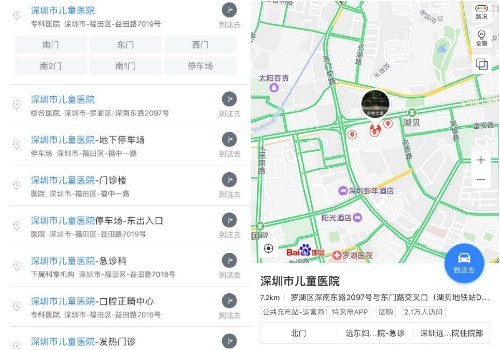 Baidu Maps redirects patients to the wrong hospital in Shenzhen.
The issue came to light when a medical staff member of the Shenzhen City Children’s Hospital (深圳市儿童医) discovered that Baidu maps indicated their work unit had “moved.” When searching for the hospital, Baidu provided the address of the Putian Far East Women’s Hospital (远东妇儿医院). This leads many patients to visit the Putian hospital, thinking they are actually visiting the Shenzhen City Children’s Hospital.
The information was disclosed by a surgeon of the Shenzhen Hospital (@深圳胖胖熊) on July 7 on Weibo, where his post soon received thousands of shares.
The doctor writes:
“The Shenzhen Children’s Hospital address was originally 709 Yitian Road, Futian District. Unfortunately, in the Baidu map search results, the link underneath this name redirects to the address of the Putian Far East Women’s Hospital, and its name is underneath on the second place. This leads many parents who want to come to our hospital to go to the Putian Department. Is this negligence, or deliberate? What is the purpose? Could I say that this is shameless?”
On July 10, Baidu responded to the controversy through Weibo, calling the search results an “error” that was immediately being adjusted by the relevant departments.
“A dog can’t stop himself from eating shit”
But many people on Weibo do not believe that the misleading information is a simple error, with some saying that this is not the first time this has happened. Others also point out that this is “too much of a coincidence,” since the ‘error’ is linked to a Putian clinic.
Many people say that Baidu has already lost its integrity: “Bad habits are hard to change,” some people write (literally: “a dog can’t stop himself from eating shit” [“狗改不了吃屎”]).
“I don’t believe you anymore, your credibility records have become too low,” some commenters said.
The alleged unethical practices of Baidu lead many people to use the Alibaba-backed Gaode Maps (高德地图) instead of Baidu.
“I’d never expect for this to get so big,” the surgeon from Shenzhen City Children’s Hospital said on Weibo in response to all the attention his initial post has received: “I am just protecting the patients’ rights, and I feel responsible for protecting the reputation of my hospital.”
Another commenter, a medical professor from Chengdu, said on Weibo: “The internet has brought us much convenience, but we need to remain clear-headed and critical when using it – this holds especially true for Baidu search engine, Baike [Baidu online encyclopedia], and Baidu Maps.”
By Manya Koetse
Follow @whatsonweibo
©2017 Whatsonweibo. All rights reserved. Do not reproduce our content without permission – you can contact us at info@whatsonweibo.com.


China Books & Literature
Why Chinese Publishers Are Boycotting the 618 Shopping Festival
Bookworms love to get a good deal on books, but when the deals are too good, it can actually harm the publishing industry.


When June begins, promotional campaigns for China’s 618 Online Shopping Festival suddenly appear everywhere—it’s hard to ignore.
The 618 Festival is a product of China’s booming e-commerce culture. Taking place annually on June 18th, it is China’s largest mid-year shopping carnival. While Alibaba’s “Singles’ Day” shopping festival has been taking place on November 11th since 2009, the 618 Festival was launched by another Chinese e-commerce giant, JD.com (京东), to celebrate the company’s anniversary, boost its sales, and increase its brand value.
By now, other e-commerce platforms such as Taobao and Pinduoduo have joined the 618 Festival, and it has turned into another major nationwide shopping spree event.
For many book lovers in China, 618 has become the perfect opportunity to stock up on books. In previous years, e-commerce platforms like JD.com and Dangdang (当当) would roll out tempting offers during the festival, such as “300 RMB ($41) off for every 500 RMB ($69) spent” or “50 RMB ($7) off for every 100 RMB ($13.8) spent.”
Starting in May, about a month before 618, the largest bookworm community group on the Douban platform, nicknamed “Buying Like Landsliding, Reading Like Silk Spinning” (买书如山倒,看书如抽丝), would start buzzing with activity, discussing book sales, comparing shopping lists, or sharing views about different issues.

Social media users share lists of which books to buy during the 618 shopping festivities.
This year, however, the mood within the group was different. Many members posted that before the 618 season began, books from various publishers were suddenly taken down from e-commerce platforms, disappearing from their online shopping carts. This unusual occurrence sparked discussions among book lovers, with speculations arising about a potential conflict between Chinese publishers and e-commerce platforms.
A joint statement posted in May provided clarity. According to Chinese media outlet The Paper (@澎湃新闻), eight publishers in Beijing and the Shanghai Publishing and Distribution Association, which represent 46 publishing units in Shanghai, issued a statement indicating they refuse to participate in this year’s 618 promotional campaign as proposed by JD.com.
The collective industry boycott has a clear motivation: during JD’s 618 promotional campaign, which offers all books at steep discounts (e.g., 60-70% off) for eight days, publishers lose money on each book sold. Meanwhile, JD.com continues to profit by forcing publishers to sell books at significantly reduced prices (e.g., 80% off). For many publishers, it is simply not sustainable to sell books at 20% of the original price.
One person who has openly spoken out against JD.com’s practices is Shen Haobo (沈浩波), founder and CEO of Chinese book publisher Motie Group (磨铁集团). Shen shared a post on WeChat Moments on May 31st, stating that Motie has completely stopped shipping to JD.com as it opposes the company’s low-price promotions. Shen said it felt like JD.com is “repeatedly rubbing our faces into the ground.”
Nevertheless, many netizens expressed confusion over the situation. Under the hashtag topic “Multiple Publishers Are Boycotting the 618 Book Promotions” (#多家出版社抵制618图书大促#), people complained about the relatively high cost of physical books.
With a single legitimate copy often costing 50-60 RMB ($7-$8.3), and children’s books often costing much more, many Chinese readers can only afford to buy books during big sales. They question the justification for these rising prices, as books used to be much more affordable.
Book blogger TaoLangGe (@陶朗歌) argues that for ordinary readers in China, the removal of discounted books is not good news. As consumers, most people are not concerned with the “life and death of the publishing industry” and naturally prefer cheaper books.
However, industry insiders argue that a “price war” on books may not truly benefit buyers in the end, as it is actually driving up the prices as a forced response to the frequent discount promotions by e-commerce platforms.
China News (@中国新闻网) interviewed publisher San Shi (三石), who noted that people’s expectations of book prices can be easily influenced by promotional activities, leading to a subconscious belief that purchasing books at such low prices is normal. Publishers, therefore, feel compelled to reduce costs and adopt price competition to attract buyers. However, the space for cost reduction in paper and printing is limited.
Eventually, this pressure could affect the quality and layout of books, including their binding, design, and editing. In the long run, if a vicious cycle develops, it would be detrimental to the production and publication of high-quality books, ultimately disappointing book lovers who will struggle to find the books they want, in the format they prefer.
This debate temporarily resolved with JD.com’s compromise. According to The Paper, JD.com has started to abandon its previous strategy of offering extreme discounts across all book categories. Publishers now have a certain degree of autonomy, able to decide the types of books and discount rates for platform promotions.
While most previously delisted books have returned for sale, JD.com’s silence on their official social media channels leaves people worried about the future of China’s publishing industry in an era dominated by e-commerce platforms, especially at a time when online shops and livestreamers keep competing over who has the best book deals, hyping up promotional campaigns like ‘9.9 RMB ($1.4) per book with free shipping’ to ‘1 RMB ($0.15) books.’
This year’s developments surrounding the publishing industry and 618 has led to some discussions that have created more awareness among Chinese consumers about the true price of books. “I was planning to bulk buy books this year,” one commenter wrote: “But then I looked at my bookshelf and saw that some of last year’s books haven’t even been unwrapped yet.”
Another commenter wrote: “Although I’m just an ordinary reader, I still feel very sad about this situation. It’s reasonable to say that lower prices are good for readers, but what I see is an unfavorable outlook for publishers and the book market. If this continues, no one will want to work in this industry, and for readers who do not like e-books and only prefer physical books, this is definitely not a good thing at all!”
By Ruixin Zhang, edited with further input by Manya Koetse
Independently reporting China trends for over a decade. Like what we do? Support us and get the story behind the hashtag by subscribing:
Spotted a mistake or want to add something? Please let us know in comments below or email us. First-time commenters, please be patient – we will have to manually approve your comment before it appears.
©2024 Whatsonweibo. All rights reserved. Do not reproduce our content without permission – you can contact us at info@whatsonweibo.com.
China Digital
China’s 2024 Gaokao Triggers Online Discussions on AI
It’s Gaokao time! For the first time, China’s Gaokao essay topic was about the latest AI developments, triggering discussions on social media.

This week, China’s National College Entrance Exams, better known as the “Gaokao” (高考), became one of the most-discussed topics on Chinese social media. ‘Gaokao,’ ‘AI,’ and ‘Gaokao essay’ were the hottest words on Weibo by the end of the week.
The Gaokao (literally: ‘higher exams’) are a prerequisite for entering China’s higher education institutions and are usually taken by students in their last year of senior high school. June 7th marked the first day of the Gaokao, which will continue until June 9th.
For the over 13.4 million participating students, the Gaokao week is a pivotal moment. Scoring high on this exam can grant access to better colleges, significantly improving their chances of obtaining a good job after graduation. Given the potentially life-changing results, the Gaokao period is a stressful time for both students and their parents.
The Gaokao essay (高考作文) is a significant component of the Chinese language exam, testing students’ writing skills, critical thinking, and ability to express ideas coherently. The essay, which must be completed within a limited time, requires students to discuss given topics.
These topics are generally related to Chinese society and culture, consistently attracting attention on social media. This year, multiple essay questions were related to AI and social media.
Those taking the Beijing exam (北京卷), for example, received a question related to the “like” function on WeChat, suggesting that some people feel strongly about the number of “likes” they receive and give, asking students to reflect on the phenomenon of receiving and giving “likes” on social media.
But the question receiving the most attention on social media was part of the New Curriculum Standard Test I (新课标I卷), which is distributed among different provinces.
Students vs. Chatbots: Letting AI Write an Essay on AI
Students received the following topic prompt for their Gaokao essay, which should be at least 800 characters long:
“With the spread of the internet and AI applications, we can quickly get answers to more and more questions. Will this also lead to us having fewer problems?” (随着互联网的普及、人工智能的应用,越来越多的问题能很快得到答案。那么,我们的问题是否会越来越少?)
The question sparked discussions because it was the first time a Gaokao essay question focused on AI applications designed to interact with users, like ChatGPT.
Although many thought the essay question was easy—unlike this year’s math exam—it still generated some interesting reflections.
Some Weibo users responded that the answer to the question was within the question itself. One Weibo blogger answered: “If there were no AI, we wouldn’t have this question, so problems/questions related to AI will only increase. The emergence of new things will inevitably be accompanied by new problems.”
Others commented on the concerns brought by the emergence of AI applications like ChatGPT. In early 2023, hashtags such as “Ten Professions That Could be Replaced by ChatGPT” (#可能被ChatGPT取代的10大职业#) gained a lot of attention on Chinese social media, where many were concerned that jobs from various industries, including customer service, programming, media, education, market research, finance, etc., would soon be done by AI chatbots instead of humans.
In line with this thought and the AI theme of this year’s Gaokao essay, netizens and some Chinese media outlets decided to let various language models take the exam and see how they would perform: could AI actually do better in writing an essay about AI than Chinese students? (Related hashtags: #让AI写高考作文#, #假如AI写高考语文作文#; #ChatGPT来交卷了#).
Xinhua, for example, asked Open AI’s ChatGPT to answer various questions. Sina Tech (新浪科技) also asked OpenAI’s ChatGPT to answer the AI-related essay question, along with Chinese chatbots, like Baidu’s Erniebot (文心一言), Tencent’s Yuanbao (元宝), iFlytek’s Sparkdesk (星火), and Alibaba’s Tongyi Qianwen (通义千问). Toutiao News did the same, letting three chatbots (ChatGPT, Erniebot, Tongyi Qianwen) compete against each other.
There is no general consensus on how well these AI chatbots can write a Gaokao essay. Although compared to last year, there are now more and better domestic AI models, OpenAI’s ChatGPT-4 is generally still seen as the best chatbot out there.
This was its answer (originally in Chinese, translated to English with ChatGPT):
New Issues and Thoughts Brought by Technological Progress
With the popularization of the internet and the application of artificial intelligence, we can quickly obtain a large amount of information, and many questions can be answered in a short time. However, does this mean that we will have fewer questions? I believe the answer is no.
Firstly, although technology provides us with convenience, new technologies also bring new problems. The popularization of the internet has made information dissemination faster, but at the same time, the authenticity and accuracy of information have become new concerns. Fake news, information overload, and privacy breaches are increasingly prominent issues. These new problems need to be identified, understood, and resolved by us.
Secondly, the application of artificial intelligence, although it improves efficiency, also brings ethical and social issues. The transparency of AI decision-making, algorithmic bias, and the impact on the job market are all urgent issues that society needs to address. People need to constantly raise new questions to ensure a balance between technological progress and social welfare.
Furthermore, the development of technology prompts us to reflect more deeply on humanity itself. We need to rethink the relationship between humans and technology and consider the role and boundaries of technology in our lives. These philosophical issues are more important than ever.
Therefore, technological progress does not reduce our questions but rather prompts more new questions and reflections. It is these constantly emerging questions that drive social progress and human thought. We need to embrace the challenges brought by technology with a more open and critical attitude and actively seek solutions.
Although the domestic chatbots gave somewhat different answers, the overall tone was similar, though some commenters argued that ChatGPT was still the strongest, along with iFlytek’s Sparkdesk.
An online poll asking Weibo users to grade the ChatGPT essay from lower than 20 points up to the full 60 points saw divided responses, though a majority rated it as lower than 20 points.
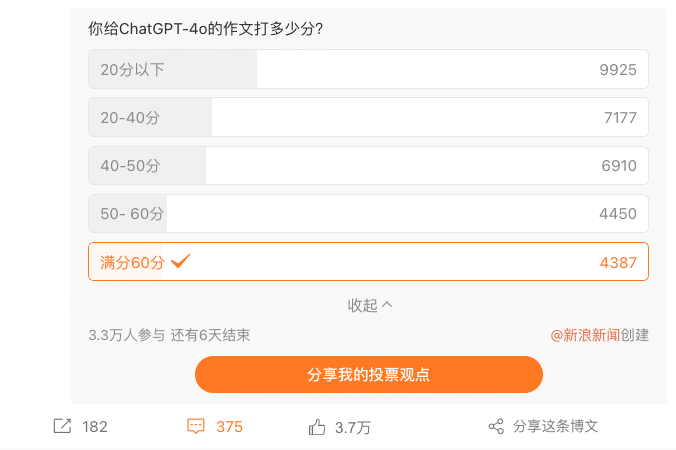
How well can ChatGPT write an essay about AI? Opinions are divided.
This shows that many commenters think that AI chatbots are still not able to beat humans when it comes to writing Gaokao essays.
Commenters reacted to the various AI-generated essays in various ways, including:
• “Actually, none of them are very good. They are too formulaic and standardized, lacking the natural creativity and originality that humans possess.”
• “They just give soulless standard answers.”
• “It’s all about ‘firstly,’ ‘secondly,’ ‘furthermore.'”
• “There are no examples, no points proven; it should be a low grade.”
• “It’s just too stiff.”
• “This is like reading reports, not essays.”
• “AI places more emphasis on logic, which aligns with the writing style of foreigners.”
• “There’s no feeling in these essays; there’s a certain kind of AI feeling to AI.”
Meanwhile, some bloggers are taking up the challenge and are publishing their own online essays in response to the Gaokao question.
Some of them are not worried that chatbots will take over their critical tasks: “AI will be AI. There’s no connection to the social realities, and it’s as cold as ice.”
“Their words might make sense, but they lack feeling.”
But for some discussing the topic, they have come to realize that they are already depending too much on digital tools and AI applications for their everyday tasks, writing: “I made an attempt to write an essay, but discovered I already forgot how to do it!” For them, the discussion itself is a wake-up call that writing an essay from scratch is a skill that requires practice and cannot be fully replaced by chatbots, making personal creativity essential to score points and avoid the ‘AI-fication’ of texts.
PS:
In his book China’s Millennials, Eric Fish describes the limits on Chinese students’ answers; taboo responses, such as those containing harsh criticisms of the Chinese government or society, could potentially lead to failure. Although the essay is purportedly meant to showcase the student’s creativity, it must adhere to the unwritten rules of what is socially acceptable.
By Manya Koetse
Spotted a mistake or want to add something? Please let us know in comments below or email us. First-time commenters, please be patient – we will have to manually approve your comment before it appears.
©2024 Whatsonweibo. All rights reserved. Do not reproduce our content without permission – you can contact us at info@whatsonweibo.com.


Weibo Watch: The Future is Here

“Bye Bye Biden”: Biden’s Many Nicknames in Chinese

Enjoying the ‘Sea’ in Beijing’s Ditan Park

A Triumph for “Comrade Trump”: Chinese Social Media Reactions to Trump Rally Shooting

Weibo Watch: Get Up, Stand Up

The Tragic Story of “Fat Cat”: How a Chinese Gamer’s Suicide Went Viral

“Old Bull Eating Young Grass”: 86-Year-Old Chinese Painter Fan Zeng Marries 36-Year-Old Xu Meng

A Brew of Controversy: Lu Xun and LELECHA’s ‘Smoky’ Oolong Tea

Singing Competition or Patriotic Fight? Hunan TV’s ‘Singer 2024’ Stirs Nationalistic Sentiments

Zara Dress Goes Viral in China for Resemblance to Haidilao Apron

Weibo Watch: The Battle for the Bottom Bed

About the “AI Chatbot Based on Xi Jinping” Story

China’s Intensified Social Media Propaganda: “Taiwan Must Return to Motherland”

Weibo Watch: Telling China’s Stories Wrong

Saying Goodbye to “Uncle Wang”: Wang Wenbin Becomes Chinese Ambassador to Cambodia
-
 China Insight3 months ago
The Tragic Story of “Fat Cat”: How a Chinese Gamer’s Suicide Went Viral
-

 China Music4 months ago
The Chinese Viral TikTok Song Explained (No, It’s Not About Samsung)
-

 China Digital10 months ago
Too Sexy for Weibo? Online Discussions on the Concept of ‘Cābiān’
-

 China Arts & Entertainment12 months ago
Behind 8 Billion Streams: Who is Dao Lang Cursing in the Chinese Hit Song ‘Luocha Kingdom’?
paquirrin
July 11, 2017 at 7:59 pm
and now the government wants to block vpns so that we all need to use Baidu Maps and go to Putian clinics
bailsafe
July 17, 2017 at 11:44 pm
That’s ridiculous. Do you have some aversion to QQ Map or Amap (listed in the article)? Or hell, even Bing Maps?