
China Health & Science
Changchun Vaccine Scandal Causes Outrage on Weibo
Another vaccine scandal heightens parents’ distrust of vaccines.

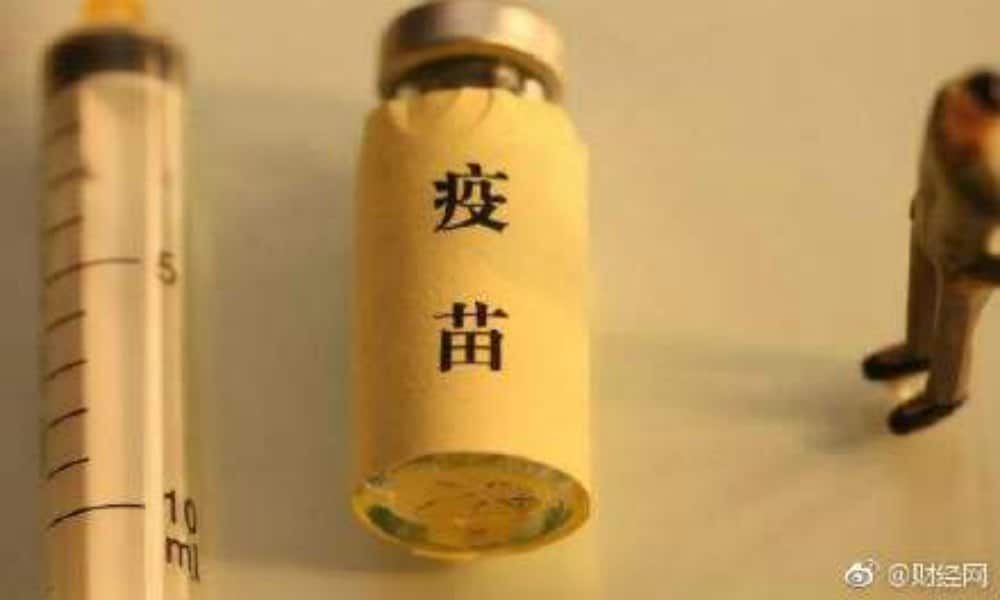
A new vaccine scandal involving Changchun Changsheng, China’s second-largest producer of anti-rabies vaccines, has caused a tsunami of outrage and media coverage in China this week.
China’s State Food and Drug Administration found that the Jilin-based Changchun company did not only produce fake anti-rabies vaccines, but also substandard DPT vaccines, Caijing News reports on Weibo.
The news about Changchun’s violations already came out on July 15th, but especially led to a social media storm this weekend after reports leaked online exposing that the same company had already violated production laws as early as October of last year.
It is not the first time China faces serious problems in its vaccine programmes. In November of 2017, over 650,000 faulty – uneffective – vaccines were recalled in Shandong, Hebei and Chongqing.
In 2016, another scandal concerning the distribution of illegal and potentially deadly vaccines also became a major trending topic on Chinese social media.
It is mandatory for children to be vaccinated in line with the China National Immunization Programme.
At time of writing, the hashtag “Changchun Changsheng Counterfeit Vaccines” (#长春长生造假疫苗#) has already received over 49 million views on Weibo.
The current scandal adds to parents’ mistrust of vaccines in China, with thousands of people on Weibo demanding that those responsible for these violations should be given capital punishment.
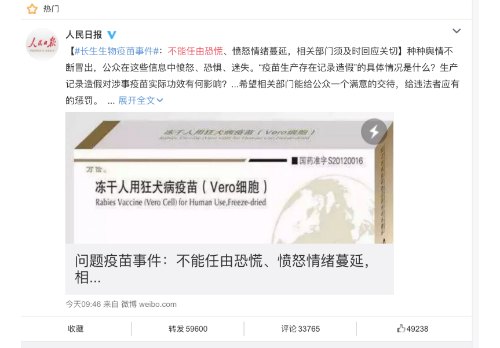
On the various Weibo accounts of Chinese state media and local authorities, however, a post has been published that asks people to “not let anger and panic spread,” and to trust that “the relevant departments will deal with this issue in a timely manner.”
Various essays and comments threads about the faulty vaccines were no longer visible as of Sunday afternoon. While Beijing News reports that the Changchun vaccines were not used in Beijing, many questions still linger for worried parents in many other parts of the country.
By Manya Koetse
Follow @whatsonweibo
Spotted a mistake or want to add something? Please let us know in comments below or email us.
©2018 Whatsonweibo. All rights reserved. Do not reproduce our content without permission – you can contact us at info@whatsonweibo.com.



Chapter Dive
Chinese Postdoc Death Raises Questions as Key Details Remain Missing
About a widely discussed “chilling effect”, the death of Chinese researcher Wang Danhao, and unanswered questions. (April 3 update included)

On March 27, news about a Chinese postdoctoral researcher based in the United States who allegedly died by suicide a day after being questioned by US law enforcement officials began trending on Chinese social media.
The news came out during the Friday regular press briefing, where a CCTV reporter asked China’s Ministry of Foreign Affairs (MFA) spokesperson Lin Jian (林剑):
🗣️ “We’ve learned [据了解] that recently, a Chinese postdoctoral scholar took their own life a day after being subjected to questioning by US law enforcement personnel. What’s the Foreign Ministry’s comment?”
Spokesperson Lin Jian responded that China is “deeply saddened by the tragedy,” and added that Chinese authorities have formally protested to the US, further commenting:
🗣️”For some time now, the US has been overstretching the concept of “national security” for political purposes, carrying out unwarranted questioning and harassment of Chinese students and scholars, infringing upon the legitimate rights and interests of Chinese citizens, undermining the normal atmosphere of China–US people-to-people exchanges, and creating a serious “chilling effect.””
Lin Jian emphasized that China urges American authorities to conduct a thorough investigation into the case, provide answers to the victim’s family and to China, and stop any “discriminatory law enforcement against Chinese students and scholars in the United States.”
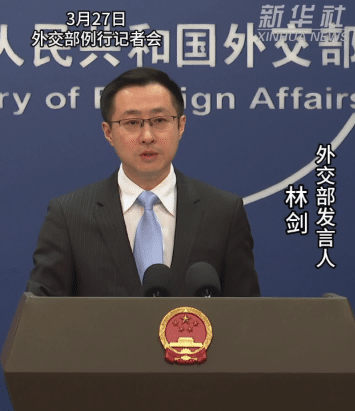
Lin Jian during the March 27 press briefing.
The “chilling effect” referenced by Lin Jian, in Chinese, is hán chán xiàoyìng (寒蝉效应), referring to a climate of fear in which people do not dare to speak out.
While xiàoyìng simply means “effect,” hán chán (寒蝉) literally means “a cicada in cold weather”—a metaphor for a repressive environment, as cicadas fall silent and become inactive in colder temperatures.
From MFA Briefing to Trending Topic
Following the press briefing, major Chinese news outlets like Xinhua and Global Times picked up the news and amplified the MFA statement across both their international and domestic channels, after which it quickly entered the top five “hot search” lists on platforms like Bilibili, Kuaishou, and Baidu. The MFA statement was also covered by Newsweek.
What is particularly noteworthy about how this news entered the online discourse is that it was reported solely through top-down, official channels. Unlike many incidents involving Chinese nationals overseas—particularly in cases of sudden death or personal tragedy—it did not first surface on social media through posts by friends or family members before prompting an official response. Nor were there any identifiable reports from local news or overseas Chinese community platforms that broke the story before the MFA did.
This left many questions about which university this researcher was affiliated with, where the incident occurred, and why the CCTV reporter asked this question on March 27 without any published news reports to go by.
Some have argued the Chinese government deliberately amplified the story to stir anti-American sentiment amid broader US-China tensions — a claim made, without supporting evidence, by the notoriously biased Epoch Times outlet.
🔍 Given the lack of details, Weibo’s own AI chatbot attributed the incident to the death of Li Haoran (李昊然). Li was a postdoctoral researcher at Princeton University who died at home in September 2025. On February 13, 2026, his death was officially ruled a suicide. Since this case predated the current report and has never been linked to law enforcement questioning, this appeared to be a hallucination error by the Weibo chatbot.
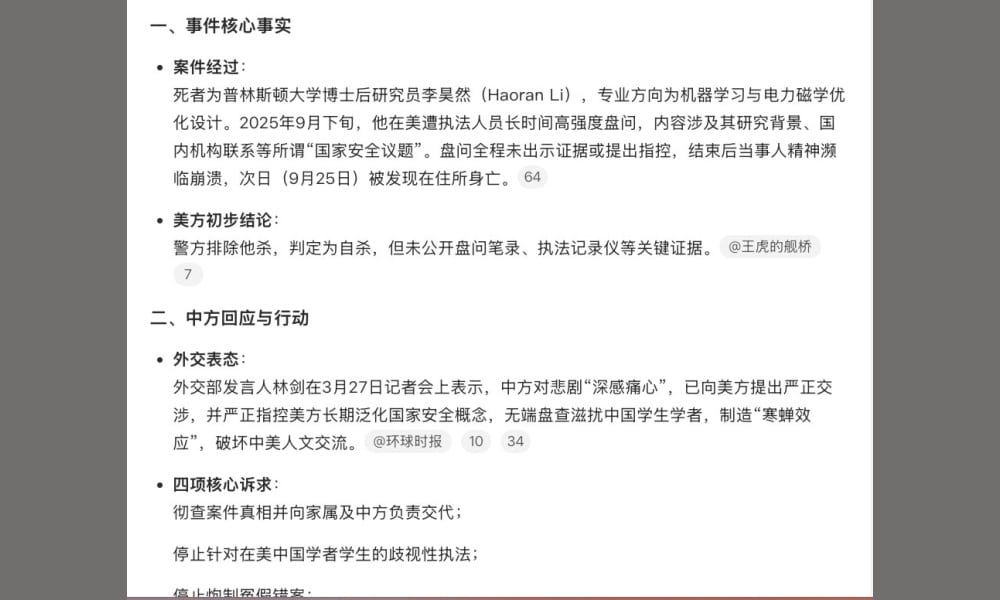
Weibo chatbot “hallucinating” and linking the current case to Li Haoran. Screenshot by author, March 27.
At the same time, claims popped up on social media regarding a recent suicide involving a researcher in the Department of Electrical & Computer Engineering (ECE) department at the University of Michigan.
One US-based Xiaohongshu user shared a screenshot of an email sent by University of Michigan staff on March 20 regarding the “sad news of the death of an Assistant Research Scientist (..) who fell from an upper story of the GG Brown building last night.”
The social media post, as well as an entire thread on another US-based Chinese community forum, had vanished by Monday, March 30, returning a “404” message.
The Michigan connection was also indirectly raised by some netizens (such as “Science Futurist” @科学未来人), who referenced earlier cases where Chinese researchers at the University of Michigan were allegedly “arrested, humiliated, and tormented.”
(🔍 Although there have been multiple incidents involving Chinese researchers at the university, this particular commenter referred to postdoctoral fellow Jian Yunqing (简云清), who was arrested by the FBI in June 2025 on charges including conspiracy and smuggling small samples of “toxic biological materials” into the US. This involved a crop-affecting fungus studied by Jian that, while also found in US fields, is illegal to import without a permit and is classified as a hazardous biological pathogen.)
Meanwhile, at the time of writing, few reports have emerged identifying any key details of the current case, and this lack of information surrounding the incident, both on the American and Chinese sides, is especially noteworthy for a case that has been framed as a major incident and a significant development in Sino-American academic exchanges.
The Michigan Connection
On March 31, the Chinese Consulate General in Chicago issued a statement via its WeChat account, responding to media inquiries regarding a Chinese scholar’s suicide following questioning by US law enforcement.
🗣️ The spokesperson confirmed that the case had occurred at a US university within its consular district, reiterating the sentiments expressed by the MFA and again using the term “chilling effect” (寒蝉效应, hán chán xiàoyìng). The statement criticized what it described as the US side’s use of “national security” to carry out unwarranted and politically motivated questioning and harassment of Chinese students and scholars.

Wechat post by Chinese Consulate in Chicago, March 31.
The Hong Kong newspaper Sing Tao Daily then connected the case to the University of Michigan’s ECE department, citing the aforementioned internal email and reporting that a local researcher died after falling from a height on the university’s North Campus.

The G.G. Brown Building, where the incident allegedly happened, when it was still under construction in 2013, photo by Michael Barera via Wikimedia Commons.
The deceased researcher was reportedly an Assistant Research Scientist on the team of Professor Zetian Mi, who specializes in semiconductors, nanomaterials, and optoelectronic technologies.
Professor Mi has been previously honored for his contributions to the growth of wide bandgap semiconductor materials, and leads a top-tier semiconductor research group that has received millions of dollars in funding from the US Department of Defense, published groundbreaking research, and earned prestigious awards in photonics and semiconductor science.
A Researcher at the Intersection of US–China Science
One Assistant Research Scientist previously listed on the official ECE website—who worked in Mi’s lab but has now been removed from the public staff list—is Dr. Wang Danhao (汪丹浩).
Wang’s research focused on next-generation semiconductor materials, including ultra-thin and ferroelectric systems with applications in electronics and photonics. He was previously part of a University of Michigan research team that explained why a new class of ferroelectric semiconductors can sustain opposing electric states without breaking apart—work published in Nature and supported by US funding sources, including the Army Research Office.
Over the years, Wang has built an extensive body of research published in some of the most prestigious scientific journals, including Nature Electronics, Nature Communications, and Science Advances.
More recently, Wang was listed as a co-first author on a study—covered by various industry publications—regarding a neuromorphic vision sensor capable of sensing, storing, and classifying images without external circuits, reportedly achieving over 95% recognition accuracy. The research was led by Professor Sun Haiding’s iGaN lab at the University of Science and Technology of China (USTC) and funded by Chinese government sources, including the National Natural Science Foundation of China.
Various Chinese sources have described this research as a breakthrough, noting that USTC developed the first optoelectronic diode integrating sensing, memory, and computing in a single device (“中国科大研制出首个具有感存算三合一功能的光电二极管”) (USTC link and news sources here and here).
According to Washtenaw County vital records, Wang Danhao died on March 20, 2026.
On that very same day, the research he contributed to (“A single diode with integrated photosensing, memory and processing for neuromorphic image sensors”) was published in Nature Electronics.
Wang’s profile, spanning research of interest to military and defense institutions, reflects involvement in both US-funded semiconductor projects (including work supported by the Army Research Office & within a DARPA-funded lab), as well as collaboration on Chinese government-funded research with a Chinese state university. This cross-institutional, cross-funded research highlights the increasingly complex and sensitive position of researchers operating across the US–China scientific landscape.
From a Mysterious Case to Serious Concerns
For now, many questions still surround this case, with official reports—from both the American and Chinese sides—likely to follow. At the time of writing, neither US government agencies nor the University of Michigan have publicly responded to the MFA statement or the Chicago consulate statement.
What we do know, and what is supported by prior studies, is that many Chinese researchers feel pressured and unsafe while carrying out academic work in the US, partly due to concerns about government investigations targeting researchers of Chinese origin.
In this recent case, Chinese online responses reflect that sentiment.
In some of the more notable discussions on Zhihu (such as this thread), users comment on the case’s mysterious nature while also linking it to a broader pattern of scrutiny and pressure on Chinese researchers in the United States.
These discussions reference past FBI investigations of Chinese academics under the so-called “China Initiative,” a 2018–2022 program launched by the US Department of Justice to counter espionage and intellectual property theft involving China.
🔍 One case mentioned is the 2024 death of Northwestern University Chinese-American neuroscientist Jane Wu (吴瑛), who died by suicide following years of federal scrutiny over her China-related ties, during which her lab was shut down, and her academic presence was later removed online.
In this context, some commenters also express skepticism about the suicide narrative in the current case. One popular comment stated:
💬 “Former Boeing quality manager and whistleblower John Barnett once publicly stated that if anything were to happen to him, it would not be suicide. On March 9, 2024, he was found dead in his car in a hotel parking lot in Charleston, South Carolina. The official ruling was suicide. He had been scheduled to testify that day, exposing issues related to Boeing’s production quality.”
Another commenter—a graduate of Peking University—argued that the US is no longer seen as a safe destination for Chinese researchers:
💬 “No matter how you look at it, he had already made it to the postdoc level, traveled all the way across the ocean only for things to end like this, it’s so unfortunate. Looking back now, the three years of the pandemic mark a very clear turning point. The “Bald Eagle” (白头鹰 – the US) is no longer an ideal destination for Chinese students, and is gradually no longer an ideal place for academic exchange and research either.”
At the same time, institutional responses are also taking shape.
🗣️ Dr. Nick Geiser, leader of the University of Michigan Postdoctoral Researchers’ Organization (UM-PRO), the union representing 1,500 postdocs, told Eye on Digital China they are currently bargaining with the university.
The union is preparing a proposal on international scholar rights that would ensure foreign postdocs are supported by the university in cases of abrupt funding cuts or warrantless investigations by US federal authorities.
This is a developing story. At the time of writing, there is no official confirmation that Wang Danhao is the individual referenced in this case. Any important updates will be added here as more information becomes available.
UPDATE April 3:
A news report by local news website MLive has come out earlier today, including additional information on this case.
In an April 1 email, Deputy Police Chief and Public Information Officer Melissa Overton stated that the researcher “jumped from the third floor and fell to the second floor inside the atrium in the George G. Brown Building on March 19.” He was later pronounced dead, and police — first called about 11 p.m. on March 19 — are investigating his death as a “possible act of self-harm.”
Paul Corliss, assistant vice president for public affairs and internal communications at the University of Michigan, has also issued a statement in an April 3 email, writing that: “Our priority is to honor the wishes of the family and those affected while adhering to legal requirements and ensuring that any information shared is accurate and non-speculative.”
An earlier internal email, sent out to the Michigan Engineering community on April 1, confirmed the passing of Wang Danhao (Dr. Danhao Wang), and stated that there is an active police investigation going on, with no further information to share.
The statement described him as “a promising and brilliant young mind,” whose research into wide bandgap III-nitride semiconductor materials and devices published in Nature “stands as a landmark, uncovering for the first time the switching and charge compensation mechanisms of emerging ferroelectric nitrides.”
The UM Postdoctoral Researchers Organization, the union that represents postdoctoral researchers, is advising its membership not to speak with federal authorities.
If you or someone you know is struggling, international mental health and crisis support helplines can be found at www.befrienders.org.
By Manya Koetse
(follow on X, LinkedIn, or Instagram)
Note: In Chinese, names are written with the surname first, followed by the given name (e.g. Wang Danhao, Mi Zetian). In English-language contexts, this order is usually reversed (e.g. Dr. Zetian Mi, Dr. Danhao Wang).
©2026 Eye on Digital China/Whatsonweibo. All rights reserved. Do not reproduce our content without permission – you can contact us at info@whatsonweibo.com.
Chapter Dive
The Fake Patients of Xiangyang: Hospital Scandal Shakes Welfare System Trust
Han Futao’s explosive report on fake patients and systemic abuse has triggered a heated online debate over hospital malpractices, the fragility of the welfare system, and the vital role of investigative reporting.


In early February, as China settled into the quiet anticipation of the Chinese New Year, one of the country’s leading investigative journalists, Han Futao (韩福涛), dropped a bombshell report that sent shockwaves of anger across the country.
Han Futao is known for breaking massive scandals. In 2024, he exposed how tank trucks that delivered chemical products also transported cooking oil, without being cleaned. That food safety scandal sparked waves of outrage and prompted a high-level official investigation, leading to criminal charges for those involved.
In his latest explosive report, published by Beijing News (新京报), Han has turned his lens to malpractice in China’s hospital sector. His investigation led him to Xiangyang, in Hubei province, a city with more than twenty psychiatric hospitals, cropping up on every corner “like beef noodle shops” over recent years.
Recruiting Patients
Han found that multiple private psychiatric hospitals lure people in under the guise of free care, promising treatment for little or no cost, along with medication and daily expenses. Some even dispatched staff to rural villages to recruit “patients.”
Troubled by the unusual marketing procedures of these psychiatric hospitals, Han went undercover at several facilities as a caregiver, and sometimes posing as a patient’s family member, only to expose a disturbing reality.
Except for a handful of genuine patients, these hospitals were filled with healthy people who actually received no treatment. Many were elderly citizens swayed by the promise of “free care,” checking in with the hope of finding a free retirement home.
When Han, posing as a patient’s family member, spoke to a hospital manager at Xiangyang Yangyiguang Psychiatric Hospital (襄阳阳一光精神病医院), the director enthusiastically pitched their “free hospitalization” by saying medical fees were completely waived and promising the potential patient a great stay: “Lots of patients stay here for years and don’t even go home for Chinese New Year!”
Meanwhile, the hospitals’ own staff, including caregivers, nurses, and security guards, were also officially registered as patients, complete with admission and hospitalization procedures.
The motive was simple: insurance fraud (骗保 piànbǎo). In China, even after state medical insurance covers part of psychiatric care costs, patients are typically still responsible for a co-pay. These hospitals, both in Xiangyang and in the city of Yichang, exploited the financial vulnerability of those unwilling or unable to pay, using the lure of free accommodation to attract the misinformed. Once admitted, the hospitals used their identities to fabricate medical records and bill the state for non-existent treatments.
According to internal billing records, medication accounted for only a small fraction of patients’ costs. The bulk of the charges came from psychotherapy and behavioral correction therapy, which often leave little material trace and, in these cases, were never actually provided. Many of these hospitals even lacked basic medical equipment and qualified personnel.
Staff were essentially manufacturing invoices, generating around 4,000 yuan (US$580) in fraudulent charges per patient each month, with most funds diverted from the National Healthcare Security Administration (NHSA).
With each patient yielding thousands of yuan, profitability became a numbers game: the more bodies in beds, the higher the revenue. This perverse incentive gave rise to a specialized workforce of marketers who recruited ordinary people from rural areas, developing sales pitches and establishing referral-based kickback chains, offering bonuses of 400 ($58) to 1,000 yuan ($145) for every new “patient” successfully brought in.
To stay under the radar, hospitals periodically discharged patients on paper to avoid scrutiny from insurance auditors, only to readmit them immediately, or never actually let them leave at all. One story involved a patient who was discharged seven times, each time being readmitted on the same day he was “discharged.”
Day after day, the national medical insurance fund, built on the collective contributions and trust of the entire population, was drained through these calculated deceptions.
From Patients to Prisoners
Han uncovered more. Even more harrowing than the scale of the medical insurance fraud was the condition of those trapped inside. To maximize profit margins, these hospitals slashed costs to the bone. Living conditions were terrible: wards overcrowded, beds crammed side-by-side, and daily activities and food substandard at best.
The hospitals treated their patients more like profit-generating assets than human beings. Patients were subjected to a strict regime: they were forced to follow rigid schedules, restricted to designated zones, and faced physical violence if they did not comply.
During Han’s undercover research, he witnessed the horrific sight of patients being tied to a bed for not following orders, with some patients allegedly being restrained for up to three days and three nights.
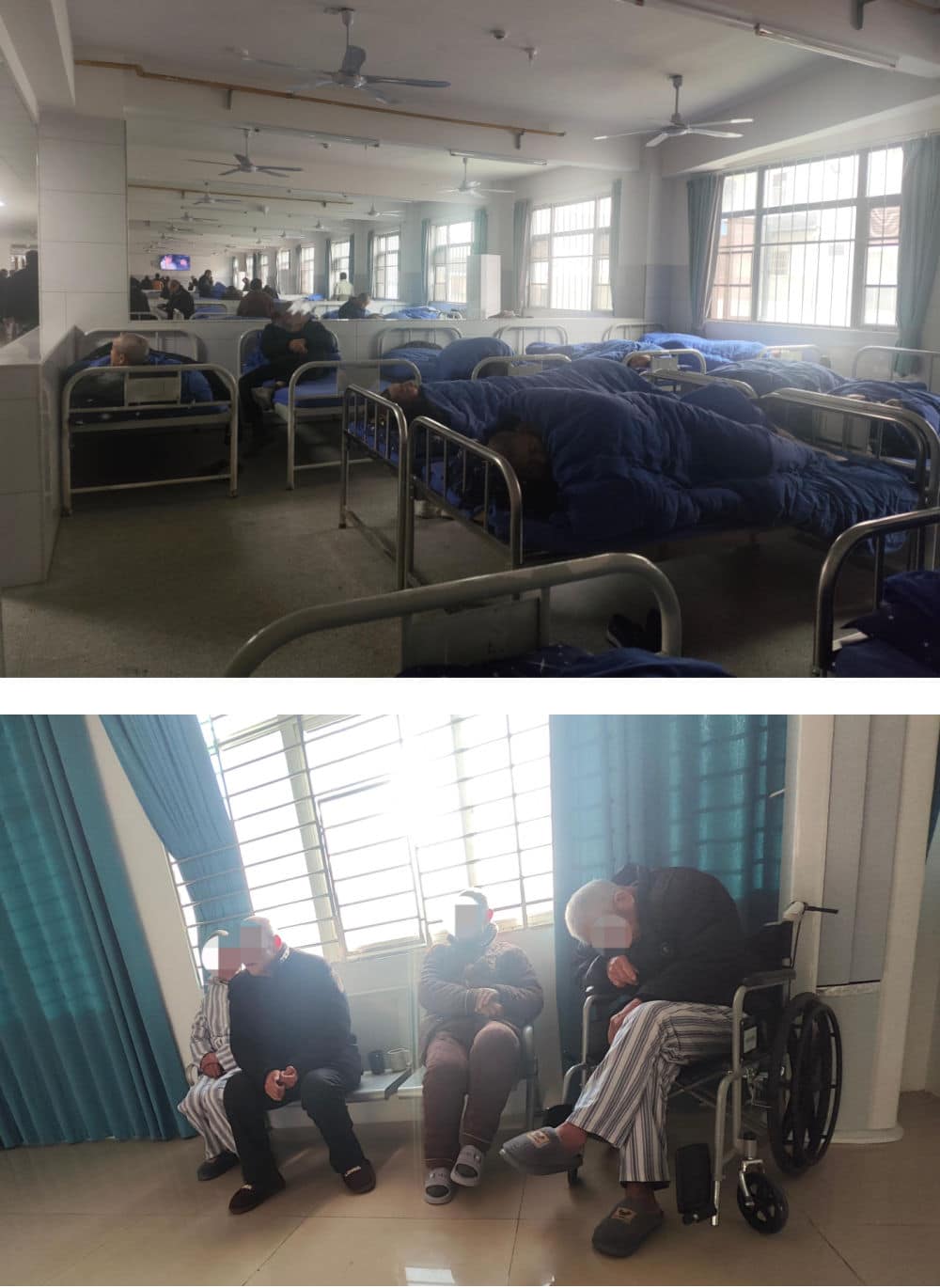
Photo by Han Futao, in Beijing News, showing a hall filled with beds at the Yichang Yiling Kangning Psychiatric Hospital, where more than 160 people were housed in just one ward. The lower photo, also by Han Futao, shows elderly “patients” kept in their wheelchairs all day at Xiangyang Hong’an Psychiatric Hospital.
Some patients, despite technically being the ones receiving care, were forced to perform manual labor for the staff. They scrubbed pots, cleaned wards, mopped latrines, and moved supplies. Others even had to take on nursing tasks for fellow patients, such as feeding, bathing, and changing clothes, all in exchange for a few cents to buy a cigarette. Their personal freedom and quality of life were virtually non-existent.
Escape was also difficult. The hospitals had no intention of releasing their cash cows. Rarely was a patient discharged on the scheduled date. To ensure long-term residency, many hospitals confiscated patients’ phones and cut off contact with their families.
Some individuals spent nearly ten years in these prison-like conditions; some even died there. Meanwhile, those truly suffering from mental illness received no real treatment, often seeing their condition worsen or developing deep-seated trauma toward psychiatric care.
Fragile Public Trust in Welfare-Related Institutions
In China, there is a common belief that if you spot one cockroach in the room, there are already a hundred more hiding. As the story has gone viral over the past two weeks, netizens pointed out that Xiangyang and Yichang were likely not the only cities using such predatory tactics to cannibalize the national treasury. Han’s investigation struck a deeper nerve, and public anxiety over the security of social insurance once again bubbled to the surface.
China’s national health insurance is a cornerstone of the broader social insurance system and a vital part of life for nearly every citizen. It is generally divided into two categories: Employee Medical Insurance and Resident Medical Insurance. Employers are legally, at least in theory, required to contribute to the employee scheme, typically 6% to 9% of a worker’s salary. Non-employees, such as farmers, students, and freelancers, usually pay for Resident Insurance out of pocket, currently costing around 400 yuan ($58) annually. Under the employee scheme, inpatient reimbursement rates are roughly 80% to 85%; after approximately 25 years of contributions, members enjoy lifelong coverage without further payments. The Resident Insurance, however, offers significantly lower protection.
This system was designed as a fundamental safety net to alleviate the fear of falling into poverty due to illness or being left destitute in old age. For young Chinese job seekers, whether a company pays into social security used to be a non-negotiable criterion. However, as scandals shaking the foundation of this system have become more frequent, the mindset of the youth is shifting: Is it even worth paying into anymore?
Recent years have seen a steady stream of corruption scandals involving the embezzlement of social security funds.
Despite the authorities’ firm stance and high-profile punishments, 2025 was still marked by reports of officials — including the insurance bureau’s finance head — misappropriating funds to play the stock market. A June 2025 report even alleged that 40.6 billion yuan (US$5.8 billion) in national pension funds had been misappropriated or embezzled by local governments.
In one surreal case from Shanxi, a CDC employee’s records were doctored 14 times to create an absurd history of “starting work at age 1 and retiring at 22,” allowing them to pocket 690,000 yuan ($100,000) in pension while still drawing a salary at a new job.
These stories exposing large-scale abuse of the medical insurance system, combined with the extension of the minimum contribution period for retirement from 15 to 20 years amid a slowing job market and a gradually rising retirement age, are leading netizens to question the necessity of paying into the system. This is reflected in comments such as:
-“First it was 20 years, then 25, then 30. They move the goalposts whenever they want, but the benefits never improve.”
-“I won’t buy anything beyond the bare minimum resident insurance; who knows if there will even be a payout in the future?”
-“With a deficit this large, whether we’ll ever see that money is a huge question mark.”
-“I’m not even sure I’ll live to see 65 anyway.”
Echoes of the Cuckoo’s Nest
In response to Han’s latest exposure, local authorities immediately launched investigations, and state-run media outlets issued sharp criticism. By now, fourteen hospital executives have been criminally detained on suspicion of fraud.
Although the official report, published on the night of February 13, acknowledged that there was widespread medical fraud, with patients remaining hospitalized after recovery or empty beds being registered without any patients there, it said no evidence was found that people without mental disorders were admitted, which was one major finding of Han’s undercover operation.
This led to new questions, because how could fraud, abuse, fake discharges, and official corruption be acknowledged while denying the central allegation: that healthy people were being locked up? And how could people prove they were not mentally ill, while being a patient inside a psychiatric hospital?
Political & social commentator Hu Xijin (胡锡进) wrote on Weibo that, while he applauded Han and his team for exposing the mismanagement at psychiatric hospitals in Hubei, he also saw the report’s conclusions about the patients as a reminder that journalists should exercise caution when making accusations. Some sarcastic commenters suggested that perhaps Han had not sacrificed enough and should have admitted himself as a patient instead.
And so, in a way, the debate has now slowly also shifted – from the initial shock over Han’s report, to the anger and distrust surrounding state institutions and social security abuse, to the role of investigative journalism in China today. “He’s a hero,” some commenters said about Han.
In the end, the entire story is so absurd that some commentators have drawn parallels to One Flew Over the Cuckoo’s Nest (飞越疯人院), where Randle P. McMurphy (Jack Nicholson) fakes insanity to serve his sentence in a mental hospital instead of a prison work farm, only to find out that the endless chain of control and abuse at the psych ward is much more brutal than a prison cell.
The question inescapably becomes who the sane ones actually are.
Meanwhile, the scandal shows that public anxiety about the future and distrust of state institutions tend to rise quickly and deepen slowly with each new controversy. As trust in the national welfare system appears fragile, one sentiment persists: that there is far more to uncover, and that there are far too few Han Futaos to do it.
By Ruixin Zhang
With additional reporting by Manya Koetse
Spotted a mistake or want to add something? Please let us know in comments below or email us. First-time commenters, please be patient – we will have to manually approve your comment before it appears.
©2026 Eye on Digital China/Powered by Whatsonweibo. All rights reserved. Do not reproduce our content without permission – you can contact us at info@whatsonweibo.com.
Eye on Digital China is a reader-supported publication by
Manya Koetse (@manyapan) and powered by What’s on Weibo.
It offers independent analysis of China’s online culture, media, and social trends.
To receive the newsletter and support this work, consider
becoming a paid subscriber.


Quick Eye: XChat, Orbán, and a Very Questionable Tripe-Strawberry Hotpot

Cancel-Proof: The Rise of China’s AI Actors

Chinese Postdoc Death Raises Questions as Key Details Remain Missing

“Auntie Mei” Captured After 20 Years, China’s Train-Stain Scandal, and Zhang Xuefeng’s Final Lesson

Raising Lobsters, 6G Coming, and China’s DIY Deity Trend

Inside Chunwan 2026: China’s Spring Festival Gala

Inside the Great Chinese Debate Over the Iran War

Chinamaxxing and the “Kill Line”: Why Two Viral Trends Took Off in the US and China

Spring Festival Trend Watch: Gala Highlights, Small-City Travel, and the Mazu Ritual Controversy

From a Hospital in Crisis to Chaotic Pig Feasts
-

 Chapter Dive9 months ago
Hidden Cameras and Taboo Topics: The Many Layers of the “Nanjing Sister Hong” Scandal
-

 China Insight9 months ago
“Jiangyou Bullying Incident”: From Online Outrage to Offline Protest
-
 Chapter Dive12 months ago
Understanding the Dr. Xiao Medical Scandal
-

 China Arts & Entertainment7 months ago
The Wong Kar-wai Scandal Explained: The Dark Side of ‘Blossoms Shanghai’
cryptolauren
January 16, 2019 at 2:55 pm
BTC Losses Coincide with China’s New Policies