
China Insight
10 State Media Cartoons on China’s Social Credit Implementation
This is how state media propagate the Social Credit System.

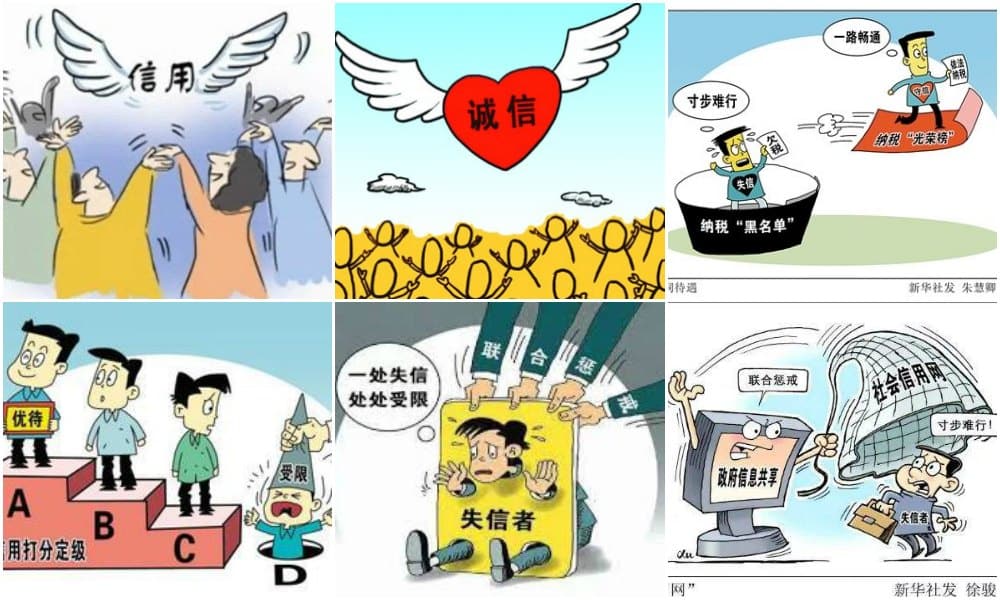
First published
The growing importance of China’s Social Credit implementation is a hot topic in the media – both in- and outside of China.
Ever since the Chinese government announced its first plans in 2014 on the construction of a nationwide Social Credit System to be rolled out by 2020, media coverage on the issue has seemingly been growing month on month.
According to the official government website, the system (or policy) is meant to “assess individuals and government agencies on areas ranging from tax payment and local government bonds to judicial credibility,” and focuses on credit in the areas of (1) administrative affairs, (2) commercial activities, (3) social behavior, and (4) the judicial system.
Part of the Social Credit plan is the implementation of blacklist systems that punish the “untrustworthy” behavior of companies or individuals through various measures. Already in 2013, China’s Supreme Court launched its online publicly available ‘blacklist’ with the names of people that have an effective court order against them.
In 2017, there were more than a hundred regions in China where local governments worked with blacklists. Earlier this year, Chinese media published reports claiming that more than 9,5 million people were blacklisted nationwide in 2017. Those on these lists could face a hold on their loans or travel bans, and will have to deal with a range of other restrictions in their daily lives until they comply with court orders.
In foreign media, the system has been called “Black Mirror-like” or “Orwellian,” while Chinese state media generally emphasize “innovation” and “harmony” when discussing these new implementations.
The cartoons that are published together with news reports on social credit also clearly show the big differences in how the social credit implementation is perceived in foreign media versus in Chinese media.
Below, on the left, is Financial Times‘ Ingram Pinn’s illustration which was featured in a 2018 article discussing both private credit scores (e.g. Sesame Credit) and the national social credit implementation (for the difference between them, please see our “Open Sesame” article). On the right is a cartoon by state media outlet Xinhua – the same illustration is regularly posted across dozens of news sites when featuring social credit-related stories.
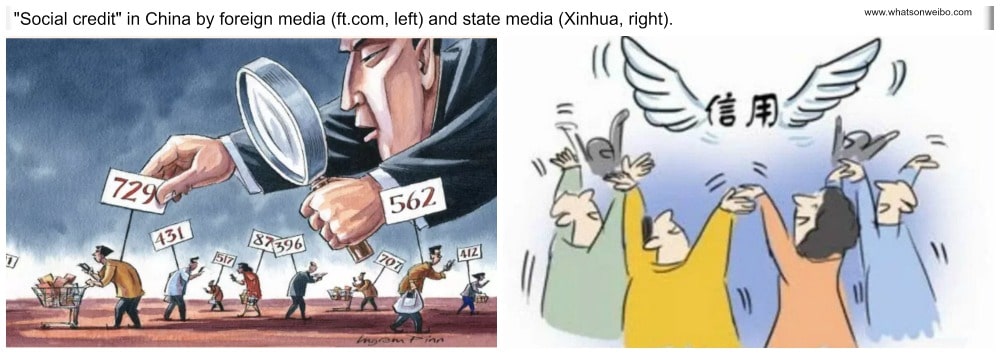
While the cartoon on the left illustrates people as carrying the heavy burden of their ‘credit score’ (note that only commercial programmes such as Sesame Credit actually have these scores), the cartoon on the right shows the social credit as flying over a group of cheering people.

1: “Xinyong” (trustworthiness) flies above the happy people.
In general, the illustrations on Social Credit in Chinese state media roughly present China’s nascent Social Credit implementation in two ways; (1) as punishing individuals for bad behavior and (2) as benefiting the collective, which builds on a more harmonious society together.
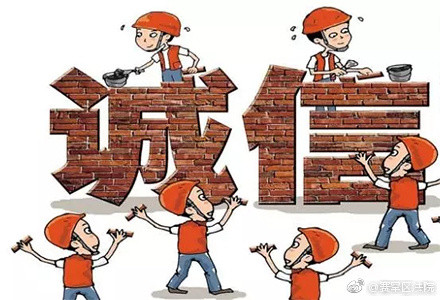
2: Building “trust” together.
This cartoon above was used in a local government post about social credit and shows people dressed as construction workers literally ‘building’ on the characters for ‘honest’ and ‘trustworthy’ (诚信).
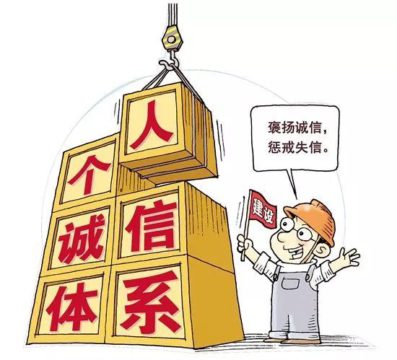
3. Xinhua cartoon: constructing the social credit system.
The idea of literally ‘building’ on a Social Credit System together is also illustrated in other cartoons used by Chinese state media, such as the one above by Xinhua that shows a person waving a flag that says “construction,” standing in front of a number of blocks that form the term “personal integrity system” (个人诚信体系).
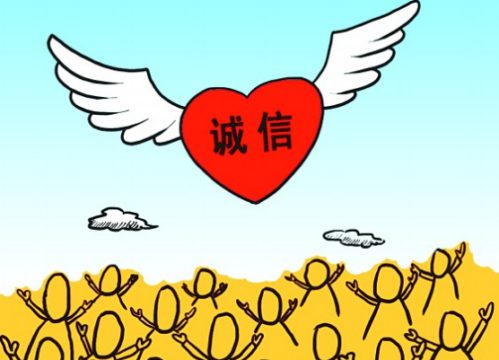
4. Integrity above the people.
The applauding and cheering keeps coming back in other cartoons, such as the one above that is published across multiple news platforms. The characters in the flying heart say “chéngxìn” (诚信) , meaning ‘integrity.’
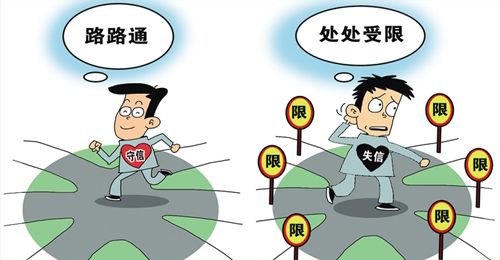
5. Blacklisted people can’t go anywhere.
Besides the illustrations propagating the benefits of the Social Credit system for the collective, there are also many which emphasize the downsides for individuals who get blacklisted. This illustration, published on on the Economic Weekly zhonghongwang.com, shows a person on the left that has a heart on his chest saying ‘keeping trust’ (or: ‘trustworthy’), and the text above his head says “I can go anywhere” (路路通). The person on the left has a ‘lose trust’ black heart on his chest; this ‘blacklisted’ individual sees “limits” on all the signs around him and the cloud text above his head says: “I’m blocked everywhere” (处处受限).
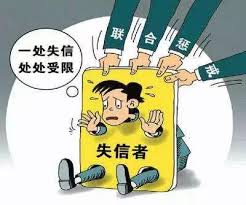
6. Lose your trust in some place, and there’s no place to go.
This illustration published on Party newspaper People’s Daily shows an individual being punished through a pillory which has the term for “blacklisted person” on it. The man’s thinking cloud says: “Lose your trust in one place, and there’s no place to go” (“一处失信、处处受限”), which is a slogan that is recently applied a lot by Chinese media writing about the Social Credit system.
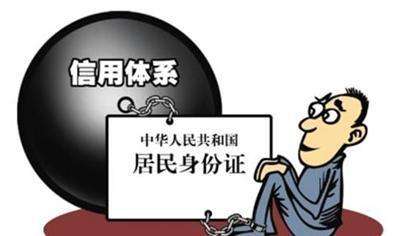
7. Social credit as ball and chain.
To be fair, the illustration above was not published by state media outlet but by various commercial sites, but I still wanted to include it here; these illustrations travel from news article to news article and it is not always easy to detect their origin. This cartoon shows a big ball and chain, the ball says “Social Credit System,” which is tied to the chain which holds a “Resident Identification Card” (official ID of the PRC) and is then tied to the individual.
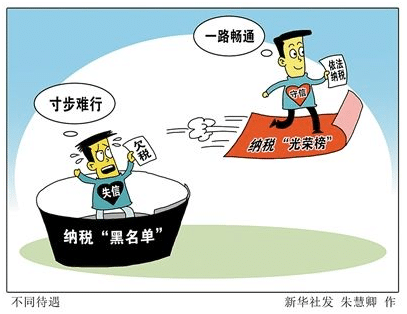
8. Tax evaders get caught.
This Xinhua illustration, also published on the official government Credit site, shows a man caught in a “black list name” confinement for tax evasion, with the cloud saying: “I can’t move a single step!” (寸不难行). On the flying carpet that says “honor list for paying tax” is another man who holds a “legal tax paper” in his hand and who says: “I can go wherever.”
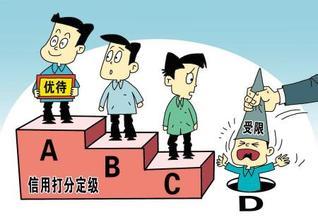
9. Trust ranks.
This widely circulating illustration shows four individuals from A to D, standing on a block that says “Trust credit levels.” The A man holds a sign that says “special treatment” (or: “favored”), whereas the number D man is put a dunce on his head that says “constrained,” while he falls into a black whole.
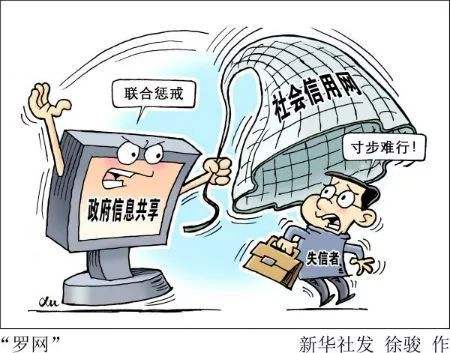
10. Big credit is gonna get you.
The cartoon above, by state media outlet Xinhua, shows a computer that has the term “government information sharing” on it, and says: “[We] unite in taking disciplinary measures!” He holds a big net that is titled “Social Credit Web,” and captures a man with a briefcase who is “blacklisted,” and also says, as we’ve seen in previous illustration, that there is “no way to go” for him.
All in all, the message these various illustrations propagate is straight-forward: those who stay off the black lists and behave like good citizens are free to go wherever they want, those who do not will be caught and lose their freedom of movement. They further emphasize that the Social Credit System is a combined effort, that will, allegedly, benefit the collective and make China a safer and more harmonious place.
Want to understand more? Also read our previous articles explaining social credit in China here and here.
By Manya Koetse
Follow @whatsonweibo
Directly support Manya Koetse. By supporting this author you make future articles possible and help the maintenance and independence of this site. Donate directly through Paypal here. Also check out the What’s on Weibo donations page for donations through creditcard & WeChat and for more information.
Spotted a mistake or want to add something? Please let us know in comments below or email us.
©2018 Whatsonweibo. All rights reserved. Do not reproduce our content without permission – you can contact us at info@whatsonweibo.com.


China Insight
Mbappé, Mao, and the Joke That Shall Not Be Named
Mbappé’s favorite Mao meme sparked major backlash in China. More on what the controversy reveals about political red lines, online humor, and censorship.
RESOU 热搜 | What’s Trending in China, Explained
Here, I briefly unpack the stories making waves on Chinese social media and share what stands out to me. Don’t miss an update: become a subscriber to Eye on Digital China today.
Oh oh oh, Mbappé, all those goals, yet you lost so many points on Chinese social media over the past 48 hours.
Following his 100th goal for Real Madrid during El Clásico and finishing second on Ballon d’Or night, French football player Mbappé is all the talk on Chinese social media — not for his achievements, but for what is seen as crossing a major red line in an online interview.
On Tuesday night, a text came in from Ruixin: “I am wide awake tonight and somehow witnessed live how the footballer Kylian Mbappé was getting blocked and totally canceled on Chinese social media for his comments about Mao Zedong over the past, like, three hours 😅”
I quickly grabbed my phone and saw the flood of Mbappé posts rapidly coming in, and it was clear that people were very cross with him.
Although it was already clear that this might not blow over any time soon, by early Wednesday morning it became painfully clear how the controversy had snowballed. Dongpeng Beverage Group (东鹏), one of the many Chinese companies that signed the famous sportsman as its brand ambassador, publicly stated that it was cutting all commercial ties with Mbappé. Soon, others followed.
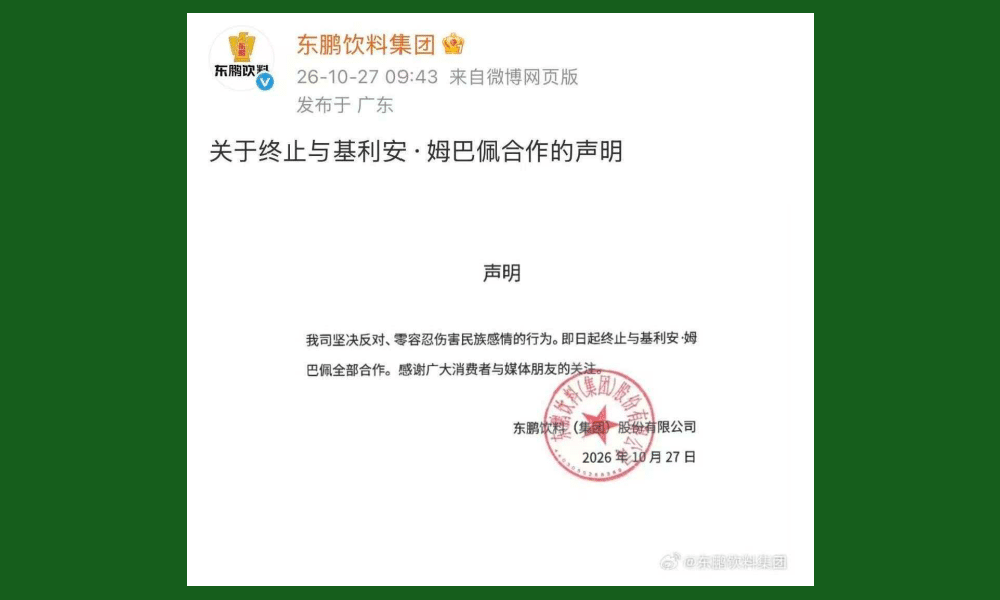
Dongpeng Beverage Group (东鹏): the first in a string of companies to cut ties with French footballer Kylian Mbappé.
Mbappé’s fall from grace in China has been sudden and spectacular, like a major avalanche of backlash that unfolded in one night, and it can all be traced back to one segment of an interview the footballer previously did on a French YouTube show (The Bridge) that resurfaced online — initially through Reddit and X, and then on Chinese social media apps, like football platform Dongqiudi (懂球帝).
In that segment, when asked about his favorite meme, Mbappé replied that one of the memes he finds funniest is:
🗣️ “the one where they put my face on some guy, a Chinese dictator. That really makes me laugh, I use it with my friends all the time.”

The interview segment where Mbappé shares his favorite meme: his face photoshopped onto the face of a “Chinese dictator.”
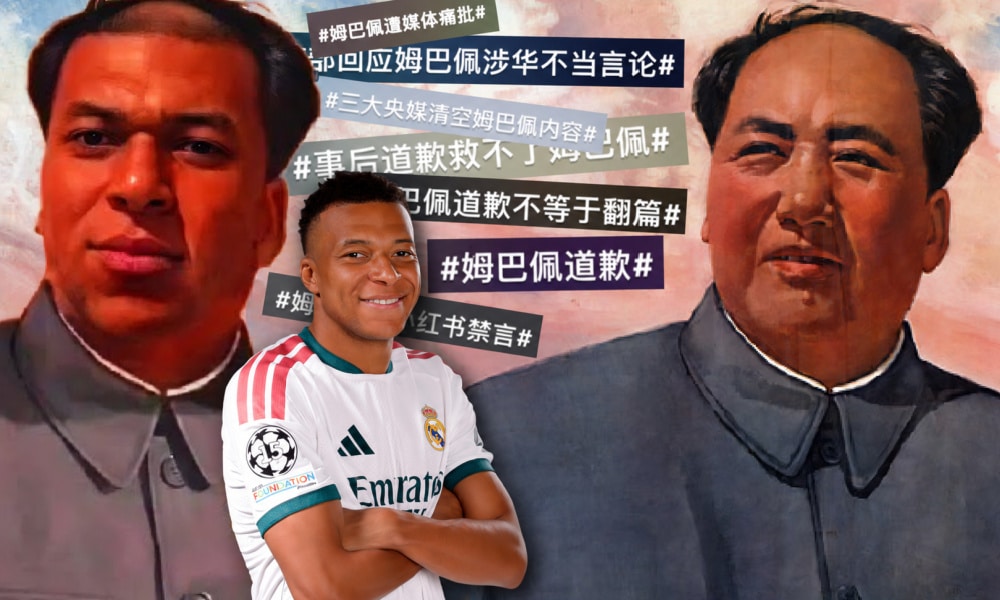
The show, created by Mbappé’s Real Madrid teammate Aurélien Tchouaméni, added the image Mbappé referred to: his face photoshopped on a Mao propaganda visual. It’s part of a series of memes that emerged in 2024 in which Mbappé’s face is edited onto the faces of dictators.1
Chapter Dive
The French Protests, Viewed from China: Five Narratives on Chinese Social Media
From the decline of Europe to historical karma: these 5 narratives reveal how Chinese social media discusses the recent unrest in France.

Eye on Digital China is a reader-supported publication by
Manya Koetse (@manyapan) and powered by What’s on Weibo.
It offers independent analysis of China’s online culture, media, and social trends.
To receive the newsletter and support this work, consider
becoming a paid subscriber.


Mbappé, Mao, and the Joke That Shall Not Be Named

The French Protests, Viewed from China: Five Narratives on Chinese Social Media

What Does 20 Yuan ($3) Mean Anymore? China’s Disappearing Living Rooms & the Great Laundry Debate

Starbucks Goes Xinjiang & The Kardashians in China

Red Carpet, Pandas, and Power: How China Read the Trump-Xi Summit

Why Japan Has So Many Surnames, China’s Back-to-School Shifts & Taiwan Pavilion Trouble

The Power of Ugly: Why Niu Lai Became China’s Unlikeliest Box-Office Hit

The Rise of “Shuaqi-ism,” Taking Starbucks to the Fields, and Pretending to Go to Work

AI Actress Ad Pulled, Baihaitun Disrupts Shanghai and Cicada Meme Bugs Huawei

Blame Games & Bad Signs: Nepal–Tibet Floods, Huawei’s Toilet Trouble, “Screwed” Graduates
-

 Chinese New Year9 months ago
Inside Chunwan 2026: China’s Spring Festival Gala
-

 China Brands, Marketing & Consumers12 months ago
Hasan Piker’s China Trip & the Unexpected Journey of a Chinese School Uniform to Angola
-

 Chapter Dive8 months ago
Inside the Great Chinese Debate Over the Iran War
-

 China Trend Watch12 months ago
Japan Tensions, Nexperia Fallout, Yunnan’s ‘Wild Child,’ & “Modern Opium”