
China Insight
The End of an Ally: China is ‘not North Korea’s savior’
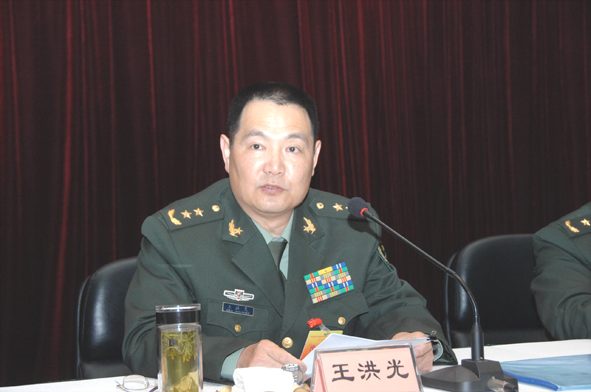
As China’s patience with North Korea is growing thin, China is questioning the ties with its 65-year long ally. “We have wiped North Korea’s ass for too long,” says General Wang Hongguang.

As China’s patience with North Korea is growing thin, China is questioning the ties with its 65-year long ally. “We have wiped North Korea’s ass for too long,” says General Wang Hongguang.
How should China deal with North Korea? It is a central question in Chinese media this week, as two prominent figures in the China-North Korea debate publicly announced their perspectives on the future of the bilateral relationship. China has been the most important ally and friend to North Korea since the separation of the two Korea’s by the end of WWII. China supported the North during the Korean War (1950-1953) and has lent political and economic backing to its leaders since. China is not only North Korea’s main trading partner, it also is its main source of food, energy and weapons (Xu & Bajoria 2014). Although the cost of subsidizing North Korea is high, the fear of a crumbling North Korean regime has been higher; North Korea’s implosion could lead to a stream of refugees into China and a security vacuum that would be filled by South Korea, Japan and the United States (Kornberg&Faust 2005, 165). But since North Korea has carried out its third nuclear test since 2006, the alliance between Beijing and Pyongyang has weakened. Instead, China’s relations to South Korea are gradually warming. It is at this time that Chinese media focus on China-North Korea ties. Over the past week, Chinese Korea specialist Li Dunqiu and retired People’s Liberation Army (PLA) lieutenant Wang Hongguang have both shared their views on the future of the China-North Korea alliance. Lieutenant Wang’s view is straightforward: “China is not North Korea’s savior.”
Recently, several Chinese scholars have suggested that China should renounce its relations with North Korea. On November 27th, Professor Li Dunqiu from Zhejiang University stated in the Chinese Global Times that China cannot simply give up its special 65-year long friendship to Pyongyang, since it is important to China in many ways. Not only is North Korea important to China as a strategic partner, it also is a communist ally that shares the same interests. Li states that giving up on North Korea could also pose a security threat to China: if North Korea crumbles, the United States might benefit from its weakness by gaining the strategic advantages it has been pursuing since the Korean War (Guancha 2014).
“China has wiped North Korea’s ass for too long,” says General Wang.
General Wang Hongguang disagrees with Li. He responded to the article on December 1st with his essay “China’s Non-Existent “Abandoning North Korea” Problem” (“中国不存在“放弃朝鲜”的问题“ ). According to Wang, the entire debate boils down to one thing: North Korea was never really China’s true ally to begin with, so their ‘non-existent’ alliance cannot be renounced. Wang denies that Pyongyang and Beijing have the same interests. If that were the case, Wang argues, then North Korea would not possess nuclear weapons. These weapons are damaging Chinese territories through pollution and are posing a serious threat to the people of China. They also jeopardize the peace of the region. Beijing fears that North Korea’s possession of a nuclear bomb will trigger Japan to get its own nuclear weapons. A regional war could erupt, involving Russia, South Korea, Japan, North Korea, China, and the US. If these powerful nations all get involved in a Northeast Asian conflict, regional security is in serious danger. From this perspective, Wang wonders how Li could maintain that North Korea and China have the same interests: North Korean does not take China’s interests into account at all. “China has to think from its own perspective and has take a stance against North Korea harming our interests ,” says Wang: “We should not even think of it as ‘abandoning’ North Korea. China has wiped North Korea’s ass for too long.” China should not go to war for North Korea, adds Wang: “China’s younger generations should not fight a battle for a country that is not theirs” (Guancha 2014).
North Korea is not China’s communist or socialist ally, according to Wang. Any ideological similarities North Korea and China once had, have disappeared since long. North Korea has developed in a vastly different direction than China has, and all of its political Marxist thoughts and principles have been replaced by those of Kim Il Sung. “It is not a real socialist country,” says Wang.
“China will not go to war for North Korea.”
Wang also denies North Korea’s significance as a strategic military partner to China because of its location, since the nature of war has changed due to globalization and the Information Age. Other factors, more important than location, have become crucial in building strategic relations.
China should not get involved if North Korea crumbles, Wang concludes. If a regime is not supported by the people, it’s only a matter of time before it falls. China’s role in this issue should not be overestimated, says Wang: “China is not North Korea’s savior” (Guancha 2014).
References
Guancha. 2014. “解放军中将:朝鲜若崩溃中国救不了 中国人不必为朝打仗” Guancha [The Observer] 1 Dec http://www.guancha.cn/internation/2014_12_01_302090.shtml (Accessed Dec 1, 2014).
Kornberg, Judith F. and John R. Faust. 2005. China World Politics: Policies, Processes, Prospects. Vancouver: UBC Press.
Xu, Beina and Jayshree Bajoria. 2014. “The China-North Korea Relationship.” Council on Foreign Relations, 22 Aug http://www.cfr.org/china/china-north-korea-relationship/p11097 (Accessed Dec 2, 2014).
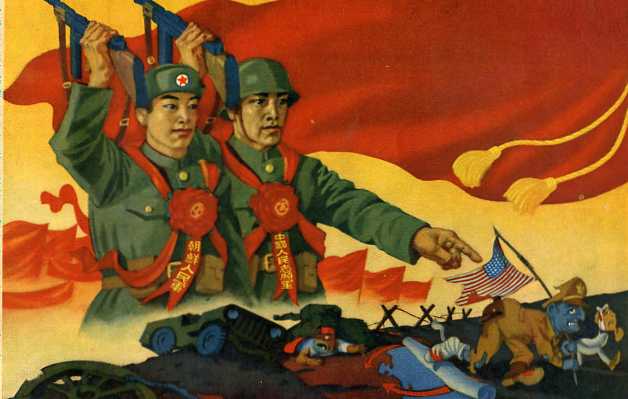
Featured image: Chinese propaganda poster from 1952: “Long live the North Korean People’s Army and the Chinese People’s Liberation Army!”, via http://www.163w.co/html/xch/cxrm.html
Appreciate this article and want to help us pay for the upkeep costs of What’s on Weibo or donate a cup of (green) tea? You can do so here!

[box type=”bio”]
 About the Author: Manya Koetse is the editor of What’s on Weibo. She’s a Sinologist who splits her time between the Netherlands and China. She earned her bachelor’s degrees in Literary Studies, Japanese & China Studies and completed her MPhil in Asian Studies. Contact: manya@whatsonweibo.com, or follow on Twitter.[/box]
©2014 Whatsonweibo. All rights reserved. Do not reproduce our content without permission – you can contact us at info@whatsonweibo.com.


Chapter Dive
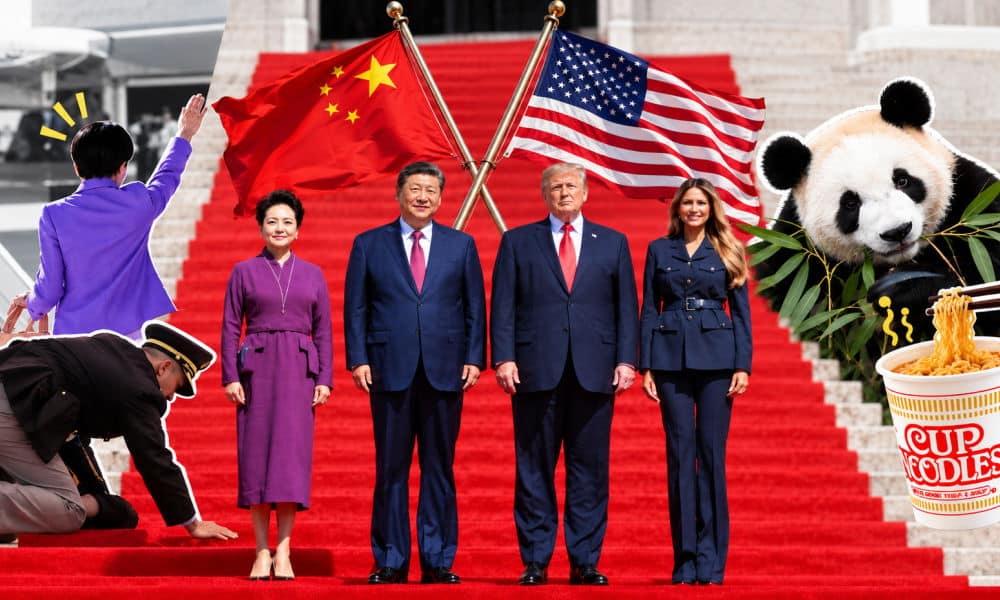
Red Carpet, Pandas, and Power: How China Read the Trump-Xi Summit
On Chinese social media, Washington’s red-carpet reception wasn’t just diplomacy but read as recognition of China’s restored status on the global stage.
Originally published in the Eye on Digital China newsletter on Sunday, September 27, 2026. Want to receive the next edition in your inbox? Become a paid subscriber here.
The past week was all about the Trump-Xi meeting in Washington. On mainstream Chinese social media feeds, much of the focus wasn’t on what was discussed, who gained what, or what was promised. It was about: How was China welcomed? How far did they go? How exceptional was the reception? And what does this say about China’s status as a major power on the world stage today?
Symbolic moments mattered more than strategic talks. Within that framework, President Trump, along with First Lady Melania Trump, hit the right notes.
The US visit by Xi Jinping and First Lady Peng Liyuan began on Wednesday (Sep 23), with Donald Trump and the First Lady personally welcoming them at Joint Base Andrews, a highly unusual move. Presidents typically receive foreign leaders at the White House; in recent decades, airport welcomes at Andrews have been reserved almost exclusively for popes. The last comparable presidential welcome was Kennedy’s 1962 greeting of British Prime Minister Harold Macmillan, a particularly close US ally at the time.
Wednesday’s welcome came with a red carpet, which members of the US military meticulously inspected and cleaned on their hands and knees right before Xi and Peng’s arrival. A photo of that scene was widely shared on Chinese social media, where many netizens seemed both bemused and struck by the sight of Americans quite literally bending over backward for their Chinese guests, with one popular Weibo account (@提刀探花在缅北) writing: “This is a scene that we will remember for decades.”
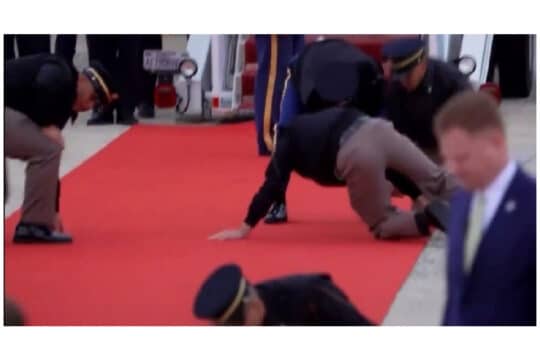
Red-carpet preparation at Joint Base Andrews
At the White House welcome ceremony on Thursday (Sep 24), where both leaders delivered remarks, Trump touched on the history of war and mentioned the American volunteer fighter group in China — the Flying Tigers — saying:
🗣️ “If we focus on our common interest, I’m confident there is much we can achieve. Throughout history, the pursuit of those common interests has connected our people across the vast oceans, across big, tremendous distances and many differences, and even made us allies in World War II. Look at the greatness we had together fighting in World War II.”
After the Washington summit concluded, Trump posted on Truth Social, calling the meeting one of “Friendship, Strength, and Success, for both China and the U.S.A.,” and adding that he looked forward to the next US-China meeting in November.
Historical Memory at the White House
But why did the special treatment given to the Chinese delegation in the US seem to matter so much in China, especially considering the ubiquitous anti-American sentiment of recent years? Not only did official media highlight it, but it also resonated strongly with netizens and became the defining story about this meeting on social media.
It goes much deeper than flattery.
Narratives of “never…
China Insight
Blame Games & Bad Signs: Nepal–Tibet Floods, Huawei’s Toilet Trouble, “Screwed” Graduates
How the Nepal–Tibet floods are being discussed on Chinese social media. From solidarity and sadness over Gyirong to censorship and anger at Taiwanese, Indian, and Western media.

In this edition:
- Teachers get shamed for their students’ bad grades
- Why the Nepal–Tibet floods sparked arguments about blame, BBC reporting, and Chinese censorship
- Huawei doesn’t appreciate viral toilet humor
- Dads are carrying mattresses into Peking University
- Chinese graduates are getting “screwed” by a million-dollar company
🗞️ QUICK SCROLLS
🧑🏫 A teacher “shame photo” taken at a local education meeting in Liangshan, Sichuan, has sparked nationwide outrage. A group of primary school teachers was forced to pose in front of a giant “SHAME” sign because their classes’ average final exam scores were below 30. “This isn’t merely ‘shame’—it’s outright public humiliation,” one commenter wrote. Liangshan’s education bureau confirmed the photo was real and said it was “puzzled” by the practice; the Leibo County government has apologized and launched an investigation.

Teachers lined up in front of a big screen that says: “Group photo of primary-school teachers whose classes averaged below 30 points in the 2025–2026 end-of-year examinations”
🥬 “Chemical cabbages” (药水白菜) or “formaldehyde cabbages” (甲醛白菜) have been a major topic on Chinese social media after a Chinese investigative vlogger captured workers in Kangbao, Hebei, dipping cabbages into formaldehyde solution before loading them onto trucks. This procedure, which allegedly adds 2–3 extra days of shelf life, is illegal: formaldehyde is a Group 1 carcinogen.
🍫 It’s been a bad week for Mars-owned chocolate brand Dove. A marketing campaign suggesting that a girl received a box of chocolates from a man she was flirting with while her boyfriend was away (“趁男友不在”) drew anger online. Then the brand’s apology also became a massive failure: when it was flagged as 100% AI-generated, Chinese netizens had little sympathy left for the brand.
💸 A “century-old” shark fin soup served by a Shanghai restaurant for no less than 4,800 yuan (US$715) per bowl (!) has gone viral for its exorbitant price and claims that it has been “simmering for more than 100 years,” since the late Qing dynasty. There was plenty of skepticism about the soup, but also disbelief that anyone would spend an ordinary person’s entire monthly living budget on a single bowl of soup.
👩💻 An eighth-grader from Shanghai earned 18,000 yuan (US$2,678) in three days using AI. Despite her limited programming experience, the 13-year-old placed third in a marketing hackathon, where teams had 48 hours to develop and market an entire AI product. She launched a study-companion app called “Being There” (在场) that 92 people bought. Although Chinese media praised her, commenters were critical, suggesting she received help from her mother, an influencer on Douyin.
💍 In an aging society where marriage rates have AGAIN dropped, more and more places are making it easier than ever to tie the knot. Registration services are popping up in…
Eye on Digital China is a reader-supported publication by
Manya Koetse (@manyapan) and powered by What’s on Weibo.
It offers independent analysis of China’s online culture, media, and social trends.
To receive the newsletter and support this work, consider
becoming a paid subscriber.


Starbucks Goes Xinjiang & The Kardashians in China

Red Carpet, Pandas, and Power: How China Read the Trump-Xi Summit

Keeping Score of History: The Mukden Incident and China’s Basketball Defeat to Japan

The Rise of “Shuaqi-ism,” Taking Starbucks to the Fields, and Pretending to Go to Work

Why Japan Has So Many Surnames, China’s Back-to-School Shifts & Taiwan Pavilion Trouble

“God Won’t Save Us, but the PLA Will”: Floods, Faith, and Kung Fu Soccer Nostalgia

How Chinese AI Videos Turned Foreigners into Villains
Why Japan Has So Many Surnames, China’s Back-to-School Shifts & Taiwan Pavilion Trouble

The Power of Ugly: Why Niu Lai Became China’s Unlikeliest Box-Office Hit

AI Actress Ad Pulled, Baihaitun Disrupts Shanghai and Cicada Meme Bugs Huawei
-

 Chinese New Year8 months ago
Inside Chunwan 2026: China’s Spring Festival Gala
-

 China Brands, Marketing & Consumers11 months ago
Hasan Piker’s China Trip & the Unexpected Journey of a Chinese School Uniform to Angola
-

 Chapter Dive7 months ago
Inside the Great Chinese Debate Over the Iran War
-

 China Trend Watch11 months ago
Japan Tensions, Nexperia Fallout, Yunnan’s ‘Wild Child,’ & “Modern Opium”