
SubscribeLog in
Connect with us

China Insight

China’s Disappearing Rural Schools: Teacher Keeps School Open for Two Students

In a rapidly urbanizing China, small rural schools are slowly disappearing. This teacher keeps his school open for two remaining students.

Manya Koetse

Published

on

In a rapidly urbanizing China, small rural schools are slowly disappearing. As children move out to the cities with their parents, some schools – once lively village institutions – have now become empty buildings. In the mountainous region of Youyang County, one teacher keeps his school open for two remaining students.
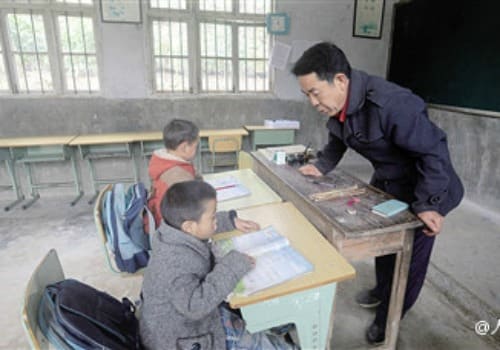
A typical People’s Daily “warm China” (#温暖中国#) Weibo story recently featured a teacher from a village in the Chongqing region who multitasks at his school for the two students that are left in the mountainous area. The story was initially published by the Chongqing Morning Newspaper on January 13.

Mr. Yang cooks for his students during lunchtime.

Yang Jinhua (杨进华), 54 years old, has been working at the village school in the Youyang county – southeastern Chongqing – for 35 years. As there are less and less children in the area, Yang is now working at the school all by himself; he fulfills the tasks of teacher, concierge, and cook for the two students that are left.

“I would do the same if there’s just one child left,” he told the Chongqing Morning Newspaper.

Ringing the school bell for the two students left on this remote village school in the Chongqing region.

According to the Chongqing Newspaper, Yang’s teaching career has seen many ups and downs. There were times when there were over 100 students at the school and only three teachers. But all that has changed now.

The story received ample attention on Chinese social media recently, where many netizens praised the teacher for his good work.

Teacher Yang and his two pupils.

The story about Yang and his two students, heartwarming as it is, represents a much bigger societal issue; that of China’s disappearing rural schools. The small schools in remote areas that are still around, also referred to “sparrow schools” (麻雀学校), are struggling to keep their doors open.


“63 rural primary schools, 30 learning centers and 3 middles schools closed on a daily basis.”


In 2001, the Chinese government launched a reform campaign for rural schools across the country as a result of the country’s rapid urbanization. It entailed the closing of remote village schools, shifting the focus to centralized county or town schools.

In 2013, China.org reported that rural schools were closing at an alarming rate in the decade following the reforms, when 63 rural primary schools, 30 learning centers and 3 middle schools were closed on a daily basis.

Due to the mass closing of village schools, some students from the more remote parts of China’s countryside had to walk for hours to reach the most nearby school, often making it unsafe or even impossible for village children to travel to and from school (Lam 2016, 82).

While many children dropped out of school, and when centralized schools were getting overcrowded, the government halted the plans to shut down small village schools in 2012 – but thousands of schools had already closed, while those that survived were struggling to stay open.

The lack of students is not the only problem for China’s ‘sparrow schools’; there is also a lack of good teachers, as those who are qualified often rather go to a central school than a remote village one.

As for Yang: he started working at the village school when he was just 18 years old. Throughout the years he has taught himself how to be a teacher by reaching out to experienced teachers from other schools, and by ordering books on education and preparing himself to be a good tutor. By now, with over three decades of educational background, he has become an experienced teacher himself.


“Amidst the giant rush to the city, many rural places in China are becoming more isolated and empty.”


Amidst the giant rush to the city, many rural places in China are becoming more isolated and empty. This process has started since the beginning of the post-Mao era, when agricultural production went up after farmland started to be partially privatized.

A surplus of rural labor and an increased labor demand in the cities caused a huge flow of peasants moving to the city to look for jobs there, leaving rural schools practically empty as children go with their parents who leave to work in other provinces. In 2015 alone, nearly 169 million rural workers migrated to cities.

But there are also those children who are left behind by their parents to go to school. China’s hukou or ‘household registration’ system – that is assigned at birth based on one’s community and family – makes it hard or even impossible for migrant children to be accepted at state schools in the cities where their parents work.

Here comes the catch: even if parents choose to leave their child behind under the care of family members for the sake of their education, their journey to school may be too long or dangerous to undertake. When families do not have the means to let their child attend boarding school in a nearby town, they soon become drop-outs.


“We simply cannot guarantee the quality of education here, but at least this is much better than letting these kids herd the sheep.”


The hyped story of Teacher Yang and his two children comes at an important time, as the Chinese Ministry of Education is expected to release guidelines this year on new standards to govern the levels of funding allocated to rural schools (Caixin 2016).

The problem of China’s disappearing rural schools has been going on for years, and has become a vicious cycle. Even if village schools stay open, the lack of students and teachers is negatively influencing all parties involved.

On Weibo, some criticize the existence of schools like that of Yang: “With only one teacher, although I applaud him, nobody can guarantee the quality of his teaching,” one netizen says.

Others see these school in a different perspective: “We simply cannot guarantee the quality of education here, but at least this is much better than letting these kids herd the sheep. At the very minimum, they can enjoy some sort of education and will not be illiterate.”

“The media is misleading,” another person says: “So many of these schools have already been torn down. The editor [of this article] would not even think of letting their child attend a small village school like this. These children are part of a society that is going through enormous changes, and the fact that they are educated like this is shameful (..) – instead of only praising the teacher, we should perhaps also advise him not to just place emphasis on himself.”

But many disagree with this view. One post-1990 netizen from Chongqing (@于杨鱼羊) writes: “My uncle also was a teacher for over a decade (..) and he put all of his energy into his students (..) Without having him, I would have since long dropped out of school to start working, and would have been lost in the waves of migrant workers. If it weren’t for him, I would not be where I am today.”

“There are many ways to take within education, but taking the way of education is always the best way,” another person writes.

Perhaps the students of Yang indeed are amongst the ‘lucky ones’, as bittersweet as it may be. Different from many children their age, they receive the full attention of their tutor and are able to attend school while still being close to their family.

Teacher Yang makes sure they get home safely; he personally walks them back to their house every day after school. It is one of the perks of attending a “sparrow school.”

– By Manya Koetse
Follow on Twitter or Like on Facebook

References

Lam, Sara G. 2016. “From Rabun County to Yonji County: The Foxfire Approach and Community-Based Education in Rural China.” In Hilton Smith & J. Cynthia McDermott (eds), The Foxfire Approach Inspiration for Classrooms and Beyond, 73-83. Rotterdam: Sense Publishers.

Sheng Menglu and Li Rongde. 2016. “Battered by Closures, Rural Schools Await New Guidelines.” Caixin Global, Dec 14 http://www.caixinglobal.com/2016-12-14/101026544.html [15.1.17].

©2016 Whatsonweibo. All rights reserved. Do not reproduce our content without permission – you can contact us at info@whatsonweibo.com.

Manya Koetse is a sinologist, writer, and public speaker specializing in China’s social trends, digital culture, and online media ecosystems. She founded What’s on Weibo in 2013 and now runs the Eye on Digital China newsletter. Learn more at manyakoetse.com or follow her on X, Instagram, or LinkedIn.

Continue Reading
2 Comments

2 Comments

  1. Marisa Vosloo

    January 23, 2017 at 9:02 am

    I have just seen a documentary on CGTN about this admirable teacher. He loves his students, and he is teacher, father and grandfather to them. What a wonderful person he is!

Leave a Reply

Your email address will not be published. Required fields are marked *

Chapter Dive

Cancel-Proof: The Rise of China’s AI Actors

China’s AI actors are on the rise, and not everyone is buying it. The country’s microdrama industry offers a glimpse of what’s to come for the broader film and TV sector.

Ruixin Zhang

Published

on

Is this the real life? Is this just fantasy? In the fast-growing world of China’s AI microdramas, even virtual actors can’t escape reality. As production companies turn them into idols, audiences are voicing discomfort, while the future for human actors looks increasingly uncertain.

– By Ruixin Zhang and Manya Koetse

For Chinese audiences, AI in film and television is nothing new. In the fall of 2023, the first fully AI digital performer in a Chinese domestic drama, the character Erzhuang (二壮) in I Am Nobody (异人之下) sparked debate on Chinese social media.

Some fans, due to Erzhuang’s convincing northeastern Chinese dialect and natural expressions, almost couldn’t believe she wasn’t a real actress.

Erzhuang in I Am Nobody (异人之下) in 2023.

But Erzhuang was just the beginning.

In 2024, China Mythology (中国神话) was promoted by state media as China’s first fully AI-produced short drama series.

A year later, In My Heart, You Are One of a Kind (在我心中,你是独一无二) premiered as Hong Kong’s very first AI-generated short drama, a youth campus romance that sparked further discussion about whether AI actors could actually replace human actors.

From the two AI dramas from 2024 and 2025: China Mythology and In My Heart, You Are One of a Kind.

Those discussions were reignited in late March of this year when Shanghai-based production company Yaoke Media (耀客传媒) introduced two newly signed AI actors, Qin Lingyue (秦凌岳) and Lin Xiyan (林汐颜), who’ll be starring in the fantasy short drama Qinling (秦岭).

Qin Lingyue (秦凌岳) and Lin Xiyan (林汐颜)

Unlike earlier AI figures in microdramas, this high-profile ‘signing’ marks a shift: the company plans to develop these characters as independent IPs, much like human actors. In other words, they are to attract fans both through their on-screen performances and their off-screen ‘personalities.’

Soon after, the two AI actors created their own social media accounts on Douyin and Xiaohongshu, and began cultivating a sense of authenticity and ‘liveness’ (活人感).

A real-looking social media profile.

But as these digital performers and real actors become harder to distinguish, audience discomfort is growing, too.


The Rise of AI Microdramas


In China’s microdrama market, AI is already playing a dominant role, with “AI dramas” (AI剧 or AI短剧) standing out as a distinct creative category within the broader industry.

Microdramas, also simply known as short dramas, have been around in China for at least a decade, but have become especially popular in recent years due to their vertical, ultra-short formats, designed for quick mobile viewing and easy ‘binge watching.’ Microdramas typically run for 60 to 100 episodes, but with each episode lasting just one to three minutes, an entire season can be watched in an hour or two.

That format also makes the industry particularly well-suited to AI. It is large, fast-moving, and often operates on limited budgets, with productions turning around quickly. In this environment, using AI-generated effects and AI actors simply makes sense. This is very different from traditional drama production, which typically involves longer timelines, higher budgets, well-known actors, and less room for experimentation.


“AI is no longer just an add-on in China’s drama sector—it is an integral part of the production process”


As a result, AI is no longer just an add-on in China’s short drama sector—it is becoming an integral part of the production process, with digital actors helping to improve efficiency and reduce costs. With the launch of Bytedance’s Seedance 2.0, production costs for AI-generated videos have dropped significantly, further boosting the growth of AI microdramas.

The scale of this shift is already clear: AI microdramas are now often outpacing live-action productions on trending charts. In 2025 alone, one Zhejiang-based production company (刚刚好影视) released 229 AI micro-dramas, generating over 513 million views.

According to Sixth Tone, short dramas featuring AI actors already represented approximately 40% of the top 100 animated short dramas in January 2026.


Turning AI Actors into Real Idols


With AI and microdramas entering a kind of symbiosis, virtual actors are no longer disposable, one-off creations. They are evolving into continuous, persona-driven figures, often designed to resemble real celebrities—much like “fandom-driven actors” (流量演员), whose core function is to monetize fan attachment and sell fantasies rather than just act.

According to Yaoke Media, their plans for Qin Lingyue and Lin Xiyan are similar to those of idol models: they are expected to interact with fans, appear in multiple productions, and eventually become monetizable assets through brand endorsements and image licensing.

This also means they will likely take on the full spectrum of idol labor, including promotional events, fan service, and carefully manufactured on-screen chemistry—sometimes even “queerbaiting” (卖腐). (There’s no perfect English equivalent, but the term refers to deliberately staging romantic interactions between two male characters aimed in particular at a female “danmei” fans or “rotten girls” audiences who like indulging in such fantasies.)

In one AI costume drama, behind-the-scenes clips showed the lead actor and actress “live-streaming” together, answering fan questions, and deliberately hyping up their on-screen chemistry.

“Behind the scenes” livestream screenshots by AI actors.

Such human-coded content is now increasingly becoming an important part of the AI microdrama industry.

Some of these online videos also show the supposed perspective of “fans” and “staff” watching the actors walk around or interacting with them, creating a simulated world that some netizens feel is pushing a sense of “realness,” with comments like: “Please don’t force AI to act so human-like.”


“AI actors featuring in AI dramas that are watched by AI audiences, it’s the perfect closed loop”


For the same AI costume drama, some clips even mimic the perspective of ‘fansite admins’ (站姐)—dedicated fan photographers who typically capture and share candid, off-stage footage of real stars.

In one vlog by a supposed prop assistant, she appears as an overworked but witty crew member, taking viewers around the set, chatting with the leads, buying them coffee, and even stepping in as an extra.

“Behind the scenes” of an AI microdrama.

These glimpses of everyday, behind-the-scenes life all feel oddly real, but everything is AI-generated: the actors, the sets, the audience interactions, the staff, even the paparazzi (see example videos here and here).

For ordinary audiences, it is striking how deeply AI has already penetrated the film & television industry. Beyond criticisms of stiff expressions and rigid aesthetics, many netizens describe the new phenomenon as “uncanny” or “just too real😨.”

With AI actors now realistic enough to pass as human at a glance, but with small details like emotional expression still being off, that gap between being almost human but not quite creates a sense of discomfort among viewers, who dub these AI actors ‘stuffed monsters’ (缝合怪) or ‘stitched-together corpses’ (尸块).

More than the actors, it’s the entire ecosystem around them that makes us believe we’re watching “candid moments” of something that is not even alive. Screenwriter Wang Hailin (汪海林) was sarcastically commented on Weibo: “AI actors featuring in AI dramas that are watched by AI audiences 👍, it’s a perfect closed loop.”


‘Borrowing’ Facial Features


Besides the simulated “aliveness” of digital performers, another controversial issue surrounding the recent rise of China’s AI actors is whether these creations infringe on portrait rights. Since the debut of Qin Lingyue and Lin Xiyan, these AI figures have been criticized for appearing to use facial features from multiple real actors.

As online discussions intensify, more AI actors in microdramas have been found to resemble real celebrities. Fans of beloved Chinese celebrities such as Dilraba Dilmurat (迪丽热巴) and Xiao Zhan (肖战) have taken to Weibo to protest this kind of “face swapping” (AI换脸) and demand protection of their idols’ likenesses.

An “AI face swap” (AI换脸): an AI actor on the left, Xiao Zhan on the right.

Yaoke responded that these images were “derived from massive datasets on the internet” and did not replicate any specific individual’s features.

This only fueled further backlash. To many, the use of “massive data” suggests that anyone, celebrity or ordinary person, could potentially have their image appropriated.


“The vlogger discovered the face swap infringement after a friend recognized his face while watching the AI drama”


In related recent trending news, a Chinese content creator (白菜汉服妆造), who typically wears traditional Chinese clothing in his videos, accused Hongguo (红果短剧), ByteDance’s short drama platform, of using his likeness without authorization to create a greedy villain in the AI-generated drama Taohua Zan (桃花簪).

On the left: greedy villain in the AI-generated drama Taohua Zan. On the right: Chinese content creator (白菜汉服妆造).

The vlogger discovered the face swap infringement after a friend recognized his face while watching the drama. The series was later taken offline.

One problem is that legal frameworks around AI lag behind technological development: by the time victims try to fight back legally, the technology has already moved on, making enforcement almost impossible.


Better Than the Real Thing?


Despite the backlash against the AI-fication of China’s short drama industry, some netizens are more optimistic about its development.

One blogger recently noted that as many people have already formed near friendship-like emotional dependencies on chatbots like ChatGPT—initially seen as cold technological tools—it is entirely possible that audiences will also develop genuine attachment to AI actors.

Current limitations that still make AI actors feel stiff, such as robotic voices or unnatural expressions, will likely diminish as the technology continues to improve.

Some call binging on AI short dramas their “guilty pleasure,” just to watch the AI actors perform. As one Weibo user wrote: “The female characters are just so beautiful—seriously, unbelievably beautiful. And they’re becoming more and more realistic: their facial expressions, especially the way their mouths move, are incredibly precise. Even the makeup looks stylish, and the hair feels very real. I honestly find myself wondering what eyeshadow and mascara they’re using.”

But support for AI performers in China’s drama industry is not limited to guilty pleasures and tech enthusiasts. For some, it also reflects a broader weariness with the perceived lack of quality among human actors.


“If the performances of real actors are already no better than AI, why not use AI actors instead?”


China’s film and television industry’s strong focus on fandom culture and good-looking idols, combined with limited budgets and a lack of formal training, has produced a wave of actors who are widely criticized for poor acting and a lack of professionalism. They are also frequently caught up in controversies, from refusing to memorize lines to relying heavily on green-screen acting.

These criticisms intensified during the 2021 major scandal involving former drama actress Zheng Shuang (郑爽), who had long faced criticism over her acting. A leaked recording at the time revealed she was earning a staggering 2.08 million RMB per day (roughly $320,000 then). Since then, “2.08 million” (208万) has become a derogatory label for fandom-driven actors who get high pays despite low-quality performances.

Amid weak acting and a distorted pay structure, many viewers have been calling for change. A common sentiment is: if their performances are already no better than AI, why not use AI actors, and give real actors a sense of crisis?


From Cancel Culture to AI Actors


But will the use of AI actors actually push the industry to improve human actors, or simply replace them?

Some Chinese industry insiders remain optimistic, arguing that AI can never fully replicate the nuance of human emotion. Among those who have spoken out are A-list actors such as Zhang Ruoyun (张若昀) and Feng Yuanzheng (冯远征), president of the Beijing People’s Art Theatre.

Others, however, are less optimistic.


“China’s “cancel culture” will eventually make AI actors an increasingly attractive bet for industry investors”


Agan Jackie (阿甘Jackie), a streamer working in the film industry, pointed out in a recent podcast that China’s “cancel culture” will eventually make AI actors an increasingly attractive bet for industry investors.

Although there’s “cancel culture” in the Western entertainment industry as well, the moral bar for Chinese celebrities is exceptionally high: anything from tax evasion to littering, simply being rude to fans could destroy an actor’s commercial value. The superstar Fan Bingbing (范冰冰), for example, disappeared from public view after a tax evasion scandal. Even after repaying her debts, she is still effectively banned from mainland productions.

China’s cancel culture is also closely tied to political red lines. One remark or move – intended or not – could end a career overnight. Zhang Zhehan (张哲瀚), an actor who quickly rose to fame a few years ago, vanished from the industry after photos surfaced of him posing near the Japanese Yasukuni Shrine.

For production companies and streaming platforms, such unpredictability creates a high-investment, high-risk environment. “Scandal-proof” AI actors offer a low-risk substitute.

This perhaps also plays a major role in why major streaming platforms such as Tencent and iQiyi are now promoting or encouraging the use of AI actors through AI feature film experiments, with the first fully AI-generated commercial blockbusters expected to be released later this year.


A Glimpse into the Future


At the recent China TV Drama Production Industry Conference, it became clear that the industry is undergoing something of an earthquake, with major changes ahead: while top actors will continue to function as traffic drivers, demand for human actors is expected to decline, and much of the mid- and lower-tier acting segment (such as extras and body doubles, but also voice actors) could largely disappear as it becomes replaceable by AI.

The microdrama industry, already heavily infiltrated by AI, offers a glimpse of the future of the broader TV and film industry when it comes to digital performers.

Microdrama actress Zhou Ye (周野) recently said that her pay has been slashed by 50% since AI-driven microdramas flooded the market, leaving many more actors jobless. For the 140,000 registered extras at Hengdian World Studios, China’s largest filming base, these developments could have far-reaching consequences.

Sometimes, these actors even sign away their fate—quite literally—as some companies now require “AI authorization” clauses as a condition of employment, effectively selling their digital likeness just to get a job. Companies can then create AI actors based on real individuals. Chinese talent management company Yuxiao Media (聿潇传媒) has introduced six such AI actors, directly modeled on real performers.


“The microdrama industry, already heavily infiltrated by AI, offers a glimpse of the future of the broader TV and film industry when it comes to digital performers”


One of these, influencer Han Anran (韩安冉), openly stated during a livestream that she had sold her likeness rights for AI creation. Playing into public criticism of her acting and heavily altered appearance, she said this was the best way to monetize her image. She even wondered that if her AI doppelganger were ever to win an award, whether she or the AI should go on stage to accept it.

Han Anran (韩安冉) on the left and the AI actress modeled after her on the right.

Perhaps nobody likes to see ordinary actors’ livelihoods being taken over by AI. But despite concerns about shrinking job opportunities, China is unlikely to see Hollywood-like strikes, as it lacks unions or organizations comparable to SAG-AFTRA or the AFL-CIO, which focus on labor representation beyond awards and industry guidelines.

For now, the only collective pushback against the full “AI-fication” of the industry comes from Chinese netizens themselves: boycotting platforms and production companies using AI actors, and voting with their views. Ultimately, only when public demand for realness becomes strong enough to threaten profits—or when laws finally catch up—will there be a sense of security for the people behind the screen—the real ones.

By Ruixin Zhang, with editing and additional context by Manya Koetse

©2026 Eye on Digital China/Whatsonweibo. All rights reserved. Do not reproduce our content without permission – you can contact us at info@whatsonweibo.com.

Continue Reading

China Brands, Marketing & Consumers

Hasan Piker’s China Trip & the Unexpected Journey of a Chinese School Uniform to Angola

Hasan Piker’s controversial China tour, a Chinese school uniform resurfaces in Africa, a new winter hotspot, why Chinese elites ‘run’ to Tokyo, and more.

Manya Koetse

Published

on

🌊 Signals — Week 47 (2025)
Part of Eye on Digital China, Signals highlights slower trends and online currents behind the daily scroll. This edition was sent to paid subscribers — subscribe to receive the next issue in your inbox.

Welcome to another edition of Eye on Digital China. Different from the China Trend Watch (check the latest one here if you missed it), this edition, part of the new Signals series, is about the slower side of China’s social media: the recurring themes and underlying shifts that signal broader trends beyond the quick daily headlines. Together with the deeper dives, the three combined aim to give you clear updates and a fuller overview of what’s happening in China’s online conversations & digital spaces.

For the coming two weeks, I’ll be traveling from Beijing to Chongqing and beyond (more on that soon) so please bear with me if my posting frequency dips a little. I’ll be sure to pick it up again soon and will do my best to keep you updated along the way. In the meantime, if you know of a must-try hotpot in Chongqing, please do let me know.

In this newsletter: Hasan Piker’s controversial China tour, a Chinese school uniform in Angola, a new winter hotspot, discussions on what happens to your Wechat after you die, why Chinese elites rùn to Tokyo, and more. Let’s dive in.

Slower Scrolls
  • 💰 The richest woman in China, according to the latest list by Hurun Research Institute, is the “queen of pharmaceuticals” Zhong Huijuan (钟慧娟) who has accumulated 141 billion yuan (over 19 billion USD). Women account for over 22% of Chinese billionaires (those with more than 5 billion RMB), underscoring China’s globally leading position in producing wealthy female entrepreneurs.
  • 🧩 What happens to your WeChat after you die? A user who registered for NetEase Music with a newly reassigned phone number unexpectedly gained access to the late singer Coco Lee’s (李玟) account, as the number had originally belonged to her. The incident has reignited debate over how digital accounts should be handled after death, prompting platforms like NetEase and Tencent to reconsider policies on long-inactive accounts and take stronger measures to protect them.
  • 📱 Although millions of viewers swoon over micro-dramas with fantasy storylines where rich, powerful men win over the “girl next door” through money and status, Chinese regulators are now stepping in to curb exaggerated plots featuring the so-called “dominant CEO” (霸道总裁) archetype, signaling stricter oversight for the booming short drama market.
  • ☕ A popular Beijing coffee chain calling itself “People’s Cafe” (人民咖啡馆), with its style and logo evoking nationalist visual nostalgia, has changed its name after facing criticism for building its brand – including pricey coffee and merchandise – on Mao era and state-media political connotations. The cafe is now ‘Yachao People’s Cafe’ (要潮人民咖啡馆).
  • 👀 Parents were recently shocked to see erotic ads appear on the Chinese nursery rhymes and children’s learning app BabyBus (宝宝巴士), which is meant for kids ages 0–8. BabyBus has since apologized, but the incident has sparked discussions about how to keep children safe from such content.
  • 🧧The 2026 holiday schedule has continued to be a big topic of conversation as it includes a 9-day long Spring Festival break (from February 15 to February 23), making it the longest Lunar New Year holiday on record. The move not only gives people more time for family reunions, but also gives a huge boost to the domestic travel industry.
Currents

Hasan Piker’s Chinese Tour & The US–China Content Honeymoon

[#HasanAbi#] [#Hasanabi柠檬哥#]

Livestreamer Hasan Piker during his visit to Tiananmen Square flag-rising ceremony.

It’s not time for the end-of-year overviews just yet – but I’ll already say that 2025 was the US–China ‘honeymoon’ year for content creation. It’s when China became “cool,” appealing, and eye-grabbing for young Western social media users, particularly Americans. The recent China trip of the prominent American online streamer Hasan Piker fits into that context.

This left-wing political commentator also known as ‘HasanAbi’ (3 million followers on Twitch, recently profiled by the New York Times) arrived in China for a two-week trip on November 11.

Piker screenshot from the interview with CGTN, published on CGTN.

His visit has been controversial on English-language social media, especially because Piker, known for his criticism of America (which he calls imperialist), has been overly praising China: calling himself “full Chinese,” waving the Chinese flag, joining state media outlet CGTN for an interview on China and the US, and gloating over a first-edition copy of Quotations from Chairman Mao (the Little Red Book). He portrays China as heavily misrepresented in the West and as a country the United States should learn from.

Hasan Piker did an interview with CGTN, posing with Li Jingjing 李菁菁.

During his livestreaming tour, Hasan, who is nicknamed “lemonbro” (柠檬哥) by Chinese netizens, also joined Chinese platforms Bilibili and Xiaohongshu.

But despite all the talk about Piker in the American online media sphere, online conversations, clicks, and views within China are underwhelming. As of now, he has around 24,000 followers on Bilibili, and he’s barely a topic of conversation on mainstream feeds.

Piker’s visit stands in stark contrast to that of American YouTuber IShowSpeed (Darren Watkins), who toured China in March. With lengthy livestreams from Beijing to Chongqing, his popularity exploded in China, where he came to be seen by many as a representative of cultural diplomacy.

IShowspeed in China, March 2025.

IShowSpeed’s success followed another peak moment in online US–China cultural exchange. In January 2025, waves of foreign TikTok users and popular creators migrated to the Chinese lifestyle app Xiaohongshu amid the looming TikTok ban.

Initially, the mass migration of American users to Xiaohongshu was a symbolic protest against Trump and US policies. In a playful act of political defiance, they downloaded Xiaohongshu to show they weren’t scared of government warnings about Chinese data collection. (For clarity: while TikTok is a made-in-China app, it is not accessible inside mainland China, where Douyin is the domestic version run by the same parent company).

The influx of foreigners — who were quickly nicknamed “TikTok refugees” — soon turned into a moment of cultural celebration. As American creators introduced themselves, Chinese users welcomed them warmly, eager to practice English and teach newcomers how to navigate the app. Discussions about language, culture, and societal differences flourished. Before long, “TikTok refugees” and “Xiaohongshu natives” were collaborating on homework assignments, swapping recipes, and bonding through humor. It was a rare moment of social media doing what we hope it can do: connect people, build bridges, and replace prejudice with curiosity.

Some of that same enthusiasm was also visible during IShowSpeed’s China tour. Despite the tour inevitably getting entangled with political and commercial interests, much of it was simply about an American boy swept up in the high energy of China’s vibrant cities and everything they offer.

Different from IShowSpeed, who is known for his meme-worthy online presence, Piker is primarily known for his radical political views. His China enthusiasm feels driven less by cultural curiosity and more by his critique of America.

Because of his stances — such as describing the US as a police state — it’s easy for Western critics to accuse him of hypocrisy in praising China, especially after a brief run-in with security police while livestreaming at Tiananmen Square.

Seen in broader context, Piker’s China trip reflects a shift in how China is used in American online discourse.

Before, it was Chinese ‘public intellectuals’ (公知) who praised the US as a ‘lighthouse country’ (灯塔国), a beacon of democracy, to indirectly critique China and promote a Western modernization model. Later, Chinese online influencers showcased their lives abroad to emphasize how much ‘brighter the moon’ was outside China.

In the post-Covid years, the current reversed: Western content creators, from TikTok influencers to political commentators, increasingly use China to make arguments that are fundamentally about America.

Between these cycles, authentic cultural curiosity gets pushed to the sidelines. The TikTok-refugee moment in early January may have been the closest we’ve come in years: a brief window where Chinese and American users met each other with curiosity, camaraderie, and creativity.

Hasan’s tour, in contrast, reflects a newer phase, one where China is increasingly used as a stage for Western political identity rather than a complex and diverse country to understand on its own terms. I think the honeymoon phase is over.

“Liu Sihan, Your School Uniform Ended Up in Angola”: China’s Second-Hand Clothing in Africa

[#刘思涵你的校服在非洲火了#]

A Chinese school uniform went viral after a Chinese social media user spotted it in Angola.

“Liu Sihan, your schooluniform is hot in Africa” (刘思涵你的校服在非洲火了) is a sentence that unexpectedly trended after a Chinese blogger named Xiao Le (小乐) shared a video of a schoolkid in Angola wearing a Chinese second-hand uniform from Qingdao Xushuilu Primary School, that had the nametag Liu Sihan on it.

The topic sparked discussions about what actually happens to clothing after it’s donated, and many people were surprised to learn how widely Chinese discarded clothing circulates in parts of Africa.

Liu Sihan’s mother, whose daughter is now a 9th grader in Qingdao, had previously donated the uniform to a community clothing donation box (社区旧衣回收箱) after Liu outgrew it. She intended it to help someone in need, never imagining it to travel all the way to Africa.

In light of this story, one netizen shared a video showing a local African market selling all kinds of Chinese school items, including backpacks, and people wearing clothing once belonging to workers for Chinese delivery platforms. “In Africa, you can see school uniforms from all parts of China, and even Meituan and Eleme outfits,” one blogger wrote.

When it comes to second-hand clothing trade, we know much more about Europe–Africa and US–Africa flows than about Chinese exports, and it seems there haven’t been many studies on this specific topic yet. Still, alongside China’s rapid economic transformations, the rise of fast fashion, and the fact that China is the world’s largest producer and consumer of textiles, the country now has an enormous abundance of second-hand clothing.

According to a 2023 study by Wu et al. (link), China still has a long way to go in sustainable clothing disposal. Around 40% of Chinese consumers either keep unwanted clothes at home or throw them away.

But there may be a shift underway. Donation options are expanding quickly, from government bins to brand programs, and from second-hand stores to online platforms that offer at-home pickup.

Chinese social media users posting images of school/work uniforms from China worn by Africans.

As awareness grows around the benefits of donating clothing (reducing waste, supporting sustainability, and the emotional satisfaction of giving), donation rates may rise significantly. The story of Liu Sihan’s uniform, which many found amusing, might even encourage more people to donate. And if that happens, scenes of African children (and adults) wearing Chinese-donated clothes may become much more common than they now are.


Digital Echoes

Laojunshan: New Hotspot in Cold Winter

Images from Xiaohongshu, 背包里的星子, 旅行定制师小漾

Go to Zibo for BBQ, go to Tianshui for malatang, go to Harbin for the Ice Festival, cycle to Kaifeng for soup dumplings, or head to Dunhuang to ride a camel — over recent years, a number of Chinese domestic destinations have turned into viral hotspots, boosted by online marketing initiatives and Xiaohongshu influencers.

This year, Laojunshan is among the places climbing the trending lists as a must-visit spot for its spectacular snow-covered landscapes that remind many of classical Chinese paintings. Laojunshan (老君山), a scenic mountain in Henan Province, is attracting more domestic tourists for winter excursions.

Xiaohongshu is filled with travel tips: how to get there from Luoyang station (by bus), and the best times of day to catch the snow in perfect light (7–9 AM or around 6–6:30 PM).

With Laojunshan, we see a familiar pattern: local tourism bureaus, state media, and influencers collectively driving new waves of visitors to the area, bringing crucial revenue to local industries during what would otherwise be slower winter months.

Platform Notes

WeChat New Features & Hong Kong Police on Douyin

🟦 WeChat has been gradually rolling out a new feature that allows users to recall a batch of messages all at once, which saves you the frantic effort of deleting each message individually after realizing you sent them to the wrong group (or just regret a late-night rant). Many users are welcoming the update, along with another feature that lets you delete a contact without wiping the entire chat history. This is useful for anyone who wants to preserve evidence of what happened before cutting ties.

🟦The Hong Kong Police Force recently celebrated its two-year anniversary on Douyin (the Chinese version of TikTok), having accumulated nearly 5 million followers during that time. To mark the occasion, they invited actor Simon Yam to record a commemorative video for their channel (@香港警察). The presence of the Hong Kong Police on the Chinese app — and the approachable, meme-friendly way they’ve chosen to engage with younger mainland audiences — is yet another signal of Hong Kong institutions’ strategic alignment with mainland China’s digital infrastructure, a shift that has been gradually taking place. The anniversary video proved popular on Douyin, attracting thousands of likes and comments.

The Extra Read

Why Chinese Elite Rùn to Japan (by ChinaTalk)


Over the past week, Japan has been trending every single day on Chinese social media in light of escalating bilateral tensions after Japanese PM Takaichi made remarks about Taiwan that China views as a direct military threat. The diplomatic freeze is triggering all kinds of trends, from rising anti-Japanese sentiment online and a ban on Japanese seafood imports to Chinese authorities warning citizens not to travel to Japan.

You’d think Chinese people would want to be anywhere but Japan right now — but the reality is far more nuanced.

In a recent feature in ChinaTalk, Jordan Schneider interviewed Japanese journalist & researcher Takehiro Masutomo (舛友雄大) who has just published a book about Japan’s new Chinese diaspora, explaining what draws Chinese dissidents, intellectuals, billionaires, and middle-class families to Tokyo.

The book is titled Run Ri: 潤日 Following the Footsteps of Elite Chinese Escaping to Japan (only available in Japanese and Traditional Chinese for now). (The word Rùn 润/潤, by the way, is Chinese online slang and meme expresses the desire to escape the country.)

A very interesting read on how Chinese communities are settling in Japan, a place they see as freer than Hong Kong and safer than the U.S., and one they’re surprisingly optimistic about — even more so than the Japanese themselves.

Read it here on ChinaTalk.

Thanks for reading this Eye on Digital China Signals. For fast-moving trends and deeper dives, keep an eye on the upcoming newsletters.

And if you just so happen to be reading this without a subscription and appreciate my work, consider joining to receive future issues straight in your inbox.

A small housekeeping note:
This Eye on Digital China newsletter is co-published for subscribers on both Substack and the main site. If you’re registered on both platforms, you’ll receive duplicate emails — so if that bothers you, please pick your preferred platform and unsubscribe from the other.

Many thanks to Miranda Barnes for helping curate some of the topics in this edition.

Manya

Spotted an error or want to add something? Comment below or email me.
First-time commenters require manual approval.

©2025 Eye on Digital China / What’s on Weibo. Do not reproduce without permission —
contact info@whatsonweibo.com.

Continue Reading

Popular Reads