
SubscribeLog in
Connect with us

China Insight

Dorm Violence: Kunming University Student Killed by Roommate for Singing A Song

A dorm murder in Yunnan province has become the focus of public attention. The lethal altercation, that took place at Kunming University, allegedly started over a song. Weibo netizens are increasingly worried about the recurring problem of dorm violence.

Manya Koetse

Published

on

A dorm murder in Yunnan province has become the focus of public attention. The lethal altercation, that took place at Kunming University, allegedly started over a song. Weibo netizens are increasingly worried about the recurring problem of dorm violence.

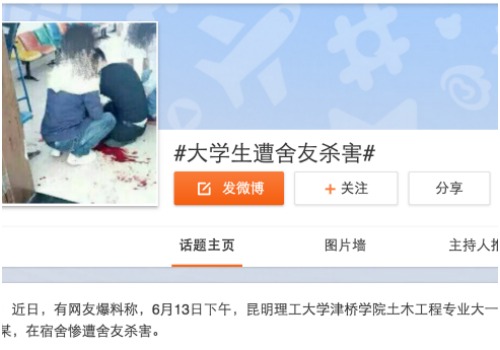
Weibo netizens recently exposed that a dorm room murder took place on June 13 at the Kunming University of Science and Technology. The topic became trending on June 17 on Sina Weibo under the hashtag of ‘University Student Killed by Roommate’ (#大学生遭舍友杀害#).

The person who was killed, a young man named Peng, was known to be previously involved in a dispute with another male dormitory student, according to Legal Evening News.

Local police has confirmed the deadly altercation started when Peng was listening to music and singing in the dorm room while others were sleeping, triggering a fight with the suspect, People’s Daily writes. Peng first assaulted the suspect with a chair, after which the suspect stabbed and killed him with a knife. The suspect has since been arrested.

News about the case, that is currently under police investigation, leaked online through netizens who shared pictures of the murder scene.

The pictures, that are blurred, show students kneeling down around the place of the murder and another picture allegedly shows the body of Peng wrapped in a bag.

729a03f02ca3c8b1919530eeb35ac667

98c4df575211489a2229f0407863fe6b

News of the murder has caused much commotion on Weibo, where many netizens worry about living conditions and dorm violence in China’s universities: “There seems to be something on the news about universities every day, from roommates killing each other to girls being molested..”

“If China doesn’t care more about mental health education, then I am afraid what’s next. Our society already is a bit messed up…”, one netizen says.

[rp4wp]

What’s on Weibo previously reported about China’s dorm life problems. In many of China’s university dorms, the poor living conditions and full rooms can lead to altercations amongst dorm students. Because there often is a lack of campus counseling and no available alternative housing, there can be extreme tension buildup amongst roommates. Small irritations can lead to deadly arguments.

“In universities nowadays, anything can lead to conflict. For example, in the afternoons, some students want to play a game in their dorm, while others want to sleep, and others want to watch a comedy show. In the evenings, while some people want to sleep, others want to sing. Who can stand this? Everything happens for a reason. But university students shouldn’t be so selfish and should learn to respect others. Their dorm is not their house,” one netizen writes.

According to China’s University Student’s Essential Website (大学生必备网), the dorm rooms at Kunming University of Science and Technology are generally shared between 4 or 8 persons, with every person paying 1200 RMB per year (±182US$) for the 4-person rooms, and 400 RMB per year (±60US$) for the 8-person rooms.

2015110155456141

2015110155446017

Over the past few years, there have been many incidents in Chinese dorms that ended up with people being killed by their fellow dorm students. A sum-up of a few of these cases:

• 2004: Student Ma Jiajue at Yunnan University kills four roommates with a hammer because he thought “they looked down upon him”.
• 2013: Student Huang Yang (黄洋) dies after the common water cooler was purposely poisoned at Fudan University. The student guilty of murdering Huang was sentenced to death in 2015. The two male students shared a dorm room and did not get along.
• 2013: A student is stabbed to death by his dorm roommate at Nanjing Aeronautics and Astronautics University after a quarrel.
• 2013: A Nanhang Jincheng College student is stabbed to death by his roommate with a fruit knife after an argument broke out between the two young men.
• 2016 (March): A student from Sichuan Normal University is killed and beheaded in his dormitory by his roommate.

Many netizens blame the recent Kunming dorm murder on China’s education and dorm system, but there are also those saying that it is a global phenomenon: “This incident cannot just be traced back to China’s faltering education system, that would be too much. Many say that foreign education is good, yet they also still have campus violence and massacres. It’s too simple to say people’s personality is formed by education, as there are many factors influencing them, and nobody’s perfect. No matter if you live in the West or in the East, our societies all have problems we need to sort out, and this process influences everybody.”

News about dorm violence has become so commonplace that the topic “how to avoid getting murdered in your dorm room” (如何避免在宿舍被杀) has now become a point of discussion amongst Chinese netizens.

– By Manya Koetse

©2016 Whatsonweibo. All rights reserved. Do not reproduce our content without permission – you can contact us at info@whatsonweibo.com.

Manya Koetse is a sinologist, writer, and public speaker specializing in China’s social trends, digital culture, and online media ecosystems. She founded What’s on Weibo in 2013 and now runs the Eye on Digital China newsletter. Learn more at manyakoetse.com or follow her on X, Instagram, or LinkedIn.

Continue Reading
2 Comments

Leave a Reply

Your email address will not be published. Required fields are marked *

China Insight

Blame Games & Bad Signs: Nepal–Tibet Floods, Huawei’s Toilet Trouble, “Screwed” Graduates

How the Nepal–Tibet floods are being discussed on Chinese social media. From solidarity and sadness over Gyirong to censorship and anger at Taiwanese, Indian, and Western media.

Manya Koetse

Published

on

Welcome back to China Trend Watch (Week 34–35 | 2026), my regular tour through the latest trends, memes, and debates driving conversation across Chinese social media. I’m Manya Koetse, a sinologist specializing in Chinese digital culture.


In this edition:

  • Teachers get shamed for their students’ bad grades
  • Why the Nepal–Tibet floods sparked arguments about blame, BBC reporting, and Chinese censorship
  • Huawei doesn’t appreciate viral toilet humor
  • Dads are carrying mattresses into Peking University
  • Chinese graduates are getting “screwed” by a million-dollar company


🗞️ QUICK SCROLLS


🧑‍🏫 A teacher “shame photo” taken at a local education meeting in Liangshan, Sichuan, has sparked nationwide outrage. A group of primary school teachers was forced to pose in front of a giant “SHAME” sign because their classes’ average final exam scores were below 30. “This isn’t merely ‘shame’—it’s outright public humiliation,” one commenter wrote. Liangshan’s education bureau confirmed the photo was real and said it was “puzzled” by the practice; the Leibo County government has apologized and launched an investigation.


Teachers lined up in front of a big screen that says: “Group photo of primary-school teachers whose classes averaged below 30 points in the 2025–2026 end-of-year examinations”


🥬 “Chemical cabbages” (药水白菜) or “formaldehyde cabbages” (甲醛白菜) have been a major topic on Chinese social media after a Chinese investigative vlogger captured workers in Kangbao, Hebei, dipping cabbages into formaldehyde solution before loading them onto trucks. This procedure, which allegedly adds 2–3 extra days of shelf life, is illegal: formaldehyde is a Group 1 carcinogen.

🍫 It’s been a bad week for Mars-owned chocolate brand Dove. A marketing campaign suggesting that a girl received a box of chocolates from a man she was flirting with while her boyfriend was away (“趁男友不在”) drew anger online. Then the brand’s apology also became a massive failure: when it was flagged as 100% AI-generated, Chinese netizens had little sympathy left for the brand.

💸 A “century-old” shark fin soup served by a Shanghai restaurant for no less than 4,800 yuan (US$715) per bowl (!) has gone viral for its exorbitant price and claims that it has been “simmering for more than 100 years,” since the late Qing dynasty. There was plenty of skepticism about the soup, but also disbelief that anyone would spend an ordinary person’s entire monthly living budget on a single bowl of soup.

👩‍💻 An eighth-grader from Shanghai earned 18,000 yuan (US$2,678) in three days using AI. Despite her limited programming experience, the 13-year-old placed third in a marketing hackathon, where teams had 48 hours to develop and market an entire AI product. She launched a study-companion app called “Being There” (在场) that 92 people bought. Although Chinese media praised her, commenters were critical, suggesting she received help from her mother, an influencer on Douyin.

💍 In an aging society where marriage rates have AGAIN dropped, more and more places are making it easier than ever to tie the knot. Registration services are popping up in…

Continue Reading

Chapter Dive

The Power of Ugly: Why Niu Lai Became China’s Unlikeliest Box-Office Hit

How the two-person animated film Niu Lai turned its “ugly” visuals, dreamcore nostalgia, and remarkable cinema journey into a nationwide participatory meme.

Manya Koetse

Published

on

A mother-and-son duo’s animated 3D film earned just 342 yuan ($US50) on opening day. Then its crude visuals turned it into a viral success, propelling it into the top ten of the year’s domestic animated releases. A meaningless ‘miracle’ or sign of shifting cultural sentiments? An explainer.

Something extraordinary has happened in Chinese cinemas this month. A tiny animated film about a yellow cow on a dreamlike adventure opened in a few hundred Chinese theaters on August 5, 2026, with zero promotion and no trailer. On its first day, the movie’s box office revenue totaled just 342 yuan (US$50).

Nobody could have expected that this microbudget indie movie, initially playing to empty seats, would become a nationwide viral hit—not because people thought it was good, but because they found it so aesthetically ugly.

The 86-minute 3D animation is titled Niu Lai (牛来, literally “Here Comes the Cow/The Cow Comes”). It was produced by just two people from Dalian: 34-year-old Xin Yumeng (信雨萌) and his mother, Sun Lifang (孙丽芳). The pair spent five years making it.

The plot follows a young calf named Niu Lai, who is too afraid to stand. In his dreams, he befriends a skylark and a young leopard on a sometimes-scary adventure, during which he grows up, loses his mother in a wolf attack, and eventually wakes up with new life lessons.

Despite being complete newcomers to the film industry, Xin and his mother handled everything themselves, from directing and writing to animation, voice acting, and music—theirs were the only two names in the end credits.

They registered the script in 2021 and, after passing the content review, received a public-screening permit in 2024. The narrative contained no apparent sensitivities, and all the paperwork was in order. A film distributor they knew reportedly helped them secure screenings at a few hundred cinemas (even though, after seeing the film’s quality, he had advised them against a theatrical release).

Around August 13-14, the movie went viral when a few netizens who saw it shared their disbelief at the primitive visuals, which contrasted sharply with the…

Continue Reading

Popular Reads