
China Insight
Fury and Loathing in Fengtai: How One Incident Sparked Chaos in Beijing Neighborhood
Fengtai chaos: this is what happens when a person from Dongbei offends Beijingers.


Over the past few days, news of an incident involving a man scolding people while driving on a restricted traffic lane has spread across Chinese social media.
The incident occurred at Beijing’s Fengtai district outside of You’anmen (右安門) during the morning rush hour of August 2nd (Thursday), when a man driving a Mazda illegally entered the restricted traffic lane while honking and yelling at cyclists from his car.

When the man bumped into a person driving an e-bike, he came out of his car and scolded the male cyclist – a Beijinger speaking the local dialect – by allegedly saying things such as: “F*ck you Beijingers!” and “While us outsiders (外地人) are driving cars, you poor-ass Beijingers are still riding miserable e-bikes.”
When bystanders’ videos and photos of the incident quickly spread on social media (including photos of the man’s license plate), many Beijing residents apparently got so upset by the man’s behavior and insults that they initiated a man-hunt.
Some online sources claim that by Thursday night, there even were people waiting outside the man’s apartment to take revenge.
Chaos outside the police station
By August 3, the man, confirmed to be a 35-year-old from Liaoning (Northeast China aka ‘Dongbei’), then turned himself into the local police station, where he was detained – but the chaos did not stop there.
When news of the man’s detainment made its rounds through social media, a group of Beijingers came out to the police station in support of the biker, demanding apologies from the Liaoning driver. On one video that has spread online, the large group of people can be heard scanting “F*ck you!” and “Apologies! Apologies!” (“Daoqian! Daoqian!”).

Reports on what exactly happened, however, are a bit conflicting. According to Radio Free Asia Chinese, there was also a large group of people from Northeast China who gathered outside the police station to show their support for the driver.

One video captured from a higher level building looking down on the police station shows hundreds of people gathering before the gates around police cars (see embedded media below).
Fury and Loathing in Fengtai: how one incident sparked chaos in Beijing neighborhood: https://t.co/XyaK3FYdYu pic.twitter.com/Ca39rQeHn7
— What's on Weibo (@WhatsOnWeibo) August 4, 2018
Videos of the chaos circulating on Wechat were censored by Friday night – a video of the incident sent by Miranda Barnes to Manya Koetse (authors) was automatically deleted on Wechat.

WECHAT. On the left: Miranda sends Manya video of the incident on Friday night. Right: screenshot of Manya, video automatically censored.
This video, at 1:50, shows how the situation turned violent, with angry people starting to attack the man as he exits the police station after processing the case.
Realising the situation could potentially be dangerous for the man, the police allegedly took him back in afterward to protect the man from the mob.

photo via dwnews.com.
On Weibo, the man’s detainment was officially confirmed through a public statement by the Fengtai police on Friday.

It is not the first time conflicts erupt within China based on tensions between locals and Chinese immigrants. Especially migrants from Northeast China or Dongbei (provinces of Liaoning, Jilin and Heilongjiang) often suffer a bad reputation in other parts of China. (For more info on this, check out this insightful Quora thread).
Apologies over ‘Regional Discrimination’
There is widespread regional discrimination (地域歧視) across China, where people are often prejudiced based on the region they come from or their ethnicity. As the Fengtai incident shows, this discrimination can be directed both ways, from immigrants to locals and vice versa.
In response to the incident, anti-Dongbei sentiments also surfaced on Weibo, with thousands of people discussing the course of events. “I’m from Hebei, I’ll join my brothers from Beijing in the fight!”, some said.
But there were also those who said: “It doesn’t matter where the guy is from, he should be judged for his illegal actions, not his native place.”
Beijing blogger Jeremy Goldkorn (@goldkorn) noted that an apology statement from the man from Dongbei has been issued online on August 3rd (see thread including videos here).
In his apology letter, the man, who says his name is Cao Yuanhang (曹远航), writes that he deeply apologizes for his words and behavior and for igniting the anger of Beijingers. He also adds that he guilty of “regional discrimination,” and apologizes to his family and company because of the stress they suffered after the video clips of his behavior went viral.

Apology statement.
Some netizens, however, could not appreciate the apology, saying: “This kind of rotten person should get the f*ck out of Beijing.”
At time of writing, it is yet unclear if the man has been released and whether or not he has gone into hiding.
By Miranda Barnes and Manya Koetse
Follow @whatsonweibo
Spotted a mistake or want to add something? Please let us know in comments below or email us.
©2018 Whatsonweibo. All rights reserved. Do not reproduce our content without permission – you can contact us at info@whatsonweibo.com.


China Insight
Mbappé, Mao, and the Joke That Shall Not Be Named
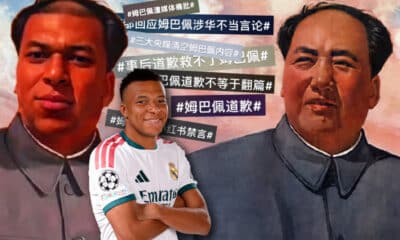
Mbappé’s favorite Mao meme sparked major backlash in China. More on what the controversy reveals about political red lines, online humor, and censorship.

RESOU 热搜 | What’s Trending in China, Explained
Here, I briefly unpack the stories making waves on Chinese social media and share what stands out to me. Don’t miss an update: become a subscriber to Eye on Digital China today.
Oh oh oh, Mbappé, all those goals, yet you lost so many points on Chinese social media over the past 48 hours.
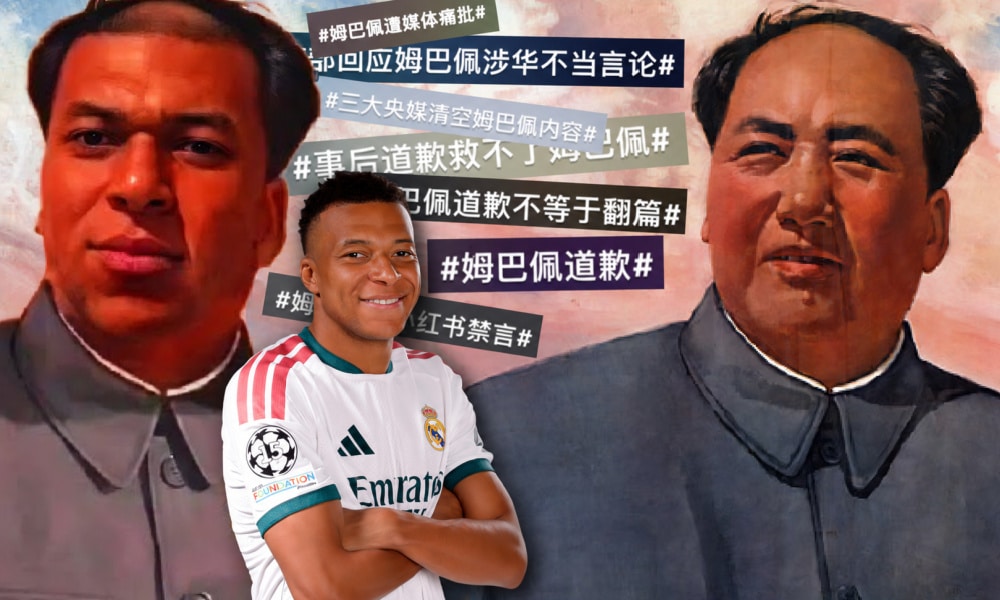
Following his 100th goal for Real Madrid during El Clásico and finishing second on Ballon d’Or night, French football player Mbappé is all the talk on Chinese social media — not for his achievements, but for what is seen as crossing a major red line in an online interview.
On Tuesday night, a text came in from Ruixin: “I am wide awake tonight and somehow witnessed live how the footballer Kylian Mbappé was getting blocked and totally canceled on Chinese social media for his comments about Mao Zedong over the past, like, three hours 😅”
I quickly grabbed my phone and saw the flood of Mbappé posts rapidly coming in, and it was clear that people were very cross with him.
Although it was already clear that this might not blow over any time soon, by early Wednesday morning it became painfully clear how the controversy had snowballed. Dongpeng Beverage Group (东鹏), one of the many Chinese companies that signed the famous sportsman as its brand ambassador, publicly stated that it was cutting all commercial ties with Mbappé. Soon, others followed.
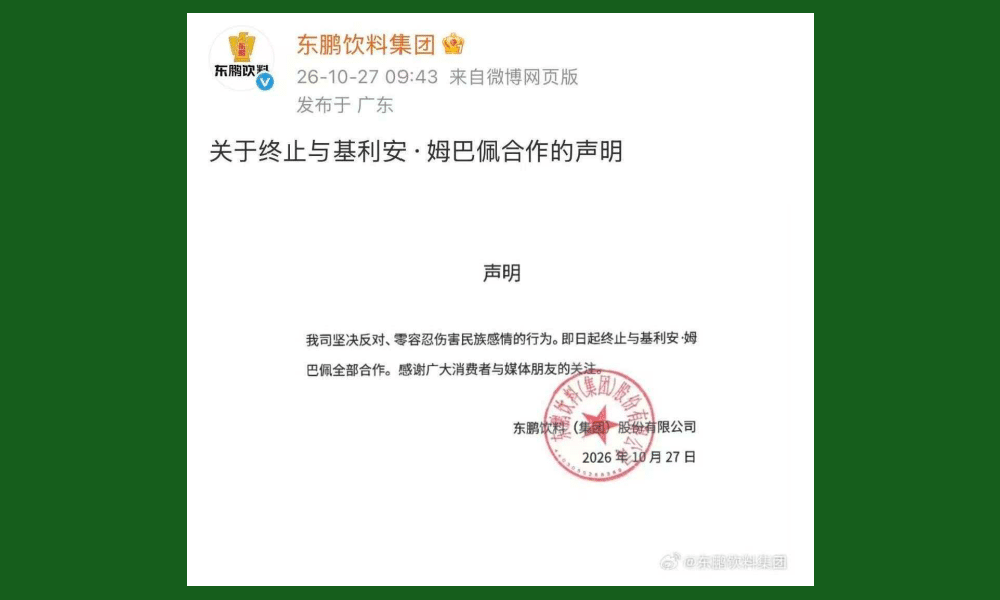
Dongpeng Beverage Group (东鹏): the first in a string of companies to cut ties with French footballer Kylian Mbappé.
Mbappé’s fall from grace in China has been sudden and spectacular, like a major avalanche of backlash that unfolded in one night, and it can all be traced back to one segment of an interview the footballer previously did on a French YouTube show (The Bridge) that resurfaced online — initially through Reddit and X, and then on Chinese social media apps, like football platform Dongqiudi (懂球帝).
In that segment, when asked about his favorite meme, Mbappé replied that one of the memes he finds funniest is:
🗣️ “the one where they put my face on some guy, a Chinese dictator. That really makes me laugh, I use it with my friends all the time.”

The interview segment where Mbappé shares his favorite meme: his face photoshopped onto the face of a “Chinese dictator.”
The show, created by Mbappé’s Real Madrid teammate Aurélien Tchouaméni, added the image Mbappé referred to: his face photoshopped on a Mao propaganda visual. It’s part of a series of memes that emerged in 2024 in which Mbappé’s face is edited onto the faces of dictators.1
Chapter Dive
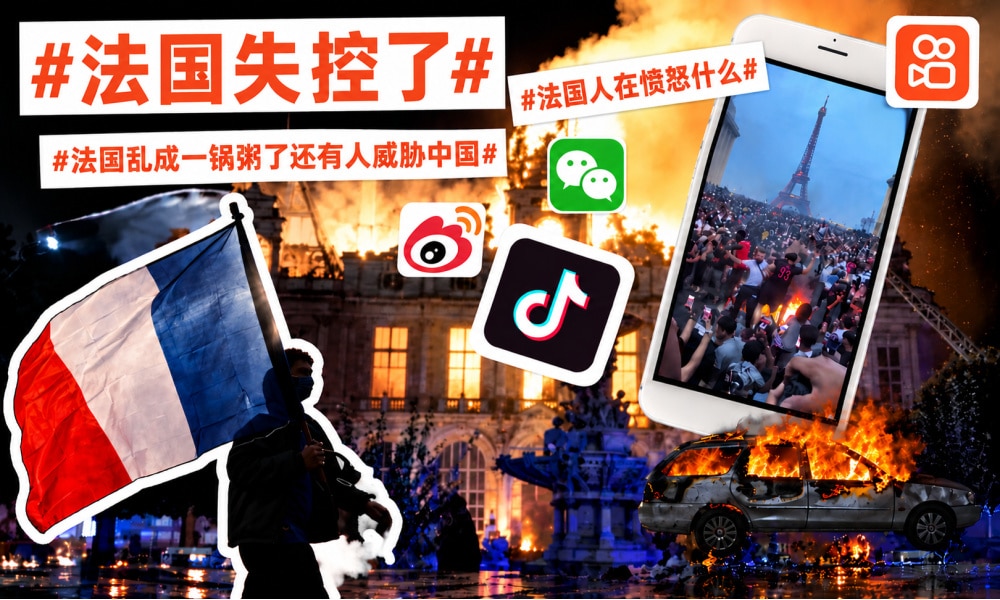
The French Protests, Viewed from China: Five Narratives on Chinese Social Media
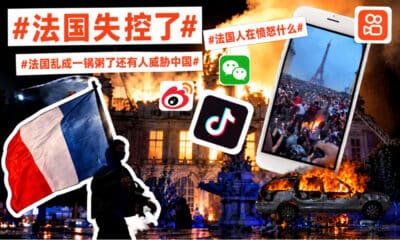
From the decline of Europe to historical karma: these 5 narratives reveal how Chinese social media discusses the recent unrest in France.
Eye on Digital China is a reader-supported publication by
Manya Koetse (@manyapan) and powered by What’s on Weibo.
It offers independent analysis of China’s online culture, media, and social trends.
To receive the newsletter and support this work, consider
becoming a paid subscriber.


From “Pure Love Warrior” to Political Victim: Jensen Huang’s Fall on Chinese Social Media

China Trend Watch: Digital Dementia and Why Everyone Says ‘Li Na’

Mbappé, Mao & the Backlash on Chinese Social Media

Mbappé, Mao, and the Joke That Shall Not Be Named

The French Protests, Viewed from China: Five Narratives on Chinese Social Media

Why Japan Has So Many Surnames, China’s Back-to-School Shifts & Taiwan Pavilion Trouble

The Power of Ugly: Why Niu Lai Became China’s Unlikeliest Box-Office Hit

The Rise of “Shuaqi-ism,” Taking Starbucks to the Fields, and Pretending to Go to Work

Blame Games & Bad Signs: Nepal–Tibet Floods, Huawei’s Toilet Trouble, “Screwed” Graduates

Starbucks Goes Xinjiang & The Kardashians in China
-

 Chinese New Year9 months ago
Inside Chunwan 2026: China’s Spring Festival Gala
-

 China Brands, Marketing & Consumers12 months ago
Hasan Piker’s China Trip & the Unexpected Journey of a Chinese School Uniform to Angola
-

 Chapter Dive9 months ago
Inside the Great Chinese Debate Over the Iran War
-

 Chapter Dive10 months ago
Chinamaxxing and the “Kill Line”: Why Two Viral Trends Took Off in the US and China
Bruce Humes
November 6, 2018 at 5:32 am
By the way, Chinese citizens relocating within China are migrants, not immigrants. Your misuse of “immigrant” is particularly ironic in this context, since regional discrimination does reach xenophobic proportions at times in the Middle Kingdom…