
China Insight
“My Life Changed Forever After A Car Crash” – Story of Duped Victim Finds Resonance on Weibo
Often it is the ‘victim’ scamming the driver in staged accidents, but now it is the driver who has scammed the victim.


Stories of traffic accident scams often make the news in China, as there are many who try to win financial compensation by setting up an accident. But what if it is not the driver, but the victim who gets scammed, because the guilty party pretends not to have the money to pay for compensation?
It is what happened to the family of Zhao Yong (赵勇), whose emotional essay and video post have become a major topic of discussion on Chinese social media over the past week.
“It has been 776 days since the day of my father’s accident,” Zhao says at the start of his post of November 22, in which he tells the story of how his life changed forever when his father, riding a bicycle, was hit by a car in Tangshan (Hebei) in 2015. “During this time, my father, who is now lying beside me in a vegetative state, had to undergo four surgeries.”

Zhao’s father passed away on December 1st.
The story of Zhao Yong has been discussed by thousands of Weibo netizens over the past few days, especially when Zhao announced that his father had passed away on December 1st as a result of his injuries. “We were unable to save him. Today, my father has gone,” Zhao posted on his Weibo account (@认真的赵先森) on Friday afternoon.
In a moving essay, Zhao describes how his happy family life suddenly turned into a nightmare on October 6th 2015; the day of his father’s grave accident. As his father had to undergo heavy injuries and had to receive immediate medical care at the hospital, Zhao Yong struggled to pay the hospital’s 10,000 yuan-per-day (±1510$) fees. Living as a vagabond, Zhao did everything he could to scrape together the money to keep his father alive; selling his house, selling his paintings, and seeking media attention for his case.

This case already made headlines in 2015, when Zhao Yong sold his house and paintings to pay for 200,000 yuan (±30,000) in medical costs for his father’s surgeries.
Zhao’s essay, that features a black and white photo of his parents in happy times, has gained over 10 million views on Weibo this week, and the video in which he tells his story has been shared more than 400,000 times, receiving over 116,000 comments.
Through text and video (which also includes recorded talks with the responsible driver), Zhao discloses how the current legal in system in China “is only effective when it comes to people with morals, not when it comes to the scum of society.”

Zhao shares the story of the past two years through his video on Weibo.
Although the local court in Hebei ordered the responsible driver Huang Shufen (黄淑芬) to pay 850,000 RMB (±128.550$) in compensation to Zhao’s family for medical costs, not only did Huang not come up with the money, she also treated the victim’s family in a rude and unreasonable way.
“I don’t have a low income,” she said in one of the conversations recorded by Zhao in the video: “But I have loans to pay and I have no morals. So what’s the use in talking to me?” Zhao says that although Huang never paid the ordered money, she did buy a house and a car and went on a New Year’s holiday to Thailand.
Zhao describes how she told him: “I have bought a house and a car now, my money is gone.” Through a friend, Zhao discovered that within months after the accident, Huang bought the car and the house and registered them under her daughter’s name to transfer all of her assets.

Huang Shufen refuses to pay the compensation, as featured in Zhao’s video.
Chinese media reporting on this story have dubbed it as a “textbook example” (“教科书式耍赖”) of “shameless refusal” to accept (legal) responsibility.
According to the latest news, the Tangshan local court has frozen the assets that are still under Huang Shufen’s name on November 24, and has since detained her for 15 days for failing to comply with the court’s order. Meanwhile, Zhao’s family still never received a single penny and have not received any messages from the driver’s family concerning the death of Zhao’s father.
In Zhao’s post, he shared a picture of how his appearances have changed over the past two years, during which he grew from an ambitious young graduate with a job, house, girlfriend, and hopeful future, into a worn-out man who has given up everything to save his father and is stuck in a pile of debt.

The sorrows of the past two years have deeply affected Zhao.
Addressing Huang Shufen, Zhao writes: “I hope you’ll also read this essay with your daughter. I have used up all my youth over these past two years. I have no escape. But you also cannot hide. It is not hard to discover you actually do have a conscience. Don’t leave me out in the cold, and show some basic humanity. The court has decided – you have no excuses left.”
On Weibo, netizens strongly condemn Huang Shufen’s actions, and also speak out against China’s legal system. “Can’t they auction all of her family property?” one netizen wonders.
“This just shows that China’s law is not healthy and that the system of legal enforcement is weak,” one person writes: “It gives scammers too much opportunity.”
“People like her are morally bankrupt. She has money to buy a house and a car, but can’t compensate the person she hit with her car. She simply has no morals,” some commenters say.
In China, traffic accidents and their aftermath often become much-discussed topics. According to Chinese law, persons who injure a victim in such accident often have to pay large sums in compensation.
This has led to situations in which it has occurred that drivers intentionally kill the pedestrians they have hit, because the compensation for killing a victim in a traffic accident is relatively small compared to paying for the care for a disabled or seriously injured survivor. This phenomenon has been researched and described by Geoffrey Sant in “Driven to Kill” (link).
It has also generated a business of professional scammers, also called ‘pengci,’ who deliberately crash against cars and then demand compensation. These kinds of fraud cases make drivers in China very vulnerable. But, as Zhao’s story points out, when a person is truly a victim of an accident and the culprit refuses to pay, they are not just vulnerable – but also become powerless.
By Manya Koetse
Follow @whatsonweibo
Spotted a mistake or want to add something? Please let us know in comments below or email us.
©2017 Whatsonweibo. All rights reserved. Do not reproduce our content without permission – you can contact us at info@whatsonweibo.com.

China Insight
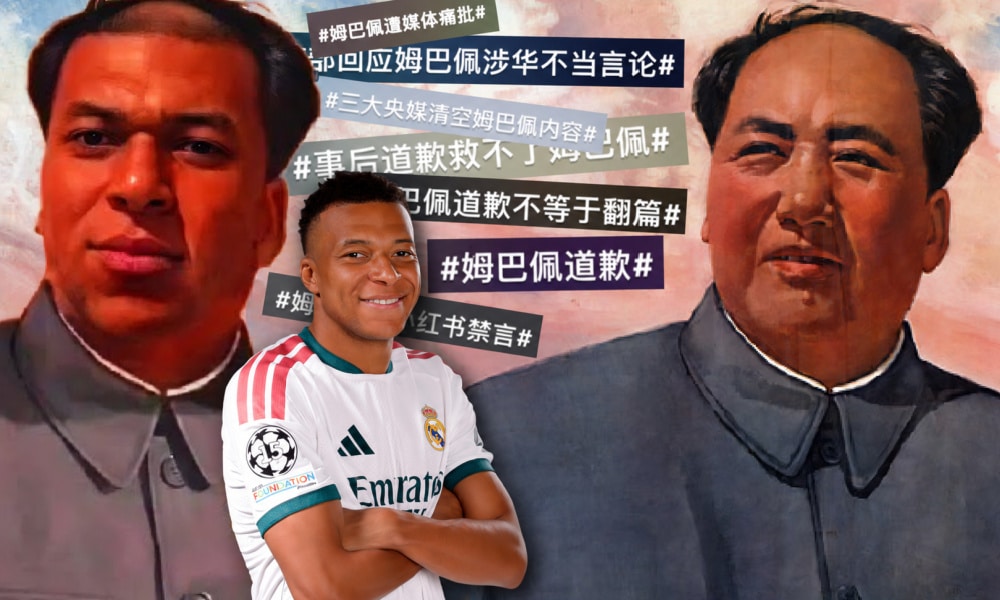
Mbappé, Mao, and the Joke That Shall Not Be Named
Mbappé’s favorite Mao meme sparked major backlash in China. More on what the controversy reveals about political red lines, online humor, and censorship.
RESOU 热搜 | What’s Trending in China, Explained
Here, I briefly unpack the stories making waves on Chinese social media and share what stands out to me. Don’t miss an update: become a subscriber to Eye on Digital China today.
Oh oh oh, Mbappé, all those goals, yet you lost so many points on Chinese social media over the past 48 hours.
Following his 100th goal for Real Madrid during El Clásico and finishing second on Ballon d’Or night, French football player Mbappé is all the talk on Chinese social media — not for his achievements, but for what is seen as crossing a major red line in an online interview.
On Tuesday night, a text came in from Ruixin: “I am wide awake tonight and somehow witnessed live how the footballer Kylian Mbappé was getting blocked and totally canceled on Chinese social media for his comments about Mao Zedong over the past, like, three hours 😅”
I quickly grabbed my phone and saw the flood of Mbappé posts rapidly coming in, and it was clear that people were very cross with him.
Although it was already clear that this might not blow over any time soon, by early Wednesday morning it became painfully clear how the controversy had snowballed. Dongpeng Beverage Group (东鹏), one of the many Chinese companies that signed the famous sportsman as its brand ambassador, publicly stated that it was cutting all commercial ties with Mbappé. Soon, others followed.
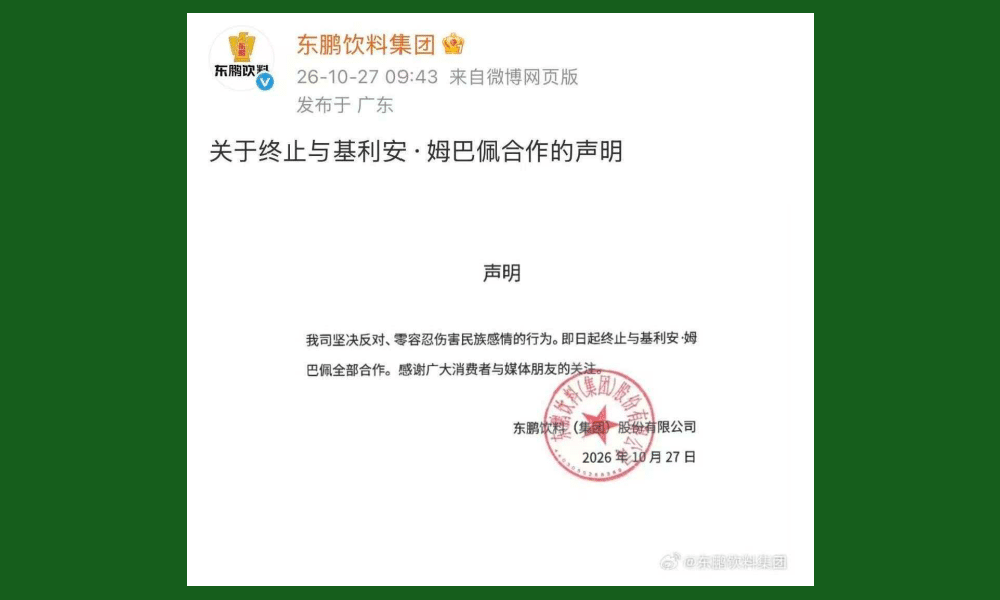
Dongpeng Beverage Group (东鹏): the first in a string of companies to cut ties with French footballer Kylian Mbappé.
Mbappé’s fall from grace in China has been sudden and spectacular, like a major avalanche of backlash that unfolded in one night, and it can all be traced back to one segment of an interview the footballer previously did on a French YouTube show (The Bridge) that resurfaced online — initially through Reddit and X, and then on Chinese social media apps, like football platform Dongqiudi (懂球帝).
In that segment, when asked about his favorite meme, Mbappé replied that one of the memes he finds funniest is:
🗣️ “the one where they put my face on some guy, a Chinese dictator. That really makes me laugh, I use it with my friends all the time.”

The interview segment where Mbappé shares his favorite meme: his face photoshopped onto the face of a “Chinese dictator.”
The show, created by Mbappé’s Real Madrid teammate Aurélien Tchouaméni, added the image Mbappé referred to: his face photoshopped on a Mao propaganda visual. It’s part of a series of memes that emerged in 2024 in which Mbappé’s face is edited onto the faces of dictators.1
Chapter Dive
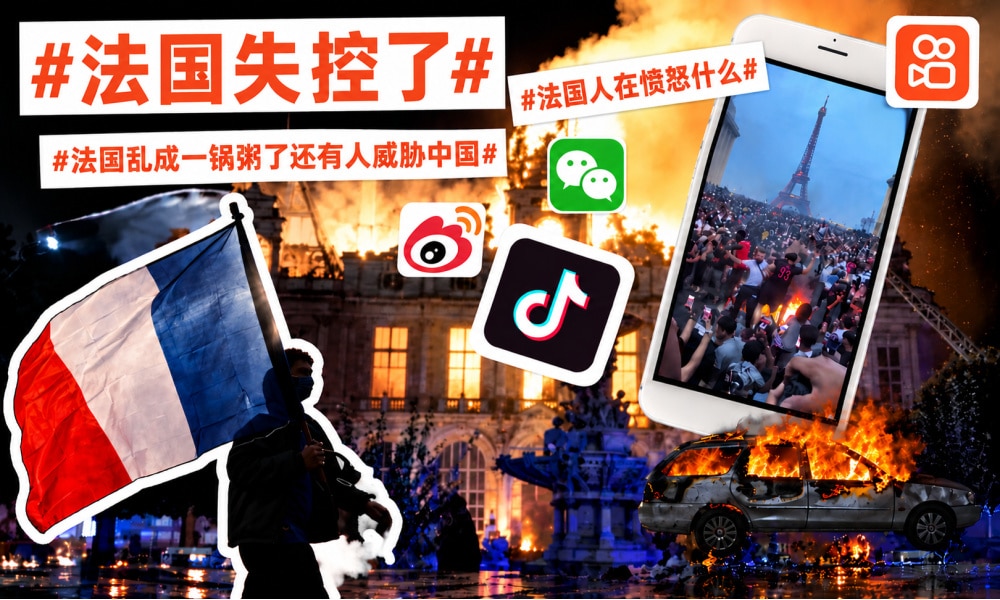
The French Protests, Viewed from China: Five Narratives on Chinese Social Media
From the decline of Europe to historical karma: these 5 narratives reveal how Chinese social media discusses the recent unrest in France.
Eye on Digital China is a reader-supported publication by
Manya Koetse (@manyapan) and powered by What’s on Weibo.
It offers independent analysis of China’s online culture, media, and social trends.
To receive the newsletter and support this work, consider
becoming a paid subscriber.

Mbappé, Mao & the Backlash on Chinese Social Media

Mbappé, Mao, and the Joke That Shall Not Be Named

The French Protests, Viewed from China: Five Narratives on Chinese Social Media

What Does 20 Yuan ($3) Mean Anymore? China’s Disappearing Living Rooms & the Great Laundry Debate

Starbucks Goes Xinjiang & The Kardashians in China

Why Japan Has So Many Surnames, China’s Back-to-School Shifts & Taiwan Pavilion Trouble

The Power of Ugly: Why Niu Lai Became China’s Unlikeliest Box-Office Hit

The Rise of “Shuaqi-ism,” Taking Starbucks to the Fields, and Pretending to Go to Work

AI Actress Ad Pulled, Baihaitun Disrupts Shanghai and Cicada Meme Bugs Huawei

Blame Games & Bad Signs: Nepal–Tibet Floods, Huawei’s Toilet Trouble, “Screwed” Graduates
-
 Chinese New Year9 months ago
Inside Chunwan 2026: China’s Spring Festival Gala
-

 China Brands, Marketing & Consumers12 months ago
Hasan Piker’s China Trip & the Unexpected Journey of a Chinese School Uniform to Angola
-

 Chapter Dive8 months ago
Inside the Great Chinese Debate Over the Iran War
-

 China Trend Watch12 months ago
Japan Tensions, Nexperia Fallout, Yunnan’s ‘Wild Child,’ & “Modern Opium”
Lu
December 2, 2017 at 9:51 pm
did you mean IRresponsible driver huang shufen?