
China Digital
New Kind Of ‘Pengci’? Chinese Users Cook Samsung Galaxy Note 7 To Make Battery Explode
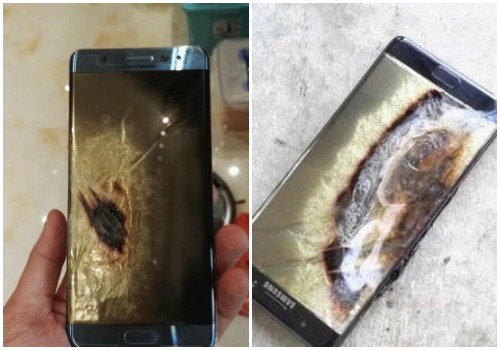
After first reports of a Samsung Galaxy Note 7 battery exploding in China, explosions are no purposely caused for compensation – a new kind of ‘pengci’?

Pengci (碰瓷) is a widespread fraud in China that involves deliberately crashing cars and then wanting compensation. Something similarly seems to be happening with the incidents of exploding Samsung Galaxy Note 7 batteries in China.
A day after Chinese media reported about exploding Samsung Galaxy Note 7 (三星盖乐世Note7) batteries in China, the official Samsung China released a statement through its Weibo account that for at least one of these cases, the fire was caused by heating outside of the phone.
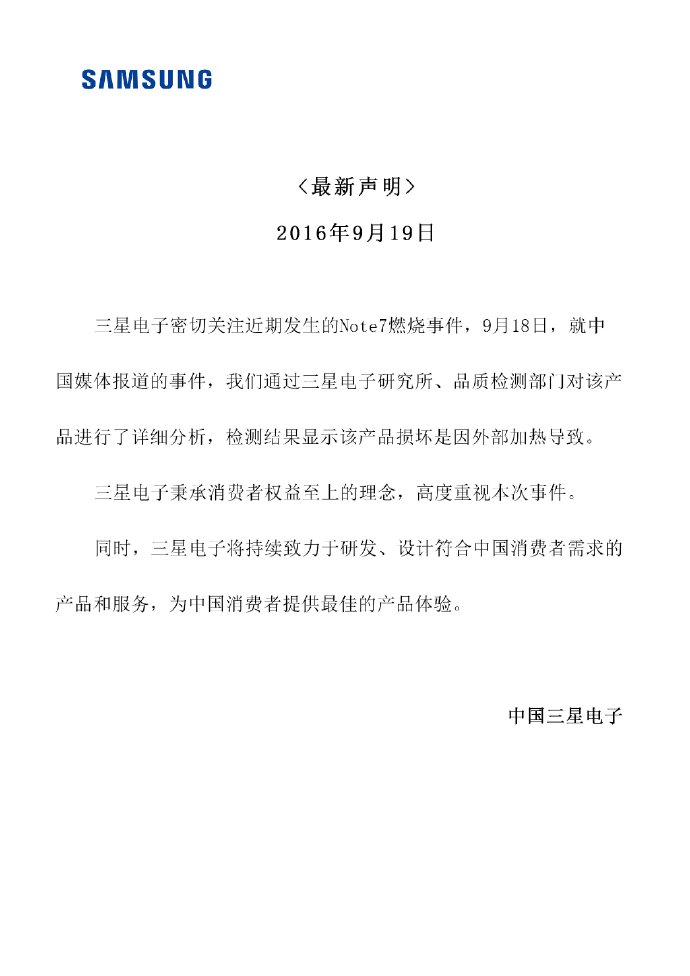
The statement comes after two Chinese Samsung Note 7 users reported their phones exploded over the weekend. The report of these cases in China indicated another setback for Samsung, that was already struggling to restore consumer trust after dozens of reports in other countries of overheating or exploding batteries.
One case that was widely reported by Chinese media on September 18 was brought to light by a 23-year-old netizen who posted pictures of his coral blue note 7 after it allegedly exploded.

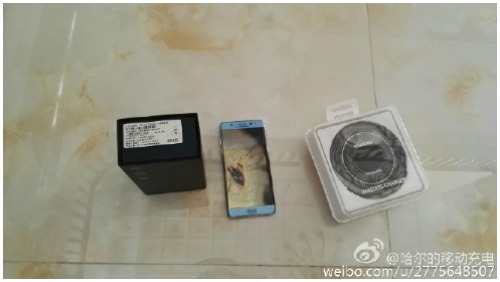
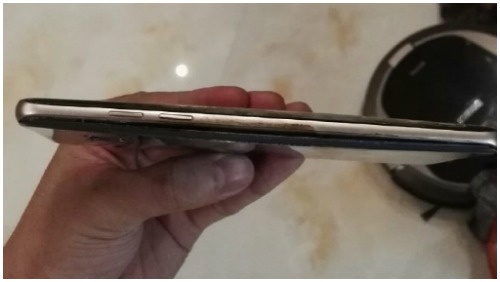
The topic “Samsung Note 7 Battery Explosions” (#三星Note7电池爆炸#) became trending on Weibo. By September 19, it had received over 2.1 million views.
“Cooking the Samsung for 2-3 Minutes”
Many netizens are unsure what Samsung actually meant with its statement that the fire was caused by “external” components: “Is Samsung saying that Chinese Samsung users are cooking their phones until they explode?” one netizen wondered.
Another person also commented: “Do you think Chinese people even put their phones in the oven?”
On September 20, South Korean media reported that the Chinese users were indeed deliberately setting off their phones to demand compensation. The incidents occurred after Samsung globally recalled its Galaxy Note 7 over battery fears in early September. After the premium smartphone had been on sale for only two weeks, already 35 faulty phone batteries were reported. The explosions were found to be caused by a battery cell issue.
Samsung assured Chinese customers that they did not need to worry about the global recall since Samsung China uses batteries from a different supplier – which is why the Galaxy Note 7 recall would not affect customers in the People’s Republic (PRC).
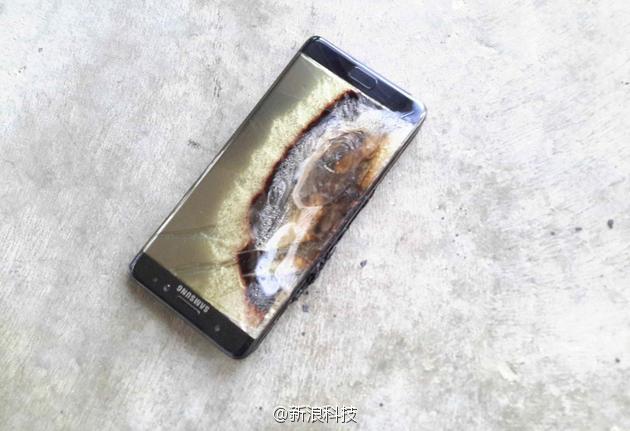
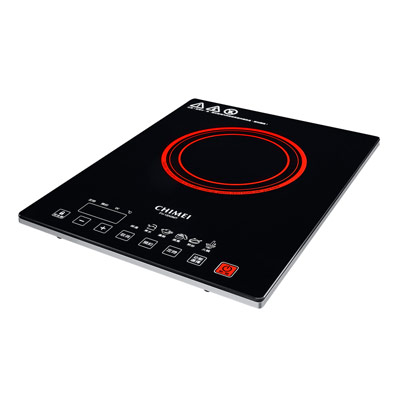
After testing the Chinese phones that allegedly exploded, Samsung found they were intentionally heated. According to media reports, similar effects to what is shown on the pictures of the Chinese netizens can be reached after putting the Samsung on an electric cooking plate for 2-3 minutes at 200 degrees. Similar effects can occur when putting the Samsung in the oven or microwave.
A New Kind of Pengci?
The intentional cooking of Samsung smartphones is similar to the phenomenon of ‘pengci’. Pengci (碰瓷,literally: knocking over porcelain) is a type of widespread fraud in China where people deliberately crash against cars and then demand compensation, as can also be seen in the gif below.
Pengci is very common in the PRC, with some extreme cases making headlines occasionally. Earlier this year, Shanghaiist reported an incident where an elderly woman was ‘hit’ by a toy Mercedes car after which she asked for medical help and allegedly wanted to be compensated.

Some people are willing to put themselves at serious risk in hopes of getting compensation. Cooking one’s smartphone belongs in the same category as it can cause an explosion that could potentially danger people around it.
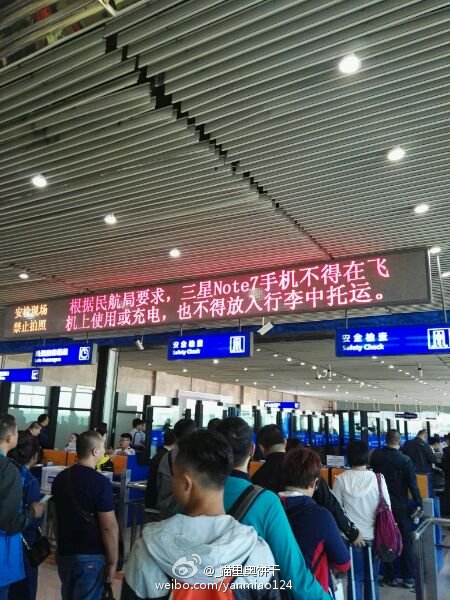
Although the battery explosions in China are found to be intentionally caused, Samsung is already suffering from the widespread fear for phone combustion. Some netizens posted pictures showing specific warning signs at the airport that the Samsung Galaxy Note 7 could not be used on board of the airplane.
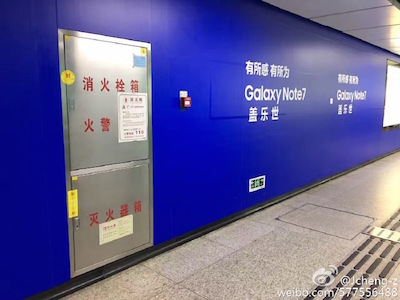
The topic also triggered many jokes on Chinese social media. One Weibo user posted this picture of a Samsung Galaxy Note 7 smartphone advertisement right next to a fire extinguisher.
– By Manya Koetse
Follow @WhatsOnWeibo
©2016 Whatsonweibo. All rights reserved. Do not reproduce our content without permission – you can contact us at info@whatsonweibo.com.






🗞️ QUICK SCROLLS
📈 Is China’s AI price war over? After a period of offering as much as possible to users at relatively low prices, Chinese AI (LLM) companies are now raising their prices. Last week, DeepSeek – known as the cheapest LLM model around – announced a raise in its API prices, showing that LLM models in China, like food delivery platforms, follow a clear strategy of first attracting users and subsidizing growth, then monetizing once users are locked in.
🐸 “Antibiotic bullfrogs” are a new cause for concern. Bullfrogs sold through e-commerce channels, popularly used in various dishes (like bullfrog hotpot), have been found to contain excessive antibiotic residues after being tested by an independent Shanghai investigation team. Antibiotics are widely used in bullfrog farming.
🌾 A 67-year-old farmer from Anhui ruined 25 acres of crops after following a chatbot’s advice on which pesticides to use. The AI tool recommended a strategy including fomesafen, which killed the farmer’s entire sesame plant crop. Chinese state media highlighted the story as a warning to the growing number of senior citizens who are relying on AI a bit too much.
👁️ A Chinese ad campaign for contact lenses has been taken offline because it starred an AI actress who doesn’t actually have eyes. Last week, I reported on the success of this AI actress, Fang Taozi (方桃子), in the AI micro drama “Laid-Off Girl” (被裁掉的女孩). After a Chinese cosmetic contact-lens brand paid a large sum to feature the actress in its commercial, regulators flagged it because the virtual actress claimed the contact lenses were “comfortable.” Because she doesn’t physically have eyes, this suggests false advertising, and the company could face an additional fine.
🎭 The famous Chinese actor Qin Yan (秦焰) has passed away at the age of 72. The veteran actor was a familiar face on Chinese TV since 1991 and was known for his many roles in TV series like Ruyi’s Royal Love in the Palace, The Knockout, and Joy of Life 2. While fans and colleagues are posting tributes online, the actor’s Baidu (Baike) page has turned black-and-white to mourn his death. The actor suffered from an illness that hasn’t been specified.

Images via Weibo, showing Qin Yan’s press photo on the left and on the right him portraying the role of Eunuch Dai, the corrupt director of the vegetable and food supply department in the popular historical drama series Joy of Life Season 2 (2024).
🏆 China’s animated film Ne Zha 2 was the biggest winner at the 38th Hundred Flower Awards, China’s most prestigious film awards. The movie grossed 15.9 billion yuan ($2.35 billion) and currently ranks as the world’s fifth highest-grossing film, right in between Titanic and Star Wars. Notably, director Jiaozi (real name Yang Yu 杨宇, b. 1980) was absent from the ceremony, as he always is. The director has a strong dislike for pointless socializing. 😂
🕯️ Remembered as a “Communist Warrior” (共产主义战士), the passing of former Chinese Premier and electrical engineer Zhu Rongji (朱镕基) became a top trending topic on Wednesday after an official obituary announced his death. Zhu is mostly remembered for his efforts to help transition from a planned economy to a socialist market economy, including his tax reform implementations, restructuring of state-owned enterprises, and creation of the mass home-ownership market. Zhu died of an illness in Beijing. He was 98 years old.
👁️ ZOOMING IN
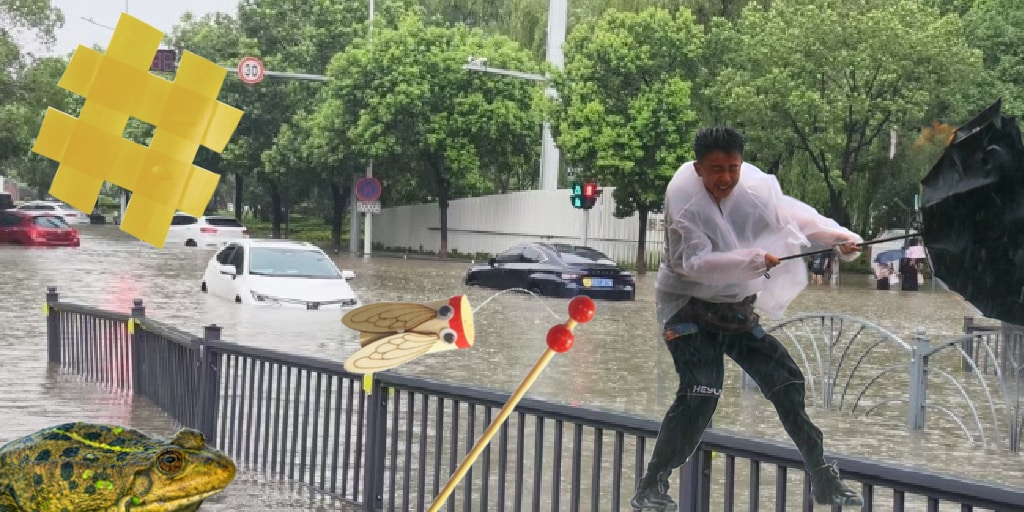
1. Typhoon Baihaitun Brings Record Rainfall to Shanghai

Image via Weibo user @粗茶大白饭
Typhoon Baihaitun (白海豚 “White Dolphin”) has been one of the biggest keywords dominating Chinese social media this week as severe weather affected eastern China.
In Shanghai and surrounding areas, the typhoon caused major disruptions on August 9–10 due to strong winds and extreme rainfall. In Xujiahui, nearly 316 mm of rain fell within 24 hours, the highest amount recorded in Shanghai since observations began over 150 years ago. (The highest total was recorded at Lantian Station in Linhai, Taizhou, where rainfall surpassed a staggering 630 mm; that’s like buckets of water simply being poured down from the sky.)
Many roads, homes, and entire parking lots were completely flooded (video on X / Bluesky). Thousands of people were evacuated, flights were canceled, and metro lines were suspended. In some neighborhoods, residents reported that the water had reached all the way up the stairs.
The typhoon coincided with the Monday morning rush. Despite official guidance encouraging working from home, online complaints made it clear that many companies still expected their employees to show up at the office.
Shanghai Disneyland also remained open despite the severe weather. Videos show park visitors riding attractions in the pouring rain, and cast members in costumes needing help to navigate the rain and wind. The happiest place on earth has never looked so sad (see various videos in my thread here on X / Bluesky).
The impact of the typhoon is expected to last until at least Sunday.
2. Streisand Effect: Huawei Gets Bugged by Bamboo Cicada Toy
If the past week had one soundbite, it would be the rasping, buzzing cicada-like sound you get by spinning the traditional handmade “bamboo cicada” (竹知了 zhúzhīliǎo) wooden toy.
It became a viral sensation after netizens used its sounds to accompany videos of a Huawei event where Chairman Richard Yu (余承东) announced a new car. He described the AITO M9 as “the best SUV under 10 million yuan” (一千万以内最好,没有之一), prompting “wawaa” sounds and cheers from the audience. Soon, a meme was born in which social media users mixed the footage with the toy’s sound – not just because of the audience, but also because of Yu’s distinctive way of speaking.
That cicada toy meme would never have become as big if Huawei’s legal department hadn’t intervened. The company submitted complaints to social media platforms, and videos were removed. But this triggered a chain reaction – when people found the sound was being censored, it blew up in popularity. By now, not only is the sound used everywhere, but the toy itself has become a summer must-have (even though its origins are contested – some say it’s traditionally Japanese and not Chinese at all).

The American term “Streisand Effect” (in Chinese: 史翠珊效应 Shǐcuìshān xiàoyìng) has been used online to describe how Huawei’s reaction backfired.
The response by Huawei – or, more precisely, HIMA, the company’s smart-vehicle alliance brand – was criticized not only by netizens but also by official voices. The official account of Zhejiang Province was among many posting critiques, saying that “the stronger a company is, the greater its capacity to accept discussion” – in other words, calling Huawei weak for its reaction.
This makes it one of those rare moments when, especially when it’s about censorship, official and grassroots voices seem to agree, for once, on the limits of the kind of content that should and should not be controlled. In this way, the cicada sound has come to represent something much more than mocking Huawei, with netizens protecting their rights to criticize & ridicule China’s most powerful business players.
3. Japanese K-Pop Fan’s Death Shows Dark Side of Fan Culture

Miki Chan on the right, posing together with ENHYPEN group member NI-KI. Image via Weibo.
A tragic suicide livestreamed on TikTok became a trending topic across Chinese platforms over the past week, sparking discussions about toxic fan cultures and online bullying.
The 26-year-old Japanese K-pop influencer Mina Chan experienced an acute mental health crisis while livestreaming from her home in Seoul on August 5. This happened after she suffered weeks of severe online bullying stemming from an incident at the US concert of her favorite pop group, the boy band ENHYPEN.
During the concert, Mina tried to give sunflowers to her favorite singer, Nishimura Riki, better known as NI-KI, by throwing them onto the stage. When another group member picked them up instead, she appeared upset. When NI-KI later criticized fans for seeking personal attention rather than enjoying the concert, many fans felt he was referring to Mina.
In the following weeks, Mina received so much online harassment, doxxing, and hate that she first apologized on X and withdrew from the fan club before eventually broadcasting her final livestream, in which she died by hanging. Mean comments continued throughout the livestream.
Online discussions in China have largely framed the incident in terms of online aggression (网暴, wǎngbào) and problematic fan circles (饭圈, fànquān). Although Mina was a Japanese fan of a South Korean band, K-pop fandom is also enormous in China.
Both online aggression and toxic fan culture have been repeatedly targeted by Chinese cyberspace authorities in recent years, undoubtedly contributing to greater public awareness of these problems. Against this backdrop, Mina’s death has prompted widespread calls to end online bullying, while thousands of Chinese netizens have expressed their sorrow over the young woman’s death.
Notably, just one day before Mina’s livestream, American celebrity blogger Perez Hilton became a global trending topic after self-harming during a TikTok livestream that remained online for approximately fifteen minutes, allowing a large audience to watch the disturbing events unfold – similar to what happened with Mina’s livestream. In the United States, the incident sparked further discussion about platform moderation and TikTok’s failure to end livestreams quickly when signs of self-harm or an acute mental health crisis emerge.
📱ON MY FEED
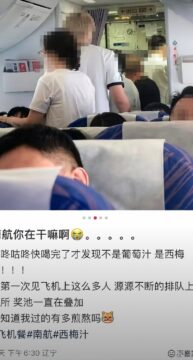
This post reads:
“China Southern, what on earth are you doing? I gulped it all down, only to realize it wasn’t grape juice, it was prune juice!!! This is the first time I’ve seen such a long, never-ending line of people waiting to use the restroom on a plane; the prize pool just kept growing.
Do you have any idea how much I suffered? #InFlightMeal #ChinaSouthern #PruneJuice”
After passengers on a China Southern Airlines flight from Wuhan to Urumqi were served prune juice with their meal, the queues for the plane’s only two toilets kept growing as dozens of passengers felt the high urge to go.
One other review said:
“What were you thinking, serving prune juice? China Southern, please answer me. You nearly made me shit myself.”
🔗 SEEN ELSEWHERE
🔹 “Grandma Economy” (“姥姥经济”) fills a void for urban Chinese Gen Z and millennial consumers who are increasingly projecting their nostalgia for the warmth of grandmothers onto the brands they buy, the content they consume, and the creators they follow. Read at Baiguan / by Amber Zhang.
🔹 Toddler twins are at the center of a very messy custody case involving a surrogate mother from Florida and a Chinese father who might never be allowed to enter the US. Born in November 2024, the twins are biologically not connected to the surrogate mother, but after the Chinese legal father never came to collect them, she and her husband want to adopt them. A new Florida law has now placed the case at the center of conservative outrage over Chinese parents allegedly exploiting the state’s lax surrogacy rules. Read at Wall Street Journal / by Katherine Long.
🔹 A Chinese state media correspondent has been accused of being a spy by the Czech Security Information Service, which identified Yang as an operative of China’s Ministry of State Security, alleging he used his cover as a journalist to collect compromising information on Czech politicians, particularly those supportive of closer ties with Taiwan. Read at Reporters Without Borders.
🔹 “What I feared to be my lifelong search has unexpectedly come to an end. Yesterday, I got a message from my family searcher in China on WeChat that I have a positive DNA match with my biological parents.” In late 2024, I wrote about how the Dutch adoptee Fengli Bottema had come to China in search of her biological family after she was left in front of an Anhui police station as a baby back in 2001. There’s now an update to her story, which echoes that of thousands of Chinese girls adopted abroad. Her search has finally come to an end. Read Fengli’s Instagram post here.
Thanks to Miranda Barnes for helping me curate topics for this edition.
China Digital
How Chinese AI Videos Turned Foreigners into Villains
How viral AI videos turn racialized outsiders into threats and violent Chinese heroes into defenders of social order, China’s first nationally broadcast AI drama, and why a newspaper is being sold for 50 times its original price.

Eye on Digital China is a reader-supported publication by
Manya Koetse (@manyapan) and powered by What’s on Weibo.
It offers independent analysis of China’s online culture, media, and social trends.
To receive the newsletter and support this work, consider
becoming a paid subscriber.


Keeping Score of History: The Mukden Incident and China’s Basketball Defeat to Japan

The Rise of “Shuaqi-ism,” Taking Starbucks to the Fields, and Pretending to Go to Work

Why Japan Has So Many Surnames, China’s Back-to-School Shifts & Taiwan Pavilion Trouble

Blame Games & Bad Signs: Nepal–Tibet Floods, Huawei’s Toilet Trouble, “Screwed” Graduates

The Power of Ugly: Why Niu Lai Became China’s Unlikeliest Box-Office Hit

China’s CITIC Tower Crash: The Story That Never Trended

“Even Pigs Have AC”: The European Heatwave Through Chinese Eyes

“God Won’t Save Us, but the PLA Will”: Floods, Faith, and Kung Fu Soccer Nostalgia

How Chinese AI Videos Turned Foreigners into Villains
The Power of Ugly: Why Niu Lai Became China’s Unlikeliest Box-Office Hit
-

 China Arts & Entertainment12 months ago
The Wong Kar-wai Scandal Explained: The Dark Side of ‘Blossoms Shanghai’
-

 Chinese New Year7 months ago
Inside Chunwan 2026: China’s Spring Festival Gala
-

 China Brands, Marketing & Consumers10 months ago
Hasan Piker’s China Trip & the Unexpected Journey of a Chinese School Uniform to Angola
-

 Chapter Dive7 months ago
Inside the Great Chinese Debate Over the Iran War