
China Animals
Woman Killed By Tiger in Beijing Safari Park – Who is Responsible?
One Chinese woman was killed and one injured by a tiger’s attack when they exited their car in the middle of a wildlife park in Beijing. Netizens now wonder if the safari park should be held responsible for the tragic incident.

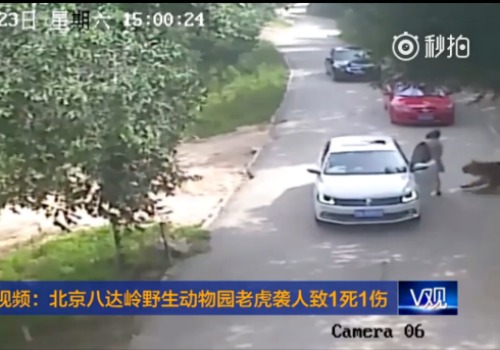
Security cameras captured how a woman was attacked by a tiger on Saturday July 23 in Beijing Badaling Wildlife World (八达岭野生动物世界). The news and footage of the initial attack, shared by CCTV on Weibo on July 24, became trending on Chinese social media.
The video shows a white car stopping in the middle of the safari park, and a woman coming out from the passenger’s side. She walks up to the driver’s side but is then attacked by a tiger from behind and dragged away. The driver and a backseat passenger come out of the car and run after the woman.
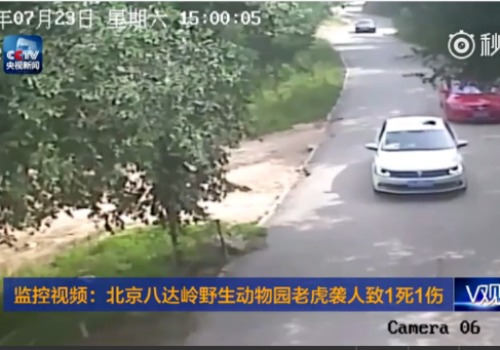
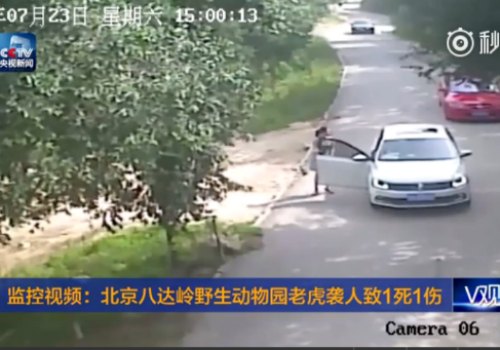
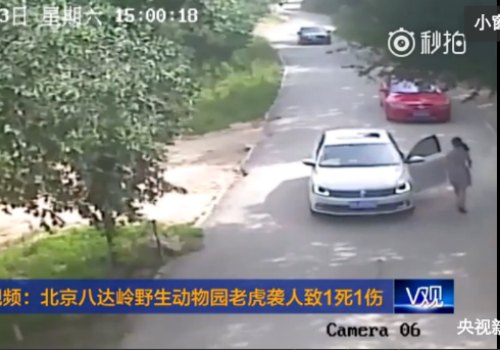
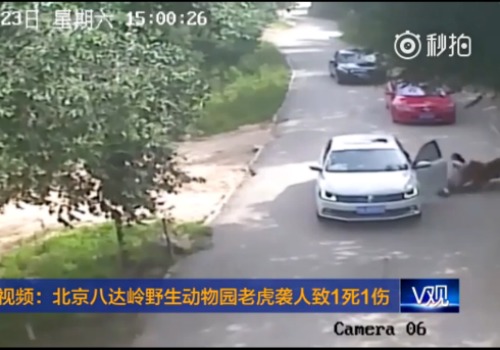

The incident left one person dead, and one person injured. According to various Chinese media, both were women in a company of four.
The young woman who got out of the car reportedly had an argument with her husband, who was in the driver’s seat, and got out of the car. The elder woman who came to her rescue as she was dragged away is the one who died; the younger woman sustained injuries. It is not clear if the elder woman was the woman’s mother. There was also a child present in the car.
The park’s official Weibo account and official website do not mention the accident. The website does mention the park will be closed due to “heavy rain”, although other sources say that it was ordered to close due to the incident.
![mention]](https://www.whatsonweibo.com/wp-content/uploads/2016/07/mention.jpg)
According to CCTV, the park rules clearly state that visitors are not to leave their cars at any times and keep door and windows securely locked.
Nevertheless, many netizens do wonder if the park is to be held responsible and if they should compensate the families of the victims.
This is not the first tragedy taking place in the Badaling Wildlife park. The managing director of the park got trampled and killed by an elephant in the park’s elephant house in March of this year.
[rp4wp]
In 2009, an 18-year-old man was killed by a tiger after he had trespassed the park’s safari area. In 2014, one of the zoo’s guards was also attacked and killed by a tiger.
The YouTube video below shows visitor’s footage of the park from 2013. The video shows that people can get close to the animals in a ‘safari’ setting. It also shows a bear drinking orange juice, parents putting their children on the back of deer and horses that seem to be in poor body condition.
According to Chinese media outlet The Oberver, sources close to the husband of the deceased victim stated they were not aware that they were still within the range of the wildlife safari, and thought they had already left.
The park indicates that its ranger honked the horn from the jeep to warn the woman not to get out of the car, but that they could not stop them from doing so.
“If you would exit the park, it is very clearly marked by a huge fence,” one netizen comments.
“This is the same as someone opening a window on an airplane,” one commenter says.
Some netizens say all parties, except for the tiger, are at fault in this matter: “Firstly, the tiger bears no responsibility for this. Secondly, the woman has no brains for coming out of the car like that. Thirdly, the park should not have visitors drive around by themselves like that.”
The case is currently under investigation. The whereabouts of the tiger are unclear. “Please don’t tell me they killed this tiger because of this moron getting out of the car,” one netizen says.
– By Manya Koetse
Follow @WhatsOnWeibo
©2016 Whatsonweibo. All rights reserved. Do not reproduce our content without permission – you can contact us at info@whatsonweibo.com.




China Animals
China Faces Unprecedented Donkey Shortage Crisis
“We have plenty of cattle and horses in China now — just not enough donkeys” (“目前我国牛马都不缺,就缺驴”).
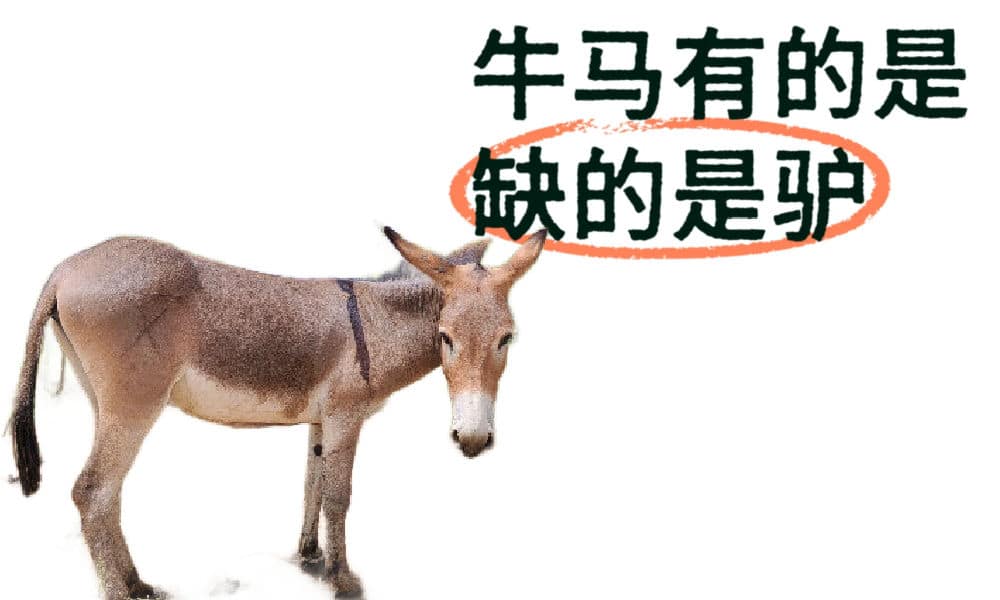
China is facing a serious donkey shortage. China’s donkey population is far below market demand, and the prices of donkey-related products continue to rise.
Recently, this issue went trending on Weibo under hashtags such as “China Currently Faces a Donkey Crisis” (#我国正面临缺驴危机#).
The Donkey Branch of China’s Livestock Association (中国畜牧业协会驴业分会) addressed this issue in Chinese media earlier last week, telling China News Weekly (中国新闻周刊): “We have plenty of cattle and horses in China now — just not enough donkeys” (“目前我国牛马都不缺,就缺驴”).
China’s donkey population has plummeted by nearly 90% over the past decades, from 11.2 million in 1990 to just 1.46 million in 2023.
The massive drop is related to the modernization of China’s agricultural industry, in which the traditional role of donkeys as farming helpers — “tractors” — has diminished. As agricultural machines took over, donkeys lost their role in Chinese villages and were “laid off.”
Donkeys also reproduce slowly, and breeding them is less profitable than pigs or sheep, partly due to their small body size.
Since 2008, Africa has surpassed Asia as the world’s largest donkey-producing region. Over the years, China has increasingly relied on imports to meet its demand for donkey products, with only about 20–30% of the donkey meat on the market coming from domestic sources.
China’s demand for donkeys mostly consists of meat and hides. As for the meat — donkey meat is both popular and culturally relevant in China, especially in northern provinces, where you’ll find many donkey meat dishes, from burgers to soups to donkey meat hotpot (驴肉火锅).
However, the main driver of donkey demand is the need for hides used to produce Ejiao (阿胶) — a traditional Chinese medicine made by stewing and concentrating donkey skin. Demand for Ejiao has surged in recent years, fueling a booming industry.
China’s dwindling donkey population has contributed to widespread overhunting and illegal killings across Africa. In response, the African Union imposed a 15-year ban on donkey skin exports in February 2023 to protect the continent’s remaining donkey population.
As a result of China’s ongoing “donkey crisis,” you’ll see increased prices for donkey hides and Ejiao products, and oh, those “donkey meat burgers” you order in China might actually be horse meat nowadays. Many vendors have switched — some secretly so (although that is officially illegal).
Efforts are underway to reverse the trend, including breeding incentives in Gansu and large-scale farms in Inner Mongolia and Xinjiang.
China is also cooperating with Pakistan, one of the world’s top donkey-producing nations, and will invest $37 million in donkey breeding.
However, experts say the shortage is unlikely to be resolved in the short term.
The quote that was featured by China News Weekly — “We have cows and horses, but no donkeys” (“牛马有的是,就缺驴”) — has sparked viral discussion online, not just because of the actual crisis but also due to some wordplay in Chinese, with “cows and horses” (“牛马”) often referring to hardworking, obedient workers, while “donkey” (“驴”) is used to describe more stubborn and less willing-to-comply individuals.

Not only is this quote making the shortage a metaphor for modern workplace dynamics in China, it also reflects on the state media editor who dared to feature this as the main header for the article. One Weibo user wrote: “It’s easy to be a cow or a horse. But being a donkey takes courage.”
By Manya Koetse
(follow on X, LinkedIn, or Instagram)
Spotted a mistake or want to add something? Please let us know in comments below or email us. First-time commenters, please be patient – we will have to manually approve your comment before it appears.
©2025 Whatsonweibo. All rights reserved. Do not reproduce our content without permission – you can contact us at info@whatsonweibo.com.
Chapter Dive
Behind the Mysterious Death of Chinese Internet Celebrity Cat Wukong
“Dont believe the media,” Zhao Shuo said: “And also don’t believe me.”
Eye on Digital China is a reader-supported publication by
Manya Koetse (@manyapan) and powered by What’s on Weibo.
It offers independent analysis of China’s online culture, media, and social trends.
To receive the newsletter and support this work, consider
becoming a paid subscriber.


Red Carpet, Pandas, and Power: How China Read the Trump-Xi Summit

Keeping Score of History: The Mukden Incident and China’s Basketball Defeat to Japan

The Rise of “Shuaqi-ism,” Taking Starbucks to the Fields, and Pretending to Go to Work

Why Japan Has So Many Surnames, China’s Back-to-School Shifts & Taiwan Pavilion Trouble

Blame Games & Bad Signs: Nepal–Tibet Floods, Huawei’s Toilet Trouble, “Screwed” Graduates

“God Won’t Save Us, but the PLA Will”: Floods, Faith, and Kung Fu Soccer Nostalgia

How Chinese AI Videos Turned Foreigners into Villains

The Power of Ugly: Why Niu Lai Became China’s Unlikeliest Box-Office Hit

AI Actress Ad Pulled, Baihaitun Disrupts Shanghai and Cicada Meme Bugs Huawei
Blame Games & Bad Signs: Nepal–Tibet Floods, Huawei’s Toilet Trouble, “Screwed” Graduates
-

 Chinese New Year8 months ago
Inside Chunwan 2026: China’s Spring Festival Gala
-

 China Brands, Marketing & Consumers11 months ago
Hasan Piker’s China Trip & the Unexpected Journey of a Chinese School Uniform to Angola
-

 Chapter Dive7 months ago
Inside the Great Chinese Debate Over the Iran War
-

 China Trend Watch11 months ago
Japan Tensions, Nexperia Fallout, Yunnan’s ‘Wild Child,’ & “Modern Opium”