
China Insight
8-Year-Old with HIV Banned from Chinese Village
8-Year-Old with HIV Banned: A small village in Sichuan has held a referendum for the banishment of an 8-year-old boy infected with HIV. The villagers unanimously agreed that the boy needs to be removed from the village and taken elsewhere to guarantee their own ‘safety’.


One of the top ten trending topics on Sina Weibo of December 17th 2014 is the case of a young HIV-infected boy expelled from his village (#艾滋男童被联名驱离#). Over 200 inhabitants from a village in Sichuan province (Xichong country) have signed a joint referendum on the banishment of the 8-year-old.
Journalist Guo Hongxin from Sichuan News reports that the inhabitants of a small Sichuan village have unanimously agreed that an 8-year-old HIV-infected boy needs to be removed from the village and taken elsewhere to guarantee the ‘safety’ of the villagers.
 The town meeting on December 7, 2014.
The boy, named Kunkun, was diagnosed with HIV in 2011 after he received hospital treatment for an accident. Doctors determined the boy had contracted the disease in his mother’s womb. The news of Kunkun’s condition soon spread like wildfire through the village.
Kunkun was raised by his ‘grandfather’ Luosheng, after Luosheng’s son and his girlfriend (Kunkun’s birth mother) left him in the village at nine months old. Luosheng’s son and Kunkun’s birth mother both work and live in Guangzhou city. Since the two are not officially married, Luosheng has no official family relation to Kunkun.
Although Luosheng’s son used to send money from Guangzou every month, he stopped contacting Luosheng and Kunkun once he heard of the boy’s condition.
Kunkun does not attend local school, as he is not accepted there. Parents feared the boy might bite their children or infect them in any way by touching.
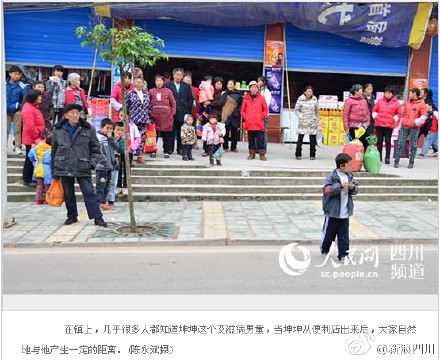 Kunkun, shunned from the small community.
On December 7th 2014, a special town meeting was arranged to discuss the status of the boy, proposing a referendum to send him away and arrange official facilities to care of him. 203 villagers signed the referendum, including grandfather Luosheng, who worries over the boy’s future due to his own old age and impoverished circumstances.
The village chief has stated that Kunkun will not be send away immediately, as the village leaders will first need to find an institution that will take him in. “Kunkun wants to go to school, but the school here is afraid to accept him. If Kunkun goes to school here, the other children won’t come anymore,” he says: “So we cannot solve the problem of his education here.” The village chief reaffirms that he hopes to find an organization that will take in Kunkun, and can provide him with medicine and schooling (Sichuan News 2014).
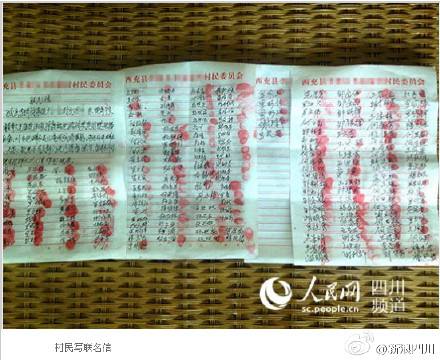 The village referendum
Weibo netizens collectively express their concern for the mental well-being of Kunkun, who is already on his own at such a young age. Some netizens emphasize that the villagers’ fear for contracting HIV by normal contact is ungrounded, as other children will not be infected if they simply go to school with Kunkun. HIV is transmitted through body fluids such as blood, semen or breast milk.
It is estimated that 780,000 people are living with HIV in China. In 2011, 28,000 people died from AIDS. Since 2009, AIDS has been the leading cause of death among infectious diseases in China. Especially the provinces of Yunnan, Guangxi, Henan, Sichuan, Xinjiang and Guangdong have the highest rate of HIV occurrence (Avert). HIV is a sensitive topic in Chinese society, as there is still a lot of stigma and discrimination around those who are infected. China’s First Lady Peng Liyuan has raised awareness on HIV through her activities as Ambassador for HIV/AIDS Prevention. The awareness and prevention of HIV are still a priority according to China’s 12th Five Year Plan. The trending story of Kunkun was published in a state-run newspaper – no coincidence, as Kunkun’s case has got people talking about HIV, which is exactly what the government wants. Raising awareness of HIV is too late for him and his fellow villagers, as the decision has already been made: Kunkun is no longer welcome.
– by Manya Koetse
Follow @WhatsOnWeibo
The story of Kunkun as reported in the Sichuan News/People’s Daily.
©2014 Whatsonweibo. All rights reserved. Do not reproduce our content without permission – you can contact us at info@whatsonweibo.com.



China Insight
Mbappé, Mao, and the Joke That Shall Not Be Named
Mbappé’s favorite Mao meme sparked major backlash in China. More on what the controversy reveals about political red lines, online humor, and censorship.
RESOU 热搜 | What’s Trending in China, Explained
Here, I briefly unpack the stories making waves on Chinese social media and share what stands out to me. Don’t miss an update: become a subscriber to Eye on Digital China today.
Oh oh oh, Mbappé, all those goals, yet you lost so many points on Chinese social media over the past 48 hours.
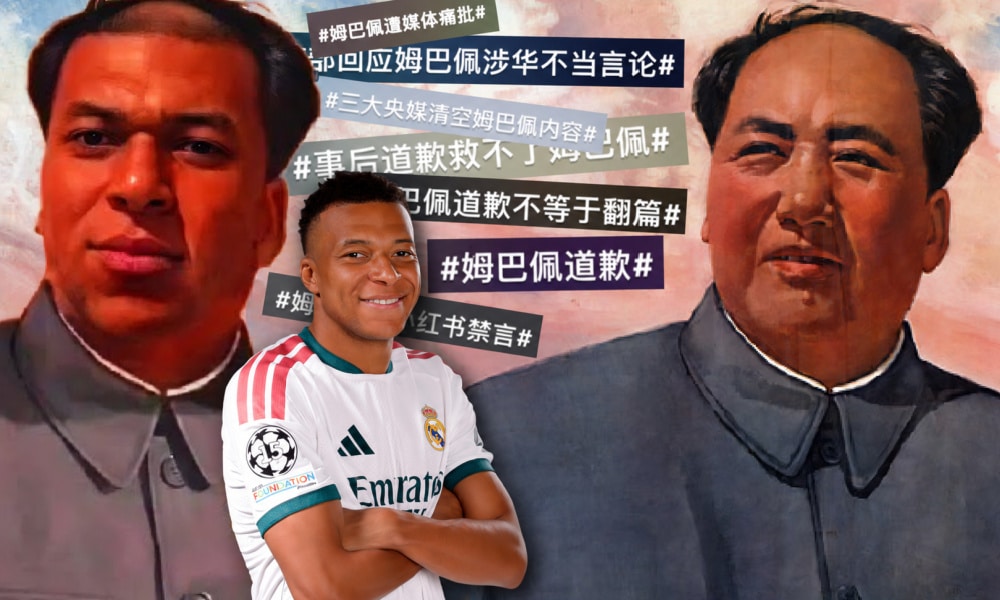
Following his 100th goal for Real Madrid during El Clásico and finishing second on Ballon d’Or night, French football player Mbappé is all the talk on Chinese social media — not for his achievements, but for what is seen as crossing a major red line in an online interview.
On Tuesday night, a text came in from Ruixin: “I am wide awake tonight and somehow witnessed live how the footballer Kylian Mbappé was getting blocked and totally canceled on Chinese social media for his comments about Mao Zedong over the past, like, three hours 😅”
I quickly grabbed my phone and saw the flood of Mbappé posts rapidly coming in, and it was clear that people were very cross with him.
Although it was already clear that this might not blow over any time soon, by early Wednesday morning it became painfully clear how the controversy had snowballed. Dongpeng Beverage Group (东鹏), one of the many Chinese companies that signed the famous sportsman as its brand ambassador, publicly stated that it was cutting all commercial ties with Mbappé. Soon, others followed.
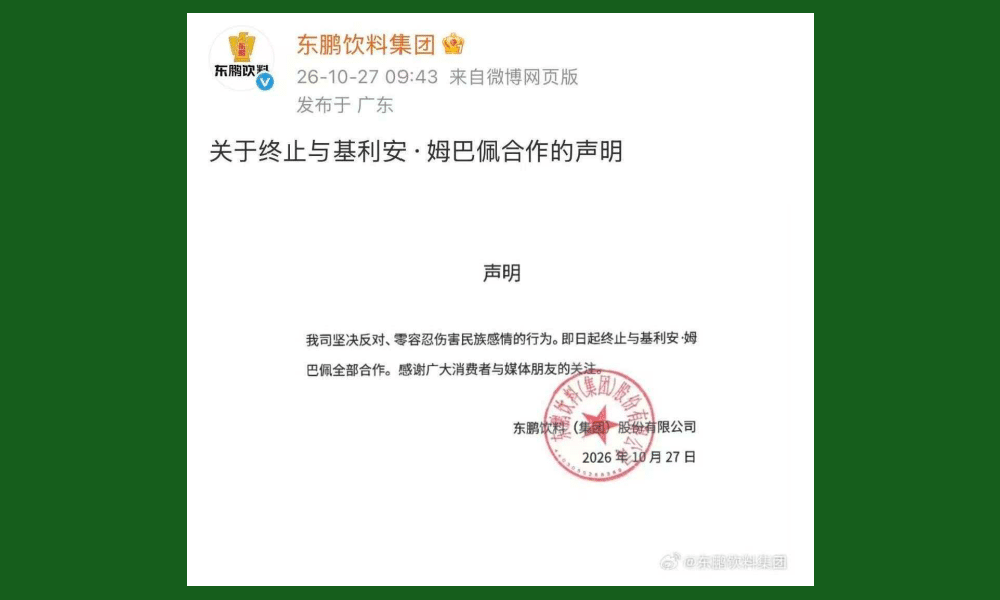
Dongpeng Beverage Group (东鹏): the first in a string of companies to cut ties with French footballer Kylian Mbappé.
Mbappé’s fall from grace in China has been sudden and spectacular, like a major avalanche of backlash that unfolded in one night, and it can all be traced back to one segment of an interview the footballer previously did on a French YouTube show (The Bridge) that resurfaced online — initially through Reddit and X, and then on Chinese social media apps, like football platform Dongqiudi (懂球帝).
In that segment, when asked about his favorite meme, Mbappé replied that one of the memes he finds funniest is:
🗣️ “the one where they put my face on some guy, a Chinese dictator. That really makes me laugh, I use it with my friends all the time.”

The interview segment where Mbappé shares his favorite meme: his face photoshopped onto the face of a “Chinese dictator.”
The show, created by Mbappé’s Real Madrid teammate Aurélien Tchouaméni, added the image Mbappé referred to: his face photoshopped on a Mao propaganda visual. It’s part of a series of memes that emerged in 2024 in which Mbappé’s face is edited onto the faces of dictators.1
Chapter Dive
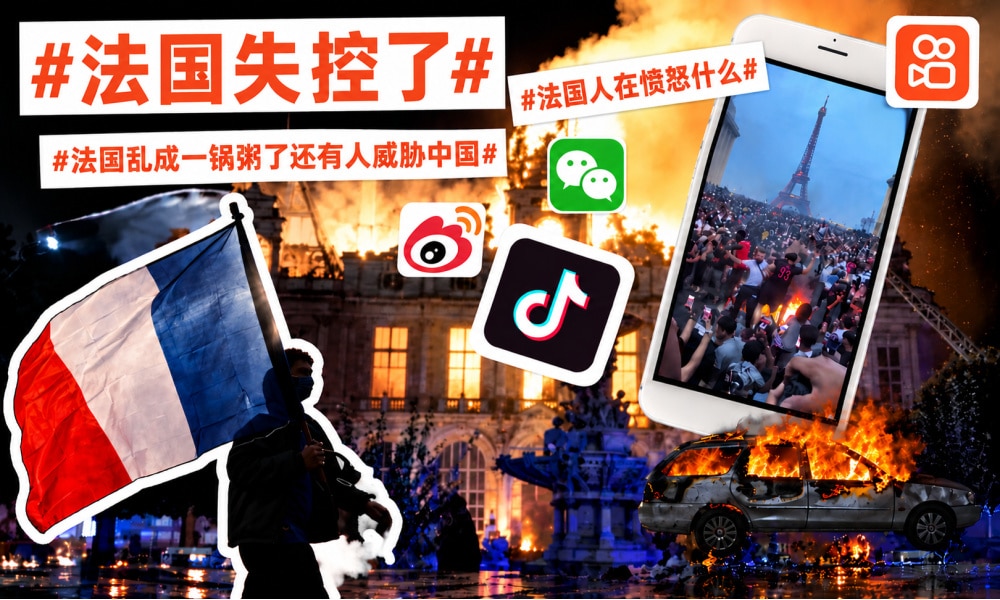
The French Protests, Viewed from China: Five Narratives on Chinese Social Media
From the decline of Europe to historical karma: these 5 narratives reveal how Chinese social media discusses the recent unrest in France.
Eye on Digital China is a reader-supported publication by
Manya Koetse (@manyapan) and powered by What’s on Weibo.
It offers independent analysis of China’s online culture, media, and social trends.
To receive the newsletter and support this work, consider
becoming a paid subscriber.


From “Pure Love Warrior” to Political Victim: Jensen Huang’s Fall on Chinese Social Media

China Trend Watch: Digital Dementia and Why Everyone Says ‘Li Na’

Mbappé, Mao & the Backlash on Chinese Social Media

Mbappé, Mao, and the Joke That Shall Not Be Named

The French Protests, Viewed from China: Five Narratives on Chinese Social Media

Why Japan Has So Many Surnames, China’s Back-to-School Shifts & Taiwan Pavilion Trouble

The Rise of “Shuaqi-ism,” Taking Starbucks to the Fields, and Pretending to Go to Work

Blame Games & Bad Signs: Nepal–Tibet Floods, Huawei’s Toilet Trouble, “Screwed” Graduates

Starbucks Goes Xinjiang & The Kardashians in China

Red Carpet, Pandas, and Power: How China Read the Trump-Xi Summit
-

 Chinese New Year9 months ago
Inside Chunwan 2026: China’s Spring Festival Gala
-

 Chapter Dive9 months ago
Inside the Great Chinese Debate Over the Iran War
-

 Chapter Dive10 months ago
Chinamaxxing and the “Kill Line”: Why Two Viral Trends Took Off in the US and China
-

 China Memes & Viral9 months ago
Two Sessions, a Celebrity Meltdown, and the Rise of China’s “Forget It” Mindset
Rosalie
December 17, 2014 at 2:44 pm
This is extremely sad and a narrow-minded & uneducated reaction, but unfortunatly that is sadly still common (all over the world). For his sake it’ll probably be better if he left anyway, so he could actually attend school somewhere. I know that is easier said that done and if only he had a place to go. Sad sad sad.
Henk Van Tilburg
December 21, 2014 at 7:44 pm
SAD, the solution should be the education people of the town.
If they need a permanent solution? I will adopted him… and give him a good life